Dark Energy Survey Year 3: Blue Shear
Pith reviewed 2026-05-23 19:20 UTC · model grok-4.3
The pith
Selecting blue galaxies in DES Y3 weak lensing stabilizes S_8 constraints against intrinsic alignment models and shrinks uncertainty by a factor of 1.5.
A machine-rendered reading of the paper's core claim, the machinery that carries it, and where it could break.
Core claim
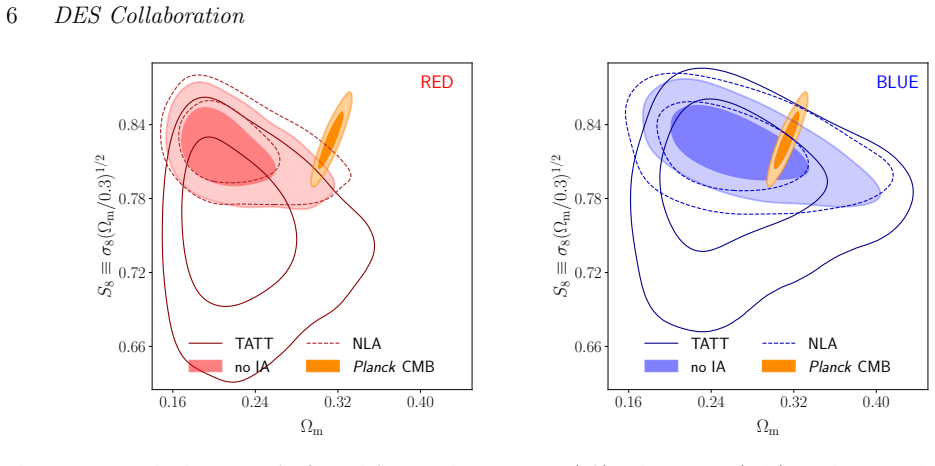
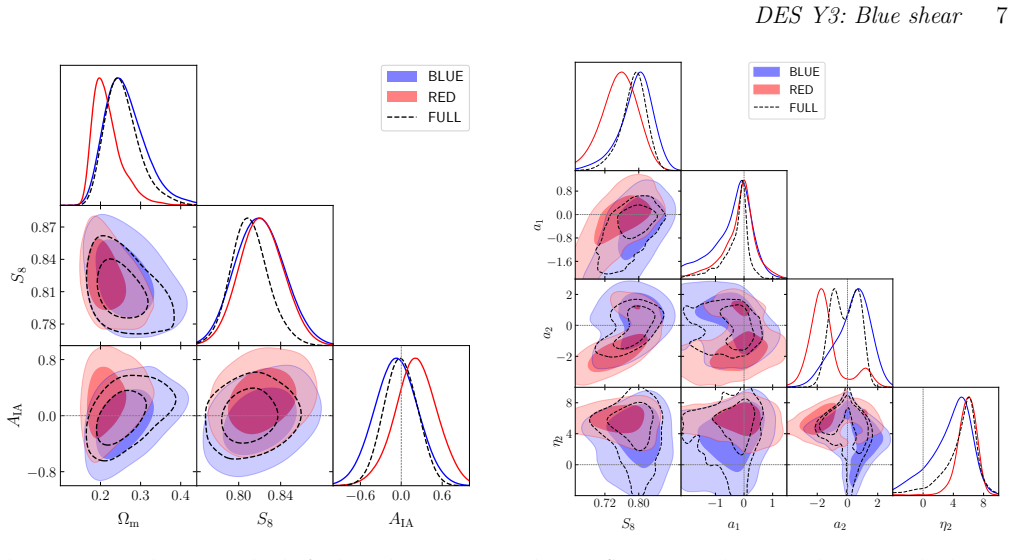
The blue cosmic shear sample from DES Year 3 produces cosmological constraints that remain stable across different intrinsic alignment models, unlike the full sample dominated by passive galaxies. The approach improves the goodness-of-fit and aligns Ω_m and S_8 values more closely with CMB results. Mitigating IA through this sample selection rather than through additional model freedom reduces the uncertainty on S_8 by a factor of 1.5.
What carries the argument
Blue galaxy sample selection, which excludes red passive galaxies to suppress intrinsic alignment contamination in the weak lensing measurements.
If this is right
- Cosmological constraints from the blue shear sample remain stable regardless of the intrinsic alignment model chosen.
- The goodness-of-fit to the data improves relative to the full DES Y3 sample.
- Inferred values of Ω_m and S_8 agree better with independent CMB measurements.
- The uncertainty on S_8 decreases by a factor of 1.5 compared with analyses that rely on flexible IA modeling.
Where Pith is reading between the lines
- The same blue-galaxy cut could be tested on overlapping datasets from other surveys to check whether the reduction in modeling uncertainty generalizes.
- Future work might quantify any residual selection biases by comparing lensing signals in blue versus full samples on the same sky patches.
- If the method holds, it could reduce the parameter space needed in joint analyses of weak lensing with galaxy clustering or CMB lensing.
Load-bearing premise
Limiting the sample to blue star-forming galaxies suppresses intrinsic alignment contamination without introducing new selection biases that affect the cosmological inference.
What would settle it
Re-running the blue-sample analysis with an alternative IA model that produces a statistically significant shift in the central value or uncertainty of S_8 would falsify the claim of model stability.
Figures


read the original abstract
Modeling the intrinsic alignment (IA) of galaxies poses a challenge to weak lensing analyses. The Dark Energy Survey is expected to be less impacted by IA when limited to blue, star-forming galaxies. The cosmological parameter constraints from this blue cosmic shear sample are stable to IA model choice, unlike passive galaxies in the full DES Y3 sample, the goodness-of-fit is improved and the $\Omega_{m}$ and $S_8$ better agree with the cosmic microwave background. Mitigating IA with sample selection, instead of flexible model choices, can reduce uncertainty in $S_8$ by a factor of 1.5.
Editorial analysis
A structured set of objections, weighed in public.
Referee Report
Summary. The manuscript presents cosmological constraints from cosmic shear in DES Y3 restricted to a blue, star-forming galaxy sample. It claims that this selection mitigates intrinsic alignment (IA) contamination, yielding parameter constraints stable to IA model choice (unlike the full sample), improved goodness-of-fit, better agreement between Ωm/S8 and CMB values, and a factor-1.5 reduction in S8 uncertainty relative to the full DES Y3 analysis.
Significance. If the central claim holds after validation, the result shows that targeted sample selection can suppress IA systematics sufficiently to permit simpler modeling while tightening constraints, offering a practical alternative to flexible IA nuisance parameters for current and future weak-lensing surveys.
major comments (2)
- [Abstract] Abstract: the factor-1.5 reduction in S8 uncertainty is presented as a direct consequence of IA mitigation via blue-sample selection, yet the text provides no explicit comparison of effective survey volume, redshift distribution n(z), or multiplicative bias calibration between the blue and full samples; without these, it is impossible to isolate the contribution of IA suppression from possible changes in the lensing kernel or galaxy bias.
- [Abstract / §4] Abstract / §4 (results): the claim that constraints are 'stable to IA model choice' and that the blue sample 'sufficiently suppresses' IA rests on the untested premise that the color selection does not simultaneously alter the effective lensing efficiency or introduce new selection biases; the manuscript must demonstrate this with direct tests (e.g., comparison of tomographic kernels or shear calibration residuals) before the stability can be attributed to IA mitigation rather than reduced signal amplitude.
minor comments (2)
- [Abstract] Abstract: the statement that the blue sample is 'expected to be less impacted by IA' should be supported by a quantitative prior on the IA amplitude for blue galaxies or a reference to the relevant literature on color-dependent alignment.
- [Abstract] Abstract: 'improved goodness-of-fit' and 'better agree with the CMB' are stated without the numerical values of χ² or the tension metric used, making it difficult to assess the magnitude of the improvement.
Simulated Author's Rebuttal
We thank the referee for their careful and constructive review. The comments highlight important points about isolating the effects of sample selection. We address each major comment below and will revise the manuscript to incorporate the requested comparisons and tests.
read point-by-point responses
-
Referee: [Abstract] Abstract: the factor-1.5 reduction in S8 uncertainty is presented as a direct consequence of IA mitigation via blue-sample selection, yet the text provides no explicit comparison of effective survey volume, redshift distribution n(z), or multiplicative bias calibration between the blue and full samples; without these, it is impossible to isolate the contribution of IA suppression from possible changes in the lensing kernel or galaxy bias.
Authors: We agree that the abstract attributes the uncertainty reduction to IA mitigation without sufficient supporting comparisons. In the revised manuscript we will add explicit side-by-side comparisons of effective number density (proxy for survey volume), the tomographic n(z) distributions, and the multiplicative bias calibration values between the blue and full samples. These will be presented in a new subsection of §3 or an appendix, allowing readers to evaluate the relative contributions. We will also adjust the abstract wording to reflect this added context. revision: yes
-
Referee: [Abstract / §4] Abstract / §4 (results): the claim that constraints are 'stable to IA model choice' and that the blue sample 'sufficiently suppresses' IA rests on the untested premise that the color selection does not simultaneously alter the effective lensing efficiency or introduce new selection biases; the manuscript must demonstrate this with direct tests (e.g., comparison of tomographic kernels or shear calibration residuals) before the stability can be attributed to IA mitigation rather than reduced signal amplitude.
Authors: The results section already shows parameter stability across IA models for the blue sample (in contrast to the full sample). However, we accept that direct tests are required to confirm this is not due to altered lensing efficiency or new biases. In the revision we will include comparisons of the tomographic lensing kernels (effective lensing efficiency) and shear calibration residuals between the blue and full samples. These tests will be added to §4 and will strengthen the interpretation that IA suppression is the dominant factor. revision: yes
Circularity Check
No circularity; empirical data analysis with no load-bearing derivations or self-referential predictions.
full rationale
The paper reports cosmological constraints from DES Y3 cosmic shear using a blue galaxy subsample selected to suppress intrinsic alignments. All claims rest on direct empirical measurements of the data, goodness-of-fit comparisons, and agreement with external CMB data. No equations, parameter fits renamed as predictions, self-citation chains, or ansatzes are present in the provided abstract or context that reduce the central result to its own inputs by construction. The analysis is self-contained against external benchmarks (CMB) and does not invoke uniqueness theorems or fitted inputs called predictions.
Axiom & Free-Parameter Ledger
axioms (1)
- domain assumption Blue star-forming galaxies experience weaker intrinsic alignments than red passive galaxies
Lean theorems connected to this paper
-
IndisputableMonolith/Cost/FunctionalEquation.leanwashburn_uniqueness_aczel unclear?
unclearRelation between the paper passage and the cited Recognition theorem.
Mitigating IA with sample selection, instead of flexible model choices, can reduce uncertainty in S8 by a factor of 1.5.
-
IndisputableMonolith/Foundation/RealityFromDistinction.leanreality_from_one_distinction unclear?
unclearRelation between the paper passage and the cited Recognition theorem.
The cosmological parameter constraints from this blue cosmic shear sample are stable to IA model choice
What do these tags mean?
- matches
- The paper's claim is directly supported by a theorem in the formal canon.
- supports
- The theorem supports part of the paper's argument, but the paper may add assumptions or extra steps.
- extends
- The paper goes beyond the formal theorem; the theorem is a base layer rather than the whole result.
- uses
- The paper appears to rely on the theorem as machinery.
- contradicts
- The paper's claim conflicts with a theorem or certificate in the canon.
- unclear
- Pith found a possible connection, but the passage is too broad, indirect, or ambiguous to say the theorem truly supports the claim.
Forward citations
Cited by 4 Pith papers
-
GI BAO as a cosmological consistency check
GI BAO provides a robust consistency check for density BAO and shear data, with the first photometric measurement on DES Y3 showing agreement at α = 0.966 ± 0.252.
-
Kinematic Lensing Ratio: Reviving Weak Lensing Cosmography as a Geometric Dark Energy Probe
KiLeR combines shear ratios with kinematic intrinsic shapes to mitigate first-order lensing systematics and forecasts a 192% improvement in dark energy constraints from the Roman telescope.
-
The contribution from small scales on two-point shear analysis: comparison between power spectrum and correlation function
Harmonic-space cosmic shear analysis yields 2-3 times smaller model-choice biases in S8 than real-space analysis when pushing to small scales, with BACCO emulator plus TATT model giving the most consistent constraints...
-
The Galaxy Luminosity Functions in ASTRID: Predictions for LSST
ASTRID simulation with dust model calibrated to SDSS at z=0 produces validated luminosity functions and LSST-ready mock catalogs of 378 million galaxies with predicted number counts in ugrizy bands from z=0 to 2.
Reference graph
Works this paper leans on
-
[1]
+ command with the same argument as the + #1 + command. +
-
[3]
Abbott T. M. C., et al., 2022, @doi [ ] 10.1103/PhysRevD.105.023520 , https://ui.adsabs.harvard.edu/abs/2022PhRvD.105b3520A 105, 023520
-
[4]
The Wide Field Infrared Survey Telescope: 100 Hubbles for the 2020s
Akeson R., et al., 2019, @doi [arXiv e-prints] 10.48550/arXiv.1902.05569 , https://ui.adsabs.harvard.edu/abs/2019arXiv190205569A p. arXiv:1902.05569
work page internal anchor Pith review Pith/arXiv arXiv doi:10.48550/arxiv.1902.05569 2019
-
[5]
Amon A., Efstathiou G., 2022, @doi [ ] 10.1093/mnras/stac2429 , 516, 5355
-
[6]
Amon A., et al., 2022, @doi [ ] 10.1103/PhysRevD.105.023514 , https://ui.adsabs.harvard.edu/abs/2022PhRvD.105b3514A 105, 023514
-
[7]
Aricò G., Angulo R. E., Zennaro M., Contreras S., Chen A., Hernández-Monteagudo C., 2023, @doi [ ] 10.1051/0004-6361/202346539 , 678, A109
-
[8]
Asgari M., et al., 2021, @doi [ ] 10.1051/0004-6361/202039070 , https://ui.adsabs.harvard.edu/abs/2021A&A...645A.104A 645, A104
-
[9]
Bakx T., Kurita T., Elisa Chisari N., Vlah Z., Schmidt F., 2023, @doi [ ] 10.1088/1475-7516/2023/10/005 , https://ui.adsabs.harvard.edu/abs/2023JCAP...10..005B 2023, 005
-
[10]
Bigwood L., et al., 2024, @doi [arXiv e-prints] 10.48550/arXiv.2404.06098 , https://ui.adsabs.harvard.edu/abs/2024arXiv240406098B p. arXiv:2404.06098
-
[11]
Blazek J., McQuinn M., Seljak U., 2011, @doi [ ] 10.1088/1475-7516/2011/05/010 , https://ui.adsabs.harvard.edu/abs/2011JCAP...05..010B 2011, 010
-
[12]
A., MacCrann N., Troxel M., Fang X., 2019, @doi [ ] 10.1103/physrevd.100.103506 , 100
Blazek J. A., MacCrann N., Troxel M., Fang X., 2019, @doi [ ] 10.1103/physrevd.100.103506 , 100
-
[13]
Brammer G. B., van Dokkum P. G., Coppi P., 2008, @doi [ ] 10.1086/591786 , https://ui.adsabs.harvard.edu/abs/2008ApJ...686.1503B 686, 1503
work page internal anchor Pith review doi:10.1086/591786 2008
-
[14]
Bridle S., King L., 2007, @doi [New Journal of Physics] 10.1088/1367-2630/9/12/444 , 9, 444
-
[15]
Brown M. L., Taylor A. N., Hambly N. C., Dye S., 2002, @doi [ ] 10.1046/j.1365-8711.2002.05354.x , 333, 501
-
[16]
Buchs R., et al., 2019, @doi [ ] 10.1093/mnras/stz2162 , 489, 820
-
[17]
Carnall A. C., et al., 2018, @doi [ ] 10.1093/mnras/sty2169 , 480, 4379
work page internal anchor Pith review doi:10.1093/mnras/sty2169 2018
-
[18]
Catelan P., Kamionkowski M., Blandford R. D., 2001, @doi [ ] 10.1046/j.1365-8711.2001.04105.x , https://ui.adsabs.harvard.edu/abs/2001MNRAS.320L...7C 320, L7
-
[19]
Chen S.-F., Kokron N., 2024, @doi [ ] 10.1088/1475-7516/2024/01/027 , https://ui.adsabs.harvard.edu/abs/2024JCAP...01..027C 2024, 027
-
[20]
Chen S., et al., 2024, @doi [arXiv e-prints] 10.48550/arXiv.2407.04795 , https://ui.adsabs.harvard.edu/abs/2024arXiv240704795C p. arXiv:2407.04795
-
[21]
DES and KiDS Collaborations et al., 2023, @doi [The Open Journal of Astrophysics] 10.21105/astro.2305.17173 , 6
- [22]
-
[23]
Delgado A. M., et al., 2023, @doi [Monthly Notices of the Royal Astronomical Society] 10.1093/mnras/stad1781 , 523, 5899–5914
-
[24]
Efstathiou G., Gratton S., 2021, @doi [The Open Journal of Astrophysics] 10.21105/astro.1910.00483 , 4
-
[25]
Euclid Collaboration et al., 2020, @doi [ ] 10.1051/0004-6361/202038071 , https://ui.adsabs.harvard.edu/abs/2020A&A...642A.191E 642, A191
-
[26]
Euclid Collaboration et al., 2022, @doi [ ] 10.1051/0004-6361/202141938 , https://ui.adsabs.harvard.edu/abs/2022A&A...662A.112E 662, A112
-
[27]
Everett S., et al., 2022, @doi [ ] 10.3847/1538-4365/ac26c1 , 258, 15
-
[28]
Fang X., Eifler T., Krause E., 2020, @doi [ ] 10.1093/mnras/staa1726 , 497, 2699
-
[29]
C., Hoekstra H., Joachimi B., Johnston H., Chisari N
Fortuna M. C., Hoekstra H., Joachimi B., Johnston H., Chisari N. E., Georgiou C., Mahony C., 2020, @doi [Monthly Notices of the Royal Astronomical Society] 10.1093/mnras/staa3802 , 501, 2983–3002
-
[30]
Fortuna M. C., et al., 2021, @doi [ ] 10.1051/0004-6361/202140706 , https://ui.adsabs.harvard.edu/abs/2021A&A...654A..76F 654, A76
-
[31]
Friedrich O., et al., 2021, @doi [ ] 10.1093/mnras/stab2384 , https://ui.adsabs.harvard.edu/abs/2021MNRAS.508.3125F 508, 3125
-
[32]
Garc \' a-Garc \' a C., Zennaro M., Aric \`o G., Alonso D., Angulo R. E., 2024, @doi [arXiv e-prints] 10.48550/arXiv.2403.13794 , https://ui.adsabs.harvard.edu/abs/2024arXiv240313794G p. arXiv:2403.13794
-
[33]
Gatti M., et al., 2021, @doi [ ] 10.1093/mnras/stab918 , 504, 4312
-
[34]
Hadzhiyska B., et al., 2023, @doi [ ] 10.1093/mnras/stad2751 , https://ui.adsabs.harvard.edu/abs/2023MNRAS.526..369H 526, 369
-
[35]
Handley W. J., Hobson M. P., Lasenby A. N., 2015a, @doi [ : Letters] 10.1093/mnrasl/slv047 , 450, L61–L65
-
[36]
Handley W. J., Hobson M. P., Lasenby A. N., 2015b, @doi [ ] 10.1093/mnras/stv1911 , 453, 4385–4399
-
[37]
Harnois-D \'e raps J., Martinet N., Reischke R., 2022, @doi [ ] 10.1093/mnras/stab3222 , https://ui.adsabs.harvard.edu/abs/2022MNRAS.509.3868H 509, 3868
-
[38]
G., et al., 2021, @doi [ ] 10.1093/mnras/stab3055 , 509, 3547
Hartley W. G., et al., 2021, @doi [ ] 10.1093/mnras/stab3055 , 509, 3547
-
[39]
Hirata C. M., Seljak U., 2004, @doi [ ] 10.1103/PhysRevD.70.063526 , https://ui.adsabs.harvard.edu/abs/2004PhRvD..70f3526H 70, 063526
-
[40]
Hirata C. M., Mandelbaum R., Ishak M., Seljak U., Nichol R., Pimbblet K. A., Ross N. P., Wake D., 2007, @doi [ ] 10.1111/j.1365-2966.2007.12312.x , https://ui.adsabs.harvard.edu/abs/2007MNRAS.381.1197H 381, 1197
-
[41]
Hoffmann K., et al., 2022, @doi [ ] 10.1103/PhysRevD.106.123510 , https://ui.adsabs.harvard.edu/abs/2022PhRvD.106l3510H 106, 123510
-
[42]
Howlett C., Lewis A., Hall A., Challinor A., 2012, @doi [Journal of Cosmology and Astroparticle Physics] 10.1088/1475-7516/2012/04/027 , 2012, 027–027
-
[43]
Ivezi \'c Z ., et al., 2019, @doi [ ] 10.3847/1538-4357/ab042c , https://ui.adsabs.harvard.edu/abs/2019ApJ...873..111I 873, 111
-
[44]
Joachimi B., Mandelbaum R., Abdalla F. B., Bridle S. L., 2011, @doi [ ] 10.1051/0004-6361/201015621 , https://ui.adsabs.harvard.edu/abs/2011A&A...527A..26J 527, A26
-
[45]
Johnston H., et al., 2019, @doi [ ] 10.1051/0004-6361/201834714 , 624, A30
-
[46]
Krause E., Eifler T., Blazek J., 2015, @doi [ ] 10.1093/mnras/stv2615 , 456, 207–222
-
[47]
LSST DESC et al., 2018, The LSST Dark Energy Science Collaboration (DESC) Science Requirements Document, @doi 10.48550/ARXIV.1809.01669 , https://arxiv.org/abs/1809.01669
-
[48]
LSST Science Book, Version 2.0
LSST Science Collaboration et al., 2009, @doi [arXiv e-prints] 10.48550/arXiv.0912.0201 , https://ui.adsabs.harvard.edu/abs/2009arXiv0912.0201L p. arXiv:0912.0201
work page internal anchor Pith review Pith/arXiv arXiv doi:10.48550/arxiv.0912.0201 2009
-
[49]
Lamman C., Tsaprazi E., Shi J., Šarčević N. N., Pyne S., Legnani E., Ferreira T., 2023, The IA Guide: A Breakdown of Intrinsic Alignment Formalisms ( @eprint arXiv 2309.08605 )
- [50]
-
[51]
Lemos P., et al., 2023, @doi [ ] 10.1093/mnras/stac2786 , https://ui.adsabs.harvard.edu/abs/2023MNRAS.521.1184L 521, 1184
-
[52]
Leonard C. D., Rau M. M., Mandelbaum R., 2024, @doi [ ] 10.1103/PhysRevD.109.083528 , https://ui.adsabs.harvard.edu/abs/2024PhRvD.109h3528L 109, 083528
-
[53]
Lewis A., Challinor A., 2011, CAMB: Code for Anisotropies in the Microwave Background , Astrophysics Source Code Library, record ascl:1102.026
work page 2011
-
[54]
Lewis A., Challinor A., Lasenby A., 2000, @doi [ ] 10.1086/309179 , 538, 473–476
- [55]
-
[56]
LoVerde M., Afshordi N., 2008, @doi [Phys. Rev. D] 10.1103/PhysRevD.78.123506 , 78, 123506
-
[57]
MacCrann N., et al., 2021, @doi [ ] 10.1093/mnras/stab2870 , 509, 3371
-
[58]
Mackey J., White M., Kamionkowski M., 2002, @doi [ ] 10.1046/j.1365-8711.2002.05337.x , https://ui.adsabs.harvard.edu/abs/2002MNRAS.332..788M 332, 788
-
[59]
Maion F., Angulo R. E., Bakx T., Chisari N. E., Kurita T., Pellejero-Ib \'a \ n ez M., 2024, @doi [ ] 10.1093/mnras/stae1331 , https://ui.adsabs.harvard.edu/abs/2024MNRAS.531.2684M 531, 2684
-
[60]
Mandelbaum R., et al., 2011, @doi [ ] 10.1111/j.1365-2966.2010.17485.x , https://ui.adsabs.harvard.edu/abs/2011MNRAS.410..844M 410, 844
-
[61]
McEwen J. E., Fang X., Hirata C. M., Blazek J. A., 2016, @doi [Journal of Cosmology and Astroparticle Physics] 10.1088/1475-7516/2016/09/015 , 2016, 015
-
[62]
Mead A. J., Brieden S., Tr \"o ster T., Heymans C., 2021, @doi [ ] 10.1093/mnras/stab082 , https://ui.adsabs.harvard.edu/abs/2021MNRAS.502.1401M 502, 1401
-
[63]
Myles J., et al., 2021, @doi [ ] 10.1093/mnras/stab1515 , 505, 4249
-
[64]
Patrignani C., 2016, @doi [Chinese Physics C] 10.1088/1674-1137/40/10/100001 , 40, 100001
-
[65]
Planck Collaboration et al., 2020, @doi [ ] 10.1051/0004-6361/201833910 , 641, A6
-
[66]
Raveri M., Hu W., 2019, @doi [ ] 10.1103/PhysRevD.99.043506 , https://ui.adsabs.harvard.edu/abs/2019PhRvD..99d3506R 99, 043506
-
[67]
Samuroff S., et al., 2019, @doi [ ] 10.1093/mnras/stz2197 , 489, 5453
-
[68]
Samuroff S., Mandelbaum R., Blazek J., 2021, @doi [ ] 10.1093/mnras/stab2520 , https://ui.adsabs.harvard.edu/abs/2021MNRAS.508..637S 508, 637
-
[69]
Samuroff S., et al., 2023, @doi [ ] 10.1093/mnras/stad2013 , https://ui.adsabs.harvard.edu/abs/2023MNRAS.524.2195S 524, 2195
-
[70]
Samuroff S., Campos A., Porredon A., Blazek J., 2024, @doi [The Open Journal of Astrophysics] 10.33232/001c.117964 , https://ui.adsabs.harvard.edu/abs/2024OJAp....7E..40S 7, 40
-
[71]
Secco L., et al., 2022, @doi [ ] 10.1103/physrevd.105.023515 , 105
-
[72]
Spergel D., et al., 2015, Wide-Field InfrarRed Survey Telescope-Astrophysics Focused Telescope Assets WFIRST-AFTA 2015 Report ( @eprint arXiv 1503.03757 )
work page internal anchor Pith review Pith/arXiv arXiv 2015
-
[73]
Stebbins A., 1996, @doi [arXiv e-prints] 10.48550/arXiv.astro-ph/9609149 , https://ui.adsabs.harvard.edu/abs/1996astro.ph..9149S pp astro--ph/9609149
work page internal anchor Pith review Pith/arXiv arXiv doi:10.48550/arxiv.astro-ph/9609149 1996
-
[74]
Troxel M., Ishak M., 2015, @doi [Physics Reports] 10.1016/j.physrep.2014.11.001 , 558, 1
-
[75]
Troxel M. A., et al., 2018, @doi [Phys. Rev. D] 10.1103/PhysRevD.98.043528 , 98, 043528
-
[76]
Vlah Z., Chisari N. E., Schmidt F., 2020, @doi [ ] 10.1088/1475-7516/2020/01/025 , https://ui.adsabs.harvard.edu/abs/2020JCAP...01..025V 2020, 025
-
[77]
Zuntz J., et al., 2015, @doi [Astronomy and Computing] https://doi.org/10.1016/j.ascom.2015.05.005 , 12, 45
-
[78]
" write newline "" before.all 'output.state := FUNCTION fin.entry write newline FUNCTION new.block output.state before.all = 'skip after.block 'output.state := if FUNCTION new.sentence output.state after.block = 'skip output.state before.all = 'skip after.sentence 'output.state := if if FUNCTION not #0 #1 if FUNCTION and 'skip pop #0 if FUNCTION or pop #1...
-
[79]
" write newline "" before.all 'output.state := FUNCTION format.archive archivePrefix empty "" archivePrefix ":" * if FUNCTION format.primaryClass primaryClass empty "" " [" primaryClass * "]" * if FUNCTION format.eprint eprint duplicate empty 'skip " " archiveprefix empty 'skip " " * archiveprefix * ":" * if " " * swap * " " * if FUNCTION n.dashify 't := ...
discussion (0)
Sign in with ORCID, Apple, or X to comment. Anyone can read and Pith papers without signing in.