The Quintom theory of dark energy after DESI DR2
Pith reviewed 2026-05-19 13:02 UTC · model grok-4.3
The pith
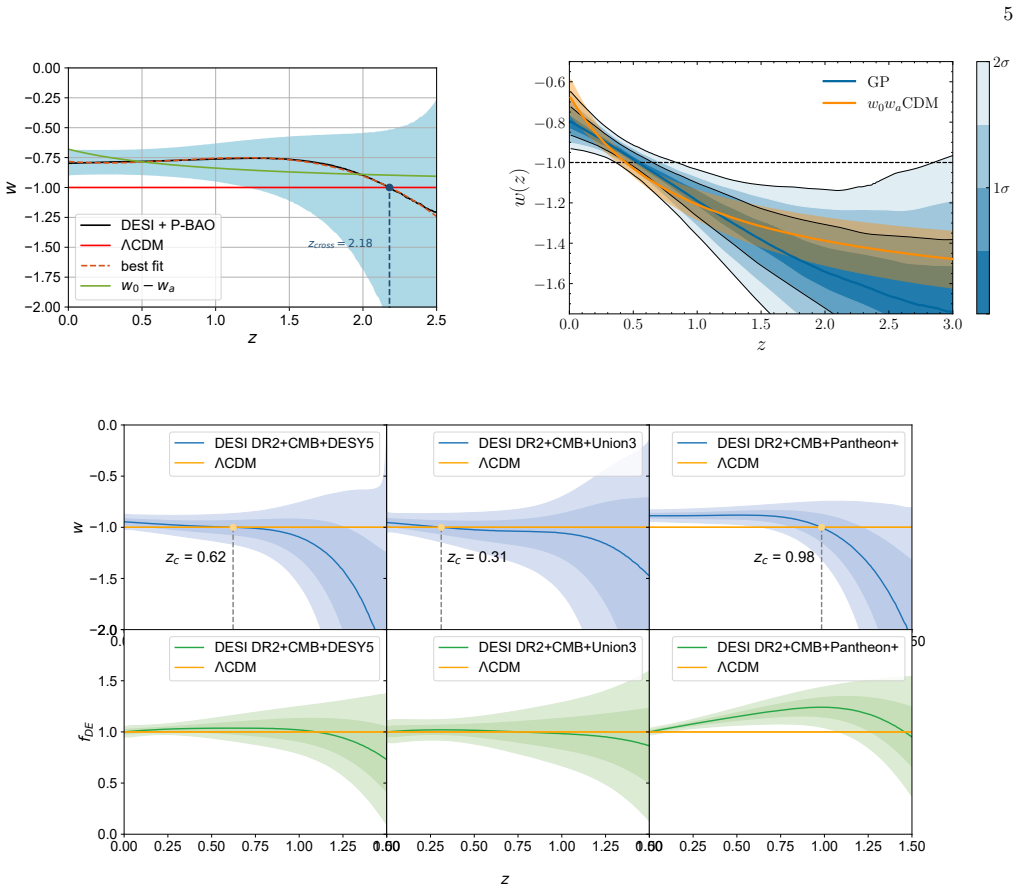
DESI DR2 data indicate dark energy equation of state crosses w = -1, which single-field models cannot achieve.
A machine-rendered reading of the paper's core claim, the machinery that carries it, and where it could break.
Core claim
DESI DR2 supplies observational support for a Quintom scenario in which the dark energy equation-of-state parameter crosses w = -1. The paper shows that this crossing is forbidden for single canonical fields or perfect fluids by a no-go theorem, and therefore surveys the range of multi-component or modified constructions that permit it while remaining consistent with the data.
What carries the argument
The no-go theorem proving single canonical fields cannot cross w = -1, together with the Quintom constructions that evade the theorem through multiple fields, higher derivatives, or interactions.
If this is right
- Dark energy must involve at least two fields or equivalent mechanisms such as higher derivatives to allow a smooth w = -1 crossing.
- Quintom models can generate non-singular universe solutions that avoid the big bang singularity.
- Interactions between Quintom fields and ordinary matter become possible and may produce observable effects.
- An effective field theory approach can unify the different Quintom constructions under a single description.
Where Pith is reading between the lines
- More precise measurements at higher redshifts could distinguish among the different Quintom constructions by mapping the detailed shape of w(z).
- Quintom dynamics might help relieve other cosmological tensions such as the Hubble constant discrepancy through their time-dependent behavior.
- Signatures in the large-scale structure or in gravitational wave propagation could provide independent tests of these models.
Load-bearing premise
The DESI DR2 measurements reflect a genuine physical crossing of w = -1 rather than a statistical fluctuation or systematic bias in the BAO data.
What would settle it
Future higher-precision BAO or supernova surveys that measure w(z) remaining strictly greater than or less than -1 across the relevant redshift range without evidence of a crossing.
Figures



read the original abstract
Observations from DESI DR2 are challenging the $\Lambda$CDM paradigm by suggesting that the equation-of-state parameter of dark energy evolves across $w = -1$, a phenomenon known as the Quintom scenario. Inspired by this development, we present a staged review of Quintom cosmology including its theoretical foundations, observational supports, and implications as well as possible extensions. We first trace the historical progression from Einstein's static cosmological constant to modern dynamical dark energy, summarizing recent cosmological constraints that favor an evolving $w(z)$ along time. A key focus is the theoretical no-go theorem for dark energy showing that no single canonical field or perfect fluid model can smoothly cross the $w = -1$ boundary. We then survey viable Quintom constructions, including two-field models, single-scalar fields with higher derivatives, modified gravity frameworks, interacting dark energy, and an effective field theory approach that unifies these mechanisms. Possible interactions of Quintom fields with ordinary matter and the potential roles in yielding non-singular universe solutions are discussed.
Editorial analysis
A structured set of objections, weighed in public.
Referee Report
Summary. The manuscript is a review of Quintom cosmology motivated by DESI DR2 data suggesting that the dark energy equation-of-state parameter crosses w = -1. It traces the historical development from the cosmological constant to dynamical dark energy, restates the no-go theorem prohibiting single canonical scalar fields or perfect fluids from smoothly crossing w = -1, and surveys constructions that evade the theorem including two-field models, higher-derivative terms, modified gravity, interacting dark energy, and an effective field theory unification. It further discusses interactions with ordinary matter and implications for non-singular cosmologies.
Significance. If the DESI DR2 indication of a w = -1 crossing is robust, the review provides a timely and structured compilation of theoretical options for realizing Quintom behavior. It correctly recalls the standard no-go theorem and lists established evasion mechanisms without introducing new derivations or performing a re-analysis of the data. The historical overview and survey of extensions constitute a useful reference for the community, though the paper's impact is constrained by its reliance on external literature for both the observational claim and the theoretical constructions.
major comments (1)
- Abstract and introduction: The paper presents DESI DR2 as established observational support for a genuine dynamical crossing of w = -1. This interpretation is load-bearing for the review's motivation and structure, yet the manuscript does not address potential systematics in BAO analyses such as template fitting choices, redshift-space distortion modeling, or covariance estimation. A short discussion of robustness under alternative pipelines would strengthen the empirical foundation without requiring new data analysis.
minor comments (2)
- Historical progression paragraph: The summary of the shift from Einstein's static cosmological constant to modern dynamical dark energy would benefit from explicit citation of at least two post-2020 reviews on the same topic to ensure completeness.
- Notation throughout: The equation-of-state parameter is referred to interchangeably as w and w(z); a single consistent definition and a brief clarification of any assumed parametrization (e.g., CPL) would improve readability.
Simulated Author's Rebuttal
We thank the referee for the positive evaluation and the constructive suggestion for minor revision. We have addressed the comment regarding the presentation of DESI DR2 results.
read point-by-point responses
-
Referee: Abstract and introduction: The paper presents DESI DR2 as established observational support for a genuine dynamical crossing of w = -1. This interpretation is load-bearing for the review's motivation and structure, yet the manuscript does not address potential systematics in BAO analyses such as template fitting choices, redshift-space distortion modeling, or covariance estimation. A short discussion of robustness under alternative pipelines would strengthen the empirical foundation without requiring new data analysis.
Authors: We agree that explicitly acknowledging potential systematics in the DESI DR2 BAO analyses would strengthen the motivation. Although the manuscript is a theoretical review that relies on published observational results rather than performing new data analysis, we will add a concise paragraph in the introduction. This paragraph will summarize the current status of robustness checks under alternative pipelines, including references to studies examining template fitting choices, redshift-space distortion modeling, and covariance estimation. The addition will note that while the w = -1 crossing preference appears in several independent analyses, we recognize that further scrutiny of systematics remains important. revision: yes
Circularity Check
Review structure relies on external literature for no-go theorem and DESI constraints; no internal derivations reduce to self-defined inputs
full rationale
This is a staged review paper that traces the historical development of dark energy models, summarizes external cosmological constraints favoring evolving w(z) from DESI DR2, and surveys Quintom constructions based on the established no-go theorem for single canonical fields. The central claims about the necessity of multi-field, higher-derivative, or modified gravity approaches are grounded in cited literature results rather than any equations or predictions derived within the manuscript itself. No load-bearing steps involve fitting parameters to subsets of data and then relabeling them as predictions, self-definitional loops, or uniqueness theorems imported solely from overlapping author citations. The paper remains self-contained against external benchmarks, with the DESI interpretation serving as observational motivation rather than an internally constructed result.
Axiom & Free-Parameter Ledger
axioms (2)
- domain assumption The universe is described by a flat FRW metric with dark energy as a dynamical component whose equation-of-state parameter w can evolve.
- standard math A no-go theorem prohibits single canonical scalar fields or perfect fluids from crossing w = -1 without instabilities.
Forward citations
Cited by 15 Pith papers
-
Model-Independent Reconstruction of Quintessence Potential and Kinetic Energy from DESI DR2 and Pantheon+ Supernovae
Quintessence potential decreases monotonically with redshift while kinetic energy crosses zero near z=1, with negative values at intermediate redshifts being statistical artifacts from derivative reconstruction.
-
Evidence for deviation in gravitational light deflection from general relativity at cosmological scales with KiDS-Legacy and CMB lensing
KiDS-Legacy weak lensing plus CMB data yields a 3 sigma deviation in light deflection from GR in a Lambda CDM background, with the signal driven by large-scale CMB lensing amplitudes.
-
Signatures of Modified Gravity Below $\mathcal{O}(10)$ Mpc in a Dynamical Dark Energy Background
Modified gravity below O(10) Mpc in a CPL dynamical dark energy background is required to suppress structure growth at low redshifts while satisfying CMB constraints from ISW and lensing.
-
Study of dark interactions through strong gravitational lenses
Strong gravitational lensing data from early-type galaxies and Abell 1689 constrain three sign-changeable dark-sector interaction models, yielding negative interaction strengths larger in magnitude than prior probes a...
-
Cosmological Impact of Redshift-Dependent Type Ia Supernovae Calibration
A phenomenological redshift-dependent SNIa magnitude correction shows no evidence in ΛCDM but is preferred at 4.3σ with dynamical dark energy, reducing Hubble tension to 1.5σ.
-
Is the $w_0w_a$CDM cosmological parameterization evidence for dark energy dynamics partially caused by the excess smoothing of Planck PR4 CMB anisotropy data?
Planck PR4 CMB data mildly favors dynamical dark energy, but this preference weakens when accounting for possible excess smoothing, indicating the signal may partly arise from data processing issues.
-
Exploring the interplay of late-time dynamical dark energy and new physics before recombination
Model-independent reconstruction finds 96.7-98.5% probability of phantom crossing if recombination is standard, but early new physics to ease Hubble tension weakens this preference while requiring unrealistically high...
-
Resolving the Planck-DESI tension by nonminimally coupled quintessence
Non-minimally coupled quintessence resolves the Planck-DESI Ω_m tension at >3σ while the effective equation of state stays above w=-1 and other tensions on neutrino mass and growth rate are relieved.
-
Constraints on Coupled Dark Energy in the DESI Era
New cosmological data mildly favor a small coupling between dark matter and a scalar dark energy field at |β| ≈ 0.03 while allowing an effective phantom-crossing equation of state.
-
Coupled Dark Energy and Dark Matter for DESI: An Effective Guide to the Phantom Divide
Coupled quintessence-dark matter models can produce an apparent phantom-crossing effective equation of state matching DESI preferences if the scalar field begins frozen in the radiation era.
-
Revisiting the Hubble tension problem in the framework of holographic dark energy
HDE models with future event horizon IR cutoff partially ease the Hubble tension while Hubble-scale cutoffs do not, consistent across six models and multiple BAO/SN/CMB combinations.
-
Evidence of dynamical dark energy found via the DESI DR2 Lyman$\alpha$ forest
DESI DR2 Lyman-alpha forest data combined with other probes yields up to 3.1 sigma preference for dynamical dark energy parameterizations over LambdaCDM, with w0 > -1 and wa < 0.
-
Probing departures from $\Lambda$CDM by late-time datasets
Late-time datasets yield 1-2.74σ preference for dynamical dark energy over ΛCDM, with consistent signs of Quintom-B behavior (ω0 > -1, ωa < 0) that strengthen when DES-Dovekie or Union3 supernovae are added.
-
Evidence for evolving dark energy from DESI DR2 BAO and Pantheon$^+$, DES-Dovekie, and Union3
DESI DR2 BAO combined with Pantheon+, DES-Dovekie and Union3 supernovae yields 1.1-2.3 sigma preference for Quintom-B type evolving dark energy (w0 > -1, wa < 0) with phantom crossing near z ~ 0.5, but no model reache...
-
Interacting Scalar Fields as Dark Energy and Dark Matter in Einstein scalar Gauss Bonnet Gravity
Interacting scalar fields coupled to Gauss-Bonnet gravity yield viable dark energy and dark matter models that match Pantheon+ and DES supernova data while preferring over LambdaCDM at high redshifts with Roman mocks.
Reference graph
Works this paper leans on
-
[1]
A. G. Riess, et al., Observational evidence from supernovae for an accelerating universe and a cosmological constant, Astron. J. 116 (1998) 1009–1038.arXiv:astro-ph/9805201
work page internal anchor Pith review Pith/arXiv arXiv 1998
-
[2]
Measurements of Omega and Lambda from 42 High-Redshift Supernovae
S. Perlmutter, et al., Measurements of Ω and Λ from 42 High Redshift Supernovae, Astrophys. J. 517 (1999) 565–586. arXiv:astro-ph/9812133
work page internal anchor Pith review Pith/arXiv arXiv 1999
-
[3]
The DESI Experiment Part I: Science,Targeting, and Survey Design
A. Aghamousa, et al., The DESI Experiment Part I: Science,Targeting, and Survey Design (10 2016).arXiv:1611.00036
work page internal anchor Pith review Pith/arXiv arXiv 2016
-
[4]
Overview of the Instrumentation for the Dark Energy Spectroscopic Instrument
B. Abareshi, et al., Overview of the Instrumentation for the Dark Energy Spectroscopic Instrument, Astron. J. 164 (5) (2022) 207.arXiv:2205.10939
work page internal anchor Pith review Pith/arXiv arXiv 2022
-
[5]
A. G. Adame, et al., DESI 2024 III: baryon acoustic oscillations from galaxies and quasars, JCAP 04 (2025) 012. arXiv:2404.03000
work page internal anchor Pith review Pith/arXiv arXiv 2024
-
[6]
A. G. Adame, et al., DESI 2024 IV: Baryon Acoustic Oscillations from the Lyman alpha forest, JCAP 01 (2025) 124. arXiv:2404.03001
work page internal anchor Pith review Pith/arXiv arXiv 2024
-
[7]
A. G. Adame, et al., DESI 2024 VI: cosmological constraints from the measurements of baryon acoustic oscillations, JCAP 02 (2025) 021.arXiv:2404.03002
work page internal anchor Pith review Pith/arXiv arXiv 2024
-
[8]
Dark Energy Constraints from the Cosmic Age and Supernova
B. Feng, X.-L. Wang, X.-M. Zhang, Dark energy constraints from the cosmic age and supernova, Phys. Lett. B 607 (2005) 35–41.arXiv:astro-ph/0404224
work page internal anchor Pith review Pith/arXiv arXiv 2005
-
[9]
DESI DR2 Results II: Measurements of Baryon Acoustic Oscillations and Cosmological Constraints
M. Abdul Karim, et al., DESI DR2 results. II. Measurements of baryon acoustic oscillations and cosmological constraints, Phys. Rev. D 112 (8) (2025) 083515.arXiv:2503.14738
work page internal anchor Pith review Pith/arXiv arXiv 2025
-
[10]
Extended Dark Energy analysis using DESI DR2 BAO measurements
K. Lodha, et al., Extended dark energy analysis using DESI DR2 BAO measurements, Phys. Rev. D 112 (8) (2025) 083511.arXiv:2503.14743
work page internal anchor Pith review Pith/arXiv arXiv 2025
-
[11]
G. Gu, et al., Dynamical dark energy in light of the DESI DR2 baryonic acoustic oscillations measurements, Nature Astron. 9 (12) (2025) 1879–1889, [Erratum: Nature Astron. 9, 1898 (2025)].arXiv:2504.06118
- [12]
-
[13]
M. Cortˆ es, A. R. Liddle, Interpreting DESI’s evidence for evolving dark energy, JCAP 12 (2024) 007.arXiv:2404.08056
-
[14]
R. Calderon, et al., DESI 2024: reconstructing dark energy using crossing statistics with DESI DR1 BAO data, JCAP 10 (2024) 048.arXiv:2405.04216
-
[15]
K. Lodha, et al., DESI 2024: Constraints on physics-focused aspects of dark energy using DESI DR1 BAO data, Phys. Rev. D 111 (2) (2025) 023532.arXiv:2405.13588
- [16]
-
[17]
H. Wang, Y.-S. Piao, Dark energy in light of DESI DR1 and Hubble tension, Phys. Lett. B 873 (2026) 140180.arXiv: 2404.18579
-
[18]
Y. Carloni, O. Luongo, M. Muccino, Does dark energy really revive using DESI 2024 data?, Phys. Rev. D 111 (2) (2025) 023512.arXiv:2404.12068. 18
- [19]
-
[20]
P. Mukherjee, A. A. Sen, Model-independent cosmological inference post DESI DR1 BAO measurements, Phys. Rev. D 110 (12) (2024) 123502.arXiv:2405.19178
- [21]
- [22]
- [23]
-
[24]
W. Giar` e, Dynamical dark energy beyond Planck? Constraints from multiple CMB probes, DESI BAO, and type-Ia supernovae, Phys. Rev. D 112 (2) (2025) 023508.arXiv:2409.17074
- [25]
-
[26]
C. Escamilla-Rivera, R. Sandoval-Orozco, f(T) gravity after DESI Baryon acoustic oscillation and DES supernovae 2024 data, JHEAp 42 (2024) 217–221.arXiv:2405.00608
-
[27]
W. Yin, Cosmic clues: DESI, dark energy, and the cosmological constant problem, JHEP 05 (2024) 327.arXiv:2404. 06444
work page 2024
-
[28]
A. Chudaykin, M. Kunz, Modified gravity interpretation of the evolving dark energy in light of DESI data, Phys. Rev. D 110 (12) (2024) 123524.arXiv:2407.02558
-
[29]
L. Huang, R.-G. Cai, S.-J. Wang, The DESI DR1/DR2 evidence for dynamical dark energy is biased by low-redshift supernovae, Sci. China Phys. Mech. Astron. 68 (10) (2025) 100413.arXiv:2502.04212
-
[30]
S. Roy Choudhury, T. Okumura, Updated Cosmological Constraints in Extended Parameter Space with Planck PR4, DESI Baryon Acoustic Oscillations, and Supernovae: Dynamical Dark Energy, Neutrino Masses, Lensing Anomaly, and the Hubble Tension (2024).arXiv:2409.13022
work page internal anchor Pith review Pith/arXiv arXiv 2024
- [31]
- [32]
- [33]
- [34]
- [35]
-
[36]
J. Pan, G. Ye, Non-minimally coupled gravity constraints from DESI DR2 data (3 2025).arXiv:2503.19898
work page internal anchor Pith review Pith/arXiv arXiv 2025
-
[37]
A. Paliathanasis, Dark energy within the generalized uncertainty principle in light of DESI DR2, JCAP 09 (2025) 067. arXiv:2503.20896
-
[38]
M. Abedin, G.-J. Wang, Y.-Z. Ma, S. Pan, In search of an interaction in the dark sector through Gaussian Process and ANN approaches, Mon. Not. Roy. Astron. Soc. 540 (2025) 2253–2268.arXiv:2505.04336
- [39]
- [40]
-
[41]
Deformation of the quintom cosmological model and its consequences
J. Sadeghi, B. Pourhassan, Z. Nekouee, M. Shokri, Deformation of the quintom cosmological model and its consequences, Int. J. Mod. Phys. D 27 (03) (2017) 1850025.arXiv:1708.04319
work page internal anchor Pith review Pith/arXiv arXiv 2017
-
[42]
A. Einstein, Kosmologische Betrachtungen zur allgemeinen Relativit¨ atstheorie, Sitzungsberichte der Königlich Preussischen Akademie der Wissenschaften (1917) 142–152
work page 1917
-
[43]
Testing for w<-1 in the Solar System
J. Martin, C. Schimd, J.-P. Uzan, Testing for w<-1 in the solar system, Phys. Rev. Lett. 96 (2006) 061303.arXiv: astro-ph/0510208
work page internal anchor Pith review Pith/arXiv arXiv 2006
-
[44]
E. V. Linder, The Mirage of w=-1 (8 2007).arXiv:0708.0024
work page internal anchor Pith review Pith/arXiv arXiv 2007
-
[45]
Dark Energy and the Accelerating Universe
J. Frieman, M. Turner, D. Huterer, Dark Energy and the Accelerating Universe, Ann. Rev. Astron. Astrophys. 46 (2008) 385–432.arXiv:0803.0982
work page internal anchor Pith review Pith/arXiv arXiv 2008
-
[46]
Evolving Newton's Constant, Extended Gravity Theories and SnIa Data Analysis
S. Nesseris, L. Perivolaropoulos, Evolving newton’s constant, extended gravity theories and snia data analysis, Phys. Rev. D 73 (2006) 103511.arXiv:astro-ph/0602053
work page internal anchor Pith review Pith/arXiv arXiv 2006
-
[47]
Y. Wang, L. Pogosian, G.-B. Zhao, A. Zucca, Evolution of dark energy reconstructed from the latest observations, Astrophys. J. Lett. 869 (2018) L8.arXiv:1807.03772
work page internal anchor Pith review Pith/arXiv arXiv 2018
-
[48]
L. Heisenberg, H. Villarrubia-Rojo, J. Zosso, Can late-time extensions solve the H0 andσ8 tensions?, Phys. Rev. D 106 (4) (2022) 043503.arXiv:2202.01202
-
[49]
L. Heisenberg, H. Villarrubia-Rojo, J. Zosso, Simultaneously solving the H0 andσ8 tensions with late dark energy, Phys. Dark Univ. 39 (2023) 101163.arXiv:2201.11623
-
[50]
In the Realm of the Hubble tension $-$ a Review of Solutions
E. Di Valentino, O. Mena, S. Pan, L. Visinelli, W. Yang, A. Melchiorri, D. F. Mota, A. G. Riess, J. Silk, In the realm of the Hubble tension—a review of solutions, Class. Quant. Grav. 38 (15) (2021) 153001.arXiv:2103.01183. 19
work page internal anchor Pith review Pith/arXiv arXiv 2021
-
[51]
Challenges for $\Lambda$CDM: An update
L. Perivolaropoulos, F. Skara, Challenges for ΛCDM: An update, New Astron. Rev. 95 (2022) 101659.arXiv:2105.05208
work page internal anchor Pith review Pith/arXiv arXiv 2022
-
[52]
E. Abdalla, et al., Cosmology intertwined: A review of the particle physics, astrophysics, and cosmology associated with the cosmological tensions and anomalies, JHEAp 34 (2022) 49–211.arXiv:2203.06142
work page internal anchor Pith review Pith/arXiv arXiv 2022
- [53]
-
[54]
E. Di Valentino, et al., The CosmoVerse White Paper: Addressing observational tensions in cosmology with systematics and fundamental physics, Phys. Dark Univ. 49 (2025) 101965.arXiv:2504.01669
work page internal anchor Pith review Pith/arXiv arXiv 2025
-
[55]
E. J. Copeland, M. Sami, S. Tsujikawa, Dynamics of dark energy, Int. J. Mod. Phys. D 15 (2006) 1753–1936.arXiv: hep-th/0603057
work page internal anchor Pith review Pith/arXiv arXiv 2006
-
[56]
Decay of cosmological constant as Bose condensate evaporation
I. Dymnikova, M. Khlopov, Decay of cosmological constant as Bose condensate evaporation, Mod. Phys. Lett. A 15 (2000) 2305–2314.arXiv:astro-ph/0102094
work page internal anchor Pith review Pith/arXiv arXiv 2000
-
[57]
Phenomenology of $\Lambda$-CDM model: a possibility of accelerating Universe with positive pressure
U. Mukhopadhyay, P. P. Ghosh, M. Khlopov, S. Ray, Phenomenology of Λ-CDM model: a possibility of accelerating Universe with positive pressure, Int. J. Theor. Phys. 50 (2011) 939–951.arXiv:0711.0686
work page internal anchor Pith review Pith/arXiv arXiv 2011
-
[58]
S. W. Hawking, G. F. R. Ellis, The Large Scale Structure of Space-Time, Cambridge Monographs on Mathematical Physics, Cambridge University Press
-
[59]
Null Energy Condition and Dark Energy Models
T. Qiu, Y.-F. Cai, X.-M. Zhang, Null Energy Condition and Dark Energy Models, Mod. Phys. Lett. A 23 (2008) 2787– 2798.arXiv:0710.0115
work page internal anchor Pith review Pith/arXiv arXiv 2008
-
[60]
E. Moghtaderi, B. R. Hull, J. Quintin, G. Geshnizjani, How much null-energy-condition breaking can the Universe endure?, Phys. Rev. D 111 (12) (2025) 123552.arXiv:2503.19955
-
[61]
Accelerating Universes with Scaling Dark Matter
M. Chevallier, D. Polarski, Accelerating universes with scaling dark matter, Int. J. Mod. Phys. D 10 (2001) 213–224. arXiv:gr-qc/0009008
work page internal anchor Pith review Pith/arXiv arXiv 2001
-
[62]
E. V. Linder, Exploring the expansion history of the universe, Phys. Rev. Lett. 90 (2003) 091301.arXiv:astro-ph/ 0208512
work page 2003
-
[63]
W. J. Percival, et al., The 2dF Galaxy Redshift Survey: The Power spectrum and the matter content of the Universe, Mon. Not. Roy. Astron. Soc. 327 (2001) 1297.arXiv:astro-ph/0105252
work page internal anchor Pith review Pith/arXiv arXiv 2001
-
[64]
F. Beutler, C. Blake, M. Colless, D. H. Jones, L. Staveley-Smith, L. A. Campbell, Q. A. Parker, Q. A. Parker, W. J. Saunders, F. G. Watson, The 6df galaxy survey: baryon acoustic oscillations and the local hubble constant, Monthly Notices of the Royal Astronomical Society 416 (2011) 3017–3032. URLhttps://api.semanticscholar.org/CorpusID:55926132
work page 2011
-
[65]
The Supernova Legacy Survey: Measurement of Omega_M, Omega_Lambda and w from the First Year Data Set
P. Astier, et al., The Supernova Legacy Survey: Measurement of Ω M, Ω Λ and⊒from the first year data set, Astron. Astrophys. 447 (2006) 31–48.arXiv:astro-ph/0510447
work page internal anchor Pith review Pith/arXiv arXiv 2006
-
[66]
N. Suzuki, D. Rubin, D. Rubin, C. Lidman, G. S. Aldering, R. Amanullah, K. Barbary, K. Barbary, L. F. Barrientos, J. Boty´ anszki, M. Brodwin, N. Connolly, K. S. Dawson, A. Dey, M. Doi, M. Donahue, S. E. Deustua, P. Eisenhardt, E. Ellingson, L. H. Faccioli, L. H. Faccioli, V. Fadeyev, H. K. Fakhouri, H. K. Fakhouri, A. S. Fruchter, D. Gilbank, M. D. Gladd...
work page 2011
-
[67]
D. N. Spergel, et al., First year Wilkinson Microwave Anisotropy Probe (WMAP) observations: Determination of cosmo- logical parameters, Astrophys. J. Suppl. 148 (2003) 175–194.arXiv:astro-ph/0302209
work page internal anchor Pith review Pith/arXiv arXiv 2003
-
[68]
D. N. Spergel, et al., Wilkinson Microwave Anisotropy Probe (WMAP) three year results: implications for cosmology, Astrophys. J. Suppl. 170 (2007) 377.arXiv:astro-ph/0603449
work page internal anchor Pith review Pith/arXiv arXiv 2007
-
[69]
Five-Year Wilkinson Microwave Anisotropy Probe (WMAP) Observations: Cosmological Interpretation
E. Komatsu, et al., Five-Year Wilkinson Microwave Anisotropy Probe (WMAP) Observations: Cosmological Interpreta- tion, Astrophys. J. Suppl. 180 (2009) 330–376.arXiv:0803.0547
work page internal anchor Pith review Pith/arXiv arXiv 2009
-
[70]
E. Komatsu, K. M. Smith, J. Dunkley, C. L. Bennett, B. Gold, G. F. Hinshaw, N. Jarosik, D. L. Larson, M. R. Nolta, L. A. Page, D. N. Spergel, M. Halpern, R. Hill, A. J. Kogut, M. Limon, S. S. Meyer, N. P. Odegard, G. S. Tucker, J. L. Weiland, E. J. Wollack, E. L. Wright, Seven-year wilkinson microwave anisotropy probe (wmap) observations: Cosmological int...
work page 2010
-
[71]
C. L. Bennett, D. L. Larson, J. L. Weiland, N. Jarosik, G. F. Hinshaw, N. P. Odegard, K. M. Smith, R. S. Hill, B. Gold, M. Halpern, E. Komatsu, M. R. Nolta, L. A. Page, D. N. Spergel, E. J. Wollack, J. Dunkley, A. J. Kogut, M. Limon, S. S. Meyer, G. S. Tucker, E. L. Wright, Nine-year wilkinson microwave anisotropy probe (wmap) observations: Final maps and...
work page 2012
-
[72]
P. A. R. Ade, et al., Planck 2013 results. XVI. Cosmological parameters, Astron. Astrophys. 571 (2014) A16.arXiv: 1303.5076
work page internal anchor Pith review Pith/arXiv arXiv 2013
-
[73]
Improved cosmological constraints from a joint analysis of the SDSS-II and SNLS supernova samples
M. Betoule, et al., Improved cosmological constraints from a joint analysis of the SDSS-II and SNLS supernova samples, Astron. Astrophys. 568 (2014) A22.arXiv:1401.4064. 20
work page internal anchor Pith review Pith/arXiv arXiv 2014
-
[74]
P. A. R. Ade, et al., Planck 2015 results. XIII. Cosmological parameters, Astron. Astrophys. 594 (2016) A13.arXiv: 1502.01589
work page internal anchor Pith review Pith/arXiv arXiv 2015
-
[75]
P. A. R. Ade, et al., Planck 2015 results. XIV. Dark energy and modified gravity, Astron. Astrophys. 594 (2016) A14. arXiv:1502.01590
work page internal anchor Pith review Pith/arXiv arXiv 2015
-
[76]
M. A. Troxel, et al., Dark Energy Survey Year 1 results: Cosmological constraints from cosmic shear, Phys. Rev. D 98 (4) (2018) 043528.arXiv:1708.01538
work page internal anchor Pith review Pith/arXiv arXiv 2018
-
[77]
T. M. C. Abbott, et al., Dark Energy Survey year 1 results: Cosmological constraints from galaxy clustering and weak lensing, Phys. Rev. D 98 (4) (2018) 043526.arXiv:1708.01530
work page internal anchor Pith review Pith/arXiv arXiv 2018
-
[78]
D. M. Scolnic, et al., The Complete Light-curve Sample of Spectroscopically Confirmed SNe Ia from Pan-STARRS1 and Cosmological Constraints from the Combined Pantheon Sample, Astrophys. J. 859 (2) (2018) 101.arXiv:1710.00845
work page internal anchor Pith review Pith/arXiv arXiv 2018
-
[79]
Planck 2018 results. VI. Cosmological parameters
N. Aghanim, et al., Planck 2018 results. VI. Cosmological parameters, Astron. Astrophys. 641 (2020) A6, [Erratum: Astron.Astrophys. 652, C4 (2021)].arXiv:1807.06209
work page internal anchor Pith review Pith/arXiv arXiv 2018
-
[80]
T. M. C. Abbott, et al., Dark Energy Survey Year 3 results: Cosmological constraints from galaxy clustering and weak lensing, Phys. Rev. D 105 (2) (2022) 023520.arXiv:2105.13549
work page internal anchor Pith review Pith/arXiv arXiv 2022
discussion (0)
Sign in with ORCID, Apple, or X to comment. Anyone can read and Pith papers without signing in.