"Is This Really a Human Peer Supporter?": Misalignments Between Peer Supporters and Experts in LLM-Supported Interactions
Pith reviewed 2026-05-19 10:29 UTC · model grok-4.3
The pith
Misalignments between peer supporters and experts reveal gaps in training for handling distress during LLM-supported interactions.
A machine-rendered reading of the paper's core claim, the machinery that carries it, and where it could break.
Core claim
When peer supporters used the LLM-supported system to interact with a simulated distressed client, they engaged with the suggestions and visuals, but mental health experts evaluating the same exchanges flagged repeated shortcomings including missed distress cues and premature advice-giving.
What carries the argument
The side-by-side comparison of peer supporter and expert judgments on the same LLM-augmented interaction sessions, which exposes differing expectations for appropriate support responses.
If this is right
- Peer support training needs standardized, psychologically grounded modules focused on recognizing distress and pacing advice.
- LLM tools for peer support work best when built with ongoing expert input to align suggestions with established practices.
- Scaling peer support globally requires attention to consistency and safety standards in emotionally charged text exchanges.
- AI systems can help close training gaps if their outputs are shaped by expert oversight rather than peer preferences alone.
Where Pith is reading between the lines
- Similar perspective gaps could appear whenever non-professionals use AI tools for sensitive helping roles, suggesting a broader design need for expert calibration.
- Testing whether aligning peer responses to expert criteria actually improves real-world client outcomes would strengthen or weaken the training-reform argument.
- The system could be extended to let experts directly annotate supporter replies during training sessions, creating a feedback loop that narrows the observed misalignment.
Load-bearing premise
Mental health experts' assessments represent the authoritative standard for correct peer supporter behavior.
What would settle it
A follow-up experiment that measures client-reported safety, satisfaction, and symptom change when peer supporters are retrained to avoid the behaviors experts flagged versus when they continue with current approaches.
Figures




read the original abstract
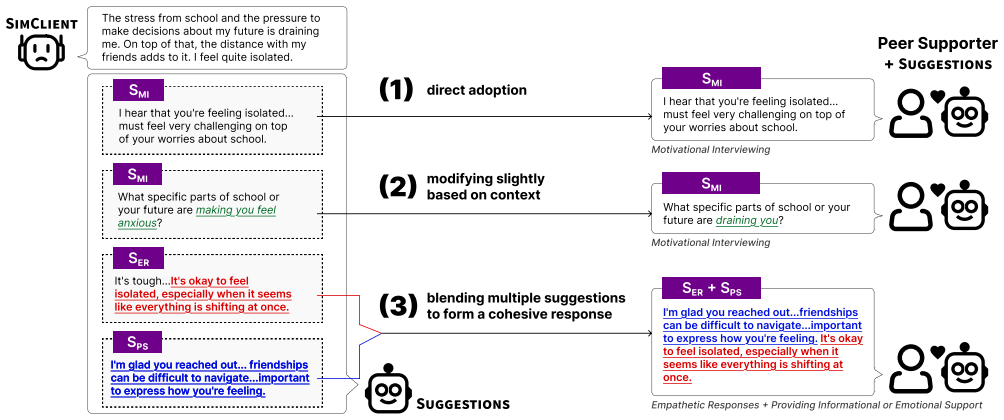
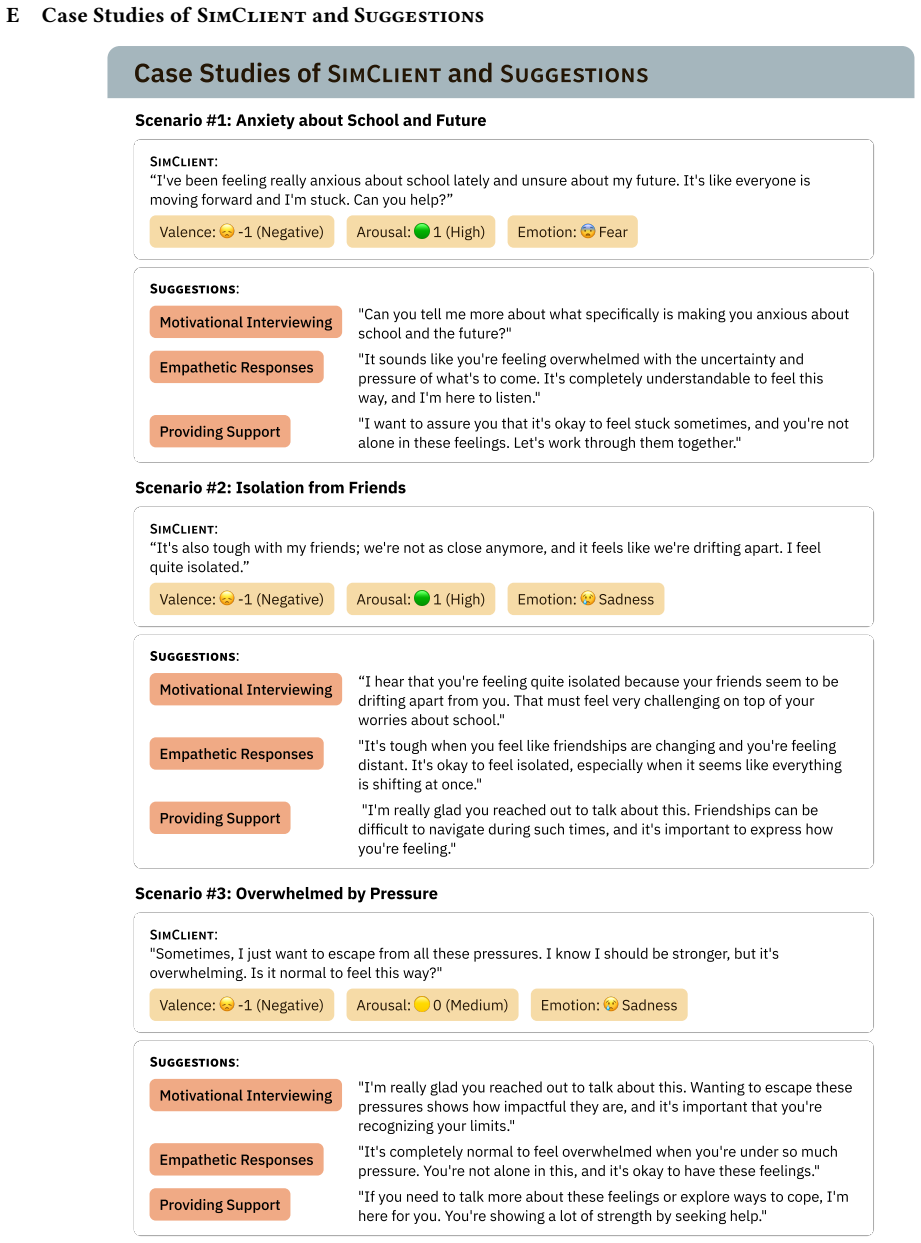
Mental health is a growing global concern, prompting interest in AI-driven solutions to expand access to psychosocial support. \emph{Peer support}, grounded in lived experience, offers a valuable complement to professional care. However, variability in training, effectiveness, and definitions raises concerns about quality, consistency, and safety. Large Language Models (LLMs) present new opportunities to enhance peer support interactions, particularly in real-time, text-based interactions. We present and evaluate an AI-supported system with an LLM-simulated distressed client (\client{}), context-sensitive LLM-generated suggestions (\suggestions{}), and real-time emotion visualisations. 2 mixed-methods studies with 12 peer supporters and 6 mental health professionals (i.e., experts) examined the system's effectiveness and implications for practice. Both groups recognised its potential to enhance training and improve interaction quality. However, we found a key tension emerged: while peer supporters engaged meaningfully, experts consistently flagged critical issues in peer supporter responses, such as missed distress cues and premature advice-giving. This misalignment highlights potential limitations in current peer support training, especially in emotionally charged contexts where safety and fidelity to best practices are essential. Our findings underscore the need for standardised, psychologically grounded training, especially as peer support scales globally. They also demonstrate how LLM-supported systems can scaffold this development--if designed with care and guided by expert oversight. This work contributes to emerging conversations on responsible AI integration in mental health and the evolving role of LLMs in augmenting peer-delivered care.
Editorial analysis
A structured set of objections, weighed in public.
Referee Report
Summary. The paper introduces an LLM-supported system for peer support training in mental health contexts, including an LLM-simulated distressed client, context-sensitive LLM-generated suggestions, and real-time emotion visualizations. It reports results from two mixed-methods studies with 12 peer supporters and 6 mental health experts. Both groups recognized the system's potential to enhance training and interaction quality, but experts consistently identified issues in peer supporter responses such as missed distress cues and premature advice-giving. The authors interpret this misalignment as evidence of limitations in current peer support training and advocate for standardized, psychologically grounded training with expert oversight.
Significance. If the empirical observations hold, this work contributes to HCI and mental health by showing how LLMs can scaffold peer support interactions and by documenting perspective differences between lived-experience peer supporters and professional experts. The mixed-methods design with direct group comparison is a methodological strength that allows concrete identification of specific response patterns. The findings could inform responsible AI design for training tools, provided the interpretive link to training shortcomings is strengthened.
major comments (1)
- [Abstract] Abstract: The claim that expert-flagged issues such as 'missed distress cues and premature advice-giving' highlight 'potential limitations in current peer support training' and the need for 'standardised, psychologically grounded training' treats expert judgments as the authoritative benchmark. The manuscript provides no data linking adherence to these expert practices with improved client safety, helpfulness, or outcomes in peer support settings; the misalignment could instead reflect legitimate differences in role, training philosophy, or interaction goals. This interpretive step is load-bearing for the central claim about training shortcomings.
minor comments (2)
- [Abstract] The abstract summarizes the studies but does not mention coding procedures, inter-rater reliability, or session sampling; these details should be briefly noted to support the strength of evidence for the reported misalignments.
- [Results] Ensure that the distinction between the two studies is clearly maintained when reporting quantitative and qualitative findings in the results section.
Simulated Author's Rebuttal
We thank the referee for their constructive feedback, particularly on the interpretive claims in the abstract. We agree that strengthening the link between observed misalignments and training implications requires more careful qualification. Below we address the major comment directly and describe the revisions we will make.
read point-by-point responses
-
Referee: [Abstract] Abstract: The claim that expert-flagged issues such as 'missed distress cues and premature advice-giving' highlight 'potential limitations in current peer support training' and the need for 'standardised, psychologically grounded training' treats expert judgments as the authoritative benchmark. The manuscript provides no data linking adherence to these expert practices with improved client safety, helpfulness, or outcomes in peer support settings; the misalignment could instead reflect legitimate differences in role, training philosophy, or interaction goals. This interpretive step is load-bearing for the central claim about training shortcomings.
Authors: We accept the referee's point that the manuscript does not contain direct outcome data (e.g., client safety or helpfulness metrics) demonstrating that alignment with expert-flagged practices produces superior results. Our interpretation rests on two elements present in the paper: (1) the experts' judgments are informed by professional training standards and literature on evidence-based peer support practices (see Section 2.2), and (2) the specific issues flagged—missed distress cues and premature advice-giving—map onto documented risks in the peer support literature that training programs explicitly target. Nevertheless, we agree that alternative explanations (role differences, interaction goals) are plausible and should be acknowledged. We will revise the abstract to replace the stronger phrasing with: 'This misalignment suggests potential areas where current peer support training could be strengthened, particularly regarding safety and fidelity in emotionally charged contexts.' We will also expand the Discussion section to explicitly note the absence of outcome data and to present the alternative interpretation that the observed differences may reflect legitimate role distinctions rather than deficits. These changes qualify the central claim without altering the empirical findings. revision: partial
Circularity Check
No circularity: empirical comparison of participant groups
full rationale
The paper reports results from two mixed-methods studies with 12 peer supporters and 6 experts interacting with an LLM-supported system. Findings derive directly from observed differences in how the two groups responded to simulated client scenarios and flagged issues such as missed distress cues. No equations, fitted parameters, predictions, or derivations appear in the text. The interpretation that misalignments indicate training limitations is an interpretive claim grounded in the collected data rather than any reduction to self-definitions, self-citations, or ansatzes by construction. The work is self-contained as an empirical HCI investigation with independent content from its participant observations and does not rely on load-bearing self-referential steps.
Axiom & Free-Parameter Ledger
axioms (1)
- domain assumption Expert mental health professionals provide the appropriate benchmark for evaluating the safety and fidelity of peer supporter responses
Forward citations
Cited by 1 Pith paper
-
"I'm Not Able to Be There for You": Emotional Labour, Responsibility, and AI in Peer Support
Peer supporters bear concentrated emotional labor from institutional ambiguity and judge AI by its effects on redistributing responsibility and risk within fragile support roles.
Reference graph
Works this paper leans on
-
[1]
2022. Mental Disorders. https://www.who.int/news-room/fact- sheets/detail/mental-disorders
work page 2022
-
[2]
Self-Care Nights and Peer Support: How Young S’poreans Are Breaking the Burnout Cycle
2024. Self-Care Nights and Peer Support: How Young S’poreans Are Breaking the Burnout Cycle. The Straits Times (Oct. 2024)
work page 2024
-
[3]
Rangina Ahmad, Dominik Siemon, Ulrich Gnewuch, and Susanne Robra- Bissantz. 2022. Designing Personality-Adaptive Conversational Agents for Mental Health Care. Information Systems Frontiers 24, 3 (June 2022), 923–943. https://doi.org/10.1007/s10796-022-10254-9
-
[4]
Mary Alavanza. 2025. Singapore Youth Turn to AI Chatbots for Mental Health Needs as They Find It ’far Cheaper than Therapy’ - Singapore News. (March 2025)
work page 2025
-
[5]
Manas Satish Bedmutha, Anuujin Tsedenbal, Kelly Tobar, Sarah Borsotto, Kim- berly R Sladek, Deepansha Singh, Reggie Casanova-Perez, Emily Bascom, Brian Wood, Janice Sabin, Wanda Pratt, Andrea Hartzler, and Nadir Weibel. 2024. ConverSense: An Automated Approach to Assess Patient-Provider Interactions Using Social Signals. In Proceedings of the 2024 CHI Con...
-
[6]
Health Promotion Board. 2022. National Population Health Survey 2022 . Techni- cal Report. 199 pages
work page 2022
-
[7]
Tracy Butryn, Leah Bryant, Christine Marchionni, and Farhad Sholevar. 2017- 01/2017-06. The Shortage of Psychiatrists and Other Mental Health Providers: Causes, Current State, and Potential Solutions.International Journal of Academic Medicine 3, 1 (2017-01/2017-06), 5. https://doi.org/10.4103/IJAM.IJAM_49_17
-
[8]
John T. Cacioppo and Richard E. Petty. 1982. The Need for Cognition. Journal of Personality and Social Psychology 42, 1 (1982), 116–131. https://doi.org/10. 1037/0022-3514.42.1.116
work page 1982
-
[9]
John T. Cacioppo, Richard E. Petty, and Chuan F. Kao. 1984. The Efficient Assessment of Need for Cognition. Journal of Personality Assessment 48, 3 (1984), 306–307. https://doi.org/10.1207/s15327752jpa4803_13
-
[10]
Alicja Chaszczewicz, Raj Shah, Ryan Louie, Bruce Arnow, Robert Kraut, and Diyi Yang. 2024. Multi-Level Feedback Generation with Large Language Models for Empowering Novice Peer Counselors. In Proceedings of the 62nd Annual Meeting of the Association for Computational Linguistics (Volume 1: Long Papers), Lun-Wei Ku, Andre Martins, and Vivek Srikumar (Eds.)...
-
[11]
Tianjiao Chen, Jingyi Ou, Gege Li, and Heng Luo. 2024. Promoting Mental Health in Children and Adolescents through Digital Technology: A Systematic Review and Meta-Analysis. Frontiers in Psychology 15 (March 2024). https: //doi.org/10.3389/fpsyg.2024.1356554
-
[12]
Tianying Chen, Kristy Zhang, Robert E. Kraut, and Laura Dabbish. 2021. Scaf- folding the Online Peer-support Experience: Novice Supporters’ Strategies and Challenges. Proc. ACM Hum.-Comput. Interact. 5, CSCW2 (Oct. 2021), 366:1– 366:30. https://doi.org/10.1145/3479510
-
[13]
Yu Ying Chiu, Ashish Sharma, Inna Wanyin Lin, and Tim Althoff. 2024. A Computational Framework for Behavioral Assessment of LLM Therapists. https: //doi.org/10.48550/arXiv.2401.00820 arXiv:2401.00820 [cs]
-
[14]
Siong Yin Chua and Karel Himawan. 2025. The Exploration of Attitudes and Perspectives of Mental Health Workers on Peer Support in Singapore. Discover Mental Health 5, 1 (Jan. 2025), 1. https://doi.org/10.1007/s44192-024-00125-x
- [15]
-
[16]
Paul M. G. Emmelkamp, Katharina Meyerbröker, and Nexhmedin Morina. 2020. Virtual Reality Therapy in Social Anxiety Disorder. Current Psychiatry Reports 22, 7 (May 2020), 32. https://doi.org/10.1007/s11920-020-01156-1
-
[17]
Kathleen Kara Fitzpatrick, Alison Darcy, and Molly Vierhile. 2017. Deliver- ing Cognitive Behavior Therapy to Young Adults With Symptoms of Depres- sion and Anxiety Using a Fully Automated Conversational Agent (Woebot): A Randomized Controlled Trial. JMIR Mental Health 4, 2 (June 2017), e7785. https://doi.org/10.2196/mental.7785
-
[18]
Carmen C. D. Franke, Barbara C. Paton, and Lee-Anne J. Gassner. 2010. Imple- menting Mental Health Peer Support: A South Australian Experience.Australian Journal of Primary Health 16, 2 (2010), 179–186. https://doi.org/10.1071/py09067
-
[19]
Russell Fulmer, Angela Joerin, Breanna Gentile, Lysanne Lakerink, and Michiel Rauws. 2018. Using Psychological Artificial Intelligence (Tess) to Relieve Symp- toms of Depression and Anxiety: Randomized Controlled Trial. JMIR Mental Health 5, 4 (Dec. 2018), e9782. https://doi.org/10.2196/mental.9782
-
[20]
Natasha Ganesan. 28 Sep 2023 03:42PM). Prevalence of Poor Mental Health Increasing in Singapore; Young Adults Have Highest Proportion at 25.3%. CNA (28 Sep 2023 03:42PM))
work page 2023
-
[21]
I Will Not Drink With You Today
Robert P Gauthier, Mary Jean Costello, and James R Wallace. 2022. “I Will Not Drink With You Today”: A Topic-Guided Thematic Analysis of Addiction Recovery on Reddit. In CHI Conference on Human Factors in Computing Systems . ACM, New Orleans LA USA, 1–17. https://doi.org/10.1145/3491102.3502076
-
[22]
Yan Han Goh. 2023. Young People Cite Anonymity, Safe Space in Turning to Discord for Mental Health Peer Support. The Straits Times (Feb. 2023)
work page 2023
-
[23]
Goldberg, Tony Rousmaniere, Scott D
Simon B. Goldberg, Tony Rousmaniere, Scott D. Miller, Jason Whipple, Ste- van Lars Nielsen, William T. Hoyt, and Bruce E. Wampold. 2016. Do Psychother- apists Improve with Time and Experience? A Longitudinal Analysis of Outcomes in a Clinical Setting. Journal of Counseling Psychology 63, 1 (Jan. 2016), 1–11. https://doi.org/10.1037/cou0000131
-
[24]
Madison P. Goodyke, Patricia E. Hershberger, Ulf G. Bronas, and Susan L. Dunn
-
[25]
Western Journal of Nursing Research 44, 11 (Nov
Perceived Social Support and Heart Rate Variability: An Integrative Review. Western Journal of Nursing Research 44, 11 (Nov. 2022), 1057–1067. https://doi.org/10.1177/01939459211028908
-
[26]
Jane Green, Lata Satyen, and John W. Toumbourou. 2024. Influence of Cultural Norms on Formal Service Engagement Among Survivors of Intimate Partner Violence: A Qualitative Meta-synthesis. Trauma, Violence, & Abuse 25, 1 (Jan. 2024), 738–751. https://doi.org/10.1177/15248380231162971
-
[27]
Chris Hollis, Caroline J. Falconer, Jennifer L. Martin, Craig Whittington, Sarah Stockton, Cris Glazebrook, and E. Bethan Davies. 2017. Annual Research Review: Digital Health Interventions for Children and Young People with Mental Health Problems – a Systematic and Meta-Review. Journal of Child Psychology and Psychiatry 58, 4 (2017), 474–503. https://doi....
-
[28]
Timothy Hsi and Ada Yee Lin Chung. 2010. Peer Helpers: Bridging the Gap between the Student Community and the University’s Counseling Service. 12th Asia-Pacific Student Services Association Conference 2010 (2010)
work page 2010
-
[29]
Shang-Ling Hsu, Raj Sanjay Shah, Prathik Senthil, Zahra Ashktorab, Casey Dugan, Werner Geyer, and Diyi Yang. 2025. Helping the Helper: Supporting Peer Counselors via AI-Empowered Practice and Feedback. Proc. ACM Hum.- Comput. Interact. 9, 2 (May 2025), CSCW095:1–CSCW095:45. https://doi.org/10. 1145/3710993
work page 2025
-
[30]
Vera Liao, Su Lin Blodgett, Alexandra Olteanu, and Adam Trischler
Angel Hsing-Chi Hwang, Q. Vera Liao, Su Lin Blodgett, Alexandra Olteanu, and Adam Trischler. 2025. ’It Was 80% Me, 20% AI’: Seeking Authenticity in Co-Writing with Large Language Models. Proc. ACM Hum.-Comput. Interact. 9, 2 (May 2025), CSCW122:1–CSCW122:41. https://doi.org/10.1145/3711020
-
[31]
Zainab Iftikhar, Yumeng Ma, and Jeff Huang. 2023. “Together but Not To- gether”: Evaluating Typing Indicators for Interaction-Rich Communication. In Proceedings of the 2023 CHI Conference on Human Factors in Computing Systems (CHI ’23). Association for Computing Machinery, New York, NY, USA, 1–12. https://doi.org/10.1145/3544548.3581248
-
[32]
Zainab Iftikhar, Sean Ransom, Amy Xiao, and Jeff Huang. 2024. Therapy as an NLP Task: Psychologists’ Comparison of LLMs and Human Peers in CBT. https://doi.org/10.48550/arXiv.2409.02244 arXiv:2409.02244 [cs]
-
[33]
Becky Inkster, Shubhankar Sarda, and Vinod Subramanian. 2018. An Empathy- Driven, Conversational Artificial Intelligence Agent (Wysa) for Digital Mental Well-Being: Real-World Data Evaluation Mixed-Methods Study. JMIR mHealth and uHealth 6, 11 (Nov. 2018), e12106. https://doi.org/10.2196/12106
-
[34]
Kampman, Michael Xing, Charmaine Lim, Ahmad Ishqi Jabir, Ryan Louie, Jimmy Lee, and Robert JT Morris
Onno P. Kampman, Michael Xing, Charmaine Lim, Ahmad Ishqi Jabir, Ryan Louie, Jimmy Lee, and Robert JT Morris. 2025. Conversational Self-Play for Discovering and Understanding Psychotherapy Approaches. https://doi.org/10. 48550/arXiv.2503.16521 arXiv:2503.16521 [cs]
-
[35]
Jasmeet Kaur and Pushpendra Singh. 2025. Exploring the Potential of Peer Support Group for Family Planning Needs of Women in Resource-constrained Settings in India.Proc. ACM Hum.-Comput. Interact.9, 2 (May 2025), CSCW080:1– CSCW080:25. https://doi.org/10.1145/3710978
-
[36]
Hye-Geum Kim, Eun-Jin Cheon, Dai-Seg Bai, Young Hwan Lee, and Bon-Hoon Koo. 2018. Stress and Heart Rate Variability: A Meta-Analysis and Review of the Literature. Psychiatry Investigation 15, 3 (March 2018), 235–245. https: //doi.org/10.30773/pi.2017.08.17
-
[37]
Meeyun Kim, Koustuv Saha, Munmun De Choudhury, and Daejin Choi. 2023. Supporters First: Understanding Online Social Support on Mental Health from a Supporter Perspective. Proceedings of the ACM on Human-Computer Interaction 7, CSCW1 (April 2023), 1–28. https://doi.org/10.1145/3579525
-
[38]
Taewan Kim, Seolyeong Bae, Hyun Ah Kim, Su-Woo Lee, Hwajung Hong, Chanmo Yang, and Young-Ho Kim. 2024. MindfulDiary: Harnessing Large Language Model to Support Psychiatric Patients’ Journaling. In Proceedings of the 2024 CHI Conference on Human Factors in Computing Systems (CHI ’24) . Association for Computing Machinery, New York, NY, USA, 1–20. https://d...
-
[39]
Nikola Kovačević, Christian Holz, Markus Gross, and Rafael Wampfler. 2024. The Personality Dimensions GPT-3 Expresses During Human-Chatbot Interactions. Proc. ACM Interact. Mob. Wearable Ubiquitous Technol.8, 2 (May 2024), 61:1–61:36. https://doi.org/10.1145/3659626
-
[40]
Kaylee Payne Kruzan, Natalya N. Bazarova, and Janis Whitlock. 2021. Investigat- ing Self-injury Support Solicitations and Responses on a Mobile Peer Support Application. Proc. ACM Hum.-Comput. Interact. 5, CSCW2 (Oct. 2021), 354:1– 354:23. https://doi.org/10.1145/3479498
-
[41]
John Lam, Buanesvari Paarvati, Collin Sim, Seyoung Oh, and Naomi Toh. 2025. An Exploratory Study of Singapore’s Only 24-Hour Crisis Textline . Technical Report
work page 2025
-
[42]
John Lam, Delilah Tan, Andre Shia, and Seyoung Oh. 2025. Listen2Me: The Experiences of CareText Volunteers and Its Service Users . Technical Report
work page 2025
-
[43]
Daniel Lambton-Howard, Emma Simpson, Kim Quimby, Ahmed Kharrufa, Heidi Hoi Ming Ng, Emma Foster, and Patrick Olivier. 2021. Blending into Everyday Life: Designing a Social Media-Based Peer Support System. In Proceedings of the 2021 CHI Conference on Human Factors in Computing Systems (CHI ’21) . Association for Computing Machinery, New York, NY, USA, 1–14...
-
[44]
Li Ying Lee. 2025. Counsellors Alarmed by Unqualified People Offering Mental Health Services on Carousell. The Straits Times (Feb. 2025)
work page 2025
-
[45]
Li Ying Lee. 2025. Safety of Mental Health Clients at Risk If Psychologists Remain Unregulated | The Straits Times. https://www.straitstimes.com/singapore/health/safety-of-mental-health- clients-at-risk-if-psychologists-remain-unregulated
work page 2025
-
[46]
Ying Ying Lee, Suying Ang, Hong Choon Chua, and Mythily Subramaniam
-
[47]
Annals of the Academy of Medicine, Singapore 48, 3 (March 2019), 95–97
Peer Support in Mental Health: A Growing Movement in Singapore. Annals of the Academy of Medicine, Singapore 48, 3 (March 2019), 95–97. https: //doi.org/10.47102/annals-acadmedsg.V48N3p95
-
[48]
Anqi Li, Yu Lu, Nirui Song, Shuai Zhang, Lizhi Ma, and Zhenzhong Lan. 2024. Understanding the Therapeutic Relationship between Counselors and Clients in Online Text-based Counseling Using LLMs. https://doi.org/10.48550/arXiv. 2402.11958 arXiv:2402.11958 [cs]
work page internal anchor Pith review doi:10.48550/arxiv 2024
-
[49]
Han Li, Renwen Zhang, Yi-Chieh Lee, Robert E. Kraut, and David C. Mohr. 2023. Systematic Review and Meta-Analysis of AI-based Conversational Agents for Promoting Mental Health and Well-Being. npj Digital Medicine 6, 1 (Dec. 2023), 1–14. https://doi.org/10.1038/s41746-023-00979-5
-
[50]
Vera Liao, Junti Zhang, and Yi-Chieh Lee
Jingshu Li, Yitian Yang, Q. Vera Liao, Junti Zhang, and Yi-Chieh Lee. 2025. As Confidence Aligns: Understanding the Effect of AI Confidence on Human Self-confidence in Human-AI Decision Making. In Proceedings of the 2025 CHI Conference on Human Factors in Computing Systems (CHI ’25) . Association for Computing Machinery, New York, NY, USA, 1–16. https://d...
-
[51]
Ethan Lim Ding Feng, Zhi-Wei Neo, Aaron William De Silva, Kellie Sim, Hong- Ray Tan, Thi-Thanh Nguyen, Karen Wei Ling Koh, Wenru Wang, and Hoang D. Nguyen. 2020. Social Behaviour Understanding Using Deep Neural Networks: Development of Social Intelligence Systems. In Social Computing and Social Media. Design, Ethics, User Behavior, and Social Network Anal...
-
[52]
Tianjian Liu, Hongzheng Zhao, Yuheng Liu, Xingbo Wang, and Zhenhui Peng
-
[53]
In Proceedings of the 37th Annual ACM Symposium on User Interface Software and Technology (UIST ’24)
ComPeer: A Generative Conversational Agent for Proactive Peer Support. In Proceedings of the 37th Annual ACM Symposium on User Interface Software and Technology (UIST ’24). Association for Computing Machinery, New York, NY, USA, 1–22. https://doi.org/10.1145/3654777.3676430
-
[54]
Si Yuan Lou. 2023. Chatbots See Greater Usage as Mental Health Support Tool but Can’t Deal with Urgent or Suicidal Cases: NTU Study. https://www.todayonline.com/singapore/chatbots-mental-health- support-suicidal-cases-ntu-study-2075326
work page 2023
-
[55]
Ryan Louie, Ananjan Nandi, William Fang, Cheng Chang, Emma Brunskill, and Diyi Yang. 2024. Roleplay-Doh: Enabling Domain-Experts to Create LLM-simulated Patients via Eliciting and Adhering to Principles. In Proceed- ings of the 2024 Conference on Empirical Methods in Natural Language Pro- cessing, Yaser Al-Onaizan, Mohit Bansal, and Yun-Nung Chen (Eds.). ...
-
[56]
Ryan Louie, Ifdita Hasan Orney, Juan Pablo Pacheco, Raj Sanjay Shah, Emma Brunskill, and Diyi Yang. 2025. Can LLM-Simulated Practice and Feedback Upskill Human Counselors? A Randomized Study with 90+ Novice Counselors. https://doi.org/10.48550/arXiv.2505.02428 arXiv:2505.02428 [cs]
-
[57]
QianHui Ma, Joseph J. Gallo, Jeanine M. Parisi, and Jin Hui Joo. 2022. De- velopment of the Mental Health Peer Support Questionnaire in Colleges and Vocational Schools in Singapore. International Journal of Mental Health Systems 16, 1 (Sept. 2022), 45. https://doi.org/10.1186/s13033-022-00555-6
-
[58]
Navonil Majumder, Pengfei Hong, Shanshan Peng, Jiankun Lu, Deepanway Ghosal, Alexander Gelbukh, Rada Mihalcea, and Soujanya Poria. 2020. MIME: MIMicking Emotions for Empathetic Response Generation. In Proceedings of the 2020 Conference on Empirical Methods in Natural Language Processing (EMNLP) , Bonnie Webber, Trevor Cohn, Yulan He, and Yang Liu (Eds.). ...
-
[59]
Laura Martinengo, Elaine Lum, and Josip Car. 2022. Evaluation of Chatbot- Delivered Interventions for Self-Management of Depression: Content Analysis. Journal of Affective Disorders 319 (Dec. 2022), 598–607. https://doi.org/10.1016/ j.jad.2022.09.028
work page 2022
-
[60]
Mara Mather and Julian F Thayer. 2018. How Heart Rate Variability Affects Emotion Regulation Brain Networks. Current Opinion in Behavioral Sciences 19 (Feb. 2018), 98–104. https://doi.org/10.1016/j.cobeha.2017.12.017
-
[61]
Robert R. McCrae and Paul T. Costa. 1997. Chapter 31 - Conceptions and Correlates of Openness to Experience. In Handbook of Personality Psychology , Robert Hogan, John Johnson, and Stephen Briggs (Eds.). Academic Press, San Diego, 825–847. https://doi.org/10.1016/B978-012134645-4/50032-9
-
[62]
R. R. McCrae and O. P. John. 1992. An Introduction to the Five-Factor Model and Its Applications. Journal of Personality 60, 2 (June 1992), 175–215. https: //doi.org/10.1111/j.1467-6494.1992.tb00970.x
-
[63]
Shery Mead and Cheryl MacNeil. 2004. Peer Support: What Makes It Unique? (Dec. 2004)
work page 2004
-
[64]
Ministry of Health. 2024. WHOLE-OF-SOCIETY EFFORTS TO SUP- PORT MENTAL HEALTH AND WELL-BEING OF YOUTHS IN SINGA- PORE. https://www.moh.gov.sg/newsroom/whole-of-society-efforts-to-support- mental-health-and-well-being-of-youths-in-singapore
work page 2024
-
[65]
Robert R Morris, Kareem Kouddous, Rohan Kshirsagar, and Stephen M Schueller
-
[66]
Journal of Medical Internet Research 20, 6 (June 2018), e10148
Towards an Artificially Empathic Conversational Agent for Mental Health Applications: System Design and User Perceptions. Journal of Medical Internet Research 20, 6 (June 2018), e10148. https://doi.org/10.2196/10148
-
[67]
Richard Mpango, Jasmine Kalha, Donat Shamba, Mary Ramesh, Fileuka Ngakongwa, Arti Kulkarni, Palak Korde, Juliet Nakku, and Grace K. Ryan
-
[68]
Globalization and Health 16, 1 (Sept
Challenges to Peer Support in Low- and Middle-Income Countries during COVID-19. Globalization and Health 16, 1 (Sept. 2020), 90. https: //doi.org/10.1186/s12992-020-00622-y
-
[69]
J. A. Naslund, K. A. Aschbrenner, L. A. Marsch, and S. J. Bartels. 2016. The Future of Mental Health Care: Peer-to-Peer Support and Social Media. Epidemiology and Psychiatric Sciences 25, 2 (April 2016), 113–122. https://doi.org/10.1017/ S2045796015001067
work page 2016
-
[70]
Chai Chin Neo, Christy Yip, and Chiew Tong Goh. 03 May 2022 06:15AM. ‘It’s Really about Normalising Mental Health’: What Schools Are Doing so Students Seek Help. CNA (03 May 2022 06:15AM)
work page 2022
-
[71]
Kathleen O’Leary, Arpita Bhattacharya, Sean A. Munson, Jacob O. Wobbrock, and Wanda Pratt. 2017. Design Opportunities for Mental Health Peer Support Technologies. In Proceedings of the 2017 ACM Conference on Computer Supported Cooperative Work and Social Computing. ACM, Portland Oregon USA, 1470–1484. https://doi.org/10.1145/2998181.2998349
-
[72]
Kathleen O’Leary, Stephen M. Schueller, Jacob O. Wobbrock, and Wanda Pratt
-
[73]
Suddenly, We Got to Become Therapists for Each Other
“Suddenly, We Got to Become Therapists for Each Other”: Designing Peer Support Chats for Mental Health. In Proceedings of the 2018 CHI Conference on Human Factors in Computing Systems (CHI ’18) . Association for Computing Machinery, New York, NY, USA, 1–14. https://doi.org/10.1145/3173574.3173905
-
[74]
Kavitha Palaniappan, Natarajan Rajaraman, and Santu Ghosh. 2023. Effective- ness of Peer Support to Reduce Depression, Anxiety and Stress among Migrant Construction Workers in Singapore. Engineering, Construction and Architectural Management 30, 10 (Jan. 2023), 4867–4880. https://doi.org/10.1108/ECAM-03- 2022-0269
-
[75]
I Wrote as If I Were Telling a Story to Someone I Knew
SoHyun Park, Anja Thieme, Jeongyun Han, Sungwoo Lee, Wonjong Rhee, and Bongwon Suh. 2021. “I Wrote as If I Were Telling a Story to Someone I Knew. ”: Designing Chatbot Interactions for Expressive Writing in Mental Health. In Proceedings of the 2021 ACM Designing Interactive Systems Conference (DIS ’21). Association for Computing Machinery, New York, NY, U...
-
[76]
Zhenhui Peng, Qingyu Guo, Ka Wing Tsang, and Xiaojuan Ma. 2020. Exploring the Effects of Technological Writing Assistance for Support Providers in Online Mental Health Community. In Proceedings of the 2020 CHI Conference on Human Factors in Computing Systems (CHI ’20). Association for Computing Machinery, New York, NY, USA, 1–15. https://doi.org/10.1145/3...
-
[77]
Instead, You’re Going to a Friend
Kate Perepezko, Mathew Bergendahl, Christopher Kunz, Alain Labrique, Matthew Carras, and Michelle Colder Carras. 2024. “Instead, You’re Going to a Friend”: Evaluation of a Community-Developed, Peer-Delivered Online Crisis Prevention Intervention. Psychiatric Services 75, 12 (Dec. 2024), 1267–1275. https://doi.org/10.1176/appi.ps.20230233
-
[78]
Amy Rayland and Jacob Andrews. 2023. From Social Network to Peer Support Network: Opportunities to Explore Mechanisms of Online Peer Support for Mental Health. JMIR Mental Health 10, 1 (Feb. 2023), e41855. https://doi.org/10. 2196/41855
work page 2023
-
[79]
Julie Repper and Tim Carter. 2011. A Review of the Literature on Peer Support in Mental Health Services. Journal of Mental Health 20, 4 (Aug. 2011), 392–411. https://doi.org/10.3109/09638237.2011.583947
-
[80]
Sara Rolando, Giulia Arrighetti, Elisa Fornero, Ombretta Farucci, and Franca Beccaria. 2023. Telegram as a Space for Peer-Led Harm Reduction Communities and Netreach Interventions. Contemporary Drug Problems 50, 2 (June 2023), 190–201. https://doi.org/10.1177/00914509221145196
discussion (0)
Sign in with ORCID, Apple, or X to comment. Anyone can read and Pith papers without signing in.