Disentangling strategies and entanglement transitions in unitary circuit games with matchgates
Pith reviewed 2026-05-19 06:24 UTC · model grok-4.3
The pith
Matchgate unitary circuit games produce qualitatively different entanglement transitions depending on whether braiding gates or generic matchgates are used for disentangling.
A machine-rendered reading of the paper's core claim, the machinery that carries it, and where it could break.
Core claim
In matchgate dynamics equivalent to non-interacting fermions, a minimal matchgate circuit representation of fermionic Gaussian states together with a generalized Yang-Baxter update rule permits well-defined disentangling strategies; when these strategies compete against entangling operations, the resulting entanglement transitions differ qualitatively between the braiding-gate model and the generic-matchgate model, and both transitions admit numerical and analytical characterization.
What carries the argument
Minimal matchgate circuit representation of fermionic Gaussian states, updated by a generalized Yang-Baxter relation, that directly measures and reduces entanglement by gate deletion.
If this is right
- Braiding-gate disentangling produces one critical rate while generic matchgate disentangling produces a different critical rate.
- Both transitions can be located by measuring how average entanglement entropy scales with circuit depth and disentangling probability.
- The same representation yields closed-form expressions or scaling relations for the transition point in each model.
- Entanglement can be reduced systematically without simulating the full many-body state.
Where Pith is reading between the lines
- The method may allow similar efficient disentangling analysis in other free-fermion or Gaussian settings outside circuit games.
- If the representation stays polynomial, it supplies a practical testbed for studying measurement-induced or monitored transitions in fermionic systems.
- The distinction between braiding and generic cases suggests that gate-set restrictions can qualitatively alter the location or nature of entanglement phases in quantum circuits.
- One could test whether adding weak interactions or measurements preserves the efficiency of the update rule.
Load-bearing premise
The minimal matchgate circuit representation remains compact and the Yang-Baxter update rule continues to track entanglement correctly after many successive disentangling steps without exponential blow-up or accumulated error.
What would settle it
For a small number of qubits, run the disentangling algorithm many times and check whether the circuit size stays linear in system size or whether the entanglement entropy computed from the circuit deviates from the exact value obtained by full diagonalization.
Figures




read the original abstract
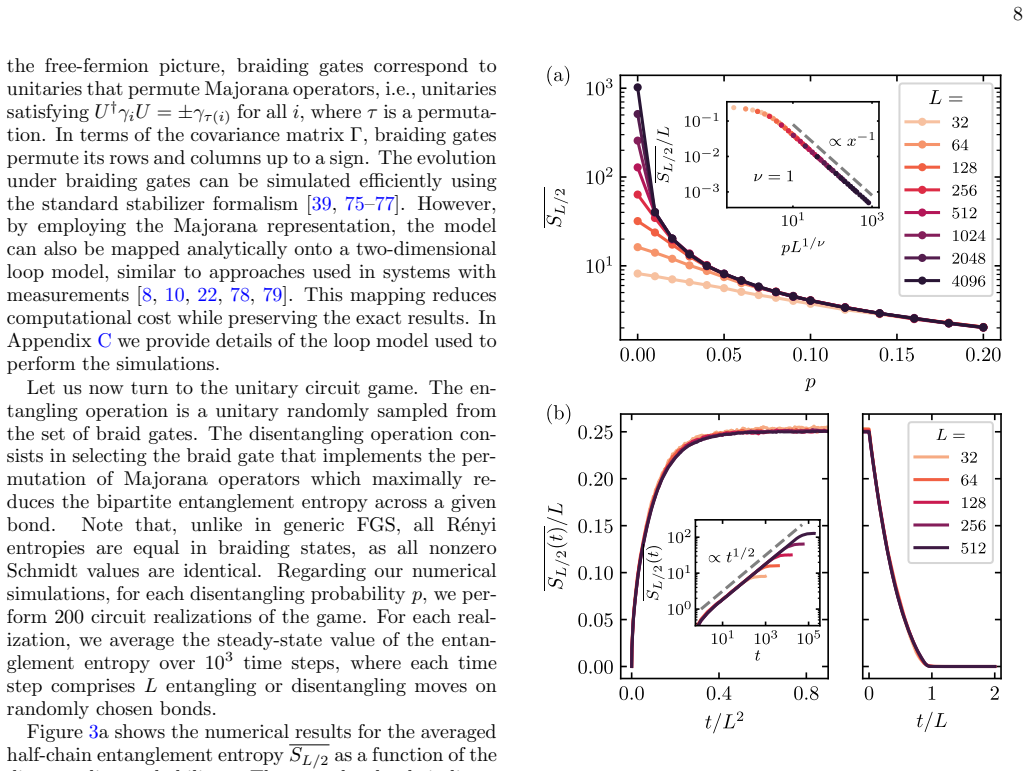
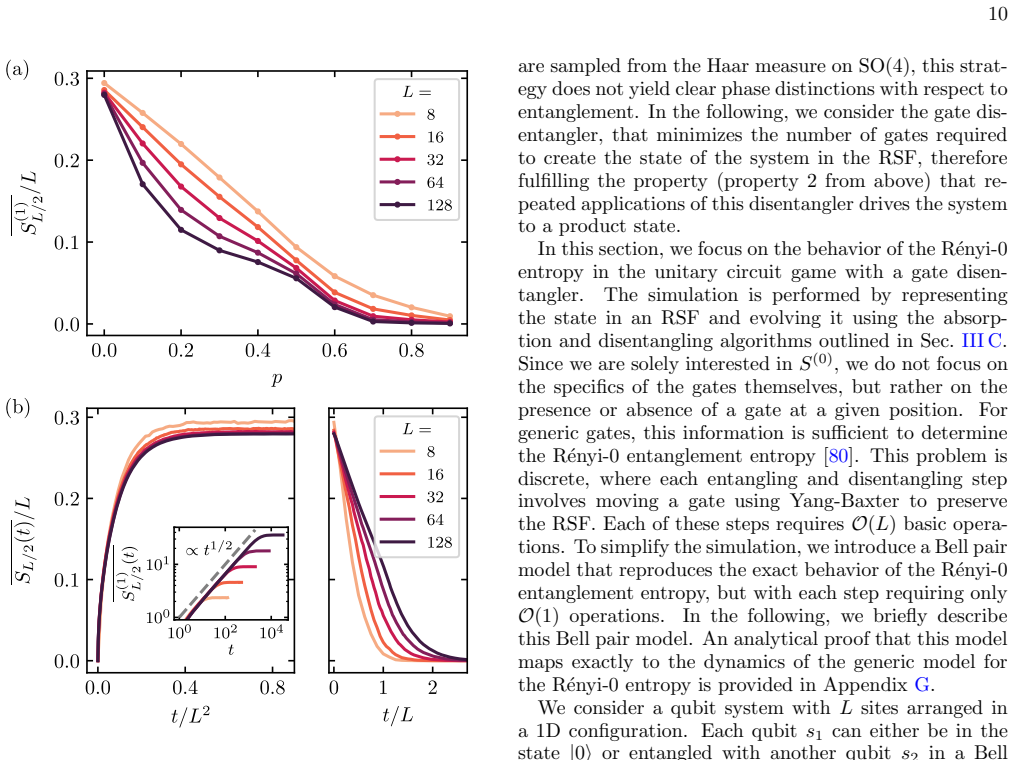
In unitary circuit games, two competing parties, an "entangler" and a "disentangler", can induce an entanglement phase transition in a quantum many-body system. The transition occurs at a certain rate at which the disentangler acts. We analyze such games within the context of matchgate dynamics, which equivalently corresponds to evolutions of non-interacting fermions. We first investigate general entanglement properties of fermionic Gaussian states (FGS). We introduce a representation of FGS using a minimal matchgate circuit capable of preparing the state and derive an algorithm based on a generalized Yang-Baxter relation for updating this representation as unitary operations are applied. This representation enables us to define a natural disentangling procedure that reduces the number of gates in the circuit, thereby decreasing the entanglement contained in the system. We then explore different strategies to disentangle the systems and study the unitary circuit game in two different scenarios: with braiding gates, i.e., the intersection of Clifford gates and matchgates, and with generic matchgates. For each model, we observe qualitatively different entanglement transitions, which we characterize both numerically and analytically.
Editorial analysis
A structured set of objections, weighed in public.
Referee Report
Summary. The manuscript analyzes unitary circuit games with an entangler and disentangler under matchgate dynamics equivalent to non-interacting fermionic evolution. It introduces a minimal matchgate circuit representation for fermionic Gaussian states together with a generalized Yang-Baxter update algorithm that allows the representation to be refreshed after each unitary application. This representation is used to define natural disentangling strategies that reduce gate count and thereby entanglement. The authors then compare two models—one restricted to braiding gates (Clifford-matchgate intersection) and one using generic matchgates—reporting qualitatively distinct entanglement transitions that are located and characterized both numerically and analytically.
Significance. If the technical claims hold, the work supplies a concrete, simulable representation for Gaussian states that directly connects circuit complexity to entanglement content, offering a practical tool for studying restricted-gate dynamics. The reported distinction between the two gate sets supplies a falsifiable prediction about how gate-set restrictions alter the location and character of entanglement transitions in fermionic systems.
major comments (2)
- [§4.2] §4.2, generalized Yang-Baxter update rule: the claim that repeated application of the update rule keeps the circuit representation both exact and compact is load-bearing for every subsequent numerical and analytical result, yet the manuscript provides no explicit bound on gate-count growth or proof that truncation errors remain negligible after O(N) disentangling steps.
- [§5.3] §5.3, numerical transition data: the reported transition points for the generic-matchgate model are obtained from the dynamics of the minimal circuit; without tabulated gate counts versus time or an explicit check that the representation does not become exponential, it is unclear whether the observed transition reflects the true fermionic Gaussian dynamics or an artifact of the representation.
minor comments (2)
- [Figure 2] Figure 2 caption: the legend does not specify the system size or number of disorder realizations used to extract the transition location.
- [§3] Notation: the symbol for the minimal circuit depth is introduced without an explicit definition in the main text; a short equation or sentence would remove ambiguity.
Simulated Author's Rebuttal
We thank the referee for the careful reading of our manuscript and the constructive comments. We have revised the manuscript to strengthen the justification of the circuit representation and to provide additional numerical validation of its efficiency. Below we respond to each major comment.
read point-by-point responses
-
Referee: [§4.2] §4.2, generalized Yang-Baxter update rule: the claim that repeated application of the update rule keeps the circuit representation both exact and compact is load-bearing for every subsequent numerical and analytical result, yet the manuscript provides no explicit bound on gate-count growth or proof that truncation errors remain negligible after O(N) disentangling steps.
Authors: We agree that an explicit discussion of stability is important. The generalized Yang-Baxter update preserves exact equivalence by algebraic identity at every step, with no truncation or approximation introduced. Compactness is maintained because the disentangling procedure is applied after each update and explicitly minimizes the gate count. In the revised version we have added an appendix containing a scaling argument showing that, for the braiding and generic matchgate sets considered, the gate count remains O(N) after O(N) steps when disentangling is performed; this is corroborated by new numerical data tracking gate count versus time. No truncation is ever applied, so representation errors remain identically zero. revision: yes
-
Referee: [§5.3] §5.3, numerical transition data: the reported transition points for the generic-matchgate model are obtained from the dynamics of the minimal circuit; without tabulated gate counts versus time or an explicit check that the representation does not become exponential, it is unclear whether the observed transition reflects the true fermionic Gaussian dynamics or an artifact of the representation.
Authors: We appreciate the request for explicit verification. The revised manuscript now includes a new figure in Section 5.3 (and accompanying table in the supplement) that reports the average number of gates in the minimal representation as a function of time for both models and several system sizes. The data demonstrate strictly linear scaling throughout the simulation window used to extract the transition points, with no indication of exponential growth. This confirms that the observed entanglement transitions are properties of the underlying fermionic Gaussian dynamics rather than artifacts of the representation. revision: yes
Circularity Check
No significant circularity; derivation introduces independent representation and applies it to new dynamics.
full rationale
The paper introduces a minimal matchgate circuit representation for fermionic Gaussian states and derives a generalized Yang-Baxter update algorithm from first principles within that representation. It then defines disentangling strategies that reduce gate count and applies them to two distinct models (braiding gates and generic matchgates), locating entanglement transitions via direct numerical simulation of the circuit dynamics and analytical characterization of the resulting phase boundaries. None of the reported transition points or qualitative distinctions reduce by construction to fitted parameters, self-citations, or redefinitions of the input data; the central claims rest on the independent content of the new representation and its evolution rules, which are externally verifiable through the stated algorithms and simulations.
Axiom & Free-Parameter Ledger
axioms (1)
- domain assumption Fermionic Gaussian states are fully characterized by their covariance matrix and can be prepared by matchgate circuits.
Lean theorems connected to this paper
-
IndisputableMonolith/Foundation/ArithmeticFromLogic.leanreality_from_one_distinction unclear?
unclearRelation between the paper passage and the cited Recognition theorem.
For each model, we observe qualitatively different entanglement transitions, which we characterize both numerically and analytically.
What do these tags mean?
- matches
- The paper's claim is directly supported by a theorem in the formal canon.
- supports
- The theorem supports part of the paper's argument, but the paper may add assumptions or extra steps.
- extends
- The paper goes beyond the formal theorem; the theorem is a base layer rather than the whole result.
- uses
- The paper appears to rely on the theorem as machinery.
- contradicts
- The paper's claim conflicts with a theorem or certificate in the canon.
- unclear
- Pith found a possible connection, but the passage is too broad, indirect, or ambiguous to say the theorem truly supports the claim.
Forward citations
Cited by 5 Pith papers
-
Measurement-enhanced entanglement in a monitored superconducting chain
Measurements enhance steady-state entanglement in a paired fermionic chain by suppressing pairing correlations, but the enhancement scales as ln squared L and vanishes in the thermodynamic limit.
-
Holographic Representation of One-Dimensional Many-Body Quantum States via Isometric Tensor Networks
Holographic isoTNS represent volume-law entangled states including arbitrary fermionic Gaussian states, Clifford states, and certain short-time evolved states using an extra network dimension with isometric constraints.
-
Non-Local Magic Resources for Fermionic Gaussian States
Closed-form formula computes non-local magic for fermionic Gaussian states from two-point correlations in polynomial time.
-
Dynamics of entanglement fluctuations and quantum Mpemba effect in the $\nu=1$ QSSEP model
Incorporating noise-induced quasiparticle correlations in the ν=1 QSSEP model yields the full-time distribution of entanglement entropy and shows the quantum Mpemba effect is extremely fine-tuned and hard to observe.
-
$\nu$-QSSEP: A toy model for entanglement spreading in stochastic diffusive quantum systems
The ν-QSSEP model generalizes QSSEP with spatially structured noise; for ν=1 entanglement dynamics follows a stochastic quasiparticle picture yielding diffusive growth.
Reference graph
Works this paper leans on
-
[1]
q ≥ k1 + l1 + 1. In this case, the additional gate commutes with the first diagonal since they act on different qubits: The problem then reduces to absorbing an addi- tional gate on qubits q, q + 1 into a circuit in RSF ((ki, li))nd i=2
-
[2]
None of the steps of the absorption algorithm can be applied
q = k1 + l1. None of the steps of the absorption algorithm can be applied. That is, it terminates immediately. The gate will be attached to the first diagonal, giving the circuit in RSF (( k1, l1 + 1), . . . ,(knd, lnd))
-
[3]
The gate can be combined with the last gate of the diagonal: The form of the circuit is not modified
q = k1 + l1 −1. The gate can be combined with the last gate of the diagonal: The form of the circuit is not modified
-
[4]
k1 < q < k 1 + l1 − 1. Step 1 of the absorption algorithm can be applied: After doing so, the problem reduces to absorbing a gate on qubits q + 1, q + 2 into a smaller circuit in RSF ((ki, li))nd i=2
-
[5]
q = k1. Here, one needs to take into account the parameters (k2, l2) of the second diagonal and con- sider two sub-cases. In the first one, k2 > k 1 + 2. Here, the algorithm performs step 1 once, then step 3, then combines two gates: 17 The resulting circuit remains in the initial RSF. In the second case, k2 = k1 + 2, the algorithm applies in sequence ste...
-
[6]
q = k1 − 1. Step 2 of the algorithm will be applied, since the check that the requirements for step 1 are not given. After step 2, no further steps are possible: The resulting circuit is in RSF (( k1 − 1, l1 + 1), . . . ,(knd, lnd))
-
[7]
None of the steps in the algorithm can be applied, it therefore terminates immediately
q ≤ k1 − 2. None of the steps in the algorithm can be applied, it therefore terminates immediately. The newly obtained circuit is already in RSF (( q, 1), (k1, l1), . . .(knd, lnd)). In two of the cases, a recursion argument is used, and the gates needs to be absorbed into an RSF circuit with nd − 1 diagonals. Repeated recursion will therefore end after a...
-
[8]
If qubit k is in the state |0⟩, increment k by one
-
[9]
If qubit k is entangled with another qubit k + l, with l ≥ 1, swap that qubit to position k + 1 by applying l − 1 SWAP operations. Append a di- agonal with parameters ( k, l) to the RSF circuit; that is, extend the current RSF circuit labeling to ((k1, l1), . . . ,(k, l)). Then, increment k by two. Figure 13 illustrates the application of this algorithm t...
-
[10]
L is even, and m = L/2,
-
[11]
L is odd, and m = (L − 1)/2. Firstly, in all of the three cases, we show min(m,L−m)X k=0 (L − m − k)Nm(k) = min(m,L−m−1)X k=0 (L − m − k)Nm(k). Seeing why this is true requires to consider the three cases separately:
-
[12]
Either, one has min( m, L − m) = m = min(m, L − m − 1), or
-
[13]
min( m, L − m − 1) = m − 1 = min(m, L − m) − 1, but the contribution to the sum with k = m drops out, or
-
[14]
Having established this, we have that L − m − k ≥ 1 for each value of the summation index k
one has min( m, L − m) = (L − 1)/2 = min(m, L − m − 1). Having established this, we have that L − m − k ≥ 1 for each value of the summation index k. When inserting the corresponding expression for Nm(k) and using L−m k (L − m − k) = L−1−m k (L − m), one obtains min(m,L−m−1)X k=0 (L − m − k)Nm(k) = (L − m) min(m,L−m−1)X k=0 k m k L − 1 − m k k! T (m − k) T...
-
[15]
Furthermore, min( m, L − m − 1) = m = min(m, L − m − 2)
Since m ≤ L/2 − 1 and k ≤ m, one always has L − m − k ≥ 2 and the recurrence can be applied for all values of k. Furthermore, min( m, L − m − 1) = m = min(m, L − m − 2)
-
[16]
However, for this k, one has T (L − m − k) = T (1) = T (0) = T (L − m − k − 1)
The maximal value of k appearing in the sum is k = L/2 − 1, in which case the recurrence relation cannot be applied. However, for this k, one has T (L − m − k) = T (1) = T (0) = T (L − m − k − 1). For all other values of k, 0 ≤ k ≤ min(m, L − m − 2), the recurrence holds
-
[17]
Similarly as above, one cannot apply the recurrence relation for the maximal value of k, given by k = (L − 1)/2. Again, it holds that T (L − m − k) = T (1) = T (0) = T (L − m − k − 1), and that for all other values of k, 0 ≤ k ≤ min(m, L − m − 2), the recurrence can be applied. In all the three cases, one can thus write min(m,L−m−1)X k=0 k m k L − 1 − m k...
-
[18]
M. P. Fisher, V. Khemani, A. Nahum, and S. Vi- jay, Random quantum circuits, Annual Review of Con- densed Matter Physics 14, 335–379 (2023)
work page 2023
-
[19]
Y. Li, X. Chen, and M. P. A. Fisher, Quantum zeno ef- fect and the many-body entanglement transition, Phys. Rev. B 98, 205136 (2018)
work page 2018
-
[20]
A. Chan, R. M. Nandkishore, M. Pretko, and G. Smith, Unitary-projective entanglement dynamics, Phys. Rev. B 99, 224307 (2019)
work page 2019
-
[21]
B. Skinner, J. Ruhman, and A. Nahum, Measurement- induced phase transitions in the dynamics of entangle- ment, Phys. Rev. X 9, 031009 (2019)
work page 2019
-
[22]
Y. Li, X. Chen, and M. P. A. Fisher, Measurement- driven entanglement transition in hybrid quantum cir- cuits, Phys. Rev. B 100, 134306 (2019)
work page 2019
- [23]
-
[24]
X. Cao, A. Tilloy, and A. D. Luca, Entanglement in a fermion chain under continuous monitoring, SciPost Phys. 7, 024 (2019)
work page 2019
-
[25]
A. Nahum and B. Skinner, Entanglement and dynam- ics of diffusion-annihilation processes with majorana de- fects, Phys. Rev. Res. 2, 023288 (2020)
work page 2020
-
[26]
X. Chen, Y. Li, M. P. A. Fisher, and A. Lucas, Emergent conformal symmetry in nonunitary random dynamics of free fermions, Phys. Rev. Res. 2, 033017 (2020)
work page 2020
-
[27]
S. Sang and T. H. Hsieh, Measurement-protected quan- tum phases, Phys. Rev. Res. 3, 023200 (2021)
work page 2021
-
[28]
M. Van Regemortel, Z.-P. Cian, A. Seif, H. Dehghani, and M. Hafezi, Entanglement entropy scaling transition under competing monitoring protocols, Phys. Rev. Lett. 126, 123604 (2021)
work page 2021
-
[29]
O. Alberton, M. Buchhold, and S. Diehl, Entanglement transition in a monitored free-fermion chain: From ex- tended criticality to area law, Phys. Rev. Lett. 126, 170602 (2021)
work page 2021
-
[30]
X. Turkeshi, A. Biella, R. Fazio, M. Dalmonte, and M. Schir´ o, Measurement-induced entanglement transi- tions in the quantum ising chain: From infinite to zero clicks, Phys. Rev. B 103, 224210 (2021)
work page 2021
-
[31]
M. Buchhold, Y. Minoguchi, A. Altland, and S. Diehl, Effective theory for the measurement-induced phase transition of dirac fermions, Phys. Rev. X 11, 041004 (2021)
work page 2021
-
[32]
L. Fidkowski, J. Haah, and M. B. Hastings, How Dy- namical Quantum Memories Forget, Quantum 5, 382 (2021)
work page 2021
-
[33]
B. Ladewig, S. Diehl, and M. Buchhold, Monitored open fermion dynamics: Exploring the interplay of mea- surement, decoherence, and free hamiltonian evolution, Phys. Rev. Res. 4, 033001 (2022)
work page 2022
-
[34]
C.-M. Jian, B. Bauer, A. Keselman, and A. W. W. Ludwig, Criticality and entanglement in nonunitary quantum circuits and tensor networks of noninteracting fermions, Phys. Rev. B 106, 134206 (2022)
work page 2022
-
[35]
M. Coppola, E. Tirrito, D. Karevski, and M. Collura, Growth of entanglement entropy under local projective measurements, Phys. Rev. B 105, 094303 (2022)
work page 2022
-
[36]
F. Carollo and V. Alba, Entangled multiplets and spreading of quantum correlations in a continuously monitored tight-binding chain, Phys. Rev. B 106, L220304 (2022)
work page 2022
-
[37]
Q. Yang, Y. Zuo, and D. E. Liu, Keldysh nonlinear sigma model for a free-fermion gas under continuous measurements, Phys. Rev. Res. 5, 033174 (2023)
work page 2023
- [38]
-
[39]
J. Merritt and L. Fidkowski, Entanglement transitions with free fermions, Phys. Rev. B 107, 064303 (2023)
work page 2023
-
[40]
A. Paviglianiti and A. Silva, Multipartite entanglement in the measurement-induced phase transition of the quantum ising chain, Phys. Rev. B 108, 184302 (2023)
work page 2023
-
[41]
M. Szyniszewski, O. Lunt, and A. Pal, Disordered mon- itored free fermions, Phys. Rev. B 108, 165126 (2023)
work page 2023
-
[42]
T. M¨ uller, S. Diehl, and M. Buchhold, Measurement- induced dark state phase transitions in long-ranged fermion systems, Phys. Rev. Lett. 128, 010605 (2022)
work page 2022
-
[43]
Y. L. Gal, X. Turkeshi, and M. Schir` o, Volume-to-area law entanglement transition in a non-Hermitian free fermionic chain, SciPost Phys. 14, 138 (2023)
work page 2023
- [44]
- [45]
-
[46]
I. Poboiko, P. P¨ opperl, I. V. Gornyi, and A. D. Mirlin, Theory of free fermions under random projective mea- surements, Phys. Rev. X 13, 041046 (2023)
work page 2023
-
[47]
M. Fava, L. Piroli, T. Swann, D. Bernard, and A. Nahum, Nonlinear sigma models for monitored dy- namics of free fermions, Phys. Rev. X13, 041045 (2023)
work page 2023
- [48]
-
[49]
K. Chahine and M. Buchhold, Entanglement phases, lo- calization and multifractality of monitored free fermions in two dimensions (2024), arXiv:2309.12391 [cond- mat.str-el]
- [50]
- [51]
-
[52]
D. Shaffer, C. Chamon, A. Hamma, and E. R. Mucci- olo, Irreversibility and entanglement spectrum statistics in quantum circuits, Journal of Statistical Mechanics: Theory and Experiment 2014, P12007 (2014)
work page 2014
-
[53]
S. True and A. Hamma, Transitions in entanglement complexity in random circuits, Quantum 6, 818 (2022)
work page 2022
-
[54]
Z.-C. Yang, A. Hamma, S. M. Giampaolo, E. R. Mucci- olo, and C. Chamon, Entanglement complexity in quan- tum many-body dynamics, thermalization, and localiza- tion, Phys. Rev. B 96, 020408 (2017)
work page 2017
-
[55]
J. Odavi´ c, G. Torre, N. Miji´ c, D. Davidovi´ c, F. Fran- chini, and S. M. Giampaolo, Random unitaries, robust- 29 ness, and complexity of entanglement, Quantum7, 1115 (2023)
work page 2023
-
[56]
S. Aaronson and D. Gottesman, Improved simulation of stabilizer circuits, Phys. Rev. A 70, 052328 (2004)
work page 2004
-
[57]
I. D. Kivlichan, J. McClean, N. Wiebe, C. Gidney, A. Aspuru-Guzik, G. K.-L. Chan, and R. Babbush, Quantum simulation of electronic structure with linear depth and connectivity, Phys. Rev. Lett. 120, 110501 (2018)
work page 2018
- [58]
-
[59]
M. Oszmaniec, N. Dangniam, M. E. Morales, and Z. Zimbor´ as, Fermion sampling: A robust quantum computational advantage scheme using fermionic linear optics and magic input states, PRX Quantum 3, 020328 (2022)
work page 2022
-
[60]
J. Hauschild, E. Leviatan, J. H. Bardarson, E. Alt- man, M. P. Zaletel, and F. Pollmann, Finding purifi- cations with minimal entanglement, Physical Review B 98, 10.1103/physrevb.98.235163 (2018)
-
[61]
Preparation Circuits for Matrix Product States by Classical Variational Disentanglement
R. Mansuroglu and N. Schuch, Preparation circuits for matrix product states by classical variational disentan- glement (2025), arXiv:2504.21298 [quant-ph]
work page internal anchor Pith review Pith/arXiv arXiv 2025
- [62]
- [64]
- [65]
- [66]
- [67]
- [68]
-
[69]
J. J. Vartiainen, M. M¨ ott¨ onen, and M. M. Salomaa, Efficient decomposition of quantum gates, Phys. Rev. Lett. 92, 177902 (2004)
work page 2004
- [70]
-
[71]
M. Plesch and ˇC. Brukner, Quantum-state preparation with universal gate decompositions, Phys. Rev. A 83, 032302 (2011)
work page 2011
-
[72]
R. Morral-Yepes, A. Smith, S. Sondhi, and F. Pollmann, Entanglement transitions in unitary circuit games, PRX Quantum 5, 10.1103/prxquantum.5.010309 (2024)
-
[73]
L. G. Valiant, Quantum computers that can be simu- lated classically in polynomial time, in Proceedings of the Thirty-Third Annual ACM Symposium on Theory of Computing , STOC ’01 (Association for Computing Machinery, New York, NY, USA, 2001) p. 114–123
work page 2001
-
[74]
Fermionic Linear Optics and Matchgates
E. Knill, Fermionic linear optics and matchgates (2001), arXiv:quant-ph/0108033 [quant-ph]
work page internal anchor Pith review Pith/arXiv arXiv 2001
-
[75]
B. M. Terhal and D. P. DiVincenzo, Classical simulation of noninteracting-fermion quantum circuits, Phys. Rev. A 65, 032325 (2002)
work page 2002
-
[76]
R. Jozsa and A. Miyake, Matchgates and classical sim- ulation of quantum circuits, Proceedings of the Royal Society A: Mathematical, Physical and Engineering Sci- ences 464, 3089–3106 (2008)
work page 2008
- [77]
-
[78]
L. G. Valiant, Expressiveness of matchgates, Theoretical Computer Science 289, 457 (2002)
work page 2002
-
[79]
To obtain the reduced state of non-consecutive qubits, these qubits first need to be swapped into a consecutive order to the first position of the chain [100]
-
[80]
G. C. Wick, The evaluation of the collision matrix, Phys. Rev. 80, 268 (1950)
work page 1950
-
[81]
V. Bach, E. H. Lieb, and J. P. Solovej, Generalized hartree-fock theory and the hubbard model, Journal of Statistical Physics 76, 3–89 (1994)
work page 1994
discussion (0)
Sign in with ORCID, Apple, or X to comment. Anyone can read and Pith papers without signing in.