Mass Distribution of Binary Black Hole Mergers from Young and Old Dense Star Clusters
Pith reviewed 2026-05-19 05:17 UTC · model grok-4.3
The pith
Dense star clusters produce binary black hole mergers across a wide primary mass range peaking near 8 solar masses.
A machine-rendered reading of the paper's core claim, the machinery that carries it, and where it could break.
Core claim
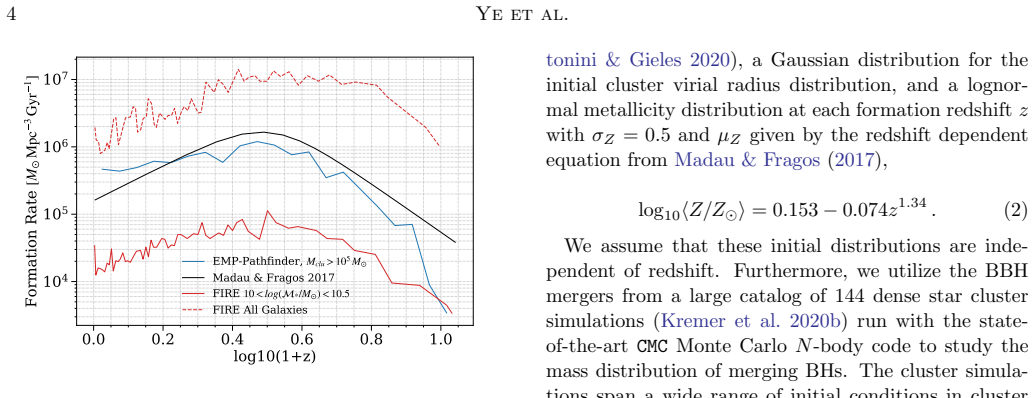
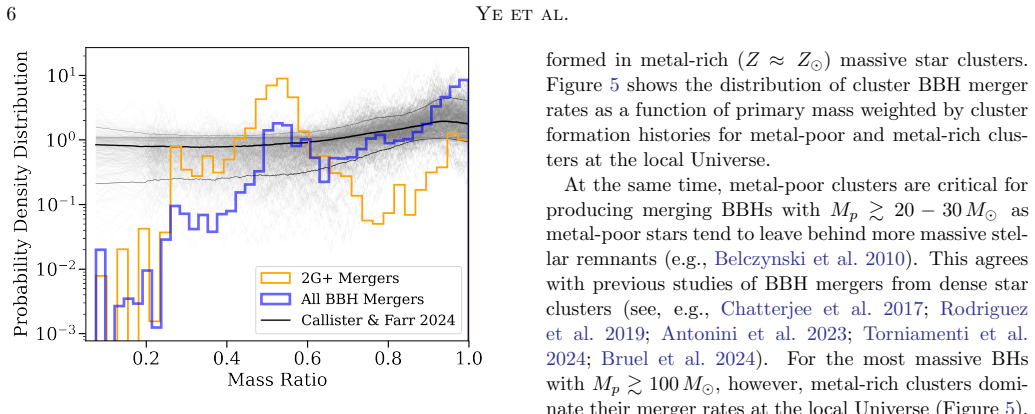
We combine N-body dynamic models of realistic dense star clusters with cluster formation histories to estimate the merger rate distribution as a function of primary mass for merging BBHs formed in these environments. Dense star clusters forming at lower redshifts and thus having higher metallicities naturally produce lower-mass BBH mergers. Cluster BBH mergers span a wide range of primary mass, from about 6 M⊙ to above 100 M⊙, with a peak near 8 M⊙, reproducing the overall merger rate distribution inferred from gravitational wave detections. Most low-mass BBH mergers originate in metal-rich dense star clusters while more massive ones form predominately in metal-poor globular clusters.
What carries the argument
N-body dynamic models of dense star clusters integrated with redshift-dependent cluster formation histories and metallicity distributions to compute the BBH primary mass distribution.
If this is right
- Cluster BBH mergers reproduce the overall merger rate distribution inferred from gravitational wave detections.
- About 95 percent of mergers with primary mass less than or equal to 20 solar masses originate in metal-rich clusters.
- More massive BBH mergers form predominantly in metal-poor globular clusters.
- Hierarchical mergers contribute to shaping the overall BBH mass distribution.
- Detections of dynamically formed low-mass BBHs identifiable by isotropic spin distributions can probe cluster formation histories in metal-rich low-redshift environments.
Where Pith is reading between the lines
- Spin information in future gravitational wave events could distinguish low-mass dynamical mergers from other formation channels.
- The model implies that young dense clusters at solar metallicity are key to explaining the low-mass end of the observed black hole merger population.
- Adjusting the assumed redshift evolution of cluster metallicity could shift the predicted contribution from different cluster types.
Load-bearing premise
The specific cluster formation histories and metallicity evolution adopted in the models accurately represent the real universe.
What would settle it
Gravitational wave observations showing that the primary mass distribution of merging binary black holes does not peak near 8 solar masses or lacks a dominant low-mass contribution from metal-rich clusters.
Figures




read the original abstract
Dense star clusters are thought to contribute significantly to the merger rates of stellar-mass binary black holes (BBHs) detected by the LIGO-Virgo-KAGRA collaboration. We combine $N$-body dynamic models of realistic dense star clusters with cluster formation histories to estimate the merger rate distribution as a function of primary mass for merging BBHs formed in these environments. It has been argued that dense star clusters -- most notably old globular clusters -- predominantly produce BBH mergers with primary masses $M_p\approx30\,M_{\odot}$. We show that dense star clusters forming at lower redshifts -- and thus having higher metallicities -- naturally produce lower-mass BBH mergers. We find that cluster BBH mergers span a wide range of primary mass, from about $6\,M_{\odot}$ to above $100\,M_{\odot}$, with a peak near $8\,M_{\odot}$, reproducing the overall merger rate distribution inferred from gravitational wave detections. Our results show that most low-mass BBH mergers (about $95\%$ with $M_p\lesssim 20\,M_{\odot}$) originate in metal-rich ($Z \sim Z_{\odot}$) dense star clusters, while more massive BBH mergers form predominately in metal-poor globular clusters. We also discuss the role of hierarchical mergers in shaping the BBH mass distribution. Gravitational wave detection of dynamically-formed low-mass BBH mergers -- potentially identifiable by features such as isotropic spin distributions -- may serve as probes of cluster formation histories in metal-rich environments at low redshifts.
Editorial analysis
A structured set of objections, weighed in public.
Referee Report
Summary. The paper combines N-body dynamical models of dense star clusters (both young and old) with redshift-dependent cluster formation histories and metallicity distributions to predict the primary-mass distribution of BBH mergers. It reports a broad distribution from ~6 M⊙ to >100 M⊙ with a peak near 8 M⊙ that reproduces the overall rate inferred from GW detections; specifically, ~95% of mergers with Mp ≲ 20 M⊙ are attributed to metal-rich (Z ~ Z⊙) clusters while higher-mass mergers arise predominantly from metal-poor globular clusters. Hierarchical mergers are also discussed as a shaping factor.
Significance. If the adopted formation histories prove accurate, the result supplies a concrete channel for the low-mass peak in the observed BBH mass function via young, high-metallicity clusters, complementing earlier emphasis on old globular clusters for the high-mass end. It also identifies a potential observational signature (isotropic spins) for dynamically formed low-mass mergers that could constrain low-redshift cluster formation. The integration of detailed N-body runs with cosmological inputs is a methodological strength when the external parameters are well justified.
major comments (2)
- [Section describing cluster formation histories and metallicity scaling] The central attribution (~95% of Mp ≲ 20 M⊙ mergers from metal-rich clusters) and the location of the 8 M⊙ peak are obtained only after folding the N-body mass distributions with the adopted redshift-dependent cluster formation rate and metallicity distribution. No sensitivity analysis or comparison to alternative observational parametrizations of these inputs is presented, rendering the quantitative percentages and peak position dependent on external assumptions whose uncertainties are not quantified.
- [Methods section on N-body simulations] The N-body model implementation, initial conditions, and convergence tests for the reported low-mass peak are not described in sufficient detail to assess whether choices in cluster sampling or merger selection criteria influence the mass distribution that is later combined with the formation histories.
minor comments (2)
- [Figure 3 or equivalent] Figure captions should explicitly state the assumed formation-rate parametrization and metallicity evolution used to generate the plotted distributions.
- [Introduction and abstract] Notation for primary mass (Mp) and metallicity (Z) should be defined consistently at first use and cross-referenced to the formation-history section.
Simulated Author's Rebuttal
We thank the referee for their detailed and constructive comments. We address each major comment below and will revise the manuscript accordingly to improve clarity and robustness.
read point-by-point responses
-
Referee: [Section describing cluster formation histories and metallicity scaling] The central attribution (~95% of Mp ≲ 20 M⊙ mergers from metal-rich clusters) and the location of the 8 M⊙ peak are obtained only after folding the N-body mass distributions with the adopted redshift-dependent cluster formation rate and metallicity distribution. No sensitivity analysis or comparison to alternative observational parametrizations of these inputs is presented, rendering the quantitative percentages and peak position dependent on external assumptions whose uncertainties are not quantified.
Authors: We agree that the reported quantitative fractions and peak location depend on the specific redshift-dependent cluster formation histories and metallicity distributions adopted. These inputs were chosen to reflect current observational constraints, but we acknowledge that alternative parametrizations exist in the literature. In the revised manuscript we will add a dedicated subsection (or appendix) that repeats the convolution using two alternative formation-rate and metallicity-evolution models drawn from recent observational studies. This will quantify the sensitivity of the ~95 % attribution and the location of the low-mass peak, thereby addressing the uncertainty concern directly. revision: yes
-
Referee: [Methods section on N-body simulations] The N-body model implementation, initial conditions, and convergence tests for the reported low-mass peak are not described in sufficient detail to assess whether choices in cluster sampling or merger selection criteria influence the mass distribution that is later combined with the formation histories.
Authors: We thank the referee for this observation. Although the N-body runs follow the framework established in our earlier papers, the present manuscript would indeed benefit from greater self-contained detail. We will expand the Methods section to include explicit descriptions of the initial cluster mass function, metallicity sampling, stellar-evolution and dynamical parameters, the precise criteria used to identify merging BBHs, and any convergence tests performed on the resulting primary-mass distribution. These additions will allow readers to evaluate the robustness of the mass distribution prior to its combination with the cosmological inputs. revision: yes
Circularity Check
No significant circularity in forward-modeling derivation
full rationale
The paper computes BBH primary-mass distributions via N-body simulations of dense clusters at varying metallicities, then weights the results by adopted redshift-dependent cluster formation histories and metallicity evolution to obtain the overall merger-rate distribution. This is explicit forward modeling from dynamical simulations plus external inputs; the output mass spectrum (peak near 8 M⊙, 95 % low-mass attribution to high-Z clusters) is not obtained by fitting to LIGO data nor by re-expressing the formation-rate parametrization. The statement that the result “reproduces” the GW-inferred distribution is a comparison, not a definitional equivalence. No self-definitional steps, fitted-input predictions, or load-bearing self-citations that reduce the central claim to prior author work appear in the provided text or skeptic analysis. The derivation remains self-contained against the stated simulation and formation-history inputs.
Axiom & Free-Parameter Ledger
free parameters (2)
- cluster formation rate as function of redshift
- metallicity distribution at given redshift
axioms (1)
- domain assumption N-body models of dense star clusters accurately capture the dynamical formation and merger of stellar-mass black hole binaries
Lean theorems connected to this paper
-
IndisputableMonolith/Foundation/RealityFromDistinction.leanreality_from_one_distinction unclear?
unclearRelation between the paper passage and the cited Recognition theorem.
We assume that the cluster formation rate follows the star formation rate in Madau & Fragos (2017) ... RGC(z) ∝ (1 + z)^az / (1 + [(1 + z)/(1 + zpeak)]^{az+bz}) with az = 2.6, bz = 3.6, zpeak = 2.2
What do these tags mean?
- matches
- The paper's claim is directly supported by a theorem in the formal canon.
- supports
- The theorem supports part of the paper's argument, but the paper may add assumptions or extra steps.
- extends
- The paper goes beyond the formal theorem; the theorem is a base layer rather than the whole result.
- uses
- The paper appears to rely on the theorem as machinery.
- contradicts
- The paper's claim conflicts with a theorem or certificate in the canon.
- unclear
- Pith found a possible connection, but the passage is too broad, indirect, or ambiguous to say the theorem truly supports the claim.
Forward citations
Cited by 2 Pith papers
-
Second-Generation Mass Peak in the Gravitational-Wave Population as a Probe of Globular Clusters
Dynamical formation in globular clusters produces a robust second black-hole mass peak at ~70 solar masses from second-generation mergers when the first-generation spectrum is truncated by pair-instability supernovae.
-
Signatures of a subpopulation of hierarchical mergers in the GWTC-4 gravitational-wave dataset
GWTC-4 data show a transition to nearly all hierarchical mergers above 46 solar masses, with the hierarchical rate peaking at 15.7 solar masses, indicating mass-dependent substructure in black hole spins.
Reference graph
Works this paper leans on
-
[1]
Abbott, B. P., Abbott, R., Abbott, T. D., et al. 2016, PhRvL, 116, 241102, doi: 10.1103/PhysRevLett.116.241102
-
[2]
Abbott, R., Abbott, T. D., Acernese, F., et al. 2023, Physical Review X, 13, 011048, doi: 10.1103/PhysRevX.13.011048
-
[3]
2020, MNRAS, 499, 3267, doi: 10.1093/mnras/staa2380
Adamo, A., Hollyhead, K., Messa, M., et al. 2020, MNRAS, 499, 3267, doi: 10.1093/mnras/staa2380
-
[4]
Adamo, A., Bradley, L. D., Vanzella, E., et al. 2024, Nature, 632, 513, doi: 10.1038/s41586-024-07703-7
-
[5]
2020, PhRvD, 102, 123016, doi: 10.1103/PhysRevD.102.123016
Antonini, F., & Gieles, M. 2020, PhRvD, 102, 123016, doi: 10.1103/PhysRevD.102.123016
-
[6]
2023, MNRAS, 522, 466, doi: 10.1093/mnras/stad972
Antonini, F., Gieles, M., Dosopoulou, F., & Chattopadhyay, D. 2023, MNRAS, 522, 466, doi: 10.1093/mnras/stad972
-
[7]
Antonini, F., & Rasio, F. A. 2016, ApJ, 831, 187, doi: 10.3847/0004-637X/831/2/187
-
[8]
Antonini, F., Romero-Shaw, I. M., & Callister, T. 2025, PhRvL, 134, 011401, doi: 10.1103/PhysRevLett.134.011401
-
[9]
2022, PhRvD, 105, 023004, doi: 10.1103/PhysRevD.105.023004
Banerjee, S. 2022, PhRvD, 105, 023004, doi: 10.1103/PhysRevD.105.023004
-
[10]
Belczynski, K., Bulik, T., Fryer, C. L., et al. 2010, ApJ, 714, 1217, doi: 10.1088/0004-637X/714/2/1217
-
[11]
Borchers, A., Ye, C. S., & Fishbach, M. 2025, arXiv e-prints, arXiv:2503.21278, doi: 10.48550/arXiv.2503.21278
-
[12]
Brown, G., & Gnedin, O. Y. 2021, MNRAS, 508, 5935, doi: 10.1093/mnras/stab2907
-
[13]
Bruel, T., Lamberts, A., Rodriguez, C. L., et al. 2025, arXiv e-prints, arXiv:2503.03810, doi: 10.48550/arXiv.2503.03810
-
[14]
Bruel, T., Rodriguez, C. L., Lamberts, A., et al. 2024, A&A, 686, A106, doi: 10.1051/0004-6361/202348716
-
[15]
Buonanno, A., Kidder, L. E., & Lehner, L. 2008, PhRvD, 77, 026004, doi: 10.1103/PhysRevD.77.026004
-
[16]
Burrows, A., Wang, T., & Vartanyan, D. 2024, arXiv e-prints, arXiv:2412.07831, doi: 10.48550/arXiv.2412.07831
-
[17]
Callister, T. A., & Farr, W. M. 2024, Physical Review X, 14, 021005, doi: 10.1103/PhysRevX.14.021005
-
[18]
Chatterjee, S., Rodriguez, C. L., Kalogera, V., & Rasio, F. A. 2017, ApJL, 836, L26, doi: 10.3847/2041-8213/aa5caa
-
[19]
J., Wilkinson, A., Duncan, K., & Mortlock, A
Conselice, C. J., Wilkinson, A., Duncan, K., & Mortlock, A. 2016, ApJ, 830, 83, doi: 10.3847/0004-637X/830/2/83 Di Carlo, U. N., Giacobbo, N., Mapelli, M., et al. 2019, MNRAS, 487, 2947, doi: 10.1093/mnras/stz1453
-
[20]
2023, MNRAS, 522, 3831, 10.1093/mnras/stad1205
Feldmann, R., Quataert, E., Faucher-Gigu` ere, C.-A., et al. 2023, MNRAS, 522, 3831, doi: 10.1093/mnras/stad1205
-
[21]
2023, MNRAS, 522, 5546, doi: 10.1093/mnras/stad1364
Fishbach, M., & Fragione, G. 2023, MNRAS, 522, 5546, doi: 10.1093/mnras/stad1364
-
[22]
Fishbach, M., Holz, D. E., & Farr, B. 2017, ApJL, 840, L24, doi: 10.3847/2041-8213/aa7045
-
[23]
2019, MNRAS, 488, 47, doi: 10.1093/mnras/stz1651 10 Ye et al
Perna, R. 2019, MNRAS, 488, 47, doi: 10.1093/mnras/stz1651 10 Ye et al
-
[24]
Fryer, C. L., Belczynski, K., Wiktorowicz, G., et al. 2012, ApJ, 749, 91, doi: 10.1088/0004-637X/749/1/91
-
[25]
Fuller, J., & Ma, L. 2019, ApJL, 881, L1, doi: 10.3847/2041-8213/ab339b
-
[26]
2017, PhRvD, 95, 124046, doi: 10.1103/PhysRevD.95.124046
Gerosa, D., & Berti, E. 2017, PhRvD, 95, 124046, doi: 10.1103/PhysRevD.95.124046
-
[27]
2018, Monthly Notices of the Royal Astronomical Society, 480, 2011–2030, doi: 10.1093/mnras/sty1999
Giacobbo, N., & Mapelli, M. 2018, MNRAS, 480, 2011, doi: 10.1093/mnras/sty1999 Gond´ an, L., Kocsis, B., Raffai, P., & Frei, Z. 2018, ApJ, 860, 5, doi: 10.3847/1538-4357/aabfee Gonz´ alez, E., Kremer, K., Chatterjee, S., et al. 2021, ApJL, 908, L29, doi: 10.3847/2041-8213/abdf5b Grudi´ c, M. Y., Hafen, Z., Rodriguez, C. L., et al. 2023, MNRAS, 519, 1366, ...
-
[28]
Joschko, P. S., Kruijssen, J. M. D., Trujillo-Gomez, S., et al. 2024, arXiv e-prints, arXiv:2412.04105, doi: 10.48550/arXiv.2412.04105
-
[29]
Kravtsov, A. V., & Gnedin, O. Y. 2005, ApJ, 623, 650, doi: 10.1086/428636
-
[30]
Rasio, F. A. 2020a, in Star Clusters: From the Milky Way to the Early Universe, ed. A. Bragaglia, M. Davies, A. Sills, & E. Vesperini, Vol. 351, 357–366, doi: 10.1017/S1743921319007269
-
[31]
Kremer, K., Ye, C. S., Rui, N. Z., et al. 2020b, ApJS, 247, 48, doi: 10.3847/1538-4365/ab7919
-
[32]
Kremer, K., Spera, M., Becker, D., et al. 2020c, ApJ, 903, 45, doi: 10.3847/1538-4357/abb945
-
[33]
Kruijssen, J. M. D. 2025, arXiv e-prints, arXiv:2501.16438, doi: 10.48550/arXiv.2501.16438
-
[34]
Kruijssen, J. M. D., Pfeffer, J. L., Crain, R. A., & Bastian, N. 2019, MNRAS, 486, 3134, doi: 10.1093/mnras/stz968
-
[35]
Star clusters across cosmic time,
Krumholz, M. R., McKee, C. F., & Bland-Hawthorn, J. 2019, ARA&A, 57, 227, doi: 10.1146/annurev-astro-091918-104430
-
[36]
2017, ApJ, 840, 39, doi: 10.3847/1538-4357/aa6af9
Madau, P., & Fragos, T. 2017, ApJ, 840, 39, doi: 10.3847/1538-4357/aa6af9
-
[37]
2025, ApJ, 980, 85, doi: 10.3847/1538-4357/ad9de7
Mali, U., & Essick, R. 2025, ApJ, 980, 85, doi: 10.3847/1538-4357/ad9de7
-
[38]
2021, in Handbook of Gravitational Wave Astronomy, ed
Mapelli, M. 2021, in Handbook of Gravitational Wave Astronomy, 16, doi: 10.1007/978-981-15-4702-7 16-1
-
[39]
Mapelli, M., Bouffanais, Y., Santoliquido, F., Arca Sedda, M., & Artale, M. C. 2022, MNRAS, 511, 5797, doi: 10.1093/mnras/stac422
-
[40]
Mowla, L., Iyer, K. G., Desprez, G., et al. 2022, ApJL, 937, L35, doi: 10.3847/2041-8213/ac90ca
-
[41]
Pfeffer, J., Kruijssen, J. M. D., Crain, R. A., & Bastian, N. 2018, MNRAS, 475, 4309, doi: 10.1093/mnras/stx3124 Portegies Zwart, S. F., McMillan, S. L. W., & Gieles, M. 2010a, ARA&A, 48, 431, doi: 10.1146/annurev-astro-081309-130834 —. 2010b, ARA&A, 48, 431, doi: 10.1146/annurev-astro-081309-130834
-
[42]
Reina-Campos, M., Keller, B. W., Kruijssen, J. M. D., et al. 2022, MNRAS, 517, 3144, doi: 10.1093/mnras/stac1934
-
[43]
Reina-Campos, M., & Kruijssen, J. M. D. 2017, MNRAS, 469, 1282, doi: 10.1093/mnras/stx790
-
[44]
Bastian, N., & Crain, R. A. 2019, MNRAS, 486, 5838, doi: 10.1093/mnras/stz1236
-
[45]
E., Chisholm, J., Welch, B., et al
Rivera-Thorsen, T. E., Chisholm, J., Welch, B., et al. 2024, A&A, 690, A269, doi: 10.1051/0004-6361/202450359
-
[46]
L., Amaro-Seoane, P., Chatterjee, S., et al
Rodriguez, C. L., Amaro-Seoane, P., Chatterjee, S., et al. 2018a, PhRvD, 98, 123005, doi: 10.1103/PhysRevD.98.123005
-
[47]
Rasio, F. A. 2018b, PhRvL, 120, 151101, doi: 10.1103/PhysRevLett.120.151101
-
[48]
L., Chatterjee, S., & Rasio, F
Rodriguez, C. L., Chatterjee, S., & Rasio, F. A. 2016, PhRvD, 93, 084029, doi: 10.1103/PhysRevD.93.084029
-
[49]
Rodriguez, C. L., Hafen, Z., Grudi´ c, M. Y., et al. 2023, MNRAS, 521, 124, doi: 10.1093/mnras/stad578
-
[50]
L., Kremer, K., Chatterjee, S., et al
Rodriguez, C. L., Kremer, K., Chatterjee, S., et al. 2021, Research Notes of the American Astronomical Society, 5, 19, doi: 10.3847/2515-5172/abdf54
-
[51]
Rodriguez, C. L., & Loeb, A. 2018, ApJL, 866, L5, doi: 10.3847/2041-8213/aae377
-
[52]
L., Zevin, M., Amaro-Seoane, P., et al
Rodriguez, C. L., Zevin, M., Amaro-Seoane, P., et al. 2019, PhRvD, 100, 043027, doi: 10.1103/PhysRevD.100.043027
-
[53]
Rodriguez, C. L., Weatherford, N. C., Coughlin, S. C., et al. 2022, ApJS, 258, 22, doi: 10.3847/1538-4365/ac2edf
-
[54]
Senchyna, P., Plat, A., Stark, D. P., et al. 2024, ApJ, 966, 92, doi: 10.3847/1538-4357/ad235e
-
[55]
Janka, H. T. 2016, ApJ, 821, 38, doi: 10.3847/0004-637X/821/1/38
work page internal anchor Pith review doi:10.3847/0004-637x/821/1/38 2016
-
[56]
2020 b , , 898, 25, 10.3847/1538-4357/ab9b8c
Tagawa, H., Haiman, Z., & Kocsis, B. 2020, ApJ, 898, 25, doi: 10.3847/1538-4357/ab9b8c
-
[57]
2022, PhRvD, 106, 103019, doi: 10.1103/PhysRevD.106.103019
Tong, H., Galaudage, S., & Thrane, E. 2022, PhRvD, 106, 103019, doi: 10.1103/PhysRevD.106.103019
-
[58]
Toomre, On the gravitational stability of a disk of stars
Toomre, A. 1964, ApJ, 139, 1217, doi: 10.1086/147861
-
[59]
2024, arXiv e-prints, arXiv:2401.14837, doi: 10.48550/arXiv.2401.14837 van Son, L
Torniamenti, S., Mapelli, M., P´ erigois, C., et al. 2024, arXiv e-prints, arXiv:2401.14837, doi: 10.48550/arXiv.2401.14837 van Son, L. A. C., de Mink, S. E., Chru´ sli´ nska, M., et al. 2023, ApJ, 948, 105, doi: 10.3847/1538-4357/acbf51 van Son, L. A. C., de Mink, S. E., Callister, T., et al. 2022, ApJ, 931, 17, doi: 10.3847/1538-4357/ac64a3 Binary Black...
-
[60]
2022, ApJL, 940, L53, doi: 10.3847/2041-8213/ac8c2d
Vanzella, E., Castellano, M., Bergamini, P., et al. 2022, ApJL, 940, L53, doi: 10.3847/2041-8213/ac8c2d
-
[61]
2023, ApJ, 945, 53, doi: 10.3847/1538-4357/acb59a
Vanzella, E., Claeyssens, A., Welch, B., et al. 2023, ApJ, 945, 53, doi: 10.3847/1538-4357/acb59a
-
[62]
Whitaker, K. E., Cutler, S. E., Chandar, R., et al. 2025, arXiv e-prints, arXiv:2501.07627, doi: 10.48550/arXiv.2501.07627
-
[63]
Ye, C. S., & Fishbach, M. 2024, ApJ, 967, 62, doi: 10.3847/1538-4357/ad3ba8
-
[64]
Ye, C. S., Fong, W.-f., Kremer, K., et al. 2020, ApJL, 888, L10, doi: 10.3847/2041-8213/ab5dc5
-
[65]
Ye, C. S., Kremer, K., Ransom, S. M., & Rasio, F. A. 2024, ApJ, 975, 77, doi: 10.3847/1538-4357/ad76a0
-
[66]
Zevin, M., Bavera, S. S., Berry, C. P. L., et al. 2021, ApJ, 910, 152, doi: 10.3847/1538-4357/abe40e
discussion (0)
Sign in with ORCID, Apple, or X to comment. Anyone can read and Pith papers without signing in.