Recognition: unknown
Second-Generation Mass Peak in the Gravitational-Wave Population as a Probe of Globular Clusters
Pith reviewed 2026-05-10 17:37 UTC · model grok-4.3
The pith
If the observed excess of black hole mergers near 35 solar masses arises in globular clusters, a second peak must appear near 70 solar masses.
A machine-rendered reading of the paper's core claim, the machinery that carries it, and where it could break.
Core claim
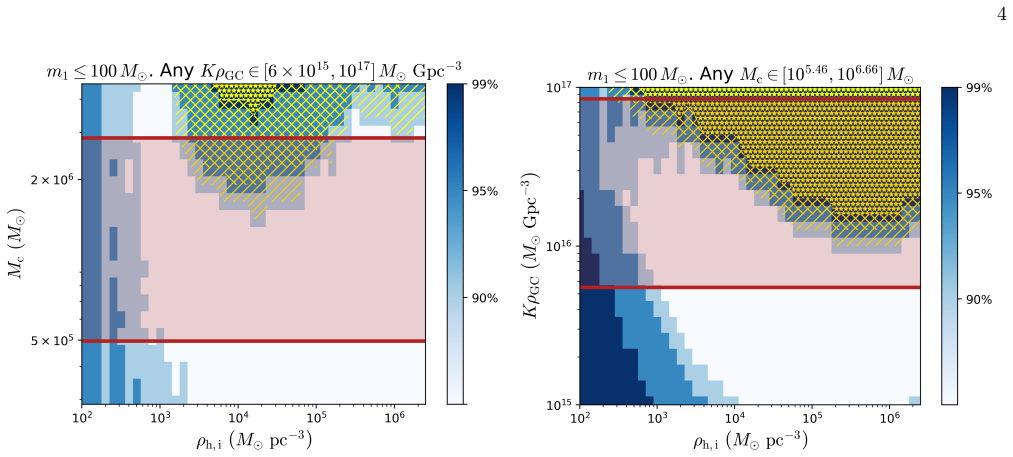
Second-generation mergers of black holes formed in globular clusters inevitably produce a mass peak near 70 solar masses once pair-instability supernovae truncate the first-generation spectrum at a characteristic mass near 35 solar masses. The peak location follows from the doubling of the cutoff mass by mergers, while its amplitude depends on cluster initial conditions. Population-synthesis calculations show that current data already constrain those initial conditions, and that clusters dominating high-mass mergers imply a minimum first-generation merger rate of at least 0.099 Gpc^{-3} yr^{-1} at 99 percent . A drop or gap in the secondary-mass spectrum is not a reliable cluster signature,
What carries the argument
The accumulation of second-generation black holes at twice the pair-instability supernova truncation mass through repeated mergers inside globular clusters.
If this is right
- Current gravitational-wave observations already constrain the birth properties of globular clusters regardless of their total contribution to the merger rate.
- If clusters dominate mergers above the pair-instability scale, the first-generation merger rate must satisfy R(m1 ≤ 50 M⊙) ≥ 0.099 Gpc^{-3} yr^{-1} at 99 percent .
- A drop or gap in the secondary black hole mass spectrum is not a robust signature of cluster origin for high-mass mergers.
- A confirmed excess near 70 solar masses would support a dynamical origin for the 35 solar mass feature and place the lower edge of the pair-instability gap at or below 50 solar masses.
Where Pith is reading between the lines
- The same doubling mechanism could operate in other dense environments such as nuclear star clusters and produce analogous high-mass features.
- Higher-sensitivity detectors targeting the 50-100 solar mass range could directly test the minimum rate constraint without requiring full cluster population models.
- Non-detection of the 70 solar mass peak would favor isolated binary evolution as the dominant channel for the 35 solar mass excess.
- The location of the peak being largely independent of detailed cluster evolution makes it a clean, testable prediction even with incomplete knowledge of globular cluster formation.
Load-bearing premise
The excess near 35 solar masses must come from dynamical formation in dense stellar systems rather than isolated binaries, and pair-instability supernovae must impose a sharp upper limit on first-generation black hole masses.
What would settle it
Future catalogs showing no excess or peak near 70 solar masses, or a rate of mergers above the pair-instability gap falling below the minimum rate implied by lower-mass observations, would rule out the predicted structure.
Figures

read the original abstract
Gravitational-wave observations have revealed an excess of binary black hole mergers with primary masses near $\sim 35\,M_\odot$. We show that if this feature originates from dynamical formation in dense stellar systems, and if the pair-instability supernova truncates the first-generation black hole mass spectrum, then second-generation mergers inevitably produce a second peak near $\sim 70\,M_\odot$. This structure reflects the suppression of first-generation black holes above a characteristic mass and the accumulation of merger remnants near twice that scale. Its location is robust, whereas its amplitude depends strongly on cluster initial conditions. Using a large suite of cluster population-synthesis models, we show that current gravitational-wave data already constrain the birth properties of globular clusters, irrespective of their overall contribution to the observed population. If clusters dominate mergers above the pair-instability scale, these constraints tighten further and imply a minimum first-generation merger rate of $\mathcal{R}(m_1 \leq 50\,M_\odot) \geq 0.099\,\mathrm{Gpc}^{-3}\,\mathrm{yr}^{-1}$ ($99\%$ confidence). We further show that a drop or gap in the secondary black hole mass spectrum is not a robust signature of a cluster origin for high-mass mergers within the pair-instability mass gap. A confirmed excess near $\sim 70\,M_\odot$ would support a dynamical origin of the $\sim 35\,M_\odot$ feature and provide independent evidence for a pair-instability mass gap with a lower edge at $\lesssim 50M_\odot$.
Editorial analysis
A structured set of objections, weighed in public.
Referee Report
Summary. The paper claims that if the observed excess of binary black hole mergers near 35 solar masses originates from dynamical formation in globular clusters and the pair-instability supernova truncates the first-generation black hole mass spectrum, then second-generation mergers will inevitably produce a second peak near 70 solar masses. Using a large suite of cluster population-synthesis models, the authors demonstrate that the peak location remains stable across initial conditions while its amplitude varies, allowing current gravitational-wave data to constrain globular cluster birth properties irrespective of overall contribution to the merger population. Under the additional assumption that clusters dominate above the pair-instability scale, they derive a lower bound on the first-generation merger rate of 0.099 Gpc^{-3} yr^{-1} at 99% confidence. They further show that a drop or gap in the secondary black hole mass spectrum is not a robust signature of a cluster origin for high-mass mergers.
Significance. If the conditional assumptions hold, this provides a falsifiable prediction that could confirm a dynamical origin for the 35 solar mass feature and offer independent evidence for the pair-instability mass gap with a lower edge at or below 50 solar masses. The work's strength is the extensive population-synthesis modeling that quantifies robustness of the peak location and derives data-driven constraints on cluster initial conditions, yielding reproducible predictions for future observations.
major comments (1)
- [Results section on rate constraints] The section deriving the rate lower bound: the minimum first-generation merger rate of 0.099 Gpc^{-3} yr^{-1} (99% confidence) is obtained under the assumption that clusters dominate mergers above the pair-instability scale, but the manuscript does not explicitly show how this dominance assumption is tested for consistency with the constraints on cluster initial conditions (which control the amplitude of the second peak).
minor comments (2)
- [Abstract] The abstract provides no quantitative details on the explored ranges of cluster initial conditions (mass, density, metallicity) or the statistical method (e.g., likelihood or posterior construction) used to derive the rate bound from non-detection; these should be summarized briefly for clarity.
- [Discussion] The claim that a gap in the secondary mass spectrum is not robust would be strengthened by an explicit side-by-side comparison to predictions from isolated binary evolution models in the same mass range.
Simulated Author's Rebuttal
We thank the referee for their constructive review and recommendation for minor revision. We address the major comment below.
read point-by-point responses
-
Referee: [Results section on rate constraints] The section deriving the rate lower bound: the minimum first-generation merger rate of 0.099 Gpc^{-3} yr^{-1} (99% confidence) is obtained under the assumption that clusters dominate mergers above the pair-instability scale, but the manuscript does not explicitly show how this dominance assumption is tested for consistency with the constraints on cluster initial conditions (which control the amplitude of the second peak).
Authors: We agree that an explicit consistency check would improve clarity. The constraints on cluster initial conditions are obtained by requiring that the amplitude of the second-generation peak (controlled by those conditions) does not overproduce the observed high-mass mergers or violate current upper limits. Under the separate dominance assumption, the same initial-condition range then sets the minimum first-generation rate needed to explain any high-mass events as second-generation mergers. In the revised manuscript we will add a short paragraph to the rate-constraints section that explicitly verifies this link, showing that the 99% lower bound corresponds to the edge of the allowed initial-condition parameter space where the predicted second-peak amplitude remains compatible with existing data under dominance. This addition will confirm that the two parts of the analysis are internally consistent. revision: yes
Circularity Check
No significant circularity; derivation is conditional and self-contained
full rationale
The paper's core logic is explicitly conditional: if the ~35 M⊙ excess is dynamical and PISN truncates the first-generation spectrum, then a second peak near 70 M⊙ follows from mass segregation and remnant accumulation. Population-synthesis runs explore initial conditions independently, showing peak location stability while amplitude varies; rate lower bounds are derived only under the stated assumption that clusters dominate above the PISN scale, using non-detection as input rather than fitting the target feature itself. No equation or claim reduces by construction to a self-citation, fitted parameter renamed as prediction, or self-definitional loop. The chain relies on external GW data and standard cluster modeling without importing uniqueness theorems or ansatzes from the authors' prior work as load-bearing.
Axiom & Free-Parameter Ledger
free parameters (2)
- cluster initial conditions (mass, density, metallicity distribution)
- fraction of mergers contributed by clusters above the pair-instability scale
axioms (2)
- domain assumption pair-instability supernovae truncate the first-generation black-hole mass spectrum at a characteristic mass
- domain assumption the observed excess near 35 solar masses originates from dynamical formation in dense stellar systems
Forward citations
Cited by 2 Pith papers
-
Secondary-Mass Features improve Spectral-Siren $H_0$ Constraints
A new model emphasizing secondary mass features and pairing transitions improves spectral siren H0 constraints by ~30% using 142 GW events from GWTC-4.0.
-
Emergent structure in the binary black hole mass distribution and implications for population-based cosmology
B-spline agnostic reconstruction of binary black hole masses from GWTC-4.0 reveals multiple features and a logarithmic hierarchy that impacts Hubble constant measurements, with a low-mass subpopulation isolation metho...
Reference graph
Works this paper leans on
-
[1]
The LIGO Scientific Collaboration, the Virgo Collab- oration, B. P. Abbott, R. Abbott, T. D. Abbott, M. R. Abernathy, F. Acernese, K. Ackley, C. Adams, T. Adams, P. Addesso, R. X. Adhikari,et al.(LIGO Scientific Collaboration and Virgo Collaboration), Ob- servation of gravitational waves from a binary black hole merger, Phys. Rev. Lett.116, 061102 (2016)
2016
-
[2]
Abbott, T
R. Abbott, T. D. Abbott, F. Acernese, K. Ackley, C. Adams, N. Adhikari, R. X. Adhikari, V. B. Adya, C. Affeldt, D. Agarwal,et al.(LIGO Scientific Collab- oration, Virgo Collaboration, and KAGRA Collabora- tion), Gwtc-3: Compact binary coalescences observed by ligo and virgo during the second part of the third observing run, Phys. Rev. X13, 041039 (2023)
2023
-
[3]
The LIGO Scientific Collaboration, the Virgo Col- laboration, the KAGRA Collaboration, A. G. Abac, I. Abouelfettouh, F. Acernese, K. Ackley, C. Adam- cewicz, S. Adhicary, D. Adhikari, N. Adhikari, R. X. Adhikari, V. K. Adkins,et al., GWTC-4.0: Popula- tion Properties of Merging Compact Binaries, arXiv e-prints , arXiv:2508.18083 (2025), arXiv:2508.18083 [...
work page internal anchor Pith review Pith/arXiv arXiv 2025
-
[4]
The LIGO Scientific Collaboration, the Virgo Collabo- ration, and the KAGRA Collaboration, Gwtc-4: Com- pact binary coalescences observed by ligo and virgo dur- ing the o3b observing run (2025)
2025
-
[5]
The Emergence of Structure in the Binary Black Hole Mass Distribution,
V. Tiwari and S. Fairhurst, The Emergence of Structure in the Binary Black Hole Mass Distribution, ApJL913, L19 (2021), arXiv:2011.04502 [astro-ph.HE]
-
[6]
Ev- idence for Three Subpopulations of Merging Binary Black Holes at Different Primary Masses,
S. Banagiri, E. Thrane, and P. D. Lasky, Evidence for Three Subpopulations of Merging Binary Black Holes at Different Primary Masses, arXiv e-prints , arXiv:2509.15646 (2025), arXiv:2509.15646 [astro- ph.HE]
- [7]
-
[8]
S. Stevenson, M. Sampson, J. Powell, A. Vigna- G´ omez, C. J. Neijssel, D. Sz´ ecsi, and I. Mandel, The Impact of Pair-instability Mass Loss on the Binary Black Hole Mass Distribution, ApJ882, 121 (2019), arXiv:1904.02821 [astro-ph.HE]
- [9]
-
[10]
S. Kishore Roy, L. A. C. van Son, and W. M. Farr, A mid-thirties crisis: dissecting the properties of grav- itational wave sources near the 35 solar mass peak, Classical and Quantum Gravity42, 225008 (2025), arXiv:2507.01086 [astro-ph.HE]
-
[11]
F. Antonini, M. Gieles, F. Dosopoulou, and D. Chat- topadhyay, Coalescing black hole binaries from globular clusters: mass distributions and comparison to gravi- tational wave data from GWTC-3, MNRAS522, 466 (2023), arXiv:2208.01081 [astro-ph.HE]
-
[12]
D. C. Heggie, Binary evolution in stellar dynamics., MNRAS173, 729 (1975)
1975
-
[13]
Hut and J
P. Hut and J. N. Bahcall, Binary-single star scattering. I - Numerical experiments for equal masses, ApJ268, 319 (1983)
1983
-
[14]
J. J. Monaghan, A statistical theory of the disruption of three-body systems - I. Low angular momentum., MN- RAS176, 63 (1976)
1976
-
[15]
J. J. Monaghan, A statistical theory of the disruption of three-body systems - II. High angular momentum., MNRAS177, 583 (1976)
1976
-
[16]
Z. P. Anosova and V. V. Orlov, Dynamical Evolution of Equal-Mass Triple Systems in Three Dimensions, So- viet Ast.30, 380 (1986)
1986
-
[17]
Mikkola, A Numerical Exploration of the Phase- Space Structure of Chaotic Three-Body Scattering, MN- RAS269, 127 (1994)
S. Mikkola, A Numerical Exploration of the Phase- Space Structure of Chaotic Three-Body Scattering, MN- RAS269, 127 (1994)
1994
-
[18]
Valtonen and H
M. Valtonen and H. Karttunen,The Three-Body Prob- lem(Cambridge University Press, Cambridge, 2006)
2006
-
[19]
J. Samsing, M. MacLeod, and E. Ramirez-Ruiz, Forma- tion of Tidal Captures and Gravitational Wave Inspi- rals in Binary-single Interactions, ApJ846, 36 (2017), arXiv:1609.09114 [astro-ph.HE]
-
[20]
J. Samsing, Eccentric black hole mergers forming in globular clusters, Phys. Rev. D97, 103014 (2018), arXiv:1711.07452 [astro-ph.HE]
-
[21]
N. C. Stone and N. W. C. Leigh, A statistical solution to the chaotic, non-hierarchical three-body problem, Na- ture576, 406 (2019)
2019
- [22]
-
[23]
B. Kol, Flux-based statistical prediction of three-body outcomes, Celestial Mechanics and Dynamical Astron- omy133, 17 (2021), arXiv:2002.11496 [gr-qc]
- [24]
-
[25]
D. Mar´ ın Pina and M. Gieles, Demographics of three- body binary black holes in star clusters: implications for gravitational waves, MNRAS527, 8369 (2024), arXiv:2308.10318 [astro-ph.GA]
-
[26]
B. Rando Forastier, D. Mar´ ın Pina, M. Gieles, S. Porte- gies Zwart, and F. Antonini, Binary-single interactions with different mass ratios: Implications for gravitational waves from globular clusters, A&A697, A118 (2025), arXiv:2405.16999 [astro-ph.GA]
-
[27]
D. Mar´ ın Pina, M. Gieles, T. Andrade, and A. A. Trani, Interactions among binary black holes in star clusters: Eccentric gravitational wave captures and triple forma- tion, A&A698, A229 (2025), arXiv:2501.02907 [astro- ph.GA]
-
[28]
Heggie and P
D. Heggie and P. Hut,The Gravitational Million–Body Problem: A Multidisciplinary Approach to Star Clus- ter Dynamics(Cambridge University Press, Cambridge, 2003)
2003
- [29]
-
[30]
V. Pavl´ ık, T. Jeˇ r´ abkov´ a, P. Kroupa, and H. Baumgardt, The black hole retention fraction in star clusters, A&A 617, A69 (2018), arXiv:1806.05192 [astro-ph.GA]
- [31]
-
[32]
M. Arca Sedda, A. W. H. Kamlah, R. Spurzem, M. Giersz, P. Berczik, S. Rastello, G. Iorio, M. Mapelli, M. Gatto, and E. K. Grebel, The DRAGON-II simula- tions - I. Evolution of single and binary compact objects in star clusters with up to 1 million stars, MNRAS528, 5119 (2024), arXiv:2307.04805 [astro-ph.GA]
-
[33]
M. Ishchenko, P. Berczik, T. Panamarev, D. Kuvatova, M. Kalambay, A. Gluchshenko, O. Veles, M. Sobolenko, O. Sobodar, and C. Omarov, Dynamical evolution of Milky Way globular clusters on the cosmological timescale: I. Mass loss and interaction with the nuclear star cluster, A&A689, A178 (2024), arXiv:2406.18987 [astro-ph.GA]
-
[34]
O. Sridhar, A. Ray, and V. Kalogera, Characterizing Binary Black Hole Subpopulations in GWTC-4 with Binned Gaussian Processes: On the Origins of the 35M⊙ Peak, arXiv e-prints , arXiv:2511.22093 (2025), arXiv:2511.22093 [astro-ph.HE]
-
[35]
W. A. Fowler and F. Hoyle, Neutrino Processes and Pair Formation in Massive Stars and Supernovae., ApJS9, 201 (1964)
1964
-
[36]
Rakavy and G
G. Rakavy and G. Shaviv, Instabilities in Highly Evolved Stellar Models, ApJ148, 803 (1967)
1967
-
[37]
Barkat, G
Z. Barkat, G. Rakavy, and N. Sack, Dynamics of 7 Supernova Explosion Resulting from Pair Formation, Phys. Rev. Lett.18, 379 (1967)
1967
-
[38]
G. S. Fraley, Supernovae Explosions Induced by Pair- Production Instability, Astrophysics and Space Science 2, 96 (1968)
1968
-
[39]
C. L. Fryer, S. E. Woosley, and A. Heger, Pair-instability supernovae, gravity waves, and gamma-ray transients, ApJ550, 372 (2001)
2001
-
[40]
S. E. Woosley, Pulsational Pair-instability Supernovae, ApJ836, 244 (2017)
2017
- [41]
-
[42]
E. Farrell, J. H. Groh, R. Hirschi, L. Murphy, E. Kaiser, S. Ekstr¨ om, C. Georgy, and G. Meynet, Is GW190521 the merger of black holes from the first stellar gen- erations?, MNRAS502, L40 (2021), arXiv:2009.06585 [astro-ph.SR]
-
[43]
K. Belczynski, R. Hirschi, E. A. Kaiser, J. Liu, J. Casares, Y. Lu, R. O’Shaughnessy, A. Heger, S. Justham, and R. Soria, The Formation of a 70 M ⊙ Black Hole at High Metallicity, ApJ890, 113 (2020), arXiv:1911.12357 [astro-ph.HE]
-
[44]
M. Spera and M. Mapelli, Very massive stars, pair- instability supernovae and intermediate-mass black holes with the sevn code, MNRAS470, 4739 (2017), arXiv:1706.06109 [astro-ph.SR]
- [46]
- [47]
- [48]
- [49]
-
[51]
B. Edelman, Z. Doctor, and B. Farr, Poking Holes: Looking for Gaps in LIGO/Virgo’s Black Hole Popu- lation, ApJL913, L23 (2021), arXiv:2104.07783 [astro- ph.HE]
- [52]
- [53]
-
[54]
S. Afroz and S. Mukherjee, Phase space of binary black holes from gravitational wave observations to unveil its formation history, Phys. Rev. D112, 023531 (2025), arXiv:2411.07304 [astro-ph.HE]
-
[55]
B. P. Abbott, R. Abbott, T. D. Abbott, S. Abraham, F. Acernese, K. Ackley, C. Adams, R. X. Adhikari, V. B. Adya, C. Affeldt,et al., GWTC-1: A Gravitational- Wave Transient Catalog of Compact Binary Mergers Observed by LIGO and Virgo during the First and Sec- ond Observing Runs, Phys. Rev. X9, 031040 (2019), arXiv:1811.12907 [astro-ph.HE]
work page internal anchor Pith review arXiv 2019
-
[56]
R. Abbott, T. D. Abbott, S. Abraham, F. Acernese, K. Ackley, A. Adams, C. Adams, R. X. Adhikari, V. B. Adya, C. Affeldt,et al., Population Proper- ties of Compact Objects from the Second LIGO-Virgo Gravitational-Wave Transient Catalog, ApJL913, L7 (2021), arXiv:2010.14533 [astro-ph.HE]
-
[57]
R. Abbott, T. D. Abbott, S. Abraham, F. Acernese, K. Ackley, A. Adams, C. Adams, R. X. Adhikari, V. B. Adya, C. Affeldt,et al., GWTC-2: Compact Binary Coalescences Observed by LIGO and Virgo during the First Half of the Third Observing Run, Phys. Rev. X 11, 021053 (2021), arXiv:2010.14527 [gr-qc]
work page internal anchor Pith review arXiv 2021
- [58]
-
[59]
C. L. Rodriguez, N. C. Weatherford, S. C. Coughlin, P. Amaro-Seoane, K. Breivik, S. Chatterjee, G. Fra- gione, F. Kıro˘ glu, K. Kremer, N. Z. Rui,et al., Modeling Dense Star Clusters in the Milky Way and beyond with the Cluster Monte Carlo Code, ApJS258, 22 (2022), arXiv:2106.02643 [astro-ph.GA]
-
[60]
J. Barber and F. Antonini, Formation and evolution of binary black holes in N-body simulations of star clusters with up to two million stars, MNRAS538, 639 (2025), arXiv:2410.03832 [astro-ph.GA]
- [61]
-
[62]
C. S. Ye, M. Fishbach, K. Kremer, and M. Reina- Campos, Mass Distribution of Binary Black Hole Merg- ers from Young and Old Dense Star Clusters, ApJ997, 267 (2026), arXiv:2507.07183 [astro-ph.HE]
work page internal anchor Pith review Pith/arXiv arXiv 2026
-
[63]
F. Antonini, M. Gieles, and A. Gualandris, Black hole growth through hierarchical black hole mergers in dense star clusters: implications for gravitational wave de- tections, MNRAS486, 5008 (2019), arXiv:1811.03640 [astro-ph.HE]
- [64]
-
[65]
Spectral siren cosmology from gravitational-wave observations in GWTC-4.0
I. Maga˜ na Hernandez and A. Palmese, Spectral siren cosmology from gravitational-wave observations in GWTC-4.0, arXiv e-prints , arXiv:2509.03607 (2025), arXiv:2509.03607 [astro-ph.CO]
-
[66]
Maga˜ na Hernandez and A
I. Maga˜ na Hernandez and A. Palmese, Evidence of a new feature in the binary black hole mass distribu- 8 tion at 70M J from gravitational-wave observations, Phys. Rev. D111, 083031 (2025)
2025
- [67]
-
[68]
Heavy Black-Holes Also Matter in Standard Siren Cosmology
G. Pierra and A. Papadopoulos, Heavy Black-Holes Also Matter in Standard Siren Cosmology, arXiv e-prints , arXiv:2601.03257 (2026), arXiv:2601.03257 [astro- ph.CO]
- [69]
- [70]
-
[71]
I. Maga˜ na Hernandez and A. Palmese, Astrophysics in- formed Gaussian processes for gravitational-wave pop- ulations: Evidence for the onset of the pair-instability supernova mass gap, arXiv e-prints , arXiv:2508.19208 (2025), arXiv:2508.19208 [astro-ph.HE]
-
[72]
2025, arXiv e-prints, arXiv:2510.25579, doi: 10.48550/arXiv.2510.25579
V. Tiwari, Population of Binary Black Holes In- ferred from One Hundred and Fifty Gravitational Wave Signals, arXiv e-prints , arXiv:2510.25579 (2025), arXiv:2510.25579 [astro-ph.HE]
-
[73]
Y.-Z. Wang, Y.-J. Li, J. S. Vink, Y.-Z. Fan, S.-P. Tang, Y. Qin, and D.-M. Wei, Potential Subpopulations and Assembling Tendency of the Merging Black Holes, ApJL 941, L39 (2022), arXiv:2208.11871 [astro-ph.HE]
-
[74]
Resolving the Stellar-Collapse and Hierarchical-Merger Origins of the Coalescing 15 Black Holes,
Y.-J. Li, Y.-Z. Wang, S.-P. Tang, and Y.-Z. Fan, Resolv- ing the Stellar-Collapse and Hierarchical-Merger Ori- gins of the Coalescing Black Holes, Phys. Rev. Lett. 133, 051401 (2024), arXiv:2303.02973 [astro-ph.HE]
-
[75]
F. Antonini, I. M. Romero-Shaw, and T. Callister, Star Cluster Population of High Mass Black Hole Mergers in Gravitational Wave Data, Phys. Rev. Lett.134, 011401 (2025), arXiv:2406.19044 [astro-ph.HE]
-
[76]
F. Antonini, T. Callister, F. Dosopoulou, I. M. Romero-Shaw, and D. Chattopadhyay, Inferring the pair-instability mass gap from gravitational wave data, Phys. Rev. D112, 063040 (2025), arXiv:2506.09154 [astro-ph.HE]
-
[77]
Gravitational-wave constraints on the pair-instability mass gap and nuclear burning in massive stars
F. Antonini, I. Romero-Shaw, T. Callister, F. Dosopoulou, D. Chattopadhyay, M. Gieles, and M. Mapelli, Gravitational waves reveal the pair- instability mass gap and constrain nuclear burning in massive stars, arXiv e-prints , arXiv:2509.04637 (2025), arXiv:2509.04637 [astro-ph.HE]
work page internal anchor Pith review Pith/arXiv arXiv 2025
-
[78]
Pierra, S
G. Pierra, S. Mastrogiovanni, and S. Perri` es, The spin magnitude of stellar-mass black holes evolves with the mass, A&A692, A80 (2024)
2024
-
[79]
F. Antonini and M. Gieles, Population synthesis of black hole binary mergers from star clusters, MNRAS492, 2936 (2020), arXiv:1906.11855 [astro-ph.HE]
-
[80]
E. Barausse, V. Morozova, and L. Rezzolla, On the Mass Radiated by Coalescing Black Hole Binaries, ApJ758, 63 (2012), arXiv:1206.3803 [gr-qc]
- [81]
-
[82]
F. Antonini and M. Gieles, Merger rate of black hole bi- naries from globular clusters: Theoretical error bars and comparison to gravitational wave data from GWTC- 2, Phys. Rev. D102, 123016 (2020), arXiv:2009.01861 [astro-ph.HE]
discussion (0)
Sign in with ORCID, Apple, or X to comment. Anyone can read and Pith papers without signing in.