The GLASS-JWST Early Release Science Program. V. Hα luminosity functions at zsim1.3 and zsim2.0
Pith reviewed 2026-05-16 19:48 UTC · model grok-4.3
The pith
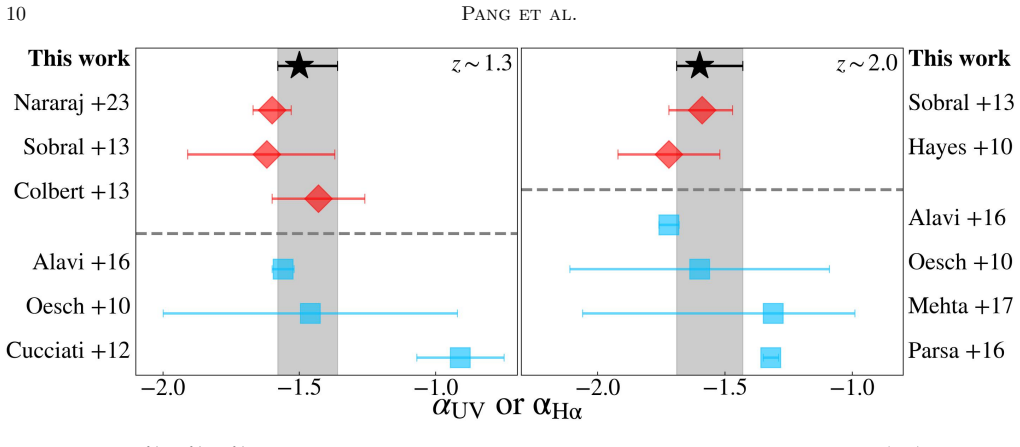
JWST grism data measures the faint-end slope of the Hα luminosity function as -1.50 at z∼1.3 and -1.60 at z∼2.0.
A machine-rendered reading of the paper's core claim, the machinery that carries it, and where it could break.
Core claim
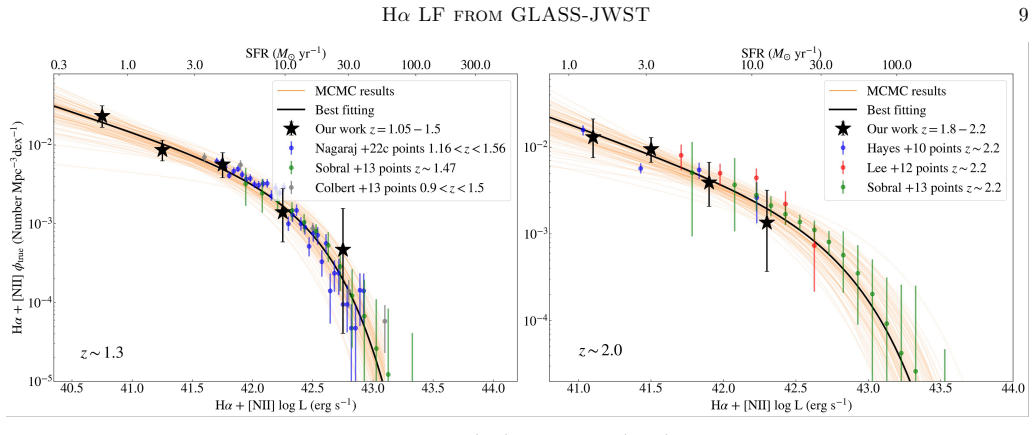
Using spectroscopically identified Hα emitters from JWST NIRISS wide-field slitless spectroscopy, the authors build luminosity functions in two redshift bins. After applying source-by-source completeness, effective-volume, and lensing-magnification corrections, the faint-end power-law slopes are found to be -1.50^{+0.14}_{-0.08} at z∼1.3 and -1.60^{+0.17}_{-0.09} at z∼2.0. Integrated star-formation-rate densities are derived as 0.097^{+0.015}_{-0.016} and 0.129^{+0.025}_{-0.030} M_⊙ yr^-1 Mpc^-3, respectively, with bright AGN contributing negligibly.
What carries the argument
The Hα luminosity function built from emission-line selected galaxies, with per-object effective volume and completeness corrections that incorporate gravitational lensing magnification to recover intrinsic luminosities.
If this is right
- Cosmic star-formation-rate density is approximately 0.1 M_⊙ yr^-1 Mpc^-3 at both redshifts.
- Bright active galactic nuclei make a negligible contribution to the observed Hα emission.
- The emission-line sample enables follow-up studies of galaxy metallicities and other properties.
- The same per-source correction methodology applies directly to future wide-field slitless surveys from Euclid, Roman, and the Chinese Space Station Telescope.
Where Pith is reading between the lines
- The measured slopes imply that faint galaxies dominate the total star-formation budget at the peak of cosmic star formation.
- Consistency with previous shallower surveys suggests little evolution in the faint-end slope between z∼1 and z∼2.
- The same lensing-assisted depth could be applied to test whether the slope steepens further at z>2.5.
- Repeating the analysis on larger JWST fields would tighten the cosmic-variance error and test for field-to-field variations.
Load-bearing premise
The detailed effective volume and completeness analysis for each source, including gravitational lensing magnification corrections, accurately recovers the intrinsic luminosities and selection function down to the stated limits.
What would settle it
An independent survey at the same redshifts that recovers a faint-end slope outside the reported 1-sigma ranges after identical cosmic-variance treatment would falsify the slope constraints.
Figures



read the original abstract
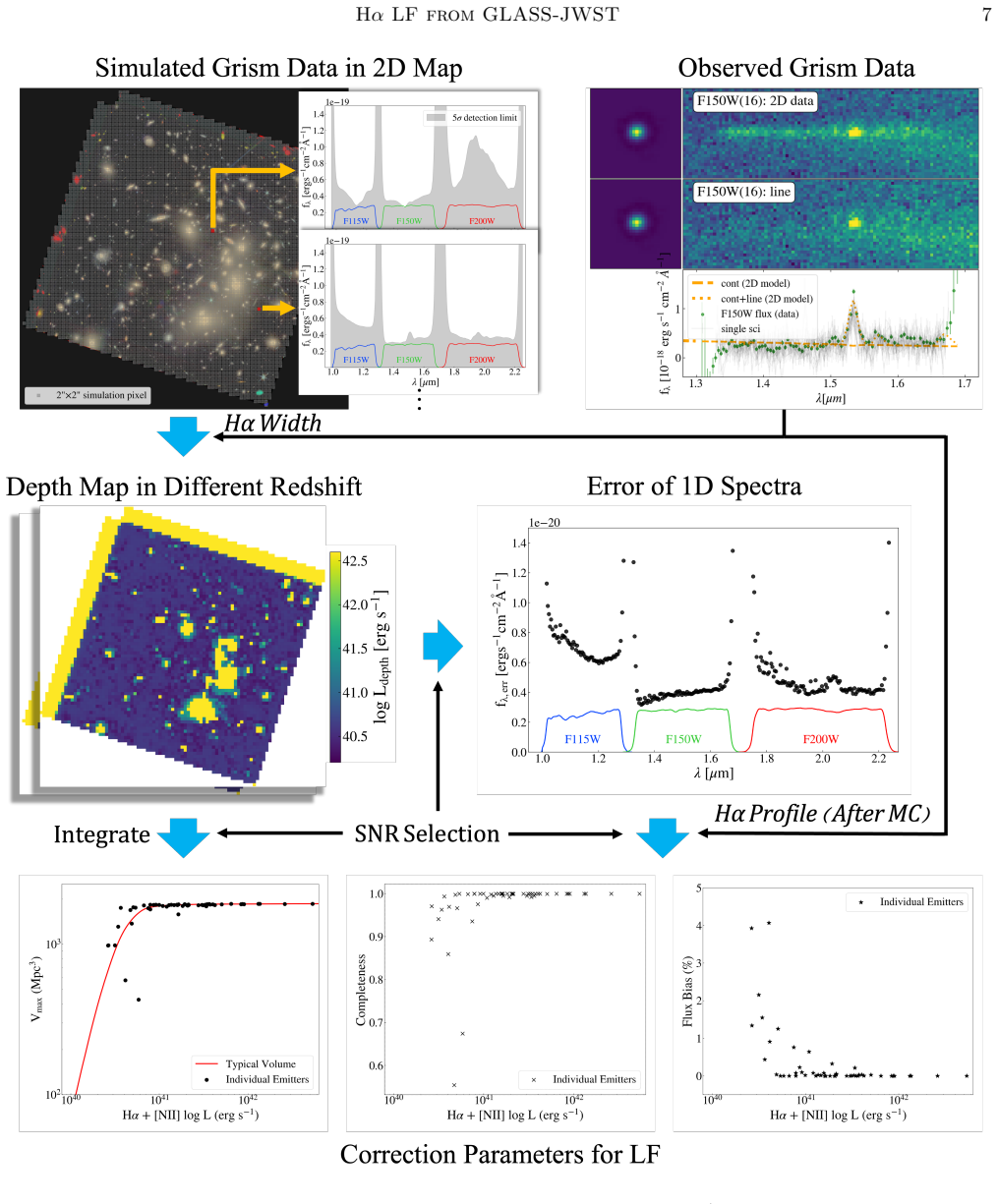
We present H$\alpha$ luminosity function (LF) measurements at redshifts $z\sim1.3$ and $z\sim2.0$ using JWST NIRISS grism data from the GLASS-JWST survey. Based on emission lines spectroscopically identified in the F115W, F150W and F200W filters, we select 99 H$\alpha$ emitters. Through detailed effective volume and completeness analysis for each source, we construct the H$\alpha$ LF in two redshift bins. Thanks to the sensitivity of NIRISS WFSS and gravitational lensing magnification, our sample reaches intrinsic H$\alpha$ luminosities $\sim$10 times deeper than previous grism surveys, down to $L_{\rm H\alpha}\sim10^{40.5}~\rm erg~s^{-1}$ at $z\sim1.3$ and $L_{\rm H\alpha}\sim10^{40.9}~\rm erg~s^{-1}$ at $z\sim2.0$ with completeness larger than 0.8, corresponding to star formation rates of 0.4 and 1.0 $M_{\odot}~\rm yr^{-1}$, respectively. We robustly constrain the faint-end slope of the H$\alpha$ luminosity function to be $-1.50^{+0.14}_{-0.08}$ at $z\sim1.3$ and $-1.60^{+0.17}_{-0.09}$ at $z\sim2.0$ after considering the cosmic variance of $\sim 20\%$, consistent with previous estimations. The emission-line samples presented here will enable further detailed studies of galaxy properties including metallicities. We find a negligible contribution from bright active galactic nuclei in our sample. We estimate integrated cosmic star formation rate densities of $0.097^{+0.015}_{-0.016}~M_{\odot}~\rm yr^{-1}~Mpc^{-3}$ at $z\sim1.3$ and $0.129^{+0.025}_{-0.030}~M_{\odot}~\rm yr^{-1}~Mpc^{-3}$ at $z\sim2.0$. The methodology presented here can be readily applicable to other JWST slitless spectroscopic datasets and future wide-field slitless surveys, including those from Euclid, Roman, and the Chinese Space Station Telescope.
Editorial analysis
A structured set of objections, weighed in public.
Referee Report
Summary. The manuscript presents Hα luminosity function measurements at z∼1.3 and z∼2.0 from 99 spectroscopically confirmed emitters in JWST NIRISS grism data of the GLASS-JWST survey. Effective volumes are computed individually for each source by folding in completeness from simulations and gravitational lensing magnification corrections to recover intrinsic luminosities, reaching L_Hα ∼10^{40.5} erg s^{-1} at z∼1.3 and ∼10^{40.9} erg s^{-1} at z∼2.0. The authors fit the binned LF to obtain faint-end slopes of −1.50^{+0.14}_{-0.08} and −1.60^{+0.17}_{-0.09}, incorporate ∼20% cosmic variance, report negligible AGN contribution, and derive integrated cosmic SFR densities of 0.097^{+0.015}_{-0.016} and 0.129^{+0.025}_{-0.030} M_⊙ yr^{-1} Mpc^{-3}.
Significance. If the per-source completeness and lensing corrections are robust, the work extends previous grism surveys by a factor of ∼10 in luminosity depth and provides well-constrained faint-end slopes at these redshifts that are consistent with earlier estimates. The direct spectroscopic selection, explicit treatment of cosmic variance, and outlined applicability to future wide-field slitless surveys (Euclid, Roman, CSST) constitute clear strengths. The negligible AGN fraction and SFRD estimates add useful context for galaxy evolution studies.
major comments (2)
- [Effective volume and completeness analysis] The section describing the effective volume and completeness analysis: the faint-end slopes (−1.50^{+0.14}_{-0.08} at z∼1.3 and −1.60^{+0.17}_{-0.09} at z∼2.0) rest on per-source gravitational lensing magnification corrections whose uncertainties increase for faint, low-mass sources that dominate the faintest bins. No quantitative propagation of lens-model uncertainties (e.g., via Monte Carlo resampling of magnification factors) or comparison against unlensed field surveys at comparable depth is presented; such a test is required to confirm that the quoted slope uncertainties are not underestimated.
- [Luminosity function fitting] The luminosity function fitting and error analysis section: the ∼20% cosmic-variance term is stated to be included, but the manuscript must show explicitly whether it is added in quadrature to Poisson errors, incorporated via a full covariance treatment, or derived from the survey geometry, and how it affects the final slope uncertainties.
minor comments (2)
- [Abstract] Abstract: the claim of reaching '∼10 times deeper' should specify the reference grism surveys used for the comparison.
- [Results] Tables or figures presenting the binned LF: include the effective volume and completeness value adopted for each luminosity bin to allow direct reproducibility.
Simulated Author's Rebuttal
We thank the referee for their constructive and detailed comments, which have helped clarify several aspects of our analysis. We address each major point below and have revised the manuscript accordingly to strengthen the presentation of our methods and results.
read point-by-point responses
-
Referee: [Effective volume and completeness analysis] The section describing the effective volume and completeness analysis: the faint-end slopes (−1.50^{+0.14}_{-0.08} at z∼1.3 and −1.60^{+0.17}_{-0.09} at z∼2.0) rest on per-source gravitational lensing magnification corrections whose uncertainties increase for faint, low-mass sources that dominate the faintest bins. No quantitative propagation of lens-model uncertainties (e.g., via Monte Carlo resampling of magnification factors) or comparison against unlensed field surveys at comparable depth is presented; such a test is required to confirm that the quoted slope uncertainties are not underestimated.
Authors: We agree that explicit propagation of lens-model uncertainties is important for validating the error budget on the faint-end slopes. Although our per-source lensing corrections rely on well-established lens models from the literature with documented uncertainties, we have now implemented a Monte Carlo resampling of the magnification factors for each source, drawing from the reported uncertainty distributions. This has been added to the revised effective-volume calculation in Section 3. The resulting slope uncertainties increase modestly (by ~15-25%), and we report the updated values in the revised manuscript. We have also added a direct comparison to published Hα luminosity functions from unlensed field surveys at comparable depths, finding consistency within the combined uncertainties. These changes are detailed in the updated Section 3 and a new Appendix B. revision: yes
-
Referee: [Luminosity function fitting] The luminosity function fitting and error analysis section: the ∼20% cosmic-variance term is stated to be included, but the manuscript must show explicitly whether it is added in quadrature to Poisson errors, incorporated via a full covariance treatment, or derived from the survey geometry, and how it affects the final slope uncertainties.
Authors: We thank the referee for requesting this clarification. In the original analysis the 20% cosmic-variance term was added in quadrature to the Poisson errors on each binned LF point before fitting the Schechter function. To make the procedure fully transparent, we have expanded the luminosity-function fitting section (now Section 4) with an explicit description of the error budget, including a table that lists Poisson errors, the cosmic-variance contribution, and the total error for each bin. We have also tested an alternative covariance-matrix approach that incorporates the survey geometry and confirm that the resulting faint-end slope uncertainties remain consistent with the values quoted in the manuscript. The cosmic-variance term primarily influences the overall normalization rather than the slope; the revised text now states this explicitly. revision: yes
Circularity Check
Direct empirical LF measurement with no circular derivation steps
full rationale
The paper constructs the Hα LF from 99 spectroscopically identified emitters in JWST NIRISS grism data by computing per-source effective volumes that incorporate completeness (from simulations) and gravitational lensing magnification corrections. The faint-end slopes are then obtained by fitting the resulting binned number densities, with a separate ~20% cosmic-variance term added. This chain is a standard observational procedure that does not reduce any claimed result to its inputs by definition, does not rename a known pattern as a new derivation, and contains no load-bearing self-citation or ansatz smuggling. The central claims remain independent empirical measurements consistent with (but not derived from) prior work.
Axiom & Free-Parameter Ledger
axioms (2)
- standard math Standard flat Lambda-CDM cosmology for comoving volume calculations
- domain assumption Gravitational lensing magnification factors from the GLASS cluster model are accurate
Lean theorems connected to this paper
-
IndisputableMonolith/Foundation/RealityFromDistinction.leanreality_from_one_distinction unclear?
unclearRelation between the paper passage and the cited Recognition theorem.
We derive the HαLFs using the direct 1/Vmax method... Φ(L) = 1/dlogL Σ 1/(Ci Vmax,i)
What do these tags mean?
- matches
- The paper's claim is directly supported by a theorem in the formal canon.
- supports
- The theorem supports part of the paper's argument, but the paper may add assumptions or extra steps.
- extends
- The paper goes beyond the formal theorem; the theorem is a base layer rather than the whole result.
- uses
- The paper appears to rely on the theorem as machinery.
- contradicts
- The paper's claim conflicts with a theorem or certificate in the canon.
- unclear
- Pith found a possible connection, but the passage is too broad, indirect, or ambiguous to say the theorem truly supports the claim.
Forward citations
Cited by 1 Pith paper
-
Galaxies at z > 10: {\Lambda}CDM predicts increased Star Formation Efficiency
Lambda CDM with the UniverseMachine model on the Uchuu simulation matches JWST/HST UV observations at z=7-14 and predicts star formation efficiency rising to 2-3% by z=10-12.
Reference graph
Works this paper leans on
-
[1]
Abdurro’uf, Accetta, K., Aerts, C., et al. 2022, ApJS, 259, 35, doi: 10.3847/1538-4365/ac4414
-
[2]
Aird, J., Coil, A. L., Georgakakis, A., et al. 2015, MNRAS, 451, 1892, doi: 10.1093/mnras/stv1062
-
[3]
Akins, H. B., Casey, C. M., Lambrides, E., et al. 2025, ApJ, 991, 37, doi: 10.3847/1538-4357/ade984
-
[4]
2016, ApJ, 832, 56, doi: 10.3847/0004-637X/832/1/56
Alavi, A., Siana, B., Richard, J., et al. 2016, ApJ, 832, 56, doi: 10.3847/0004-637X/832/1/56
-
[5]
F., Argudo-Fern \' a ndez, M., et al
Almeida, A., Anderson, S. F., Argudo-Fern´ andez, M., et al. 2023, ApJS, 267, 44, doi: 10.3847/1538-4365/acda98
-
[6]
Atek, H., Furtak, L. J., Oesch, P., et al. 2022, MNRAS, 511, 4464, doi: 10.1093/mnras/stac360
-
[7]
Baldwin, J. A., Phillips, M. M., & Terlevich, R. 1981, PASP, 93, 5, doi: 10.1086/130766
-
[8]
Barro, G., Perez-Gonzalez, P. G., Kocevski, D. D., et al. 2024, arXiv e-prints, arXiv:2412.01887, doi: 10.48550/arXiv.2412.01887
-
[9]
2023, ApJ, 952, 84, doi: 10.3847/1538-4357/acd643
Bergamini, P., Acebron, A., Grillo, C., et al. 2023a, ApJ, 952, 84, doi: 10.3847/1538-4357/acd643 —. 2023b, A&A, 670, A60, doi: 10.1051/0004-6361/202244575
-
[10]
2023, ApJ, 946, 117, doi: 10.3847/1538-4357/acbc79 HαLF from GLASS-JWST15
Bollo, V., Gonz´ alez, V., Stefanon, M., et al. 2023, ApJ, 946, 117, doi: 10.3847/1538-4357/acbc79 HαLF from GLASS-JWST15
-
[11]
2022, ApJ, 940, 55, doi: 10.3847/1538-4357/ac86d1
Stefanon, M. 2022, ApJ, 940, 55, doi: 10.3847/1538-4357/ac86d1
-
[12]
Bowman, W. P., Zeimann, G. R., Ciardullo, R., et al. 2019, ApJ, 875, 152, doi: 10.3847/1538-4357/ab108a
-
[13]
Bowman, W. P., Ciardullo, R., Zeimann, G. R., et al. 2021, ApJ, 920, 78, doi: 10.3847/1538-4357/ac1a0e
-
[14]
2021, gbrammer/grizli: Release 2021, 1.3.2, Zenodo, doi: 10.5281/zenodo.5012699
Brammer, G., & Matharu, J. 2021, gbrammer/grizli: Release 2021, 1.3.2, Zenodo, doi: 10.5281/zenodo.5012699
-
[15]
Calzetti, D., Armus, L., Bohlin, R. C., et al. 2000, ApJ, 533, 682, doi: 10.1086/308692
work page internal anchor Pith review doi:10.1086/308692 2000
-
[16]
Carniani, S., D’Eugenio, F., Ji, X., et al. 2025, A&A, 696, A87, doi: 10.1051/0004-6361/202452451
-
[17]
2003, PASP, 115, 763, doi: 10.1086/376392
Chabrier, G. 2003, PASP, 115, 763, doi: 10.1086/376392 Chavez Ortiz, O. A., Finkelstein, S. L., Plat, A., et al. 2025, arXiv e-prints, arXiv:2511.03035, doi: 10.48550/arXiv.2511.03035
work page internal anchor Pith review doi:10.1086/376392 2003
-
[18]
Cochrane, R. K., Kondapally, R., Best, P. N., et al. 2023, MNRAS, 523, 6082, doi: 10.1093/mnras/stad1602
-
[19]
W., Teplitz, H., Atek, H., et al
Colbert, J. W., Teplitz, H., Atek, H., et al. 2013, ApJ, 779, 34, doi: 10.1088/0004-637X/779/1/34
-
[20]
Conroy, C., & Gunn, J. E. 2010, ApJ, 712, 833, doi: 10.1088/0004-637X/712/2/833
work page internal anchor Pith review doi:10.1088/0004-637x/712/2/833 2010
-
[21]
Conroy, C., Gunn, J. E., & White, M. 2009, ApJ, 699, 486, doi: 10.1088/0004-637X/699/1/486
work page internal anchor Pith review doi:10.1088/0004-637x/699/1/486 2009
-
[22]
2012, A&A, 539, A31, doi: 10.1051/0004-6361/201118010
Cucciati, O., Tresse, L., Ilbert, O., et al. 2012, A&A, 539, A31, doi: 10.1051/0004-6361/201118010
-
[23]
2024, MNRAS, 533, 2391, doi: 10.1093/mnras/stae2006 de Mellos, M
Dalmasso, N., Leethochawalit, N., Trenti, M., & Boyett, K. 2024, MNRAS, 533, 2391, doi: 10.1093/mnras/stae2006 de Mellos, M. S. Z., Riffel, R. A., Schimoia, J. S., et al. 2024, MNRAS, 535, 123, doi: 10.1093/mnras/stae2352
-
[24]
Data Release 1 of the Dark Energy Spectroscopic Instrument
Delvecchio, I., Gruppioni, C., Pozzi, F., et al. 2014, MNRAS, 439, 2736, doi: 10.1093/mnras/stu130 DESI Collaboration, Abdul-Karim, M., Adame, A. G., et al. 2025, arXiv e-prints, arXiv:2503.14745, doi: 10.48550/arXiv.2503.14745
work page internal anchor Pith review Pith/arXiv arXiv doi:10.1093/mnras/stu130 2014
-
[25]
Dey, A., Schlegel, D. J., Lang, D., et al. 2019, AJ, 157, 168, doi: 10.3847/1538-3881/ab089d
-
[26]
2020, A&A, 644, A144, doi: 10.1051/0004-6361/202038405
Donevski, D., Lapi, A., Ma lek, K., et al. 2020, A&A, 644, A144, doi: 10.1051/0004-6361/202038405
-
[27]
Eddington, A. S. 1913, MNRAS, 73, 359, doi: 10.1093/mnras/73.5.359
-
[28]
Emami, N., Siana, B., Weisz, D. R., et al. 2019, ApJ, 881, 71, doi: 10.3847/1538-4357/ab211a
-
[29]
2022, ApJ, 927, 204, doi: 10.3847/1538-4357/ac51ca
Enia, A., Talia, M., Pozzi, F., et al. 2022, ApJ, 927, 204, doi: 10.3847/1538-4357/ac51ca
-
[30]
L., Masters, D., Wang, Y., et al
Faisst, A. L., Masters, D., Wang, Y., et al. 2018, ApJ, 855, 132, doi: 10.3847/1538-4357/aab1fc
-
[31]
Fitzpatrick, E. L. 1999, PASP, 111, 63, doi: 10.1086/316293
-
[32]
Fleming, D. E. B., Harris, W. E., Pritchet, C. J., & Hanes, D. A. 1995, AJ, 109, 1044, doi: 10.1086/117340
-
[33]
Flesch, E. W. 2023, The Open Journal of Astrophysics, 6, 49, doi: 10.21105/astro.2308.01505 F¨ orster Schreiber, N. M., & Wuyts, S. 2020, ARA&A, 58, 661, doi: 10.1146/annurev-astro-032620-021910
-
[34]
2025, ApJ, 987, 186, doi: 10.3847/1538-4357/adddb1
Fu, S., Sun, F., Jiang, L., et al. 2025, ApJ, 987, 186, doi: 10.3847/1538-4357/adddb1
-
[35]
2024, ApJS, 275, 36, doi: 10.3847/1538-4365/ad5ae2 Gaia Collaboration, Vallenari, A., Brown, A
Fujimoto, S., Kohno, K., Ouchi, M., et al. 2024, ApJS, 275, 36, doi: 10.3847/1538-4365/ad5ae2 Gaia Collaboration, Vallenari, A., Brown, A. G. A., et al. 2023, A&A, 674, A1, doi: 10.1051/0004-6361/202243940
- [36]
-
[37]
Greene, J. E., & Ho, L. C. 2005, ApJ, 630, 122, doi: 10.1086/431897
work page internal anchor Pith review doi:10.1086/431897 2005
-
[38]
2020, A&A, 643, A8, doi: 10.1051/0004-6361/202038487
Gruppioni, C., B´ ethermin, M., Loiacono, F., et al. 2020, A&A, 643, A8, doi: 10.1051/0004-6361/202038487
-
[39]
2010, A&A, 509, L5, doi: 10.1051/0004-6361/200913217
Hayes, M., Schaerer, D., & ¨Ostlin, G. 2010, A&A, 509, L5, doi: 10.1051/0004-6361/200913217
-
[40]
Hopkins, A. M., & Beacom, J. F. 2006, ApJ, 651, 142, doi: 10.1086/506610
-
[41]
Hoversten, E. A., & Glazebrook, K. 2008, ApJ, 675, 163, doi: 10.1086/524095
-
[42]
Ilbert, O., McCracken, H. J., Le F` evre, O., et al. 2013, A&A, 556, A55, doi: 10.1051/0004-6361/201321100
-
[43]
Jullo, E., Kneib, J.-P., Limousin, M., et al. 2007, New Journal of Physics, 9, 447, doi: 10.1088/1367-2630/9/12/447 Juodˇ zbalis, I., Conselice, C. J., Singh, M., et al. 2023, Monthly Notices of the Royal Astronomical Society, 525, 1353, doi: 10.1093/mnras/stad2396
-
[44]
Karim, A., Schinnerer, E., Mart´ ınez-Sansigre, A., et al. 2011, ApJ, 730, 61, doi: 10.1088/0004-637X/730/2/61
-
[45]
Kennicutt, R. C., & Evans, N. J. 2012, ARA&A, 50, 531, doi: 10.1146/annurev-astro-081811-125610
work page internal anchor Pith review doi:10.1146/annurev-astro-081811-125610 2012
-
[46]
2019, MNRAS, 486, 2215, doi: 10.1093/mnras/stz989
Kimm, T., Blaizot, J., Garel, T., et al. 2019, MNRAS, 486, 2215, doi: 10.1093/mnras/stz989
-
[47]
Kocevski, D. D., Finkelstein, S. L., Barro, G., et al. 2025, ApJ, 986, 126, doi: 10.3847/1538-4357/adbc7d
-
[48]
Kokorev, V., Caputi, K. I., Greene, J. E., et al. 2024, ApJ, 968, 38, doi: 10.3847/1538-4357/ad4265
-
[49]
Kroupa, P. 2001, MNRAS, 322, 231, doi: 10.1046/j.1365-8711.2001.04022.x
-
[50]
Labbe, I., Greene, J. E., Bezanson, R., et al. 2025, ApJ, 978, 92, doi: 10.3847/1538-4357/ad3551
-
[51]
C., Gil de Paz, A., Tremonti, C., et al
Lee, J. C., Gil de Paz, A., Tremonti, C., et al. 2009, ApJ, 706, 599, doi: 10.1088/0004-637X/706/1/599
-
[52]
C., Ly, C., Spitler, L., et al
Lee, J. C., Ly, C., Spitler, L., et al. 2012, PASP, 124, 782, doi: 10.1086/666528 16Pang et al
-
[53]
2018, ApJ, 853, 172, doi: 10.3847/1538-4357/aaa600
Liu, D., Daddi, E., Dickinson, M., et al. 2018, ApJ, 853, 172, doi: 10.3847/1538-4357/aaa600
-
[54]
2014, Annual Review of Astronomy and Astrophysics, 52, 415, doi: 10.1146/annurev-astro-081811-125615
Madau, P., & Dickinson, M. 2014, ARA&A, 52, 415, doi: 10.1146/annurev-astro-081811-125615
work page internal anchor Pith review doi:10.1146/annurev-astro-081811-125615 2014
-
[55]
R., Dickinson M., Le Borgne D., Frayer D
Magnelli, B., Elbaz, D., Chary, R. R., et al. 2011, A&A, 528, A35, doi: 10.1051/0004-6361/200913941
-
[56]
2019, A&A Rv, 27, 3, doi: 10.1007/s00159-018-0112-2
Maiolino, R., & Mannucci, F. 2019, A&A Rv, 27, 3, doi: 10.1007/s00159-018-0112-2
-
[57]
2025, arXiv e-prints, arXiv:2512.10186, doi: 10.48550/arXiv.2512.10186
Malkan, M., Jensen, L., & Hao, L. 2025, arXiv e-prints, arXiv:2512.10186, doi: 10.48550/arXiv.2512.10186
-
[58]
A., Alavi, A., Atek, H., et al
Malkan, M. A., Alavi, A., Atek, H., et al. 2021, PASSAGE-Parallel Application of Slitless Spectroscopy to Analyze Galaxy Evolution, JWST Proposal. Cycle 1, ID. #1571
work page 2021
-
[59]
A., Mehta, V., Acharyya, A., et al
Malkan, M. A., Mehta, V., Acharyya, A., et al. 2025, The Astrophysical Journal, 993, 152, doi: 10.3847/1538-4357/ae00bb
-
[60]
Maseda, M. V., Bacon, R., Lam, D., et al. 2020, MNRAS, 493, 5120, doi: 10.1093/mnras/staa622
-
[61]
Matharu, J., Shen, L., Shivaei, I., et al. 2025, A first look at a complete view of spatially resolved star formation at 1¡z¡1.8 with JWST NGDEEP+FRESCO slitless spectroscopy. https://arxiv.org/abs/2511.15792
-
[62]
2017, MNRAS, 465, 3637, doi: 10.1093/mnras/stw2973
Matthee, J., Sobral, D., Best, P., et al. 2017, MNRAS, 465, 3637, doi: 10.1093/mnras/stw2973
-
[63]
Matthee, J., Naidu, R. P., Brammer, G., et al. 2024, ApJ, 963, 129, doi: 10.3847/1538-4357/ad2345
-
[64]
McLure, R. J., Jarvis, M. J., Targett, T. A., Dunlop, J. S., & Best, P. N. 2006, MNRAS, 368, 1395, doi: 10.1111/j.1365-2966.2006.10228.x
-
[65]
2017, ApJ, 838, 29, doi: 10.3847/1538-4357/aa6259
Mehta, V., Scarlata, C., Rafelski, M., et al. 2017, ApJ, 838, 29, doi: 10.3847/1538-4357/aa6259
-
[66]
Momcheva, I. G., Brammer, G. B., van Dokkum, P. G., et al. 2016, ApJS, 225, 27, doi: 10.3847/0067-0049/225/2/27
-
[67]
Moster, B. P., Somerville, R. S., Newman, J. A., & Rix, H.-W. 2011, ApJ, 731, 113, doi: 10.1088/0004-637X/731/2/113
-
[68]
Muzzin, A., Marchesini, D., Stefanon, M., et al. 2013, ApJ, 777, 18, doi: 10.1088/0004-637X/777/1/18
work page internal anchor Pith review doi:10.1088/0004-637x/777/1/18 2013
-
[69]
2023, ApJ, 943, 5, doi: 10.3847/1538-4357/aca7bb
Gronwall, C. 2023, ApJ, 943, 5, doi: 10.3847/1538-4357/aca7bb
-
[70]
Naidu, R. P., Oesch, P. A., van Dokkum, P., et al. 2022, ApJL, 940, L14, doi: 10.3847/2041-8213/ac9b22
-
[71]
Naidu, R. P., Oesch, P. A., Brammer, G., et al. 2025, arXiv e-prints, arXiv:2505.11263, doi: 10.48550/arXiv.2505.11263
-
[72]
Nanayakkara, T., Glazebrook, K., Kacprzak, G. G., et al. 2017, MNRAS, 468, 3071, doi: 10.1093/mnras/stx605
-
[73]
2017, A&A, 602, A5, doi: 10.1051/0004-6361/201629436
Novak, M., Smolˇ ci´ c, V., Delhaize, J., et al. 2017, A&A, 602, A5, doi: 10.1051/0004-6361/201629436
-
[74]
Oesch, P. A., Bouwens, R. J., Carollo, C. M., et al. 2010, ApJL, 725, L150, doi: 10.1088/2041-8205/725/2/L150
-
[75]
Osterbrock, D. E., & Ferland, G. J. 2006, Astrophysics of gaseous nebulae and active galactic nuclei
work page 2006
-
[76]
Parsa, S., Dunlop, J. S., McLure, R. J., & Mortlock, A. 2016, MNRAS, 456, 3194, doi: 10.1093/mnras/stv2857 P´ erez-Gonz´ alez, P. G., Rieke, G. H., Villar, V., et al. 2008, ApJ, 675, 234, doi: 10.1086/523690
-
[77]
Qiu, Y., Wyithe, J. S. B., Oesch, P. A., et al. 2018, MNRAS, 481, 4885, doi: 10.1093/mnras/sty2633
-
[78]
Reddy, N. A., & Steidel, C. C. 2009, ApJ, 692, 778, doi: 10.1088/0004-637X/692/1/778
-
[79]
T., Lacy, M., Storrie-Lombardi, L
Richards, G. T., Lacy, M., Storrie-Lombardi, L. J., et al. 2006a, ApJS, 166, 470, doi: 10.1086/506525
-
[80]
Richards, G. T., Strauss, M. A., Fan, X., et al. 2006b, AJ, 131, 2766, doi: 10.1086/503559
discussion (0)
Sign in with ORCID, Apple, or X to comment. Anyone can read and Pith papers without signing in.