Prospects of resolving and localising individual supermassive black hole binaries with pulsar timing arrays: the host ranking challenge
Pith reviewed 2026-06-28 21:38 UTC · model grok-4.3
The pith
Pulsar timing arrays have a 21 to 51 percent chance of resolving individual supermassive black hole binaries over the next decade, though host galaxies remain difficult to identify.
A machine-rendered reading of the paper's core claim, the machinery that carries it, and where it could break.
Core claim
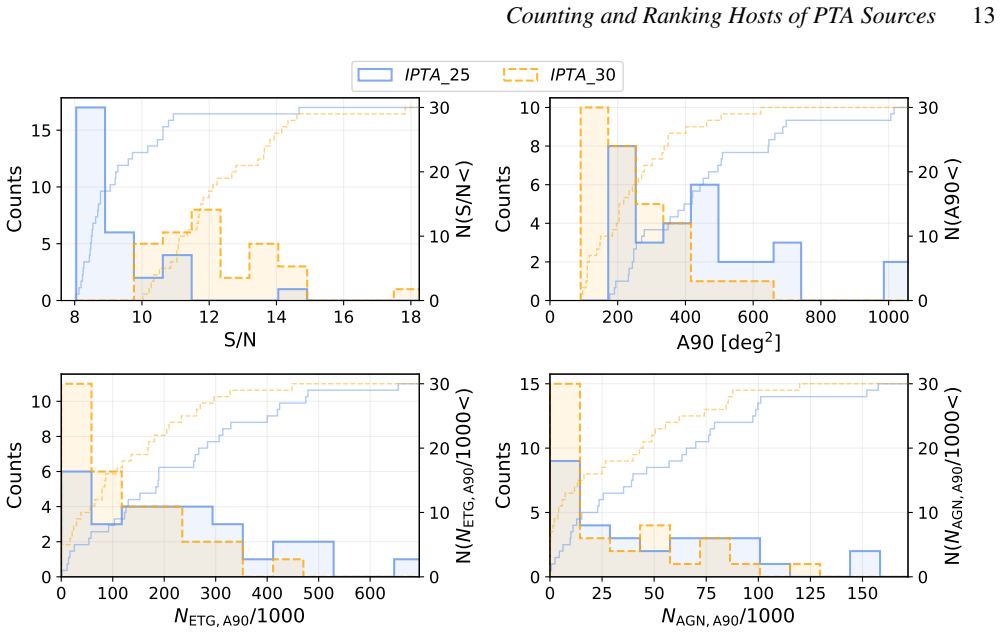
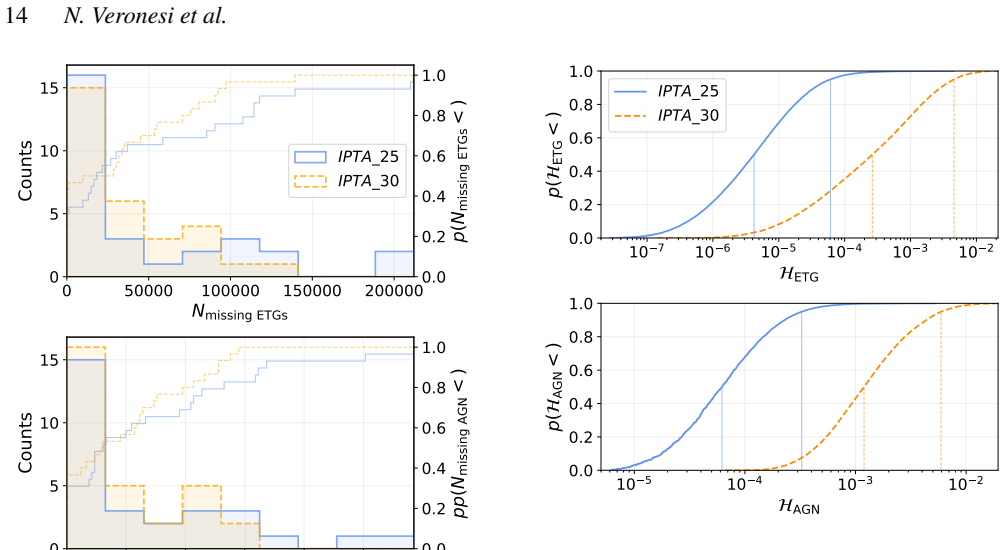
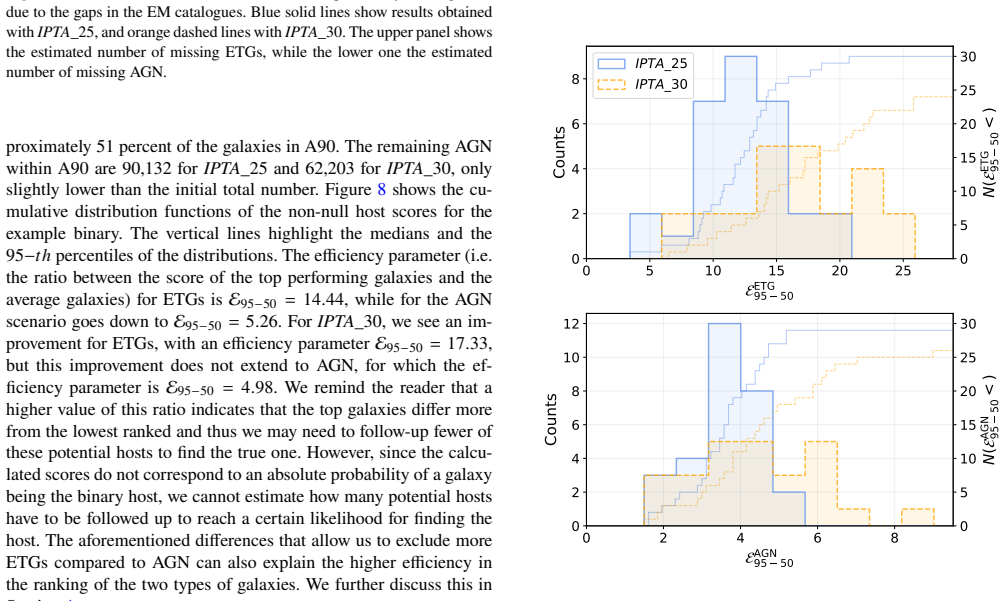
Simulations of realistic binary populations consistent with the gravitational wave background project that pulsar timing arrays have approximately 21 percent probability of resolving an individual binary now, rising to 38 percent in five years and 51 percent in ten years. These probabilities fall to 0.3, 3.8 and 14.1 percent when only well-constrained localisation areas are counted. The areas contain on average 190,000 early-type galaxies and 40,000 active galactic nuclei, with 25,000 missing candidate hosts due to incomplete sky coverage. The ranking method excludes about half of the potential hosts when galaxy catalogues supply black-hole masses and redshifts.
What carries the argument
The ranking system that excludes galaxies whose properties are inconsistent with the gravitational wave posteriors and prioritizes the remaining galaxies for follow-up observations.
Load-bearing premise
The simulations assume that the injected binary populations and the gravitational wave background are drawn from a distribution fully consistent with current pulsar timing array upper limits and that the standard detection pipeline recovers unbiased posteriors on sky location and binary parameters.
What would settle it
An actual detection whose measured localisation area contains a number of early-type galaxies that differs substantially from the simulated average of 190,000 would falsify the projected statistics.
Figures

read the original abstract
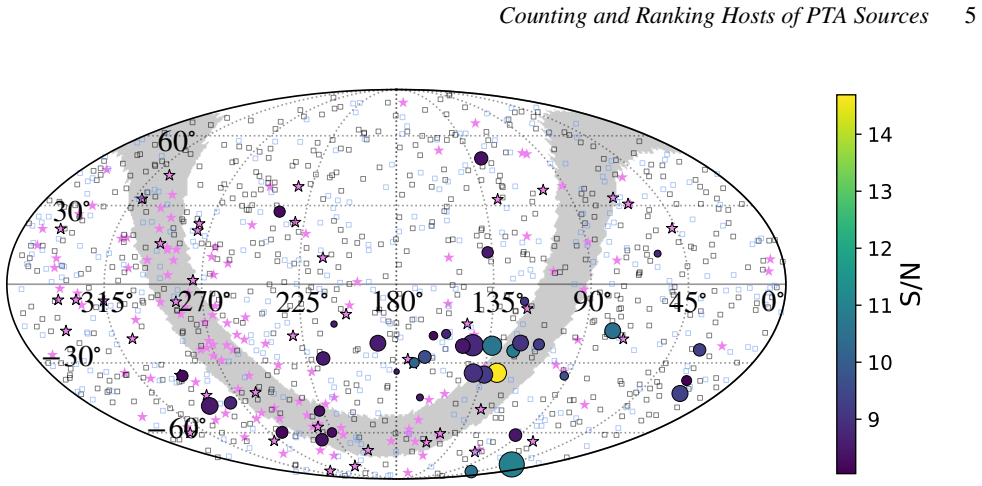
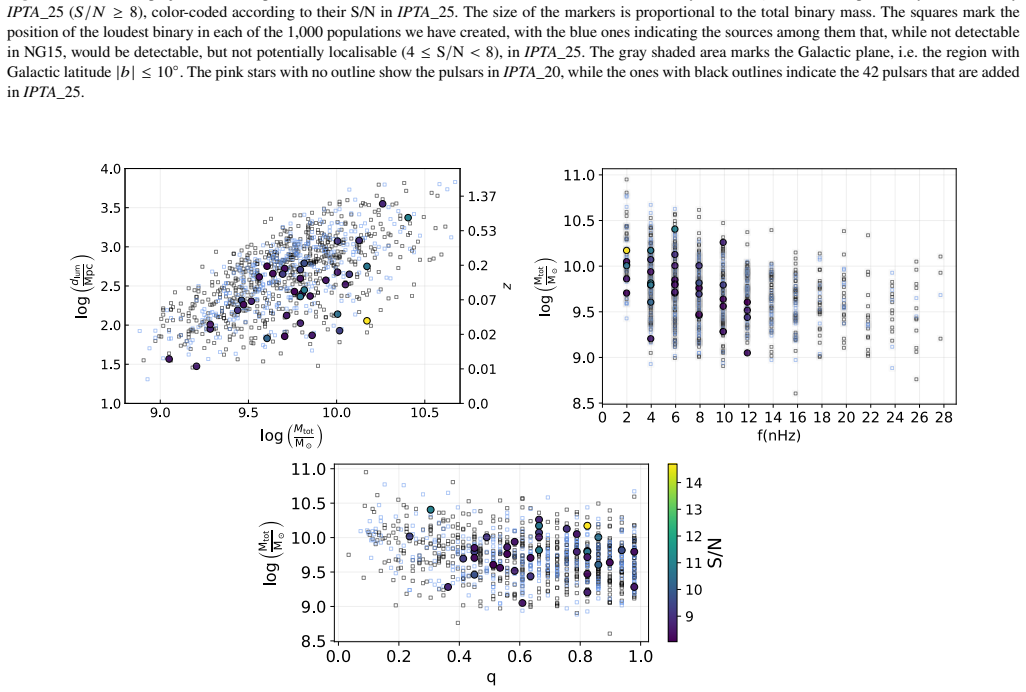
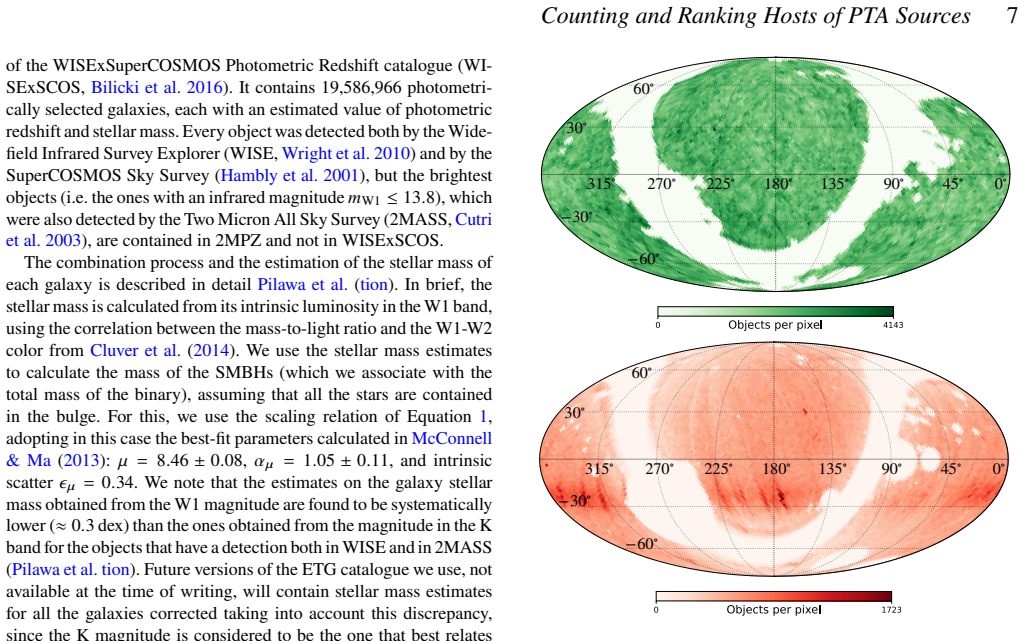
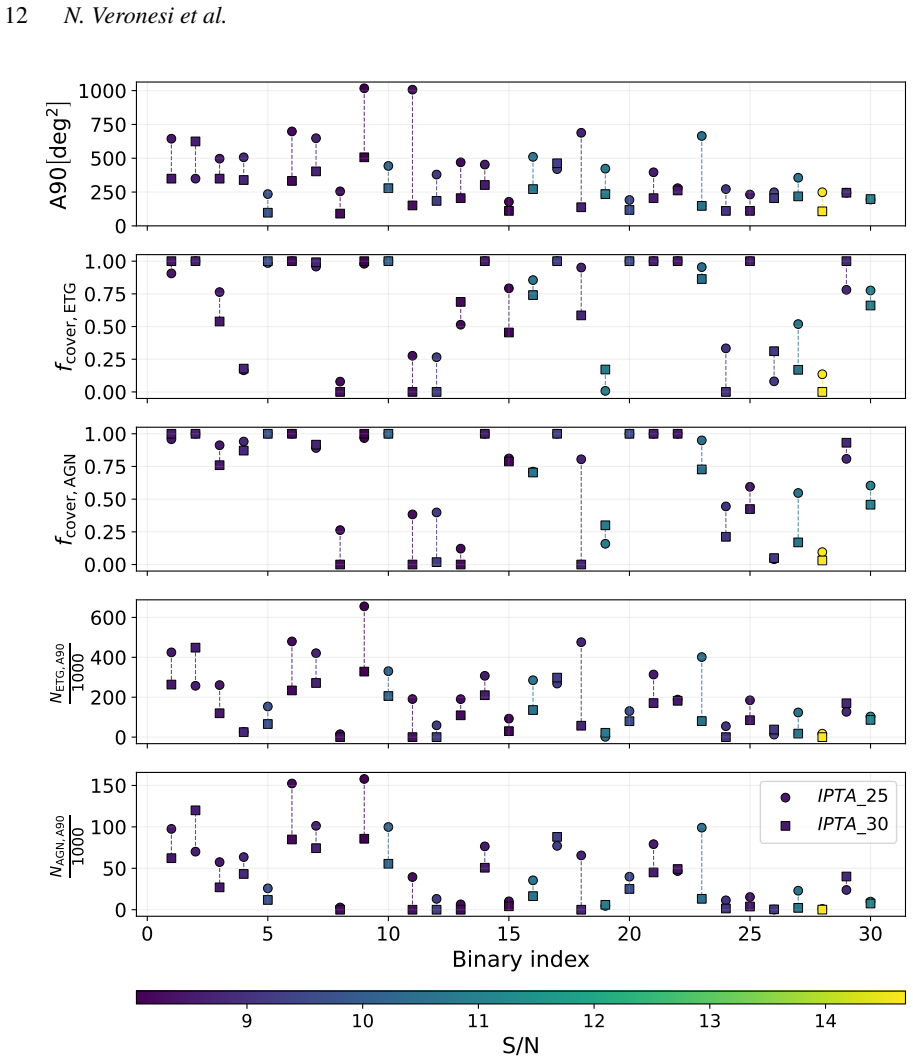
Pulsar Timing Arrays (PTAs) are soon expected to detect individually resolved supermassive black hole (SMBH) binaries, opening the possibility for multi-messenger discoveries. The biggest challenge will be to pinpoint the host galaxy in a large localisation area. We simulate realistic binary populations consistent with the gravitational wave (GW) background, projecting the PTA sensitivity for the next 0-10 years. We inject the loudest binary on top of the background and use one of the standard detection pipelines to constrain its properties. We cross-match the localisation areas with comprehensive all-sky galaxy catalogues and estimate the number of candidate hosts in the localisation area assessing, for the first time, the number of missing galaxies due to incomplete coverage. We develop a ranking system that excludes galaxies with properties inconsistent with the GW posteriors, and prioritizes the remaining galaxies for follow-up observations. We find a $\approx$21, $\approx$38 and $\approx$51 percent probability of resolving a binary in the next 0, 5 and 10 years, respectively, reduced to 0.3, 3.8 and 14.1 percent if we require potentially well-constrained localisation areas. The localisation areas span hundreds of square degrees, but shrink significantly with the addition of more data. They contain on average $\approx$190,000 early type galaxies and $\approx$40,000 active galactic nuclei, with $\approx$25,000 missing candidate hosts. Our ranking method can exclude about half of the potential hosts and efficiently rank those remaining when the galaxy catalogue provides SMBH masses and redshifts, but becomes more inefficient when we rely on apparent magnitudes.
Editorial analysis
A structured set of objections, weighed in public.
Referee Report
Summary. The manuscript simulates realistic populations of supermassive black hole binaries drawn consistently with the PTA gravitational wave background, injects the loudest such binary atop the background, recovers its parameters and sky location using a standard detection pipeline, cross-matches the resulting localization regions against all-sky galaxy catalogs (including an assessment of missing hosts due to incomplete coverage), and develops a ranking procedure that excludes galaxies whose properties are inconsistent with the GW posteriors. It reports probabilities of resolving a binary of ≈21%, ≈38% and ≈51% over the next 0, 5 and 10 years (reduced to 0.3%, 3.8% and 14.1% for well-constrained localizations), finds that the localization areas contain on average ≈190,000 early-type galaxies and ≈40,000 AGN with ≈25,000 missing candidates, and shows that the ranking can exclude roughly half the hosts when SMBH masses and redshifts are available.
Significance. If the numerical results hold, the work supplies concrete, observationally relevant forecasts for the host-identification challenge that will accompany the first individual SMBHB detections by PTAs. The quantification of missing galaxies, the size of the candidate lists, and the performance of the ranking method under different catalog assumptions constitute practical guidance for multi-messenger follow-up planning.
major comments (1)
- [Methods] Methods (population model and detection pipeline): the abstract and results sections quote specific probabilities and host counts derived from forward simulations, yet the manuscript provides no explicit description of the binary population parameters, the precise implementation of the detection pipeline, validation tests against known cases, or error propagation; without these details it is impossible to judge whether the reported fractions are robust or sensitive to modeling choices.
minor comments (2)
- [Abstract] Abstract: the phrase “one of the standard detection pipelines” should name the specific code or algorithm employed.
- [Results] Results: the statement that the ranking “becomes more inefficient when we rely on apparent magnitudes” would benefit from a quantitative comparison (e.g., exclusion fraction or rank statistics) between the two catalog cases.
Simulated Author's Rebuttal
We thank the referee for their careful reading of the manuscript and for highlighting the need for greater methodological transparency. We address the single major comment below and will revise the paper accordingly.
read point-by-point responses
-
Referee: [Methods] Methods (population model and detection pipeline): the abstract and results sections quote specific probabilities and host counts derived from forward simulations, yet the manuscript provides no explicit description of the binary population parameters, the precise implementation of the detection pipeline, validation tests against known cases, or error propagation; without these details it is impossible to judge whether the reported fractions are robust or sensitive to modeling choices.
Authors: We agree that the Methods section requires additional explicit detail to support reproducibility and to allow readers to evaluate robustness. In the revised manuscript we will expand the Methods to include: (i) the precise parameters of the binary population model (mass function, redshift distribution, eccentricity distribution, and normalization chosen to be consistent with the PTA gravitational-wave background); (ii) the exact implementation of the detection pipeline, including the form of the PTA likelihood, the sampling algorithm employed, and any approximations or priors; (iii) results of validation tests on a set of injected signals with known parameters; and (iv) a quantitative assessment of error propagation together with a brief sensitivity analysis to the main modeling choices. These additions will directly address the concern that the quoted probabilities may be sensitive to undocumented assumptions. revision: yes
Circularity Check
No significant circularity in simulation-based workflow
full rationale
The paper reports probabilities and host counts from forward Monte Carlo simulations: populations are drawn to be consistent with existing PTA upper limits on the GW background, the loudest binary is injected atop that background, a standard external detection pipeline is applied to recover sky-location posteriors, and the resulting localisation regions are cross-matched against independent galaxy catalogues. None of the output statistics (resolution probabilities, average host counts, ranking efficiency) are obtained by fitting parameters to a subset of the same data and then relabeling the fit as a prediction, nor do any equations reduce the reported percentages to quantities defined in terms of themselves. No load-bearing self-citations, uniqueness theorems, or ansatzes imported from prior author work appear in the described chain. The workflow therefore remains self-contained against external benchmarks.
Axiom & Free-Parameter Ledger
free parameters (1)
- binary population parameters
axioms (2)
- domain assumption Standard PTA detection pipelines produce unbiased posteriors on sky location when a single loud binary is injected on top of the background
- domain assumption All-sky galaxy catalogs are representative enough that cross-matching yields a meaningful count of candidate hosts
Reference graph
Works this paper leans on
-
[17]
Using gravitational-wave standard sirens
Using Gravitational-Wave Standard Sirens. , keywords =. doi:10.1086/431341 , archivePrefix =. astro-ph/0504616 , primaryClass =
work page internal anchor Pith review Pith/arXiv arXiv doi:10.1086/431341
-
[18]
Multimessenger time-domain signatures of supermassive black hole binaries. , keywords =. doi:10.1093/mnras/stab3713 , archivePrefix =. 2110.14661 , primaryClass =
-
[25]
Emission Lines as a Tool in Search for Supermassive Black Hole Binaries and Recoiling Black Holes
Emission lines as a tool in search for supermassive black hole binaries and recoiling black holes. , keywords =. doi:10.1016/j.newar.2009.09.005 , archivePrefix =. 0909.0516 , primaryClass =
work page internal anchor Pith review Pith/arXiv arXiv doi:10.1016/j.newar.2009.09.005 2009
-
[26]
The Population of Viscosity- and Gravitational Wave-driven Supermassive Black Hole Binaries Among Luminous Active Galactic Nuclei. , keywords =. doi:10.1088/0004-637X/700/2/1952 , archivePrefix =. 0904.1383 , primaryClass =
work page internal anchor Pith review Pith/arXiv arXiv doi:10.1088/0004-637x/700/2/1952 1952
-
[31]
, year = 1976, month = jan, volume =
An analytic expression for the luminosity function for galaxies. , year = 1976, month = jan, volume =. doi:10.1086/154079 , adsurl =
-
[39]
2MASS All Sky Catalog of point sources
-
[44]
Mid-infrared Selection of Active Galactic Nuclei with the Wide-field Infrared Survey Explorer. II. Properties of WISE-selected Active Galactic Nuclei in the NDWFS Bo \"o tes Field. , keywords =. doi:10.1088/0004-637X/772/1/26 , archivePrefix =. 1209.6055 , primaryClass =
work page internal anchor Pith review Pith/arXiv arXiv doi:10.1088/0004-637x/772/1/26
-
[49]
The Absolute Magnitude of the Sun in Several Filters
The Absolute Magnitude of the Sun in Several Filters. , keywords =. doi:10.3847/1538-4365/aabfdf , archivePrefix =. 1804.07788 , primaryClass =
work page internal anchor Pith review Pith/arXiv arXiv doi:10.3847/1538-4365/aabfdf
-
[50]
IAU 2015 Resolution B2 on Recommended Zero Points for the Absolute and Apparent Bolometric Magnitude Scales. arXiv e-prints , keywords =. doi:10.48550/arXiv.1510.06262 , archivePrefix =. 1510.06262 , primaryClass =
work page internal anchor Pith review Pith/arXiv arXiv doi:10.48550/arxiv.1510.06262 2015
-
[54]
A New Wide-field Infrared Survey Explorer Calibration of Stellar Mass. , keywords =. doi:10.3847/1538-4357/acb68f , archivePrefix =. 2301.05952 , primaryClass =
-
[59]
Radio Crickets: Chirping Jets from Black Hole Binaries Entering their Gravitational Wave Inspiral
Radio crickets: chirping jets from black hole binaries entering their gravitational wave inspiral. , keywords =. doi:10.1093/mnras/stv2940 , archivePrefix =. 1507.06990 , primaryClass =
work page internal anchor Pith review Pith/arXiv arXiv doi:10.1093/mnras/stv2940
-
[64]
Quaia, the Gaia-unWISE Quasar Catalog: An All-sky Spectroscopic Quasar Sample. , keywords =. doi:10.3847/1538-4357/ad1328 , archivePrefix =. 2306.17749 , primaryClass =
-
[68]
Towards a complete census of AGN in nearby Galaxies: a large population of optically unidentified AGN. , keywords =. doi:10.1111/j.1365-2966.2009.15194.x , archivePrefix =. 0906.0772 , primaryClass =
-
[71]
Jacob Pilawa and others , note =
-
[72]
Petrov and others , note =
-
[94]
Agazie G., et al., 2023a, @doi [ ] 10.3847/2041-8213/acdac6 , https://ui.adsabs.harvard.edu/abs/2023ApJ...951L...8A 951, L8
-
[95]
Agazie G., et al., 2023b, @doi [ ] 10.3847/2041-8213/acda9a , https://ui.adsabs.harvard.edu/abs/2023ApJ...951L...9A 951, L9
-
[96]
Agazie G., et al Nanograv Collaboration 2023c, @doi [ ] 10.3847/2041-8213/ace18b , https://ui.adsabs.harvard.edu/abs/2023ApJ...952L..37A 952, L37
-
[97]
Agazie G., et al., 2024, @doi [ ] 10.3847/1538-4357/ad36be , https://ui.adsabs.harvard.edu/abs/2024ApJ...966..105A 966, 105
-
[98]
Agazie G., et al., 2025, @doi [ ] 10.3847/1538-4357/ad93d5 , https://ui.adsabs.harvard.edu/abs/2025ApJ...978...31A 978, 31
-
[99]
Arzoumanian Z., et al., 2021, @doi [ ] 10.3847/1538-4357/abfcd3 , https://ui.adsabs.harvard.edu/abs/2021ApJ...914..121A 914, 121
-
[100]
J., Stern D., Noirot G., Jun H
Assef R. J., Stern D., Noirot G., Jun H. D., Cutri R. M., Eisenhardt P. R. M., 2018, @doi [ ] 10.3847/1538-4365/aaa00a , https://ui.adsabs.harvard.edu/abs/2018ApJS..234...23A 234, 23
-
[101]
Astropy Collaboration et al., 2018, @doi [ ] 10.3847/1538-3881/aabc4f , https://ui.adsabs.harvard.edu/abs/2018AJ....156..123A 156, 123
-
[102]
Bardati J., Ruan J. J., Haggard D., Tremmel M., 2024, @doi [ ] 10.3847/1538-4357/ad055a , https://ui.adsabs.harvard.edu/abs/2024ApJ...961...34B 961, 34
-
[103]
B \'e csy B., Cornish N. J., Digman M. C., 2022a, @doi [ ] 10.1103/PhysRevD.105.122003 , https://ui.adsabs.harvard.edu/abs/2022PhRvD.105l2003B 105, 122003
-
[104]
B \'e csy B., Cornish N. J., Kelley L. Z., 2022b, @doi [ ] 10.3847/1538-4357/aca1b2 , https://ui.adsabs.harvard.edu/abs/2022ApJ...941..119B 941, 119
-
[105]
Begelman M. C., Blandford R. D., Rees M. J., 1980, @doi [ ] 10.1038/287307a0 , https://ui.adsabs.harvard.edu/abs/1980Natur.287..307B 287, 307
-
[106]
Bilicki M., Jarrett T. H., Peacock J. A., Cluver M. E., Steward L., 2014, @doi [ ] 10.1088/0067-0049/210/1/9 , https://ui.adsabs.harvard.edu/abs/2014ApJS..210....9B 210, 9
-
[107]
Bilicki M., et al., 2016, @doi [ ] 10.3847/0067-0049/225/1/5 , https://ui.adsabs.harvard.edu/abs/2016ApJS..225....5B 225, 5
-
[108]
Bluck A. F. L., Mendel J. T., Ellison S. L., Moreno J., Simard L., Patton D. R., Starkenburg E., 2014, @doi [ ] 10.1093/mnras/stu594 , https://ui.adsabs.harvard.edu/abs/2014MNRAS.441..599B 441, 599
-
[109]
Cardelli J. A., Clayton G. C., Mathis J. S., 1989, @doi [ ] 10.1086/167900 , https://ui.adsabs.harvard.edu/abs/1989ApJ...345..245C 345, 245
-
[110]
Charisi M., Taylor S. R., Witt C. A., Runnoe J., 2024, @doi [ ] 10.1103/PhysRevLett.132.061401 , https://ui.adsabs.harvard.edu/abs/2024PhRvL.132f1401C 132, 061401
-
[111]
Charisi M., Taylor S. R., Runnoe J., Witt C., Petrov P., 2026, @doi [ ] 10.1093/mnras/stag477 , https://ui.adsabs.harvard.edu/abs/2026MNRAS.tmp..459C
-
[112]
Chiang Y.-K., 2023, @doi [ ] 10.3847/1538-4357/acf4a1 , https://ui.adsabs.harvard.edu/abs/2023ApJ...958..118C 958, 118
-
[113]
Cluver M. E., et al., 2014, @doi [ ] 10.1088/0004-637X/782/2/90 , https://ui.adsabs.harvard.edu/abs/2014ApJ...782...90C 782, 90
-
[114]
Cury o M., Thrane E., Lasky P. D., Gaynor D. S., 2026, @doi [arXiv e-prints] 10.48550/arXiv.2604.19073 , https://ui.adsabs.harvard.edu/abs/2026arXiv260419073C p. arXiv:2604.19073
work page internal anchor Pith review Pith/arXiv arXiv doi:10.48550/arxiv.2604.19073 2026
-
[115]
M., et al., 2003, 2MASS All Sky Catalog of point sources
Cutri R. M., et al., 2003, 2MASS All Sky Catalog of point sources
2003
-
[116]
D'Orazio D. J., Charisi M., 2023, @doi [arXiv e-prints] 10.48550/arXiv.2310.16896 , https://ui.adsabs.harvard.edu/abs/2023arXiv231016896D p. arXiv:2310.16896
-
[117]
Davis M. C., et al., 2024, @doi [ ] 10.3847/1538-4357/ad276e , https://ui.adsabs.harvard.edu/abs/2024ApJ...965...34D 965, 34
-
[118]
Deng X., Finn L. S., 2011, @doi [ ] 10.1111/j.1365-2966.2010.17913.x , https://ui.adsabs.harvard.edu/abs/2011MNRAS.414...50D 414, 50
-
[119]
Dewdney P. E., Hall P. J., Schilizzi R. T., Lazio T. J. L. W., 2009, @doi [IEEE Proceedings] 10.1109/JPROC.2009.2021005 , https://ui.adsabs.harvard.edu/abs/2009IEEEP..97.1482D 97, 1482
-
[120]
EPTA Collaboration et al., 2023, @doi [ ] 10.1051/0004-6361/202346844 , https://ui.adsabs.harvard.edu/abs/2023A&A...678A..50E 678, A50
-
[121]
Ellis J. A., Vallisneri M., Taylor S. R., Baker P. T., 2020, ENTERPRISE: Enhanced Numerical Toolbox Enabling a Robust PulsaR Inference SuitE, Zenodo, @doi 10.5281/zenodo.4059815 , https://doi.org/10.5281/zenodo.4059815
-
[122]
Ferrarese L., Merritt D., 2000, @doi [ ] 10.1086/312838 , https://ui.adsabs.harvard.edu/abs/2000ApJ...539L...9F 539, L9
work page internal anchor Pith review doi:10.1086/312838 2000
-
[123]
Gardiner E. C., Kelley L. Z., Lemke A.-M., Mitridate A., 2024, @doi [ ] 10.3847/1538-4357/ad2be8 , https://ui.adsabs.harvard.edu/abs/2024ApJ...965..164G 965, 164
-
[124]
Gardiner E. C., B \'e csy B., Kelley L. Z., Cornish N. J., 2025, @doi [arXiv e-prints] 10.48550/arXiv.2502.16016 , https://ui.adsabs.harvard.edu/abs/2025arXiv250216016G p. arXiv:2502.16016
-
[125]
Goicovic F. G., Sesana A., Cuadra J., Stasyszyn F., 2017, @doi [ ] 10.1093/mnras/stx1996 , https://ui.adsabs.harvard.edu/abs/2017MNRAS.472..514G 472, 514
-
[126]
Goldstein J. M., Veitch J., Sesana A., Vecchio A., 2018, @doi [ ] 10.1093/mnras/sty892 , https://ui.adsabs.harvard.edu/abs/2018MNRAS.477.5447G 477, 5447
-
[127]
Goldstein J. M., Sesana A., Holgado A. M., Veitch J., 2019, @doi [ ] 10.1093/mnras/stz420 , https://ui.adsabs.harvard.edu/abs/2019MNRAS.485..248G 485, 248
-
[128]
Hallinan G., et al., 2019, in Bulletin of the American Astronomical Society. p. 255 ( @eprint arXiv 1907.07648 ), @doi 10.48550/arXiv.1907.07648
work page internal anchor Pith review Pith/arXiv arXiv doi:10.48550/arxiv.1907.07648 2019
-
[129]
Hambly N. C., et al., 2001, @doi [ ] 10.1111/j.1365-2966.2001.04660.x , https://ui.adsabs.harvard.edu/abs/2001MNRAS.326.1279H 326, 1279
-
[130]
Harris C. R., et al., 2020, @doi [ ] 10.1038/s41586-020-2649-2 , https://ui.adsabs.harvard.edu/abs/2020Natur.585..357H 585, 357
-
[131]
Computing in Science and Engineering , keywords =
Hunter J. D., 2007, @doi [Computing in Science and Engineering] 10.1109/MCSE.2007.55 , https://ui.adsabs.harvard.edu/abs/2007CSE.....9...90H 9, 90
-
[132]
Ivezi \'c Z ., et al., 2019, @doi [ ] 10.3847/1538-4357/ab042c , https://ui.adsabs.harvard.edu/abs/2019ApJ...873..111I 873, 111
-
[133]
Kauffmann G., et al., 2003, @doi [ ] 10.1111/j.1365-2966.2003.07154.x , https://ui.adsabs.harvard.edu/abs/2003MNRAS.346.1055K 346, 1055
-
[134]
Z., Blecha L., Hernquist L., Sesana A., Taylor S
Kelley L. Z., Blecha L., Hernquist L., Sesana A., Taylor S. R., 2018, @doi [ ] 10.1093/mnras/sty689 , https://ui.adsabs.harvard.edu/abs/2018MNRAS.477..964K 477, 964
-
[135]
Kelley L., et al., 2019, @doi [ ] 10.48550/arXiv.1903.07644 , https://ui.adsabs.harvard.edu/abs/2019BAAS...51c.490K 51, 490
work page internal anchor Pith review Pith/arXiv arXiv doi:10.48550/arxiv.1903.07644 2019
-
[136]
G., Schwarzenberg-Czerny A., Middleton M
Krishnan S., Markowitz A. G., Schwarzenberg-Czerny A., Middleton M. J., 2021, @doi [ ] 10.1093/mnras/stab2839 , https://ui.adsabs.harvard.edu/abs/2021MNRAS.508.3975K 508, 3975
-
[137]
Laal N., Taylor S. R., Matt C., Gultekin K., 2025, @doi [arXiv e-prints] 10.48550/arXiv.2512.11981 , https://ui.adsabs.harvard.edu/abs/2025arXiv251211981L p. arXiv:2512.11981
work page internal anchor Pith review Pith/arXiv arXiv doi:10.48550/arxiv.2512.11981 2025
-
[138]
Lang P., et al., 2014, @doi [ ] 10.1088/0004-637X/788/1/11 , https://ui.adsabs.harvard.edu/abs/2014ApJ...788...11L 788, 11
-
[139]
Lyke B. W., et al., 2020, @doi [ ] 10.3847/1538-4365/aba623 , https://ui.adsabs.harvard.edu/abs/2020ApJS..250....8L 250, 8
-
[140]
E., McConnell N., Janish R., Blakeslee J
Ma C.-P., Greene J. E., McConnell N., Janish R., Blakeslee J. P., Thomas J., Murphy J. D., 2014, @doi [ ] 10.1088/0004-637X/795/2/158 , https://ui.adsabs.harvard.edu/abs/2014ApJ...795..158M 795, 158
-
[141]
McConnell N. J., Ma C.-P., 2013, @doi [ ] 10.1088/0004-637X/764/2/184 , https://ui.adsabs.harvard.edu/abs/2013ApJ...764..184M 764, 184
work page internal anchor Pith review doi:10.1088/0004-637x/764/2/184 2013
-
[142]
McGrath C., D'Orazio D. J., Creighton J., 2022, @doi [ ] 10.1093/mnras/stac2593 , https://ui.adsabs.harvard.edu/abs/2022MNRAS.517.1242M 517, 1242
-
[143]
Miles M. T., et al., 2023, @doi [ ] 10.1093/mnras/stac3644 , https://ui.adsabs.harvard.edu/abs/2023MNRAS.519.3976M 519, 3976
-
[144]
Miles M. T., et al., 2025, @doi [ ] 10.1093/mnras/stae2571 , https://ui.adsabs.harvard.edu/abs/2025MNRAS.536.1489M 536, 1489
-
[145]
Mingarelli C. M. F., et al., 2017, @doi [Nature Astronomy] 10.1038/s41550-017-0299-6 , https://ui.adsabs.harvard.edu/abs/2017NatAs...1..886M 1, 886
-
[146]
Petiteau A., Babak S., Sesana A., de Ara \'u jo M., 2013, @doi [ ] 10.1103/PhysRevD.87.064036 , https://ui.adsabs.harvard.edu/abs/2013PhRvD..87f4036P 87, 064036
-
[147]
Petrov P., Taylor S. R., Charisi M., Ma C.-P., 2024, @doi [ ] 10.3847/1538-4357/ad7b1410.1134/S1063772908070032 , https://ui.adsabs.harvard.edu/abs/2024ApJ...976..129P 976, 129
work page internal anchor Pith review Pith/arXiv arXiv doi:10.3847/1538-4357/ad7b1410.1134/s1063772908070032 2024
-
[148]
Petrov P., Schult L., Taylor S. R., Pol N., Laal N., Charisi M., Ma C.-P., 2025, @doi [arXiv e-prints] 10.48550/arXiv.2510.01316 , https://ui.adsabs.harvard.edu/abs/2025arXiv251001316P p. arXiv:2510.01316
work page internal anchor Pith review Pith/arXiv arXiv doi:10.48550/arxiv.2510.01316 2025
-
[149]
Petrov et al., In preparation, In preparation
-
[150]
Pilawa J., et al., In preparation, In preparation
-
[151]
Planck Collaboration et al., 2020, @doi [ ] 10.1051/0004-6361/201833910 , https://ui.adsabs.harvard.edu/abs/2020A&A...641A...6P 641, A6
-
[152]
Reardon D. J., et al., 2023, @doi [ ] 10.3847/2041-8213/acdd02 , https://ui.adsabs.harvard.edu/abs/2023ApJ...951L...6R 951, L6
-
[153]
Rosado P. A., Sesana A., Gair J., 2015, @doi [ ] 10.1093/mnras/stv1098 , https://ui.adsabs.harvard.edu/abs/2015MNRAS.451.2417R 451, 2417
-
[154]
Runnoe J. C., Brotherton M. S., Shang Z., 2012, @doi [ ] 10.1111/j.1365-2966.2012.20620.x , https://ui.adsabs.harvard.edu/abs/2012MNRAS.422..478R 422, 478
-
[155]
Sato-Polito G., Zaldarriaga M., 2025, @doi [arXiv e-prints] 10.48550/arXiv.2509.08041 , https://ui.adsabs.harvard.edu/abs/2025arXiv250908041S p. arXiv:2509.08041
-
[156]
Pulsar timing arrays and the challenge of massive black hole binary astrophysics
Sesana A., 2015, in Sopuerta C. F., ed., Astrophysics and Space Science Proceedings Vol. 40, Gravitational Wave Astrophysics. p. 147 ( @eprint arXiv 1407.5693 ), @doi 10.1007/978-3-319-10488-1_13
work page internal anchor Pith review Pith/arXiv arXiv doi:10.1007/978-3-319-10488-1_13 2015
-
[157]
Sesana A., Vecchio A., 2010, @doi [ ] 10.1103/PhysRevD.81.104008 , https://ui.adsabs.harvard.edu/abs/2010PhRvD..81j4008S 81, 104008
-
[158]
Shang Z., et al., 2011, @doi [ ] 10.1088/0067-0049/196/1/2 , https://ui.adsabs.harvard.edu/abs/2011ApJS..196....2S 196, 2
discussion (0)
Sign in with ORCID, Apple, or X to comment. Anyone can read and Pith papers without signing in.