Hybrid Probabilistic Forecasting of Under-Five Malaria Admissions in Ghana: A Gaussian Process Regression with Holt-Winters Smoothing
Pith reviewed 2026-06-28 17:43 UTC · model grok-4.3
The pith
A hybrid of Gaussian process regression and Holt-Winters smoothing produces accurate probabilistic forecasts of under-five malaria admissions across Ghana districts.
A machine-rendered reading of the paper's core claim, the machinery that carries it, and where it could break.
Core claim
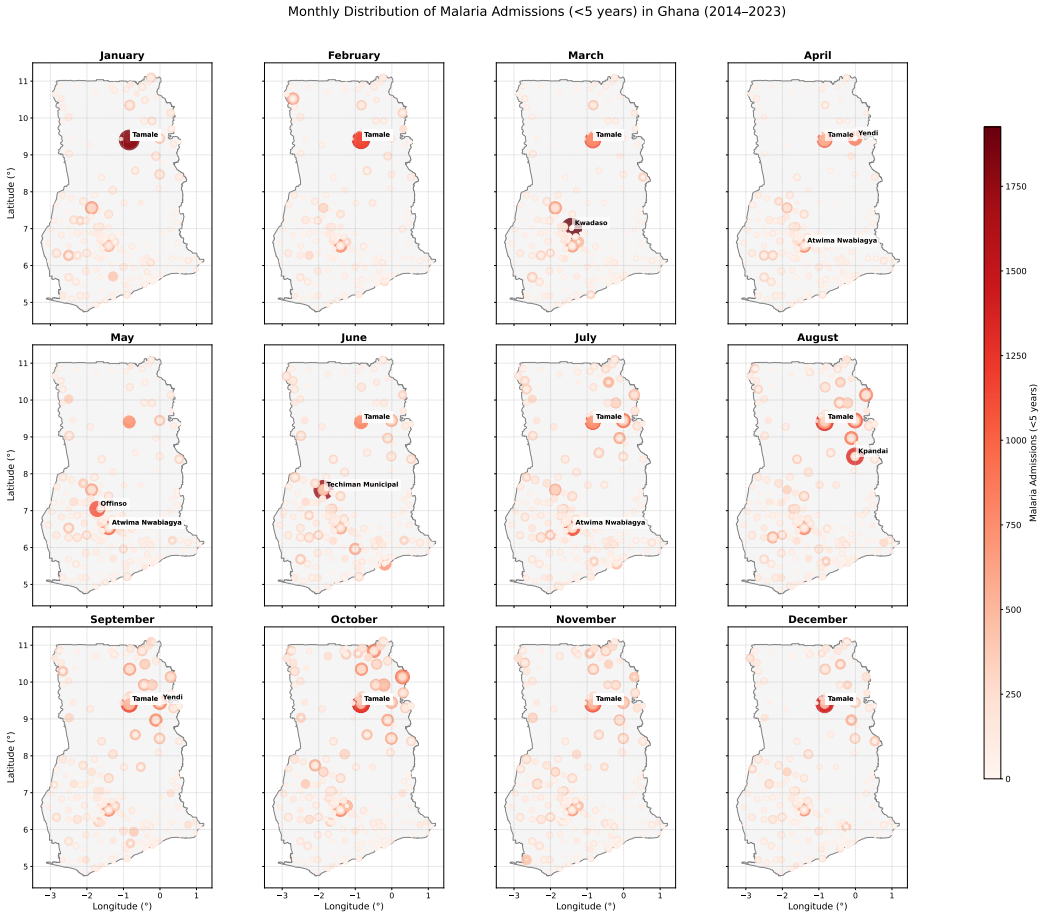
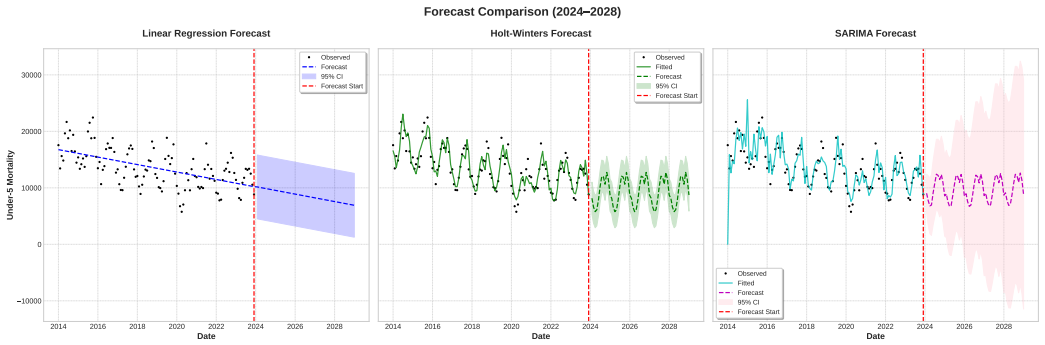
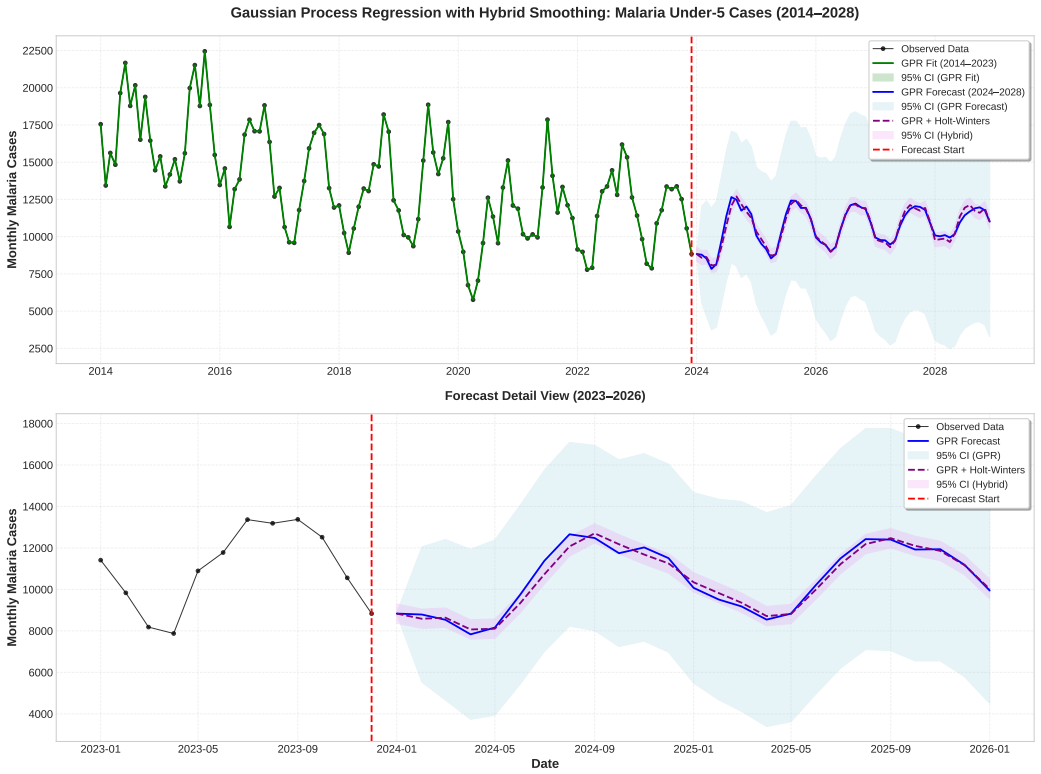
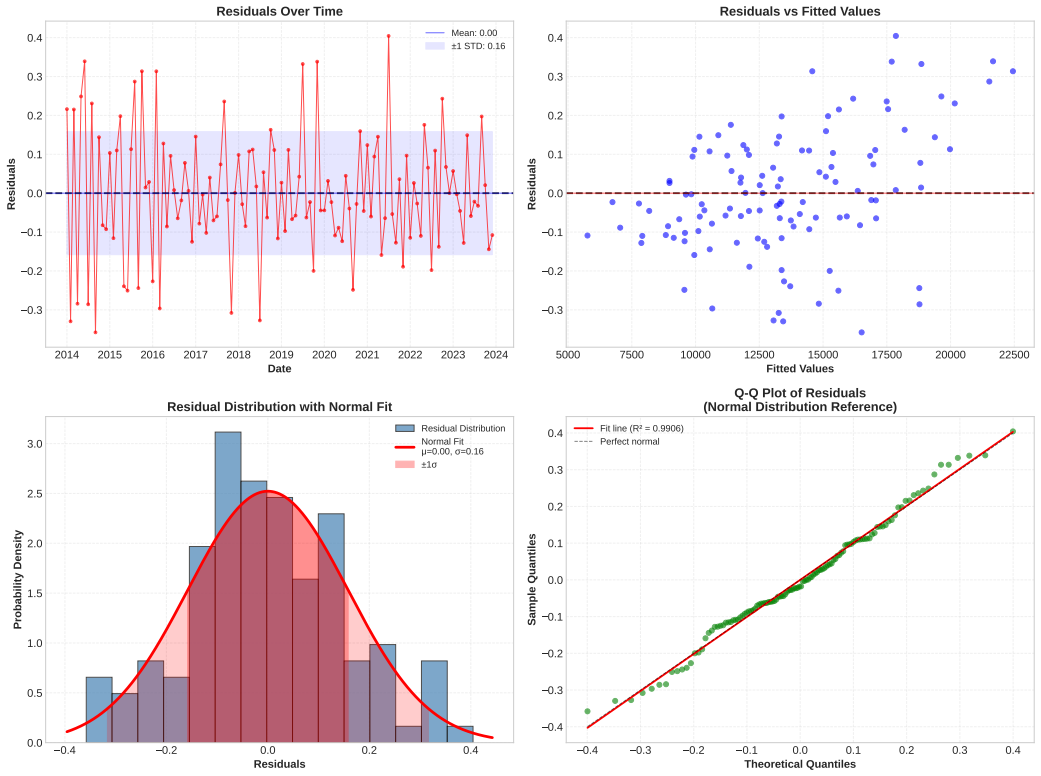
The hybrid framework of Gaussian Process Regression with Holt-Winters exponential smoothing achieves an R-squared of 0.9906 on monthly under-five malaria admissions from 2014-2023, compared with 0.8213 for Holt-Winters alone, places 94.2 percent of residuals inside two standard deviation bounds, and generates 2024-2028 forecasts of average monthly admissions between approximately 8,000 and 12,200 cases while identifying stable relative patterns in northern high-burden districts despite large absolute changes.
What carries the argument
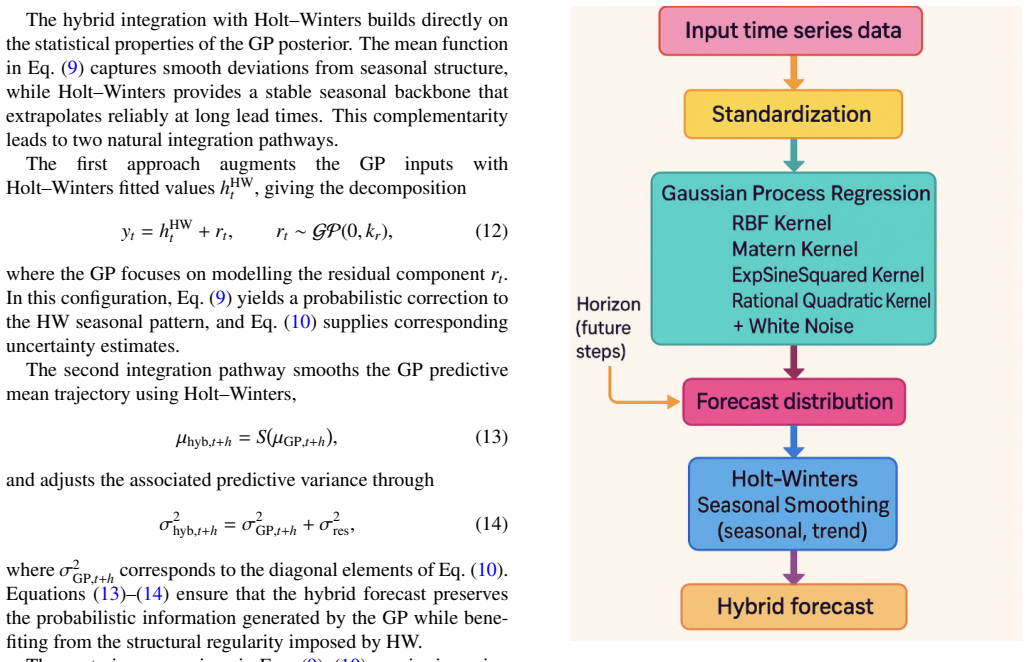
The hybrid model that integrates Gaussian Process Regression for non-linear uncertainty quantification with Holt-Winters smoothing to preserve seasonal structure and stabilize long-horizon projections.
If this is right
- District-level probabilistic forecasts can directly feed into Ghana's national malaria control planning for resource allocation.
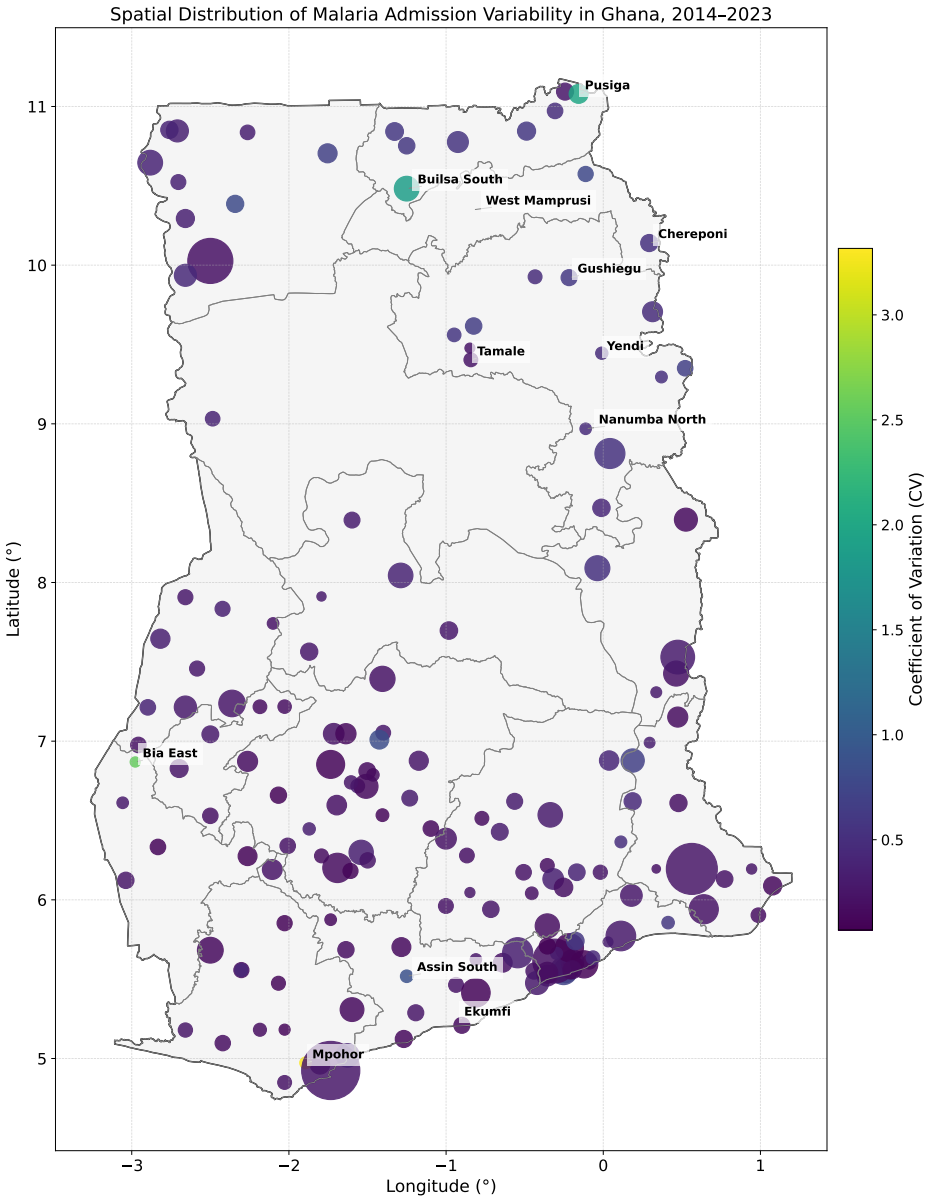
- Spatio-temporal heterogeneity shows that high-burden northern districts maintain stable relative rankings even when absolute numbers fluctuate.
- The framework supplies a scalable probabilistic early-warning tool usable in other endemic sub-Saharan settings with similar data constraints.
- Long-horizon projections to 2028 allow advance preparation for expected increases in average monthly case loads.
Where Pith is reading between the lines
- The same hybrid structure could be tested on other seasonal infectious diseases where limited historical records are the main constraint.
- Adding environmental or intervention covariates might further reduce uncertainty, though the paper does not examine that extension.
- If the rolling-window validation proves robust, the approach offers a template for updating forecasts in real time as new surveillance data arrive.
Load-bearing premise
Rolling-origin expanding-window checks on the 2014-2023 records are sufficient to confirm that the model will generalize under future changes in transmission intensity and reporting completeness.
What would settle it
New monthly admission counts for 2024 or 2025 that fall consistently outside the projected 8,000-to-12,200 range or that produce more than 5.8 percent of residuals beyond two standard deviations would falsify the performance claim.
Figures

read the original abstract
Accurate malaria forecasting remains a major challenge in sub-Saharan Africa, where strong seasonality, reporting uncertainty, and non-stationary transmission dynamics reduce the reliability of conventional models. In Ghana, district-level malaria surveillance requires forecasting frameworks that are probabilistically rigorous and robust under limited data. This study proposes a hybrid framework integrating Gaussian Process Regression (GPR) with Holt-Winters exponential smoothing for modelling monthly under-five malaria admissions. GPR captures non-linear behaviour and predictive uncertainty, while Holt-Winters stabilises long-horizon forecasts and preserves seasonal structure. Using ten years of district-level data (2014-2023), performance was evaluated via rolling-origin expanding-window validation. The hybrid model achieved $R^2 = 0.9906$ versus $0.8213$ for Holt-Winters alone, with $94.2\%$ of residuals within $\pm 2\sigma$ bounds. Forecasts for 2024-2028 project average monthly admissions from approximately 8{,}000 to 12{,}200 cases. Spatio-temporal analysis revealed pronounced ecological heterogeneity: northern high-burden districts exhibited stable relative patterns despite large absolute fluctuations. The framework provides a scalable probabilistic approach for malaria early warning and operational planning in endemic settings, supporting Ghana's national malaria control strategy.
Editorial analysis
A structured set of objections, weighed in public.
Referee Report
Summary. The manuscript proposes a hybrid Gaussian Process Regression (GPR) combined with Holt-Winters exponential smoothing for probabilistic forecasting of monthly under-five malaria admissions in Ghana. Using 2014-2023 district-level data and rolling-origin expanding-window validation, it reports R² = 0.9906 (vs. 0.8213 for Holt-Winters alone) with 94.2% of residuals within ±2σ bounds, and projects 2024-2028 average monthly admissions ranging from approximately 8,000 to 12,200 cases while highlighting ecological heterogeneity in northern districts.
Significance. If the performance and coverage claims are robust, the hybrid framework could provide a practical probabilistic tool for malaria surveillance and early warning in endemic settings with strong seasonality and limited data, supporting operational planning under Ghana's national strategy. The integration of GPR for uncertainty quantification with Holt-Winters for seasonal stability addresses a relevant gap in applied forecasting for non-stationary epidemiological time series.
major comments (2)
- [Abstract and Methods (validation)] Abstract and validation description: The rolling-origin expanding-window scheme applied within the 2014-2023 window cannot test generalization under the non-stationary transmission dynamics and reporting uncertainty explicitly flagged in the abstract; this directly affects the reliability of the 2024-2028 horizon projections and the 94.2% ±2σ coverage claim, as no stress tests for regime shifts (policy, climate, or surveillance changes) are described.
- [Abstract and Methods] Abstract and Methods: No information is provided on GPR kernel family, hyperparameter selection procedure, or missing-data handling, all of which are load-bearing for reproducing and interpreting the headline R² = 0.9906 and residual coverage statistics.
minor comments (1)
- [Abstract] Abstract: The notation '8{,}000' appears to be an unrendered LaTeX artifact and should be corrected to 8,000 for readability.
Simulated Author's Rebuttal
We thank the referee for these constructive comments, which highlight important aspects of validation scope and reproducibility. We respond to each major comment below.
read point-by-point responses
-
Referee: [Abstract and Methods (validation)] Abstract and validation description: The rolling-origin expanding-window scheme applied within the 2014-2023 window cannot test generalization under the non-stationary transmission dynamics and reporting uncertainty explicitly flagged in the abstract; this directly affects the reliability of the 2024-2028 horizon projections and the 94.2% ±2σ coverage claim, as no stress tests for regime shifts (policy, climate, or surveillance changes) are described.
Authors: We agree that the rolling-origin expanding-window validation remains internal to the 2014-2023 data and does not incorporate explicit stress tests for regime shifts. While this scheme successively evaluates performance on held-out later periods and thereby tests temporal generalization within the observed series, it cannot address external shocks. We will add a limitations paragraph in the Discussion section that explicitly notes this scope restriction and its implications for the long-horizon forecasts and coverage statistics, and we will suggest that post-2023 data be used for external validation when available. revision: partial
-
Referee: [Abstract and Methods] Abstract and Methods: No information is provided on GPR kernel family, hyperparameter selection procedure, or missing-data handling, all of which are load-bearing for reproducing and interpreting the headline R² = 0.9906 and residual coverage statistics.
Authors: The referee correctly identifies that these implementation details are absent from the current manuscript. We will expand the Methods section in the revision to specify the GPR kernel family, the hyperparameter selection procedure, and the missing-data handling approach. revision: yes
Circularity Check
No significant circularity in derivation or evaluation chain
full rationale
The paper fits a hybrid GPR + Holt-Winters model to the 2014-2023 district-level series and reports empirical performance via rolling-origin expanding-window validation on held-out segments within that interval. The quoted metrics (R² = 0.9906, 94.2 % residuals within ±2σ) are computed on those out-of-sample folds and are not algebraically forced by the parameter values themselves. The 2024-2028 projections are forward extrapolations from the fitted model; no self-definitional equations, fitted-input-renamed-as-prediction steps, or load-bearing self-citations appear in the provided text that would collapse the claimed results back to the inputs by construction. The validation scheme therefore supplies independent content relative to the model specification.
Axiom & Free-Parameter Ledger
free parameters (2)
- GPR kernel hyperparameters
- Holt-Winters level, trend, and seasonal smoothing parameters
axioms (2)
- domain assumption The malaria admission time series can be adequately modeled as a Gaussian process plus seasonal component
- domain assumption Ten years of district-level data suffice to learn parameters that generalize beyond the training window
Reference graph
Works this paper leans on
-
[1]
Casanova, V
D. Casanova, V . Baptista, M. Costa, B. Freitas, M. d. N. I. Pereira, C. Calçada, P. Mota, O. Kythrich, M. H. J. S. Pereira, N. S. Osório, et al., Artemisinin resistance- associated gene mutations in plasmodium falciparum: a case study of severe malaria from mozambique, Travel Medicine and Infectious Disease 57 (2024) 102684
2024
-
[2]
H. J. Oladipo, Y . A. Tajudeen, I. O. Oladunjoye, S. I. Yusuff, R. O. Yusuf, E. M. Oluwaseyi, M. O. AbdulBasit, Y . A. Adebisi, M. S. El-Sherbini, Increasing challenges of malaria control in sub-saharan africa: Priorities for public health research and policymakers, Annals of Medicine and Surgery 81 (2022) 104366
2022
-
[3]
Sarpong, D
E. Sarpong, D. O. Acheampong, G. N. R. Fordjour, A. Anyanful, E. Aninagyei, D. A. Tuoyire, D. Blackhurst, G. B. Kyei, M. Ekor, N. E. Thomford, Zero malaria: a mirage or reality for populations of sub-saharan africa in health transition, Malaria Journal 21 (2022) 314
2022
-
[4]
W. H. Organization, et al., World malaria report 2022, World Health Organization, 2022
2022
-
[5]
E. K. Aidoo, F. T. Aboagye, G. E. Agginie, F. A. Botch- way, G. Osei-Adjei, M. Appiah, R. D. Takyi, S. A. Sakyi, L. Amoah, G. Arthur, et al., Malaria elimination in ghana: recommendations for reactive case detection strategy im- plementation in a low endemic area of asutsuare, ghana, Malaria Journal 23 (2024) 5
2024
-
[6]
Awine, K
T. Awine, K. Malm, C. Bart-Plange, S. P. Silal, Towards malaria control and elimination in ghana: challenges and decision making tools to guide planning, Global health action 10 (2017) 1381471
2017
-
[7]
Awine, K
T. Awine, K. Malm, N. Y . Peprah, S. P. Silal, Spatio- temporal heterogeneity of malaria morbidity in ghana: analysis of routine health facility data, PLoS One 13 (2018) e0191707
2018
-
[8]
Adu-Prah, E
S. Adu-Prah, E. K. Tetteh, Spatiotemporal analysis of cli- mate variability impacts on malaria prevalence in ghana, Applied Geography 60 (2015) 266–273
2015
-
[9]
M. F. Myers, D. Rogers, J. Cox, A. Flahault, S. I. Hay, Forecasting disease risk for increased epidemic prepared- ness in public health, Advances in parasitology 47 (2000) 309–330
2000
-
[10]
G. E. Box, G. M. Jenkins, G. C. Reinsel, G. M. Ljung, Time series analysis: forecasting and control, John Wiley & Sons, 2015
2015
-
[11]
J. W. Taylor, Short-term electricity demand forecasting using double seasonal exponential smoothing, Journal of the Operational Research Society 54 (2003) 799–805
2003
-
[12]
Viboud, K
C. Viboud, K. Sun, R. Gaffey, M. Ajelli, L. Fumanelli, S. Merler, Q. Zhang, G. Chowell, L. Simonsen, A. Vespig- nani, et al., The rapidd ebola forecasting challenge: Syn- thesis and lessons learnt, Epidemics 22 (2018) 13–21
2018
-
[13]
L. Held, M. Höhle, M. Hofmann, A statistical framework for the analysis of multivariate infectious disease surveil- lance counts, Statistical modelling 5 (2005) 187–199
2005
-
[14]
C. K. Williams, C. E. Rasmussen, Gaussian processes for machine learning, volume 2, MIT press Cambridge, MA, 2006
2006
-
[15]
Paliwal, A
S. Paliwal, A. Sharma, S. Jain, S. Sharma, Machine learn- ing and deep learning in bioinformatics, in: Bioinformat- ics and Computational Biology, Chapman and Hall/CRC, 2023, pp. 63–74
2023
-
[16]
De Souza, L
D. De Souza, L. Kelly-Hope, B. Lawson, M. Wilson, D. Boakye, Environmental factors associated with the distribution of anopheles gambiae ss in ghana; an impor- tant vector of lymphatic filariasis and malaria, PloS one 5 (2010) e9927
2010
-
[17]
M. N. Adokiya, Perspectives of health workers on malaria case referral among pregnant women attending antenatal care in savelugu municipality, ghana: A qualitative de- scriptive study, PloS one 20 (2025) e0319567
2025
-
[18]
A. S. Kolekang, Y . Afrane, S. Apanga, D. Zurovac, A. Kwarteng, S. Afari-Asiedu, K. P. Asante, A. Danso- Appiah, Challenges with adherence to the ‘test, treat, and track’malaria case management guideline among pre- scribers in ghana, Malaria Journal 21 (2022) 332
2022
-
[19]
J. N. Fobil, A. Kraemer, C. G. Meyer, J. May, Neigh- borhood urban environmental quality conditions are likely to drive malaria and diarrhea mortality in accra, ghana, Journal of environmental and public health 2011 (2011) 484010
2011
-
[20]
N. Y . Peprah, W. Mohammed, G. A. Adu, D. Dadzie, S. Oppong, S. Barikisu, J. Narh, S. Appiah, J. Frimpong, K. L. Malm, Patient socio-demographics and clinical factors associated with malaria mortality: a case control study in the northern region of ghana, Malaria Journal 23 (2024) 230
2024
-
[21]
T. V . Oheneba-Dornyo, S. Amuzu, A. Maccagnan, T. Tay- lor, Estimating the impact of temperature and rainfall on malaria incidence in ghana from 2012 to 2017, Environ- mental Modeling & Assessment 27 (2022) 473–489. 21
2012
-
[22]
K. P. Asante, C. Zandoh, D. B. Dery, C. Brown, G. Ad- jei, Y . Antwi-Dadzie, M. Adjuik, K. Tchum, D. Dosoo, S. Amenga-Etego, et al., Malaria epidemiology in the ahafo area of ghana, Malaria journal 10 (2011) 211
2011
-
[23]
F. A. Asante, K. Asenso-Okyere, Economic burden of malaria in ghana, World Health Organization (WHO) (2003) 1–81
2003
-
[24]
G. F. Reed, F. Lynn, B. D. Meade, Use of coefficient of variation in assessing variability of quantitative assays, Clinical and Vaccine Immunology 9 (2002) 1235–1239. doi:10.1128/cdli.9.6.1235-1239.2002
-
[25]
Akter, M
T. Akter, M. T. Islam, M. F. Hossain, M. S. Ullah, A com- parative study between time series and machine learning technique to predict dengue fever in dhaka city, Discrete Dynamics in Nature and Society 2024 (2024) 2757381
2024
-
[26]
M. L. H. MABASO, M. CRAIG, A. ROSS, T. SMITH, Environmental predictors of the seasonality of malaria transmission in africa: The challenge, The American Jour- nal of Tropical Medicine and Hygiene 76 (2007) 33–38. doi:10.4269/ajtmh.2007.76.33
-
[27]
G. M. Assefa, M. D. Muluneh, Z. A. Alemu, The rela- tionship of climate change and malaria incidence in the gambella region, ethiopia, Climate 13 (2025) 104
2025
-
[28]
G. J. Abiodun, P. J. Witbooi, K. O. Okosun, R. Maharaj, Exploring the impact of climate variability on malaria transmission using a dynamic mosquito-human malaria model, The open infectious diseases journal 10 (2018) 88
2018
-
[29]
C. J. Armando, J. Rocklöv, M. Sidat, Y . Tozan, A. F. Mavume, M. O. Sewe, Spatio-temporal modelling and prediction of malaria incidence in mozambique using cli- matic indicators from 2001 to 2018, Scientific reports 15 (2025) 11971
2001
-
[30]
Ebhuoma, M
O. Ebhuoma, M. Gebreslasie, L. Magubane, A sea- sonal autoregressive integrated moving average (sarima) forecasting model to predict monthly malaria cases in kwazulu-natal, south africa, South African medical jour- nal 108 (2018)
2018
-
[31]
Yeboah, J
D. Yeboah, J. Owusu-Marfo, Y . N. Agyeman, Predictors of malaria vaccine uptake among children 6–24 months in the kassena nankana municipality in the upper east re- gion of ghana, Malaria Journal 21 (2022). doi:10.1186/ s12936-022-04378-1
2022
-
[32]
E. Korenromp, G. Mahiané, M. Hamilton, C. Preto- rius, R. Cibulskis, J. Lauer, T. A. Smith, O. J. T. Briët, Malaria intervention scale-up in africa: ef- fectiveness predictions for health programme plan- ning tools, based on dynamic transmission mod- elling, Malaria Journal 15 (2016). URL:http:// dx.doi.org/10.1186/s12936-016-1461-9. doi:10. 1186/s12936-0...
-
[33]
L. Chen, Application progress of ensemble forecast tech- nology in influenza forecast based on infectious disease model, Frontiers in Public Health 11 (2023). doi:10. 3389/fpubh.2023.1335499
arXiv 2023
-
[34]
Dixon, R
S. Dixon, R. Keshavamurthy, D. H. Farber, A. Stevens, K. T. Pazdernik, L. E. Charles, A comparison of infec- tious disease forecasting methods across locations, dis- eases, and time, Pathogens 11 (2022) 185. doi:10.3390/ pathogens11020185
2022
-
[35]
Meakin, S
S. Meakin, S. Abbott, N. Bosse, J. Munday, H. Gruson, J. Hellewell, K. Sherratt, L. A. C. Chapman, K. Prem, P. Klepac, T. Jombart, G. M. Knight, Y . Jafari, S. Flasche, W. Waites, M. Jit, R. M. Eggo, C. J. Villabona-Arenas, T. W. Russell, G. Medley, W. J. Edmunds, N. G. Davies, Y . Liu, S. Hué, O. Brady, R. Pung, K. Abbas, A. Gimma, P. Mee, A. Endo, S. Cl...
2022
-
[36]
E. L. Ray, N. G. Reich, Prediction of infec- tious disease epidemics via weighted density ensem- bles, PLOS Computational Biology 14 (2018) e1005910. URL:http://dx.doi.org/10.1371/journal.pcbi. 1005910. doi:10.1371/journal.pcbi.1005910
-
[37]
K. H. Brodersen, F. Gallusser, J. Koehler, N. Remy, S. L. Scott, Inferring causal impact using bayesian struc- tural time-series models, The Annals of Applied Statis- tics 9 (2015). URL:http://dx.doi.org/10.1214/ 14-AOAS788. doi:10.1214/14-aoas788
-
[38]
S. W. Jalloh, B. Malenje, H. Imboga, M. H. Hodges, Fore- casting malaria cases using climate variability in sierra leone, Malaria Journal 24 (2025) 158
2025
-
[39]
D. C. Medina, S. E. Findley, B. Guindo, S. Doumbia, Forecasting non-stationary diarrhea, acute respiratory in- fection, and malaria time-series in niono, mali, PLoS One 2 (2007) e1181. 22
2007
discussion (0)
Sign in with ORCID, Apple, or X to comment. Anyone can read and Pith papers without signing in.