TRAPS: Therapeutic Response Analysis via Pathway-informed Stratification
Pith reviewed 2026-06-27 22:59 UTC · model grok-4.3
The pith
A unified benchmark shows pathway models have task-specific strengths, with GraphPath achieving an AUROC of 0.92 on prostate targeted molecular therapy prediction.
A machine-rendered reading of the paper's core claim, the machinery that carries it, and where it could break.
Core claim
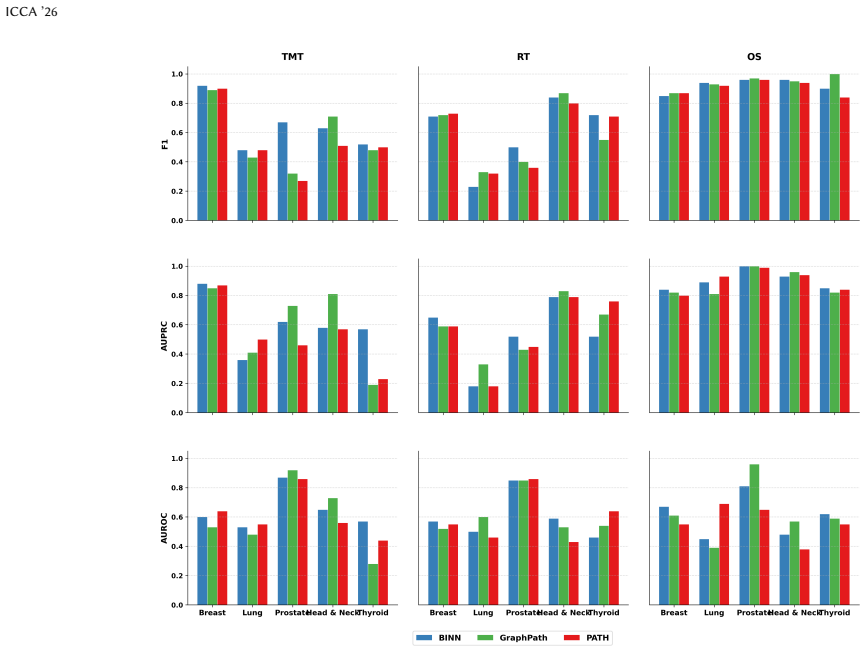
We present the first unified benchmark for pathway-guided therapy response modeling, evaluating BINN, GraphPath, and PATH across five cancer cohorts from The Cancer Genome Atlas representing 2,622 patients encoded using Reactome pathway activity scores. Each model is trained jointly on targeted molecular therapy, radiation therapy, and survival prediction under identical conditions, showing task-dependent performance with GraphPath reaching 0.92 AUROC on prostate targeted molecular therapy.
What carries the argument
The unified benchmark that jointly evaluates biologically informed deep learning architectures on multiple clinical outcomes using Reactome pathway activity scores.
If this is right
- Model performance varies by clinical task, requiring task-specific architecture selection.
- Lateral co-regulation in pathways enables high performance for targeted therapies in cancers with focused driver programs even under class imbalance.
- Radiation therapy prediction requires clinical variables beyond gene expression pathway scores.
- Joint multi-outcome training allows fair comparison of pathway-informed models.
Where Pith is reading between the lines
- Different models could be deployed depending on the therapy decision at hand in clinical settings.
- Future models might benefit from combining gene expression with clinical data for radiation decisions.
- The benchmark could be extended to additional cancer types or pathway databases to test generalizability.
- High AUROC in imbalanced data suggests utility for identifying rare responsive patients.
Load-bearing premise
Reactome pathway activity scores provide a sufficient representation of the biological information needed for therapy response modeling across the evaluated tasks.
What would settle it
A test showing whether adding clinical variables significantly improves radiation therapy prediction performance beyond what pathway scores alone achieve.
Figures

read the original abstract
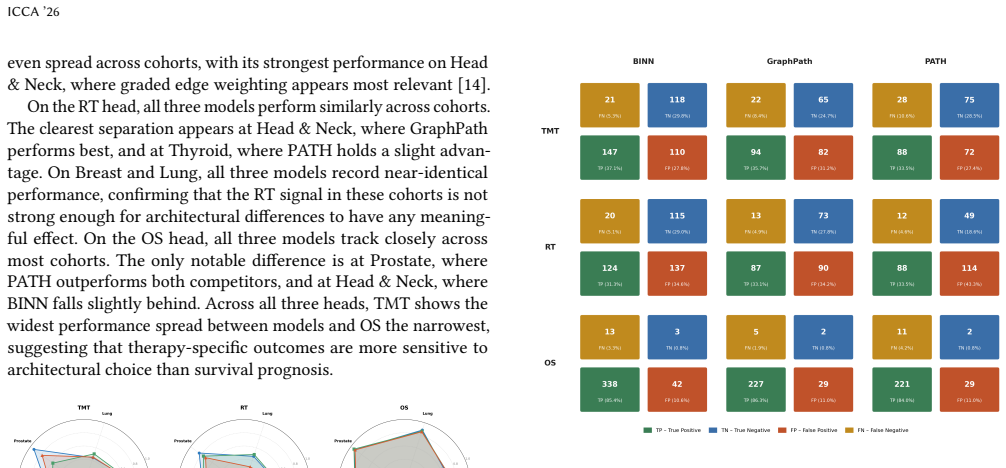
Cancer treatment planning requires decisions across multiple clinical dimensions at once. Clinicians must determine whether a patient should receive targeted molecular therapy, radiation therapy, and whether they are likely to survive beyond six months. Existing pathway-informed deep learning models have been developed and tested in isolation, making fair comparison across architectures impossible. We present the first unified benchmark for pathway-guided therapy response modeling, evaluating three biologically informed architectures, BINN, GraphPath, and PATH, across five cancer cohorts drawn from The Cancer Genome Atlas, representing 2,622 patients encoded using Reactome pathway activity scores. Each model is trained jointly on all three clinical outcomes under identical data and evaluation conditions, the first study to treat pathway-structured deep learning as a combined therapy and survival prediction problem. Our results show that no single architecture wins across all tasks: PATH performs best for targeted molecular therapy prediction overall, BINN is most reliable for survival prediction, and no model produces useful predictions for radiation therapy, as the key drivers of that decision are clinical variables not captured in gene expression data. Most strikingly, GraphPath achieves an AUROC of 0.92 on prostate targeted molecular therapy prediction, the highest score in the entire benchmark, demonstrating that lateral co-regulation structure produces exceptional discriminative power when matched to a cohort with a narrow targetable driver programme, even under conditions of extreme class imbalance at only 11\% positive prevalence.
Editorial analysis
A structured set of objections, weighed in public.
Referee Report
Summary. The manuscript introduces TRAPS, the first unified benchmark evaluating three pathway-informed architectures (BINN, GraphPath, PATH) on joint prediction of targeted molecular therapy response, radiation therapy response, and 6-month survival. It uses Reactome pathway activity scores from 2,622 TCGA patients across five cancer cohorts, with all models trained under identical multi-task conditions. Results indicate no architecture dominates all tasks (PATH strongest overall for targeted therapy, BINN for survival), no model is useful for radiation therapy (attributed to missing clinical variables), and GraphPath reaches 0.92 AUROC on prostate targeted therapy despite 11% positive prevalence, which the authors attribute to the benefits of modeling lateral co-regulation structure.
Significance. If the empirical results and data-processing pipeline hold under full scrutiny, the work supplies a reproducible, standardized multi-task benchmark that enables fair head-to-head comparison of biologically structured models—an explicit strength. The explicit acknowledgment that radiation decisions lie outside gene-expression data is a useful negative result. The GraphPath prostate result, if robust, supplies a concrete, falsifiable data point for the utility of graph-based lateral co-regulation inductive biases under narrow-driver, imbalanced regimes.
major comments (1)
- [Abstract] Abstract: The headline claim that GraphPath’s 0.92 AUROC demonstrates the discriminative power of lateral co-regulation structure under narrow driver programmes rests on the untested premise that Reactome pathway activity scores alone encode the biologically relevant signals for targeted molecular therapy response. The abstract correctly states that radiation decisions hinge on clinical variables absent from gene expression, yet supplies no parallel confirmation, ablation, or external validation (e.g., addition of mutation status or clinical covariates) that targeted-therapy labels are adequately represented by the Reactome features. This assumption is load-bearing for interpreting the result as architectural evidence rather than dataset artifact or leakage.
minor comments (2)
- [Abstract] Abstract: The five cancer cohorts are not enumerated; explicit listing would aid readers in assessing generalizability.
- [Abstract] Abstract: No mention is made of the statistical procedure used to establish that 0.92 is meaningfully higher than the other models or of how class imbalance was handled during training and evaluation.
Simulated Author's Rebuttal
We thank the referee for the detailed and constructive feedback on our manuscript. We address the single major comment below and indicate where revisions will be made to strengthen the presentation.
read point-by-point responses
-
Referee: [Abstract] Abstract: The headline claim that GraphPath’s 0.92 AUROC demonstrates the discriminative power of lateral co-regulation structure under narrow driver programmes rests on the untested premise that Reactome pathway activity scores alone encode the biologically relevant signals for targeted molecular therapy response. The abstract correctly states that radiation decisions hinge on clinical variables absent from gene expression, yet supplies no parallel confirmation, ablation, or external validation (e.g., addition of mutation status or clinical covariates) that targeted-therapy labels are adequately represented by the Reactome features. This assumption is load-bearing for interpreting the result as architectural evidence rather than dataset artifact or leakage.
Authors: We appreciate the referee’s observation that the manuscript draws an explicit parallel for radiation therapy but does not supply an equivalent statement or experiment for targeted therapy. The core contribution of the work is a controlled, multi-task benchmark that holds data, preprocessing, and training protocol fixed while varying only the model architecture; performance differences are therefore attributable to architectural inductive biases rather than differences in input representation. Nevertheless, we agree that the absolute claim that Reactome pathway scores are sufficient to represent the targeted-therapy signal would be strengthened by an explicit caveat or limited ablation. In the revised manuscript we will (i) insert a qualifying clause in the abstract stating that results are conditioned on Reactome-derived features and (ii) add a short paragraph in the Discussion acknowledging that incorporation of mutation status or clinical covariates could further validate the feature set and is left for future work. These textual changes will make the scope and limitations of the interpretation transparent without altering the benchmark design. revision: partial
Circularity Check
Empirical benchmark evaluation with no derivation chain
full rationale
The paper reports results from a unified benchmark comparing three architectures (BINN, GraphPath, PATH) on TCGA cohorts using Reactome pathway activity scores. All performance metrics (e.g., AUROC 0.92) are obtained via direct evaluation on held-out data under joint training on multiple outcomes. No equations, first-principles derivations, or parameter-fitting steps are described that reduce predictions to inputs by construction. The abstract explicitly notes limitations for radiation therapy due to missing clinical variables, confirming the work is empirical rather than deductive. No self-citation chains or ansatzes are invoked as load-bearing for the central claims.
Axiom & Free-Parameter Ledger
Reference graph
Works this paper leans on
-
[1]
Barbie, Pablo Tamayo, Jesse S
David A. Barbie, Pablo Tamayo, Jesse S. Boehm, So Young Kim, Susan E. Moody, Ian F. Dunn, Anna C. Schinzel, Peter Sandy, Etienne Meylan, Claudia Scholl, et al
-
[2]
Systematic RNA interference reveals that oncogenic KRAS-driven cancers require TBK1.Nature462, 7269 (2009), 108–112. doi:10.1038/nature08460
-
[3]
Rajamanickam Baskar, Kuo Ann Lee, Richard Yeo, and Kheng-Wei Yeoh. 2012. Cancer and radiation therapy: current advances and future directions.Interna- tional Journal of Medical Sciences9, 3 (2012), 193–199. doi:10.7150/ijms.3635
-
[4]
Harald Binder et al. 2020. Adaptive ERK Signalling Activation in Response to Therapy and In Silico Prognostic Evaluation of EGFR-MAPK in HNSCC.British Journal of Cancer(2020). doi:10.1038/s41416-020-0892-9
-
[5]
Jim Clauwaert, Gerben Menschaert, and Willem Waegeman. 2021. Explainability in transformer models for functional genomics.Briefings in Bioinformatics22, 5 (2021), bbab060. doi:10.1093/bib/bbab060
-
[6]
Dhillon, Suzanne Hagan, Oliver Rath, and Walter Kolch
Amardeep S. Dhillon, Suzanne Hagan, Oliver Rath, and Walter Kolch. 2007. MAP Kinase Signalling Pathways in Cancer.Oncogene26, 22 (2007), 3279–3290. doi:10.1038/sj.onc.1210421
-
[7]
Yifan Dou and Golrokh Mirzaei. 2025. MO-GCAN: multi-omics integration based on graph convolutional and attention networks.Bioinformatics41, 8 (2025), btaf405. doi:10.1093/bioinformatics/btaf405
-
[8]
Vijay Prakash Dwivedi and Xavier Bresson. 2021. A Generalization of Trans- former Networks to Graphs.AAAI Workshop on Deep Learning on Graphs: Methods and Applications(2021). https://arxiv.org/abs/2012.09699
arXiv 2021
-
[9]
Elmarakeby, Justin Hwang, Rand Arafeh, Jett Crowdis, Sydney Gang, David Liu, Saud H
Haitham A. Elmarakeby, Justin Hwang, Rand Arafeh, Jett Crowdis, Sydney Gang, David Liu, Saud H. AlDubayan, Keyan Salari, Steven Kregel, Camden Richter, et al
-
[10]
Nature598, 7880 (2021), 348–352
Biologically informed deep neural network for prostate cancer discovery. Nature598, 7880 (2021), 348–352. doi:10.1038/s41586-021-03922-4
-
[11]
Alexander S. Fisch et al. 2022. Precision Drugging of the MAPK Pathway in Head and Neck Cancer.npj Genomic Medicine(2022). doi:10.1038/s41525-022-00293-1
-
[12]
Yan-Li Ge et al. 2013. MiR-200c Increases the Radiosensitivity of NSCLC Cell Line A549 by Targeting VEGF-VEGFR2 Pathway.PLOS ONE(2013). https: //www.ncbi.nlm.nih.gov/pmc/articles/PMC3813610/ PMC3813610
2013
-
[13]
Marc Gillespie, Bijay Jassal, Ralf Stephan, Marija Milacic, Karen Rothfels, Andrea Senff-Ribeiro, Johannes Griss, Cristoffer Sevilla, Lisa Matthews, Chuqiao Gong, et al. 2022. The Reactome pathway knowledgebase 2022.Nucleic Acids Research 50, D1 (2022), D687–D692. doi:10.1093/nar/gkab1028
-
[14]
Goldman, Brian Craft, Mim Hastie, Kristupas Repečka, Fran McDade, Akhil Kamath, Ayan Banerjee, Yunhai Luo, Dave Rogers, Angela N
Mary J. Goldman, Brian Craft, Mim Hastie, Kristupas Repečka, Fran McDade, Akhil Kamath, Ayan Banerjee, Yunhai Luo, Dave Rogers, Angela N. Brooks, et al
-
[15]
Nature Biotechnology38 (2020), 675–678
Visualizing and interpreting cancer genomics data via the Xena platform. Nature Biotechnology38 (2020), 675–678. doi:10.1038/s41587-020-0546-8
-
[16]
Scott, Christofer Karlsson, Tirthankar Mohanty, Suvi T
Erik Hartman, Aaron M. Scott, Christofer Karlsson, Tirthankar Mohanty, Suvi T. Vaara, Adam Linder, Lars Malmström, and Johan Malmström. 2023. Interpret- ing biologically informed neural networks for enhanced proteomic biomarker discovery and pathway analysis.Nature Communications14 (2023), 5359. doi:10.1038/s41467-023-41146-4
-
[17]
Koushik Howlader, Md Tauhidul Islam, and Wei Le. 2026. Graph Transformer- Based Pathway Embedding for Cancer Prognosis. arXiv:2604.16685 [cs.LG] https://arxiv.org/abs/2604.16685
Pith/arXiv arXiv 2026
-
[18]
Zhi Huang, Xiaohui Zhan, Shuo Xiang, Travis S. Johnson, Bryan R. Helm, Christina Y. Yu, Jie Zhang, Paul Salama, Monther Rizkalla, Zhi Han, and Kun Huang. 2019. SALMON: Survival Analysis Learning With Multi-Omics Neural Networks on Breast Cancer.Frontiers in Genetics10 (2019), 166. doi:10.3389/ fgene.2019.00166
arXiv 2019
-
[19]
Yuexu Jiang, Manish Sridhar Immadi, Duolin Wang, Shuai Zeng, Yen On Chan, Jing Zhou, Dong Xu, and Trupti Joshi. 2024. IRnet: Immunotherapy response prediction using pathway knowledge-informed graph neural network.Journal of Advanced Research72 (2024), 319–331. doi:10.1016/j.jare.2024.07.036
-
[20]
Diederik P. Kingma and Jimmy Ba. 2015. Adam: A method for stochastic optimization. InInternational Conference on Learning Representations (ICLR). https://arxiv.org/abs/1412.6980
Pith/arXiv arXiv 2015
-
[21]
Hiroki Kudo et al . 2025. Androgen Receptor Contributes to Radioresistance Through DNA Repair and Autophagy in AR-Positive Prostate Cancer Cells. bioRxiv. doi:10.64898/2025.12.03.690226
-
[22]
Wei Lan, Haibo Liao, Qingfeng Chen, Ling-ling Zhu, Yi Pan, and Yi-Ping Phoebe Chen. 2024. DeepKEGG: a multi-omics data integration framework with biologi- cal insights for cancer recurrence prediction and biomarker discovery.Briefings in Bioinformatics25, 3 (2024), bbae185. doi:10.1093/bib/bbae185
-
[23]
Dohee Lee, Jaegyoon Ahn, and Jonghwan Choi. 2025. PathNetDRP: a novel biomarker discovery framework using pathway and protein–protein interaction networks for immune checkpoint inhibitor response prediction.BMC Bioinfor- matics26, 1 (2025), 119. doi:10.1186/s12859-025-06125-0
-
[24]
Jin, Mingzhu Lou, Shaobo Deng, Lei Wang, and Hua Rao
Min Li, M. Jin, Mingzhu Lou, Shaobo Deng, Lei Wang, and Hua Rao. 2025. Multiview-cooperated graph neural network enables novel multi-omics can- cer subtype classification.Computational Biology and Chemistry(2025). doi:10. 1016/j.compbiolchem.2025.108560
arXiv 2025
-
[25]
Xiangmei Li, Bin Pan, Yao He, et al. 2025. PathHDNN: a pathway hierarchical- informed deep neural network framework for predicting immunotherapy re- sponse and mechanism interpretation.Genome Medicine17 (2025), 152. doi:10. 1186/s13073-025-01584-9
2025
-
[26]
Cheng-Pei Lin, Yann-Jen Ho, Yen-Peng Chiu, Yun Tang, You Sheng Paik, Guan Chen, Wei-Chih Huang, and Tzong-Yi Lee. 2026. MoAGNN: a multi-omics hier- archical graph neural network for subtype classification and prognosis predic- tion in lung adenocarcinoma.Briefings in Bioinformatics27, 1 (2026), bbaf735. doi:10.1093/bib/bbaf735
-
[27]
Xiaofan Liu, Yuhuan Tao, Zilin Cai, Pengfei Bao, Hongli Ma, Kexing Li, Mingyue Li, Yongchang Zhu, and Zhi John Lu. 2024. Pathformer: a biological pathway informed transformer for disease diagnosis and prognosis using multi-omics data. Bioinformatics40, 5 (2024), btae316. doi:10.1093/bioinformatics/btae316
-
[28]
Ilya Loshchilov and Frank Hutter. 2019. Decoupled weight decay regularization. InInternational Conference on Learning Representations (ICLR). https://arxiv.org/ abs/1711.05101
Pith/arXiv arXiv 2019
-
[29]
Lundberg and Su-In Lee
Scott M. Lundberg and Su-In Lee. 2017. A unified approach to interpret- ing model predictions. InAdvances in Neural Information Processing Sys- tems (NeurIPS), Vol. 30. https://papers.nips.cc/paper_files/paper/2017/hash/ 8a20a8621978632d76c43dfd28b67767-Abstract.html
2017
-
[30]
Teng Ma and Jianxin Wang. 2024. GraphPath: a graph attention model for molecu- lar stratification with interpretability based on the pathway–pathway interaction network.Bioinformatics40, 4 (2024), btae165. doi:10.1093/bioinformatics/btae165
-
[31]
Teng Ma, Haochen Zhao, Qichang Zhao, and Jianxin Wang. 2024. Cox-Path: Biological Pathway-Informed Graph Neural Network for Cancer Survival Pre- diction. InProceedings of the 15th ACM International Conference on Bioinfor- matics, Computational Biology and Health Informatics (BCB ’24). 70:1–70:6. doi:10.1145/3698587.3701397
-
[32]
Hye-Young Min and Ho-Young Lee. 2022. Molecular targeted therapy for anti- cancer treatment.Experimental & Molecular Medicine54, 10 (2022), 1670–1694. doi:10.1038/s12276-022-00864-3
-
[33]
Masataka Okabe and Kei Ito. 2008. Color universal design (CUD): How to make figures and presentations that are friendly to colorblind people.Color Universal Design Organization technical note(2008). https://jfly.uni-koeln.de/color/
2008
-
[34]
Parikh, Christopher Manz, Corey Chivers, et al
Ravi B. Parikh, Christopher Manz, Corey Chivers, et al. 2019. Machine learning approaches to predict 6-month mortality among patients with cancer.JAMA Network Open2, 10 (2019), e1915997. doi:10.1001/jamanetworkopen.2019.15997
-
[35]
Adam Paszke, Sam Gross, Francisco Massa, Adam Lerer, James Bradbury, Gregory Chanan, Trevor Killeen, Zeming Lin, Natalia Gimelshein, Luca Antiga, et al. 2019. PyTorch: An imperative style, high-performance deep learning library.Advances in Neural Information Processing Systems32 (2019). https://papers.nips.cc/paper_ files/paper/2019/hash/bdbca288fee7f92f2...
2019
-
[36]
Pedregosa, G
F. Pedregosa, G. Varoquaux, A. Gramfort, V. Michel, B. Thirion, O. Grisel, M. Blondel, P. Prettenhofer, R. Weiss, V. Dubourg, et al. 2011. Scikit-learn: Machine learning in Python.Journal of Machine Learning Research12 (2011), 2825–2830. https://www.jmlr.org/papers/v12/pedregosa11a.html
2011
-
[37]
Ethan Perez, Florian Strub, Harm de Vries, Vincent Dumoulin, and Aaron Courville. 2018. FiLM: Visual reasoning with a general conditioning layer. In Proceedings of the AAAI Conference on Artificial Intelligence, Vol. 32. doi:10.1609/ aaai.v32i1.11671
2018
-
[38]
Olivier B Poirion, Zheng Jing, Kuldeep Chaudhary, Sijia Huang, and Lana X Garmire. 2021. DeepProg: an ensemble of deep-learning and machine-learning models for prognosis prediction using multi-omics data.Genome Medicine13, 1 (2021), 112. doi:10.1186/s13073-021-00930-x
-
[39]
Rikard Rosenbacke, Åsa Melhus, Martin McKee, and David Stuckler. 2024. How Explainable Artificial Intelligence Can Increase or Decrease Clinicians’ Trust in AI Applications in Health Care: Systematic Review.JMIR AI3 (2024), e53207. doi:10.2196/53207 9 ICCA ’26
-
[40]
Decoding of the speech envelope from EEG using the VLAAI deep neural network,
Chris J. Sidey-Gibbons, Charlotte Sun, Alina Schneider, et al. 2022. Predicting 180- day mortality for women with ovarian cancer using machine learning and patient- reported outcome data.Scientific Reports12, 1 (2022), 20614. doi:10.1038/s41598- 022-22614-1
-
[41]
Srinivasa Prasad Sisinthy and Dhruv L. Bhatt. 2021. Everything Old Is New Again: Drug Repurposing Approach for NSCLC Targeting MAPK Signaling Pathway. Frontiers in Oncology11 (2021). doi:10.3389/fonc.2021.741326
-
[42]
Mootha, Sayan Mukherjee, Ben- jamin L
Aravind Subramanian, Pablo Tamayo, Vamsi K. Mootha, Sayan Mukherjee, Ben- jamin L. Ebert, Michael A. Gillette, Amanda Paulovich, Scott L. Pomeroy, Todd R. Golub, Eric S. Lander, and Jill P. Mesirov. 2005. Gene set enrichment analysis: a knowledge-based approach for interpreting genome-wide expression profiles. Proceedings of the National Academy of Scienc...
-
[43]
The Cancer Genome Atlas Network. 2012. Comprehensive molecular portraits of human breast tumours.Nature490, 7418 (2012), 61–70. doi:10.1038/nature11412
-
[44]
Petar Veličković, Guillem Cucurull, Arantxa Casanova, Adriana Romero, Pietro Liò, and Yoshua Bengio. 2018. Graph attention networks. InInternational Confer- ence on Learning Representations (ICLR). https://arxiv.org/abs/1710.10903
Pith/arXiv arXiv 2018
-
[45]
Di Wang, Chupei Tang, Junxiao Kong, Jixiu Zhai, Moyu Tang, and Tianchi Lu
-
[46]
arXiv:2604.24371 [cs.LG] https://arxiv.org/abs/2604
PathMoG: A Pathway-Centric Modular Graph Neural Network for Multi- Omics Survival Prediction. arXiv:2604.24371 [cs.LG] https://arxiv.org/abs/2604. 24371
-
[47]
Johnson, Paul A
Asim Waqas, Aakash Tripathi, Sabeen Ahmed, Ashwin Mukund, Hamza Farooq, Joseph O. Johnson, Paul A. Stewart, Mia Naeini, Matthew B. Schabath, and Ghulam Rasool. 2025. Self-Normalizing Multi-Omics Neural Network for Pan- Cancer Prognostication.International Journal of Molecular Sciences26, 15 (2025),
2025
-
[48]
doi:10.3390/ijms26157358
-
[49]
John N. Weinstein, Eric A. Collisson, Gordon B. Mills, Kenna R. Mills Shaw, Brad A. Ozenberger, Kyle Ellrott, Ilya Shmulevich, Chris Sander, and Joshua M. Stuart. 2013. The Cancer Genome Atlas Pan-Cancer analysis project.Nature Genetics45, 10 (2013), 1113–1120. doi:10.1038/ng.2764
-
[50]
Gang Wen and Limin Li. 2023. FGCNSurv: dually fused graph convolutional network for multi-omics survival prediction.Bioinformatics39, 8 (2023), btad472. doi:10.1093/bioinformatics/btad472
-
[51]
Bang Wong. 2011. Points of view: Color blindness.Nature Methods8, 6 (2011),
2011
-
[52]
doi:10.1038/nmeth.1618
-
[53]
Magdalena Wysocka, Oskar Wysocki, Marie Zufferey, Dónal Landers, and André Freitas. 2023. A systematic review of biologically-informed deep learning models for cancer: fundamental trends for encoding and interpreting oncology data. BMC Bioinformatics24 (2023), 198. doi:10.1186/s12859-023-05262-8
-
[54]
Hongxi Yan, Dawei Weng, Dongguo Li, Yu Gu, Wenjie Ma, and Qingjie Liu
-
[55]
Prior knowledge-guided multilevel graph neural network for tumor risk prediction and interpretation via multi-omics data integration.Briefings in Bioinformatics25, 3 (2024), bbae184. doi:10.1093/bib/bbae184
-
[56]
Jiayang Zhang, Yilin Che, Rongrong Liu, Zhicheng Wang, and Weiwu Liu. 2025. Deep learning–driven multi-omics analysis: enhancing cancer diagnostics and therapeutics.Briefings in Bioinformatics26, 4 (2025), bbaf440. doi:10.1093/bib/ bbaf440
-
[57]
Tinghe Zhang, Md Hasib, Yu-Chiao Chiu, Zhizhong Han, Yu-Fang Jin, Mario Flo- res, Yidong Chen, and Yufei Huang. 2022. Transformer for Gene Expression Mod- eling (T-GEM): An Interpretable Deep Learning Model for Gene Expression-Based Phenotype Predictions.Cancers14, 19 (2022), 4763. doi:10.3390/cancers14194763
-
[58]
Lianhe Zhao, Qiongye Dong, Chunlong Luo, Yang Wu, Dechao Bu, Xiaoning Qi, Yufan Luo, and Yi Zhao. 2021. DeepOmix: A scalable and interpretable multi-omics deep learning framework and application in cancer survival analysis. Computational and Structural Biotechnology Journal19 (2021), 2719–2725. doi:10. 1016/j.csbj.2021.04.067
2021
-
[59]
Yue Zhao et al. 2015. Prognostic Values of ERK1/2 and p-ERK1/2 Expressions for Poor Survival in Non-Small Cell Lung Cancer.Tumor Biology(2015). doi:10. 1007/s13277-015-3048-4
2015
-
[60]
Rong Zheng et al. 2015. TAT-ODD-p53 Enhances Radiosensitivity of Hypoxic Breast Cancer Cells by Inhibiting Parkin-Mediated Mitophagy.Oncotarget(2015). https://www.ncbi.nlm.nih.gov/pmc/articles/PMC4627318/ PMC4627318
2015
-
[61]
Jiening Zhu, John H. Oh, Anish K. Simhal, Rena Elkin, Larry Norton, Joseph O. Deasy, and Allen Tannenbaum. 2023. Geometric graph neural networks on multi-omics data to predict cancer survival outcomes.Computers in Biology and Medicine163 (2023), 107117. doi:10.1016/j.compbiomed.2023.107117
-
[62]
Payam Zohari and Mostafa Haghir Chehreghani. 2025. Graph Neural Net- works in Multi-Omics Cancer Research: A Structured Survey.arXiv(2025). arXiv:2506.17234 https://arxiv.org/abs/2506.17234 10
arXiv 2025
discussion (0)
Sign in with ORCID, Apple, or X to comment. Anyone can read and Pith papers without signing in.