Beyond the interface: Persistent Hopping Transport and Frequency Dispersion in Strong-inversion Cryogenic MOSFETs
Pith reviewed 2026-06-26 23:19 UTC · model grok-4.3
The pith
Cryogenic MOSFETs with high channel doping show persistent frequency dispersion in strong inversion due to variable-range hopping through band-tail states distributed throughout the depletion region.
A machine-rendered reading of the paper's core claim, the machinery that carries it, and where it could break.
Core claim
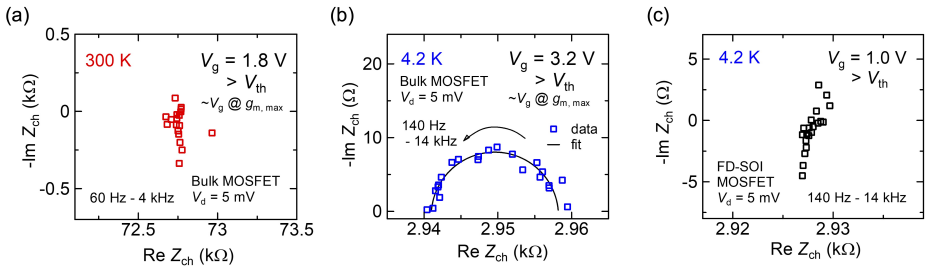
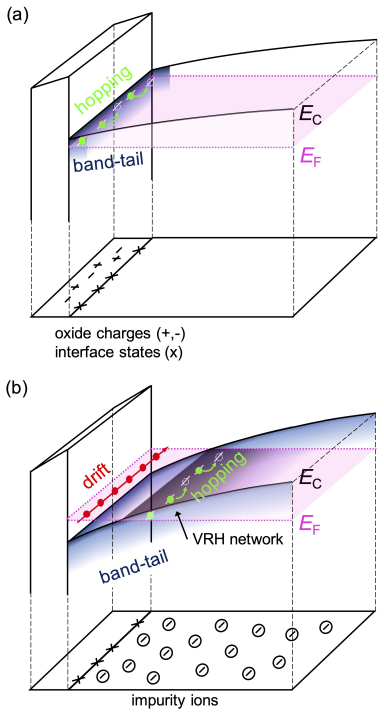
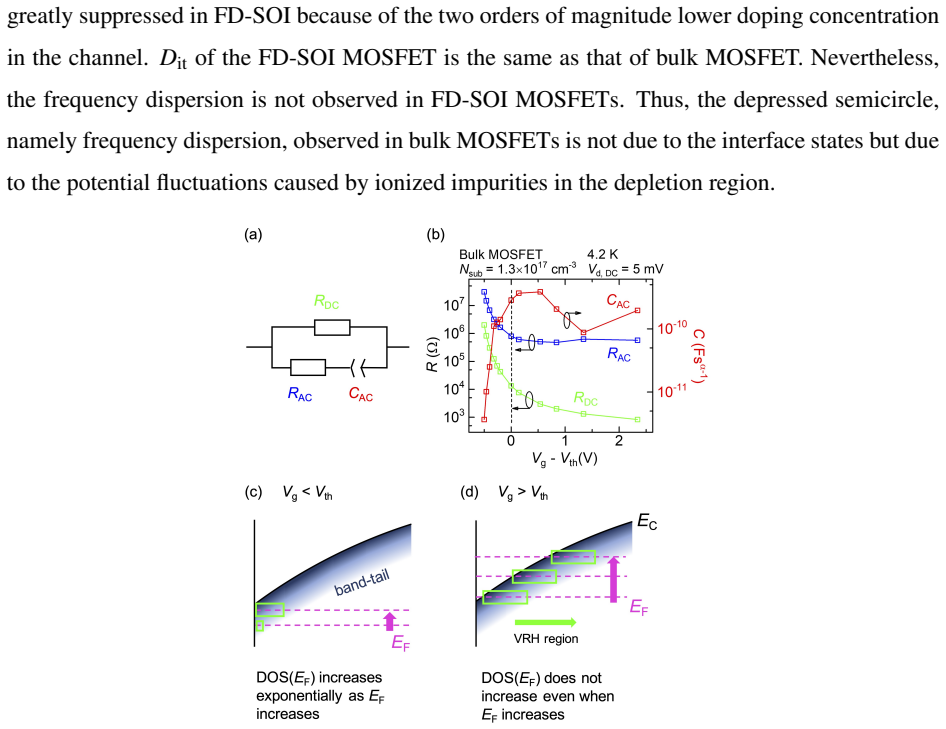
In MOSFETs with high channel doping the band-tail states are induced by ionized impurities and distributed throughout the depletion region, enabling variable-range hopping that produces frequency dispersion in channel impedance even when drift conduction dominates; the dispersion is characterized as a depressed semicircle via Cole-Cole plots and accounts for the observed behavior under strong inversion.
What carries the argument
Variable-range hopping through ionized-impurity-induced band-tail localized states distributed throughout the depletion region
If this is right
- Ionized-impurities-induced hopping governs the dynamic response of cryo-MOSFET channel impedance even when drift conduction dominates.
- Accurate small-signal modeling of cryogenic MOSFETs must incorporate this intrinsic dispersion mechanism.
- High-frequency cryo-CMOS circuit design requires accounting for hopping transport through depletion-region band-tail states.
- The paradigm explains frequency dispersion that continues under strong inversion conditions.
Where Pith is reading between the lines
- The mechanism suggests that doping profiles could be engineered to reduce unwanted dispersion in quantum-interface circuits.
- Similar impurity-induced states may appear in other low-temperature semiconductor systems where drift and hopping compete.
- Direct spatial mapping of band-tail density through the depletion region would provide an independent test of the distribution claim.
- Temperature-dependent activation energies extracted from the hopping model could be compared against impurity ionization levels to strengthen the causal link.
Load-bearing premise
The observed frequency dispersion is intrinsic to the channel and the Cole-Cole plot shape specifically confirms variable-range hopping via band-tail states distributed throughout the depletion region.
What would settle it
Impedance measurements on otherwise identical devices fabricated with low channel doping that show no frequency dispersion or a different Cole-Cole shape would falsify the attribution to ionized-impurity-induced band-tail states throughout the depletion region.
Figures

read the original abstract
Cryogenic complementary metal-oxide-semiconductor (cryo-CMOS) technology is essential for quantum computing interfaces, which require precise modeling of dynamic device behavior. The output impedance of MOS field-effect transistors (MOSFETs) is frequency dependent, which has been conventionally attributed to extrinsic parasitics. Here, we report an intrinsic frequency dispersion in the channel impedance of cryogenic MOSFETs that persists deep into the strong-inversion region. Through a Cole-Cole analysis, we characterize this dispersion as a depressed semicircle in the impedance plane and attribute its behavior to variable-range hopping through band-tail localized states. Unlike conventional models where band-tail states are confined to the oxide interface, we demonstrate that in MOSFETs with high channel doping the band-tail states are induced by ionized impurities and distributed throughout the depletion region. Our paradigm accounts for frequency dispersion under strong inversion. This work demonstrates that ionized-impurities-induced hopping governs the dynamic response of cryo-MOSFETs channel impedance even when drift conduction dominates, offering critical insights for accurate small-signal modeling and high-frequency cryo-CMOS circuit design.
Editorial analysis
A structured set of objections, weighed in public.
Referee Report
Summary. The manuscript reports an intrinsic frequency dispersion in the channel impedance of cryogenic high-doped MOSFETs that persists deep into strong inversion. Cole-Cole plots of the impedance exhibit depressed semicircles, which the authors attribute to variable-range hopping through band-tail localized states induced by ionized impurities and distributed throughout the depletion region (rather than confined to the oxide interface). This mechanism is proposed to govern the dynamic response even when drift conduction dominates, with implications for small-signal modeling in cryo-CMOS circuits.
Significance. If the central interpretation holds, the result would provide a microscopic explanation for frequency dispersion in strong inversion that is absent from standard interface-state models, directly affecting accurate high-frequency modeling of cryo-CMOS devices used in quantum interfaces. The work highlights an intrinsic channel effect over extrinsic parasitics and could guide doping and temperature-dependent device design.
major comments (2)
- [Abstract] Abstract and results sections: The depressed semicircle in the Cole-Cole plot is presented as diagnostic of variable-range hopping in impurity-induced band-tail states distributed throughout the depletion region. However, a depressed semicircle is a generic signature of any broad distribution of relaxation times and does not, by itself, discriminate between interface-confined states, depletion-region states, or other mechanisms; additional evidence (e.g., explicit doping-series scaling of the dispersion with depletion width or temperature-activated VRH signatures) is required to make the spatial and microscopic attribution load-bearing.
- [Abstract] The claim that the observed dispersion is intrinsic to the channel (and not due to extrinsic parasitics) rests on the persistence into strong inversion, but without quantitative exclusion of parasitic contributions (e.g., via comparison to low-doped control devices or explicit parasitic modeling), the interpretation that ionized-impurity band tails throughout the depletion region are the dominant cause remains under-supported.
minor comments (2)
- Notation for the Cole-Cole parameters (e.g., the depression angle or characteristic frequency) should be defined explicitly with reference to the equivalent-circuit model used.
- The manuscript would benefit from a brief comparison table or figure overlaying the observed dispersion against conventional interface-trap models to quantify the improvement.
Simulated Author's Rebuttal
We thank the referee for the careful and constructive review. We address each major comment below with clarifications drawn from the manuscript and indicate planned revisions.
read point-by-point responses
-
Referee: [Abstract] Abstract and results sections: The depressed semicircle in the Cole-Cole plot is presented as diagnostic of variable-range hopping in impurity-induced band-tail states distributed throughout the depletion region. However, a depressed semicircle is a generic signature of any broad distribution of relaxation times and does not, by itself, discriminate between interface-confined states, depletion-region states, or other mechanisms; additional evidence (e.g., explicit doping-series scaling of the dispersion with depletion width or temperature-activated VRH signatures) is required to make the spatial and microscopic attribution load-bearing.
Authors: We agree that a depressed semicircle alone does not uniquely identify the mechanism. The manuscript's attribution rests on the combination of the Cole-Cole signature with the observed scaling of dispersion magnitude with channel doping (which sets ionized-impurity density and depletion width) and with temperature, where the frequency dependence follows the expected VRH form. We will revise the abstract and results sections to state these supporting observations more explicitly and to clarify how they constrain the states to the depletion region rather than the interface. revision: yes
-
Referee: [Abstract] The claim that the observed dispersion is intrinsic to the channel (and not due to extrinsic parasitics) rests on the persistence into strong inversion, but without quantitative exclusion of parasitic contributions (e.g., via comparison to low-doped control devices or explicit parasitic modeling), the interpretation that ionized-impurity band tails throughout the depletion region are the dominant cause remains under-supported.
Authors: Persistence deep into strong inversion is the primary argument, because interface-state and most parasitic contributions are screened once the surface potential places the Fermi level well into the conduction band. The manuscript already contains explicit parasitic modeling showing that standard package and interconnect contributions cannot reproduce the measured impedance dispersion. We will expand this modeling discussion in the revised manuscript and add a quantitative statement on the doping dependence as further discrimination against extrinsic effects. revision: partial
Circularity Check
No significant circularity; interpretation rests on standard Cole-Cole phenomenology without definitional reduction
full rationale
The paper observes frequency dispersion persisting into strong inversion and reports a depressed semicircle via Cole-Cole analysis, then attributes this to VRH through impurity-induced band-tail states distributed across the depletion region. No equations, fitted parameters renamed as predictions, or self-citations are shown that would make the claimed mechanism equivalent to the inputs by construction. The attribution is an interpretive step from a generic signature of distributed relaxation times, but the derivation chain contains no self-definitional loops, load-bearing self-citations, or ansatzes smuggled via prior work. The result is therefore self-contained as an empirical interpretation rather than a forced identity.
Axiom & Free-Parameter Ledger
axioms (1)
- domain assumption Depressed semicircle in Cole-Cole impedance plot indicates variable-range hopping through band-tail localized states
invented entities (1)
-
band-tail localized states distributed throughout the depletion region
no independent evidence
Reference graph
Works this paper leans on
-
[1]
Cryo-. IEEE J. Solid-State Circuits , author =. 2018 , pages =. doi:10.1109/JSSC.2017.2737549 , abstract =
-
[2]
IEEE Journal of the Electron Devices Society
Incandela, \ Rosario M.\ and Lin Song and Harald Homulle and Edoardo Charbon and Andrei Vladimirescu and Fabio Sebastiano. IEEE Journal of the Electron Devices Society. 2018. doi:10.1109/JEDS.2018.2821763
-
[3]
and Gupta, Sumreti and Vega, Reinaldo A
Singh, Sujit K. and Gupta, Sumreti and Vega, Reinaldo A. and Dixit, Abhisek , journal=. 2022 , volume=
2022
-
[4]
2024 , volume=
Tada, Munehiro and Okamoto, Koichiro and Tanaka, Takahisa and Miyamura, Makoto and Ishikuro, Hiroki and Uchida, Ken and Sakamoto, Toshitsugu , journal=. 2024 , volume=
2024
-
[5]
Technical Digest - International Electron Devices Meeting
Ken Uchida and Junji Koga and Takagi, \ Shin ichi\. Technical Digest - International Electron Devices Meeting. 2003
2003
-
[6]
, journal=
Yujun Li and Ma, T.-P. , journal=. 1998 , volume=
1998
-
[7]
and Cristoloveanu, S
Ouisse, T. and Cristoloveanu, S. and Elewa, T. and Haddara, H. and Borel, G. and Ioannou, D.E. , journal=. 1991 , volume=
1991
-
[8]
2022 , volume=
Miyao, Tomohisa and Tanaka, Takahisa and Imanishi, Itsuki and Ichikawa, Masayuki and Nakagawa, Shuya and Ishikuro, Hiroki and Sakamoto, Toshitsugu and Tada, Munehiro and Uchida, Ken , booktitle=. 2022 , volume=
2022
-
[9]
Tsui, D. C. and Allen, S. J. , journal =. 1974 , month =. doi:10.1103/PhysRevLett.32.1200 , url =
-
[10]
M. Pepper and S. Pollitt and C.J. Adkins and R.E. Oakeley , abstract =. Physics Letters A , volume =. 1974 , issn =. doi:https://doi.org/10.1016/0375-9601(74)90111-X , url =
-
[11]
J. Phys. C: Solid State Phys. , author =. 1975 , pages =. doi:10.1088/0022-3719/8/11/007 , abstract =
-
[12]
Zittartz, J. and Langer, J. S. , journal =. 1966 , month =. doi:10.1103/PhysRev.148.741 , url =
-
[13]
Journal of Physics C: Solid State Physics , abstract =
D J Thouless and M E Elzain , title =. Journal of Physics C: Solid State Physics , abstract =. 1978 , month =. doi:10.1088/0022-3719/11/16/012 , url =
-
[14]
Cole, Kenneth S. and Cole, Robert H. , title =. The Journal of Chemical Physics , volume =. 1941 , month =. doi:10.1063/1.1750906 , url =
-
[15]
Low-. Phys. Rev. , author =. 1961 , pages =. doi:10.1103/PhysRev.122.1742 , language =
-
[16]
Golin, Stuart , journal =. 1963 , month =. doi:10.1103/PhysRev.132.178 , url =
-
[17]
Appl. Phys. Express , author =. 2024 , pages =. doi:10.35848/1882-0786/ad3d2a , abstract =
-
[18]
F. Argall and A.K. Jonscher , abstract =. Thin Solid Films , volume =. 1968 , issn =. doi:https://doi.org/10.1016/0040-6090(68)90002-3 , url =
-
[19]
E.B. Ivkin and B.T. Kolomiets , abstract =. Journal of Non-Crystalline Solids , volume =. 1970 , issn =. doi:https://doi.org/10.1016/0022-3093(70)90104-3 , url =
-
[20]
Journal of Non-Crystalline Solids , volume =
Howard K Rockstad , abstract =. Journal of Non-Crystalline Solids , volume =. 1972 , note =. doi:https://doi.org/10.1016/0022-3093(72)90201-3 , url =
-
[21]
M.S. Frost and A.K. Jonscher , abstract =. Thin Solid Films , volume =. 1975 , issn =. doi:https://doi.org/10.1016/0040-6090(75)90211-4 , url =
-
[22]
N. F. Mott , title =. The Philosophical Magazine: A Journal of Theoretical Experimental and Applied Physics , volume =. 1969 , publisher =. doi:10.1080/14786436908216338 , URL =
-
[23]
Solid-State Electronics , author =
Characterization and modeling of 28-nm. Solid-State Electronics , author =. 2019 , pages =. doi:10.1016/j.sse.2019.03.033 , abstract =
-
[24]
Theoretical. IEEE Electron Device Lett. , author =. 2020 , pages =. doi:10.1109/LED.2019.2963379 , abstract =
-
[25]
Physical. IEEE J. Electron Devices Soc. , author =. 2020 , pages =. doi:10.1109/JEDS.2020.2989629 , abstract =
-
[26]
2020 , volume=
Beckers, Arnout and Jazaeri, Farzan and Enz, Christian , journal=. 2020 , volume=
2020
-
[27]
Physics-. IEEE Trans. Nanotechnology , author =. doi:10.1109/TNANO.2023.3314811 , abstract =
-
[28]
2025 , volume=
Beckers, Arnout , journal=. 2025 , volume=
2025
-
[29]
Cryogenic. IEEE Electron Device Lett. , author =. 2019 , pages =. doi:10.1109/LED.2019.2903111 , abstract =
-
[30]
and Han, Y
Richstein, B. and Han, Y. and Zhao, Q. and Hellmich, L. and Klos, J. and Scholz, S. and Schreiber, L. R. and Knoch, J. , journal=. 2022 , volume=
2022
-
[31]
Influence of substrate impurity concentration on sub-threshold swing of. Jpn. J. Appl. Phys. , author =. 2023 , pages =. doi:10.35848/1347-4065/acb362 , abstract =
-
[32]
In2023 International Electron Devices Meeting (IEDM), 1–4 (2023)
Oka, H. and Asai, H. and Inaba, T. and Shitakata, S. and Yui, H. and Fuketa, H. and Iizuka, S. and Kato, K. and Nakayama, T. and Mori, T. , month = dec, year =. Milli-. 2023. doi:10.1109/IEDM45741.2023.10413872 , urldate =
-
[33]
Solid-State Electronics , author =
On the modelling of temperature dependence of subthreshold swing in. Solid-State Electronics , author =. 2020 , pages =. doi:10.1016/j.sse.2020.107820 , abstract =
-
[34]
Analytical. IEEE Electron Device Lett. , author =. 2024 , pages =. doi:10.1109/LED.2023.3331022 , abstract =
-
[35]
Origin of. IEEE Access , author =. 2023 , pages =. doi:10.1109/ACCESS.2023.3327731 , abstract =
-
[36]
Understanding the. IEEE Trans. Electron Devices , author =. 2023 , pages =. doi:10.1109/TED.2022.3233551 , abstract =
-
[37]
Performance and. IEEE Trans. Electron Devices , author =. 2020 , pages =. doi:10.1109/TED.2020.3021999 , abstract =
-
[38]
Cryogenic. IEEE J. Electron Devices Soc. , author =. 2024 , pages =. doi:10.1109/JEDS.2024.3432283 , abstract =
-
[39]
Enz, Christian and Han, Hung-Chi , month = may, year =. Design of. 2023. doi:10.1109/ISCAS46773.2023.10181986 , urldate =
-
[40]
Shklovskii, Boris I. and Efros, Alex L. , editor =. Electronic. doi:10.1007/978-3-662-02403-4 , urldate =
-
[41]
Modeling of the cryogenic conductivity of highly doped silicon in advanced. Appl. Phys. Express , author =. 2025 , pages =. doi:10.35848/1882-0786/ae077f , abstract =
discussion (0)
Sign in with ORCID, Apple, or X to comment. Anyone can read and Pith papers without signing in.