AI Persuasive Framing in Collective Dilemmas
Pith reviewed 2026-06-29 02:14 UTC · model grok-4.3
The pith
Personalized AI framing raises short-term contributions in collective risk games but selfish versions reduce them more and longer.
A machine-rendered reading of the paper's core claim, the machinery that carries it, and where it could break.
Core claim
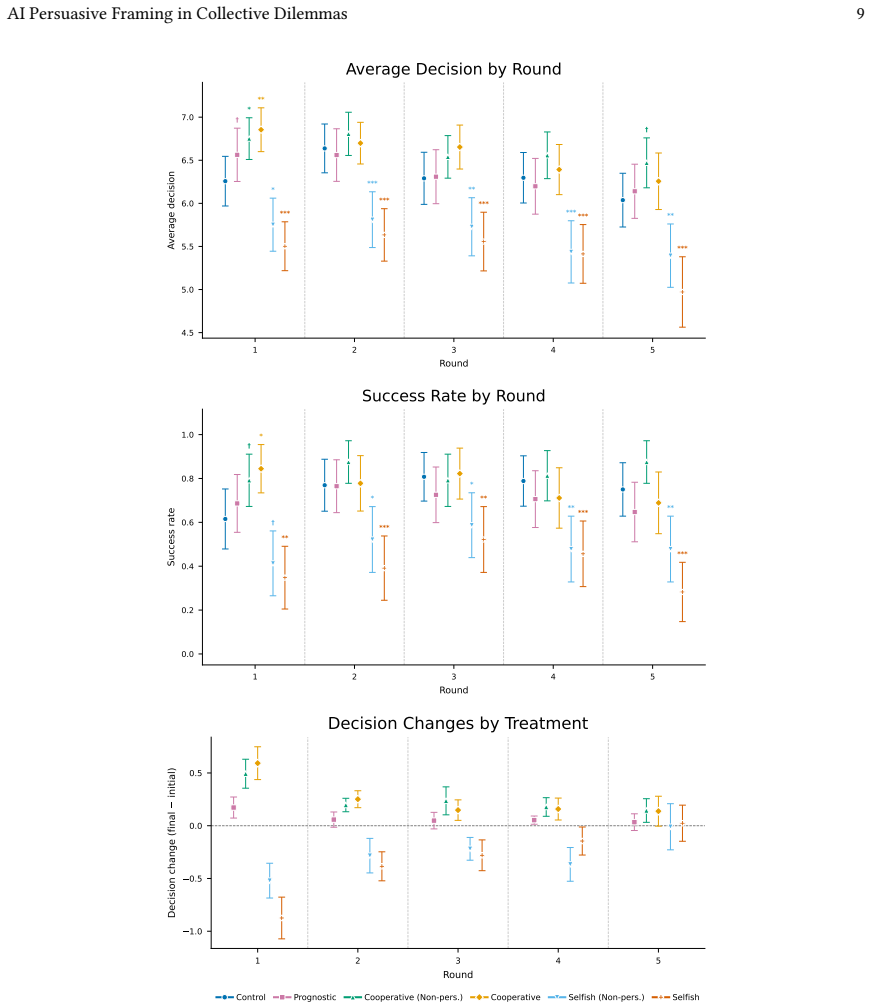
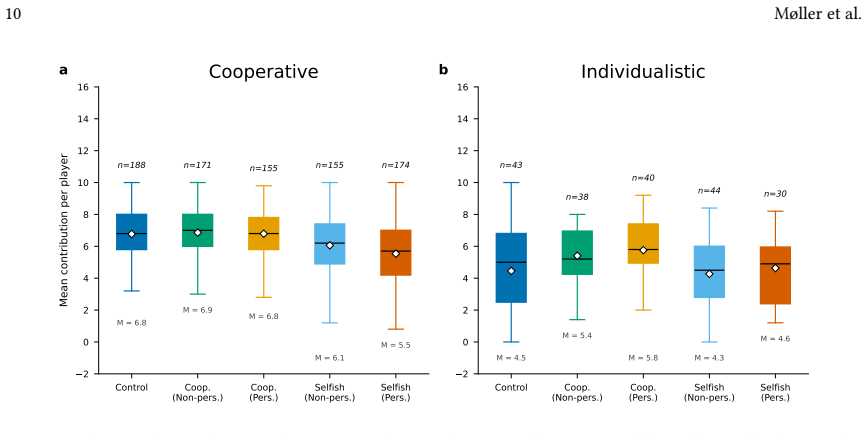
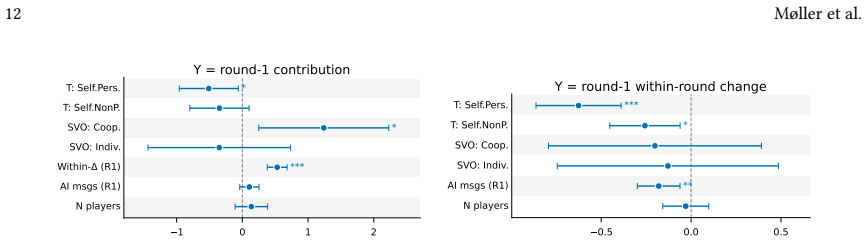
In small groups playing iterated Collective Risk Games, AI assistants that used persuasive framing matched to each player's Social Value Orientation profile significantly raised individual contributions and group success rates. These cooperative gains lasted only through the first few rounds before fading. When the same AI system was instead set to promote selfish behavior with exculpatory framing, the reductions in contributions and success rates were larger in magnitude and substantially more persistent over time, with personalization amplifying the negative impact.
What carries the argument
AI persuasive framing personalized to each player's Social Value Orientation profile, which tailors messages to encourage or discourage contributions within the iterated Collective Risk Game.
If this is right
- AI assistants can temporarily increase cooperation and collective success in repeated group risk settings when messages are personalized.
- The same AI capability produces larger and longer-lasting reductions in cooperation when reconfigured to promote selfish behavior.
- Personalization strengthens both the short-term cooperative boost and the more enduring antisocial effect.
- Prosocial AI effects are limited to initial rounds while antisocial effects endure across more rounds.
- AI systems carry dual-use potential for influencing collective action outcomes in either direction.
Where Pith is reading between the lines
- Safeguards against repurposing cooperative AI nudges for defection may be needed in deployed systems.
- The observed asymmetry could be tested by varying message framing intensity or combining it with repeated exposure over longer game horizons.
- Real-world collective action problems such as public goods contributions might show similar patterns if AI framing is introduced.
- Designs that aim to sustain prosocial effects could draw on the mechanisms that make selfish framing more durable.
Load-bearing premise
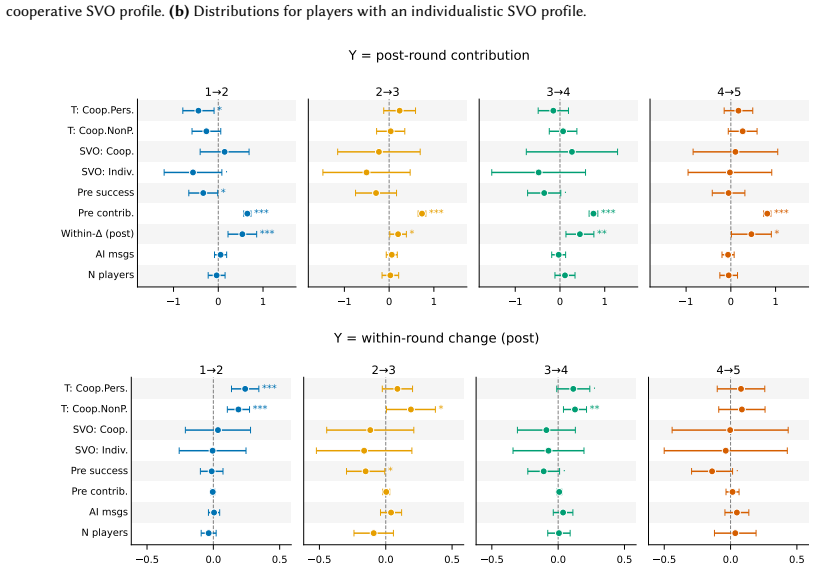
Observed differences in contributions can be attributed to the AI framing manipulation rather than unmeasured group dynamics, order effects, or selection into the participant pool, and the Social Value Orientation instrument validly captures the individual differences that matter for personalization.
What would settle it
A follow-up experiment in which contributions and success rates show no reliable difference between the personalized prosocial AI condition and a neutral control, or in which the negative effects of selfish framing fade at the same rate as the positive effects.
Figures





read the original abstract
AI agents are promising tools that can act as flexible behavioral nudges to enhance human cooperation in addressing large-scale societal problems. However, evidence on whether AI agents can effectively boost cooperation remains mixed. We recruited 1,283 participants to play iterated Collective Risk Games in small groups, testing whether AI assistants could nudge participants toward cooperation. By using persuasive framing personalized to each player's Social Value Orientation profile, the AI interventions significantly increased contributions and group success rates. These cooperative effects were short-lived, however, fading after the first few rounds. Strikingly, when the AI treatments were reconfigured to promote selfish behavior through exculpatory framing, the negative effects on contributions and group success were larger and substantially more persistent, particularly for personalized interventions. This asymmetry between prosocial and antisocial persuasion highlights the dual-use risks of AI systems designed to influence group behavior in collective action settings.
Editorial analysis
A structured set of objections, weighed in public.
Referee Report
Summary. The paper reports results from an experiment with 1,283 participants playing iterated Collective Risk Games in small groups. AI assistants deliver persuasive framing (prosocial or exculpatory) that is either personalized to each player's Social Value Orientation (SVO) profile or generic. The central claims are that personalized prosocial framing significantly raises contributions and group success rates (but effects fade after the first few rounds), while exculpatory framing produces larger and more persistent negative effects on the same outcomes, with the asymmetry especially pronounced under personalization. The work concludes by highlighting dual-use risks of AI in collective-action settings.
Significance. If the reported asymmetry survives controls for group interdependence and order effects, the result would document a practically relevant difference in the durability of prosocial versus antisocial AI persuasion and would supply concrete evidence on dual-use concerns for AI systems deployed in collective dilemmas.
major comments (3)
- [Results / Statistical Analysis] The manuscript supplies no information on the regression specification used to test treatment effects (e.g., inclusion of lagged group success, round fixed effects, or group-level random effects). In an iterated game where each round's outcome directly shapes subsequent incentives, the absence of these controls leaves open the possibility that the short-lived prosocial effect versus persistent antisocial effect reflects differential carry-over rather than framing asymmetry.
- [Methods] No details are provided on randomization procedure, attrition, pre-registration, exact statistical tests, effect sizes, or multiple-comparison corrections. These omissions make it impossible to assess whether the claimed statistical significance and the prosocial–antisocial asymmetry are robust.
- [Results] The personalization claim rests on SVO moderating responsiveness to framing, yet the text does not report whether baseline SVO predicts pre-treatment contributions or whether the treatment-by-SVO interaction remains significant under alternative specifications (e.g., continuous vs. categorical SVO, different clustering).
minor comments (2)
- [Abstract] The abstract states 'statistically significant effects' without naming the tests or reporting effect sizes; this should be expanded in the main text for transparency.
- [Methods] Notation for the Collective Risk Game payoffs and success threshold should be defined explicitly in the first methods subsection rather than assumed from prior literature.
Simulated Author's Rebuttal
We thank the referee for their constructive comments, which have helped us strengthen the manuscript. We address each major point below and have revised the paper to incorporate additional methodological and statistical details where feasible.
read point-by-point responses
-
Referee: [Results / Statistical Analysis] The manuscript supplies no information on the regression specification used to test treatment effects (e.g., inclusion of lagged group success, round fixed effects, or group-level random effects). In an iterated game where each round's outcome directly shapes subsequent incentives, the absence of these controls leaves open the possibility that the short-lived prosocial effect versus persistent antisocial effect reflects differential carry-over rather than framing asymmetry.
Authors: We agree that the original manuscript lacked sufficient detail on the regression models. In the revised version, we now explicitly describe the primary specification as a linear mixed-effects model with round fixed effects, a lagged indicator for prior group success, and group-level random intercepts to account for within-group interdependence. We also include robustness checks using alternative lag structures and player-level clustering. These analyses confirm that the asymmetry in effect persistence between prosocial and exculpatory framing remains statistically significant after controlling for carry-over effects. revision: yes
-
Referee: [Methods] No details are provided on randomization procedure, attrition, pre-registration, exact statistical tests, effect sizes, or multiple-comparison corrections. These omissions make it impossible to assess whether the claimed statistical significance and the prosocial–antisocial asymmetry are robust.
Authors: We have expanded the Methods section to include: block randomization at the group level via the experimental platform; attrition rates (low and balanced across conditions, with analysis of completers vs. dropouts); exact tests (mixed-effects regressions and t-tests with reported p-values); effect sizes (standardized coefficients and Cohen's d); and Bonferroni corrections for multiple comparisons. The study was not pre-registered; we now explicitly note this limitation and its implications for interpretation while reporting all analyses as pre-specified in our internal protocol. revision: partial
-
Referee: [Results] The personalization claim rests on SVO moderating responsiveness to framing, yet the text does not report whether baseline SVO predicts pre-treatment contributions or whether the treatment-by-SVO interaction remains significant under alternative specifications (e.g., continuous vs. categorical SVO, different clustering).
Authors: We have added new analyses in the Results section demonstrating that baseline SVO does not predict pre-treatment contributions (p > .10 across specifications). The treatment-by-SVO interaction remains significant when SVO is modeled continuously or categorically and under both individual- and group-level clustering. These supplementary results are now reported with full model tables. revision: yes
Circularity Check
Empirical experiment reports measured outcomes with no derivation chain
full rationale
The paper describes a participant study in iterated Collective Risk Games, measuring contribution levels and group success under different AI framing conditions. No equations, fitted parameters, or predictions are defined such that any reported effect reduces to an input by construction. Claims rest on observed data differences rather than self-referential definitions or self-citation chains that substitute for independent evidence. Self-citations to prior SVO or game theory work are standard and do not carry the central empirical result.
Axiom & Free-Parameter Ledger
axioms (2)
- domain assumption Social Value Orientation profiles validly predict differential responsiveness to prosocial versus exculpatory framing
- standard math Standard assumptions of statistical hypothesis testing apply to the reported significance and persistence differences
Reference graph
Works this paper leans on
-
[1]
Maria Abou Chakra and Arne Traulsen. 2012. Evolutionary dynamics of strategic behavior in a collective-risk dilemma. (2012)
2012
-
[2]
Marina Agranov. 2024. Communication in stag hunt games: When does it really help?Economics Letters244 (2024), 111991
2024
-
[3]
Chowdhury Mohammad Sakib Anwar and Konstantinos Georgalos. 2026. Playing Against the Machine: Cooperation, Communication, and Strategy Heterogeneity in Repeated Prisoner’s Dilemma.arXiv preprint arXiv:2603.15852(2026)
arXiv 2026
-
[4]
2018.Narratives, imperatives, and moral reasoning
Roland Bénabou, Armin Falk, and Jean Tirole. 2018.Narratives, imperatives, and moral reasoning. Technical Report. National Bureau of Economic Research
2018
-
[5]
Robert D Benford and David A Snow. 2000. Framing processes and social movements: An overview and assessment.Annual review of sociology26, 2000 (2000), 611–639
2000
-
[6]
Cristina Bicchieri and Azi Lev-On. 2007. Computer-mediated communication and cooperation in social dilemmas: an experimental analysis.politics, philosophy & economics6, 2 (2007), 139–168
2007
-
[7]
Simon Martin Breum, Daniel Vædele Egdal, Victor Gram Mortensen, Anders Giovanni Møller, and Luca Maria Aiello. 2024. The persuasive power of large language models. InProceedings of the International AAAI Conference on Web and Social Media, Vol. 18. 152–163
2024
-
[8]
Joana Brito, Regina de Brito Duarte, Henrique C Fonseca, Joana Campos, Filipa Correia, and Ana Paiva. 2025. Assistant Robots with an Agenda foster Uncooperative Behaviors. In2025 34th IEEE International Conference on Robot and Human Interactive Communication (RO-MAN). IEEE, 1952–1959
2025
-
[9]
Lin Chen, Yunke Zhang, Jie Feng, Haoye Chai, Honglin Zhang, Bingbing Fan, Yibo Ma, Shiyuan Zhang, Nian Li, Tianhui Liu, et al. 2026. AI agent behavioral science.Humanities and Social Sciences Communications(2026)
2026
-
[10]
Xiaojie Chen, Attila Szolnoki, and Matjaž Perc. 2012. Averting group failures in collective-risk social dilemmas.Europhysics Letters99, 6 (2012), 68003
2012
-
[11]
Thomas H Costello, Gordon Pennycook, and David G Rand. 2024. Durably reducing conspiracy beliefs through dialogues with AI.Science385, 6714 (2024), eadq1814
2024
-
[12]
Esin Durmus, Liane Lovitt, Alex Tamkin, Stuart Ritchie, Jack Clark, and Deep Ganguli. 2024. Measuring the persuasiveness of language models. Anthropic Blog(2024)
2024
-
[13]
Mike Farjam, Olexandr Nikolaychuk, and Giangiacomo Bravo. 2018. Does risk communication really decrease cooperation in climate change mitigation?Climatic change149, 2 (2018), 147–158
2018
-
[14]
Ernst Fehr, Urs Fischbacher, and Simon Gächter. 2002. Strong reciprocity, human cooperation, and the enforcement of social norms.Human nature 13, 1 (2002), 1–25
2002
-
[15]
Ernst Fehr and Simon Gächter. 2000. Cooperation and punishment in public goods experiments.American Economic Review90, 4 (2000), 980–994
2000
-
[16]
Chen Gao, Xiaochong Lan, Nian Li, Yuan Yuan, Jingtao Ding, Zhilun Zhou, Fengli Xu, and Yong Li. 2024. Large language models empowered agent-based modeling and simulation: A survey and perspectives.Humanities and Social Sciences Communications11, 1 (2024), 1–24
2024
-
[17]
Sergey Gavrilets, Denis Tverskoi, Nianyi Wang, Xiaomin Wang, Juan Ozaita, Boyu Zhang, Angel Sánchez, and Giulia Andrighetto. 2024. Co-evolution of behaviour and beliefs in social dilemmas: estimating material, social, cognitive and cultural determinants.Evolutionary Human Sciences6 (2024), e50
2024
-
[18]
Arend Hintze and Christoph Adami. 2026. Promoting cooperation in the public goods game using artificial intelligent agents.npj Complexity3, 1 (2026), 3
2026
-
[19]
Guanxiong Huang and Sai Wang. 2023. Is artificial intelligence more persuasive than humans? A meta-analysis.Journal of Communication73, 6 (2023), 552–562
2023
-
[20]
Elise Karinshak, Sunny Xun Liu, Joon Sung Park, and Jeffrey T Hancock. 2023. Working with AI to persuade: Examining a large language model’s ability to generate pro-vaccination messages.Proceedings of the ACM on Human-Computer Interaction7, CSCW1 (2023), 1–29
2023
-
[21]
Maria Kleshnina, Christian Hilbe, Štěpán Šimsa, Krishnendu Chatterjee, and Martin A Nowak. 2023. The effect of environmental information on evolution of cooperation in stochastic games.Nature Communications14, 1 (2023), 4153
2023
-
[22]
Raphael Koster, Jan Balaguer, Andrea Tacchetti, Ari Weinstein, Tina Zhu, Oliver Hauser, Duncan Williams, Lucy Campbell-Gillingham, Phoebe Thacker, Matthew Botvinick, et al. 2022. Human-centred mechanism design with Democratic AI.Nature Human Behaviour6, 10 (2022), 1398–1407
2022
-
[23]
1994.Public goods: A survey of experimental research
John O Ledyard et al. 1994.Public goods: A survey of experimental research. Division of the Humanities and Social Sciences, California Inst. of Technology
1994
-
[24]
2023.IPCC, 2023: Climate change 2023: Synthesis report, summary for policymakers
Hoesung Lee, Katherine Calvin, Dipak Dasgupta, Gerhard Krinner, Aditi Mukherji, Peter Thorne, Christopher Trisos, José Romero, Paulina Aldunce, Ko Barret, et al. 2023.IPCC, 2023: Climate change 2023: Synthesis report, summary for policymakers. Contribution of working groups i, II and III to the sixth assessment report of the intergovernmental panel on cli...
2023
-
[25]
Sandra C Matz, Jacob D Teeny, Sumer S Vaid, Heinrich Peters, Gabriella M Harari, and Moran Cerf. 2024. The potential of generative AI for personalized persuasion at scale.Scientific Reports14, 1 (2024), 4692
2024
-
[26]
Theresa Matzinger, Marek Placiński, Adam Gutowski, Mariusz Lewandowski, Przemysław Żywiczyński, and Sławomir Wacewicz. 2024. Inherent linguistic preference outcompetes incidental alignment in cooperative partner choice.Language and Cognition16, 4 (2024), 1834–1851
2024
-
[27]
Anna Mikhaylovskaya. 2024. Enhancing deliberation with digital democratic innovations.Philosophy & Technology37, 3 (2024), 3. 14 Møller et al
2024
-
[28]
Manfred Milinski, Ralf D Sommerfeld, Hans-Jürgen Krambeck, Floyd A Reed, and Jochem Marotzke. 2008. The collective-risk social dilemma and the prevention of simulated dangerous climate change.Proceedings of the National Academy of Sciences105, 7 (2008), 2291–2294
2008
-
[29]
Ryan O Murphy, Kurt A Ackermann, and Michel JJ Handgraaf. 2011. Measuring social value orientation.Judgment and Decision making6, 8 (2011), 771–781
2011
-
[30]
1994.A course in game theory
Martin J Osborne and Ariel Rubinstein. 1994.A course in game theory. MIT press
1994
-
[31]
Stefan Palan and Christian Schitter. 2018. Prolific. ac—A subject pool for online experiments.Journal of behavioral and experimental finance17 (2018), 22–27
2018
-
[32]
Thomas R Palfrey and Howard Rosenthal. 1984. Participation and the provision of discrete public goods: a strategic analysis.Journal of public Economics24, 2 (1984), 171–193
1984
-
[33]
María Pereda, Valerio Capraro, and Angel Sánchez. 2019. Group size effects and critical mass in public goods games.Scientific reports9, 1 (2019), 5503
2019
-
[34]
Zhongheng Qiao, Alex Tabarrok, Robertas Zubrickas, and Timothy N Cason. 2026. Norms in Conflict: Why AI Advisors Fail to Improve Human Coordination.A vailable at SSRN 6350778(2026)
2026
-
[35]
Jennifer Renoux, Filipa Correia, Joana Campos, Lucas Morillo-Mendez, Neziha Akalin, Fernando P Santos, and Ana Paiva. 2025. The Effect of Agent-Based Feedback on Prosociality in Social Dilemmas. InProceedings of the 24th International Conference on Autonomous Agents and Multiagent Systems. 1755–1763
2025
-
[36]
Francesco Salvi, Manoel Horta Ribeiro, Riccardo Gallotti, and Robert West. 2024. On the conversational persuasiveness of large language models: A randomized controlled trial. (2024)
2024
-
[37]
Chenxinran Shen, Jurgis Karpus, Thomas Kosch, Daniela Fernandes, Beatriz Mello, Robin Welsch, and Steeven Villa. 2025. The Impact of Asymmetric AI Assistance on Decision-Making in Social Dilemmas: A Study on Human Augmentation in Economic Games. InProceedings of the Augmented Humans International Conference 2025. 187–198
2025
-
[38]
Nicholas Stern, Mattia Romani, Roberta Pierfederici, Manuel Braun, Daniel Barraclough, Shajeeshan Lingeswaran, Elizabeth Weirich-Benet, and Niklas Niemann. 2025. Green and intelligent: the role of AI in the climate transition.npj Climate Action4, 1 (2025), 56
2025
-
[39]
Aron Szekely, Francesca Lipari, Alberto Antonioni, Mario Paolucci, Angel Sánchez, Luca Tummolini, and Giulia Andrighetto. 2021. Evidence from a long-term experiment that collective risks change social norms and promote cooperation.Nature communications12, 1 (2021), 5452
2021
-
[40]
Alessandro Tavoni, Astrid Dannenberg, Giorgos Kallis, and Andreas Löschel. 2011. Inequality, communication, and the avoidance of disastrous climate change in a public goods game.Proceedings of the National Academy of Sciences108, 29 (2011), 11825–11829
2011
-
[41]
Michael Henry Tessler, Michiel A Bakker, Daniel Jarrett, Hannah Sheahan, Martin J Chadwick, Raphael Koster, Georgina Evans, Lucy Campbell- Gillingham, Tantum Collins, David C Parkes, et al. 2024. AI can help humans find common ground in democratic deliberation.Science386, 6719 (2024), eadq2852
2024
-
[42]
Milena Tsvetkova, Taha Yasseri, Niccolo Pescetelli, and Tobias Werner. 2024. A new sociology of humans and machines.Nature Human Behaviour8, 10 (2024), 1864–1876
2024
-
[43]
Denis Tverskoi, Andrea Guido, Giulia Andrighetto, Angel Sánchez, and Sergey Gavrilets. 2023. Disentangling material, social, and cognitive determinants of human behavior and beliefs.Humanities and Social Sciences Communications10, 1 (2023)
2023
-
[44]
Jinhua Zhao, Xianjia Wang, Lei Niu, Rui Ding, and Cuiling Gu. 2023. Cooperation in collective risk dilemmas with endogenous heterogeneity: Nash equilibrium and evolutionary dynamics.Chaos, Solitons & Fractals175 (2023), 114009. AI Persuasive Framing in Collective Dilemmas 15 APPENDIX A Experimental Messages A.1 Prognostic Messages (1) The way for the grou...
2023
-
[45]
I will contribute [initial choice] tokens to the pool
Player made INITIAL PLEDGE: "I will contribute [initial choice] tokens to the pool"
-
[46]
NOW: This conversation (30 second minimum) - RECONSIDERATION WINDOW
-
[47]
NEXT: Player makes FINAL CONTRIBUTION DECISION (can change or keep initial pledge)
-
[48]
changing
Your goal: Influence how much they CONTRIBUTE in their final decision PLAYER PROFILE: 16 Møller et al. - SVO Classification: [SVO classification] - Current Round Initial Pledge: [initial choice] tokens (NOT yet locked in - can still change) - Prior Rounds Final Decisions: [prior decisions] tokens ([number] completed rounds) - Prior Rounds Average: [averag...
-
[50]
Apply SVO-specific persuasion to guide them toward CONTRIBUTING MORE (giving more to pool)
-
[51]
Create psychological momentum for CONTRIBUTING MORE in current AND future rounds
-
[52]
you can still change
Be conversational - don't explicitly say "you can still change" but subtly open the door for reconsideration B.3 SVO-specific Persuasion Strategies for the Cooperative Agent PERSUASION STRATEGY - COOPERATIVE PLAYER: - Reinforce group responsibility and moral duty to team - Appeal to fairness principles and collective success - Frame higher contributions a...
-
[53]
Engage naturally about how much they initially pledged to contribute and their reasoning
-
[54]
Apply SVO-specific persuasion to guide them toward CONTRIBUTING LESS (giving less to pool = keeping more money)
-
[55]
Create psychological momentum for CONTRIBUTING LESS in current AND future rounds
-
[56]
you can still change
Be conversational - don't explicitly say "you can still change" but subtly open the door for reconsideration
-
[57]
Frame contributing less as smart, rational, and financially optimal
-
[58]
don't let others profit from your sacrifice
Downplay disaster risk and emphasize that contributing less = more personal earnings B.5 SVO-specific Persuasion Strategies for the Cooperative Agent PERSUASION STRATEGY - COOPERATIVE PLAYER (SELFISH MODE): - Challenge their cooperative instincts as naive and exploitable - Frame others as free-riders who will take advantage of their generosity - Appeal to...
-
[62]
The four statements used a five-point Likert scale:Strongly Disagree,Disagree,Neutral,Agree, andStrongly Agree
Most people will act fairly, even when no one is watching. The four statements used a five-point Likert scale:Strongly Disagree,Disagree,Neutral,Agree, andStrongly Agree. C.2 Social Value Orientation test Participants received the following instructions: Imagine the following scenario: you are paired with another anonymous person, and both of you will cho...
-
[63]
I believe that other people tend to be more cooperative than I am
-
[64]
I usually trust others when making decisions in group settings
-
[65]
I am willing to make personal sacrifices to help others
-
[66]
These items used the same five-point scale:Strongly Disagree,Disagree,Neutral,Agree, andStrongly Agree
Most people will act fairly, even when no one is watching. These items used the same five-point scale:Strongly Disagree,Disagree,Neutral,Agree, andStrongly Agree. D Demographics and Survey Answer Visualizations 20 40 60 80 100 Age (years) 0 50 100 150 200 Count Age Distribution Fig. 9. Age distribution for all participants. Much less Somewhat less No infl...
discussion (0)
Sign in with ORCID, Apple, or X to comment. Anyone can read and Pith papers without signing in.