Continual Reinforcement Learning with Diversity Exploration and Adversarial Self-Correction
Pith reviewed 2026-05-25 19:03 UTC · model grok-4.3
The pith
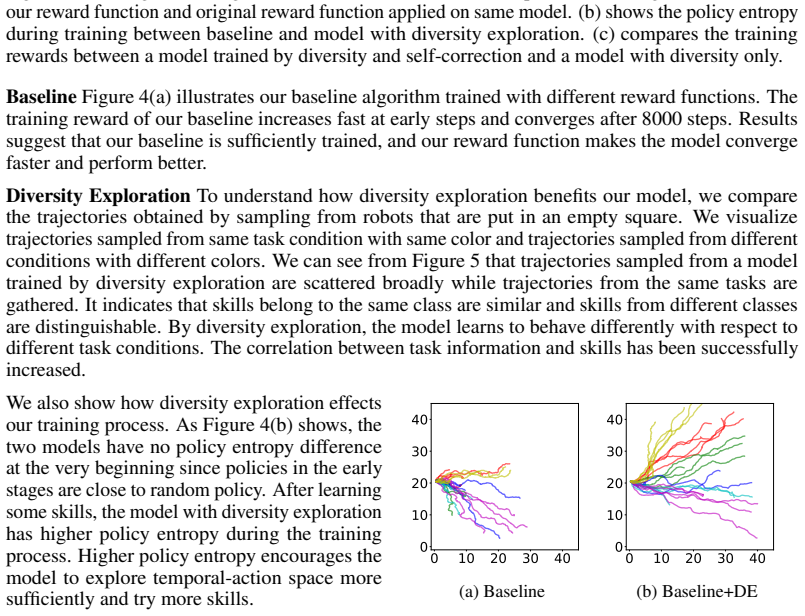
The CDAN framework overcomes catastrophic forgetting in continual reinforcement learning for continuous control by pairing unsupervised diversity exploration with adversarial self-correction.
A machine-rendered reading of the paper's core claim, the machinery that carries it, and where it could break.
Core claim
The central claim is that an unsupervised diversity exploration step can extract task-specific skills without relying on task-reward alignment, while an adversarial self-correction step can exploit previous experience to prevent forgetting, and that these two steps support each other in continuous control domains.
What carries the argument
Continual Diversity Adversarial Network (CDAN), which runs unsupervised diversity exploration to generate task-specific skills alongside adversarial self-correction that reuses past trajectories to stabilize earlier policies.
If this is right
- Agents can acquire distinct behaviors for each task in a sequence even without explicit task labels in the reward.
- Stored experience from earlier tasks can be turned into an adversarial signal that actively corrects policy drift on new tasks.
- The two procedures together produce measurable gains on a sequential continuous-control benchmark measured by both path efficiency and average reward.
- A dedicated environment and metric become available for comparing future continual reinforcement learning methods on continuous domains.
Where Pith is reading between the lines
- The same pairing of unsupervised diversity and adversarial correction could be tried in discrete-action or partially observable settings where task boundaries are also unclear.
- If the reciprocal benefit holds, one might expect performance to improve further by iterating the two procedures more tightly within each episode rather than across separate phases.
- Real-world robot platforms that must master successive manipulation or navigation skills could adopt the method once the unsupervised exploration is made safe for physical hardware.
Load-bearing premise
The assumption that an unsupervised objective can still produce useful task-specific skills when rewards and task identity are only loosely related, and that the diversity and correction procedures reinforce each other.
What would settle it
A controlled run on the Continual Ant Maze environment in which removing the unsupervised diversity term produces no measurable drop in the ability to handle later tasks, or in which the adversarial correction term fails to improve retention of earlier task performance.
Figures



read the original abstract
Deep reinforcement learning has made significant progress in the field of continuous control, such as physical control and autonomous driving. However, it is challenging for a reinforcement model to learn a policy for each task sequentially due to catastrophic forgetting. Specifically, the model would forget knowledge it learned in the past when trained on a new task. We consider this challenge from two perspectives: i) acquiring task-specific skills is difficult since task information and rewards are not highly related; ii) learning knowledge from previous experience is difficult in continuous control domains. In this paper, we introduce an end-to-end framework namely Continual Diversity Adversarial Network (CDAN). We first develop an unsupervised diversity exploration method to learn task-specific skills using an unsupervised objective. Then, we propose an adversarial self-correction mechanism to learn knowledge by exploiting past experience. The two learning procedures are presumably reciprocal. To evaluate the proposed method, we propose a new continuous reinforcement learning environment named Continual Ant Maze (CAM) and a new metric termed Normalized Shorten Distance (NSD). The experimental results confirm the effectiveness of diversity exploration and self-correction. It is worthwhile noting that our final result outperforms baseline by 18.35% in terms of NSD, and 0.61 according to the average reward.
Editorial analysis
A structured set of objections, weighed in public.
Referee Report
Summary. The paper proposes the Continual Diversity Adversarial Network (CDAN) as an end-to-end framework for continual reinforcement learning in continuous control domains. It introduces an unsupervised diversity exploration method to acquire task-specific skills via an unsupervised objective and an adversarial self-correction mechanism to mitigate catastrophic forgetting by exploiting past experience; these two procedures are described as presumably reciprocal. A new environment (Continual Ant Maze, CAM) and metric (Normalized Shorten Distance, NSD) are presented, with experimental results claimed to confirm effectiveness and to outperform a baseline by 18.35% in NSD and 0.61 in average reward.
Significance. If the reciprocity between the unsupervised and adversarial components can be demonstrated and the results shown to generalize beyond the custom CAM environment, the work would address a core challenge in continual RL by providing a mechanism for skill acquisition without strong task-reward correlation. The introduction of a new benchmark and metric could also be useful if properly validated against existing continuous-control suites.
major comments (3)
- [Abstract] Abstract: the assertion that the two learning procedures 'are presumably reciprocal' is load-bearing for the central claim yet is presented without ablations, transfer analysis, or mechanistic evidence showing that diversity exploration improves self-correction (or vice versa); this leaves the interaction unverified.
- [Abstract] Abstract / Experimental Results: the new CAM environment and NSD metric are introduced to support the 18.35% NSD improvement claim, but no validation against standard continuous-control benchmarks (e.g., MuJoCo tasks) or existing metrics is described, raising the possibility that reported gains are environment-specific artifacts rather than general evidence for the framework.
- [Abstract] Abstract: quantitative claims of outperforming the baseline by 18.35% NSD and 0.61 average reward are stated without any reference to implementation details, baseline algorithms, number of runs, variance, or statistical tests, which prevents assessment of whether the central effectiveness claim is reproducible.
minor comments (2)
- [Abstract] The phrase 'presumably reciprocal' is vague; replacing it with a precise statement of the hypothesized interaction would improve clarity.
- [Abstract] The abstract provides no information on the unsupervised objective function or the adversarial loss formulation; adding these equations (even at high level) would aid readability.
Simulated Author's Rebuttal
We thank the referee for the thoughtful and constructive comments. We address each major comment below, indicating where revisions to the manuscript are warranted.
read point-by-point responses
-
Referee: [Abstract] Abstract: the assertion that the two learning procedures 'are presumably reciprocal' is load-bearing for the central claim yet is presented without ablations, transfer analysis, or mechanistic evidence showing that diversity exploration improves self-correction (or vice versa); this leaves the interaction unverified.
Authors: We agree that the phrasing 'presumably reciprocal' in the abstract implies a mutual benefit that is not directly verified through dedicated ablations or transfer analysis. The manuscript demonstrates that each component contributes to performance and that the combined CDAN framework outperforms baselines, but does not isolate the reciprocal interaction. We will revise the abstract to remove or qualify this claim and add an ablation study examining the interaction between the two procedures in the revised manuscript. revision: yes
-
Referee: [Abstract] Abstract / Experimental Results: the new CAM environment and NSD metric are introduced to support the 18.35% NSD improvement claim, but no validation against standard continuous-control benchmarks (e.g., MuJoCo tasks) or existing metrics is described, raising the possibility that reported gains are environment-specific artifacts rather than general evidence for the framework.
Authors: The CAM environment and NSD metric were introduced to specifically evaluate continual learning in sequential task settings with continuous control, which existing MuJoCo suites do not directly provide. However, we acknowledge that demonstrating results on standard benchmarks would better support generality. We will add experiments on selected MuJoCo tasks using both NSD and standard metrics in the revision. revision: yes
-
Referee: [Abstract] Abstract: quantitative claims of outperforming the baseline by 18.35% NSD and 0.61 average reward are stated without any reference to implementation details, baseline algorithms, number of runs, variance, or statistical tests, which prevents assessment of whether the central effectiveness claim is reproducible.
Authors: The abstract is intentionally concise, but we agree it should reference key experimental details for the reported numbers. The full manuscript contains implementation details, baseline descriptions, and results averaged over multiple random seeds with variance; we will update the abstract to include the number of runs, mention of variance, and note on statistical testing. revision: partial
Circularity Check
No significant circularity; claims rest on proposed methods and experiments
full rationale
The paper introduces CDAN with unsupervised diversity exploration and adversarial self-correction, asserts they are 'presumably reciprocal,' and validates via experiments on the new CAM environment and NSD metric, reporting specific improvements (18.35% NSD, 0.61 reward). No equations, derivations, or self-citations are shown that reduce any central claim to fitted inputs or prior self-work by construction. The derivation chain is self-contained against external benchmarks and empirical results.
Axiom & Free-Parameter Ledger
axioms (2)
- domain assumption Unsupervised diversity exploration can learn task-specific skills when task information and rewards are not highly related
- domain assumption Adversarial self-correction can learn knowledge from previous experience in continuous control domains
invented entities (3)
-
CDAN
no independent evidence
-
CAM
no independent evidence
-
NSD
no independent evidence
Reference graph
Works this paper leans on
-
[1]
Variational Option Discovery Algorithms
J. Achiam, H. Edwards, D. Amodei, and P. Abbeel. Variational option discovery algorithms.arXiv preprint arXiv:1807.10299, 2018
work page internal anchor Pith review Pith/arXiv arXiv 2018
-
[2]
Emergent Complexity via Multi-Agent Competition
T. Bansal, J. Pachocki, S. Sidor, I. Sutskever, and I. Mordatch. Emergent complexity via multi-agent competition. arXiv preprint arXiv:1710.03748, 2017
work page internal anchor Pith review Pith/arXiv arXiv 2017
- [3]
-
[4]
Marathon Environments: Multi-Agent Continuous Control Benchmarks in a Modern Video Game Engine
J. Booth and J. Booth. Marathon environments: Multi-agent continuous control benchmarks in a modern video game engine. arXiv preprint arXiv:1902.09097, 2019
work page internal anchor Pith review Pith/arXiv arXiv 1902
-
[5]
HoME: a Household Multimodal Environment
S. Brodeur, E. Perez, A. Anand, F. Golemo, L. Celotti, F. Strub, J. Rouat, H. Larochelle, and A. Courville. Home: A household multimodal environment. arXiv preprint arXiv:1711.11017, 2017
work page internal anchor Pith review Pith/arXiv arXiv 2017
-
[6]
Y . Duan, X. Chen, R. Houthooft, J. Schulman, and P. Abbeel. Benchmarking deep reinforcement learning for continuous control. In International Conference on Machine Learning, pages 1329–1338, 2016
work page 2016
-
[7]
Diversity is All You Need: Learning Skills without a Reward Function
B. Eysenbach, A. Gupta, J. Ibarz, and S. Levine. Diversity is all you need: Learning skills without a reward function. arXiv preprint arXiv:1802.06070, 2018
work page internal anchor Pith review Pith/arXiv arXiv 2018
-
[8]
PathNet: Evolution Channels Gradient Descent in Super Neural Networks
C. Fernando, D. Banarse, C. Blundell, Y . Zwols, D. Ha, A. A. Rusu, A. Pritzel, and D. Wierstra. Pathnet: Evolution channels gradient descent in super neural networks. arXiv preprint arXiv:1701.08734, 2017
work page internal anchor Pith review Pith/arXiv arXiv 2017
-
[9]
V . François-Lavet, P. Henderson, R. Islam, M. G. Bellemare, J. Pineau, et al. An introduction to deep reinforcement learning. Foundations and Trends R⃝ in Machine Learning, 11(3-4):219–354, 2018
work page 2018
-
[10]
I. Goodfellow, J. Pouget-Abadie, M. Mirza, B. Xu, D. Warde-Farley, S. Ozair, A. Courville, and Y . Bengio. Generative adversarial nets. In Z. Ghahramani, M. Welling, C. Cortes, N. D. Lawrence, and K. Q. Weinberger, editors,Advances in Neural Information Processing Systems 27, pages 2672–2680. Curran Associates, Inc., 2014
work page 2014
-
[11]
K. Gregor, D. J. Rezende, and D. Wierstra. Variational intrinsic control. arXiv preprint arXiv:1611.07507, 2016
work page internal anchor Pith review Pith/arXiv arXiv 2016
-
[12]
Reinforcement Learning with Unsupervised Auxiliary Tasks
M. Jaderberg, V . Mnih, W. M. Czarnecki, T. Schaul, J. Z. Leibo, D. Silver, and K. Kavukcuoglu. Rein- forcement learning with unsupervised auxiliary tasks. arXiv preprint arXiv:1611.05397, 2016
work page internal anchor Pith review Pith/arXiv arXiv 2016
-
[13]
Continual Reinforcement Learning with Complex Synapses
C. Kaplanis, M. Shanahan, and C. Clopath. Continual reinforcement learning with complex synapses. arXiv preprint arXiv:1802.07239, 2018
work page internal anchor Pith review Pith/arXiv arXiv 2018
-
[14]
T. P. Lillicrap, J. J. Hunt, A. Pritzel, N. Heess, T. Erez, Y . Tassa, D. Silver, and D. Wierstra. Continuous control with deep reinforcement learning. arXiv preprint arXiv:1509.02971, 2015
work page internal anchor Pith review Pith/arXiv arXiv 2015
-
[15]
D. Lopez-Paz et al. Gradient episodic memory for continual learning. In Advances in Neural Information Processing Systems, pages 6467–6476, 2017
work page 2017
-
[16]
V . Mnih, A. P. Badia, M. Mirza, A. Graves, T. Lillicrap, T. Harley, D. Silver, and K. Kavukcuoglu. Asynchronous methods for deep reinforcement learning. In International conference on machine learning, pages 1928–1937, 2016
work page 1928
-
[17]
V . Mnih, K. Kavukcuoglu, D. Silver, A. Graves, I. Antonoglou, D. Wierstra, and M. Riedmiller. Playing atari with deep reinforcement learning. arXiv preprint arXiv:1312.5602, 2013
work page internal anchor Pith review Pith/arXiv arXiv 2013
-
[18]
V . Mnih, K. Kavukcuoglu, D. Silver, A. A. Rusu, J. Veness, M. G. Bellemare, A. Graves, M. Riedmiller, A. K. Fidjeland, G. Ostrovski, et al. Human-level control through deep reinforcement learning. Nature, 518(7540):529, 2015
work page 2015
-
[19]
Learning to Learn without Forgetting by Maximizing Transfer and Minimizing Interference
M. Riemer, I. Cases, R. Ajemian, M. Liu, I. Rish, Y . Tu, and G. Tesauro. Learning to learn without forgetting by maximizing transfer and minimizing interference. arXiv preprint arXiv:1810.11910, 2018
work page internal anchor Pith review Pith/arXiv arXiv 2018
-
[20]
A. A. Rusu, N. C. Rabinowitz, G. Desjardins, H. Soyer, J. Kirkpatrick, K. Kavukcuoglu, R. Pascanu, and R. Hadsell. Progressive neural networks. arXiv preprint arXiv:1606.04671, 2016
work page internal anchor Pith review Pith/arXiv arXiv 2016
-
[21]
T. Schaul, J. Quan, I. Antonoglou, and D. Silver. Prioritized experience replay. arXiv preprint arXiv:1511.05952, 2015
work page internal anchor Pith review Pith/arXiv arXiv 2015
-
[22]
J. Schulman, S. Levine, P. Abbeel, M. Jordan, and P. Moritz. Trust region policy optimization. In International Conference on Machine Learning, pages 1889–1897, 2015
work page 2015
-
[23]
Proximal Policy Optimization Algorithms
J. Schulman, F. Wolski, P. Dhariwal, A. Radford, and O. Klimov. Proximal policy optimization algorithms. arXiv preprint arXiv:1707.06347, 2017
work page internal anchor Pith review Pith/arXiv arXiv 2017
- [24]
-
[25]
P. Sun, X. Sun, L. Han, J. Xiong, Q. Wang, B. Li, Y . Zheng, J. Liu, Y . Liu, H. Liu, et al. Tstarbots: Defeating the cheating level builtin ai in starcraft ii in the full game. arXiv preprint arXiv:1809.07193, 2018
work page internal anchor Pith review Pith/arXiv arXiv 2018
-
[26]
R. S. Sutton and A. G. Barto. Reinforcement learning: An introduction. MIT press, 2018
work page 2018
-
[27]
L. Tai, G. Paolo, and M. Liu. Virtual-to-real deep reinforcement learning: Continuous control of mobile robots for mapless navigation. In 2017 IEEE/RSJ International Conference on Intelligent Robots and Systems (IROS), pages 31–36. IEEE, 2017
work page 2017
-
[28]
Y . Tassa, Y . Doron, A. Muldal, T. Erez, Y . Li, D. d. L. Casas, D. Budden, A. Abdolmaleki, J. Merel, A. Lefrancq, et al. Deepmind control suite. arXiv preprint arXiv:1801.00690, 2018
work page internal anchor Pith review Pith/arXiv arXiv 2018
-
[29]
H. Van Hasselt, A. Guez, and D. Silver. Deep reinforcement learning with double q-learning. In Thirtieth AAAI Conference on Artificial Intelligence, 2016
work page 2016
-
[30]
S. Wang, D. Jia, and X. Weng. Deep reinforcement learning for autonomous driving. arXiv preprint arXiv:1811.11329, 2018
work page internal anchor Pith review Pith/arXiv arXiv 2018
-
[31]
Z. Wang, T. Schaul, M. Hessel, H. Van Hasselt, M. Lanctot, and N. De Freitas. Dueling network architectures for deep reinforcement learning. arXiv preprint arXiv:1511.06581, 2015
work page internal anchor Pith review Pith/arXiv arXiv 2015
-
[32]
Y . Wu, Y . Wu, G. Gkioxari, and Y . Tian. Building generalizable agents with a realistic and rich 3d environment. arXiv preprint arXiv:1801.02209, 2018. 10
work page internal anchor Pith review Pith/arXiv arXiv 2018
discussion (0)
Sign in with ORCID, Apple, or X to comment. Anyone can read and Pith papers without signing in.