Theta functions and quiver Grassmannians
Pith reviewed 2026-05-25 13:09 UTC · model grok-4.3
The pith
Hall algebra theta functions recover the cluster character formula via the Euler characteristic map, while broken lines stratify quiver Grassmannians by their bends.
A machine-rendered reading of the paper's core claim, the machinery that carries it, and where it could break.
Core claim
Using the relationship between cluster scattering diagrams and stability scattering diagrams, the paper shows that a path with positive crossing traverses in the direction opposite the Auslander-Reiten quiver of Q. The Hall algebra theta functions recover the cluster character formula by the Euler characteristic map. Hall algebra broken lines then stratify the quiver Grassmannians according to the bending of the lines.
What carries the argument
Hall algebra broken lines, whose bends in scattering diagrams determine the stratification of quiver Grassmannians
Load-bearing premise
The relationship between cluster scattering diagrams and stability scattering diagrams is enough to connect quiver representations to the diagrams, and the notion of positive crossing of a path determines that it runs opposite the Auslander-Reiten quiver.
What would settle it
An explicit quiver and path where a positive crossing fails to run opposite the Auslander-Reiten quiver, or where the Hall algebra theta functions do not recover the cluster character formula under the Euler characteristic map.
Figures
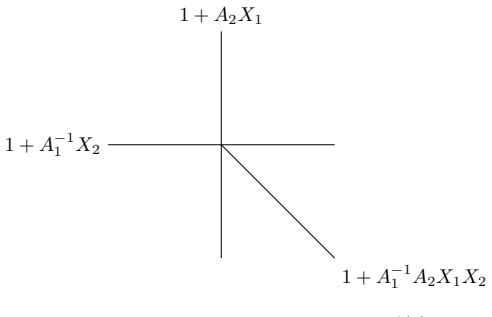


read the original abstract
In this article, we use the relationship between cluster scattering diagrams and stability scattering diagrams to relate quiver representations with these diagrams. With a notion of positive crossing of a path $\gamma$, we show that if $\gamma$ has positive crossing in the scattering diagram, then it goes in the opposite direction of the Auslander-Reiten quiver of $Q$. We then give the Hall algebra theta functions which recover the cluster character formula by the Euler characteristic map. At last, we define the Hall algebra broken lines and then are able to give the stratification of the quiver Grassmannians by the bending of the broken lines.
Editorial analysis
A structured set of objections, weighed in public.
Referee Report
Summary. The paper uses the relationship between cluster scattering diagrams and stability scattering diagrams to relate quiver representations to these diagrams. It introduces a notion of positive crossing for a path γ and proves that positive crossings imply the path traverses in the opposite direction to the Auslander-Reiten quiver of Q. It then constructs Hall algebra theta functions that recover the cluster character formula via the Euler characteristic map, and defines Hall algebra broken lines to stratify quiver Grassmannians according to the bending of these lines.
Significance. If the stated constructions and proofs hold, the work would connect scattering diagram techniques with Hall algebra methods to provide explicit stratifications of quiver Grassmannians and recover cluster characters, building directly on established literature in cluster algebras and quiver representations without introducing free parameters or circular definitions. This could offer new combinatorial tools in the field, though the abstract alone supplies no proofs or explicit constructions to evaluate the technical depth.
major comments (1)
- Abstract: The central claims (positive crossing implying opposite direction to the Auslander-Reiten quiver, Hall algebra theta functions recovering cluster characters via Euler characteristic, and broken-line stratification of quiver Grassmannians) are stated as a sequence of results, but the provided text contains no proofs, definitions of key terms such as 'positive crossing', or explicit constructions. This renders the load-bearing steps unverifiable from the manuscript as presented.
Simulated Author's Rebuttal
We thank the referee for their report. Below we respond point-by-point to the single major comment. The full manuscript (arXiv:1906.12299) contains the definitions, constructions, and proofs summarized in the abstract; the abstract itself follows standard conventions for brevity.
read point-by-point responses
-
Referee: Abstract: The central claims (positive crossing implying opposite direction to the Auslander-Reiten quiver, Hall algebra theta functions recovering cluster characters via Euler characteristic, and broken-line stratification of quiver Grassmannians) are stated as a sequence of results, but the provided text contains no proofs, definitions of key terms such as 'positive crossing', or explicit constructions. This renders the load-bearing steps unverifiable from the manuscript as presented.
Authors: Abstracts are concise summaries and do not contain proofs or full definitions; these appear in the body of the paper. The notion of positive crossing is defined in Section 2. The statement that a path with positive crossing traverses in the opposite direction to the Auslander-Reiten quiver of Q is proved as Theorem 3.2. The Hall algebra theta functions, together with the proof that the Euler characteristic map recovers the cluster character formula, are given in Section 4. The Hall algebra broken lines and the resulting stratification of quiver Grassmannians by bending are constructed and proved in Section 5. These sections supply the explicit constructions and verifications referenced in the abstract. revision: no
Circularity Check
No significant circularity detected
full rationale
The paper's derivation consists of explicit constructions: relating cluster and stability scattering diagrams to quiver representations via a defined notion of positive crossing, defining Hall algebra theta functions that map to cluster characters via Euler characteristic, and defining Hall algebra broken lines to stratify quiver Grassmannians. These steps build on established external literature on scattering diagrams and Hall algebras without reducing any central claim to a self-referential definition, a fitted parameter renamed as a prediction, or a load-bearing self-citation chain. The abstract and stated goals exhibit no equations or steps that equate outputs to inputs by construction.
Axiom & Free-Parameter Ledger
axioms (2)
- standard math Standard properties of Hall algebras and the Euler characteristic map in quiver representation theory
- domain assumption Existence and basic properties of cluster scattering diagrams and stability scattering diagrams as developed in prior literature
Lean theorems connected to this paper
-
IndisputableMonolith/Foundation/AlexanderDuality.leanalexander_duality_circle_linking unclear?
unclearRelation between the paper passage and the cited Recognition theorem.
if γ has positive crossing in the scattering diagram, then it goes in the opposite direction of the Auslander-Reiten quiver of Q
What do these tags mean?
- matches
- The paper's claim is directly supported by a theorem in the formal canon.
- supports
- The theorem supports part of the paper's argument, but the paper may add assumptions or extra steps.
- extends
- The paper goes beyond the formal theorem; the theorem is a base layer rather than the whole result.
- uses
- The paper appears to rely on the theorem as machinery.
- contradicts
- The paper's claim conflicts with a theorem or certificate in the canon.
- unclear
- Pith found a possible connection, but the passage is too broad, indirect, or ambiguous to say the theorem truly supports the claim.
Reference graph
Works this paper leans on
- [1]
-
[2]
Tilting theory and cluster combinatorics
Aslak Bakke Buan, Robert Marsh, Markus Reineke, Idun Reiten, and Gordana Todorov. Tilting theory and cluster combinatorics. Advances in mathematics , 204(2):572--618, 2006
work page 2006
-
[3]
T. Bridgeland. An introduction to motivic Hall algebras . Advances in Mathematics , 229:102–--138, 2012
work page 2012
-
[4]
Scattering diagrams, hall algebras and stability conditions
Tom Bridgeland. Scattering diagrams, hall algebras and stability conditions. arXiv preprint arXiv:1603.00416 , 2016
-
[5]
P. Caldero and F. Chapoton. Cluster algebras as hall algebras of quiver representations. Commentarii Mathematici Helvetci , 81:595--616, 2006
work page 2006
-
[6]
The greedy basis equals the theta basis: A rank two haiku
Man-Wai Cheung, Mark Gross, Greg Muller, Gregg Musiker, Dylan Rupel, Salvatore Stella, and Harold Williams. The greedy basis equals the theta basis: A rank two haiku. Journal of Combinatorial Theory, Series A , 145:150 -- 171, 2017
work page 2017
-
[7]
Lecture notes on cluster algebras and cluster varieties
Man-Wai Cheung. Lecture notes on cluster algebras and cluster varieties
-
[8]
From triangulated categories to cluster algebras
Philippe Caldero and Bernhard Keller. From triangulated categories to cluster algebras. Inventiones Mathematicae , 172(1):169--211, 2008
work page 2008
-
[9]
Donaldson-thomas invariants from tropical disks
Man-Wai Cheung and Travis Mandel. Donaldson-thomas invariants from tropical disks. arXiv preprint arXiv:1902.05393 , 2019
-
[10]
A tropical view of L andau- G inzburg models
Michael Carl, Max Pumperla, and Bernd Siebert. A tropical view of L andau- G inzburg models. http://www.math.uni-hamburg.de/home/siebert/preprints/LGtrop.pdf , 8:406, 2010
work page 2010
-
[11]
P. Caldero and A. Zelevinskii. Laurent expansions in cluster algebras via quiver representations . Mosc. Math. J. , 6(3):411--429, 2006
work page 2006
-
[12]
Atomic bases of cluster algebras of types a and a
Gr \'e goire Dupont and Hugh Thomas. Atomic bases of cluster algebras of types a and a. Proceedings of the London Mathematical Society , 107(4):825--850, 2013
work page 2013
-
[13]
V. Fock and A. B. Goncharov. Moduli spaces of local systems and higher teichm\" u ller theory. Publ. Math. de l'IH\' E S , pages 1--211, 2006
work page 2006
-
[14]
Introduction to cluster algebras
Sergey Fomin, Lauren Williams, and Andrei Zelevinsky. Introduction to cluster algebras. chapters 1-3. arXiv preprint arXiv:1608.05735 , 2016
-
[15]
S. Fomin and A. Zelevinsky. Cluster algebras I : Foundations. J. Amer. Math. Soc. , 15:497--–529, 2002
work page 2002
-
[16]
S. Fomin and A. Zelevinsky. Cluster algebras II : Finite type classification. Invent. Math. , 154:63–--121, 2003
work page 2003
-
[17]
Cluster algebras IV : Coefficients
Sergey Fomin and Andrei Zelevinsky. Cluster algebras IV : Coefficients. Compositio Mathematica , 143(1):112--164, 2007
work page 2007
-
[18]
Mirror symmetry for log calabi-yau surfaces I
Mark Gross, Paul Hacking, and Sean Keel. Mirror symmetry for log calabi-yau surfaces I . Publications math \'e matiques de l'IH \'E S , pages 1--104, 2011
work page 2011
- [19]
-
[20]
Canonical bases for cluster algebras
Mark Gross, Paul Hacking, Sean Keel, and Maxim Kontsevich. Canonical bases for cluster algebras. Journal of the American Mathematical Society , 31(2):497--608, 2018
work page 2018
-
[21]
Generic bases for cluster algebras and the chamber ansatz
Christof Geiss, Bernard Leclerc, and Jan Schr \"o er. Generic bases for cluster algebras and the chamber ansatz. Journal of the American Mathematical Society , 25(1):21--76, 2012
work page 2012
- [22]
-
[23]
Mirror symmetry for P^2 and tropical geometry
Mark Gross. Mirror symmetry for P^2 and tropical geometry. Adv. Math. , 224(1):169--245, 2010
work page 2010
-
[24]
From real affine geometry to complex geometry
Mark Gross and Bernd Siebert. From real affine geometry to complex geometry. Annals of mathematics , 174(3):1301--1428, 2011
work page 2011
-
[25]
Configurations in abelian categories
Dominic Joyce. Configurations in abelian categories. II . ringel--hall algebras. Advances in Mathematics , 210(2):635--706, 2007
work page 2007
-
[26]
B. Keller. Cluster algebras and derived categories . 2012. preprint, arXiv:1202.4161
work page internal anchor Pith review Pith/arXiv arXiv 2012
-
[27]
Cluster algebras and cluster monomials
Bernhard Keller. Cluster algebras and cluster monomials. In European Congress of Mathematics Krak \'o w, 2--7 July, 2012 , pages 399--413, 2014
work page 2012
-
[28]
Affine structures and non-Archimedean analytic spaces
Maxim Kontsevich and Yan Soibelman. Affine structures and non-Archimedean analytic spaces . Springer, 2006
work page 2006
-
[29]
Bases for cluster algebras from surfaces
Gregg Musiker, Ralf Schiffler, and Lauren Williams. Bases for cluster algebras from surfaces. Compositio Mathematica , 149(2):217--263, 2013
work page 2013
-
[30]
On tropical dualities in cluster algebras
Tomoki Nakanishi and Andrei Zelevinsky. On tropical dualities in cluster algebras. Contemp. Math , 565:217--226, 2012
work page 2012
- [31]
discussion (0)
Sign in with ORCID, Apple, or X to comment. Anyone can read and Pith papers without signing in.