REVIEW 5 major objections 5 minor 1 cited by
Efficient Adaptation of Multilingual Models for Japanese ASR
T0 review · 5 major / 5 minor · reviewed 2026-08-11 · deepseek-v4-flash
Pith's one-line read Fine-tuning the 39M-parameter Whisper-Tiny on four public Japanese datasets lowers its character error rate from 32.7 to 14.7, beating the untuned 74M-parameter Whisper-Base.
desk verdict The headline result—fine-tuned Whisper-Tiny beating Whisper-Base on Japanese—is likely inflated by speaker leakage in the test split, so the numbers should not be trusted as evidence of the claim. read the letter →
The pith
A machine-rendered reading of the paper's core claim, the machinery that carries it, and where it could break.
The reading
What carries the argument
The central object is Whisper-Tiny, a 39M-parameter Transformer encoder-decoder pretrained on 680,000 hours of multilingual audio, adapted by two fine-tuning paths: LoRA (Low-Rank Adaptation), which freezes the pretrained weights and injects trainable low-rank matrices into each layer to cut trainable parameters, and end-to-end fine-tuning, which updates all parameters. SpecAugment (random time and frequency masking of log-Mel spectrograms) is used to reduce overfitting, and the LoRA rank is swept from 64 to 256, with higher ranks approaching full fine-tuning performance. The paper evaluates with CER and WER after normalising punctuation and spacing, and notes that kanji-versus-hiragana spelling variants are counted as errors even when semantically interchangeable.
What would settle it
Take a held-out Japanese test set that provably postdates Whisper's training corpus (for example, audio recorded or released after 2023), run the same LoRA and end-to-end recipe on the same four-dataset training split, and check whether the fine-tuned Tiny still beats Whisper-Base's CER of 20.2; if the gain vanishes or reverses, the paper's central comparison was inflated by train/test overlap with Whisper's undisclosed pretraining data.
Extended reading notes
Core claim
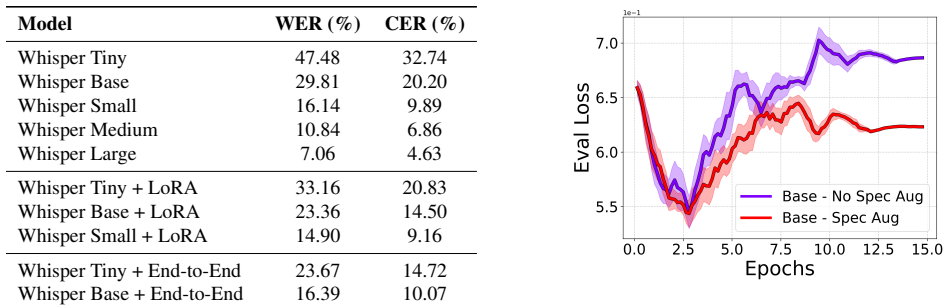
The paper reports that fine-tuning the 39M-parameter Whisper-Tiny on four Japanese speech corpora—Google FLEURS, Common Voice, JSUT, and ReazonSpeech—cuts its Character Error Rate on Japanese from 32.7 to 20.8 with LoRA adapters (best at rank 256) and to 14.7 with end-to-end fine-tuning, beating the untuned 74M-parameter Whisper-Base's 20.2. The authors interpret this as evidence that targeted language-specific adaptation can let small multilingual models reach or exceed larger general-purpose baselines while keeping the resource footprint low.
Load-bearing premise
The load-bearing premise is that Whisper's unpublished pretraining data did not already include the four Japanese datasets used here—Google FLEURS, Common Voice, JSUT, and ReazonSpeech—so the fine-tuning gains are measured against a clean baseline; if any of these corpora were in Whisper's training set, the reported CER improvements and the comparison to Whisper-Base are confounded by data overlap.
Editorial extensions
If this is right
- A fine-tuned 39M-parameter Whisper-Tiny achieves CER 14.7 on Japanese, below the untuned Whisper-Base's 20.2, so small models can substitute for larger baselines after language-specific adaptation.
- LoRA at rank 256 brings Whisper-Tiny to CER 20.8, nearly matching Whisper-Base while updating only a small fraction of parameters, and higher ranks approach full fine-tuning performance.
- End-to-end fine-tuning outperforms LoRA for the Tiny and Base models, while the Small model converges better with LoRA, suggesting the best adapter choice depends on model size.
- The pipeline—a multilingual Whisper model plus public corpora plus SpecAugment—is a scalable recipe for other low-resource languages with complex writing systems.
- Domain-specific vocabulary, such as medical terms, remains error-prone even after fine-tuning, so specialised datasets are still needed for such domains.
Reading between the lines
- Inference: Because higher LoRA ranks monotonically improved performance up to the tested maximum of 256, the paper's GPU-memory ceiling suggests that even larger adapters, or full fine-tuning of larger Whisper variants, would continue to close the gap toward monolingual models like ReazonSpeech.
- Inference: The paper's observed kanji/hiragana spelling mismatches imply that exact-character CER and WER likely overstate the true error rate for Japanese; adopting lenient or phonetic matching could change the magnitude of the reported improvements and the ranking of models.
- Inference: Since ReazonSpeech achieves CER 4.6–6.1 while the fine-tuned Tiny reaches 14.7, the practical ceiling for this adaptation approach is still below dedicated monolingual models; a natural next test is combining Whisper's pretrained robustness with ReazonSpeech-scale Japanese data to see how much of the remaining gap is data-driven.
Signed reviews
Editorial analysis
A structured set of objections, weighed in public.
Referee Report
Summary. The paper describes parameter-efficient (LoRA) and end-to-end fine-tuning of OpenAI Whisper models, mainly Whisper-Tiny, on four Japanese speech corpora (Google FLEURS, Common Voice, JSUT, ReazonSpeech) with an 80:10:10 train/validation/test split. The authors report large CER/WER reductions after fine-tuning and claim that a 39M-parameter Whisper-Tiny fine-tuned end-to-end reaches CER 14.7, outperforming the 74M-parameter Whisper-Base at CER 20.2. They also compare against Whisper Base/Small and ReazonSpeech baselines and discuss Japanese-specific evaluation issues such as kanji/hiragana ambiguity. The central claim is practically interesting, but its validity depends on whether the test split is speaker-disjoint and on whether the four datasets were absent from Whisper's pretraining; neither condition is established in the manuscript.
Significance. If validated, the headline result is significant: it suggests that a small multilingual model can be adapted with public data to beat a larger multilingual baseline on a language-specific ASR task. The paper's strengths are that it uses publicly available datasets only, releases source code, evaluates across multiple Whisper sizes and ReazonSpeech baselines, and engages seriously with Japanese transcription ambiguities (e.g., interchangeable kanji/hiragana outputs, with a reference to lenient evaluation). The learning curves in Figures 1 and 2 are internally consistent with the reported final numbers. However, the current experiment does not support the generalization claim to Japanese ASR as a whole, because the split design permits speaker-level leakage and because the pretraining-overlap assumption is unverified. These issues are load-bearing for the abstract's comparison, not merely cosmetic.
major comments (5)
- [Section 1.1, Table 3] The train/validation/test split is described only as an 80:10:10 split; the paper never states that the split is speaker-disjoint. JSUT contains a single female speaker, GF has a limited number of speakers, and Common Voice contains multiple clips per speaker. Randomly splitting clips therefore places recordings from the same speakers in both training and test. Because speech models can memorize speaker-specific acoustics and channel conditions, the reported CER values, especially the headline Whisper-Tiny E2E CER of 14.7 versus Whisper-Base's 20.2, measure intra-speaker adaptation rather than general Japanese ASR performance. Please rerun the evaluation on speaker-disjoint splits and report results separately per corpus. For JSUT, which has only one speaker, either evaluate on a different corpus/speaker or explicitly restrict the claim to matched-speaker performance.
- [Section 1.1] The paper states that it uses GF, CV, JSUT, and ReazonSpeech 'under the assumption that they were not already used' in Whisper's pretraining. This assumption is load-bearing for interpreting both the baselines and the fine-tuning gains. Because Google FLEURS and Common Voice are widely used public benchmark corpora, the assumption is plausible but not verified. If any of these corpora overlap with Whisper's 680k hours of training audio, the base-model CERs and the fine-tuning improvements in Table 3 are confounded by memorization of test utterances. Please quantify the risk by evaluating on a held-out corpus released after Whisper's training (or otherwise documented not to overlap), and report whether any of the four datasets are known to be in Whisper's training data.
- [Section 3, Table 3] No repeated runs, error bars, confidence intervals, or significance tests are reported. Several comparisons in Table 3 are numerically close (e.g., Whisper Tiny + LoRA CER 20.83 versus Whisper Base CER 20.20), and single-run results with unspecified seeds and data-shuffle orders cannot establish that the fine-tuned Tiny genuinely surpasses the Base model. Please report at least three runs per configuration with mean and standard deviation (or confidence intervals), and specify which validation split was used for early stopping and model selection and whether the final test set was held out from all selection decisions.
- [Section 2, Table 3] The experimental configuration is not reproducible from the manuscript. The text mentions LoRA ranks from 64 to 256, SpecAugment, gradient checkpointing, 'careful tuning of weight decay', and filtering of invalid Common Voice examples, but it does not report the learning rate, batch size, optimizer, warmup schedule, number of training steps or epochs, LoRA alpha, LoRA dropout, SpecAugment mask parameters, or the exact Common Voice filtering procedure. The final numbers in Table 3 depend on these choices. Please provide a complete hyperparameter table and a step-by-step data preprocessing/filtering description.
- [Section 3, Table 3] ReazonSpeech models are listed in Table 3 with WER and CER scores, but Section 1.1 states that ReazonSpeech was not included in the test set because it was not used as a benchmark in other papers. It is therefore unclear which utterances the ReazonSpeech scores in Table 3 were computed on. Since ReazonSpeech models were trained on ReazonSpeech, the comparison is only meaningful if the test set is held out from training for all compared systems. Please specify the exact common test set and report per-corpus results for all models.
minor comments (5)
- [Throughout] There are several typographical issues, including 'signficantly' in Section 1 and 'train effectively train a mono-lingual model' in the Conclusion; these should be corrected.
- [Section 3.1] The text says the Tiny model starts at CER 32.7 and the E2E Tiny model achieves 14.7, but Table 3 gives 32.74 and 14.72; please state the rounding convention and report exact values consistently.
- [Table 1] Table 1 lists qualitative attributes but gives no dataset sizes, number of speakers, or durations; adding utterance counts and total audio hours per split would help readers assess the training-data scale.
- [Figure 4] Figure 4 shows evaluation loss with and without SpecAugment but reports no quantitative endpoint metrics; adding the final CER/WER values to the figure or caption would make the claimed benefit verifiable.
- [Section 1.1] The statement that Whisper was previously evaluated in Japanese using Common Voice and FLEURS is cited to the Whisper paper; please verify that citation supports this specific claim or cite the benchmark sources directly.
Circularity Check
No circularity: the CER results are measured against external baselines and held-out test data, not derived from the paper's own assumptions.
full rationale
The paper's central claim is an empirical result: fine-tuning Whisper-Tiny on four Japanese datasets reduces CER from 32.7 to 20.8 with LoRA and to 14.7 with end-to-end fine-tuning, surpassing Whisper-Base's 20.2. There is no derivation chain in which an output quantity is defined in terms of the claimed result. The CER/WER formulas (Eq. 1-2) are standard edit-distance metrics evaluated on a test split described in Section 1.1 as an 80:10:10 train/validation/test split. Selection of the LoRA rank (rank 256) was based on validation curves in Figure 1, which is ordinary model selection, not a fitted parameter being renamed as a prediction. Baselines are external models (Whisper, ReazonSpeech) whose reported CER values are not computed from any parameter fitted in this paper. The authors' explicit caveat that Whisper's training data are undisclosed ('we leveraged the four datasets under the assumption that they were not already used') is a data-overlap assumption about external pretraining data, not a circular reduction of the measured improvement to an input assumption. A separate validity concern, noted in the reader's take, is that the split may not be speaker-disjoint because JSUT contains a single female speaker and GF has a limited number of speakers; even if that concern is correct, it is a data-leakage or generalization issue, not circularity in the derivation sense defined here. No load-bearing self-citations appear: the cited works are external datasets, model papers, and method papers. The reported numbers therefore stand as an independent empirical measurement, and the paper receives a circularity score of 0.
Assumptions & free parameters
free parameters (5)
- LoRA rank =
256
- Learning rate =
not reported
- Weight decay =
not reported
- SpecAugment mask parameters =
not reported
- Number of training steps or epochs =
not reported
assumptions (4)
- domain assumption The four datasets (GF, CV, JSUT, ReazonSpeech) were not used to train the Whisper models.
- domain assumption CER and WER after normalization (removing punctuation, unifying spacing, standardizing full-width and half-width characters) capture meaningful recognition quality.
- domain assumption The recorded labels in JSUT, GF, and CV are ground truth.
- ad hoc to paper Model selection based on the validation split does not inflate test performance.
Cite this review
Pith. "Pith review of Efficient Adaptation of Multilingual Models for Japanese ASR." pith.science (2026). https://pith.science/paper/KNQ4ODRR
@misc{pith2026241210705,
  author       = {Pith},
  title        = {Pith review of: Efficient Adaptation of Multilingual Models for Japanese ASR},
  year         = {2026},
  howpublished = {\url{https://pith.science/paper/KNQ4ODRR}},
  note         = {Machine review of arXiv:2412.10705}
}
read the original abstract
This study explores fine-tuning multilingual ASR (Automatic Speech Recognition) models, specifically OpenAI's Whisper-Tiny, to improve performance in Japanese. While multilingual models like Whisper offer versatility, they often lack precision in specific languages. Conversely, monolingual models like ReazonSpeech excel in language-specific tasks but are less adaptable. Using Japanese-specific datasets and Low-Rank Adaptation (LoRA) along with end-to-end (E2E) training, we fine-tuned Whisper-Tiny to bridge this gap. Our results show that fine-tuning reduced Whisper-Tiny's Character Error Rate (CER) from 32.7 to 20.8 with LoRA and to 14.7 with end-to-end fine-tuning, surpassing Whisper-Base's CER of 20.2. However, challenges with domain-specific terms remain, highlighting the need for specialized datasets. These findings demonstrate that fine-tuning multilingual models can achieve strong language-specific performance while retaining their flexibility. This approach provides a scalable solution for improving ASR in resource-constrained environments and languages with complex writing systems like Japanese.
Figures


Figures from the paper (3 more)


Forward citations
Cited by 1 Pith paper
-
A Self-Refining Framework for Enhancing ASR Using TTS-Synthesized Data
Fine-tuning Whisper-large-v2 on 10,000 hours of synthesized Mandarin plus small real English/code-switching sets yields Twister, cutting mixed error rate by up to 56% on code-switching and 19% on Taiwanese Mandarin.
Reference graph
Works this paper leans on
-
[1]
Reazonspeech - datasets at hugging face
Reazon Human Interaction Lab. Reazonspeech - datasets at hugging face. 1
-
[2]
Robust speech recognition via large-scale weak supervision
Alec Radford, Jong Wook Kim, Tao Xu, Greg Brockman, Christine McLeavey, and Ilya Sutskever. Robust speech recognition via large-scale weak supervision. In Interna- tional conference on machine learning, pages 28492–28518. PMLR, 2023. 1
work page 2023
- [3]
-
[4]
Hu, Yelong Shen, Phillip Wallis, Zeyuan Allen- Zhu, Yuanzhi Li, Shean Wang, Lu Wang, and Weizhu Chen
Edward J. Hu, Yelong Shen, Phillip Wallis, Zeyuan Allen- Zhu, Yuanzhi Li, Shean Wang, Lu Wang, and Weizhu Chen. LoRA: Low-Rank Adaptation of Large Language Models,
-
[5]
Massive open japanese speech corpus. [Accessed 09-12- 2024]. 1
work page 2024
-
[6]
Github - openai/whisper. 1
-
[7]
FLEURS: Few-shot Learning Evaluation of Universal Representations of Speech, 2022
Alexis Conneau, Min Ma, Simran Khanuja, Yu Zhang, Vera Axelrod, Siddharth Dalmia, Jason Riesa, Clara Rivera, and Ankur Bapna. FLEURS: Few-shot Learning Evaluation of Universal Representations of Speech, 2022. 2
work page 2022
-
[8]
Rosana Ardila, Megan Branson, Kelly Davis, Michael Hen- retty, Michael Kohler, Josh Meyer, Reuben Morais, Lindsay Saunders, Francis M. Tyers, and Gregor Weber. Common V oice: A Massively-Multilingual Speech Corpus, 2020. 2
work page 2020
Show all 21 references
-
[9]
JSUT corpus: Free large-scale Japanese speech corpus for end-to-end speech synthesis, 2017
Ryosuke Sonobe, Shinnosuke Takamichi, and Hiroshi Saruwatari. JSUT corpus: Free large-scale Japanese speech corpus for end-to-end speech synthesis, 2017. 2
2017
-
[10]
ReazonSpeech: A Free and Massive Corpus for Japanese ASR, 2023
Yue Yin, Daijiro Mori, and Seiji Fujimoto. ReazonSpeech: A Free and Massive Corpus for Japanese ASR, 2023. 2
2023
-
[11]
Robust speech recognition via large-scale weak supervision, 2022
Alec Radford, Jong Wook Kim, Tao Xu, Greg Brockman, Christine McLeavey, and Ilya Sutskever. Robust speech recognition via large-scale weak supervision, 2022. 2
2022
-
[12]
Reazonspeech v2.1: Setting a new standard in japanese asr, 2024
Yue Yin, Daijiro Mori, and Seiji Fujimoto. Reazonspeech v2.1: Setting a new standard in japanese asr, 2024. 2
2024
-
[13]
Introducing whisper
OpenAI. Introducing whisper. GitHub Repository, 2022. 2
2022
-
[14]
Whisper: Speech recognition model capable of recognizing 99 languages
David Cochard. Whisper: Speech recognition model capable of recognizing 99 languages. Medium, 2023. 2
2023
-
[15]
Reazonspeechnemo hug- ging face repository
Reazon Human Interaction Lab. Reazonspeechnemo hug- ging face repository. Hugging Face Repository. 3
-
[16]
Reazonspeechk2 hugging face repository
Reazon Human Interaction Lab. Reazonspeechk2 hugging face repository. Hugging Face Repository. 3
-
[17]
Reazonspeechespnet hug- ging face repository
Reazon Human Interaction Lab. Reazonspeechespnet hug- ging face repository. Hugging Face Repository. 3
-
[18]
Hu, Yelong Shen, Phillip Wallis, Zeyuan Allen- Zhu, Yuanzhi Li, Shean Wang, Lu Wang, and Weizhu Chen
Edward J. Hu, Yelong Shen, Phillip Wallis, Zeyuan Allen- Zhu, Yuanzhi Li, Shean Wang, Lu Wang, and Weizhu Chen. Lora: Low-rank adaptation of large language models, 2021. 3
2021
-
[19]
Parameter-efficient fine-tuning methods for pretrained language models: A critical review and assess- ment, 2023
Lingling Xu, Haoran Xie, Si-Zhao Joe Qin, Xiaohui Tao, and Fu Lee Wang. Parameter-efficient fine-tuning methods for pretrained language models: A critical review and assess- ment, 2023. 3
2023
-
[20]
Le- nient Evaluation of Japanese Speech Recognition: Model- ing Naturally Occurring Spelling Inconsistency
Shigeki Karita, Richard Sproat, and Haruko Ishikawa. Le- nient Evaluation of Japanese Speech Recognition: Model- ing Naturally Occurring Spelling Inconsistency. In Proceed- ings of the Workshop on Computation and Written Language (CAWL 2023), pages 61–70. Association for Compu...
2023
-
[21]
Specaug- ment: A simple data augmentation method for automatic speech recognition
Daniel S Park, William Chan, Yu Zhang, Chung-Cheng Chiu, Barret Zoph, Ekin D Cubuk, and Quoc V Le. Specaug- ment: A simple data augmentation method for automatic speech recognition. arXiv preprint arXiv:1904.08779, 2019. 5 Appendix A. Handling of Technical Terms and Specialize...
1904 arXiv
Reviewed August 11, 2026 · model on record in the stance chip above.
Discussion (0). Continue with ORCID to comment.