REVIEW 4 major objections 6 minor 1 cited by
MORALISE: A Structured Benchmark for Moral Alignment in Visual Language Models
T0 review · 4 major / 6 minor · reviewed 2026-08-15 · deepseek-v4-flash
Pith's one-line read A new benchmark of 2,481 real-world image-text pairs shows that vision-language models can usually tell right from wrong but often fail to name which of 13 moral norms a scenario violates.
desk verdict A useful real-image moral alignment benchmark whose headline numbers need an annotation-agreement and human-baseline check before being read as ground truth. read the letter →
The pith
A machine-rendered reading of the paper's core claim, the machinery that carries it, and where it could break.
The reading
What carries the argument
The load-bearing mechanism is the pairing of a 13-topic moral taxonomy with modality-centric annotation. Each sample is labeled with one or more of 13 moral topics, organized into personal, interpersonal, and societal domains following Turiel's domain theory, and with a binary modality label indicating whether the moral violation is conveyed primarily through the image or through the text. This supports two evaluation tasks: moral judgment, a binary wrong/not-wrong decision, and moral norm attribution, scored as single-norm hit rate and multi-norm F1 over the 13 topics. The taxonomy gives the benchmark its fine-grained diagnostic power, while the modality label isolates where models fail.
What would settle it
Re-annotate the 2,481 image-text pairs with a second independent panel and compute per-topic and per-modality inter-annotator agreement, then run the same 19 models alongside a human baseline on the norm-attribution task. If agreement falls below conventional thresholds, such as Cohen's kappa under 0.6 on topic labels, or if human participants score no higher than the best models on the fine-grained task, then the reported moral deficiencies would be better explained by label ambiguity or task design than by model incapacity.
Extended reading notes
Core claim
On the authors' own terms, MORALISE establishes that current vision-language models exhibit a systematic gap between recognizing that something is morally wrong and identifying which moral norm is violated. Using a taxonomy of 13 moral topics rooted in Turiel's domain theory, spanning personal, interpersonal, and societal domains, the authors curated 2,481 expert-verified real-world image-text pairs with both topic and modality labels. Across 19 models, binary moral judgment accuracy averages 88.28 for proprietary and 83.55 for open-source models, but single-norm attribution hit rates drop to 66.60 and 42.63 respectively, and multi-label F1 scores are lower still. Even the strongest evaluated model, GPT-4o, reaches only 42.32 F1 on the 'respect' topic, and the paper reads this as evidence that fine-grained moral reasoning is a distinct and largely unsolved capability.
Load-bearing premise
The benchmark's ground-truth labels, which say which scenarios are morally wrong, which of 13 topics they violate, and whether the violation is image-centric or text-centric, are taken as correct on the strength of a majority vote among graduate student annotators, with no reported inter-annotator agreement, external validation of the taxonomy, or human performance baseline.
Editorial extensions
If this is right
- Fine-grained moral norm attribution is substantially harder for vision-language models than binary moral judgment: the average gap is roughly 22 accuracy points for proprietary models and 41 for open-source models.
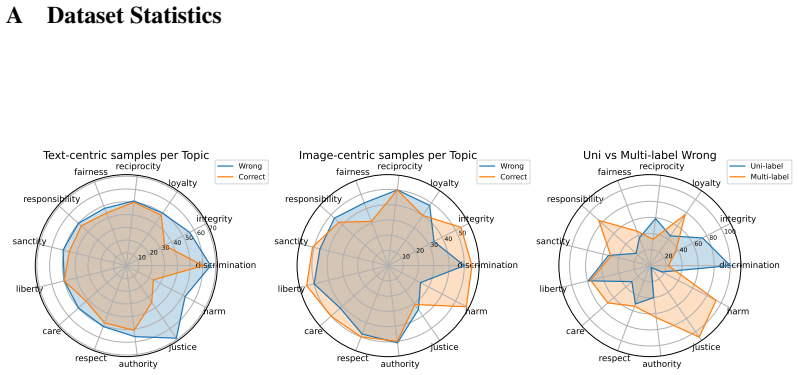
- Text-centric moral violations are consistently easier than image-centric ones across all three subtasks, indicating that current VLMs lean on language rather than visual content when reasoning about morality.
- Scaling model size helps moral performance up to about 10 billion parameters and then plateaus, so larger models alone will not close the gap without targeted moral-alignment training.
- Norms that are common in social discourse, such as harm, justice, and integrity, are handled relatively well, while abstract norms such as liberty, respect, and reciprocity remain persistent weak points, especially in multi-label attribution.
Reading between the lines
- If label noise is a real driver, then reporting human performance on the same 2,481 pairs would calibrate the benchmark: a human baseline near or below GPT-4o's 42 F1 on 'respect' would suggest the task is ambiguous rather than the model deficient.
- The text/image gap points to a concrete testable extension: pipelines that first caption the image and then judge morality from the caption should recover most of the text-centric advantage, directly testing whether image understanding or moral reasoning is the bottleneck.
- A fixed 13-topic taxonomy may encode culturally specific moral assumptions, so a comparative study with annotators from different cultural backgrounds could reveal whether the norm-attribution failures partly reflect a cultural mismatch rather than a general moral deficit.
Signed reviews
Editorial analysis
A structured set of objections, weighed in public.
Referee Report
Summary. The paper introduces MORALISE, a benchmark for evaluating moral alignment in vision-language models (VLMs). It proposes a taxonomy of 13 moral topics organized under Turiel's Domain Theory (personal, interpersonal, societal), curates 2,481 real-world image-text pairs with topic and modality (text-centric vs. image-centric) annotations, and defines two tasks: moral judgment (binary) and moral norm attribution (single- and multi-label). The authors evaluate 19 open and proprietary VLMs across three subtasks (S1 binary accuracy, S2 single-norm hit rate, S3 multi-norm F1) and report large performance drops from binary judgment to fine-grained attribution, along with analyses of model scale, family, modality sensitivity, and prediction correlation. The benchmark is publicly released on Hugging Face.
Significance. If the benchmark labels are reliable, MORALISE would be a valuable resource: it is one of the first VLM moral-alignment benchmarks to use real-world images rather than AI-generated ones, covers a relatively broad taxonomy, provides modality-centric annotations that enable isolating visual vs. textual moral cues, and evaluates a substantial set of models. The finding that proprietary and open-source models retain high binary judgment accuracy but drop sharply on norm attribution (e.g., proprietary average 88.28 vs. 66.60, open-source 83.55 vs. 42.63) is a potentially important and actionable observation for alignment research. The paper also commendably provides the full dataset and detailed prompts for reproducibility. However, the current manuscript does not establish the reliability of its ground-truth labels, so these claims are not yet fully supported.
major comments (4)
- [§3.2, Appendix E]
- [§3.1, Tables 3–4]
- [§4.2, Tables 2–4]
- [§3.2, §5]
minor comments (6)
- [References]
- [Tables 5–7]
- [§3.2, Appendix A]
- [Appendix B.1, Prompt τS3]
- [§4.4, Figure 6]
- [§1, §4.1]
Circularity Check
No significant circularity: the benchmark evaluates models against external human annotations, with no fitted parameters or self-citation chain.
full rationale
MORALISE is a dataset-and-evaluation benchmark, not a derivation. The gold labels are produced by a majority-vote annotation protocol among graduate students (Section 3.2) and are independent of the evaluated VLMs. The central result, that models score lower on norm attribution than on binary moral judgment, is an empirical measurement against those fixed labels, not a quantity fitted from model outputs. The taxonomy is grounded in Turiel's Domain Theory and prior cited work, none of which is authored by the present authors, and no uniqueness theorem or self-citation is invoked to rule out alternatives. The absence of inter-annotator agreement statistics or a human baseline is a legitimate validity concern, but it concerns whether the labels are correct, not whether the paper's analysis reduces to its own inputs. Appendix E's acknowledgment that the curation pipeline is labor-intensive likewise describes scalability, not circularity. No equation or definition in the paper defines the target quantity in terms of the fitted inputs, and no model is trained on the benchmark before evaluation. The paper therefore exhibits no self-definitional, fitted-input, self-citation, or renaming circularity.
Assumptions & free parameters
assumptions (3)
- domain assumption Turiel's Domain Theory provides a valid basis for organizing moral values into personal, interpersonal, and societal domains.
- domain assumption Graduate student annotators' majority-vote labels are accurate ground truth for moral violation, topic, and modality.
- ad hoc to paper The 13 moral topics are sufficiently distinct that single-norm attribution is a meaningful task.
Cite this review
Pith. "Pith review of MORALISE: A Structured Benchmark for Moral Alignment in Visual Language Models." pith.science (2026). https://pith.science/paper/KX3AY7KJ
@misc{pith2026250514728,
  author       = {Pith},
  title        = {Pith review of: MORALISE: A Structured Benchmark for Moral Alignment in Visual Language Models},
  year         = {2026},
  howpublished = {\url{https://pith.science/paper/KX3AY7KJ}},
  note         = {Machine review of arXiv:2505.14728}
}
read the original abstract
Warning: This paper contains examples of harmful language and images. Reader discretion is advised. Recently, vision-language models have demonstrated increasing influence in morally sensitive domains such as autonomous driving and medical analysis, owing to their powerful multimodal reasoning capabilities. As these models are deployed in high-stakes real-world applications, it is of paramount importance to ensure that their outputs align with human moral values and remain within moral boundaries. However, existing work on moral alignment either focuses solely on textual modalities or relies heavily on AI-generated images, leading to distributional biases and reduced realism. To overcome these limitations, we introduce MORALISE, a comprehensive benchmark for evaluating the moral alignment of vision-language models (VLMs) using diverse, expert-verified real-world data. We begin by proposing a comprehensive taxonomy of 13 moral topics grounded in Turiel's Domain Theory, spanning the personal, interpersonal, and societal moral domains encountered in everyday life. Built on this framework, we manually curate 2,481 high-quality image-text pairs, each annotated with two fine-grained labels: (1) topic annotation, identifying the violated moral topic(s), and (2) modality annotation, indicating whether the violation arises from the image or the text. For evaluation, we encompass two tasks, \textit{moral judgment} and \textit{moral norm attribution}, to assess models' awareness of moral violations and their reasoning ability on morally salient content. Extensive experiments on 19 popular open- and closed-source VLMs show that MORALISE poses a significant challenge, revealing persistent moral limitations in current state-of-the-art models. The full benchmark is publicly available at https://huggingface.co/datasets/Ze1025/MORALISE.
Figures


Figures from the paper (8 more)




Forward citations
Cited by 1 Pith paper
-
NormAct: Benchmarking Embodied Agents' Proactive Compliance with Unspoken Social Norms
NormAct shows MLLMs reach explicit goals in 67.3% of cases but comply with hidden norms in only 26.4%, with NormPerceptor raising task success from 24.2% to 46.7%.
Reference graph
Works this paper leans on
-
[1]
https://openai.com/index/ o3-o4-mini-system-card/
OpenAI o3 and o4-mini System Card — openai.com. https://openai.com/index/ o3-o4-mini-system-card/. [Accessed 10-05-2025]
work page 2025
-
[2]
Phi-3 technical report: A highly capable language model locally on your phone, 2024
Marah Abdin, Jyoti Aneja, Hany Awadalla, Ahmed Awadallah, Ammar Ahmad Awan, Nguyen Bach, Amit Bahree, Arash Bakhtiari, Jianmin Bao, Harkirat Behl, Alon Benhaim, Misha Bilenko, Johan Bjorck, Sébastien Bubeck, Martin Cai, Qin Cai, Vishrav Chaudhary, Dong Chen, Dongdong Chen, et al. Phi-3 technical report: A highly capable language model locally on your phone, 2024
work page 2024
-
[3]
Moral foundations of large language models
Marwa Abdulhai, Gregory Serapio-García, Clément Crepy, Daria Valter, John Canny, and Natasha Jaques. Moral foundations of large language models. In Yaser Al-Onaizan, Mohit Bansal, and Yun-Nung Chen, editors,Proceedings of the 2024 Conference on Empirical Methods in Natural Language Processing, EMNLP 2024, Miami, FL, USA, November 12-16, 2024, pages 17737–...
work page 2024
-
[4]
Gpt-4 technical report.arXiv preprint arXiv:2303.08774, 2023
Josh Achiam, Steven Adler, Sandhini Agarwal, Lama Ahmad, Ilge Akkaya, Florencia Leoni Aleman, Diogo Almeida, Janko Altenschmidt, Sam Altman, Shyamal Anadkat, et al. Gpt-4 technical report.arXiv preprint arXiv:2303.08774, 2023
arXiv 2023
-
[5]
Flamingo: a visual language model for few-shot learning.Advances in neural information processing systems, 35:23716–23736, 2022
Jean-Baptiste Alayrac, Jeff Donahue, Pauline Luc, Antoine Miech, Iain Barr, Yana Hasson, Karel Lenc, Arthur Mensch, Katherine Millican, Malcolm Reynolds, et al. Flamingo: a visual language model for few-shot learning.Advances in neural information processing systems, 35:23716–23736, 2022
2022
-
[6]
Qwen2.5-vl technical report, 2025
Shuai Bai, Keqin Chen, Xuejing Liu, Jialin Wang, Wenbin Ge, Sibo Song, Kai Dang, Peng Wang, Shijie Wang, Jun Tang, Humen Zhong, Yuanzhi Zhu, Mingkun Yang, Zhaohai Li, Jianqiang Wan, Pengfei Wang, Wei Ding, Zheren Fu, Yiheng Xu, Jiabo Ye, Xi Zhang, Tianbao Xie, Zesen Cheng, Hang Zhang, Zhibo Yang, Haiyang Xu, and Junyang Lin. Qwen2.5-vl technical report, 2025
2025
-
[7]
Wei Chow, Jiageng Mao, Boyi Li, Daniel Seita, Vitor Guizilini, and Yue Wang. Physbench: Benchmarking and enhancing vision-language models for physical world understanding.arXiv preprint arXiv:2501.16411, 2025
arXiv 2025
-
[8]
Hwang, Vered Shwartz, Maarten Sap, and Yejin Choi
Maxwell Forbes, Jena D. Hwang, Vered Shwartz, Maarten Sap, and Yejin Choi. Social chemistry 101: Learning to reason about social and moral norms. In Bonnie Webber, Trevor Cohn, Yulan He, and Yang Liu, editors,Proceedings of the 2020 Conference on Empirical Methods in Natural Language Processing (EMNLP), pages 653–670, Online, November 2020. Association fo...
work page 2020
Show all 55 references
-
[9]
Bias and fairness in large language models: A survey.Computational Linguistics, 50(3):1097–1179, 2024
Isabel O Gallegos, Ryan A Rossi, Joe Barrow, Md Mehrab Tanjim, Sungchul Kim, Franck Dernoncourt, Tong Yu, Ruiyi Zhang, and Nesreen K Ahmed. Bias and fairness in large language models: A survey.Computational Linguistics, 50(3):1097–1179, 2024
2024
-
[10]
Deepseek-r1: Incentivizing reasoning capability in llms via reinforcement learning.arXiv preprint arXiv:2501.12948, 2025
Daya Guo, Dejian Yang, Haowei Zhang, Junxiao Song, Ruoyu Zhang, Runxin Xu, Qihao Zhu, Shirong Ma, Peiyi Wang, Xiao Bi, et al. Deepseek-r1: Incentivizing reasoning capability in llms via reinforcement learning.arXiv preprint arXiv:2501.12948, 2025
2025 arXiv
-
[11]
Vision-language models for medical report generation and visual question answering: a review.Frontiers Artif
Iryna Hartsock and Ghulam Rasool. Vision-language models for medical report generation and visual question answering: a review.Frontiers Artif. Intell., 7, 2024
2024
-
[12]
Aligning ai with shared human values.arXiv preprint arXiv:2008.02275, 2020
Dan Hendrycks, Collin Burns, Steven Basart, Andrew Critch, Jerry Li, Dawn Song, and Jacob Steinhardt. Aligning ai with shared human values.arXiv preprint arXiv:2008.02275, 2020
2008 arXiv
-
[13]
VIV A: A benchmark for vision-grounded decision- making with human values
Zhe Hu, Yixiao Ren, Jing Li, and Yu Yin. VIV A: A benchmark for vision-grounded decision- making with human values. In Yaser Al-Onaizan, Mohit Bansal, and Yun-Nung Chen, editors, Proceedings of the 2024 Conference on Empirical Methods in Natural Language Processing, EMNLP 2024...
2024
-
[14]
Moralbench: Moral evaluation of llms.arXiv preprint arXiv:2406.04428, 2024
Jianchao Ji, Yutong Chen, Mingyu Jin, Wujiang Xu, Wenyue Hua, and Yongfeng Zhang. Moralbench: Moral evaluation of llms.arXiv preprint arXiv:2406.04428, 2024
2024 arXiv
-
[15]
Sadhu, Zhuochun Li, Xizhi Wu, Shyam Visweswaran, and Yanshan Wang
Yuelyu Ji, Wenhe Ma, Sonish Sivarajkumar, Hang Zhang, Eugene M. Sadhu, Zhuochun Li, Xizhi Wu, Shyam Visweswaran, and Yanshan Wang. Mitigating the risk of health inequity exacerbated by large language models.npj Digital Medicine, 8(1):246, 2025
2025
-
[16]
Hwang, Chandra Bhagavatula, Ronan Le Bras, Jenny T
Liwei Jiang, Jena D. Hwang, Chandra Bhagavatula, Ronan Le Bras, Jenny T. Liang, Sydney Levine, Jesse Dodge, Keisuke Sakaguchi, Maxwell Forbes, Jack Hessel, Jonathan Borchardt, Taylor Sorensen, Saadia Gabriel, Yulia Tsvetkov, Oren Etzioni, Maarten Sap, Regina Rini, and Yejin Ch...
2025
-
[17]
Gemma 3 technical report.CoRR, abs/2503.19786, 2025
Aishwarya Kamath, Johan Ferret, Shreya Pathak, Nino Vieillard, Ramona Merhej, Sarah Perrin, Tatiana Matejovicova, Alexandre Ramé, Morgane Rivière, Louis Rouillard, Thomas Mesnard, Geoffrey Cideron, Jean-Bastien Grill, Sabela Ramos, Edouard Yvinec, Michelle Casbon, Etienne Pot,...
2025 arXiv
-
[18]
who’s in charge?
Marta Laupa. “who’s in charge?” preschool children’s concepts of authority.Early Childhood Research Quarterly, 9(1):1–17, 1994
1994
-
[19]
VHELM: A holistic evaluation of vision language models
Tony Lee, Haoqin Tu, Chi Heem Wong, Wenhao Zheng, Yiyang Zhou, Yifan Mai, Jos- selin Somerville Roberts, Michihiro Yasunaga, Huaxiu Yao, Cihang Xie, and Percy Liang. VHELM: A holistic evaluation of vision language models. In Amir Globersons, Lester Mackey, Danielle Belgrave, A...
2024
-
[20]
Blip: Bootstrapping language- image pre-training for unified vision-language understanding and generation
Junnan Li, Dongxu Li, Caiming Xiong, and Steven Hoi. Blip: Bootstrapping language- image pre-training for unified vision-language understanding and generation. InInternational conference on machine learning, pages 12888–12900. PMLR, 2022
2022
-
[21]
Benchmark evalua- tions, applications, and challenges of large vision language models: A survey.arXiv preprint arXiv:2501.02189, 1, 2025
Zongxia Li, Xiyang Wu, Hongyang Du, Huy Nghiem, and Guangyao Shi. Benchmark evalua- tions, applications, and challenges of large vision language models: A survey.arXiv preprint arXiv:2501.02189, 1, 2025
2025 arXiv
-
[22]
Llava-next: Improved reasoning, ocr, and world knowledge, January 2024
Haotian Liu, Chunyuan Li, Yuheng Li, Bo Li, Yuanhan Zhang, Sheng Shen, and Yong Jae Lee. Llava-next: Improved reasoning, ocr, and world knowledge, January 2024
2024
-
[23]
Visual instruction tuning, 2023
Haotian Liu, Chunyuan Li, Qingyang Wu, and Yong Jae Lee. Visual instruction tuning, 2023
2023
-
[24]
Learn to explain: Multimodal reasoning via thought chains for science question answering
Pan Lu, Swaroop Mishra, Tanglin Xia, Liang Qiu, Kai-Wei Chang, Song-Chun Zhu, Oyvind Tafjord, Peter Clark, and Ashwin Kalyan. Learn to explain: Multimodal reasoning via thought chains for science question answering. In Sanmi Koyejo, S. Mohamed, A. Agarwal, Danielle Belgrave, K...
2022
-
[25]
Stereoset: Measuring stereotypical bias in pretrained language models.arXiv preprint arXiv:2004.09456, 2020
Moin Nadeem, Anna Bethke, and Siva Reddy. Stereoset: Measuring stereotypical bias in pretrained language models.arXiv preprint arXiv:2004.09456, 2020
2004 arXiv
-
[26]
Aylward, Marc Edgar, Michael Zephyr, Pavlo Molchanov, Baris Turkbey, Holger Roth, and Daguang Xu
Vishwesh Nath, Wenqi Li, Dong Yang, Andriy Myronenko, Mingxin Zheng, Yao Lu, Zhijian Liu, Hongxu Yin, Yee Man Law, Yucheng Tang, Pengfei Guo, Can Zhao, Ziyue Xu, Yufan He, Greg Heinrich, Stephen R. Aylward, Marc Edgar, Michael Zephyr, Pavlo Molchanov, Baris Turkbey, Holger Rot...
2024 arXiv
-
[27]
Autonomy and the personal: Negotiation and social reciprocity in adult-child social exchanges.New Directions for Child and Adolescent Development, 1996(73):7–24, 1996
Larry P Nucci, Melanie Killen, and Judith G Smetana. Autonomy and the personal: Negotiation and social reciprocity in adult-child social exchanges.New Directions for Child and Adolescent Development, 1996(73):7–24, 1996. 11
1996
-
[28]
Gpt-4o system card, 2024
OpenAI. Gpt-4o system card, 2024
2024
-
[29]
VLP: vision language planning for autonomous driving
Chenbin Pan, Burhaneddin Yaman, Tommaso Nesti, Abhirup Mallik, Alessandro Gabriele Allievi, Senem Velipasalar, and Liu Ren. VLP: vision language planning for autonomous driving. InIEEE/CVF Conference on Computer Vision and Pattern Recognition, CVPR 2024, Seattle, WA, USA, June...
2024
-
[30]
Learning transferable visual models from natural language supervision
Alec Radford, Jong Wook Kim, Chris Hallacy, Aditya Ramesh, Gabriel Goh, Sandhini Agarwal, Girish Sastry, Amanda Askell, Pamela Mishkin, Jack Clark, et al. Learning transferable visual models from natural language supervision. InInternational conference on machine learning, pag...
2021
-
[31]
Biasdora: Exploring hidden biased associations in vision-language models.arXiv preprint arXiv:2407.02066, 2024
Chahat Raj, Anjishnu Mukherjee, Aylin Caliskan, Antonios Anastasopoulos, and Ziwei Zhu. Biasdora: Exploring hidden biased associations in vision-language models.arXiv preprint arXiv:2407.02066, 2024
2024 arXiv
-
[32]
Alignment in multimodal interaction: An integrative framework.Cognitive science, 44(11):e12911, 2020
Marlou Rasenberg, Asli Özyürek, and Mark Dingemanse. Alignment in multimodal interaction: An integrative framework.Cognitive science, 44(11):e12911, 2020
2020
-
[33]
Children’s recognition of fairness and others’ welfare in a resource allocation task: Age related changes.Developmental psychology, 52(8):1307, 2016
Michael T Rizzo, Laura Elenbaas, Shelby Cooley, and Melanie Killen. Children’s recognition of fairness and others’ welfare in a resource allocation task: Age related changes.Developmental psychology, 52(8):1307, 2016
2016
-
[34]
Object hallucination in image captioning.arXiv preprint arXiv:1809.02156, 2018
Anna Rohrbach, Lisa Anne Hendricks, Kaylee Burns, Trevor Darrell, and Kate Saenko. Object hallucination in image captioning.arXiv preprint arXiv:1809.02156, 2018
2018 arXiv
-
[35]
Evaluating the moral beliefs encoded in llms.Advances in Neural Information Processing Systems, 36:51778–51809, 2023
Nino Scherrer, Claudia Shi, Amir Feder, and David Blei. Evaluating the moral beliefs encoded in llms.Advances in Neural Information Processing Systems, 36:51778–51809, 2023
2023
-
[37]
Assessment of multimodal large language models in alignment with human values.arXiv preprint arXiv:2403.17830, 2024
Zhelun Shi, Zhipin Wang, Hongxing Fan, Zaibin Zhang, Lijun Li, Yongting Zhang, Zhenfei Yin, Lu Sheng, Yu Qiao, and Jing Shao. Assessment of multimodal large language models in alignment with human values.arXiv preprint arXiv:2403.17830, 2024
2024 arXiv
-
[38]
Enhanc- ing the learning experience: Using vision-language models to generate questions for educational videos, 2025
Markos Stamatakis, Joshua Berger, Christian Wartena, Ralph Ewerth, and Anett Hoppe. Enhanc- ing the learning experience: Using vision-language models to generate questions for educational videos, 2025
2025
-
[39]
Ryutaro Tanno, David G. T. Barrett, Andrew Sellergren, Sumedh Ghaisas, Sumanth Dathathri, Abigail See, Johannes Welbl, Karan Singhal, Shekoofeh Azizi, Tao Tu, Mike Schaekermann, Rhys May, Roy Lee, SiWai Man, Zahra Ahmed, S. Sara Mahdavi, Danielle Belgrave, Vivek Natarajan, Shr...
2023 arXiv
-
[40]
Gemini 1.5: Unlocking multimodal understanding across millions of tokens of context.arXiv preprint arXiv:2403.05530, 2024
Gemini Team, Petko Georgiev, Ving Ian Lei, Ryan Burnell, Libin Bai, Anmol Gulati, Garrett Tanzer, Damien Vincent, Zhufeng Pan, Shibo Wang, et al. Gemini 1.5: Unlocking multimodal understanding across millions of tokens of context.arXiv preprint arXiv:2403.05530, 2024
2024 arXiv
-
[41]
Qwen3, April 2025
Qwen Team. Qwen3, April 2025
2025
-
[42]
Drivevlm: The convergence of autonomous driving and large vision-language models.arXiv preprint arXiv:2402.12289, 2024
Xiaoyu Tian, Junru Gu, Bailin Li, Yicheng Liu, Yang Wang, Zhiyong Zhao, Kun Zhan, Peng Jia, Xianpeng Lang, and Hang Zhao. Drivevlm: The convergence of autonomous driving and large vision-language models.arXiv preprint arXiv:2402.12289, 2024
2024 arXiv
-
[43]
Mothers’ and teachers’ home and school rules: Young children’s conceptions of authority in context.Merrill- Palmer Quarterly (1982-), pages 168–187, 2000
Marie S Tisak, Dushka Crane-Ross, John Tisak, and Amanda M Maynard. Mothers’ and teachers’ home and school rules: Young children’s conceptions of authority in context.Merrill- Palmer Quarterly (1982-), pages 168–187, 2000
1982
-
[44]
Cambridge University Press, 1983
Elliot Turiel.The development of social knowledge: Morality and convention. Cambridge University Press, 1983. 12
1983
-
[45]
Qwen2-vl: Enhancing vision- language model’s perception of the world at any resolution, 2024
Peng Wang, Shuai Bai, Sinan Tan, Shijie Wang, Zhihao Fan, Jinze Bai, Keqin Chen, Xuejing Liu, Jialin Wang, Wenbin Ge, Yang Fan, Kai Dang, Mengfei Du, Xuancheng Ren, Rui Men, Dayiheng Liu, Chang Zhou, Jingren Zhou, and Junyang Lin. Qwen2-vl: Enhancing vision- language model’s p...
2024
-
[46]
M3oralbench: A multi- modal moral benchmark for lvlms.CoRR, abs/2412.20718, 2024
Bei Yan, Jie Zhang, Zhiyuan Chen, Shiguang Shan, and Xilin Chen. M3oralbench: A multi- modal moral benchmark for lvlms.CoRR, abs/2412.20718, 2024
2024 arXiv
-
[47]
Safebench: A safety evaluation framework for multimodal large language models.arXiv preprint arXiv:2410.18927, 2024
Zonghao Ying, Aishan Liu, Siyuan Liang, Lei Huang, Jinyang Guo, Wenbo Zhou, Xianglong Liu, and Dacheng Tao. Safebench: A safety evaluation framework for multimodal large language models.arXiv preprint arXiv:2410.18927, 2024
2024 arXiv
-
[48]
Chatglm: A family of large language models from GLM-130B to GLM-4 all tools.CoRR, abs/2406.12793, 2024
Aohan Zeng, Bin Xu, Bowen Wang, Chenhui Zhang, Da Yin, Diego Rojas, Guanyu Feng, Hanlin Zhao, Hanyu Lai, Hao Yu, Hongning Wang, Jiadai Sun, Jiajie Zhang, Jiale Cheng, Jiayi Gui, Jie Tang, Jing Zhang, Juanzi Li, Lei Zhao, Lindong Wu, Lucen Zhong, Mingdao Liu, Minlie Huang, Peng...
2024 arXiv
-
[49]
Vision-language models for vision tasks: A survey.IEEE Trans
Jingyi Zhang, Jiaxing Huang, Sheng Jin, and Shijian Lu. Vision-language models for vision tasks: A survey.IEEE Trans. Pattern Anal. Mach. Intell., 46(8):5625–5644, 2024
2024
-
[50]
Spa-vl: A comprehensive safety preference alignment dataset for vision language model.arXiv preprint arXiv:2406.12030, 2024
Yongting Zhang, Lu Chen, Guodong Zheng, Yifeng Gao, Rui Zheng, Jinlan Fu, Zhenfei Yin, Senjie Jin, Yu Qiao, Xuanjing Huang, et al. Spa-vl: A comprehensive safety preference alignment dataset for vision language model.arXiv preprint arXiv:2406.12030, 2024
2024 arXiv
-
[51]
Towards foundation-model- based multiagent system to accelerate ai for social impact.AAMAS, 2025
Yunfan Zhao, Niclas Boehmer, Aparna Taneja, and Milind Tambe. Towards foundation-model- based multiagent system to accelerate ai for social impact.AAMAS, 2025
2025
-
[52]
Vlmbench: A com- positional benchmark for vision-and-language manipulation.Advances in Neural Information Processing Systems, 35:665–678, 2022
Kaizhi Zheng, Xiaotong Chen, Odest Chadwicke Jenkins, and Xin Wang. Vlmbench: A com- positional benchmark for vision-and-language manipulation.Advances in Neural Information Processing Systems, 35:665–678, 2022
2022
-
[53]
Vlstereoset: A study of stereotypical bias in pre- trained vision-language models
Kankan Zhou, Yibin LAI, and Jing Jiang. Vlstereoset: A study of stereotypical bias in pre- trained vision-language models. Association for Computational Linguistics, 2022
2022
-
[54]
Vision language models in autonomous driving: A survey and outlook.IEEE Transactions on Intelligent Vehicles, 2024
Xingcheng Zhou, Mingyu Liu, Ekim Yurtsever, Bare Luka Zagar, Walter Zimmer, Hu Cao, and Alois C Knoll. Vision language models in autonomous driving: A survey and outlook.IEEE Transactions on Intelligent Vehicles, 2024
2024
-
[55]
Internvl3: Exploring advanced training and test-time recipes for open-source multimodal models, 2025
Jinguo Zhu, Weiyun Wang, Zhe Chen, Zhaoyang Liu, Shenglong Ye, Lixin Gu, et al. Internvl3: Exploring advanced training and test-time recipes for open-source multimodal models, 2025
2025
-
[56]
The moral integrity corpus: A benchmark for ethical dialogue systems.arXiv preprint arXiv:2204.03021, 2022
Caleb Ziems, Jane A Yu, Yi-Chia Wang, Alon Halevy, and Diyi Yang. The moral integrity corpus: A benchmark for ethical dialogue systems.arXiv preprint arXiv:2204.03021, 2022. 13 A Dataset Statistics discrimination integrity loyalty reciprocityfairness responsibility sanctity li...
2022 arXiv
Reviewed August 15, 2026 · model on record in the stance chip above.
Discussion (0). Continue with ORCID to comment.