REVIEW 4 major objections 4 minor 8 cited by
RCR-Router: Efficient Role-Aware Context Routing for Multi-Agent LLM Systems with Structured Memory
T0 review · 4 major / 4 minor · reviewed 2026-08-05 · deepseek-v4-flash
Pith's one-line read RCR-Router claims that routing role-relevant memory slices under token budgets lifts multi-agent LLM answer quality while lowering token cost.
desk verdict Plausible role-aware memory routing idea, but the empirical core is undermined by estimated rows in the ablation tables being used as measured results. read the letter →
The pith
A machine-rendered reading of the paper's core claim, the machinery that carries it, and where it could break.
The reading
What carries the argument
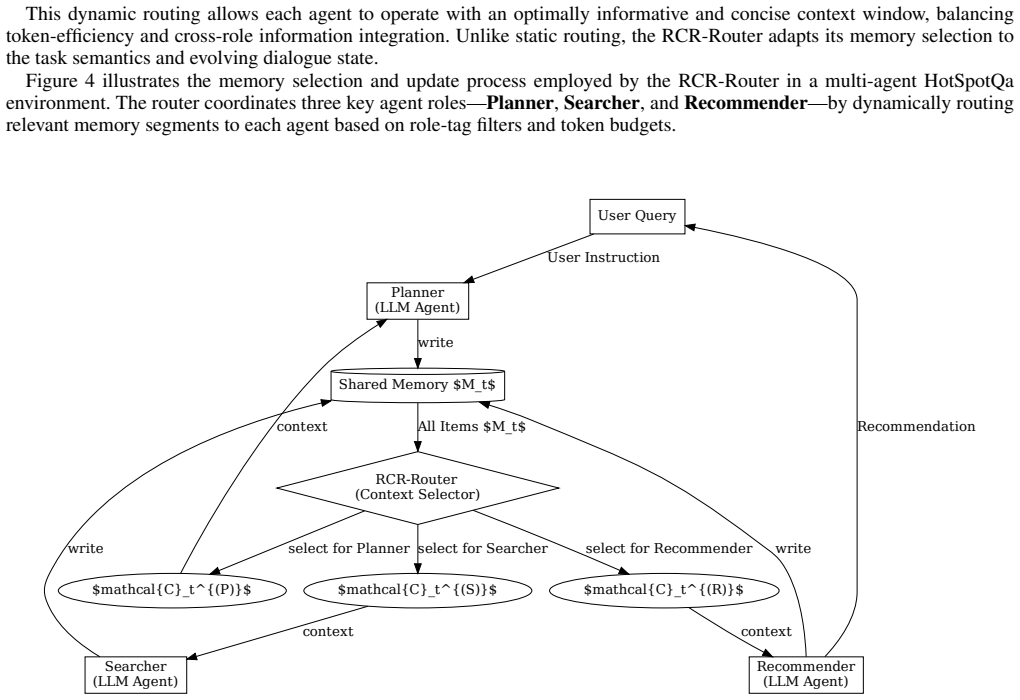
The load-bearing object is the routing policy of Eq. (3): choose $C' \subseteq M_t$ maximizing $\sum_{m \in C'} \alpha(m; R_i, S_t)$ subject to $\sum_{m \in C'} \mathrm{TokenLength}(m) \le B_i$, solved by sorting memory items on $\alpha$ and taking items until the budget is spent. The importance scorer (Appendix E) is a weighted sum of a role-keyword match, a task-stage type preference, and an exponential recency decay $\exp(-\lambda(t-t_m))$. A memory-update step converts agent outputs into structured entries for the next round. The greedy selection is justified as the 0/1-knapsack heuristic, optimal when memory items have uniform token length.
What would settle it
Run RCR-router with identical token budgets and iteration counts but with importance scores replaced by random or uniform values. If answer quality and token savings stay roughly the same, the semantic scorer is not carrying the result; if they collapse, the reported gains depend on the role/stage importance signal.
Extended reading notes
Core claim
At each round a shared memory store holds agent histories, external knowledge, and structured state. A centralized router scores every memory item for every agent with $\alpha(m; R_i, S_t)$, combining role-keyword relevance, task-stage priority, and recency decay, then greedily packs the highest-scoring items into each agent's prompt up to a role-adjusted token budget $B_i$. Agent outputs are written back into memory, so the next round's contexts can be refined. The empirical claim is that this beats both baselines on all three benchmarks: on HotPotQA, answer quality reaches 4.91 versus 4.35 for static and 4.17 for full-context routing, tokens fall to 3.77K, and precision, recall, and F1 all
Load-bearing premise
The load-bearing premise is that the hand-built importance scorer from Appendix E—role keyword lists, stage-type preferences, recency decay, and the weights and decay rate that combine them—is an informative signal for what each agent truly needs, and the paper does not report these components or rule out tuning on the test benchmarks.
Editorial extensions
If this is right
- Selective routing can replace full-context routing without sacrificing quality: on all three benchmarks RCR-router reports both better QA metrics and lower latency than full-context.
- Most gains come with modest context: quality saturates around a 2048-token per-agent budget on HotPotQA and MuSiQue, so extra context mostly adds cost.
- Iteration count matters: in the paper's ablation answer quality peaks at three routing iterations and declines afterward, so progressive refinement helps only up to a point.
- The proposed Answer Quality Score gives multi-agent systems a model-agnostic 1–5 evaluation layer that captures correctness, relevance, completeness, and clarity beyond exact QA accuracy.
Reading between the lines
- Because the importance scorer's keyword lists, stage-type sets, weights, and decay rate are not reported, the clearest next test is whether the same parameters transfer to an unseen benchmark; a learned scorer, which the architecture already permits, is the natural follow-up.
- The same routing mechanism should transfer to retrieval-augmented generation and tool-use loops, where shared memory already exists; only a role/stage importance signal would need to be supplied.
- The Answer Quality Score is produced by an LLM judge, so the routing gains should be validated against human quality judgments before interpreting them as quality rather than judge preference.
- The current budget rule is fixed per role; an adaptive allocator that reallocates unused budget across rounds could plausibly cut tokens further while holding quality.
Editorial analysis
A structured set of objections, weighed in public.
Referee Report
Summary. The paper proposes RCR-Router, a role-aware context routing mechanism for multi-agent LLM systems. At each interaction round, a centralized router scores shared-memory items by role relevance, task-stage priority, and recency, and greedily selects a token-budgeted context for each agent; agent outputs are then written back to shared memory for iterative refinement. The method is formalized as a budgeted importance-maximization policy (Eq. 3), with a knapsack-style complexity analysis in Appendix C. The experiments compare RCR-Router with static and full-context routing on HotPotQA, MuSiQue, and 2WikiMultihop, reporting token reductions, an LLM-based Answer Quality Score, and standard QA metrics. The paper also claims that iterative routing improves quality up to a small number of iterations, with T=3 as the apparent optimum.
Significance. Role-aware, budgeted memory routing is a sensible and practically motivated idea, and the knapsack framing with a greedy selector gives a clean algorithmic core. If the empirical claims were substantiated, the paper would offer a useful efficiency-oriented design for multi-agent LLM systems, and the extension sketches to ALFWorld and WebShop show potential breadth. However, the empirical support is currently insufficient: the iterative-routing ablation, which is one of the stated contributions, is largely based on explicitly estimated rows rather than measurements; the experimental protocol is under-specified; and the new Answer Quality Score is not validated. The theoretical efficiency results are reasonable, but the convergence theorem rests on an unproved monotonicity assumption. The significance is therefore conditional on a complete re-run and transparent reporting of the experiments.
major comments (4)
- [Ablation Studies, 'Effect of Iterative Routing'; Tables 5–6; Figure 2] Tables 5 and 6 state that 'Results for T = 3 are actual measurements; others are estimated to illustrate the trend.' The surrounding text and Figure 2 nevertheless treat these non-measurements as empirical evidence: the paper concludes that 'Answer quality peaks at T = 3 (score: 4.91)' and that 'modest iteration counts (K=3) suffice to achieve most performance gains.' This is a load-bearing issue because iterative routing is a listed contribution and the optimal K is a central design conclusion. The estimated rows must be replaced with actual measurements, and any illustrative estimates must be clearly separated from measured results.
- [Experiments; Benchmarks and Metrics; Tables 2–6] The experimental protocol is not described. The paper does not state the backbone LLM, the number of test episodes, the data split, random seeds, variance/confidence intervals, or the prompt templates used for the agents or the scoring LLM. Without this information, Tables 2–6 cannot be reproduced or independently verified. In an empirical paper, the core comparison (RCR vs. static vs. full-context) requires at least the model name and the exact evaluation set size. This also applies to the additional ALFWorld and WebShop results in the appendices.
- [Answer Quality Score Algorithm; Appendix A.4] The Answer Quality Score is a newly introduced LLM-judge metric that is used as a headline result, but it is never validated against human judgments, against the datasets' gold answers, or against the concurrently reported Precision/Recall/F1. The paper does not report judge agreement, correlation with standard metrics, or stability across scoring LLMs. Since the abstract and results frame improvements in 'answer quality' using this metric, its validity is load-bearing. The authors should provide calibration or agreement evidence, or present this metric only as a secondary, exploratory measure.
- [Appendix C, Lemma .4 and Theorem .5] The claimed convergence of iterative context refinement is not established. Lemma .4 asserts 'monotonic memory relevance' with only a justificatory paragraph, and Theorem .5's proof assumes that selecting the highest-importance items from a 'better' memory pool yields a better routed context—essentially the conclusion to be proved. Moreover, the quality notion in Definition .3 is an average of the same heuristic importance scores α used by the router, so the argument risks being circular. This does not invalidate the algorithmic idea, but it should not be presented as a proof in its current form.
minor comments (4)
- [Results, '2wikimultihop'; Figure 2; Figure 3] Typographical issues: '2wikimulrihop' in the results text, 'HotsPotQa' in the Figure 2 caption, and 'MCP-Router' on the Figure 3 x-axis (the method is RCR-Router).
- [Abstract; Contributions; Table 2] Token-reduction claims are inconsistent: the abstract says 'up to 30%', the contributions say '25–47%', and Table 2 shows a MuSiQue reduction versus Full-Context of about 11% ((13.41−11.89)/13.41). The numbers should be reconciled and the comparison base (Full-Context or Static) made explicit.
- [Throughout] The notation for the number of iterations is used inconsistently: T appears in the method and Tables 5–6, while K appears in the experiments and conclusion. Please define both and use one consistently.
- [Future Work; Appendix A.4] The Future Work paragraph has an incomplete sentence ('We plan to explore learned routing policies...') and a dangling 'span-aware supervision' clause. Also, 'Y AML' appears as a corrupted rendering of YAML in several places; the formatting should be fixed.
Circularity Check
Iterative-routing ablation uses self-admitted 'estimated' rows as measured evidence for the T=3 optimum; Appendix C's convergence proof assumes its own conclusion.
-
fitted input called prediction
[Experiments, 'Effect of Iterative Routing' (Tables 5 and 6, Figure 2) and Conclusion]
"Results for T = 3 are actual measurements; others are estimated to illustrate the trend. ... Answer quality peaks at T = 3 (score: 4.91), with the lowest token usage (3.77K). ... confirm that modest iteration counts (K=3) suffice to achieve most performance gains."
The rows for T=1,2,4,5 are explicitly labeled as estimates, not measurements, yet the text and Figure 2 use them to conclude that answer quality peaks at T=3 and that three routing iterations are optimal. The peak is built into the inserted trend, so the 'empirical' support for the iterative-routing contribution is an artifact of estimation rather than a measured result. This is a fitted curve presented as a finding: the conclusion that K=3 suffices is forced by the estimated rows, not by data.
-
self definitional
[Appendix C.2, Lemma .4 and Theorem .5]
"Assume that the expected quality of an agent's structured output Oi t is a monotonically increasing function of the quality of its input context C i t. ... Therefore, the iterative feedback loop ensures a non-decreasing trajectory for the expected quality of the routed context, formalizing the concept of progressive refinement."
Theorem .5's conclusion—that routed context quality is non-decreasing over rounds—is essentially the assumption of Lemma .4 restated: if better context yields better outputs, and the memory update filters and selects 'best' items, then context quality cannot decrease. This is a definitional consequence of the premise, not an independent derivation. It does not establish that RCR-router's specific scoring/routing improves quality; it only repackages the monotonicity assumption as a proof.
full rationale
The paper's headline comparison (RCR-router vs Full-Context/Static Routing) is supported by Table 2 with standard F1/precision/recall numbers, so that part is not circular per se. However, the second contribution—iterative routing with feedback and the claimed optimality of T=3—rests on Tables 5/6, which explicitly label T≠3 rows as 'estimated to illustrate the trend.' The surrounding text and Figure 2 convert those estimates into measured findings ('Answer quality peaks at T=3...'), and the conclusion repeats 'K=3 suffices.' That is a fitted curve presented as empirical evidence, so the iterative-routing 'prediction' reduces to construction rather than measurement. Compounding this, the Appendix C convergence proof derives the progressive-refinement conclusion from Lemma .4, whose assumption is already that better context produces better outputs; the theorem therefore restates its own premise. There is no load-bearing self-citation of a uniqueness theorem or ansatz-smuggling citation; the multiple self-citations in Related Work are not used to justify the core claims. I score 6 because the central iterative-routing claim is partly circular/constructed, while the main static vs dynamic routing comparison still has independent (though underreported) metrics.
Assumptions & free parameters
free parameters (5)
- Token budget offsets βbase and βrole(Ri) =
not reported
- Importance weights w1, w2, w3 =
default 1.0, not tuned
- Recency decay factor λ =
not reported
- Role keyword lists Ki and stage-type sets Tt =
manually curated, not published
- Per-role token budgets =
Planner 1500, Searcher 1000, Recommender 800 (Appendix B) vs 2048 per agent (Table 2)
assumptions (5)
- domain assumption Memory relevance is monotone: feeding higher-quality context to an LLM agent yields higher-quality outputs, and the memory update preserves this order (Lemma 4).
- domain assumption The LLM-based Answer Quality Score from DeepSeek or GPT-4 is a valid proxy for answer quality.
- domain assumption HotPotQA, MuSiQue, and 2WikiMultihop can be decomposed into Planner/Searcher/Recommender agents with a shared memory store.
- standard math The greedy top-k selection approximates the optimal knapsack solution well in practice.
- ad hoc to paper Rows labeled 'estimated to illustrate the trend' can be used as valid evidence for the shape of an ablation curve.
Cite this review
Pith. "Pith review of RCR-Router: Efficient Role-Aware Context Routing for Multi-Agent LLM Systems with Structured Memory." pith.science (2026). https://pith.science/paper/CS7BQJDM
@misc{pith2026250804903,
  author       = {Pith},
  title        = {Pith review of: RCR-Router: Efficient Role-Aware Context Routing for Multi-Agent LLM Systems with Structured Memory},
  year         = {2026},
  howpublished = {\url{https://pith.science/paper/CS7BQJDM}},
  note         = {Machine review of arXiv:2508.04903}
}
read the original abstract
Multi-agent large language model (LLM) systems have shown strong potential in complex reasoning and collaborative decision-making tasks. However, most existing coordination schemes rely on static or full-context routing strategies, which lead to excessive token consumption, redundant memory exposure, and limited adaptability across interaction rounds. We introduce RCR-Router, a modular and role-aware context routing framework designed to enable efficient, adaptive collaboration in multi-agent LLMs. To our knowledge, this is the first routing approach that dynamically selects semantically relevant memory subsets for each agent based on its role and task stage, while adhering to a strict token budget. A lightweight scoring policy guides memory selection, and agent outputs are iteratively integrated into a shared memory store to facilitate progressive context refinement. To better evaluate model behavior, we further propose an Answer Quality Score metric that captures LLM-generated explanations beyond standard QA accuracy. Experiments on three multi-hop QA benchmarks -- HotPotQA, MuSiQue, and 2WikiMultihop -- demonstrate that RCR-Router reduces token usage (up to 30%) while improving or maintaining answer quality. These results highlight the importance of structured memory routing and output-aware evaluation in advancing scalable multi-agent LLM systems.
Figures


Figures from the paper (1 more)
Forward citations
Cited by 8 Pith papers
-
Beyond Individual Intelligence: Surveying Collaboration, Failure Attribution, and Self-Evolution in LLM-based Multi-Agent Systems
A survey that unifies prior work on multi-agent LLM systems via the LIFE framework, mapping dependencies across collaboration, failure attribution, and autonomous self-evolution while identifying cross-stage challenges.
-
Weak-Link Optimization for Multi-Agent Reasoning and Collaboration
WORC improves multi-agent LLM reasoning to 82.2% average accuracy by predicting and compensating for the weakest agent via targeted extra sampling rather than uniform reinforcement.
-
Learning Agent Routing From Early Experience
BoundaryRouter routes queries to LLM or agent using early experience memory from a seed set, cutting inference time 60.6% versus always using agents and raising performance 28.6% versus always using direct LLM inference.
-
MemRouter: Memory-as-Embedding Routing for Long-Term Conversational Agents
A lightweight supervised router using frozen-LLM embeddings for memory admission decisions outperforms LLM-based memory managers in both F1 score and latency on the LoCoMo benchmark.
-
Beyond Individual Intelligence: Surveying Collaboration, Failure Attribution, and Self-Evolution in LLM-based Multi-Agent Systems
The survey proposes the LIFE framework to unify fragmented research on collaboration, failure attribution, and self-evolution in LLM multi-agent systems into a progression toward self-organizing intelligence.
-
AI-Model Network: Concept, Current State and Future
The paper introduces the concept, vision, and hierarchical architecture of a worldwide AI-model network (AI-ModelNet) for model interconnection, sharing, and collaboration, validated via a prototype.
-
Token Economics for LLM Agents: A Dual-View Study from Computing and Economics
The paper delivers a unified survey of token economics for LLM agents, conceptualizing tokens as production factors, exchange mediums, and units of account across micro, meso, macro, and security dimensions using esta...
-
Toward Efficient Agents: Memory, Tool learning, and Planning
A survey that organizes efficiency techniques for LLM agents into memory, tool learning, and planning, and consolidates benchmarks and metrics for measuring cost-performance trade-offs.
Reference graph
Works this paper leans on
-
[1]
Input: A user query Q and the corresponding generated answer A
-
[2]
Build Prompt P using a standardized scoring instruction template
-
[3]
In Proceedings of the AAAI Sym- posium Series, volume 2, 277–280
Memory matters: The need to improve long-term memory in llm-agents. In Proceedings of the AAAI Sym- posium Series, volume 2, 277–280. Ho, X.; Duong Nguyen, A.-K.; Sugawara, S.; and Aizawa, A. 2020. Constructing A Multi-hop QA Dataset for Com- prehensive Evaluation of Reasoning Steps. In Proceed- ings of the 28th International Conference on Computational L...
arXiv 2020
-
[4]
Memory sandbox: Transparent and interactive mem- ory management for conversational agents. In Adjunct Pro- ceedings of the 36th Annual ACM Symposium on User Inter- face Software and Technology, 1–3. Ji, H.; Li, S.; Cao, Y .; Ding, C.; Xu, J.; Tan, Q.; Liu, J.; Li, A.; Tang, X.; Zheng, L.; et al. 2025. A computation and energy efficient hardware architectu...
arXiv 2025
-
[5]
In European Conference on Computer Vision, 18–34
Instructgie: Towards generalizable image editing. In European Conference on Computer Vision, 18–34. Springer. Niu, W.; Sun, M.; Li, Z.; Chen, J.-A.; Guan, J.; Shen, X.; Liu, J.; Zhang, M.; Wang, Y .; Lin, X.; and Ren, B
-
[7]
In Proceedings of the 34th International Joint Conference on Artificial Intel- ligence
FairSMOE: Mitigating Multi-Attribute Fairness Prob- lem with Sparse Mixture-of-Experts. In Proceedings of the 34th International Joint Conference on Artificial Intel- ligence. Yang, Z.; Qi, P.; Zhang, S.; Bengio, Y .; Cohen, W. W.; Salakhutdinov, R.; and Manning, C. D. 2018. HotpotQA: A dataset for diverse, explainable multi-hop question answer- ing. arXi...
arXiv 2018
-
[10]
Send P to an LLM Scoring Engine (e.g., DeepSeek, GPT-4) via API call: output ← llm query api(P )
-
[11]
Parse Score: Convert the LLM output into a JSON object and extract the numerical score: score ← json.loads(output)["score"]
Show all 32 references
-
[12]
Remarks This scoring framework is model-agnostic and supports different LLM backends, such as DeepSeek or OpenAI, provided they follow a consistent prompt-response format
Return: A quality score in the range [1, 5], with optional justification text. Remarks This scoring framework is model-agnostic and supports different LLM backends, such as DeepSeek or OpenAI, provided they follow a consistent prompt-response format. It judges answer quality b...
-
[13]
Memory Pool Initialization: At time step t, the memory set Mt consists of all past memory items {m1, m2, ..., mt} accumulated from prior agent outputs
-
[14]
Token Budget Allocation: For each agent role i, a pre-defined token budget Bi is allocated (e.g., Planner: 1500 tokens, Searcher: 1000 tokens, Recommender: 800 tokens)
-
[15]
Memory Scoring: Each memory item mj ∈ Mt is scored using an importance scorer s(mj, i,stage, t), where the score reflects the relevance of mj for agent i at the current stage
-
[16]
Semantic Filtering: All memory items are ranked by their scores, and top-ranked items are greedily selected under the token constraint Bi, forming the contextual input C (i) t for agent i
-
[17]
Memory Update Strategy After each round of agent execution, RCR-Router:
Prompt Construction and Agent Invocation:The filtered memory C (i) t is converted into context text and inserted into the prompt template for the specific agent role, which is then passed to the LLM to generate the next action. Memory Update Strategy After each round of agent ...
-
[18]
Selects a role-specific subset of Mt based on predefined filters
-
[19]
Forms a prompt to query the LLM (or environment)
-
[20]
Key Design Insight This staged memory routing allows each agent to operate within its own contextual window while contributing to a globally consistent shared memory
Appends the resulting output as a new memory entry with timestamp and tags. Key Design Insight This staged memory routing allows each agent to operate within its own contextual window while contributing to a globally consistent shared memory. The design balances modularity and...
2009
-
[21]
The RCR-Router’s selection mechanism (Algorithm 1) is designed to select the subset of items with the highest importance scores from the memory pool
-
[22]
Applying a selection function that chooses the ”best” items to a ”better” pool ( Mt+1) will, in expectation, yield a selected subset (C i t+1) of higher quality than applying it to the previous pool (Mt)
-
[23]
This supports the empirical results of the iterative routing ablation study
Therefore, the iterative feedback loop ensures a non-decreasing trajectory for the expected quality of the routed context, formalizing the concept of progressive refinement. This supports the empirical results of the iterative routing ablation study . D Extended Role Examples ...
2021
-
[24]
Planner interprets the instruction and generates sub-goals
-
[25]
Searcher queries the environment (via Perception) to identify objects satisfying current sub-goal
-
[26]
Navigator moves the agent toward target objects or locations
-
[27]
Interactor performs the necessary environment interaction
-
[28]
Evaluator verifies task completion and optionally signals Planner for replanning. Design Benefits • Role Modularity and Separation of Concerns: Each agent is assigned a distinct functional role—such as planning, navi- gation, or interaction—enabling clean abstraction of respon...
-
[29]
Planner receives the instruction and performs constraint extraction (e.g., attributes, options), forming a structured query
-
[30]
Searcher takes the query and retrieves candidate products using a retrieval engine (e.g., Pyserini + indexed corpus, or live ScraperAPI)
-
[31]
Recommender evaluates the retrieved products, matching them against user constraints and preferences, and generates a ranked shortlist with textual rationales
-
[32]
choose [Product Title]
(Optional) The final product or product list is returned to the user, or used to simulate downstream actions (e.g., “choose [Product Title]”, “choose [Option]”, etc.). Agents interact via a shared structured memory Mt, with context routed at each iteration based on role and ta...
-
[2023]
In 2023 IEEE International Conference on Data Mining Workshops (ICDMW), 1565–1574
Optimization and improvement of fake news detec- tion using voting technique for societal benefit. In 2023 IEEE International Conference on Data Mining Workshops (ICDMW), 1565–1574. IEEE. Chinta, S. V .; Wang, Z.; Palikhe, A.; Zhang, X.; Kashif, A.; Smith, M. A.; Liu, J.; and ...
2023
-
[2024]
In Proceed- ings of the IEEE/CVF Winter Conference on Applications of Computer Vision, 1267–1276
Physical-space multi-body mesh detection achieved by local alignment and global dense learning. In Proceed- ings of the IEEE/CVF Winter Conference on Applications of Computer Vision, 1267–1276. Elovic. 2025. GPT Researcher: an open deep research agent designed for both web and...
2025 arXiv
-
[2025]
ACM Trans
Mobile-3DCNN: An Acceleration Framework for Ultra-Real-Time Execution of Large 3D CNNs on Mobile Devices. ACM Trans. Archit. Code Optim. Shridhar, M.; Yuan, X.; Cˆot´e, M.-A.; Bisk, Y .; Trischler, A.; and Hausknecht, M. 2021. ALFWorld: Aligning Text and Embodied Environments ...
2021 arXiv
Reviewed August 5, 2026 · model on record in the stance chip above.
Discussion (0). Sign in to comment.