Dark Dimension Right-handed Neutrinos Confronted with Long-Baseline Oscillation Experiments
Pith reviewed 2026-05-21 15:40 UTC · model grok-4.3
The pith
T2K and NOvA data remain compatible with standard oscillations while excluding dark dimension neutrino parameters
A machine-rendered reading of the paper's core claim, the machinery that carries it, and where it could break.
Core claim
Right-handed neutrinos naturally appear in dark extra dimension models and affect neutrino oscillations. Long-baseline experiments can probe the model parameters by comparing predicted oscillation spectra to data. The T2K and NOvA results match standard three-neutrino oscillations without extra dimensions, yielding stringent exclusion limits on the dark dimension parameters at high confidence. These limits complement constraints from colliders and cosmology.
What carries the argument
Modified neutrino oscillation spectra due to right-handed neutrinos in dark extra dimensions
If this is right
- The T2K and NOvA data support the standard neutrino oscillation hypothesis.
- Stringent exclusion limits are established for the extra dimension model parameters.
- The constraints on dark dimension right-handed neutrinos complement those from collider experiments and cosmological observations.
Where Pith is reading between the lines
- Future long-baseline experiments could apply similar analyses to further restrict the model space.
- These results may guide the development of unified theories incorporating extra dimensions and neutrino properties.
- Cross-checks with other types of neutrino data, such as from reactors or accelerators, could strengthen or weaken the exclusions.
Load-bearing premise
The oscillation spectra are computed in a way that accurately includes all relevant effects from the dark dimension without overlooked uncertainties.
What would settle it
A statistical preference in the T2K or NOvA dataset for the extra dimension model parameters over the standard model at high significance would challenge the exclusion limits.
Figures




read the original abstract
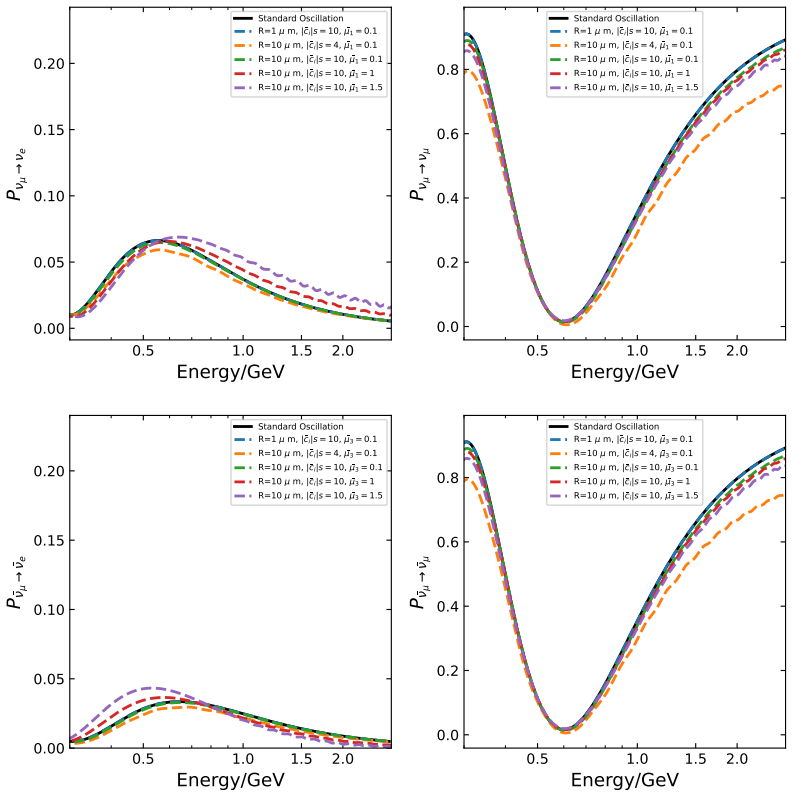
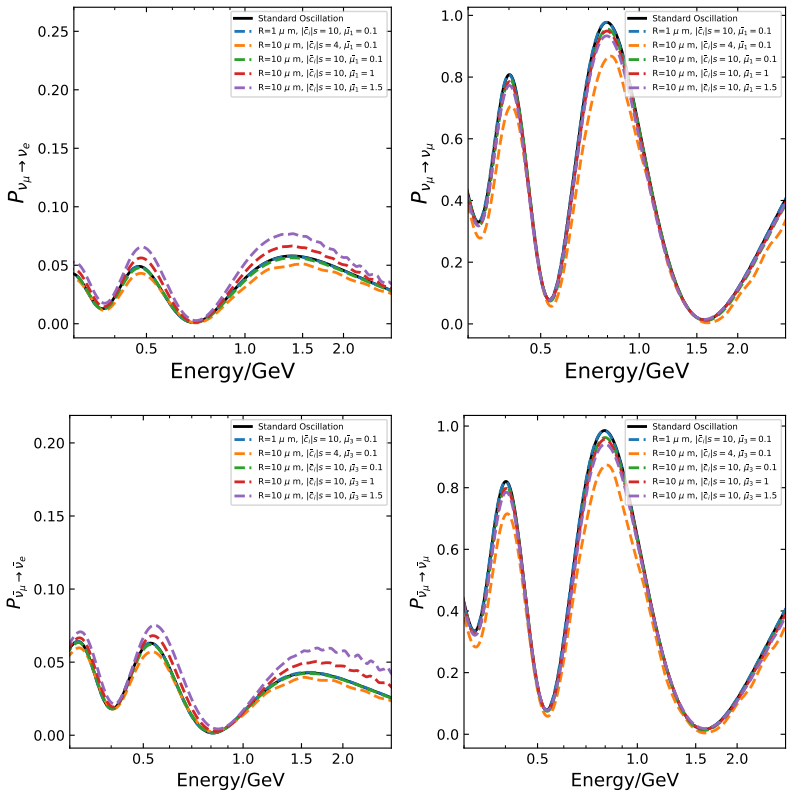
Right-handed neutrinos are naturally induced by dark extra dimension models and play an essential role in neutrino oscillations. The model parameters can be examined by the long-baseline neutrino oscillation experiments. In this work, we compute the predicted neutrino oscillation spectra within/without extra dimension models and compare them with the experimental data. We find that the neutrino data in the T2K and NOvA experiments are compatible with the standard neutrino oscillation hypothesis. The results set the stringent exclusion limit on the extra dimension model parameters at a high confidence level. The derived constraints on dark dimension right-handed neutrinos are complementary to those results from the collider experiments and cosmological observations.
Editorial analysis
A structured set of objections, weighed in public.
Referee Report
Summary. The manuscript investigates right-handed neutrinos induced by dark extra dimension models and their effects on neutrino oscillations. The authors compute oscillation spectra with and without the extra-dimension contributions, compare these to T2K and NOvA data, and report compatibility with the standard three-flavor oscillation hypothesis. They derive stringent exclusion limits on the dark-dimension model parameters at high confidence level, presenting these as complementary to collider and cosmological constraints.
Significance. If the exclusion limits are derived with a statistically sound procedure that properly marginalizes over experimental systematics, the work would provide useful new constraints on extra-dimensional neutrino models using existing long-baseline data. This approach is complementary to direct searches and could help test the viability of dark-dimension scenarios in a regime not accessible to colliders or cosmology alone.
major comments (1)
- [§4] §4 (Statistical Analysis): The manuscript does not specify whether the full published covariance matrices and nuisance parameters from T2K and NOvA are included in the likelihood or chi-squared function. Long-baseline results are systematics-dominated; without marginalization over flux, cross-section, and detector uncertainties the derived exclusion contours risk being artificially tight, directly affecting the central claim of 'stringent exclusion limits'.
minor comments (2)
- [Figure 1] Figure 1: Axis labels and curve styles should explicitly distinguish the standard oscillation case from the dark-dimension cases with different parameter values.
- [References] References: Add the specific T2K and NOvA data-release papers with publication years and arXiv identifiers for reproducibility.
Simulated Author's Rebuttal
We thank the referee for the careful reading of our manuscript and the constructive comment on the statistical analysis. We address this point directly below and have revised the manuscript to provide the requested clarification and details.
read point-by-point responses
-
Referee: [§4] §4 (Statistical Analysis): The manuscript does not specify whether the full published covariance matrices and nuisance parameters from T2K and NOvA are included in the likelihood or chi-squared function. Long-baseline results are systematics-dominated; without marginalization over flux, cross-section, and detector uncertainties the derived exclusion contours risk being artificially tight, directly affecting the central claim of 'stringent exclusion limits'.
Authors: We agree that explicit documentation of the statistical procedure is necessary, especially since long-baseline results are systematics-dominated. The original manuscript in §4 describes the computation of oscillation spectra and their comparison to T2K and NOvA data but does not detail the precise form of the likelihood or chi-squared function. To address this, we will revise §4 to specify that the analysis employs the full published covariance matrices provided by the T2K and NOvA collaborations. We will also describe the marginalization over the relevant nuisance parameters for flux, cross-section, and detector uncertainties. This revision will confirm that the derived exclusion limits properly incorporate these systematics and are not artificially tight. We believe the updated description will strengthen the presentation of our results while preserving the central findings. revision: yes
Circularity Check
No circularity: standard data confrontation with external experiments
full rationale
The paper computes oscillation spectra with and without dark-dimension right-handed neutrino effects, then directly compares both to independent T2K and NOvA data sets to test compatibility with standard three-flavor oscillations and derive exclusion limits on the extra-dimension parameters. This is a conventional likelihood or chi-squared analysis against external experimental results; no step reduces a claimed prediction to a fitted input by construction, no self-citation is invoked as a uniqueness theorem or load-bearing premise, and the central result (compatibility plus limits) is not equivalent to the model definition or to any internal fit. The derivation therefore remains self-contained against external benchmarks.
Axiom & Free-Parameter Ledger
Lean theorems connected to this paper
-
IndisputableMonolith/Foundation/AlexanderDuality.leanalexander_duality_circle_linking contradicts?
contradictsCONTRADICTS: the theorem conflicts with this paper passage, or marks a claim that would need revision before publication.
Our model lives in a 5D spacetime that is the direct product of the 4D Minkowski spacetime labeled by coordinates x^μ and an extra direction that is an interval of length πR
-
IndisputableMonolith/Foundation/AlexanderDuality.leanD3_admits_circle_linking contradicts?
contradictsCONTRADICTS: the theorem conflicts with this paper passage, or marks a claim that would need revision before publication.
the 5D Planck mass is of order 10^9 GeV... right-handed (R) neutrinos propagate in the dark dimension
What do these tags mean?
- matches
- The paper's claim is directly supported by a theorem in the formal canon.
- supports
- The theorem supports part of the paper's argument, but the paper may add assumptions or extra steps.
- extends
- The paper goes beyond the formal theorem; the theorem is a base layer rather than the whole result.
- uses
- The paper appears to rely on the theorem as machinery.
- contradicts
- The paper's claim conflicts with a theorem or certificate in the canon.
- unclear
- Pith found a possible connection, but the passage is too broad, indirect, or ambiguous to say the theorem truly supports the claim.
Forward citations
Cited by 1 Pith paper
-
Breaking Free from the Swampland of Impossible Universes through the DESI Portal
DESI data indicating evolving dark energy may allow string theory to describe observed universes without violating swampland constraints on constant dark energy.
Reference graph
Works this paper leans on
-
[1]
Antoniadis,A Possible new dimension at a few TeV, Phys
I. Antoniadis,A Possible new dimension at a few TeV, Phys. Lett. B246(1990) 377–384
work page 1990
-
[2]
The Hierarchy Problem and New Dimensions at a Millimeter
N. Arkani-Hamed, S. Dimopoulos and G. R. Dvali,The Hierarchy problem and new dimensions at a millimeter, Phys. Lett. B429(1998) 263–272 [hep-ph/9803315]
work page internal anchor Pith review Pith/arXiv arXiv 1998
-
[3]
New Dimensions at a Millimeter to a Fermi and Superstrings at a TeV
I. Antoniadis, N. Arkani-Hamed, S. Dimopoulos and G. R. Dvali,New dimensions at a millimeter to a Fermi and superstrings at a TeV, Phys. Lett. B436(1998) 257–263 [hep-ph/9804398]
work page internal anchor Pith review Pith/arXiv arXiv 1998
-
[4]
On the Geometry of the String Landscape and the Swampland
H. Ooguri and C. Vafa,On the Geometry of the String Landscape and the Swampland, Nucl. Phys. B766(2007) 21–33 [hep-th/0605264]
work page internal anchor Pith review Pith/arXiv arXiv 2007
- [5]
-
[6]
M. Montero, C. Vafa and I. Valenzuela,The dark dimension and the Swampland, JHEP 02(2023) 022 [2205.12293]
- [7]
-
[8]
K. R. Dienes, E. Dudas and T. Gherghetta,Neutrino oscillations without neutrino masses or heavy mass scales: A Higher dimensional seesaw mechanism, Nucl. Phys. B 557(1999) 25 [hep-ph/9811428]
work page internal anchor Pith review Pith/arXiv arXiv 1999
-
[9]
Neutrino Masses from Large Extra Dimensions
N. Arkani-Hamed, S. Dimopoulos, G. R. Dvali and J. March-Russell,Neutrino masses from large extra dimensions, Phys. Rev. D65(2001) 024032 [hep-ph/9811448]
work page internal anchor Pith review Pith/arXiv arXiv 2001
-
[10]
G. R. Dvali and A. Y. Smirnov,Probing large extra dimensions with neutrinos, Nucl. Phys. B563(1999) 63–81 [hep-ph/9904211]
work page internal anchor Pith review Pith/arXiv arXiv 1999
-
[11]
P. A. N. Machado, H. Nunokawa and R. Zukanovich Funchal,Testing for Large Extra Dimensions with Neutrino Oscillations, Phys. Rev. D84(2011) 013003 [1101.0003]
work page internal anchor Pith review Pith/arXiv arXiv 2011
- [12]
-
[13]
Neutrino oscillations and large extra dimensions
R. Barbieri, P. Creminelli and A. Strumia,Neutrino oscillations from large extra dimensions, Nucl. Phys. B585(2000) 28–44 [hep-ph/0002199]
work page internal anchor Pith review Pith/arXiv arXiv 2000
-
[14]
R. N. Mohapatra and A. Perez-Lorenzana,Three flavor neutrino oscillations in models with large extra dimensions, Nucl. Phys. B593(2001) 451–470 [hep-ph/0006278]
work page internal anchor Pith review Pith/arXiv arXiv 2001
-
[15]
Probing Large Extra Dimensions With IceCube
A. Esmaili, O. L. G. Peres and Z. Tabrizi,Probing Large Extra Dimensions With IceCube, JCAP12(2014) 002 [1409.3502]
work page internal anchor Pith review Pith/arXiv arXiv 2014
-
[16]
Probing new physics scenarios in accelerator and reactor neutrino experiments
A. Di Iura, I. Girardi and D. Meloni,Probing new physics scenarios in accelerator and reactor neutrino experiments, J. Phys. G42(2015) 065003 [1411.5330]
work page internal anchor Pith review Pith/arXiv arXiv 2015
-
[17]
J. M. Berryman, A. de Gouvˆ ea, K. J. Kelly, O. L. G. Peres and Z. Tabrizi,Large, Extra Dimensions at the Deep Underground Neutrino Experiment, Phys. Rev. D94(2016), no. 3, 033006 [1603.00018]
work page internal anchor Pith review Pith/arXiv arXiv 2016
- [18]
- [19]
-
[20]
Roy,Capability of the proposed long-baseline experiments to probe large extra dimension, Phys
S. Roy,Capability of the proposed long-baseline experiments to probe large extra dimension, Phys. Rev. D108(2023), no. 5, 055015 [2305.16234]
- [21]
- [22]
- [23]
-
[24]
Solar neutrino oscillation from large extra dimensions
A. Lukas, P. Ramond, A. Romanino and G. G. Ross,Solar neutrino oscillation from large extra dimensions, Phys. Lett. B495(2000) 136–146 [hep-ph/0008049]
work page internal anchor Pith review Pith/arXiv arXiv 2000
-
[25]
Remarks on models with singlet neutrino in large extra dimensions
K. Agashe and G.-H. Wu,Remarks on models with singlet neutrino in large extra dimensions, Phys. Lett. B498(2001) 230–236 [hep-ph/0010117]
work page internal anchor Pith review Pith/arXiv arXiv 2001
-
[26]
Neutrino Masses and Mixing in Brane-World Theories
A. Lukas, P. Ramond, A. Romanino and G. G. Ross,Neutrino Masses and Mixing in Brane World Theories, JHEP04(2001) 010 [hep-ph/0011295]
work page internal anchor Pith review Pith/arXiv arXiv 2001
-
[27]
Dirac Vs. Majorana Neutrino Masses From a TeV Interval
D. Diego and M. Quiros,Dirac Versus Majorana Neutrino Masses From a TeV Interval, Nucl. Phys. B805(2008) 148–167 [0804.2838]
work page internal anchor Pith review Pith/arXiv arXiv 2008
-
[28]
Neutrinos in Large Extra Dimensions and Short-Baseline $\nu_e$ Appearance
M. Carena, Y.-Y. Li, C. S. Machado, P. A. N. Machado and C. E. M. Wagner,Neutrinos in Large Extra Dimensions and Short-Baselineν e Appearance, Phys. Rev. D96(2017), no. 9, 095014 [1708.09548]
work page internal anchor Pith review Pith/arXiv arXiv 2017
- [29]
- [30]
-
[31]
Searching for a Dark Dimension Right-handed Neutrino in KATRIN
I. Antoniadis, A. Chatrabhuti and H. Isono,Searching for a Dark Dimension Right-handed Neutrino in KATRIN,2509.05233
work page internal anchor Pith review Pith/arXiv arXiv
-
[32]
Do neutrinos dream in 5D? Towards a comprehensive extra-dimensional neutrino phenomenology
A. de Giorgi, D. Pasari and J. Turner,Do neutrinos dream in 5D? Towards a comprehensive extra-dimensional neutrino phenomenology,2512.02101
work page internal anchor Pith review Pith/arXiv arXiv
-
[33]
Planck 2018 results. I. Overview and the cosmological legacy of Planck
Planck Collaboration, N. Aghanimet al.,Planck 2018 results. I. Overview and the cosmological legacy of Planck, Astron. Astrophys.641(2020) A1 [1807.06205]
work page internal anchor Pith review Pith/arXiv arXiv 2018
-
[34]
Planck 2018 results. VI. Cosmological parameters
Planck Collaboration, N. Aghanimet al.,Planck 2018 results. VI. Cosmological parameters, Astron. Astrophys.641(2020) A6 [1807.06209], [Erratum: Astron.Astrophys. 652, C4 (2021)]
work page internal anchor Pith review Pith/arXiv arXiv 2018
-
[35]
Acharyaet al.,Sterile-neutrino search based on 259 days of KATRIN data, Nature648(2025), no
KATRIN Collaboration, H. Acharyaet al.,Sterile-neutrino search based on 259 days of KATRIN data, Nature648(2025), no. 8092, 70–75 [2503.18667]
-
[36]
NuFit-6.0: Updated global analysis of three-flavor neutrino oscillations
I. Esteban, M. C. Gonzalez-Garcia, M. Maltoni, I. Martinez-Soler, J. P. Pinheiro and T. Schwetz,NuFit-6.0: updated global analysis of three-flavor neutrino oscillations, JHEP 12(2024) 216 [2410.05380]
work page internal anchor Pith review Pith/arXiv arXiv 2024
-
[37]
Simulation of long-baseline neutrino oscillation experiments with GLoBES
P. Huber, M. Lindner and W. Winter,Simulation of long-baseline neutrino oscillation experiments with GLoBES (General Long Baseline Experiment Simulator), Comput. Phys. Commun.167(2005) 195 [hep-ph/0407333]
work page internal anchor Pith review Pith/arXiv arXiv 2005
-
[38]
From Double Chooz to Triple Chooz - Neutrino Physics at the Chooz Reactor Complex
P. Huber, J. Kopp, M. Lindner, M. Rolinec and W. Winter,New features in the simulation of neutrino oscillation experiments with GLoBES 3.0: General long baseline experiment simulator, Comput. Phys. Commun.177(2007) 432–438 [hep-ph/0601266]. [39]https://github.com/WeiMXi/LED.git. 23
work page internal anchor Pith review Pith/arXiv arXiv 2007
-
[39]
T2K Collaboration, K. Abeet al.,Measurements of neutrino oscillation parameters from the T2K experiment using3.6×10 21 protons on target, Eur. Phys. J. C83(2023), no. 9, 782 [2303.03222]
- [40]
-
[41]
Superbeams versus Neutrino Factories
P. Huber, M. Lindner and W. Winter,Superbeams versus Neutrino Factories, Nucl.Phys. B645(2002) 3–48 [hep-ph/0204352]
work page internal anchor Pith review Pith/arXiv arXiv 2002
-
[42]
Getting the most from the statistical analysis of solar neutrino oscillations
G. Fogli, E. Lisi, A. Marrone, D. Montanino and A. Palazzo,Getting the most from the statistical analysis of solar neutrino oscillations, Phys.Rev.D66(2002) 053010 [hep-ph/0206162]
work page internal anchor Pith review Pith/arXiv arXiv 2002
-
[43]
Atmospheric Neutrino Oscillations and New Physics
M. Gonzalez-Garcia and M. Maltoni,Atmospheric Neutrino Oscillations and New Physics, Phys.Rev.D70(2004) 033010 [hep-ph/0404085]
work page internal anchor Pith review Pith/arXiv arXiv 2004
- [44]
discussion (0)
Sign in with ORCID, Apple, or X to comment. Anyone can read and Pith papers without signing in.