Recognition: no theorem link
Listen to Rhythm, Choose Movements: Autoregressive Multimodal Dance Generation via Diffusion and Mamba with Decoupled Dance Dataset
Pith reviewed 2026-05-16 16:35 UTC · model grok-4.3
The pith
Diffusion model with Mamba generates coherent long dance sequences from audio and text inputs.
A machine-rendered reading of the paper's core claim, the machinery that carries it, and where it could break.
Core claim
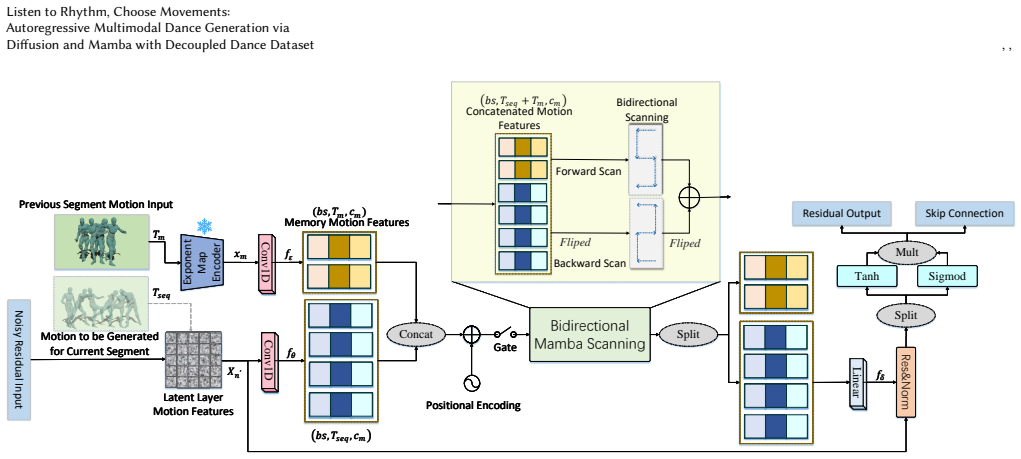
LRCM presents a multimodal-guided diffusion framework that supports diverse input modalities and autoregressive dance motion generation. By exploring a feature decoupling paradigm generalized to the Motorica Dance dataset, it separates motion capture data, audio rhythm, and annotated text descriptions. The architecture integrates audio-latent Conformer and text-latent Cross-Conformer with the Motion Temporal Mamba Module to enable smooth, long-duration synthesis.
What carries the argument
The feature decoupling paradigm combined with the Motion Temporal Mamba Module (MTMM) in a diffusion architecture, which processes latents from audio and text to produce coherent motion sequences.
Where Pith is reading between the lines
- Potential extension to real-time interactive systems where users provide audio or text cues for dance.
- Applicability of Mamba modules to other long-sequence generative tasks in graphics.
- Opportunity to test the framework on additional datasets beyond Motorica for validation.
Load-bearing premise
The combination of feature decoupling with the audio and text Conformer modules and the Mamba temporal module will produce better semantic control and long-sequence coherence in dance generation.
What would settle it
Quantitative results where LRCM shows no significant improvement over baseline methods in metrics for long sequence coherence or semantic alignment with inputs.
Figures







read the original abstract
Advances in generative models and sequence learning have greatly promoted research in dance motion generation, yet current methods still suffer from coarse semantic control and poor coherence in long sequences. In this work, we present Listen to Rhythm, Choose Movements (LRCM), a multimodal-guided diffusion framework supporting both diverse input modalities and autoregressive dance motion generation. We explore a feature decoupling paradigm for dance datasets and generalize it to the Motorica Dance dataset, separating motion capture data, audio rhythm, and professionally annotated global and local text descriptions. Our diffusion architecture integrates an audio-latent Conformer and a text-latent Cross-Conformer, and incorporates a Motion Temporal Mamba Module (MTMM) to enable smooth, long-duration autoregressive synthesis. Experimental results indicate that LRCM delivers strong performance in both functional capability and quantitative metrics, demonstrating notable potential in multimodal input scenarios and extended sequence generation. The project page is available at https://oranduanstudy.github.io/LRCM/.
Editorial analysis
A structured set of objections, weighed in public.
Referee Report
Summary. The manuscript presents LRCM, a multimodal-guided diffusion framework for autoregressive dance motion generation. It proposes a feature decoupling paradigm for dance datasets (generalized to Motorica), separating motion capture, audio rhythm, and global/local text annotations. The architecture combines an audio-latent Conformer, text-latent Cross-Conformer, and Motion Temporal Mamba Module (MTMM) to support diverse modalities and long-sequence synthesis.
Significance. If the reported gains hold, the work would advance dance generation by improving semantic control via decoupled features and long-sequence coherence via Mamba-based temporal modeling, with clear relevance to animation and VR applications. The explicit decoupling and autoregressive diffusion setup are strengths that could be built upon.
major comments (2)
- [§5] §5 (Experimental Results): The abstract and main text claim 'strong performance in both functional capability and quantitative metrics' with 'notable potential,' yet no specific numbers, baselines, error bars, or statistical tests are referenced in the provided summary; this makes the central empirical claim difficult to evaluate without the full tables and comparisons.
- [§3.2] §3.2 (MTMM description): The integration of the Motion Temporal Mamba Module with the diffusion denoising process is described at a high level; a concrete equation or pseudocode showing how MTMM conditions the noise prediction for autoregressive extension would strengthen the long-sequence coherence claim.
minor comments (2)
- [Abstract] The project page link is given but the manuscript should explicitly state which supplementary materials (code, models, or additional videos) are available there.
- [§3] Notation for the decoupled features (motion, audio, text latents) should be introduced once in §3 and used consistently to avoid ambiguity in later sections.
Simulated Author's Rebuttal
We thank the referee for the constructive review and the recommendation for minor revision. We address each major comment below and have incorporated clarifications to strengthen the manuscript.
read point-by-point responses
-
Referee: [§5] §5 (Experimental Results): The abstract and main text claim 'strong performance in both functional capability and quantitative metrics' with 'notable potential,' yet no specific numbers, baselines, error bars, or statistical tests are referenced in the provided summary; this makes the central empirical claim difficult to evaluate without the full tables and comparisons.
Authors: The full manuscript in Section 5 contains detailed tables reporting quantitative metrics against multiple baselines, including error bars and statistical comparisons. To improve immediate accessibility, we will revise the abstract and the opening paragraph of Section 5 to explicitly cite the key numerical gains (e.g., FID, diversity, and coherence scores) and reference the corresponding tables. revision: yes
-
Referee: [§3.2] §3.2 (MTMM description): The integration of the Motion Temporal Mamba Module with the diffusion denoising process is described at a high level; a concrete equation or pseudocode showing how MTMM conditions the noise prediction for autoregressive extension would strengthen the long-sequence coherence claim.
Authors: We agree that an explicit formulation would clarify the autoregressive mechanism. In the revised manuscript we will insert a concrete equation showing the MTMM-conditioned noise prediction (ε_θ(x_t, t, c_audio, c_text, m_t)) together with pseudocode for the autoregressive rollout, directly linking the Mamba state to the diffusion step. revision: yes
Circularity Check
No significant circularity in derivation chain
full rationale
The paper describes an architectural pipeline (feature decoupling on Motorica dataset, audio-latent Conformer, text-latent Cross-Conformer, Motion Temporal Mamba Module) and reports experimental metrics without any equations, predictions, or derivations that reduce to fitted parameters or self-referential definitions. No self-citation load-bearing steps, uniqueness theorems, or ansatz smuggling appear in the provided text; all claims rest on stated training protocol and quantitative results that remain externally falsifiable.
Axiom & Free-Parameter Ledger
axioms (2)
- domain assumption Diffusion models conditioned on multimodal inputs can generate semantically controlled dance motions.
- domain assumption Mamba architecture supports efficient autoregressive modeling of long motion sequences.
invented entities (2)
-
Motion Temporal Mamba Module (MTMM)
no independent evidence
-
Decoupled dance dataset
no independent evidence
Reference graph
Works this paper leans on
-
[1]
Chaitanya Ahuja and Louis-Philippe Morency. 2019. Language2pose: Natural language grounded pose forecasting. In2019 International Conference on 3D Vision (3DV). IEEE, 719–728
work page 2019
-
[2]
Simon Alexanderson, Rafael Nagy, Jonas Beskow, et al. 2023. Listen, denoise, action! audio-driven motion synthesis with diffusion models.ACM Transactions on Graphics (TOG)42, 4 (2023), 1–20
work page 2023
- [3]
-
[4]
Martin Biquard, Matthieu Chabert, François Genin, et al. 2025. Variational Bayes image restoration with compressive autoencoders.IEEE Transactions on Image Processing34 (2025), 2896–2909
work page 2025
-
[5]
Steven Brown. 2024. The performing arts combined: the triad of music, dance, and narrative.Frontiers in Psychology15 (2024), 1344354
work page 2024
-
[6]
Florinel-Alin Croitoru, Vlad Hondru, Radu Tudor Ionescu, et al. 2023. Diffusion models in vision: A survey.IEEE Transactions on Pattern Analysis and Machine Intelligence45, 9 (2023), 10850–10869
work page 2023
-
[7]
Prafulla Dhariwal and Alexander Nichol. 2021. Diffusion models beat gans on image synthesis. InAdvances in Neural Information Processing Systems, Vol. 34. 8780–8794
work page 2021
- [8]
-
[9]
Team GLM, :, Aohan Zeng, Bin Xu, Bowen Wang, Chenhui Zhang, Da Yin, Dan Zhang, Diego Rojas, Guanyu Feng, Hanlin Zhao, Hanyu Lai, Hao Yu, Hongning Wang, Jiadai Sun, Jiajie Zhang, Jiale Cheng, Jiayi Gui, Jie Tang, Jing Zhang, Jingyu Sun, Juanzi Li, Lei Zhao, Lindong Wu, Lucen Zhong, Mingdao Liu, Minlie Huang, Peng Zhang, Qinkai Zheng, Rui Lu, Shuaiqi Duan, ...
work page internal anchor Pith review Pith/arXiv arXiv 2024
-
[10]
Kaixuan Gong, Dong Lian, Hongjie Chang, et al. 2023. Tm2d: Bimodality driven 3d dance generation via music-text integration. InProceedings of the IEEE/CVF International Conference on Computer Vision. 9942–9952
work page 2023
-
[11]
Albert Gu and Tri Dao. 2023. Mamba: Linear-time sequence modeling with selective state spaces.arXiv preprint arXiv:2312.00752(2023)
work page internal anchor Pith review Pith/arXiv arXiv 2023
-
[12]
Chuan Guo, Yuxuan Mu, Muhammad Gohar Javed, Sen Wang, and Li Cheng. 2024. Momask: Generative masked modeling of 3d human motions. InProceedings of the IEEE/CVF Conference on Computer Vision and Pattern Recognition. 1900–1910
work page 2024
-
[13]
Chuan Guo, Shihao Zou, Xinxin Zuo, et al. 2022. Generating diverse and natural 3d human motions from text. InProceedings of the IEEE/CVF Conference on Computer Vision and Pattern Recognition. 5152–5161
work page 2022
-
[14]
Jonathan Ho, Ajay Jain, and Pieter Abbeel. 2020. Denoising diffusion probabilistic models. InAdvances in Neural Information Processing Systems, Vol. 33. 6840–6851
work page 2020
-
[15]
Zhaoyang Huang, Xiaoxuan Xu, Chen Xu, et al. 2024. Beat-it: Beat-synchronized multi-condition 3d dance generation. InEuropean Conference on Computer Vision. Springer, 273–290
work page 2024
-
[16]
Katsushi Ikeuchi, Zhen Ma, Zhilei Yan, et al. 2018. Describing upper-body motions based on labanotation for learning-from-observation robots.International Journal of Computer Vision126 (2018), 1415–1429
work page 2018
-
[17]
Min Li, Zhenjiang Miao, and Yantao Lu. 2023. LabanFormer: Multi-scale graph attention network and transformer with gated recurrent positional encoding for labanotation generation.Neurocomputing539 (2023), 126203
work page 2023
-
[18]
Ruilong Li, Shan Yang, David A Ross, et al . 2021. Ai choreographer: Music conditioned 3d dance generation with aist++. InProceedings of the IEEE/CVF international conference on computer vision. 13401–13412
work page 2021
-
[19]
Ronghui Li, YuXiang Zhang, Yong Zhang, et al. 2024. Lodge: A coarse to fine diffusion network for long dance generation guided by the characteristic dance primitives. InProceedings of the IEEE/CVF Conference on Computer Vision and Pattern Recognition. 1524–1534
work page 2024
-
[20]
Ruilong Li, Jiafan Zhao, Yong Zhang, et al . 2023. Finedance: A fine-grained choreography dataset for 3d full body dance generation. InProceedings of the IEEE/CVF International Conference on Computer Vision. 10234–10243
work page 2023
-
[21]
Siyao Li, Weijiang Yu, Tianpei Gu, Chunze Lin, Quan Wang, Chen Qian, Chen Change Loy, and Ziwei Liu. 2022. Bailando: 3D dance generation by actor-critic GPT with choreographic memory. InProceedings of the IEEE/CVF Conference on Computer Vision and Pattern Recognition. 11050–11059
work page 2022
-
[22]
Benjamin Lindemann, Timo Müller, Hannes Vietz, Nasser Jazdi, and Michael Weyrich. 2021. A survey on long short-term memory networks for time series prediction.Procedia CIRP99 (2021), 650–655
work page 2021
-
[23]
Zachary C Lipton, John Berkowitz, and Charles Elkan. 2015. A critical review of recurrent neural networks for sequence learning.arXiv preprint arXiv:1506.00019 (2015)
work page internal anchor Pith review Pith/arXiv arXiv 2015
-
[24]
Xinran Liu, Xu Dong, Diptesh Kanojia, et al. 2025. GCDance: Genre-controlled 3D full body dance generation driven by music.arXiv preprint arXiv:2502.18309 (2025)
work page internal anchor Pith review Pith/arXiv arXiv 2025
-
[25]
Matthew Loper, Naureen Mahmood, Javier Romero, et al. 2023. SMPL: A skinned multi-person linear model. InSeminal Graphics Papers: Pushing the Boundaries, Volume 2. ACM, 851–866
work page 2023
-
[26]
Xiaoxuan Ma, Jiajun Su, Chunyu Wang, et al. 2023. 3d human mesh estimation from virtual markers. InProceedings of the IEEE/CVF Conference on Computer Vision and Pattern Recognition. 534–543
work page 2023
-
[27]
Xuan Ma and Kai Wang. 2022. Dance action generation model based on recurrent neural network.Mathematical Problems in Engineering2022 (2022), 1–12
work page 2022
-
[28]
Sangjune Park, Inhyeok Choi, Donghyeon Soon, et al. 2025. Not like transformers: Drop the beat representation for dance generation with mamba-based diffusion model. In1st Workshop on Generative AI for Audio-Visual Content Creation
work page 2025
-
[29]
Matthias Plappert, Christian Mandery, and Tamim Asfour. 2016. The kit motion- language dataset.Big data4, 4 (2016), 236–252
work page 2016
- [30]
-
[31]
Robin Rombach, Andreas Blattmann, Dominik Lorenz, Patrick Esser, and Björn Ommer. 2022. High-resolution image synthesis with latent diffusion models. In Proceedings of the IEEE/CVF conference on computer vision and pattern recognition. 10684–10695
work page 2022
-
[32]
Hao Sun, Ruixiang Zheng, Haibin Huang, et al . 2024. LGTM: Local-to-global text-driven human motion diffusion model. InACM SIGGRAPH 2024 Conference Papers. 1–9
work page 2024
-
[33]
Yu Sun, Xinhao Li, Karan Dalal, Jiarui Xu, Arjun Vikram, Genghan Zhang, Yann Dubois, Xinlei Chen, Xiaolong Wang, Sanmi Koyejo, et al. 2024. Learning to (Learn at Test Time): RNNs with expressive hidden states.arXiv preprint arXiv:2407.04620 (2024)
work page internal anchor Pith review Pith/arXiv arXiv 2024
-
[34]
Guy Tevet, Sigal Raab, Brian Gordon, Yoni Shafir, Daniel Cohen-or, and Amit Haim Bermano. 2023. Human motion diffusion model. InThe Eleventh International Conference on Learning Representations
work page 2023
-
[35]
Jonathan Tseng, Rafael Castellon, and Kexin Liu. 2023. Edge: Editable dance generation from music. InProceedings of the IEEE/CVF Conference on Computer Vision and Pattern Recognition. 448–458
work page 2023
-
[36]
Guillermo Valle-Pérez, Gustav Eje Henter, Jonas Beskow, et al. 2021. Transflower: Probabilistic autoregressive dance generation with multimodal attention.ACM Transactions on Graphics (TOG)40, 6 (2021), 1–14
work page 2021
-
[37]
Ashish Vaswani, Noam Shazeer, Niki Parmar, Jakob Uszkoreit, Llion Jones, Aidan N Gomez, Łukasz Kaiser, and Illia Polosukhin. 2017. Attention is all you need. InAdvances in neural information processing systems. 5998–6008
work page 2017
-
[38]
Nelson Yalta, Shinji Watanabe, Kazuhiro Nakadai, and Tetsuya Ogata. 2019. Weakly-supervised deep recurrent neural networks for basic dance step gener- ation. In2019 International Joint Conference on Neural Networks (IJCNN). IEEE, 1–8
work page 2019
- [39]
- [40]
- [41]
-
[42]
Mihai Zanfir, Andrei Zanfir, Eduard Gabriel Bazavan, and Cristian Sminchisescu
-
[43]
In Proceedings of the IEEE/CVF International Conference on Computer Vision
Thundr: Transformer-based 3d human reconstruction with markers. In Proceedings of the IEEE/CVF International Conference on Computer Vision. 12971– 12980
-
[44]
Jianrong Zhang, Yangsong Zhang, Xiaodong Cun, Yong Zhang, Hongwei Zhao, Hongtao Lu, Xi Shen, and Ying Shan. 2023. Generating human motion from Listen to Rhythm, Choose Movements: Autoregressive Multimodal Dance Generation via Diffusion and Mamba with Decoupled Dance Dataset , , textual descriptions with discrete representations. InProceedings of the IEEE/...
work page 2023
-
[45]
Mingyuan Zhang, Daisheng Jin, Chenyang Gu, et al. 2024. Large motion model for unified multi-modal motion generation. InEuropean Conference on Computer Vision. Springer, 397–421
work page 2024
-
[46]
Zhipeng Zhang, Andy Liu, Ian Reid, et al. 2024. Motion mamba: Efficient and long sequence motion generation. InEuropean Conference on Computer Vision. Springer, 265–282
work page 2024
-
[47]
Ce Zheng, Shuang Wu, Chao Chen, et al. 2023. Deep learning-based human pose estimation: A survey.Comput. Surveys56, 1 (2023), 1–37
work page 2023
-
[48]
Wentao Zhu, Xiaoxuan Ma, Dongwoo Ro, Hai Ci, Jinlu Zhang, Jiaxin Shi, Feng Gao, Qi Tian, and Yizhou Wang. 2023. Human motion generation: A survey.IEEE Transactions on Pattern Analysis and Machine Intelligence46, 4 (2023), 2430–2449. A Large Language Model Fine-tuning Details To enable professional-level textual guidance for dance motion gen- eration, we f...
work page 2023
discussion (0)
Sign in with ORCID, Apple, or X to comment. Anyone can read and Pith papers without signing in.