Recognition: 2 theorem links
· Lean TheoremSED and Galactic kinematic diagnostics for dormant BH/NS binary candidates
Pith reviewed 2026-05-16 09:50 UTC · model grok-4.3
The pith
Combining ultraviolet excess measurements with Galactic kinematic data narrows 1,328 dormant black hole and neutron star binary candidates to 182 highest-priority targets for follow-up, including 19 with fitted companion masses of at least
A machine-rendered reading of the paper's core claim, the machinery that carries it, and where it could break.
Core claim
By performing broadband SED fitting that incorporates GALEX ultraviolet photometry on 1,328 Gaia DR3 dormant black hole and neutron star binary candidates, and by supplementing this with Galactic kinematic analysis for natal-kick signatures, the authors identify 182 sources as the highest-priority candidates for follow-up observations; 19 of these have fitted companion masses of at least 3 solar masses and are therefore classified as black-hole candidates.
What carries the argument
Ultraviolet excess measured by comparing observed GALEX near-UV fluxes against single-star SED model predictions, combined with kinematic deviations from expected Galactic rotation that trace natal kicks.
If this is right
- 182 sources now have the highest priority for spectroscopic or photometric follow-up to confirm the presence of compact objects.
- 19 candidates with fitted companion masses greater than or equal to 3 solar masses become the leading black-hole candidates in the sample.
- Moderate ultraviolet excesses in some sources can be explained by non-degenerate stellar companions rather than compact objects.
- Kinematic analysis isolates systems whose space velocities are consistent with receiving a natal kick during compact-object formation.
Where Pith is reading between the lines
- The same ultraviolet-plus-kinematic filtering approach could be applied to larger candidate lists expected from future Gaia data releases.
- Confirmed systems among the 182 targets would provide direct constraints on the efficiency of natal kicks in black-hole and neutron-star formation channels.
- If many of the ultraviolet excesses turn out to be produced by faint white-dwarf companions instead of black holes or neutron stars, the method would still yield a clean sample of close white-dwarf binaries.
Load-bearing premise
Single-star SED models correctly predict the primary star's flux contribution, so that any ultraviolet excess must arise from a non-degenerate companion or a compact object, and that observed kinematic deviations are caused primarily by natal kicks rather than other dynamical processes.
What would settle it
Radial-velocity monitoring of the 19 black-hole candidates that fails to detect orbital motion from any companion more massive than about 3 solar masses would falsify the black-hole classification for those sources.
Figures


read the original abstract
The third data release of the Gaia mission (Gaia DR3) has enabled large-scale searches for dormant black hole and neutron star binaries with stellar companions at AU-scale separations. A recent study has proposed thousands of dormant black hole and neutron star binary candidates using summary statistics from Gaia DR3 by simulating and fitting Gaia observables. In this work, we perform broadband spectral energy distribution (SED) fitting from the optical to the infrared for 1,328 candidates, incorporating GALEX ultraviolet photometry to assess the presence of hidden hot companions. We quantify ultraviolet excess by comparing observed near-ultraviolet fluxes with single-star SED predictions and further test whether excesses can be explained by non-degenerate stellar companions for sources exhibiting moderate excess. We additionally examine the Galactic kinematics of the sample to identify systems potentially affected by natal kicks during compact-object formation. By combining the ultraviolet and kinematic diagnostics, we identify 182 sources as the highest-priority candidates for follow-up observations, in which 19 are black hole candidates with fit_companion_mass $\geq$ 3 $M_\odot$.
Editorial analysis
A structured set of objections, weighed in public.
Referee Report
Summary. The manuscript performs broadband SED fitting from optical to infrared on 1,328 Gaia DR3 dormant BH/NS binary candidates, incorporates GALEX NUV photometry to quantify UV excess relative to single-star model predictions, tests whether moderate excesses can be explained by non-degenerate companions, and applies Galactic kinematic cuts to flag potential natal-kick signatures. Combining the UV and kinematic diagnostics yields 182 highest-priority candidates for follow-up, of which 19 are classified as black-hole candidates with fit_companion_mass ≥ 3 M⊙.
Significance. If the UV-excess and kinematic filters prove reliable, the work supplies a concrete, observationally prioritized list of 182 candidates that could accelerate targeted spectroscopic or photometric follow-up of dormant compact-object binaries at AU separations. The reliance on public Gaia DR3 and GALEX catalogs is a methodological strength that enables reproducible large-scale selection.
major comments (2)
- [Abstract and SED-fitting section] Abstract and the section describing the SED fitting workflow: quantitative details on fitting procedures, error budgets, adopted model grids (e.g., BT-Settl), reddening treatment, and validation against known single stars or confirmed binaries are absent. Without these, the numerical support for the headline counts of 182 and 19 candidates remains only moderately defensible, as the UV-excess step is load-bearing for the entire selection.
- [UV-excess quantification section] Section on ultraviolet-excess quantification: the central assumption that single-star SED models accurately predict the primary NUV flux (so that any excess can be attributed to a companion or compact object) is not tested against systematic uncertainties such as chromospheric activity, metallicity-dependent line blanketing, or reddening errors. If these models systematically under-predict UV flux, moderate excesses will produce false positives that inflate the 182-candidate list; the kinematic filter cannot rescue the sample if the UV step already contains contamination.
minor comments (2)
- [Results section] Clarify the precise definition and derivation of the parameter fit_companion_mass, including its uncertainty and how it is obtained from the SED fit.
- [Results section] Add a table or figure that directly compares the UV-excess distribution of the final 182 candidates against a control sample of confirmed single stars to demonstrate the separation achieved.
Simulated Author's Rebuttal
We thank the referee for their constructive comments and positive assessment of the potential impact of our work. We address each major comment below, providing clarifications and indicating revisions that will be incorporated to strengthen the manuscript.
read point-by-point responses
-
Referee: [Abstract and SED-fitting section] Abstract and the section describing the SED fitting workflow: quantitative details on fitting procedures, error budgets, adopted model grids (e.g., BT-Settl), reddening treatment, and validation against known single stars or confirmed binaries are absent. Without these, the numerical support for the headline counts of 182 and 19 candidates remains only moderately defensible, as the UV-excess step is load-bearing for the entire selection.
Authors: We agree that the current description of the SED-fitting workflow lacks sufficient quantitative detail. In the revised manuscript we will expand the relevant section to specify: the chi-squared minimization procedure and convergence criteria; the full error budget incorporating both photometric uncertainties and model systematics; the exact BT-Settl grid parameters and ranges adopted for effective temperature, surface gravity, and metallicity; the reddening treatment using the standard Cardelli et al. extinction law with R_V = 3.1; and validation results obtained by applying the same pipeline to a control sample of spectroscopically confirmed single stars and known binaries drawn from the literature. These additions will directly support the robustness of the 182- and 19-candidate counts. revision: yes
-
Referee: [UV-excess quantification section] Section on ultraviolet-excess quantification: the central assumption that single-star SED models accurately predict the primary NUV flux (so that any excess can be attributed to a companion or compact object) is not tested against systematic uncertainties such as chromospheric activity, metallicity-dependent line blanketing, or reddening errors. If these models systematically under-predict UV flux, moderate excesses will produce false positives that inflate the 182-candidate list; the kinematic filter cannot rescue the sample if the UV step already contains contamination.
Authors: We acknowledge that the single-star NUV predictions have not been explicitly tested against the listed systematics in the submitted version. In the revision we will add a new subsection that (i) quantifies typical NUV excesses from chromospheric activity using literature relations for solar-type stars, (ii) examines metallicity-dependent line blanketing by comparing BT-Settl variants at [Fe/H] = 0 and -0.5, and (iii) assesses the impact of reddening uncertainties by repeating the fits with E(B-V) varied by ±0.05 mag. A sensitivity analysis will be presented showing how these effects shift the UV-excess thresholds and the size of the final candidate list. While the kinematic diagnostics provide an independent check, we agree that strengthening the UV step itself is essential and will report the resulting robustness metrics. revision: partial
Circularity Check
No significant circularity; selection uses external catalogs and post-hoc filters
full rationale
The paper starts from an external list of 1,328 candidates drawn from a prior study and public Gaia DR3/GALEX data, then applies UV-excess quantification (observed NUV minus single-star SED prediction) and kinematic cuts as independent diagnostics. These steps are not fitted parameters renamed as predictions, nor do any equations reduce the final 182-candidate count or the 19 BH candidates to the input list by construction. No self-definitional loops, load-bearing self-citations, or ansatzes smuggled via prior work appear in the derivation chain. The central result remains a straightforward application of external data and standard modeling assumptions.
Axiom & Free-Parameter Ledger
free parameters (1)
- fit_companion_mass
axioms (2)
- domain assumption Single-star SED templates accurately predict the flux of the visible primary without hidden companions
- domain assumption Deviations in galactic kinematics primarily trace natal kicks from compact-object formation
Lean theorems connected to this paper
-
IndisputableMonolith/Cost/FunctionalEquationwashburn_uniqueness_aczel unclear?
unclearRelation between the paper passage and the cited Recognition theorem.
We quantify ultraviolet excess by comparing observed near-ultraviolet fluxes with single-star SED predictions... fit the SEDs with a single-star model... using BT-Settl library... reduced χ²... R_NUV = F_NUV,obs/F_NUV,mod
-
IndisputableMonolith/Foundation/ArrowOfTimearrow_from_z unclear?
unclearRelation between the paper passage and the cited Recognition theorem.
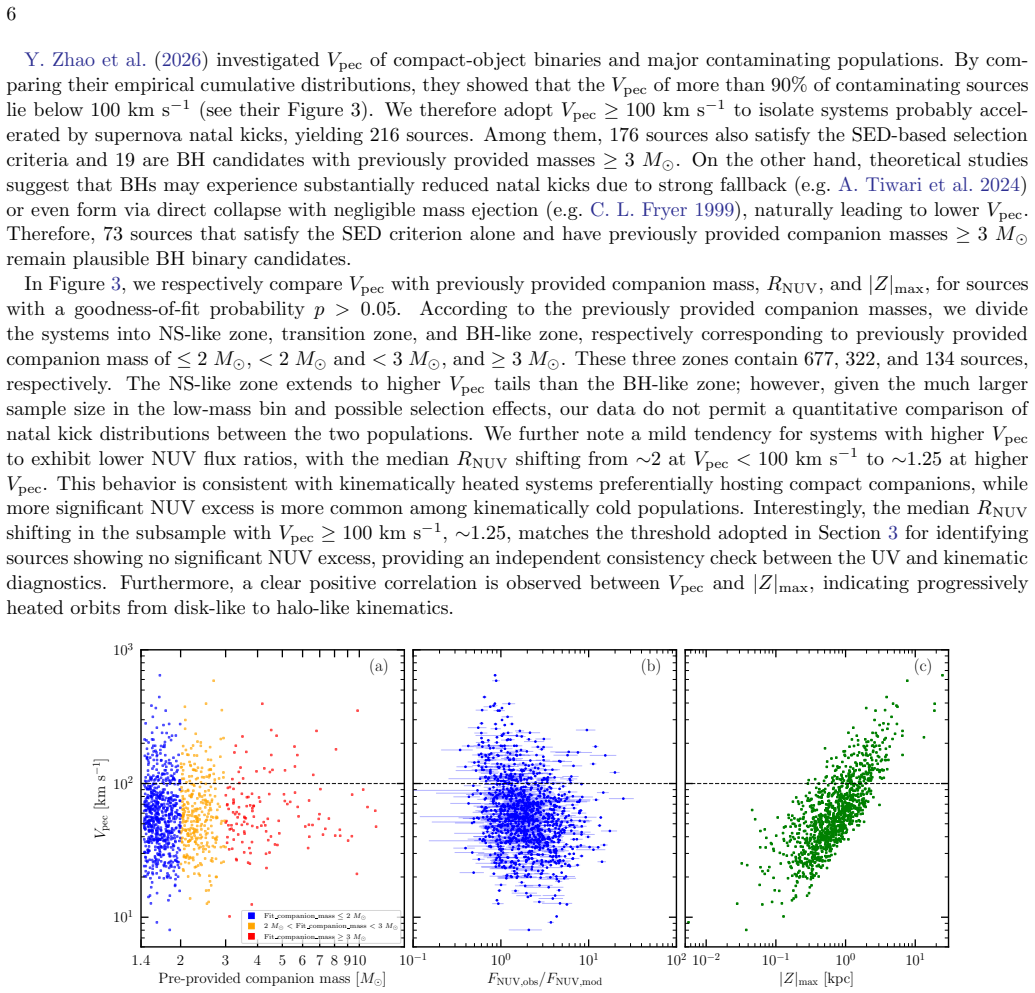
We evaluate the V_pec at the Galactic-plane crossing phase... integrate the orbits backward for 1 Gyr in the Galactic potential under the Milky Way potential model McMillan17... V_pec ≥ 100 km s⁻¹
What do these tags mean?
- matches
- The paper's claim is directly supported by a theorem in the formal canon.
- supports
- The theorem supports part of the paper's argument, but the paper may add assumptions or extra steps.
- extends
- The paper goes beyond the formal theorem; the theorem is a base layer rather than the whole result.
- uses
- The paper appears to rely on the theorem as machinery.
- contradicts
- The paper's claim conflicts with a theorem or certificate in the canon.
- unclear
- Pith found a possible connection, but the passage is too broad, indirect, or ambiguous to say the theorem truly supports the claim.
Reference graph
Works this paper leans on
-
[1]
Abbott, B. P., Abbott, R., Abbott, T. D., et al. 2016, PhRvL, 116, 061102, doi: 10.1103/PhysRevLett.116.061102
-
[2]
Allard, F. 2016, in SF2A-2016: Proceedings of the Annual meeting of the French Society of Astronomy and Astrophysics, ed. C. Reyl´ e, J. Richard, L. Cambr´ esy, M. Deleuil, E. P´ econtal, L. Tresse, & I. Vauglin, 223–227
work page 2016
-
[3]
Allard, F., Hauschildt, P. H., Alexander, D. R., Tamanai, A., & Schweitzer, A. 2001, ApJ, 556, 357, doi: 10.1086/321547
-
[4]
Allard, F., Homeier, D., & Freytag, B. 2012, Philosophical Transactions of the Royal Society of London Series A, 370, 2765, doi: 10.1098/rsta.2011.0269 Astropy Collaboration, Robitaille, T. P., Tollerud, E. J., et al. 2013, A&A, 558, A33, doi: 10.1051/0004-6361/201322068 Astropy Collaboration, Price-Whelan, A. M., Sip˝ ocz, B. M., et al. 2018, AJ, 156, 12...
-
[5]
2016, extinction v0.3.0, Zenodo, doi: 10.5281/zenodo.804967
Barbary, K. 2016, extinction v0.3.0, Zenodo, doi: 10.5281/zenodo.804967
-
[6]
2008, A&A, 492, 277, doi: 10.1051/0004-6361:200810395
Bayo, A., Rodrigo, C., Barrado Y Navascu´ es, D., et al. 2008, A&A, 492, 277, doi: 10.1051/0004-6361:200810395
-
[7]
2024, ApJ, 976, 131, doi: 10.3847/1538-4357/ad712f
Bianchi, L., Hutchings, J., Bohlin, R., Thilker, D., & Berti, E. 2024, ApJ, 976, 131, doi: 10.3847/1538-4357/ad712f
-
[8]
2016, ARA&A, 54, 529, doi: 10.1146/annurev-astro-081915-023441
Bland-Hawthorn, J., & Gerhard, O. 2016, ARA&A, 54, 529, doi: 10.1146/annurev-astro-081915-023441
-
[9]
2015, ApJS, 216, 29, doi: 10.1088/0067-0049/216/2/29
Bovy, J. 2015, ApJS, 216, 29, doi: 10.1088/0067-0049/216/2/29
-
[10]
Cardelli, J. A., Clayton, G. C., & Mathis, J. S. 1989, ApJ, 345, 245, doi: 10.1086/167900
-
[11]
M., Casares, J., Mu˜ noz-Darias, T., et al
Corral-Santana, J. M., Casares, J., Mu˜ noz-Darias, T., et al. 2016, A&A, 587, A61, doi: 10.1051/0004-6361/201527130
-
[12]
2023a, MNRAS, 518, 1057, doi: 10.1093/mnras/stac3140
El-Badry, K., Rix, H.-W., Quataert, E., et al. 2023a, MNRAS, 518, 1057, doi: 10.1093/mnras/stac3140
-
[13]
2023b, MNRAS, 521, 4323, doi: 10.1093/mnras/stad799
El-Badry, K., Rix, H.-W., Cendes, Y., et al. 2023b, MNRAS, 521, 4323, doi: 10.1093/mnras/stad799
-
[14]
Fitzpatrick, E. L. 1999, PASP, 111, 63, doi: 10.1086/316293
-
[15]
Foreman-Mackey, D., Hogg, D. W., Lang, D., & Goodman, J. 2013, PASP, 125, 306, doi: 10.1086/670067 9
-
[16]
2024, A&A, 684, A124, doi: 10.1051/0004-6361/202347908
Chaty, S. 2024, A&A, 684, A124, doi: 10.1051/0004-6361/202347908
-
[17]
Fryer, C. L. 1999, ApJ, 522, 413, doi: 10.1086/307647 Gaia Collaboration, Vallenari, A., Brown, A. G. A., et al. 2023, A&A, 674, A1, doi: 10.1051/0004-6361/202243940
-
[18]
Ginsburg, A., Sip˝ ocz, B. M., Brasseur, C. E., et al. 2019, AJ, 157, 98, doi: 10.3847/1538-3881/aafc33 GRAVITY Collaboration, Abuter, R., Amorim, A., et al. 2019, A&A, 625, L10, doi: 10.1051/0004-6361/201935656
-
[19]
Harris, C. R., Millman, K. J., van der Walt, S. J., et al. 2020, Nature, 585, 357, doi: 10.1038/s41586-020-2649-2
-
[20]
A., Levine, S., Terrell, D., & Welch, D
Henden, A. A., Levine, S., Terrell, D., & Welch, D. L. 2015, in American Astronomical Society Meeting Abstracts, Vol. 225, American Astronomical Society Meeting Abstracts #225, 336.16
work page 2015
-
[21]
Hobbs, G., Lorimer, D. R., Lyne, A. G., & Kramer, M. 2005, MNRAS, 360, 974, doi: 10.1111/j.1365-2966.2005.09087.x
-
[22]
Huang, Y., Liu, X. W., Yuan, H. B., et al. 2015, MNRAS, 449, 162, doi: 10.1093/mnras/stv204
-
[23]
Hunter, J. D. 2007, Computing in Science & Engineering, 9, 90, doi: 10.1109/MCSE.2007.55
-
[24]
2025a, ApJ, 984, 58, doi: 10.3847/1538-4357/adc2fa
Hutchinson, B. 2025a, ApJ, 984, 58, doi: 10.3847/1538-4357/adc2fa
-
[25]
Hutchinson, B. 2025b, VizieR Online Data Catalog: Stellar parameters from XP and RVS spectra (Huson+, 2025),, VizieR On-line Data Catalog: J/ApJ/984/58. Originally published in: 2025ApJ...984...58H
work page 2025
-
[26]
2013, MNRAS, 434, 1355, doi: 10.1093/mnras/stt1106
Janka, H.-T. 2013, MNRAS, 434, 1355, doi: 10.1093/mnras/stt1106
-
[27]
Jayasinghe, T., Stanek, K. Z., Thompson, T. A., et al. 2021, MNRAS, 504, 2577, doi: 10.1093/mnras/stab907
-
[28]
2025, arXiv e-prints, arXiv:2509.10608, doi: 10.48550/arXiv.2509.10608
Jayasinghe, T. 2025, arXiv e-prints, arXiv:2509.10608, doi: 10.48550/arXiv.2509.10608
-
[29]
Lyne, A. G., & Lorimer, D. R. 1994, Nature, 369, 127, doi: 10.1038/369127a0
-
[30]
2022, A&A, 664, A159, doi: 10.1051/0004-6361/202243147
Mahy, L., Sana, H., Shenar, T., et al. 2022, A&A, 664, A159, doi: 10.1051/0004-6361/202243147
-
[31]
Manchester, R. N., Hobbs, G. B., Teoh, A., & Hobbs, M. 2005, AJ, 129, 1993, doi: 10.1086/428488
work page internal anchor Pith review doi:10.1086/428488 2005
-
[32]
C., Fanson, J., Schiminovich, D., et al
Martin, D. C., Fanson, J., Schiminovich, D., et al. 2005, ApJL, 619, L1, doi: 10.1086/426387
work page internal anchor Pith review doi:10.1086/426387 2005
-
[33]
McMillan, P. J. 2017, MNRAS, 465, 76, doi: 10.1093/mnras/stw2759
work page internal anchor Pith review doi:10.1093/mnras/stw2759 2017
-
[34]
Morrissey, P., Schiminovich, D., Barlow, T. A., et al. 2005, ApJL, 619, L7, doi: 10.1086/424734
-
[35]
Morton, T. D. 2015, isochrones: Stellar model grid package,, Astrophysics Source Code Library, record ascl:1503.010 http://ascl.net/1503.010 M¨ uller-Horn, J., Rix, H.-W., El-Badry, K., et al. 2025, arXiv e-prints, arXiv:2510.05982, doi: 10.48550/arXiv.2510.05982
work page internal anchor Pith review Pith/arXiv arXiv doi:10.48550/arxiv.2510.05982 2015
-
[36]
2000, A&AS, 143, 23, doi: 10.1051/aas:2000169 pandas development team, T
Ochsenbein, F., Bauer, P., & Marcout, J. 2000, A&AS, 143, 23, doi: 10.1051/aas:2000169 pandas development team, T. 2020, pandas-dev/pandas: Pandas, latest Zenodo, doi: 10.5281/zenodo.3509134
-
[37]
Ricker, G. R., Winn, J. N., Vanderspek, R., et al. 2015, Journal of Astronomical Telescopes, Instruments, and Systems, 1, 014003, doi: 10.1117/1.JATIS.1.1.014003
work page internal anchor Pith review doi:10.1117/1.jatis.1.1.014003 2015
-
[38]
C., Anderson, J., Casertano, S., et al
Sahu, K. C., Anderson, J., Casertano, S., et al. 2025, ApJ, 983, 104, doi: 10.3847/1538-4357/adbe6e
-
[39]
2010, A&A, 510, A23, doi: 10.1051/0004-6361/200912222
Sartore, N., Ripamonti, E., Treves, A., & Turolla, R. 2010, A&A, 510, A23, doi: 10.1051/0004-6361/200912222
-
[40]
Skrutskie, M. F., Cutri, R. M., Stiening, R., et al. 2006, AJ, 131, 1163, doi: 10.1086/498708 The LIGO Scientific Collaboration, the Virgo Collaboration, the KAGRA Collaboration, et al. 2025, arXiv e-prints, arXiv:2508.18079, doi: 10.48550/arXiv.2508.18079
-
[41]
Thompson, T. A., Kochanek, C. S., Stanek, K. Z., et al. 2019, Science, 366, 637, doi: 10.1126/science.aau4005
-
[42]
Timmes, F. X., Woosley, S. E., & Weaver, T. A. 1996, ApJ, 457, 834, doi: 10.1086/176778
-
[43]
2024, MNRAS, 527, 8586, doi: 10.1093/mnras/stad3749
Chatterjee, S. 2024, MNRAS, 527, 8586, doi: 10.1093/mnras/stad3749
-
[44]
2024, Nature Astronomy, 8, 1583, doi: 10.1038/s41550-024-02359-9
Wang, S., Zhao, X., Feng, F., et al. 2024, Nature Astronomy, 8, 1583, doi: 10.1038/s41550-024-02359-9
-
[45]
Wright, E. L., Eisenhardt, P. R. M., Mainzer, A. K., et al. 2010, AJ, 140, 1868, doi: 10.1088/0004-6256/140/6/1868
work page internal anchor Pith review doi:10.1088/0004-6256/140/6/1868 2010
-
[46]
2016, MNRAS, 458, 3012, doi: 10.1093/mnras/stw426
Wyrzykowski, L., Kostrzewa-Rutkowska, Z., Skowron, J., et al. 2016, MNRAS, 458, 3012, doi: 10.1093/mnras/stw426
-
[47]
2022, Nature Astronomy, 6, 1203, doi: 10.1038/s41550-022-01766-0 zhang-zhixiang
Yi, T., Gu, W.-M., Zhang, Z.-X., et al. 2022, Nature Astronomy, 6, 1203, doi: 10.1038/s41550-022-01766-0 zhang-zhixiang. 2025, zhang-zhixiang/spectool: spectool version 1.0.1, v1.0.1 Zenodo, doi: 10.5281/zenodo.14947417
-
[48]
2026, MNRAS, doi: 10.1093/mnras/stag058
Zhao, Y., Gandhi, P., Knigge, C., et al. 2026, MNRAS, doi: 10.1093/mnras/stag058
discussion (0)
Sign in with ORCID, Apple, or X to comment. Anyone can read and Pith papers without signing in.