Recognition: no theorem link
Turbulent AGN coronae as the origin of diffuse neutrinos up to PeV energies
Pith reviewed 2026-05-15 19:50 UTC · model grok-4.3
The pith
AGN coronae with high magnetization can explain the full IceCube diffuse neutrino flux up to PeV energies.
A machine-rendered reading of the paper's core claim, the machinery that carries it, and where it could break.
Core claim
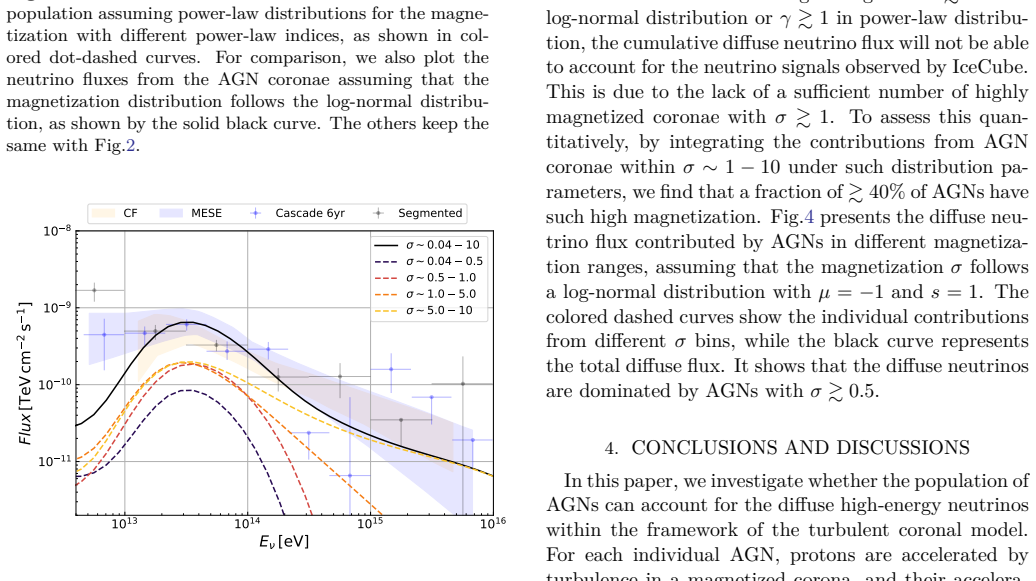
A population of AGN coronae with a sufficiently wide range of magnetization parameters sigma approximately 1-10 produces the entire diffuse neutrino spectrum measured by IceCube up to PeV energies through turbulence acceleration, and the fit is insensitive to the precise shape of the sigma distribution provided the high-magnetization tail is populated.
What carries the argument
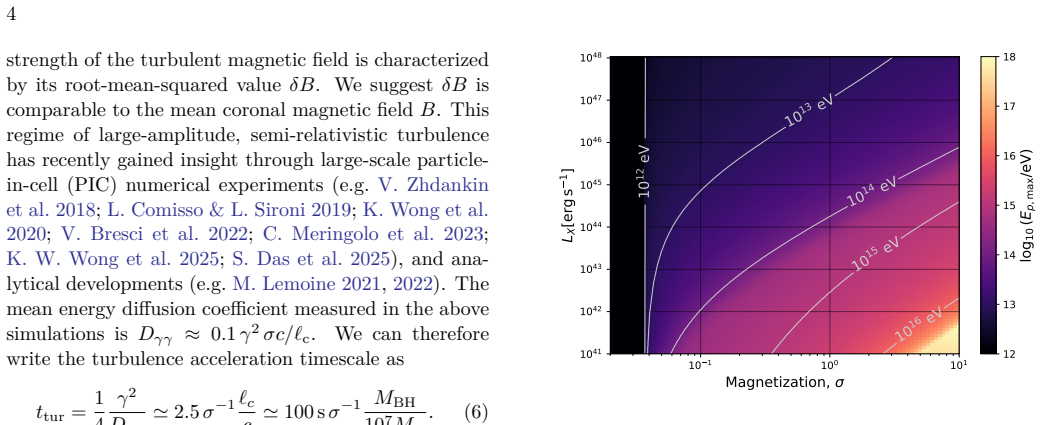
Turbulence acceleration of protons in magnetized AGN coronae, where the magnetization parameter sigma sets both the maximum proton energy and the hardness of the accelerated spectrum.
If this is right
- The model naturally produces the observed peak in the diffuse neutrino spectrum near 30 TeV without extra tuning.
- No separate high-energy source class is required to explain neutrinos above 100 TeV.
- The accumulated flux is dominated by the subset of AGNs whose coronae reach sigma of several to ten.
Where Pith is reading between the lines
- Individual detections such as the >100 TeV neutrino from NGC 7469 become representative rather than exceptional once the population includes high-sigma coronae.
- Correlations between neutrino arrival directions and X-ray bright Seyfert galaxies could be used to measure the actual fraction of high-magnetization coronae.
- The same coronae would accelerate cosmic-ray protons to energies that might also contribute to the extragalactic gamma-ray background through photopion or proton synchrotron processes.
Load-bearing premise
A substantial fraction of the overall AGN population has coronae with magnetization parameter sigma between roughly 1 and 10.
What would settle it
A sharp cutoff in the diffuse neutrino spectrum well below 1 PeV, or a failure to detect neutrinos above 100 TeV from a statistically large sample of Seyfert galaxies whose X-ray and radio properties indicate high corona magnetization.
Figures


read the original abstract
It has been shown that the turbulence acceleration in AGN coronae can account for 1-10 TeV neutrinos from some AGNs, such as the Seyfert galaxy NGC 1068. Based on this, there are attempts to explain the diffuse neutrinos observed by IceCube with the accumulated contribution from a population of AGNs, but it is found that the maximum neutrino energy is less than tens of TeV, and as a result, additional source classes are needed to explain the high-energy component above this energy. Recently, motivated by the detection of $>100$ TeV neutrinos from the Seyfert galaxy NGC 7469, it was shown that the turbulence acceleration in the corona can explain $>$100 TeV neutrinos given a larger magnetization parameter ($\sigma\sim 1$) in the corona, which leads to a larger maximum proton energy and a hard proton spectrum. In this paper, we extend this assumption to the population of AGNs and study whether the population of AGNs with a wide range of magnetization can explain the entire diffuse neutrino flux. We find that AGN coronae could account for the diffuse neutrinos up to PeV energies if a significant fraction of AGNs have magnetizations as large as $\sigma\sim 1-10$. This conclusion is insensitive to the shape of the magnetization parameter distribution as long as the range of the magnetization parameter is sufficiently wide and the distribution is flat towards high magnetization. Interestingly, this model can also explain the peak of the diffuse neutrino spectrum at $\sim30$ TeV.
Editorial analysis
A structured set of objections, weighed in public.
Referee Report
Summary. The manuscript claims that turbulent particle acceleration in AGN coronae can explain the full IceCube diffuse neutrino spectrum up to PeV energies (including the observed peak near 30 TeV) provided a significant fraction of the AGN population has coronae with magnetization parameters σ ∼ 1–10; the result is stated to be insensitive to the precise shape of the σ distribution so long as it is wide and flat at the high-σ end.
Significance. If the central assumption can be independently justified, the result would be significant: it would unify the entire observed neutrino flux (TeV to PeV) under a single source class and mechanism, removing the need to invoke separate populations for the high-energy tail. The work correctly extends the turbulence-acceleration framework previously applied to NGC 7469 and NGC 1068 to the population level and demonstrates that the spectral shape can be reproduced under the stated conditions.
major comments (3)
- [§4] §4 (population synthesis): the magnetization distribution is constructed to be wide and flat at high σ precisely so that the integrated flux and high-energy cutoff match IceCube data; the PeV component is therefore a direct consequence of the chosen parameter range rather than an independent prediction.
- [§2.2–2.3] §2.2–2.3 (model assumptions): no derivation from MHD corona simulations, X-ray polarization measurements, or variability statistics is supplied to justify why a non-negligible fraction of AGNs should reach σ ∼ 1–10 rather than the lower values (σ ≪ 1) expected from equipartition; the prevalence of high-σ coronae remains an unconstrained population statistic.
- [§5] §5 (results): quantitative outputs for the neutrino spectrum are shown only for the tuned distribution; the claimed insensitivity to distribution shape is not demonstrated by explicit comparison of multiple functional forms with the same high-σ tail.
minor comments (2)
- [Abstract] The abstract and §1 could more explicitly state the minimum fraction of high-σ sources required to match the observed normalization.
- [Figures] Figure captions should clarify the exact functional forms and parameter ranges used for the magnetization distributions shown in the plots.
Simulated Author's Rebuttal
We thank the referee for the constructive and detailed comments. We have revised the manuscript to address the concerns raised, particularly by adding explicit comparisons and expanded discussion of model assumptions. Our point-by-point responses follow.
read point-by-point responses
-
Referee: [§4] §4 (population synthesis): the magnetization distribution is constructed to be wide and flat at high σ precisely so that the integrated flux and high-energy cutoff match IceCube data; the PeV component is therefore a direct consequence of the chosen parameter range rather than an independent prediction.
Authors: We acknowledge that the distribution parameters, including the width and flat high-σ tail, are chosen such that the integrated flux matches IceCube observations. However, the upper range σ ∼ 1–10 is not arbitrary: it is directly motivated by the turbulence-acceleration modeling of NGC 7469, where σ ∼ 1 is required to produce neutrinos above 100 TeV. The population-level calculation then tests whether a distribution that includes such objects (as required by at least one detected source) can unify the entire TeV–PeV spectrum. We have revised §4 to clarify this motivation from individual sources and to emphasize that the spectral extension to PeV energies follows from the acceleration physics at high magnetization rather than from fine-tuning alone. revision: partial
-
Referee: [§2.2–2.3] §2.2–2.3 (model assumptions): no derivation from MHD corona simulations, X-ray polarization measurements, or variability statistics is supplied to justify why a non-negligible fraction of AGNs should reach σ ∼ 1–10 rather than the lower values (σ ≪ 1) expected from equipartition; the prevalence of high-σ coronae remains an unconstrained population statistic.
Authors: We agree that the manuscript does not derive the required fraction of high-σ coronae from first-principles MHD simulations or observational statistics. The assumption is motivated by the need to explain the >100 TeV neutrinos detected from NGC 7469. In the revised manuscript we have expanded §2.3 with a new paragraph that discusses possible physical pathways to elevated magnetization (e.g., localized magnetic-flux accumulation in reconnection layers, as suggested by some corona MHD simulations) and notes that future X-ray polarization observations can provide independent constraints. We present the high-σ fraction as a testable prediction rather than a derived result. revision: partial
-
Referee: [§5] §5 (results): quantitative outputs for the neutrino spectrum are shown only for the tuned distribution; the claimed insensitivity to distribution shape is not demonstrated by explicit comparison of multiple functional forms with the same high-σ tail.
Authors: We thank the referee for this observation. The revised §5 now includes a new figure that explicitly compares the diffuse neutrino spectra obtained with three different σ distributions (uniform, power-law with index −1, and log-normal), each normalized to have the same high-σ tail extending to σ = 10. The resulting fluxes agree to within ∼20 % above 10 TeV, including the location of the ∼30 TeV peak and the extension to PeV energies, thereby demonstrating the claimed insensitivity to the precise functional form. revision: yes
Circularity Check
Magnetization distribution chosen to reproduce IceCube flux up to PeV
specific steps
-
fitted input called prediction
[Abstract]
"We find that AGN coronae could account for the diffuse neutrinos up to PeV energies if a significant fraction of AGNs have magnetizations as large as σ∼1-10. This conclusion is insensitive to the shape of the magnetization parameter distribution as long as the range of the magnetization parameter is sufficiently wide and the distribution is flat towards high magnetization."
The wide range and flat high-σ tail are selected so the integrated flux matches IceCube data; the PeV component and overall spectrum shape are therefore direct consequences of the fitted population distribution rather than an independent prediction from corona physics.
full rationale
The central claim extends a turbulence-acceleration model (previously applied to individual sources) to the full AGN population by positing a wide, flat distribution of σ reaching 1–10. This population assumption directly determines both the normalization and the high-energy cutoff of the cumulative neutrino spectrum, with the paper noting the result is insensitive to exact shape provided the high-σ tail is present. No independent constraint from MHD simulations or observations is supplied to justify the required fraction of high-σ sources; the match to data therefore follows from the input choice rather than an independent derivation.
Axiom & Free-Parameter Ledger
free parameters (1)
- magnetization parameter distribution
axioms (1)
- domain assumption Turbulent acceleration in AGN coronae produces neutrinos via proton-photon or proton-gas interactions
Reference graph
Works this paper leans on
-
[1]
2021, PhRvD, 104, 022002, doi: 10.1103/PhysRevD.104.022002
Abbasi, R., Ackermann, M., Adams, J., et al. 2021, PhRvD, 104, 022002, doi: 10.1103/PhysRevD.104.022002
-
[2]
2022, ApJ, 928, 50, doi: 10.3847/1538-4357/ac4d29
Abbasi, R., Ackermann, M., Adams, J., et al. 2022, ApJ, 928, 50, doi: 10.3847/1538-4357/ac4d29
-
[3]
2025a, arXiv e-prints, arXiv:2507.22233, doi: 10.48550/arXiv.2507.22233 10
Abbasi, R., Ackermann, M., Adams, J., et al. 2025a, arXiv e-prints, arXiv:2507.22233, doi: 10.48550/arXiv.2507.22233 10
-
[4]
2025b, arXiv e-prints, arXiv:2510.13403
Abbasi, R., Ackermann, M., Adams, J., et al. 2025b, arXiv e-prints, arXiv:2510.13403. https://arxiv.org/abs/2510.13403
-
[5]
2025c, ApJ, 988, 141, doi: 10.3847/1538-4357/addd05
Abbasi, R., Ackermann, M., Adams, J., et al. 2025c, ApJ, 988, 141, doi: 10.3847/1538-4357/addd05
-
[6]
Ackermann, M., Ajello, M., Atwood, W. B., et al. 2012, ApJ, 750, 3, doi: 10.1088/0004-637X/750/1/3
-
[7]
2024, JCAP, 2024, 075, doi: 10.1088/1475-7516/2024/09/075
Ambrosone, A. 2024, JCAP, 2024, 075, doi: 10.1088/1475-7516/2024/09/075
-
[8]
2025, arXiv e-prints, arXiv:2507.06002, doi: 10.48550/arXiv.2507.06002
Basu, V., Balagopal V., A., & Karle, A. 2025, arXiv e-prints, arXiv:2507.06002, doi: 10.48550/arXiv.2507.06002
-
[9]
Beloborodov, A. M. 2017, ApJ, 850, 141, doi: 10.3847/1538-4357/aa8f4f
-
[10]
2022, PhRvD, 106, 023028, doi: 10.1103/PhysRevD.106.023028
Bresci, V., Lemoine, M., Gremillet, L., et al. 2022, PhRvD, 106, 023028, doi: 10.1103/PhysRevD.106.023028
-
[11]
2019, ApJ, 886, 122, doi: 10.3847/1538-4357/ab4c33
Comisso, L., & Sironi, L. 2019, ApJ, 886, 122, doi: 10.3847/1538-4357/ab4c33
-
[12]
Studying the mirror acceleration via kinetic simulations of relativistic plasma turbulence
Das, S., Xu, S., & Nättilä, J. 2025, arXiv e-prints, arXiv:2506.04212, doi: 10.48550/arXiv.2506.04212 Di Matteo, T., Blackman, E. G., & Fabian, A. C. 1997, MNRAS, 291, L23, doi: 10.1093/mnras/291.1.L23
work page internal anchor Pith review Pith/arXiv arXiv doi:10.48550/arxiv.2506.04212 2025
-
[13]
Eichmann, B., Oikonomou, F., Salvatore, S., Dettmar, R.-J., & Tjus, J. B. 2022, ApJ, 939, 43, doi: 10.3847/1538-4357/ac9588
-
[14]
C., Lohfink, A., Kara, E., et al
Fabian, A. C., Lohfink, A., Kara, E., et al. 2015, MNRAS, 451, 4375, doi: 10.1093/mnras/stv1218
-
[15]
Fiorillo, D. F. G., Comisso, L., Peretti, E., Petropoulou, M., & Sironi, L. 2024, ApJ, 974, 75, doi: 10.3847/1538-4357/ad7021
-
[16]
Fiorillo, D. F. G., Comisso, L., Peretti, E., Petropoulou, M., & Sironi, L. 2025, ApJ, 989, 215, doi: 10.3847/1538-4357/adec9c Grošelj, D., Hakobyan, H., Beloborodov, A. M., Sironi, L., & Philippov, A. 2024, PhRvL, 132, 085202, doi: 10.1103/PhysRevLett.132.085202
-
[17]
1991, ApJL, 380, L51, doi: 10.1086/186171
Haardt, F., & Maraschi, L. 1991, ApJL, 380, L51, doi: 10.1086/186171
-
[18]
2023, arXiv e-prints, arXiv:2305.07086, doi: 10.48550/arXiv.2305.07086
Halzen, F. 2023, arXiv e-prints, arXiv:2305.07086, doi: 10.48550/arXiv.2305.07086
-
[19]
2022, arXiv e-prints, arXiv:2202.00694, doi: 10.48550/arXiv.2202.00694
Halzen, F., & Kheirandish, A. 2022, arXiv e-prints, arXiv:2202.00694, doi: 10.48550/arXiv.2202.00694
-
[20]
Hopkins, P. F., Richards, G. T., & Hernquist, L. 2007, ApJ, 654, 731, doi: 10.1086/509629 IceCube Collaboration. 2013, Science, 342, 1242856, doi: 10.1126/science.1242856 IceCube Collaboration, Abbasi, R., Ackermann, M., et al. 2022, Science, 378, 538, doi: 10.1126/science.abg3395
-
[21]
2022, arXiv e-prints, arXiv:2207.02097, doi: 10.48550/arXiv.2207.02097
Inoue, S., Cerruti, M., Murase, K., & Liu, R.-Y. 2022, arXiv e-prints, arXiv:2207.02097, doi: 10.48550/arXiv.2207.02097
-
[22]
2018, ApJ, 869, 114, doi: 10.3847/1538-4357/aaeb95
Inoue, Y., & Doi, A. 2018, ApJ, 869, 114, doi: 10.3847/1538-4357/aaeb95
-
[23]
2020, ApJL, 891, L33, doi: 10.3847/2041-8213/ab7661
Inoue, Y., Khangulyan, D., & Doi, A. 2020, ApJL, 891, L33, doi: 10.3847/2041-8213/ab7661
-
[24]
2019, ApJ, 880, 40, doi: 10.3847/1538-4357/ab2715
Inoue, Y., Khangulyan, D., Inoue, S., & Doi, A. 2019, ApJ, 880, 40, doi: 10.3847/1538-4357/ab2715
-
[25]
Jiang, Y.-F., Stone, J. M., & Davis, S. W. 2014, ApJ, 784, 169, doi: 10.1088/0004-637X/784/2/169
-
[26]
Karavola, D., Petropoulou, M., Fiorillo, D. F. G., et al. 2026, arXiv e-prints, arXiv:2601.01533, doi: 10.48550/arXiv.2601.01533
work page internal anchor Pith review Pith/arXiv arXiv doi:10.48550/arxiv.2601.01533 2026
-
[27]
2010, PASJ, 62, 621, doi: 10.1093/pasj/62.3.621
Kawabata, R., & Mineshige, S. 2010, PASJ, 62, 621, doi: 10.1093/pasj/62.3.621
-
[28]
Kelner, S. R., Aharonian, F. A., & Bugayov, V. V. 2006, PhRvD, 74, 034018, doi: 10.1103/PhysRevD.74.034018
-
[29]
Kheirandish, A., Murase, K., & Kimura, S. S. 2021, ApJ, 922, 45, doi: 10.3847/1538-4357/ac1c77
-
[30]
Kimura, S. S., Murase, K., & Mészáros, P. 2021, Nature Communications, 12, 5615, doi: 10.1038/s41467-021-25111-7
-
[31]
Kimura, S. S., Murase, K., & Toma, K. 2015, ApJ, 806, 159, doi: 10.1088/0004-637X/806/2/159
-
[32]
Kurahashi, N., Murase, K., & Santander, M. 2022, Annual Review of Nuclear and Particle Science, 72, 365, doi: 10.1146/annurev-nucl-011122-061547
-
[33]
2021, PhRvD, 104, 063020, doi: 10.1103/PhysRevD.104.063020
Lemoine, M. 2021, PhRvD, 104, 063020, doi: 10.1103/PhysRevD.104.063020
-
[34]
2022, PhRvL, 129, 215101, doi: 10.1103/PhysRevLett.129.215101
Lemoine, M. 2022, PhRvL, 129, 215101, doi: 10.1103/PhysRevLett.129.215101
-
[35]
2024, PhRvD, 109, 063006, doi: 10.1103/PhysRevD.109.063006
Lemoine, M., Murase, K., & Rieger, F. 2024, PhRvD, 109, 063006, doi: 10.1103/PhysRevD.109.063006
-
[36]
2025, A&A, 697, A124, doi: 10.1051/0004-6361/202453296
Lemoine, M., & Rieger, F. 2025, A&A, 697, A124, doi: 10.1051/0004-6361/202453296
-
[37]
Liska, M. T. P., Musoke, G., Tchekhovskoy, A., Porth, O., & Beloborodov, A. M. 2022, ApJL, 935, L1, doi: 10.3847/2041-8213/ac84db
-
[38]
F., Mineshige, S., & Shibata, K
Liu, B. F., Mineshige, S., & Shibata, K. 2002, ApJL, 572, L173, doi: 10.1086/341877
-
[39]
2016, MNRAS, 456, L94, doi: 10.1093/mnrasl/slv178
Marinucci, A., Bianchi, S., Matt, G., et al. 2016, MNRAS, 456, L94, doi: 10.1093/mnrasl/slv178
-
[40]
Mayers, J. A., Romer, K., Fahari, A., et al. 2018, arXiv e-prints, arXiv:1803.06891, doi: 10.48550/arXiv.1803.06891
work page internal anchor Pith review Pith/arXiv arXiv doi:10.48550/arxiv.1803.06891 2018
-
[41]
2023, ApJ, 944, 122, doi: 10.3847/1538-4357/acaefe
Meringolo, C., Cruz-Osorio, A., Rezzolla, L., & Servidio, S. 2023, ApJ, 944, 122, doi: 10.3847/1538-4357/acaefe
-
[42]
Merloni, A., Di Matteo, T., & Fabian, A. C. 2000, MNRAS, 318, L15, doi: 10.1046/j.1365-8711.2000.03943.x 11
-
[43]
Merloni, A., & Fabian, A. C. 2001, MNRAS, 321, 549, doi: 10.1046/j.1365-8711.2001.04060.x
-
[44]
Evaporation: The change from accretion via a thin disk to a coronal flow
Meyer, F., Liu, B. F., & Meyer-Hofmeister, E. 2000, A&A, 361, 175, doi: 10.48550/arXiv.astro-ph/0007091
work page internal anchor Pith review Pith/arXiv arXiv doi:10.48550/arxiv.astro-ph/0007091 2000
-
[45]
2022, ApJL, 941, L17, doi: 10.3847/2041-8213/aca53c
Murase, K. 2022, ApJL, 941, L17, doi: 10.3847/2041-8213/aca53c
-
[46]
Murase, K., Kimura, S. S., & Mészáros, P. 2020a, PhRvL, 125, 011101, doi: 10.1103/PhysRevLett.125.011101
-
[47]
2020b, ApJ, 902, 108, doi: 10.3847/1538-4357/abb3c0
Petropoulou, M. 2020b, ApJ, 902, 108, doi: 10.3847/1538-4357/abb3c0
-
[48]
2024, A&A, 684, L21, doi: 10.1051/0004-6361/202450025
Henningsen, F. 2024, A&A, 684, L21, doi: 10.1051/0004-6361/202450025
-
[49]
2015, MNRAS, 452, 1877, doi: 10.1093/mnras/stv1467
Padovani, P., Petropoulou, M., Giommi, P., & Resconi, E. 2015, MNRAS, 452, 1877, doi: 10.1093/mnras/stv1467
-
[50]
Pringle, J. E. 1981, ARA&A, 19, 137, doi: 10.1146/annurev.aa.19.090181.001033 Różańska, A., & Czerny, B. 2000, A&A, 360, 1170, doi: 10.48550/arXiv.astro-ph/0004158
-
[51]
2026, PhRvD, 113, 023019, doi: 10.1103/f66p-k6z9
Saurenhaus, L., Capel, F., Oikonomou, F., & Buchner, J. 2026, PhRvD, 113, 023019, doi: 10.1103/f66p-k6z9
-
[52]
Sironi, L., & Beloborodov, A. M. 2020, ApJ, 899, 52, doi: 10.3847/1538-4357/aba622
-
[53]
2025, ApJ, 981, 103, doi: 10.3847/1538-4357/adb031
Sommani, G., Franckowiak, A., Lincetto, M., & Dettmar, R.-J. 2025, ApJ, 981, 103, doi: 10.3847/1538-4357/adb031
-
[54]
Stecker, F. W., Done, C., Salamon, M. H., & Sommers, P. 1991, PhRvL, 66, 2697, doi: 10.1103/PhysRevLett.66.2697
-
[55]
Svensson, R., & Zdziarski, A. A. 1994, ApJ, 436, 599, doi: 10.1086/174934
-
[56]
Thorne, K. S. 1974, ApJ, 191, 507, doi: 10.1086/152991
-
[57]
Trakhtenbrot, B., Ricci, C., Koss, M. J., et al. 2017, MNRAS, 470, 800, doi: 10.1093/mnras/stx1117
-
[58]
Watson, M. G. 2014, ApJ, 786, 104, doi: 10.1088/0004-637X/786/2/104
-
[59]
Wong, K., Zhdankin, V., Uzdensky, D. A., Werner, G. R., & Begelman, M. C. 2020, ApJL, 893, L7, doi: 10.3847/2041-8213/ab8122
-
[60]
Wong, K. W., Zhdankin, V., Uzdensky, D. A., Werner, G. R., & Begelman, M. C. 2025, MNRAS, 543, 1842, doi: 10.1093/mnras/staf1589
-
[61]
2025, ApJ, 995, 166, doi: 10.3847/1538-4357/ae1ba6
Lemoine, M. 2025, ApJ, 995, 166, doi: 10.3847/1538-4357/ae1ba6
-
[62]
Yuan, C., Fiorillo, D. F. G., Petropoulou, M., & Liu, Q. 2025, arXiv e-prints, arXiv:2508.08233, doi: 10.48550/arXiv.2508.08233
-
[63]
Begelman, M. C. 2018, ApJL, 867, L18, doi: 10.3847/2041-8213/aae88c
-
[64]
2025, arXiv e-prints, arXiv:2511.16869, doi: 10.48550/arXiv.2511.16869
Zhou, S., Sun, M., Mou, G., et al. 2025, arXiv e-prints, arXiv:2511.16869, doi: 10.48550/arXiv.2511.16869
-
[65]
Miller, J. M. 2005, ApJ, 618, 832, doi: 10.1086/426071
discussion (0)
Sign in with ORCID, Apple, or X to comment. Anyone can read and Pith papers without signing in.