Recognition: 2 theorem links
· Lean TheoremCosmological Constraints from GW-FRB Associations without Redshift Measurements for LIGO-Virgo and Cosmic Explorer
Pith reviewed 2026-05-13 18:41 UTC · model grok-4.3
The pith
Cosmic Explorer can constrain cosmological parameters from GW-FRB associations without any redshift measurements.
A machine-rendered reading of the paper's core claim, the machinery that carries it, and where it could break.
Core claim
Using the luminosity distance-dispersion measure relation in a redshift-independent framework that accounts for astrophysical uncertainties, realistic simulations demonstrate that Cosmic Explorer observations will enable high-precision constraints on cosmological parameters and host galaxy dispersion measure contributions, whereas the LIGO-Virgo network lacks sufficient precision at redshifts below 0.2; the results hold across both the corrected Macquart PDF and log-normal dispersion measure distributions and whether or not host contributions are included.
What carries the argument
The luminosity distance-dispersion measure relation applied in a redshift-independent framework that incorporates host galaxy uncertainties and varying dispersion measure distributions.
If this is right
- Cosmic Explorer simultaneously constrains cosmology and host galaxy parameters without redshift information.
- Constraints remain robust whether the corrected Macquart PDF or a log-normal dispersion measure distribution is adopted.
- Excluding host galaxy dispersion measure contributions changes precision but does not prevent Cosmic Explorer from breaking degeneracies.
- Current LIGO-Virgo sensitivity at z less than 0.2 cannot produce meaningful cosmological constraints from this relation.
- Next-generation detectors are required for the GW-FRB association method to become a practical cosmological tool.
Where Pith is reading between the lines
- The framework could extend to other multi-messenger distance indicators that combine propagation effects with luminosity distance to lessen dependence on electromagnetic redshifts.
- Accumulating GW-FRB events with future detectors may provide an independent test of dark energy models at intermediate redshifts.
- The method might help address current cosmological tensions by supplying an alternative distance ladder free of spectroscopic selection biases.
Load-bearing premise
The simulated observations accurately capture the true identification rates of genuine GW-FRB associations and the underlying dispersion measure distributions including host contributions.
What would settle it
Finding that real Cosmic Explorer data on GW-FRB events produce cosmological parameter values that disagree with independent probes such as Type Ia supernovae or baryon acoustic oscillations would falsify the framework.
Figures

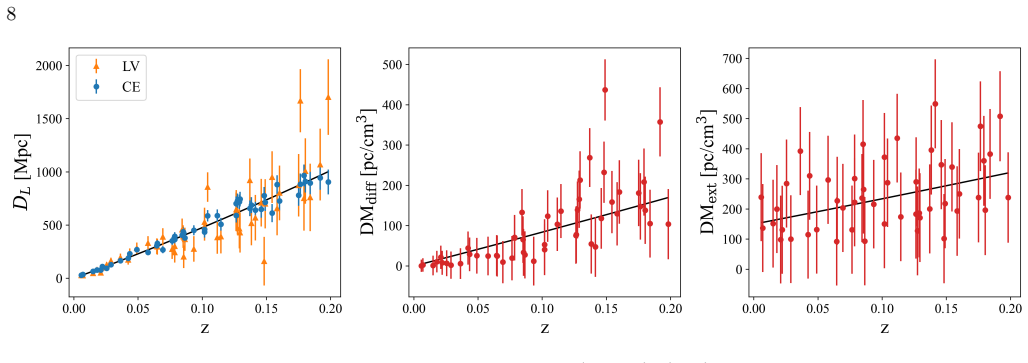


read the original abstract
The potential association between gravitational waves (GWs) and fast radio bursts (FRBs) offers a unique multi-messenger probe for cosmology. In this paper, we develop a redshift-independent framework to constrain cosmological parameters using the luminosity distance - dispersion measure relation, accounting for realistic astrophysical uncertainties. We perform a comprehensive comparative analysis across different GWs detector sensitivities and modeling assumptions. Specifically, we investigate the performance of the current LIGO-Virgo (LV) network (at $z < 0.2$) versus the future Cosmic Explorer (CE). Our study further evaluates the impact of different dispersion measure (DM) distributions -- specifically the corrected Macquart's PDF (Zhuge+2025) and the log-normal distribution -- and explores the influence of including or excluding host galaxy DM contributions. Using realistic simulated observations, we find that while the current LV network lacks the precision to provide meaningful constraints, CE will enable high-precision cosmology. Even without spectroscopic redshifts, CE observations can effectively break parameter degeneracies and robustly constrain both cosmology and host galaxy parameters. These results highlight the necessity of next-generation detectors.
Editorial analysis
A structured set of objections, weighed in public.
Referee Report
Summary. The paper develops a redshift-independent framework using the luminosity distance-dispersion measure (DL-DM) relation from GW-FRB associations to constrain cosmological parameters, incorporating astrophysical uncertainties. Through simulations, it compares the current LIGO-Virgo network (limited to z<0.2) with the future Cosmic Explorer (CE), evaluating impacts of DM distributions (corrected Macquart PDF vs. log-normal) and host-galaxy DM contributions. The central finding is that LV lacks precision for meaningful constraints, while CE breaks parameter degeneracies to jointly constrain cosmology and host-galaxy parameters without spectroscopic redshifts.
Significance. If the simulated catalogs prove representative, the work would establish a practical path for next-generation GW detectors to deliver multi-messenger cosmological constraints independent of redshift measurements, underscoring CE's role in degeneracy breaking and joint inference of host parameters.
major comments (2)
- [§3] §3 (Simulation Methodology): The quantitative constraints and degeneracy-breaking claims for CE rest entirely on forward-simulated catalogs that adopt the corrected Macquart PDF (Zhuge+2025) and a log-normal alternative together with specific host-DM inclusion choices; the manuscript does not demonstrate that these distributions are free of selection effects or match the true scatter and false-positive rate of identifiable GW-FRB associations, which directly undermines the reported precision gains.
- [§4] §4 (Results and Comparative Analysis): The headline statement that CE 'robustly constrain[s] both cosmology and host galaxy parameters' is generated solely from the mocks; no external validation against existing FRB or GW catalogs is presented, so the claimed robustness cannot be assessed independently of the simulation assumptions.
minor comments (2)
- [Abstract, §2] The abstract and §2 should explicitly state the redshift range and number of simulated events used for each detector configuration to allow readers to gauge statistical power.
- [§2] Notation for the DL-DM relation and the precise definition of the 'corrected Macquart PDF' should be given in a single equation block rather than scattered across text.
Simulated Author's Rebuttal
We thank the referee for their careful and constructive review. We address each major comment below, clarifying the simulation-based scope of the work while incorporating revisions to better highlight assumptions and limitations.
read point-by-point responses
-
Referee: [§3] §3 (Simulation Methodology): The quantitative constraints and degeneracy-breaking claims for CE rest entirely on forward-simulated catalogs that adopt the corrected Macquart PDF (Zhuge+2025) and a log-normal alternative together with specific host-DM inclusion choices; the manuscript does not demonstrate that these distributions are free of selection effects or match the true scatter and false-positive rate of identifiable GW-FRB associations, which directly undermines the reported precision gains.
Authors: We agree that the results depend on the adopted DM distributions and simulation assumptions. The corrected Macquart PDF follows Zhuge et al. (2025) to incorporate recent observational constraints on FRB DMs, while the log-normal serves as a standard alternative; host-DM choices are varied explicitly to test sensitivity. We have revised §3 to expand the discussion of potential selection effects, scatter mismatches, and false-positive rates, including a new paragraph on how these could affect precision. As a forward-looking study, we cannot empirically demonstrate absence of all selection effects without real GW-FRB events, but the multi-distribution approach shows that CE retains degeneracy-breaking power across the tested cases. revision: partial
-
Referee: [§4] §4 (Results and Comparative Analysis): The headline statement that CE 'robustly constrain[s] both cosmology and host galaxy parameters' is generated solely from the mocks; no external validation against existing FRB or GW catalogs is presented, so the claimed robustness cannot be assessed independently of the simulation assumptions.
Authors: The manuscript is a simulation forecast for future detectors, as confirmed GW-FRB associations with joint luminosity-distance and DM measurements do not yet exist in the literature. We have revised the abstract, §4, and conclusions to replace absolute claims of robustness with phrasing such as 'within the simulated framework' and 'under the adopted astrophysical models,' and added explicit caveats on the dependence on input distributions. This makes clear that the degeneracy-breaking results are conditional on the mocks rather than claiming external validation. revision: partial
Circularity Check
Minor self-citation to DM model choice; forecast derivation remains independent of fitted inputs
specific steps
-
self citation load bearing
[Abstract and DM modeling section]
"the corrected Macquart's PDF (Zhuge+2025) and the log-normal distribution"
The paper adopts the corrected Macquart PDF via self-citation to prior work by the lead author. While this choice affects the simulated DM scatter and thus the recovered constraints, the citation is not used to justify a uniqueness theorem or to forbid alternatives; the paper still compares it against a log-normal alternative and reports results under both.
full rationale
The paper performs forward simulations of GW-FRB associations under chosen DM distributions (corrected Macquart PDF from Zhuge+2025 and log-normal) and recovers parameters from those mocks. No equation reduces a claimed prediction to a fitted input by construction, and the central claim is a comparative forecast between LV and CE sensitivities rather than a tautological recovery. The sole self-citation (Zhuge+2025) supplies one modeling choice but is not load-bearing for the degeneracy-breaking result itself, which follows from the simulation pipeline and detector assumptions. This matches the expected low-circularity outcome for simulation-based forecasts.
Axiom & Free-Parameter Ledger
free parameters (1)
- DM distribution parameters
axioms (1)
- domain assumption True GW-FRB associations can be identified with sufficient purity for cosmological use
Lean theorems connected to this paper
-
IndisputableMonolith/Foundation/RealityFromDistinction.leanreality_from_one_distinction unclear?
unclearRelation between the paper passage and the cited Recognition theorem.
We develop a redshift-independent framework to constrain cosmological parameters using the luminosity distance - dispersion measure relation... Bayesian analysis... MCMC simulations
-
IndisputableMonolith/Cost/FunctionalEquation.leanwashburn_uniqueness_aczel unclear?
unclearRelation between the paper passage and the cited Recognition theorem.
DM diff PDF... corrected Macquart’s PDF (Zhuge+2025) and the log-normal distribution
What do these tags mean?
- matches
- The paper's claim is directly supported by a theorem in the formal canon.
- supports
- The theorem supports part of the paper's argument, but the paper may add assumptions or extra steps.
- extends
- The paper goes beyond the formal theorem; the theorem is a base layer rather than the whole result.
- uses
- The paper appears to rely on the theorem as machinery.
- contradicts
- The paper's claim conflicts with a theorem or certificate in the canon.
- unclear
- Pith found a possible connection, but the passage is too broad, indirect, or ambiguous to say the theorem truly supports the claim.
Reference graph
Works this paper leans on
-
[1]
Aasi, J., Abbott, B. P., Abbott, R., et al. 2015, Classical and Quantum Gravity, 32, 074001, doi: 10.1088/0264-9381/32/7/074001
-
[2]
Abbott, B. P., Abbott, R., Abbott, T. D., et al. 2016b, Physical Review X, 6, 041015, doi: 10.1103/PhysRevX.6.041015 —. 2016c, PhRvD, 93, 122008, doi: 10.1103/PhysRevD.93.122008 —. 2017a, Nature, 551, 85, doi: 10.1038/nature24471 —. 2017b, PhRvL, 119, 161101, doi: 10.1103/PhysRevLett.119.161101 —. 2017c, ApJL, 848, L12, doi: 10.3847/2041-8213/aa91c9 —. 20...
-
[3]
Abbottet al.[LIGO Scientific and Virgo], Phys
Abbott, R., Abbott, T. D., Abraham, S., et al. 2020a, PhRvL, 125, 101102, doi: 10.1103/PhysRevLett.125.101102 —. 2020b, ApJL, 900, L13, doi: 10.3847/2041-8213/aba493 —. 2021, Physical Review X, 11, 021053, doi: 10.1103/PhysRevX.11.021053
-
[4]
Abbott, R., Abbott, T. D., Acernese, F., et al. 2023a, Physical Review X, 13, 041039, doi: 10.1103/PhysRevX.13.041039 —. 2023b, ApJ, 955, 155, doi: 10.3847/1538-4357/acd770
-
[5]
Abbott, R., et al. 2024, Phys. Rev. D, 109, 022001, doi: 10.1103/PhysRevD.109.022001
-
[6]
2024, ApJ, 966, 137, doi: 10.3847/1538-4357/ad27d3
Abbott, R., Abe, H., Acernese, F., et al. 2024, ApJ, 966, 137, doi: 10.3847/1538-4357/ad27d3
-
[7]
2015, Classical and Quantum Gravity, 32, 024001, doi: 10.1088/0264-9381/32/2/024001
Acernese, F., Agathos, M., Agatsuma, K., et al. 2015, Classical and Quantum Gravity, 32, 024001, doi: 10.1088/0264-9381/32/2/024001
- [8]
-
[9]
Ashton, G., H¨ ubner, M., Lasky, P. D., et al. 2019, ApJS, 241, 27, doi: 10.3847/1538-4365/ab06fc
-
[10]
2013, PhRvD, 88, 043007, doi: 10.1103/PhysRevD.88.043007 Astropy Collaboration, Robitaille, T
Aso, Y., Michimura, Y., Somiya, K., et al. 2013, PhRvD, 88, 043007, doi: 10.1103/PhysRevD.88.043007 Astropy Collaboration, Robitaille, T. P., Tollerud, E. J., et al. 2013, A&A, 558, A33, doi: 10.1051/0004-6361/201322068 Astropy Collaboration, Price-Whelan, A. M., Sip˝ ocz, B. M., et al. 2018, AJ, 156, 123, doi: 10.3847/1538-3881/aabc4f
-
[11]
Bandura, K., Addison, G. E., Amiri, M., et al. 2014, in Society of Photo-Optical Instrumentation Engineers (SPIE) Conference Series, Vol. 9145, Ground-based and Airborne Telescopes V, ed. L. M. Stepp, R. Gilmozzi, & H. J. Hall, 914522, doi: 10.1117/12.2054950
-
[12]
2022, MNRAS, 512, 3703, doi: 10.1093/mnras/stac648
Bird, S., Ni, Y., Di Matteo, T., et al. 2022, MNRAS, 512, 3703, doi: 10.1093/mnras/stac648
-
[13]
Bochenek, C. D., Ravi, V., Belov, K. V., et al. 2020, Nature, 587, 59, doi: 10.1038/s41586-020-2872-x
-
[14]
2016, Physics of the Dark Universe, 12, 56, doi: 10.1016/j.dark.2016.02.001
Bull, P., Akrami, Y., Adamek, J., et al. 2016, Physics of the Dark Universe, 12, 56, doi: 10.1016/j.dark.2016.02.001
-
[15]
2017, PhRvD, 95, 044024, doi: 10.1103/PhysRevD.95.044024 21 Calder´ on Bustillo, J., Leong, S
Cai, R.-G., & Yang, T. 2017, PhRvD, 95, 044024, doi: 10.1103/PhysRevD.95.044024 21 Calder´ on Bustillo, J., Leong, S. H. W., Chandra, K.,
-
[16]
McKernan, B., & Ford, K. E. S. 2021, arXiv e-prints, arXiv:2112.12481, doi: 10.48550/arXiv.2112.12481
-
[17]
Carroll, S. M. 2001, Living Reviews in Relativity, 4, 1, doi: 10.12942/lrr-2001-1
-
[18]
Systematic Uncertainty of Standard Sirens from the Viewing Angle of Binary Neutron Star Inspirals
Chen, H.-Y. 2020, PhRvL, 125, 201301, doi: 10.1103/PhysRevLett.125.201301
-
[19]
Cosmography with next-generation gravitational wave detectors
Chen, H.-Y., Ezquiaga, J. M., & Gupta, I. 2024a, Classical and Quantum Gravity, 41, 125004, doi: 10.1088/1361-6382/ad424f
-
[20]
Chen, H.-Y., Haster, C.-J., Vitale, S., Farr, W. M., & Isi, M. 2022, Mon. Not. Roy. Astron. Soc., 513, 2152, doi: 10.1093/mnras/stac989
-
[21]
2019, Physical Review X, 9, 031028, doi: 10.1103/PhysRevX.9.031028
Chen, H.-Y., Vitale, S., & Narayan, R. 2019, Physical Review X, 9, 031028, doi: 10.1103/PhysRevX.9.031028
-
[22]
2024b, PhRvD, 109, 024041, doi: 10.1103/PhysRevD.109.024041
Chen, R., Wang, Y.-Y., Zu, L., & Fan, Y.-Z. 2024b, PhRvD, 109, 024041, doi: 10.1103/PhysRevD.109.024041
-
[23]
Chernoff, D. F., & Finn, L. S. 1993, ApJL, 411, L5, doi: 10.1086/186898 CHIME/FRB Collaboration, Amiri, M., Bandura, K., et al. 2018, ApJ, 863, 48, doi: 10.3847/1538-4357/aad188 CHIME/FRB Collaboration, Andersen, B. C., Bandura, K. M., et al. 2020, Nature, 587, 54, doi: 10.1038/s41586-020-2863-y
-
[24]
Colombo, A., Salafia, O. S., Gabrielli, F., et al. 2022, ApJ, 937, 79, doi: 10.3847/1538-4357/ac8d00
-
[25]
2025, Nature Astronomy, 9, 1226, doi: 10.1038/s41550-025-02566-y
Connor, L., Ravi, V., Sharma, K., et al. 2025, Nature Astronomy, 9, 1226, doi: 10.1038/s41550-025-02566-y
-
[26]
Cordes, J. M., & Chatterjee, S. 2019, ARA&A, 57, 417, doi: 10.1146/annurev-astro-091918-104501
-
[27]
NE2001.I. A New Model for the Galactic Distribution of Free Electrons and its Fluctuations
Cordes, J. M., & Lazio, T. J. W. 2002a, arXiv e-prints, astro, doi: 10.48550/arXiv.astro-ph/0207156 —. 2002b, arXiv e-prints, astro, doi: 10.48550/arXiv.astro-ph/0207156
work page internal anchor Pith review Pith/arXiv arXiv doi:10.48550/arxiv.astro-ph/0207156
-
[28]
Cordes, J. M., & Lazio, T. J. W. 2003, NE2001. II. Using Radio Propagation Data to Construct a Model for the Galactic Distribution of Free Electrons. https://arxiv.org/abs/astro-ph/0301598
work page internal anchor Pith review Pith/arXiv arXiv 2003
-
[29]
Cutler, C., & Holz, D. E. 2009, PhRvD, 80, 104009, doi: 10.1103/PhysRevD.80.104009
-
[30]
Dai, Z. G. 2019, ApJL, 873, L13, doi: 10.3847/2041-8213/ab0b45 Del Pozzo, W. 2012, PhRvD, 86, 043011, doi: 10.1103/PhysRevD.86.043011
-
[31]
DESI DR2 Results II: Measurements of Baryon Acoustic Oscillations and Cosmological Constraints
Deng, W., & Zhang, B. 2014, ApJL, 783, L35, doi: 10.1088/2041-8205/783/2/L35 DESI Collaboration, Abdul-Karim, M., Aguilar, J., et al. 2025, arXiv e-prints, arXiv:2503.14738, doi: 10.48550/arXiv.2503.14738 Di Valentino, E., Mena, O., Pan, S., et al. 2021, Classical and Quantum Gravity, 38, 153001
work page internal anchor Pith review Pith/arXiv arXiv doi:10.1088/2041-8205/783/2/l35 2014
-
[32]
2024, Modern Cosmology (Academic Press)
Dodelson, S., & Schmidt, F. 2024, Modern Cosmology (Academic Press). https://books.google.com/books?id=TpUmEQAAQBAJ
work page 2024
-
[33]
Dolag, K., Gaensler, B. M., Beck, A. M., & Beck, M. C. 2015, MNRAS, 451, 4277, doi: 10.1093/mnras/stv1190
-
[34]
A Horizon Study for Cosmic Explorer: Science, Observatories, and Community
Evans, M., Adhikari, R. X., Afle, C., et al. 2021, arXiv e-prints, arXiv:2109.09882, doi: 10.48550/arXiv.2109.09882
work page internal anchor Pith review Pith/arXiv arXiv doi:10.48550/arxiv.2109.09882 2021
-
[35]
Spectral Sirens: Cosmology from the Full Mass Distribution of Compact Binaries
Ezquiaga, J. M., & Holz, D. E. 2022, PhRvL, 129, 061102, doi: 10.1103/PhysRevLett.129.061102
-
[36]
Farah, A. M., Callister, T. A., Ezquiaga, J. M., Zevin, M., & Holz, D. E. 2025, ApJ, 978, 153, doi: 10.3847/1538-4357/ad9253
-
[37]
Ferri, J., Tashiro, I. L., Abramo, L. R., et al. 2025, JCAP, 2025, 008, doi: 10.1088/1475-7516/2025/04/008
-
[38]
Cosmology with LIGO/Virgo dark sirens: Hubble parameter and modified gravitational wave propagation
Mancarella, M. 2021, JCAP, 2021, 026, doi: 10.1088/1475-7516/2021/08/026
-
[39]
Fong, W., Berger, E., Margutti, R., & Zauderer, B. A. 2015, ApJ, 815, 102, doi: 10.1088/0004-637X/815/2/102
-
[40]
2016, The Journal of Open Source Software, 1, 24, doi: 10.21105/joss.00024
Foreman-Mackey, D. 2016, The Journal of Open Source Software, 1, 24, doi: 10.21105/joss.00024
-
[41]
and Lang, Dustin and Goodman, Jonathan , title =
Foreman-Mackey, D., Hogg, D. W., Lang, D., & Goodman, J. 2013, PASP, 125, 306, doi: 10.1086/670067
-
[42]
Fortunato, J. A. S., Hip´ olito-Ricaldi, W. S., & dos Santos, M. V. 2023, MNRAS, 526, 1773, doi: 10.1093/mnras/stad2856
-
[43]
Frieman, J. A., Turner, M. S., & Huterer, D. 2008, ARA&A, 46, 385, doi: 10.1146/annurev.astro.46.060407.145243
-
[44]
Fukugita, M., Hogan, C. J., & Peebles, P. J. E. 1998, ApJ, 503, 518, doi: 10.1086/306025
-
[45]
Gair, J. R., Ghosh, A., Gray, R., et al. 2023, AJ, 166, 22, doi: 10.3847/1538-3881/acca78
-
[46]
Gao, D. H., Wu, Q., Hu, J. P., et al. 2025, A&A, 698, A215, doi: 10.1051/0004-6361/202453006
-
[47]
2020, arXiv e-prints, arXiv:2009.14247, doi: 10.48550/arXiv.2009.14247
Gayathri, V., Healy, J., Lange, J., et al. 2020, arXiv e-prints, arXiv:2009.14247, doi: 10.48550/arXiv.2009.14247
-
[48]
2024, arXiv e-prints, arXiv:2410.24072, doi: 10.48550/arXiv.2410.24072
Glowacki, M., & Lee, K.-G. 2024, arXiv e-prints, arXiv:2410.24072, doi: 10.48550/arXiv.2410.24072
-
[49]
Graham, M. J., Ford, K. E. S., McKernan, B., et al. 2020, PhRvL, 124, 251102, doi: 10.1103/PhysRevLett.124.251102
-
[50]
Cosmological inference using gravitational wave standard sirens: A mock data analysis
Gray, R., Hernandez, I. M., Qi, H., et al. 2020, PhRvD, 101, 122001, doi: 10.1103/PhysRevD.101.122001
-
[51]
2022, MNRAS, 511, 662, doi: 10.1093/mnras/stac077 22
Hagstotz, S., Reischke, R., & Lilow, R. 2022, MNRAS, 511, 662, doi: 10.1093/mnras/stac077 22
-
[52]
The DSA-2000 -- A Radio Survey Camera
Hallinan, G., Ravi, V., Weinreb, S., et al. 2019, in Bulletin of the American Astronomical Society, Vol. 51, 255, doi: 10.48550/arXiv.1907.07648
work page internal anchor Pith review Pith/arXiv arXiv doi:10.48550/arxiv.1907.07648 2019
-
[53]
Hansen, B. M. S., & Lyutikov, M. 2001, MNRAS, 322, 695, doi: 10.1046/j.1365-8711.2001.04103.x
-
[54]
Harris, C. R., Millman, K. J., van der Walt, S. J., et al. 2020, Nature, 585, 357, doi: 10.1038/s41586-020-2649-2
-
[55]
Hobson, M. P., Efstathiou, G. P., & Lasenby, A. N. 2006, General Relativity (Cambridge University Press), doi: 10.2277/0521829518
-
[56]
Hogg, D. W., Myers, A. D., & Bovy, J. 2010, ApJ, 725, 2166, doi: 10.1088/0004-637X/725/2/2166
- [57]
-
[58]
1929, Proceedings of the National Academy of Science, 15, 168
Hubble, E. 1929, Proceedings of the National Academy of Science, 15, 168
work page 1929
-
[59]
Hunter, J. D. 2007, Computing in Science & Engineering, 9, 90, doi: 10.1109/MCSE.2007.55
-
[60]
2004, MNRAS, 351, 1379, doi: 10.1111/j.1365-2966.2004.07876.x
Inoue, S. 2004, MNRAS, 348, 999, doi: 10.1111/j.1365-2966.2004.07359.x
-
[61]
2003, ApJL, 598, L79, doi: 10.1086/380598
Ioka, K. 2003, ApJL, 598, L79, doi: 10.1086/380598
-
[62]
Jahns-Schindler, J. N., & Spitler, L. G. 2025, arXiv e-prints, arXiv:2508.14434, doi: 10.48550/arXiv.2508.14434
-
[63]
James, C. W., Ghosh, E. M., Prochaska, J. X., et al. 2022, MNRAS, 516, 4862, doi: 10.1093/mnras/stac2524
-
[64]
2020, JCAP, 2020, 051, doi: 10.1088/1475-7516/2020/03/051
Jin, S.-J., He, D.-Z., Xu, Y., Zhang, J.-F., & Zhang, X. 2020, JCAP, 2020, 051, doi: 10.1088/1475-7516/2020/03/051
-
[65]
2026, Science China Physics, Mechanics, and Astronomy, 69, 220401, doi: 10.1007/s11433-025-2829-9
Jin, S.-J., Song, J.-Y., Sun, T.-Y., et al. 2026, Science China Physics, Mechanics, and Astronomy, 69, 220401, doi: 10.1007/s11433-025-2829-9
-
[66]
2025, Physics of the Dark Universe, 48, 101926, doi: 10.1016/j.dark.2025.101926
Kalita, S., Bhatporia, S., & Weltman, A. 2025, Physics of the Dark Universe, 48, 101926, doi: 10.1016/j.dark.2025.101926
-
[67]
Konietzka, R. M., Connor, L., Semenov, V. A., et al. 2025, arXiv e-prints, arXiv:2507.07090, doi: 10.48550/arXiv.2507.07090
-
[68]
2012, ApJL, 757, L3, doi: 10.1088/2041-8205/757/1/L3 Lemaˆ ıtre, G
Lai, D. 2012, ApJL, 757, L3, doi: 10.1088/2041-8205/757/1/L3 Lemaˆ ıtre, G. 1931, MNRAS, 91, 483
-
[69]
Levin, J., D’Orazio, D. J., & Garcia-Saenz, S. 2018, PhRvD, 98, 123002, doi: 10.1103/PhysRevD.98.123002
-
[70]
Li, Z., Gao, H., Wei, J. J., et al. 2020, MNRAS, 496, L28, doi: 10.1093/mnrasl/slaa070
-
[71]
Linder, E. V. 2003, PhRvL, 90, 091301, doi: 10.1103/PhysRevLett.90.091301
-
[72]
Loredo, T. J., & Hendry, M. A. 2019, arXiv e-prints, arXiv:1911.12337, doi: 10.48550/arXiv.1911.12337
-
[73]
Lorimer, D. R., Bailes, M., McLaughlin, M. A., Narkevic, D. J., & Crawford, F. 2007, Science, 318, 777, doi: 10.1126/science.1147532
-
[74]
Lu, W., McKee, C. F., & Mooley, K. P. 2021, MNRAS, 507, 3672, doi: 10.1093/mnras/stab2388
-
[75]
Macquart, J. P., Prochaska, J. X., McQuinn, M., et al. 2020, Nature, 581, 391, doi: 10.1038/s41586-020-2300-2 Maga˜ na Hernandez, I., & Ray, A. 2024, arXiv e-prints, arXiv:2404.02522, doi: 10.48550/arXiv.2404.02522
-
[76]
Functions of Bounded Variation and Free Discontinuity Problems
Maggiore, M. 2007, Gravitational Waves: Volume 1: Theory and Experiments (Oxford University Press), doi: 10.1093/acprof:oso/9780198570745.001.0001
work page doi:10.1093/acprof:oso/9780198570745.001.0001 2007
-
[77]
Mali, U., & Essick, R. 2025, ApJ, 980, 85, doi: 10.3847/1538-4357/ad9de7
-
[78]
Margalit, B., Berger, E., & Metzger, B. D. 2019, ApJ, 886, 110, doi: 10.3847/1538-4357/ab4c31
-
[79]
Mastrogiovanni, S., & Steer, D. A. 2020, Measuring Cosmological Parameters with Gravitational Waves (Singapore: Springer Singapore), 1–51, doi: 10.1007/978-981-15-4702-7 48-1
-
[80]
2013, The Astrophysical Journal Letters, 780, L33, doi: 10.1088/2041-8205/780/2/L33
McQuinn, M. 2013, The Astrophysical Journal Letters, 780, L33, doi: 10.1088/2041-8205/780/2/L33
discussion (0)
Sign in with ORCID, Apple, or X to comment. Anyone can read and Pith papers without signing in.