Recognition: 2 theorem links
· Lean TheoremBiTDiff: Fine-Grained 3D Conducting Motion Generation via BiMamba-Transformer Diffusion
Pith reviewed 2026-05-10 19:21 UTC · model grok-4.3
The pith
BiTDiff uses a BiMamba-Transformer diffusion model and a new motion dataset to generate fine-grained 3D conducting gestures from music.
A machine-rendered reading of the paper's core claim, the machinery that carries it, and where it could break.
Core claim
BiTDiff is a diffusion framework that decomposes human kinematics into hand-specific and body-specific forward-kinematics branches, injects auxiliary physical-consistency losses, and employs a BiMamba-Transformer backbone to model long music sequences while aligning them to motion features; trained on the newly collected CM-Data, the model produces higher-quality and more temporally coherent 3D conducting motions than prior methods while supporting training-free joint-level editing.
What carries the argument
BiMamba-Transformer hybrid inside a diffusion generator with hand-/body-specific forward-kinematics decomposition and physical-consistency losses.
If this is right
- Generated sequences remain coherent over long music excerpts because BiMamba reduces memory cost for temporal modeling.
- Users can edit individual joints at inference time without retraining, enabling interactive human-AI co-creation.
- Motions satisfy basic physical constraints such as joint limits and inter-limb consistency through the added losses and kinematics design.
- The public CM-Data resource provides a standardized benchmark for measuring future progress on music-driven conducting animation.
Where Pith is reading between the lines
- The same decomposition of body and hand kinematics could be reused for other fine-motor music-related tasks such as piano playing or conducting multiple instruments.
- If the physical-consistency losses transfer, the framework might reduce artifacts in longer animation pipelines that currently rely on post-processing cleanup.
- Real-time inference versions could support live virtual-reality conducting or remote music teaching where the avatar mirrors the input audio instantly.
Load-bearing premise
The hybrid architecture plus kinematic decomposition and consistency losses will produce motions that remain natural and accurate when applied to music or conductors outside the collected training set.
What would settle it
Train the model on CM-Data and then evaluate it on an independent set of conducting recordings from new performers or different musical styles; if the generated motions show visibly worse joint alignment, foot sliding, or loss of fine finger detail compared with real data or competing methods, the central performance claim would not hold.
Figures

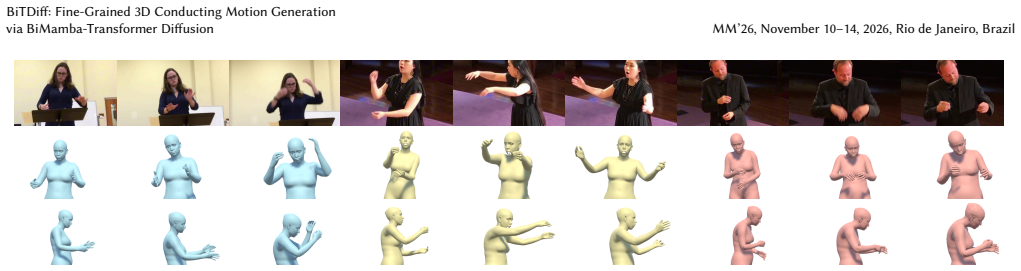


read the original abstract
3D conducting motion generation aims to synthesize fine-grained conductor motions from music, with broad potential in music education, virtual performance, digital human animation, and human-AI co-creation. However, this task remains underexplored due to two major challenges: (1) the lack of large-scale fine-grained 3D conducting datasets and (2) the absence of effective methods that can jointly support long-sequence generation with high quality and efficiency. To address the data limitation, we develop a quality-oriented 3D conducting motion collection pipeline and construct CM-Data, a fine-grained SMPL-X dataset with about 10 hours of conducting motion data. To the best of our knowledge, CM-Data is the first and largest public dataset for 3D conducting motion generation. To address the methodological limitation, we propose BiTDiff, a novel framework for 3D conducting motion generation, built upon a BiMamba-Transformer hybrid model architecture for efficient long-sequence modeling and a Diffusion-based generative strategy with human-kinematic decomposition for high-quality motion synthesis. Specifically, BiTDiff introduces auxiliary physical-consistency losses and a hand-/body-specific forward-kinematics design for better fine-grained motion modeling, while leveraging BiMamba for memory-efficient long-sequence temporal modeling and Transformer for cross-modal semantic alignment. In addition, BiTDiff supports training-free joint-level motion editing, enabling downstream human-AI interaction design. Extensive quantitative and qualitative experiments demonstrate that BiTDiff achieves state-of-the-art (SOTA) performance for 3D conducting motion generation on the CM-Data dataset. Code will be available upon acceptance.
Editorial analysis
A structured set of objections, weighed in public.
Referee Report
Summary. The paper introduces CM-Data, the first large-scale public fine-grained 3D conducting motion dataset (~10 hours, SMPL-X) collected via a quality-oriented pipeline, and proposes BiTDiff, a diffusion model using a BiMamba-Transformer hybrid architecture, hand-/body-specific forward-kinematics decomposition, and auxiliary physical-consistency losses to generate conductor motions from music. It further claims support for training-free joint-level editing and reports state-of-the-art quantitative and qualitative performance on CM-Data.
Significance. If the central claims hold, the work would be a meaningful contribution to specialized 3D motion generation by releasing the first public conducting dataset and demonstrating an efficient long-sequence hybrid architecture. The kinematic decomposition and editing capability address practical needs in animation and human-AI co-creation. Credit is due for the dataset construction effort and the memory-efficient BiMamba component, which could generalize beyond this domain if properly validated.
major comments (3)
- [Experiments] The SOTA claim (abstract and Experiments section) is load-bearing but rests on comparisons whose details are not fully anchored. Prior motion-diffusion baselines (e.g., MDM-style or Transformer-diffusion methods) must be re-implemented and trained on CM-Data under identical protocols; without this, reported gains could arise from dataset-specific artifacts (camera angles, SMPL-X fitting biases, or conductor-style distribution) rather than the BiMamba-Transformer hybrid or FK losses.
- [4.3] No ablation tables or quantitative breakdowns are referenced for the auxiliary physical-consistency losses or the hand-/body-specific FK design. These components are central to the fine-grained motion claim; their removal should be shown to degrade metrics such as hand-joint error or physical plausibility scores.
- [5] The manuscript provides no cross-dataset evaluation or zero-shot transfer results. Generalization beyond the authors' own collection pipeline is required to substantiate that the method solves the stated challenges of long-sequence quality and efficiency rather than fitting CM-Data idiosyncrasies.
minor comments (3)
- [Abstract] The abstract states 'about 10 hours' but omits exact sequence count, number of conductors, and train/val/test splits; these numbers should appear in §3 or a dataset table for reproducibility.
- [4] Notation for the BiMamba-Transformer fusion (e.g., how Mamba states are injected into Transformer layers) is described at high level; an explicit equation or block diagram in §4 would improve clarity.
- [5] Figure captions and qualitative examples should include frame indices or music timestamps to allow readers to verify temporal alignment claims.
Simulated Author's Rebuttal
We thank the referee for the constructive and detailed feedback. We address each major comment point by point below, providing the strongest honest defense of the manuscript while committing to revisions that improve clarity and rigor where appropriate.
read point-by-point responses
-
Referee: [Experiments] The SOTA claim (abstract and Experiments section) is load-bearing but rests on comparisons whose details are not fully anchored. Prior motion-diffusion baselines (e.g., MDM-style or Transformer-diffusion methods) must be re-implemented and trained on CM-Data under identical protocols; without this, reported gains could arise from dataset-specific artifacts (camera angles, SMPL-X fitting biases, or conductor-style distribution) rather than the BiMamba-Transformer hybrid or FK losses.
Authors: We appreciate the referee's emphasis on ensuring fair and transparent comparisons. In the original submission, we re-implemented the referenced baselines (MDM-style and Transformer-diffusion methods) and trained them from scratch on CM-Data using the exact same data splits, optimizer settings, training duration, and evaluation metrics as BiTDiff. To eliminate any ambiguity, we will revise the Experiments section with an expanded subsection that documents the re-implementation details, hyperparameter choices, and any minor adaptations required for compatibility with SMPL-X. This addition will confirm that observed improvements arise from the BiMamba-Transformer hybrid and kinematic components rather than dataset idiosyncrasies. revision: yes
-
Referee: [4.3] No ablation tables or quantitative breakdowns are referenced for the auxiliary physical-consistency losses or the hand-/body-specific FK design. These components are central to the fine-grained motion claim; their removal should be shown to degrade metrics such as hand-joint error or physical plausibility scores.
Authors: We agree that explicit quantitative ablations strengthen the claims regarding these design choices. Section 4.3 currently focuses on qualitative analysis and overall metrics; we will add new ablation tables in the revised manuscript that isolate the contribution of the auxiliary physical-consistency losses and the hand-/body-specific forward-kinematics decomposition. These tables will report the resulting increases in hand-joint error and decreases in physical plausibility scores when each component is removed, providing direct evidence of their necessity for fine-grained quality. revision: yes
-
Referee: [5] The manuscript provides no cross-dataset evaluation or zero-shot transfer results. Generalization beyond the authors' own collection pipeline is required to substantiate that the method solves the stated challenges of long-sequence quality and efficiency rather than fitting CM-Data idiosyncrasies.
Authors: We recognize the importance of demonstrating generalization. However, CM-Data is the first large-scale public 3D conducting motion dataset, so no prior comparable datasets exist for cross-dataset or zero-shot evaluation. We will revise the manuscript to include an explicit Limitations and Future Work section that states this constraint and outlines plans for additional data collection. We will also report performance on internal held-out splits to support robustness within the current data distribution. revision: partial
- Cross-dataset or zero-shot evaluation on other 3D conducting motion datasets, as none exist publicly.
Circularity Check
No circularity: empirical SOTA on newly collected CM-Data with novel architecture
full rationale
The paper introduces CM-Data via an author-defined collection pipeline and proposes BiTDiff with BiMamba-Transformer, diffusion, auxiliary physical-consistency losses, and hand-/body-specific FK decomposition. The central claim of SOTA performance is supported solely by quantitative/qualitative experiments on this dataset. No equations, derivations, or self-citations are present that reduce any result to its inputs by construction. This matches the default case of a self-contained empirical ML contribution with no load-bearing circular steps.
Axiom & Free-Parameter Ledger
axioms (2)
- domain assumption BiMamba enables memory-efficient long-sequence temporal modeling while Transformer handles cross-modal alignment
- domain assumption Human-kinematic decomposition and auxiliary physical-consistency losses improve fine-grained motion synthesis
Lean theorems connected to this paper
-
IndisputableMonolith/Cost/FunctionalEquation.leanwashburn_uniqueness_aczel unclear?
unclearRelation between the paper passage and the cited Recognition theorem.
BiTDiff introduces auxiliary physical-consistency losses and a hand-/body-specific forward-kinematics design... leveraging BiMamba for memory-efficient long-sequence temporal modeling and Transformer for cross-modal semantic alignment.
-
IndisputableMonolith/Foundation/RealityFromDistinction.leanreality_from_one_distinction unclear?
unclearRelation between the paper passage and the cited Recognition theorem.
BiTDiff achieves state-of-the-art (SOTA) performance for 3D conducting motion generation on the CM-Data dataset.
What do these tags mean?
- matches
- The paper's claim is directly supported by a theorem in the formal canon.
- supports
- The theorem supports part of the paper's argument, but the paper may add assumptions or extra steps.
- extends
- The paper goes beyond the formal theorem; the theorem is a base layer rather than the whole result.
- uses
- The paper appears to rely on the theorem as machinery.
- contradicts
- The paper's claim conflicts with a theorem or certificate in the canon.
- unclear
- Pith found a possible connection, but the passage is too broad, indirect, or ambiguous to say the theorem truly supports the claim.
Forward citations
Cited by 3 Pith papers
-
Interactive Multi-Turn Retrieval for Health Videos
DATR combines coarse CLIP-based retrieval with multi-turn query fusion and cross-encoder re-ranking to improve health video retrieval, supported by the new MHVRC corpus.
-
CustomDancer: Customized Dance Recommendation by Text-Dance Retrieval
CustomDancer achieves state-of-the-art text-to-dance retrieval with 10.23% Recall@1 on the new TD-Data dataset by aligning text, music, and motion features through a CLIP-based framework.
-
MG-Former: A Transformer-Based Framework for Music-Driven 3D Conducting Gesture Generation
TransConductor generates 3D conducting gestures from music via a Trans-Temporal Music Encoder and Gesture Decoder, outperforming baselines on retrieval-based alignment metrics with a new ConductorMotion dataset.
Reference graph
Works this paper leans on
-
[1]
Junming Chen, Yunfei Liu, Jianan Wang, Ailing Zeng, Yu Li, and Qifeng Chen
-
[2]
InProceedings of the IEEE/CVF Conference on Computer Vision and Pattern Recognition
Diffsheg: A diffusion-based approach for real-time speech-driven holistic 3d expression and gesture generation. InProceedings of the IEEE/CVF Conference on Computer Vision and Pattern Recognition. 7352–7361
- [3]
-
[4]
Dorothée Legrand and Susanne Ravn. 2009. Perceiving subjectivity in bodily movement: The case of dancers.Phenomenology and the Cognitive Sciences8 (2009), 389–408
2009
-
[5]
Ronghui Li, YuXiang Zhang, Yachao Zhang, Hongwen Zhang, Jie Guo, Yan Zhang, Yebin Liu, and Xiu Li. 2024. Lodge: A coarse to fine diffusion network for long dance generation guided by the characteristic dance primitives. InProceedings of the IEEE/CVF Conference on Computer Vision and Pattern Recognition. 1524–1534
2024
-
[6]
Kaixing Yang, Xulong Tang, Ziqiao Peng, Yuxuan Hu, Jun He, and Hongyan Liu
- [7]
-
[8]
Zhuoran Zhao, Jinbin Bai, Delong Chen, Debang Wang, and Yubo Pan. 2023. Taming diffusion models for music-driven conducting motion generation. InPro- ceedings of the AAAI Symposium Series, Vol. 1. 40–44
2023
discussion (0)
Sign in with ORCID, Apple, or X to comment. Anyone can read and Pith papers without signing in.