Recognition: 2 theorem links
· Lean TheoremDiffHDR: Re-Exposing LDR Videos with Video Diffusion Models
Pith reviewed 2026-05-10 18:58 UTC · model grok-4.3
The pith
Video diffusion models restore realistic high-dynamic-range radiance to standard low-dynamic-range videos by inpainting overexposed and underexposed regions.
A machine-rendered reading of the paper's core claim, the machinery that carries it, and where it could break.
Core claim
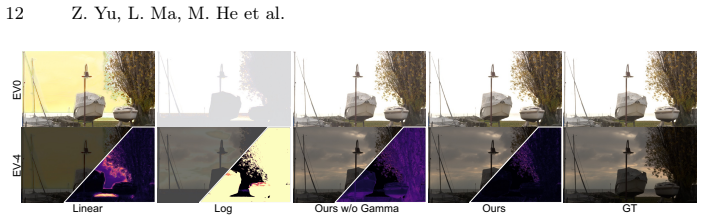
DiffHDR formulates LDR-to-HDR conversion as a generative radiance inpainting task within the latent space of a video diffusion model. Operating in Log-Gamma color space, it leverages spatio-temporal generative priors from a pretrained video diffusion model to synthesize plausible HDR radiance in over- and underexposed regions while recovering the continuous scene radiance of the quantized pixels. The framework supports controllable conversion guided by text prompts or reference images and trains on synthetic HDR video data generated from static HDRI maps.
What carries the argument
Generative radiance inpainting task performed in the latent space of a pretrained video diffusion model, operating in Log-Gamma color space to leverage spatio-temporal priors.
If this is right
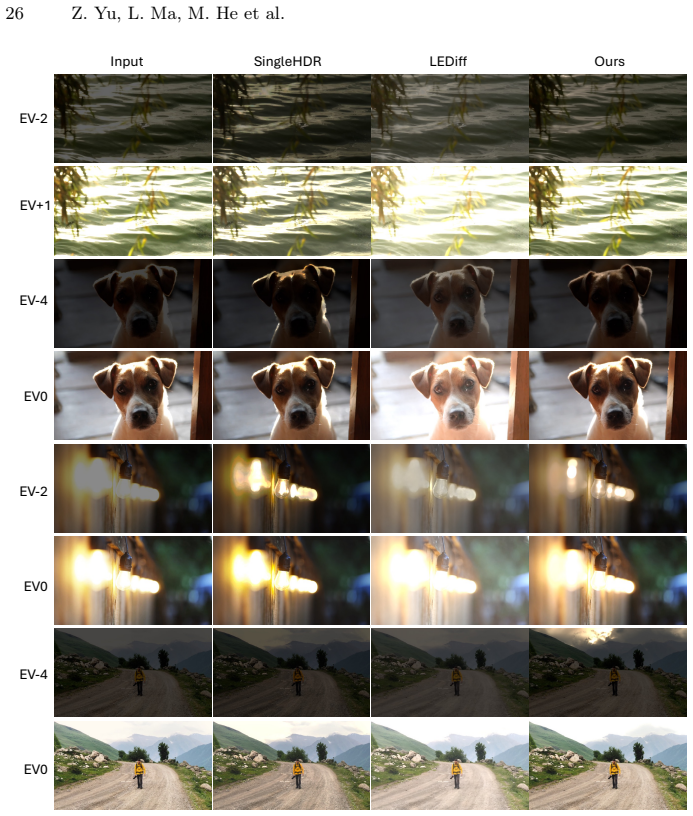
- HDR videos exhibit higher radiance fidelity and greater temporal stability than outputs from prior LDR-to-HDR techniques.
- The same model accepts text prompts or reference images to steer the appearance of restored highlights and shadows.
- Generated videos retain enough dynamic range to support large brightness shifts during post-production re-exposure.
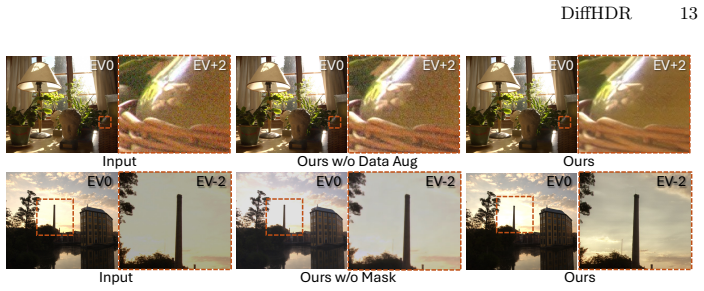
- Synthetic training data derived from static HDRI maps enables effective learning despite the absence of large paired HDR video datasets.
Where Pith is reading between the lines
- The inpainting framing could transfer to other video restoration problems such as recovering motion blur or removing compression artifacts by the same latent-space mechanism.
- If the recovered radiance proves consistent across different diffusion backbones, the method might serve as a general post-capture upgrade layer for any existing video archive.
- Real-time deployment would require distilling the diffusion steps or replacing them with a feed-forward network while preserving the same radiance accuracy.
Load-bearing premise
A video diffusion model trained on ordinary footage can reliably invent accurate bright and dark details for overexposed and underexposed areas without creating visible inconsistencies across frames.
What would settle it
Simultaneous capture of the same real-world scene with both a standard LDR camera and a calibrated HDR camera, followed by direct comparison of radiance values in the regions that were saturated or crushed in the LDR input.
Figures






read the original abstract
Most digital videos are stored in 8-bit low dynamic range (LDR) formats, where much of the original high dynamic range (HDR) scene radiance is lost due to saturation and quantization. This loss of highlight and shadow detail precludes mapping accurate luminance to HDR displays and limits meaningful re-exposure in post-production workflows. Although techniques have been proposed to convert LDR images to HDR through dynamic range expansion, they struggle to restore realistic detail in the over- and underexposed regions. To address this, we present DiffHDR, a framework that formulates LDR-to-HDR conversion as a generative radiance inpainting task within the latent space of a video diffusion model. By operating in Log-Gamma color space, DiffHDR leverages spatio-temporal generative priors from a pretrained video diffusion model to synthesize plausible HDR radiance in over- and underexposed regions while recovering the continuous scene radiance of the quantized pixels. Our framework further enables controllable LDR-to-HDR video conversion guided by text prompts or reference images. To address the scarcity of paired HDR video data, we develop a pipeline that synthesizes high-quality HDR video training data from static HDRI maps. Extensive experiments demonstrate that DiffHDR significantly outperforms state-of-the-art approaches in radiance fidelity and temporal stability, producing realistic HDR videos with considerable latitude for re-exposure.
Editorial analysis
A structured set of objections, weighed in public.
Referee Report
Summary. The manuscript introduces DiffHDR, a framework for LDR-to-HDR video conversion formulated as generative radiance inpainting in the latent space of a pretrained video diffusion model. Operating in Log-Gamma color space, it leverages spatio-temporal priors to synthesize plausible HDR radiance in over- and underexposed regions while recovering continuous scene radiance. A synthesis pipeline generates paired training data from static HDRI maps, and the method supports controllable conversion via text prompts or reference images. Extensive experiments are claimed to show significant outperformance over state-of-the-art methods in radiance fidelity and temporal stability.
Significance. If the results hold under real-world conditions, this approach could advance practical HDR video workflows by enabling high-quality re-exposure and detail recovery in post-production using generative video priors. The data synthesis strategy addresses a key scarcity issue, and the emphasis on temporal stability via diffusion models represents a timely application of recent generative techniques.
major comments (1)
- [§3.3] §3.3: The training data synthesis pipeline generates all paired HDR video data by warping static HDRI environment maps onto video sequences. This construction cannot reproduce temporally correlated real-world effects such as moving specular highlights, object-motion-dependent cast shadows, or varying inter-reflections. Because the central claims of improved radiance fidelity and temporal stability depend on the video diffusion priors learning plausible inpainting from this data distribution, the absence of validation on real paired HDR-LDR video sequences or targeted ablations on dynamic lighting directly threatens the generalization of the reported gains.
minor comments (2)
- [Abstract] The abstract asserts outperformance without any numerical results or error metrics; moving key quantitative highlights (e.g., PSNR, temporal consistency scores) from the experiments section into the abstract would improve readability.
- [§3] Notation for the Log-Gamma color space transformation and the precise conditioning mechanism (text vs. reference image) should be defined explicitly with equations in §3 or §4 to avoid ambiguity for readers.
Simulated Author's Rebuttal
We thank the referee for the constructive comment on the data synthesis pipeline. We address the concern directly below and propose a partial revision to strengthen the manuscript.
read point-by-point responses
-
Referee: [§3.3] §3.3: The training data synthesis pipeline generates all paired HDR video data by warping static HDRI environment maps onto video sequences. This construction cannot reproduce temporally correlated real-world effects such as moving specular highlights, object-motion-dependent cast shadows, or varying inter-reflections. Because the central claims of improved radiance fidelity and temporal stability depend on the video diffusion priors learning plausible inpainting from this data distribution, the absence of validation on real paired HDR-LDR video sequences or targeted ablations on dynamic lighting directly threatens the generalization of the reported gains.
Authors: We acknowledge that warping static HDRI maps onto video sequences cannot fully reproduce dynamic lighting effects such as moving specular highlights, motion-dependent cast shadows, or varying inter-reflections. This is an inherent limitation of the synthesis approach. However, the video diffusion model is pretrained on large-scale real-world video corpora that contain natural temporal lighting dynamics; by performing generative inpainting in latent space, the model leverages these priors to produce plausible, motion-consistent HDR radiance even when the paired training examples are synthesized from static maps. Our experiments evaluate on real LDR videos (qualitative results and user studies), where DiffHDR exhibits improved temporal stability and detail recovery over baselines. Real paired HDR-LDR video data remains scarce, which is why synthesis was necessary; we therefore cannot provide quantitative metrics on such pairs. We will revise the paper to add an explicit limitations paragraph on the data synthesis strategy, clarify the mitigating role of pretrained priors, and include any feasible targeted analysis of dynamic lighting consistency. revision: partial
- Quantitative validation on real paired HDR-LDR video sequences, as no sufficiently large public dataset of this kind exists.
Circularity Check
No significant circularity in derivation chain
full rationale
The paper's core formulation treats LDR-to-HDR conversion as generative radiance inpainting inside a pretrained video diffusion model's latent space, with a separate synthetic data pipeline built from static HDRI maps. These elements are constructed independently of the final empirical claims. Performance assertions rest on comparative experiments for radiance fidelity and temporal stability rather than any quantity defined by fitting parameters to the target outputs or by self-referential equations. No load-bearing self-citations, uniqueness theorems, or ansatzes reduce the results to the inputs by construction.
Axiom & Free-Parameter Ledger
Lean theorems connected to this paper
-
IndisputableMonolith/Cost/FunctionalEquation.leanwashburn_uniqueness_aczel unclear?
unclearRelation between the paper passage and the cited Recognition theorem.
we propose a Log-Gamma color mapping defined as: T(x) = (log(1 + γx)/log(1 + γM))^(1/γ)
-
IndisputableMonolith/Foundation/ArithmeticFromLogic.leanreality_from_one_distinction unclear?
unclearRelation between the paper passage and the cited Recognition theorem.
formulates LDR-to-HDR conversion as a generative radiance inpainting task within the latent space of a video diffusion model
What do these tags mean?
- matches
- The paper's claim is directly supported by a theorem in the formal canon.
- supports
- The theorem supports part of the paper's argument, but the paper may add assumptions or extra steps.
- extends
- The paper goes beyond the formal theorem; the theorem is a base layer rather than the whole result.
- uses
- The paper appears to rely on the theorem as machinery.
- contradicts
- The paper's claim conflicts with a theorem or certificate in the canon.
- unclear
- Pith found a possible connection, but the passage is too broad, indirect, or ambiguous to say the theorem truly supports the claim.
Forward citations
Cited by 2 Pith papers
-
Generating HDR Video from SDR Video
A multi-exposure video model predicts bracketed linear SDR sequences from single nonlinear SDR input, which a merging model combines into HDR video preserving shadow and highlight detail.
-
Single-Shot HDR Recovery via a Video Diffusion Prior
Single-shot HDR is achieved by conditioning a video diffusion model on an LDR input to generate an exposure bracket and fusing the bracket with per-pixel weights from a lightweight UNet.
Reference graph
Works this paper leans on
-
[1]
Poly haven (2024),https://polyhaven.com/, accessed: 2024-10-21
2024
-
[2]
In: International Conference on Learning Representa- tions (ICLR) (2024)
Adiya, T., Ha, S.J.: Omnipainter: Global-local temporally consistent video in- painting diffusion model. In: International Conference on Learning Representa- tions (ICLR) (2024)
2024
-
[3]
Cosmos World Foundation Model Platform for Physical AI
Agarwal, N., Ali, A., Bala, M., Balaji, Y., Barker, E., Cai, T., Chattopadhyay, P., Chen, Y., Cui, Y., Ding, Y., et al.: Cosmos world foundation model platform for physical ai. arXiv preprint arXiv:2501.03575 (2025)
work page internal anchor Pith review arXiv 2025
-
[4]
In: International conference on machine learning
Arjovsky, M., Chintala, S., Bottou, L.: Wasserstein generative adversarial net- works. In: International conference on machine learning. pp. 214–223. Pmlr (2017)
2017
-
[5]
Graph.43(2) (Mar 2024).https://doi.org/10.1145/3648570, https://doi.org/10.1145/3648570
Banterle, F., Marnerides, D., Bashford-rogers, T., Debattista, K.: Self-supervised high dynamic range imaging: What can be learned from a single 8-bit video? ACM Trans. Graph.43(2) (Mar 2024).https://doi.org/10.1145/3648570, https://doi.org/10.1145/3648570
-
[6]
Bracket diffusion: Hdr image generation by consistent ldr denoising, 2025
Bemana, M., Leimkühler, T., Myszkowski, K., Seidel, H.P., Ritschel, T.: Bracket diffusion: Hdr image generation by consistent ldr denoising. arXiv preprint arXiv:2405.14304 (2024)
-
[7]
Stable Video Diffusion: Scaling Latent Video Diffusion Models to Large Datasets
Blattmann, A., Dockhorn, T., Kulal, S., Mendelevitch, D., Kilian, M., Lorenz, D., Levi, Y., English, Z., Voleti, V., Letts, A., et al.: Stable video diffusion: Scaling latent video diffusion models to large datasets. arXiv preprint arXiv:2311.15127 (2023)
work page internal anchor Pith review arXiv 2023
-
[8]
In: Proceedings of the Computer Vision and Pattern Recognition Conference
Burgert, R., Xu, Y., Xian, W., Pilarski, O., Clausen, P., He, M., Ma, L., Deng, Y., Li, L., Mousavi, M., et al.: Go-with-the-flow: Motion-controllable video diffusion models using real-time warped noise. In: Proceedings of the Computer Vision and Pattern Recognition Conference. pp. 13–23 (2025)
2025
-
[9]
In: Proceedings of the IEEE/CVF conference on computer vision and pattern recognition
Chan, E.R., Lin, C.Z., Chan, M.A., Nagano, K., Pan, B., De Mello, S., Gallo, O., Guibas, L.J., Tremblay, J., Khamis, S., et al.: Efficient geometry-aware 3d generative adversarial networks. In: Proceedings of the IEEE/CVF conference on computer vision and pattern recognition. pp. 16123–16133 (2022)
2022
-
[10]
In: Proceedings of the IEEE/CVF conference on computer vision and pattern recog- nition
Chan, E.R., Monteiro, M., Kellnhofer, P., Wu, J., Wetzstein, G.: pi-gan: Peri- odic implicit generative adversarial networks for 3d-aware image synthesis. In: Proceedings of the IEEE/CVF conference on computer vision and pattern recog- nition. pp. 5799–5809 (2021)
2021
-
[11]
In: Proceedings of the IEEE/CVF International Conference on Computer Vision (ICCV)
Chen, G., Chen, C., Guo, S., Liang, Z., Wong, K.Y.K., Zhang, L.: Hdr video reconstruction: A coarse-to-fine network and a real-world benchmark dataset. In: Proceedings of the IEEE/CVF International Conference on Computer Vision (ICCV). pp. 2502–2511 (October 2021)
2021
-
[12]
In: Proceedings of the AAAI Conference on Artificial Intelligence
Chen, R., Zheng, B., Zhang, H., Chen, Q., Yan, C., Slabaugh, G., Yuan, S.: Improving dynamic hdr imaging with fusion transformer. In: Proceedings of the AAAI Conference on Artificial Intelligence. vol. 37, pp. 340–349 (2023)
2023
-
[13]
In: Proceedings of the Computer Vision and Pattern Recognition Conference
Chen, Z., Wang, Y., Cai, X., You, Z., Lu, Z., Zhang, F., Guo, S., Xue, T.: Ultra- fusion: Ultra high dynamic imaging using exposure fusion. In: Proceedings of the Computer Vision and Pattern Recognition Conference. pp. 16111–16121 (2025)
2025
-
[14]
Chung, H., Cho, N.I.: Lan-hdr: Luminance-based alignment network for high dy- namicrangevideoreconstruction.In:ProceedingsoftheIEEE/CVFInternational Conference on Computer Vision (ICCV). pp. 12760–12769 (October 2023)
2023
-
[15]
In: Proceedings of the 24th Annual Conference on Computer Graphics and Interactive Techniques
Debevec, P.E., Malik, J.: Recovering high dynamic range radiance maps from pho- tographs. In: Proceedings of the 24th Annual Conference on Computer Graphics DiffHDR 17 and Interactive Techniques. p. 369–378. SIGGRAPH ’97, ACM Press/Addison- Wesley Publishing Co., USA (1997).https://doi.org/10.1145/258734.258884, https://doi.org/10.1145/258734.258884
-
[16]
Advances in neural information processing systems34, 8780–8794 (2021)
Dhariwal, P., Nichol, A.: Diffusion models beat gans on image synthesis. Advances in neural information processing systems34, 8780–8794 (2021)
2021
-
[17]
Dille, S., Careaga, C., Aksoy, Y.: Intrinsic single-image hdr reconstruction. In: Computer Vision – ECCV 2024: 18th European Conference, Milan, Italy, Septem- ber 29–October 4, 2024, Proceedings, Part XI. p. 161–177. Springer-Verlag, Berlin, Heidelberg (2024).https://doi.org/10.1007/978-3-031-73247-8_10, https://doi.org/10.1007/978-3-031-73247-8_10
-
[18]
ACM transactions on graphics (TOG)36(6), 1–15 (2017)
Eilertsen, G., Kronander, J., Denes, G., Mantiuk, R.K., Unger, J.: Hdr image reconstruction from a single exposure using deep cnns. ACM transactions on graphics (TOG)36(6), 1–15 (2017)
2017
-
[19]
ACM Trans
Endo, Y., Kanamori, Y., Mitani, J.: Deep reverse tone mapping. ACM Trans. Graph.36(6), 177–1 (2017)
2017
-
[20]
In: Digital photography X
Froehlich, J., Grandinetti, S., Eberhardt, B., Walter, S., Schilling, A., Brendel, H.: Creating cinematic wide gamut hdr-video for the evaluation of tone mapping operators and hdr-displays. In: Digital photography X. vol. 9023, pp. 279–288. SPIE (2014)
2014
-
[21]
In: 2015 IEEE Conference on Computer Vision and Pattern Recognition Workshops (CVPRW)
Gallo, O., Troccoli, A., Hu, J., Pulli, K., Kautz, J.: Locally non-rigid registration for mobile hdr photography. In: 2015 IEEE Conference on Computer Vision and Pattern Recognition Workshops (CVPRW). pp. 48–55 (2015).https://doi.org/ 10.1109/CVPRW.2015.7301366
-
[22]
Communications of the ACM63(11), 139–144 (2020)
Goodfellow, I., Pouget-Abadie, J., Mirza, M., Xu, B., Warde-Farley, D., Ozair, S., Courville, A., Bengio, Y.: Generative adversarial networks. Communications of the ACM63(11), 139–144 (2020)
2020
-
[23]
arXiv preprint arXiv:2405.15468 (2024)
Goswami, A., Singh, A.R., Banterle, F., Debattista, K., Bashford-Rogers, T.: Semantic aware diffusion inverse tone mapping. arXiv preprint arXiv:2405.15468 (2024)
-
[24]
In: Proceedings of the Special Interest Group on Computer Graphics and Interactive Techniques Conference Conference Papers
Gu, Z., Yan, R., Lu, J., Li, P., Dou, Z., Si, C., Dong, Z., Liu, Q., Lin, C., Liu, Z., et al.: Diffusion as shader: 3d-aware video diffusion for versatile video generation control. In: Proceedings of the Special Interest Group on Computer Graphics and Interactive Techniques Conference Conference Papers. pp. 1–12 (2025)
2025
-
[25]
In: Proceedings of the IEEE/CVF International Conference on Computer Vision
Guan,Y.,Xu,R.,Liao,Y.,Yao,M.,Wang,L.,Xiong,Z.:Hdrimagegenerationvia gain map decomposed diffusion. In: Proceedings of the IEEE/CVF International Conference on Computer Vision. pp. 17536–17545 (2025)
2025
-
[26]
In: European Conference on Computer Vision
Guan, Y., Xu, R., Yao, M., Gao, R., Wang, L., Xiong, Z.: Diffusion-promoted hdr video reconstruction. In: European Conference on Computer Vision. pp. 20–38. Springer (2024)
2024
-
[27]
Guan, Y., Xu, R., Yao, M., Gao, R., Wang, L., Xiong, Z.: Diffusion-promoted hdr video reconstruction. In: Computer Vision – ECCV 2024 Workshops: Milan, Italy, September 29–October 4, 2024, Proceedings, Part IX. p. 20–38. Springer-Verlag, Berlin, Heidelberg (2025).https://doi.org/10.1007/978-3-031-91838-4_2, https://doi.org/10.1007/978-3-031-91838-4_2
-
[28]
In: Proceedings of the IEEE/CVF Conference on Computer Vision and Pattern Recognition (CVPR)
Guo, C., Fan, L., Xue, Z., Jiang, X.: Learning a practical sdr-to-hdrtv up- conversion using new dataset and degradation models. In: Proceedings of the IEEE/CVF Conference on Computer Vision and Pattern Recognition (CVPR). pp. 22231–22241 (June 2023)
2023
-
[29]
In: Proceedings of the Asian Conference on Computer Vision (ACCV)
Guo, C., Jiang, X.: Lhdr: Hdr reconstruction for legacy content using a lightweight dnn. In: Proceedings of the Asian Conference on Computer Vision (ACCV). pp. 3155–3171 (December 2022) 18 Z. Yu, L. Ma, M. He et al
2022
-
[30]
In: Proceedings of the IEEE/CVF conference on computer vision and pattern recognition
Guo, S., Yan, Z., Zhang, K., Zuo, W., Zhang, L.: Toward convolutional blind denoising of real photographs. In: Proceedings of the IEEE/CVF conference on computer vision and pattern recognition. pp. 1712–1722 (2019)
2019
-
[31]
LTX-Video: Realtime Video Latent Diffusion
HaCohen, Y., Chiprut, N., Brazowski, B., Shalem, D., Moshe, D., Richardson, E., Levin, E., Shiran, G., Zabari, N., Gordon, O., Panet, P., Weissbuch, S., Ku- likov, V., Bitterman, Y., Melumian, Z., Bibi, O.: Ltx-video: Realtime video latent diffusion. arXiv preprint arXiv:2501.00103 (2024)
work page internal anchor Pith review arXiv 2024
-
[32]
Princeton university press (2020)
Hamilton, J.D.: Time series analysis. Princeton university press (2020)
2020
-
[33]
In: ACM SIGGRAPH 2022 conference proceedings
Hanji, P., Mantiuk, R., Eilertsen, G., Hajisharif, S., Unger, J.: Comparison of single image hdr reconstruction methods—the caveats of quality assessment. In: ACM SIGGRAPH 2022 conference proceedings. pp. 1–8 (2022)
2022
-
[34]
In: SIGGRAPH Asia 2024 conference papers
He, M., Clausen, P., Taşel, A.L., Ma, L., Pilarski, O., Xian, W., Rikker, L., Yu, X., Burgert, R., Yu, N., et al.: Diffrelight: Diffusion-based facial performance relighting. In: SIGGRAPH Asia 2024 conference papers. pp. 1–12 (2024)
2024
-
[35]
Advances in neural information processing systems30(2017)
Heusel, M., Ramsauer, H., Unterthiner, T., Nessler, B., Hochreiter, S.: Gans trained by a two time-scale update rule converge to a local nash equilibrium. Advances in neural information processing systems30(2017)
2017
-
[36]
Classifier-Free Diffusion Guidance
Ho, J., Salimans, T.: Classifier-free diffusion guidance. arXiv preprint arXiv:2207.12598 (2022)
work page internal anchor Pith review Pith/arXiv arXiv 2022
-
[37]
Hu, J., Gallo, O., Pulli, K., Sun, X.: Hdr deghosting: How to deal with satura- tion? In: Proceedings of the IEEE Conference on Computer Vision and Pattern Recognition (CVPR) (June 2013)
2013
-
[38]
In: Proceedings of the IEEE/CVF Conference on Computer Vi- sion and Pattern Recognition (CVPR)
Hu, T., Yan, Q., Qi, Y., Zhang, Y.: Generating content for hdr deghosting from frequency view. In: Proceedings of the IEEE/CVF Conference on Computer Vi- sion and Pattern Recognition (CVPR). pp. 25732–25741 (June 2024)
2024
-
[39]
Huang, Z., Yu, N., Chen, G., Qiu, H., Debevec, P., Liu, Z.: Vchain: Chain-of- visual-thought for reasoning in video generation. arXiv preprint arXiv:2510.05094 (2025)
-
[40]
ACM Transactions on Graphics42(3), 1–18 (2023)
Jiang, K., Chen, S.Y., Fu, H., Gao, L.: Nerffacelighting: Implicit and disentangled face lighting representation leveraging generative prior in neural radiance fields. ACM Transactions on Graphics42(3), 1–18 (2023)
2023
-
[41]
Jiang, Z., Han, Z., Mao, C., Zhang, J., Pan, Y., Liu, Y.: Vace: All-in-one video creation and editing. arXiv preprint arXiv:2503.07598 (2025)
-
[42]
In: European Conference on Computer Vision
Ju, X., Liu, X., Wang, X., Bian, Y., Shan, Y., Xu, Q.: Brushnet: A plug-and-play image inpainting model with decomposed dual-branch diffusion. In: European Conference on Computer Vision. pp. 150–168. Springer (2024)
2024
-
[43]
Kalantari, N.K., Ramamoorthi, R.: Deep hdr video from sequences with alter- nating exposures. Computer Graphics Forum38(2), 193–205 (2019).https: //doi.org/https://doi.org/10.1111/cgf.13630,https://onlinelibrary. wiley.com/doi/abs/10.1111/cgf.13630
-
[44]
ACM Trans
Kalantari, N.K., Ramamoorthi, R., et al.: Deep high dynamic range imaging of dynamic scenes. ACM Trans. Graph.36(4), 144–1 (2017)
2017
-
[45]
Kalantari, N.K., Shechtman, E., Barnes, C., Darabi, S., Goldman, D.B., Sen, P.: Patch-based high dynamic range video. ACM Trans. Graph.32(6) (Nov 2013).https://doi.org/10.1145/2508363.2508402,https://doi.org/10. 1145/2508363.2508402
-
[47]
Kang, S.B., Uyttendaele, M., Winder, S., Szeliski, R.: High dynamic range video. ACM Trans. Graph.22(3), 319–325 (Jul 2003).https://doi.org/10.1145/ 882262.882270,https://doi.org/10.1145/882262.882270
-
[48]
Advances in neural information processing systems34, 852–863 (2021)
Karras, T., Aittala, M., Laine, S., Härkönen, E., Hellsten, J., Lehtinen, J., Aila, T.: Alias-free generative adversarial networks. Advances in neural information processing systems34, 852–863 (2021)
2021
-
[49]
In: Proceedings of the IEEE/CVF conference on computer vision and pattern recognition
Karras, T., Laine, S., Aila, T.: A style-based generator architecture for generative adversarial networks. In: Proceedings of the IEEE/CVF conference on computer vision and pattern recognition. pp. 4401–4410 (2019)
2019
-
[50]
In: Proceedings of the IEEE/CVF conference on computer vision and pattern recognition
Karras, T., Laine, S., Aittala, M., Hellsten, J., Lehtinen, J., Aila, T.: Analyzing and improving the image quality of stylegan. In: Proceedings of the IEEE/CVF conference on computer vision and pattern recognition. pp. 8110–8119 (2020)
2020
-
[51]
In: Proceedings of the IEEE/CVF international conference on computer vision
Ke, J., Wang, Q., Wang, Y., Milanfar, P., Yang, F.: Musiq: Multi-scale image quality transformer. In: Proceedings of the IEEE/CVF international conference on computer vision. pp. 5148–5157 (2021)
2021
-
[52]
arXiv preprint arXiv:2407.16308 (2024)
Kong, L., Li, B., Xiong, Y., Zhang, H., Gu, H., Chen, J.: Safnet: Selective align- ment fusion network for efficient hdr imaging. arXiv preprint arXiv:2407.16308 (2024)
-
[53]
Kronander, J., Gustavson, S., Bonnet, G., Ynnerman, A., Unger, J.: A unified framework for multi-sensor hdr video reconstruction. Image Commun.29(2), 203–215 (Feb 2014).https://doi.org/10.1016/j.image.2013.08.018,https: //doi.org/10.1016/j.image.2013.08.018
-
[54]
In: Proceedings of the IEEE/CVF Winter Conference on Applications of Computer Vision (WACV)
Le, P.H., Le, Q., Nguyen, R., Hua, B.S.: Single-image hdr reconstruction by multi- exposure generation. In: Proceedings of the IEEE/CVF Winter Conference on Applications of Computer Vision (WACV). pp. 4063–4072 (January 2023)
2023
-
[55]
In: proceedings of the European Conference on Computer Vision (ECCV)
Lee, S., An, G.H., Kang, S.J.: Deep recursive hdri: Inverse tone mapping using generative adversarial networks. In: proceedings of the European Conference on Computer Vision (ECCV). pp. 596–611 (2018)
2018
-
[56]
Neurocomputing479, 47–59 (2022)
Li, H., Yang, Y., Chang, M., Feng, H., Xu, Z., Li, Q., Chen, Y.: Srdiff: Single image super-resolution with diffusion probabilistic models. Neurocomputing479, 47–59 (2022)
2022
-
[57]
In: The Thirteenth International Conference on Learning Representations (2025)
Liao, Y., Guan, Y., Xu, R., Li, J., Sun, S., Xiong, Z.: Learning gain map for inverse tone mapping. In: The Thirteenth International Conference on Learning Representations (2025)
2025
-
[58]
Flow Matching for Generative Modeling
Lipman, Y., Chen, R.T., Ben-Hamu, H., Nickel, M., Le, M.: Flow matching for generative modeling. arXiv preprint arXiv:2210.02747 (2022)
work page internal anchor Pith review Pith/arXiv arXiv 2022
-
[59]
Flow Straight and Fast: Learning to Generate and Transfer Data with Rectified Flow
Liu, X., Gong, C., Liu, Q.: Flow straight and fast: Learning to generate and transfer data with rectified flow. arXiv preprint arXiv:2209.03003 (2022)
work page internal anchor Pith review Pith/arXiv arXiv 2022
-
[60]
In: Proceedings of the IEEE/CVF conference on computer vision and pattern recognition
Liu, Y.L., Lai, W.S., Chen, Y.S., Kao, Y.L., Yang, M.H., Chuang, Y.Y., Huang, J.B.: Single-image hdr reconstruction by learning to reverse the camera pipeline. In: Proceedings of the IEEE/CVF conference on computer vision and pattern recognition. pp. 1651–1660 (2020)
2020
-
[61]
In: European Conference on Computer Vision
Liu, Z., Wang, Y., Zeng, B., Liu, S.: Ghost-free high dynamic range imaging with context-aware transformer. In: European Conference on Computer Vision. pp. 344–360. Springer (2022)
2022
-
[62]
Decoupled Weight Decay Regularization
Loshchilov, I., Hutter, F.: Decoupled weight decay regularization. arXiv preprint arXiv:1711.05101 (2017)
work page internal anchor Pith review Pith/arXiv arXiv 2017
-
[63]
Lugmayr, A., Danelljan, M., Romero, A., Yu, F., Timofte, R., Van Gool, L.: Repaint:Inpaintingusingdenoisingdiffusionprobabilisticmodels.In:Proceedings of the IEEE/CVF conference on computer vision and pattern recognition. pp. 11461–11471 (2022) 20 Z. Yu, L. Ma, M. He et al
2022
-
[64]
ACM Transactions on Graphics (TOG)40(4), 1–19 (2021)
Mantiuk, R.K., Denes, G., Chapiro, A., Kaplanyan, A., Rufo, G., Bachy, R., Lian, T., Patney, A.: Fovvideovdp: A visible difference predictor for wide field-of-view video. ACM Transactions on Graphics (TOG)40(4), 1–19 (2021)
2021
-
[65]
Mantiuk, R.K., Hammou, D., Hanji, P.: Hdr-vdp-3: A multi-metric for predicting image differences, quality and contrast distortions in high dynamic range and regular content. arXiv preprint arXiv:2304.13625 (2023)
-
[66]
In: Computer Graphics Forum
Marnerides, D., Bashford-Rogers, T., Hatchett, J., Debattista, K.: Expandnet: A deep convolutional neural network for high dynamic range expansion from low dynamic range content. In: Computer Graphics Forum. vol. 37, pp. 37–49. Wiley Online Library (2018)
2018
-
[67]
In: Proceedings of the Computer Vision and Pattern Recognition Conference
Mei, Y., He, M., Ma, L., Philip, J., Xian, W., George, D.M., Yu, X., Dedic, G., Taşel, A.L., Yu, N., et al.: Lux post facto: Learning portrait performance relighting with conditional video diffusion and a hybrid dataset. In: Proceedings of the Computer Vision and Pattern Recognition Conference. pp. 5510–5522 (2025)
2025
-
[68]
In: International Conference on Learning Representations (ICLR) (2022)
Meng, C., He, Y., Song, Y., Song, J., Wu, J., Zhu, J.Y., Ermon, S.: Sdedit: Guided image synthesis and editing with stochastic differential equations. In: International Conference on Learning Representations (ICLR) (2022)
2022
-
[69]
In: The Thirty-ninth Annual Confer- ence on Neural Information Processing Systems (2025),https://openreview
Meng, Y., Jin, X., Lei, L., Guo, C.L., Li, C.: UltraLED: Learning to see every- thing in ultra-high dynamic range scenes. In: The Thirty-ninth Annual Confer- ence on Neural Information Processing Systems (2025),https://openreview. net/forum?id=zZLfHw4Erp
2025
-
[70]
In: Proceedings of the AAAI Conference on Artificial Intelli- gence
Mou, C., Wang, X., Xie, L., Wu, Y., Zhang, J., Qi, Z., Shan, Y., Qie, X.: T2i- adapter: Learning adapters to dig out more controllable ability for text-to-image diffusion models. In: Proceedings of the AAAI Conference on Artificial Intelli- gence. vol. 38, pp. 4296–4304 (2024)
2024
-
[71]
IEEE Transactions on Image Processing30, 3885–3896 (2021)
Niu, Y., Wu, J., Liu, W., Guo, W., Lau, R.W.: Hdr-gan: Hdr image reconstruction from multi-exposed ldr images with large motions. IEEE Transactions on Image Processing30, 3885–3896 (2021)
2021
-
[72]
Pexels: Pexels: Free stock photos & videos.https://www.pexels.com(2026), accessed: 2026-03-03
2026
-
[73]
IEEE transactions on visualization and computer graphics11(1), 13– 24 (2005)
Reinhard, E., Devlin, K.: Dynamic range reduction inspired by photoreceptor physiology. IEEE transactions on visualization and computer graphics11(1), 13– 24 (2005)
2005
-
[74]
In: Proceedings of the IEEE/CVF conference on computer vision and pattern recognition
Rombach, R., Blattmann, A., Lorenz, D., Esser, P., Ommer, B.: High-resolution image synthesis with latent diffusion models. In: Proceedings of the IEEE/CVF conference on computer vision and pattern recognition. pp. 10684–10695 (2022)
2022
-
[75]
IEEE Transactions on Pattern Analysis and Machine Intelligence45(4), 4713–4726 (2023)
Saharia, C., Ho, J., Chan, W., Salimans, T., Fleet, D.J., Norouzi, M.: Image super-resolution via iterative refinement. IEEE Transactions on Pattern Analysis and Machine Intelligence45(4), 4713–4726 (2023)
2023
-
[76]
ACM Transactions on Graphics (TOG)39(4), 80–1 (2020)
Santos, M.S., Ren, T.I., Kalantari, N.K.: Single image hdr reconstruction using a cnn with masked features and perceptual loss. ACM Transactions on Graphics (TOG)39(4), 80–1 (2020)
2020
-
[77]
ACM Trans
Sen,P.,Kalantari,N.K.,Yaesoubi,M.,Darabi,S.,Goldman,D.B.,Shechtman,E.: Robust patch-based hdr reconstruction of dynamic scenes. ACM Trans. Graph. 31(6), 203–1 (2012)
2012
-
[78]
In: European Conference on Computer Vision
Song, J.W., Park, Y.I., Kong, K., Kwak, J., Kang, S.J.: Selective transhdr: Transformer-based selective hdr imaging using ghost region mask. In: European Conference on Computer Vision. pp. 288–304. Springer (2022)
2022
-
[79]
In: Proceedings DiffHDR 21 of the IEEE/CVF conference on computer vision and pattern recognition
Sun, J., Wang, X., Wang, L., Li, X., Zhang, Y., Zhang, H., Liu, Y.: Next3d: Generative neural texture rasterization for 3d-aware head avatars. In: Proceedings DiffHDR 21 of the IEEE/CVF conference on computer vision and pattern recognition. pp. 20991–21002 (2023)
2023
-
[80]
Gemini: A Family of Highly Capable Multimodal Models
Team, G., Anil, R., Borgeaud, S., Alayrac, J.B., Yu, J., Soricut, R., Schalkwyk, J., Dai, A.M., Hauth, A., Millican, K., et al.: Gemini: a family of highly capable multimodal models. arXiv preprint arXiv:2312.11805 (2023)
work page internal anchor Pith review Pith/arXiv arXiv 2023
-
[81]
In: 2023 IEEE/CVF International Conference on Computer Vision (ICCV)
Tel, S., Wu, Z., Zhang, Y., Heyrman, B., Demonceaux, C., Timofte, R., Ginhac, D.: Alignment-free hdr deghosting with semantics consistent transformer. In: 2023 IEEE/CVF International Conference on Computer Vision (ICCV). pp. 12790– 12799. IEEE (2023)
2023
discussion (0)
Sign in with ORCID, Apple, or X to comment. Anyone can read and Pith papers without signing in.