Recognition: no theorem link
The Stepwise Informativeness Assumption: Why are Entropy Dynamics and Reasoning Correlated in LLMs?
Pith reviewed 2026-05-15 13:01 UTC · model grok-4.3
The pith
The correlation between entropy dynamics and reasoning correctness in LLMs arises because autoregressive models accumulate information about the true answer in their generation prefixes.
A machine-rendered reading of the paper's core claim, the machinery that carries it, and where it could break.
Core claim
The paper claims that autoregressive models reason correctly when they accumulate information about the true answer via answer-informative prefixes. This intuition is formalized in the Stepwise Informativeness Assumption, which states that reasoning prefixes accumulate answer-relevant information in expectation as generation progresses. SIA emerges from maximum-likelihood optimization on human reasoning traces and is reinforced by fine-tuning and reinforcement-learning pipelines. Deriving observable signatures, the authors link conditional answer entropy dynamics to correctness and validate this empirically on benchmarks including GSM8K, ARC, and SVAMP using various open-weight LLMs.
What carries the argument
The Stepwise Informativeness Assumption (SIA), under which reasoning prefixes accumulate answer-relevant information in expectation as generation progresses, linking entropy reduction to answer correctness.
If this is right
- Correct reasoning traces display characteristic patterns of decreasing conditional answer entropy.
- SIA is induced naturally by maximum-likelihood training on human reasoning traces.
- Fine-tuning and reinforcement learning pipelines further reinforce SIA.
- Entropy-based signals serve as reliable indicators of reasoning correctness across models.
Where Pith is reading between the lines
- If SIA is true, methods that enhance stepwise information accumulation could improve LLM reasoning performance.
- The assumption may apply to other autoregressive tasks where sequence generation builds toward a target outcome.
- New interpretability tools could monitor prefix informativeness to detect likely correct reasoning in real time.
Load-bearing premise
Reasoning prefixes accumulate answer-relevant information in expectation as generation progresses.
What would settle it
An observation that would falsify the claim is the absence of distinct conditional answer entropy reduction patterns in correct reasoning traces compared to incorrect ones across the tested benchmarks and models.
Figures




read the original abstract
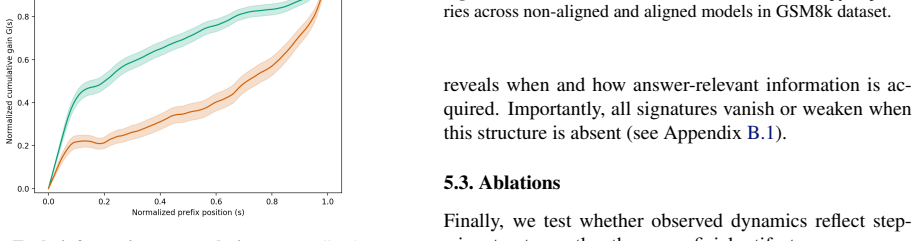
Recent work uses entropy-based signals at multiple representation levels to study reasoning in large language models, but the field remains largely empirical. A central unresolved puzzle is why internal entropy dynamics, defined under the predictive distribution of a model, correlate so robustly with external correctness given by the ground-truth answer. In this paper, we argue that this correlation arises because autoregressive models reason correctly when they accumulate information about the true answer via answer-informative prefixes. We formalize this intuition via the Stepwise Informativeness Assumption (SIA), which states that reasoning prefixes accumulate answer-relevant information in expectation as generation progresses. We show that SIA naturally emerges from maximum-likelihood optimization on human reasoning traces and is reinforced by standard fine-tuning and reinforcement-learning pipelines. We then derive observable signatures of SIA linking conditional answer entropy dynamics to correctness. We empirically test SIA across multiple reasoning benchmarks (GSM8K, ARC, SVAMP) and a diverse set of open-weight LLMs (Gemma-2, LLaMA-3.2, Qwen-2.5, DeepSeek and Olmo variants), showing that training induces it and that correct traces exhibit characteristic conditional answer entropy patterns.
Editorial analysis
A structured set of objections, weighed in public.
Referee Report
Summary. The paper claims that the robust correlation between internal entropy dynamics and external reasoning correctness in LLMs arises because autoregressive models accumulate answer-relevant information via answer-informative prefixes during correct reasoning. It formalizes this as the Stepwise Informativeness Assumption (SIA), argues that SIA emerges from maximum-likelihood optimization on human reasoning traces (and is reinforced by fine-tuning/RL), derives observable signatures linking conditional answer entropy patterns to correctness, and empirically validates the signatures on GSM8K, ARC, and SVAMP across Gemma-2, LLaMA-3.2, Qwen-2.5, DeepSeek, and Olmo models.
Significance. If the central derivation can be tightened, the result would supply a mechanistic account for why entropy signals track correctness, unifying disparate empirical findings on LLM reasoning dynamics and providing a training-objective-based explanation for the utility of entropy as a diagnostic. The multi-benchmark, multi-model empirical component strengthens the case for generality if controls are sufficient.
major comments (1)
- [Section 3] Section 3: The argument that SIA follows directly from MLE on reasoning traces treats the expectation over prefixes as given and does not demonstrate that the MLE predictive distribution necessarily produces the observed monotonic drop in conditional answer entropy exclusively on correct traces. If the correlation is instead driven by higher probability mass on ground-truth sequences irrespective of prefix informativeness, SIA is epiphenomenal rather than explanatory.
minor comments (2)
- [Abstract] The abstract states that SIA is reinforced by 'standard fine-tuning and reinforcement-learning pipelines,' but the main text should specify which exact objectives or datasets were examined to support this claim.
- [Empirical evaluation] Empirical sections: Clarify the exact controls used when comparing entropy dynamics across the diverse set of models to rule out architecture-specific confounds.
Simulated Author's Rebuttal
We thank the referee for the constructive feedback on our manuscript. The major comment identifies a genuine gap in the tightness of the derivation in Section 3, and we will revise the paper to address it directly.
read point-by-point responses
-
Referee: Section 3: The argument that SIA follows directly from MLE on reasoning traces treats the expectation over prefixes as given and does not demonstrate that the MLE predictive distribution necessarily produces the observed monotonic drop in conditional answer entropy exclusively on correct traces. If the correlation is instead driven by higher probability mass on ground-truth sequences irrespective of prefix informativeness, SIA is epiphenomenal rather than explanatory.
Authors: We agree that the current argument in Section 3 motivates SIA from MLE but does not rigorously derive the specific entropy dynamics as a necessary consequence. The manuscript notes that MLE on human traces encourages stepwise information accumulation but leaves the link to monotonic conditional entropy reduction implicit. In revision we will add a formal proposition and short proof sketch showing that the MLE objective induces lower conditional answer entropy on prefixes that align with the training distribution (correct traces) while incorrect traces lack this property. This will distinguish SIA from a simple higher probability mass on ground-truth sequences and make the explanatory role explicit. We will also add a brief discussion of why the alternative (epiphenomenal) account is inconsistent with the observed cross-model and cross-benchmark patterns. revision: yes
Circularity Check
SIA derivation from MLE reduces to definitional link between training objective and entropy drop on correct traces
specific steps
-
self definitional
[Section 3]
"We show that SIA naturally emerges from maximum-likelihood optimization on human reasoning traces and is reinforced by standard fine-tuning and reinforcement-learning pipelines. We then derive observable signatures of SIA linking conditional answer entropy dynamics to correctness."
SIA is defined as reasoning prefixes accumulating answer-relevant information in expectation. MLE on human traces (correct reasoning sequences) trains the model to minimize loss exactly on those sequences, which by definition produces lower conditional entropy on the ground-truth answer tokens for correct generations. The claimed derivation of entropy dynamics from SIA is therefore equivalent to the training objective itself.
full rationale
The paper claims SIA emerges naturally from MLE on human reasoning traces and then derives entropy-correctness signatures from it. However, SIA is defined precisely as prefixes accumulating answer-relevant information (i.e., lowering conditional entropy on the true answer), while MLE on correct traces optimizes exactly for higher probability on those sequences. This makes the central explanatory link hold by construction rather than independent derivation. Empirical checks on benchmarks are present but do not break the definitional dependence. No load-bearing self-citations or uniqueness theorems are invoked in the provided text.
Axiom & Free-Parameter Ledger
axioms (1)
- ad hoc to paper Stepwise Informativeness Assumption: reasoning prefixes accumulate answer-relevant information in expectation as generation progresses.
Reference graph
Works this paper leans on
-
[1]
Ali, R., Caso, F., Irwin, C., and Li `o, P
URLhttps://arxiv.org/ abs/2505.15134. Ali, R., Caso, F., Irwin, C., and Li `o, P. Entropy-lens: Uncovering decision strategies in LLMs,
-
[2]
URL https://arxiv.org/abs/2502.16570. Audenaert, K. M. R. A sharp continuity estimate for the von Neumann entropy.Journal of Physics A: Mathe- matical and Theoretical, 40(28):8127, jun
-
[3]
doi: 10.1088/1751-8113/40/28/S18. URLhttps://doi. org/10.1088/1751-8113/40/28/S18. Clark, P., Cowhey, I., Etzioni, O., Khot, T., Sabharwal, A., Schoenick, C., and Tafjord, O. Think you have solved question answering? Try ARC, the AI2 reasoning challenge,
-
[4]
Think you have Solved Question Answering? Try ARC, the AI2 Reasoning Challenge
URLhttps://arxiv.org/abs/ 1803.05457. Cobbe, K., Kosaraju, V ., Bavarian, M., Chen, M., Jun, H., Kaiser, L., Plappert, M., Tworek, J., Hilton, J., Nakano, R., Hesse, C., and Schulman, J. Training veri- fiers to solve math word problems,
work page internal anchor Pith review Pith/arXiv arXiv
-
[5]
Training Verifiers to Solve Math Word Problems
URLhttps: //arxiv.org/abs/2110.14168. Cover, T. M. and Thomas, J. A.Elements of Information Theory 2nd Edition (Wiley Series in Telecommunications and Signal Processing). Wiley-Interscience, July
work page internal anchor Pith review Pith/arXiv arXiv
-
[6]
DeepSeek LLM: Scaling Open-Source Language Models with Longtermism
URL https://arxiv.org/abs/2401.02954. Farquhar, S., Kossen, J., Kuhn, L., and Gal, Y . De- tecting hallucinations in large language models us- ing semantic entropy.Nature, 630(8017):625–630, June
work page internal anchor Pith review Pith/arXiv arXiv
-
[7]
doi: 10.1038/ s41586-024-07421-0
ISSN 1476-4687. doi: 10.1038/ s41586-024-07421-0. URLhttps://doi.org/ 10.1038/s41586-024-07421-0. Futrell, R. and Hahn, M. Linguistic structure from a bottle- neck on sequential information processing.Nature Hu- man Behaviour, November
-
[8]
doi: 10.1038/s41562-025-02336-w
ISSN 2397-3374. doi: 10.1038/s41562-025-02336-w. URLhttps://doi. org/10.1038/s41562-025-02336-w. Gemma Team, Riviere, M., Pathak, S., Sessa, P. G., Hardin, C., Bhupatiraju, S., Hussenot, L., Mesnard, T., Shahri- ari, B., Ram´e, A., Ferret, J., Liu, P., Tafti, P., Friesen, A., Casbon, M., Ramos, S., Kumar, R., Lan, C. L., Jerome, S., Tsitsulin, A., Vieilla...
-
[9]
URL https://arxiv.org/abs/2408.00118. Grattafiori, A., Dubey, A., Jauhri, A., Pandey, A., Kadian, A., Al-Dahle, A., Letman, A., Mathur, A., Schelten, A., Vaughan, A., Yang, A., Fan, A., Goyal, A., Hartshorn, A., Yang, A., Mitra, A., Sravankumar, A., Korenev, A., Hinsvark, A., Rao, A., Zhang, A., Rodriguez, A., Gregerson, A., Spataru, A., Roziere, B., Biro...
work page internal anchor Pith review Pith/arXiv arXiv
-
[10]
URLhttps://arxiv.org/abs/2407.21783. Guo, D., Yang, D., Zhang, H., Song, J., Wang, P., Zhu, Q., Xu, R., Zhang, R., Ma, S., Bi, X., Zhang, X., Yu, X., Wu, Y ., Wu, Z. F., Gou, Z., Shao, Z., Li, Z., Gao, Z., Liu, A., Xue, B., Wang, B., Wu, B., Feng, B., Lu, C., Zhao, C., Deng, C., Ruan, C., Dai, D., Chen, D., Ji, D., Li, E., Lin, F., Dai, F., Luo, F., Hao, ...
work page internal anchor Pith review Pith/arXiv arXiv
-
[11]
DeepSeek-R1 incentivizes reasoning in LLMs through reinforcement learning
1038/s41586-025-09422-z. URLhttp://dx.doi. org/10.1038/s41586-025-09422-z. Guo, X. Measuring reasoning utility in LLMs via con- ditional entropy reduction,
-
[12]
URLhttps:// arxiv.org/abs/2508.20395. Kambhampati, S., Stechly, K., Valmeekam, K., Saldyt, L., Bhambri, S., Palod, V ., Gundawar, A., Samineni, S. R., Kalwar, D., and Biswas, U. Stop anthropomorphizing intermediate tokens as reasoning/thinking traces!,
-
[13]
Kaplan, J., McCandlish, S., Henighan, T., Brown, T
URLhttps://arxiv.org/abs/2504.09762. Kaplan, J., McCandlish, S., Henighan, T., Brown, T. B., Chess, B., Child, R., Gray, S., Radford, A., Wu, J., and Amodei, D. Scaling laws for Neural Language Mod- 11 Why are Entropy Dynamics and Reasoning Correlated in LLMs? els,
-
[14]
URLhttps://arxiv.org/abs/2001. 08361. Li, Z., Zhong, J., Zheng, Z., Wen, X., Xu, Z., Cheng, Y ., Zhang, F., and Xu, Q. Compressing Chain-of-Thought in LLMs via step entropy,
work page 2001
-
[15]
URLhttps://arxiv. org/abs/2508.03346. Liu, P., Xu, F., and Li, Y . Token signature: Predict- ing Chain-of-Thought gains with token decoding fea- ture in Large Language Models,
-
[16]
Ouyang, L., Wu, J., Jiang, X., Almeida, D., Wainwright, C
URLhttps: //arxiv.org/abs/2506.06008. Ouyang, L., Wu, J., Jiang, X., Almeida, D., Wainwright, C. L., Mishkin, P., Zhang, C., Agarwal, S., Slama, K., Ray, A., Schulman, J., Hilton, J., Kelton, F., Miller, L., Simens, M., Askell, A., Welinder, P., Christiano, P., Leike, J., and Lowe, R. Training language models to follow instructions with human feedback,
-
[17]
Training language models to follow instructions with human feedback
URL https://arxiv.org/abs/2203.02155. Palod, V ., Valmeekam, K., Stechly, K., and Kambhampati, S. Performative thinking? the brittle correlation be- tween CoT length and problem complexity,
work page internal anchor Pith review Pith/arXiv arXiv
-
[18]
Patel, A., Bhattamishra, S., and Goyal, N
URL https://arxiv.org/abs/2509.07339. Patel, A., Bhattamishra, S., and Goyal, N. Are NLP models really able to solve simple math word problems?,
-
[19]
Qian, C., Liu, D., Wen, H., Bai, Z., Liu, Y ., and Shao, J
URLhttps://arxiv.org/abs/2103.07191. Qian, C., Liu, D., Wen, H., Bai, Z., Liu, Y ., and Shao, J. Demystifying reasoning dynamics with Mutual Infor- mation: Thinking tokens are information peaks in LLM reasoning,
-
[20]
URLhttps://arxiv.org/abs/ 2506.02867. Qwen, Yang, A., Yang, B., Zhang, B., Hui, B., Zheng, B., Yu, B., Li, C., Liu, D., Huang, F., Wei, H., Lin, H., Yang, J., Tu, J., Zhang, J., Yang, J., Yang, J., Zhou, J., Lin, J., Dang, K., Lu, K., Bao, K., Yang, K., Yu, L., Li, M., Xue, M., Zhang, P., Zhu, Q., Men, R., Lin, R., Li, T., Tang, T., Xia, T., Ren, X., Ren,...
-
[21]
URL https://arxiv.org/abs/2412.15115. Schulman, J., Wolski, F., Dhariwal, P., Radford, A., and Klimov, O. Proximal policy optimization algorithms,
work page internal anchor Pith review Pith/arXiv arXiv
-
[22]
Shao, Z., Wang, P., Zhu, Q., Xu, R., Song, J., et al
doi: 10.1002/j.1538-7305.1951.tb01366.x. Shao, Z., Wang, P., Zhu, Q., Xu, R., Song, J., et al. DeepSeekMath: Pushing the limits of mathematical rea- soning in Open Language Models,
-
[23]
URL https://arxiv.org/abs/2512.13961. Ton, J.-F., Taufiq, M. F., and Liu, Y . Understanding Chain- of-Thought in LLMs through Information Theory,
work page internal anchor Pith review Pith/arXiv arXiv
-
[24]
URLhttps://arxiv.org/abs/2411.11984. Wang, S., Yu, L., Gao, C., Zheng, C., Liu, S., Lu, R., Dang, K., Chen, X., Yang, J., Zhang, Z., Liu, Y ., Yang, A., Zhao, A., Yue, Y ., Song, S., Yu, B., Huang, G., and Lin, J. Beyond the 80/20 rule: High-entropy minority tokens drive effective reinforcement learning for LLM reasoning,
-
[25]
URLhttps://arxiv.org/abs/ 2506.01939. Wen, X., Liu, Z., Zheng, S., Ye, S., Wu, Z., Wang, Y ., Xu, Z., Liang, X., Li, J., Miao, Z., Bian, J., and Yang, M. Reinforcement learning with verifiable rewards implic- itly incentivizes correct reasoning in Base LLMs,
work page internal anchor Pith review Pith/arXiv arXiv
-
[26]
URLhttps://arxiv.org/abs/2506.14245. Zhang, J., Wang, X., Mo, F., Zhou, Y ., Gao, W., and Liu, K. Entropy-based exploration conduction for multi-step reasoning,
work page internal anchor Pith review Pith/arXiv arXiv
-
[27]
12 Why are Entropy Dynamics and Reasoning Correlated in LLMs? A
URLhttps://arxiv.org/abs/ 2503.15848. 12 Why are Entropy Dynamics and Reasoning Correlated in LLMs? A. Experimental setup and evaluation protocol A.1. Evaluation protocol A.1.1. TASKS AND DATASETS We focus on reasoning tasks with a discrete answer spaceA, which enables empirical estimation of conditional answer entropy. Each example consists of a question...
-
[28]
SubstitutingY= (Q, C 1:k)yields P (k) e ≥ H(A|Q, C 1:k)−log 2 log(|A| −1)
states that H(A|Y)≤log 2 +P e(Y) log(|A| −1), which rearranges to Pe(Y)≥ H(A|Y)−log 2 log(|A| −1) . SubstitutingY= (Q, C 1:k)yields P (k) e ≥ H(A|Q, C 1:k)−log 2 log(|A| −1) . 18 Why are Entropy Dynamics and Reasoning Correlated in LLMs? Proof of Lemma 2.By definition of expectation underr, we have L(θ) =E X∼r[−logp θ(X)] =− X x r(x) logp θ(x). We now add...
work page 1951
discussion (0)
Sign in with ORCID, Apple, or X to comment. Anyone can read and Pith papers without signing in.