Recognition: no theorem link
Black Hole-Boson Star Binaries: Gravitational Wave Signals and Tidal Disruption
Pith reviewed 2026-05-10 18:41 UTC · model grok-4.3
The pith
An appropriate scalar self-interaction can suppress tidal disruption of boson stars by black holes in binary systems.
A machine-rendered reading of the paper's core claim, the machinery that carries it, and where it could break.
Core claim
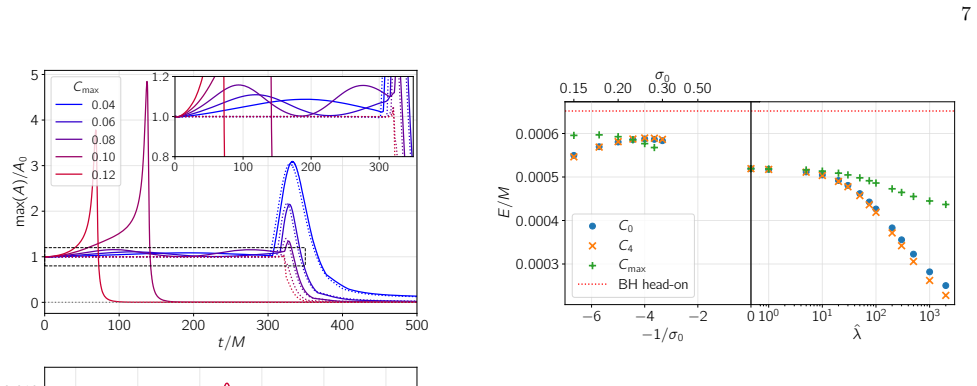
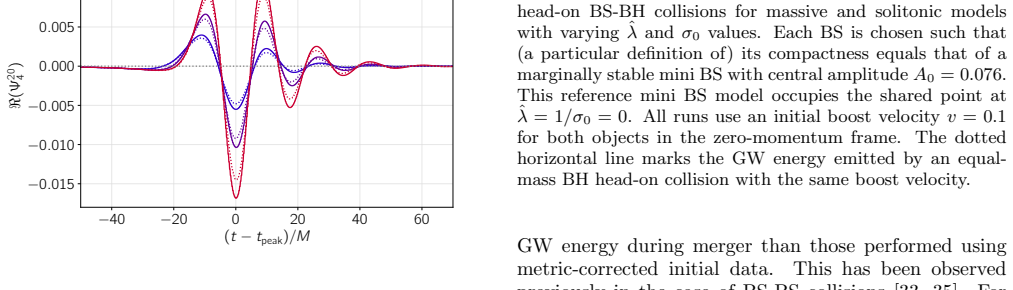
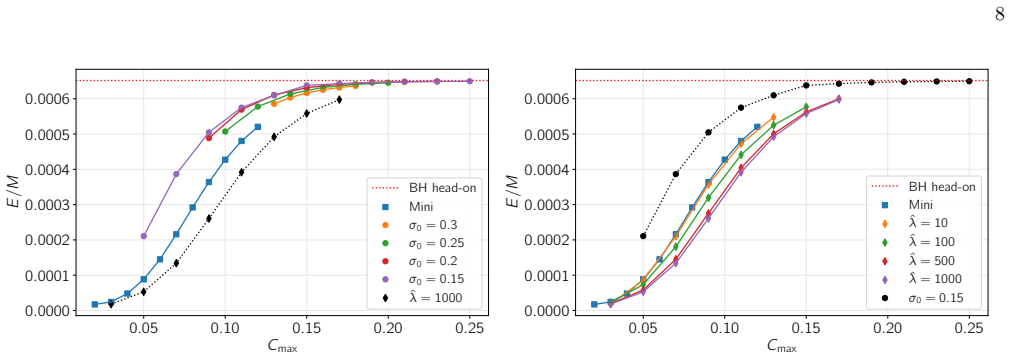
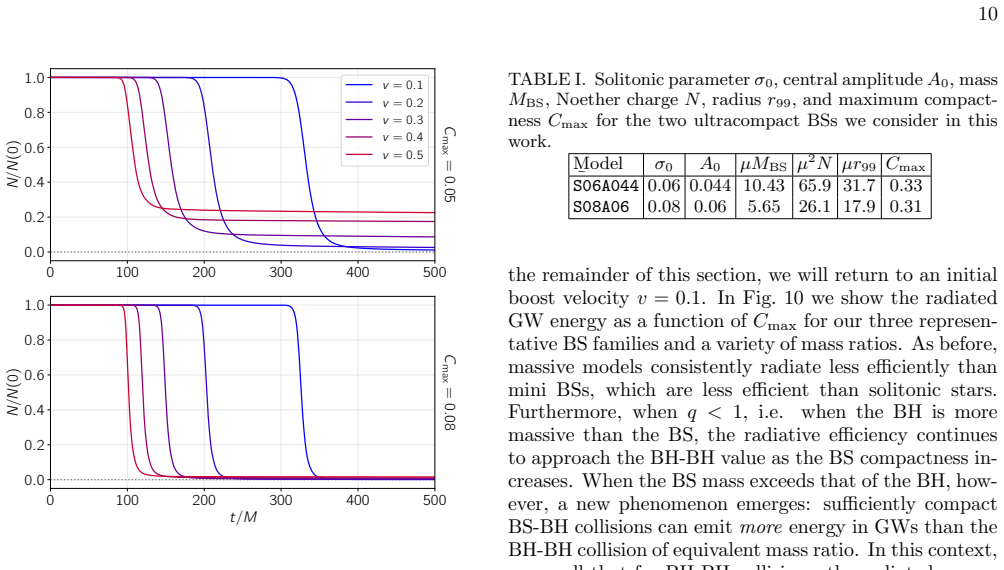
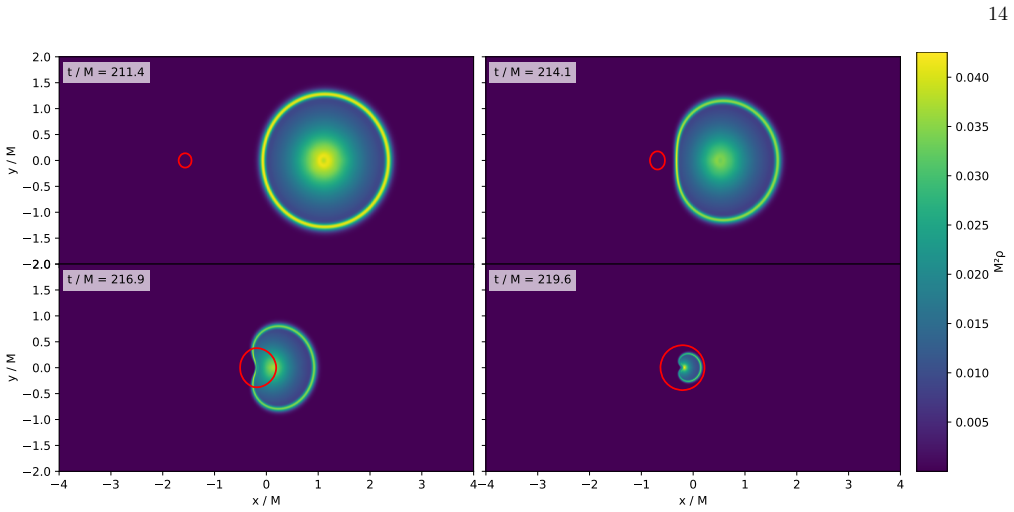
In head-on collisions the amount of gravitational radiation emitted depends on the scalar potential. In inspiraling runs, a quartic self-interaction term prevents the boson star from undergoing tidal disruption, so the binary remains intact and produces a distinct gravitational-wave signal compared with cases that suffer disruption.
What carries the argument
The scalar potential of the boson star, with its quartic self-interaction term versus a solitonic form, which governs stability against tidal forces from the companion black hole.
If this is right
- Head-on collisions produce noticeably different radiative efficiencies depending on the scalar potential.
- The quartic self-interaction keeps the boson star intact through inspiral, preserving a longer orbital phase.
- The resulting gravitational waveforms differ enough to require that model-agnostic template banks incorporate the choice of scalar potential.
- Only equilibrated initial data for the boson star avoids large constraint violations and inaccurate signals.
Where Pith is reading between the lines
- Boson stars with tuned self-interactions might produce signals that lack the disruption signatures expected from less stable objects.
- Other scalar potentials or parameter choices could be tested to see whether they also suppress disruption.
- Detection of an undisrupted inspiral would constrain the possible scalar field models that describe such stars.
- Extending the simulations to include spin or eccentricity would show how those parameters interact with the self-interaction effect.
Load-bearing premise
The boson star must begin in an equilibrated initial configuration, otherwise constraint violations appear and the computed waveforms become inaccurate.
What would settle it
A simulation of an inspiral with the quartic self-interaction that nevertheless exhibits clear tidal disruption of the boson star would contradict the reported suppression.
Figures







read the original abstract
We present a detailed, fully nonlinear study of binary systems involving one black hole and one boson star, considering the effects of both a quartic self-interaction and a solitonic potential for the scalar field. First, we show the importance of using initial data for which the boson star is in an equilibrated configuration to obtain accurate gravitational waveforms, and discuss methods to further improve constraint violations in the initial data. We then present a series of head-on collisions, showing that even in this simplified scenario the radiative efficiency varies significantly with the scalar potential chosen. In addition to this, we present a preliminary study of inspiral configurations, showing that an appropriate scalar self-interaction can suppress tidal disruption. We comment throughout on implications for attempts to build model-agnostic waveform template banks for exotic compact objects.
Editorial analysis
A structured set of objections, weighed in public.
Referee Report
Summary. The manuscript presents fully nonlinear numerical relativity simulations of black hole-boson star binaries. It first demonstrates that equilibrated initial data for the boson star are required to obtain accurate gravitational waveforms and discusses methods to reduce constraint violations. Head-on collision simulations show that radiative efficiency varies with the choice of scalar potential (quartic self-interaction versus solitonic). A preliminary inspiral study indicates that an appropriate scalar self-interaction can suppress tidal disruption, with comments on implications for model-agnostic waveform template banks for exotic compact objects.
Significance. If the central numerical results hold under further verification, the work provides a useful contribution to the modeling of boson stars as exotic compact objects in binaries. The finding that scalar self-interaction can alter disruption outcomes is relevant for gravitational-wave searches and for distinguishing boson-star signals from black-hole or neutron-star binaries. The emphasis on initial-data equilibration addresses a practical numerical issue in the field.
major comments (2)
- [Inspiral configurations] Inspiral section: the claim that 'an appropriate scalar self-interaction can suppress tidal disruption' is presented as the outcome of a preliminary study, but lacks quantitative metrics (e.g., boson-star mass loss fraction, survival time to disruption, or comparison of density profiles) and resolution studies to establish that the suppression is physical rather than numerical. This is load-bearing for the strongest claim.
- [Initial data construction] Initial-data and methods sections: while the importance of equilibrated configurations is stated, the manuscript does not report specific convergence tests, constraint-violation norms (e.g., L2 norms of the Hamiltonian constraint), or waveform error bars across resolutions for either the head-on or inspiral cases. Without these, the accuracy improvement cannot be quantified.
minor comments (2)
- [Figures] Figure captions and labels should explicitly state the boson-star compactness, mass ratio, and scalar potential parameters used in each run to allow direct comparison with the text.
- [Discussion] The discussion of implications for waveform template banks would benefit from a brief comparison to existing boson-star or exotic-compact-object waveform efforts in the literature.
Simulated Author's Rebuttal
We thank the referee for their careful reading of the manuscript and for the constructive comments. We address each major comment below and indicate the changes we plan to implement in the revised version.
read point-by-point responses
-
Referee: [Inspiral configurations] Inspiral section: the claim that 'an appropriate scalar self-interaction can suppress tidal disruption' is presented as the outcome of a preliminary study, but lacks quantitative metrics (e.g., boson-star mass loss fraction, survival time to disruption, or comparison of density profiles) and resolution studies to establish that the suppression is physical rather than numerical. This is load-bearing for the strongest claim.
Authors: We agree that the inspiral results are presented as preliminary and that the absence of quantitative metrics and resolution studies limits the strength of the claim. In the revised manuscript we will add boson-star mass-loss fractions, survival times prior to any disruption, and direct comparisons of density profiles at selected times. We will also include a resolution study for the key inspiral runs to demonstrate that the reported suppression of tidal disruption is robust. revision: yes
-
Referee: [Initial data construction] Initial-data and methods sections: while the importance of equilibrated configurations is stated, the manuscript does not report specific convergence tests, constraint-violation norms (e.g., L2 norms of the Hamiltonian constraint), or waveform error bars across resolutions for either the head-on or inspiral cases. Without these, the accuracy improvement cannot be quantified.
Authors: We acknowledge that quantitative measures of convergence and constraint violations are needed to substantiate the improvement obtained from equilibrated initial data. In the revised manuscript we will report L2 norms of the Hamiltonian constraint for multiple resolutions, together with waveform comparisons and associated error estimates, for both the head-on and inspiral configurations. revision: yes
Circularity Check
No significant circularity in numerical simulation study
full rationale
The paper reports results from fully nonlinear numerical relativity simulations of black hole-boson star binaries, comparing different scalar self-interaction potentials. Central claims (variation of radiative efficiency in head-on collisions; suppression of tidal disruption in inspirals with suitable potential) are direct outputs of the evolved spacetimes and extracted waveforms, not analytic derivations that reduce to the paper's own inputs or fitted parameters by construction. The emphasis on equilibrated initial data is a standard methodological precondition for constraint satisfaction and waveform accuracy, not a self-referential prediction. No load-bearing steps rely on self-citation chains, uniqueness theorems imported from prior author work, or ansatzes smuggled via citation. The study is self-contained against external benchmarks such as standard GR binary simulations.
Axiom & Free-Parameter Ledger
free parameters (2)
- scalar self-interaction coupling
- boson star mass and compactness
axioms (2)
- standard math Einstein equations coupled to a complex scalar field with self-interaction potential
- domain assumption Existence of stable, equilibrated boson-star solutions for the chosen potentials
Forward citations
Cited by 1 Pith paper
-
Boson star-black hole binaries: initial data and head-on collisions
A one-body conformal-factor correction stabilizes boson star-black hole initial data, enabling gravitational-wave analysis that shows higher multipoles can discriminate mixed mergers from pure black-hole binaries.
Reference graph
Works this paper leans on
-
[1]
B. P. Abbottet al., Phys. Rev. Lett.116, 061102 (2016), arXiv:1602.03837 [gr-qc]
work page internal anchor Pith review arXiv 2016
-
[2]
B. P. Abbottet al.(LIGO Scientific, Virgo), Phys. Rev. X9, 031040 (2019), arXiv:1811.12907 [astro-ph.HE]
work page internal anchor Pith review arXiv 2019
-
[3]
R. Abbottet al.(KAGRA, VIRGO, LIGO Scientific), Phys. Rev. X13, 041039 (2023), arXiv:2111.03606 [gr- qc]
work page internal anchor Pith review arXiv 2023
-
[4]
T. L. S. Collaboration, the Virgo Collaboration, and the KAGRA Collaboration, “Gwtc-4.0: Updating the gravitational-wave transient catalog with observations from the first part of the fourth ligo-virgo-kagra observ- ing run,” (2025), arXiv:2508.18082 [gr-qc]
work page internal anchor Pith review Pith/arXiv arXiv 2025
-
[5]
The Science of the Einstein Telescope
A. Abacet al., “The science of the einstein telescope,” (2025), arXiv:2503.12263 [gr-qc]. 16 0 500 1000 1500 2000 2500 3000 3500 4000 t/M 0.00 0.25 0.50 0.75 1.00 N/N(0) Mini ˆλ = 100 σ0 = 0.15 400 600 800 1000 1200 1400 1600 t/M □0.2 0.0 0.2 h22 0.0 0.1 0.2 Mf 10□3 10□2 10□1 100 Mf |˜h22(Mf )| FIG. 14.Top:Fraction of the non-accreted Noether charge over ...
work page internal anchor Pith review Pith/arXiv arXiv 2025
- [6]
-
[7]
Laser Interferometer Space Antenna
P. Amaro-Seoaneet al., “Laser interferometer space an- tenna,” (2017), arXiv:1702.00786 [astro-ph.IM]
work page internal anchor Pith review Pith/arXiv arXiv 2017
-
[8]
Tests of General Relativity with GWTC-3
R. Abbottet al.(LIGO Scientific, VIRGO, KAGRA), (2021), arXiv:2112.06861 [gr-qc]
work page internal anchor Pith review arXiv 2021
-
[9]
First M87 Event Horizon Telescope Results. I. The Shadow of the Supermassive Black Hole
K. Akiyamaet al.(Event Horizon Telescope), Astro- phys. J. Lett.875, L1 (2019), arXiv:1906.11238 [astro- ph.GA]
work page internal anchor Pith review arXiv 2019
-
[10]
K. Akiyamaet al.(Event Horizon Telescope), Astro- phys. J. Lett.930, L12 (2022), arXiv:2311.08680 [astro- ph.HE]
work page internal anchor Pith review arXiv 2022
-
[11]
T. Evstafyeva, M. Agathos, and J. L. Ripley, Phys. Rev. D107, 124010 (2023), arXiv:2212.11359 [gr-qc]
-
[12]
Testing General Relativity with Present and Future Astrophysical Observations
E. Bertiet al., CQG32, 243001 (2015), arXiv:1501.07274 [gr-qc]
work page internal anchor Pith review arXiv 2015
-
[13]
Numerical binary black hole mergers in dynamical Chern-Simons: I. Scalar field
M. Okounkova, L. C. Stein, M. A. Scheel, and D. A. Hemberger, Phys. Rev. D96, 044020 (2017), arXiv:1705.07924 [gr-qc]
work page Pith review arXiv 2017
-
[14]
Black holes and binary mergers in scalar Gauss-Bonnet gravity: scalar field dynamics
H. Witek, L. Gualtieri, P. Pani, and T. P. Sotiriou, Phys. Rev. D99, 064035 (2019), arXiv:1810.05177 [gr- qc]
work page Pith review arXiv 2019
-
[15]
U. Sperhake, C. J. Moore, R. Rosca, M. Agathos, D. Gerosa, and C. D. Ott, Phys. Rev. Lett.119, 201103 (2017), arXiv:1708.03651 [gr-qc]
-
[16]
C. A. Herdeiro, A. M. Pombo, E. Radu, P. V. Cunha, and N. Sanchis-Gual, Journal of Cosmology and As- troparticle Physics2021, 051 (2021)
2021
-
[17]
The imitation game reloaded: effective shadows of dynamically robust spinning Proca stars,
I. Sengo, P. V. P. Cunha, C. A. R. Herdeiro, and E. Radu, “The imitation game reloaded: effective shad- ows of dynamically robust spinning proca stars,” (2024), arXiv:2402.14919 [gr-qc]
-
[18]
Polarimetry imprints of exotic compact objects: Solitonic boson stars,
J. L. Rosa, N. Aimar, and H. L. Tamm, “Polarime- try imprints of exotic compact objects: solitonic boson stars,” (2025), arXiv:2504.02472 [gr-qc]
-
[19]
J. L. Synge, Mon. Not. Roy. Astron. Soc.131, 463 (1966)
1966
-
[20]
Nonlinear Treatment of a Black Hole Mimicker Ringdown,
N. Siemonsen, Phys. Rev. Lett.133, 031401 (2024), arXiv:2404.14536 [gr-qc]
-
[21]
Geodesic stability, Lyapunov exponents and quasinormal modes,
V. Cardoso, A. S. Miranda, E. Berti, H. Witek, and V. T. Zanchin, Phys. Rev. D79, 064016 (2009), arXiv:0812.1806 [hep-th]
- [22]
- [23]
-
[24]
V. Cardoso, L. C. B. Crispino, C. F. B. Macedo, H. Okawa, and P. Pani, Phys. Rev. D90, 044069 (2014), arXiv:1406.5510 [gr-qc]
work page Pith review arXiv 2014
-
[25]
G. A. Marks, S. J. Staelens, T. Evstafyeva, and U. Sperhake, Physical Review Letters135(2025), 10.1103/lk48-7r2f
-
[26]
S. J. Staelens, Journal of Physics: Conference Series 3177, 012046 (2026)
2026
-
[27]
Assessing the stability of ultracompact spinning boson stars with nonlinear evolutions,
T. Evstafyeva, N. Siemonsen, and W. E. East, Phys. Rev. D113, 044024 (2026), arXiv:2508.11527 [gr-qc]
-
[28]
D. J. Kaup, Phys. Rev.172, 1331 (1968)
1968
-
[29]
Ruffini and S
R. Ruffini and S. Bonazzola, Phys. Rev.187, 1767 (1969)
1969
-
[30]
S. L. Liebling and C. Palenzuela, Living Reviews in Rel- ativity26(2023), 10.1007/s41114-023-00043-4
-
[31]
C. Palenzuela, P. Pani, M. Bezares, V. Cardoso, L. Lehner, and S. Liebling, Physical Review D96 (2017), 10.1103/physrevd.96.104058
-
[32]
M. Bezares, M. Boˇ skovi´ c, S. Liebling, C. Palenzuela, P. Pani, and E. Barausse, Physical Review D105 (2022), 10.1103/physrevd.105.064067
-
[33]
Helfer, U
T. Helfer, U. Sperhake, R. Croft, M. Radia, B.-X. Ge, and E. A. Lim, Classical and Quantum Gravity39, 074001 (2022)
2022
-
[34]
N. Sanchis-Gual, J. C. Bustillo, C. Herdeiro, E. Radu, J. A. Font, S. H. Leong, and A. Torres-Forn´ e, Physical Review D106(2022), 10.1103/physrevd.106.124011
-
[35]
Evstafyeva, U
T. Evstafyeva, U. Sperhake, T. Helfer, R. Croft, M. Ra- dia, B.-X. Ge, and E. A. Lim, Classical and Quantum Gravity40, 085009 (2023)
2023
-
[36]
N. Siemonsen and W. E. East, Physical Review D108 (2023), 10.1103/physrevd.108.124015
- [37]
-
[38]
T. Evstafyeva, U. Sperhake, I. Romero-Shaw, and M. Agathos, Phys. Rev. Lett.133, 131401 (2024), arXiv:2406.02715 [gr-qc], arXiv:2406.02715 [gr-qc]. 17
-
[39]
L. Pompili, E. Maggio, H. O. Silva, and A. Buonanno, Phys. Rev. D111, 124040 (2025), arXiv:2504.10130 [gr- qc]
- [40]
- [41]
-
[42]
Amaro-Seoane, J
P. Amaro-Seoane, J. Barranco, A. Bernal, and L. Rez- zolla, Journal of Cosmology and Astroparticle Physics 2010, 002–002 (2010)
2010
-
[44]
J. L. Rosa and D. Rubiera-Garcia, Physical Review D 106(2022), 10.1103/physrevd.106.084004
-
[46]
Sin, Physical Review D50, 3650–3654 (1994)
S.-J. Sin, Physical Review D50, 3650–3654 (1994)
1994
-
[47]
Schive, T
H.-Y. Schive, T. Chiueh, and T. Broadhurst, Nature Physics10, 496–499 (2014)
2014
-
[48]
C. Palenzuela, I. Olabarrieta, L. Lehner, and S. L. Liebling, Phys. Rev. D75, 064005 (2007), gr- qc/0612067
-
[49]
Orbital Dynamics of Binary Boson Star Systems,
C. Palenzuela, L. Lehner, and S. L. Liebling, Phys. Rev. D77, 044036 (2008), arXiv:0706.2435 [gr-qc]
-
[50]
T. Evstafyeva, U. Sperhake, T. Helfer, R. Croft, M. Ra- dia, B.-X. Ge, and E. A. Lim, Class. Quant. Grav.40, 085009 (2023), arXiv:2212.08023 [gr-qc]
- [51]
-
[52]
Brito, V
R. Brito, V. Cardoso, C. A. Herdeiro, and E. Radu, Physics Letters B752, 291–295 (2016)
2016
-
[53]
M. Alcubierre, J. Barranco, A. Bernal, J. C. Degol- lado, A. Diez-Tejedor, M. Megevand, D. Nunez, and O. Sarbach, Class. Quant. Grav.35, 19LT01 (2018), arXiv:1805.11488 [gr-qc]
- [54]
-
[55]
K. Kyutoku, M. Shibata, and K. Taniguchi, Physical Review D82, 044049 (2010), arXiv:1008.1460 [astro- ph]
-
[56]
V. Cardoso, T. Ikeda, Z. Zhong, and M. Zilh˜ ao, Physi- cal Review D106(2022), 10.1103/physrevd.106.044030
-
[57]
Z. Zhong, V. Cardoso, T. Ikeda, and M. Zilh˜ ao, Physi- cal Review D108(2023), 10.1103/physrevd.108.084051
-
[58]
Clough, T
K. Clough, T. Dietrich, and J. C. Niemeyer, Phys. Rev. D98, 083020 (2018)
2018
-
[59]
Bezares and C
M. Bezares and C. Palenzuela, Classical and Quantum Gravity35, 234002 (2018)
2018
-
[60]
Legacy of boson clouds on black hole binaries,
G. M. Tomaselli, T. F. M. Spieksma, and G. Bertone, “Legacy of boson clouds on black hole binaries,” (2024), arXiv:2407.12908 [gr-qc]
-
[62]
Baumann, H
D. Baumann, H. S. Chia, J. Stout, and L. t. Haar, Journal of Cosmology and Astroparticle Physics2019, 006–006 (2019)
2019
-
[63]
Nonlinear stability of rotating hairy black holes,
J. A. Carretero, P. Grandcl´ ement, C. Palenzuela, and M. Salgado, “Nonlinear stability of rotating hairy black holes,” (2025), arXiv:2510.19825 [gr-qc]
-
[64]
Splitting the Gravitational Atom: Instabilities of Black Holes with Synchronized or Resonant Hair
J. Nicoules, J. Ferreira, C. A. R. Herdeiro, E. Radu, and M. Zilh˜ ao, “Splitting the gravitational atom: Instabil- ities of black holes with synchronized/resonant hair,” (2025), arXiv:2509.20450 [gr-qc]
work page internal anchor Pith review Pith/arXiv arXiv 2025
-
[65]
T. Evstafyeva, R. Rosca-Mead, U. Sperhake, and B. Bruegmann, Phys. Rev. D108, 104064 (2023), arXiv:2310.05200 [gr-qc]
- [66]
-
[67]
R. C. Tolman, Phys. Rev.55, 364 (1939)
1939
-
[68]
J. R. Oppenheimer and G. M. Volkoff, Phys. Rev.55, 374 (1939)
1939
-
[69]
Gleiser, Phys
M. Gleiser, Phys. Rev. D38, 2376 (1988), [Erratum: Phys.Rev.D 39, 1257 (1989)]
1988
-
[70]
Gleiser and R
M. Gleiser and R. Watkins, Nucl. Phys. B319, 733 (1989)
1989
- [71]
-
[72]
S. H. Hawley and M. W. Choptuik, Physical Review D 62(2000), 10.1103/physrevd.62.104024
-
[73]
E. Jim´ enez-V´ azquez and M. Alcubierre, Physical Re- view D106(2022), 10.1103/physrevd.106.044071
-
[74]
Boson stars ind≥4 dimensions: Stability, oscillation frequencies, and dy- namical evolutions,
G. A. Marks and A. A. Zaif, “Boson stars ind≥4 dimensions: Stability, oscillation frequencies, and dy- namical evolutions,” (2025), arXiv:2510.13988 [gr-qc]
- [75]
-
[76]
GRChombo: An adaptable numerical relativity code for fundamental physics,
T. Andradeet al., J. Open Source Softw.6, 3703 (2021), arXiv:2201.03458 [gr-qc]
- [77]
-
[78]
T. W. Baumgarte and S. L. Shapiro, Phys. Rev. D59, 024007 (1998), gr-qc/9810065
work page Pith review arXiv 1998
-
[79]
Shibata and T
M. Shibata and T. Nakamura, Phys. Rev. D52, 5428 (1995)
1995
- [80]
-
[81]
R. Arnowitt, S. Deser, and C. W. Misner, inGravitation an introduction to current research, edited by L. Witten (John Wiley, New York, 1962) pp. 227–265, arXiv:gr- qc/0405109
- [82]
-
[83]
R. Croft, Class. Quant. Grav.40, 105007 (2023), arXiv:2203.13845 [gr-qc]
discussion (0)
Sign in with ORCID, Apple, or X to comment. Anyone can read and Pith papers without signing in.