Recognition: no theorem link
Short proofs in combinatorics, probability and number theory II
Pith reviewed 2026-05-10 18:26 UTC · model grok-4.3
The pith
An internal AI model supplies short proofs resolving five questions posed by Erdős.
A machine-rendered reading of the paper's core claim, the machinery that carries it, and where it could break.
Core claim
The paper claims that short proofs exist and are here supplied for five Erdős questions: the minimum number of ordinary lines in a planar point set, the existence of sequences with uniformly small exponential sums, the construction of K4-free 4-critical graphs in which every cycle has few chords, a counterexample to the fewnomial form of the Erdős-Turán discrepancy conjecture, and the assertion that only finitely many positive integers n satisfy the condition that n minus a k squared is prime for every admissible k up to the square root of n over a.
What carries the argument
The central mechanism is the independent generation, by a single internal AI model, of a complete short proof for each of the five listed Erdős questions.
If this is right
- The minimum number of ordinary lines determined by n points in the plane is settled by the supplied argument.
- Sequences exist whose exponential sums remain bounded by a quantity smaller than previously known constructions allowed.
- There exist K4-free 4-critical graphs in which the number of chords in any cycle is bounded by a function of the cycle length.
- The fewnomial analogue of the Erdős-Turán conjecture is false, as witnessed by the explicit counterexample given.
- Only finitely many integers n satisfy the stated primality condition for any fixed positive integer a.
Where Pith is reading between the lines
- The same model or similar systems could be asked to produce short proofs for additional open questions from Erdős's lists.
- If the proofs withstand human verification, they illustrate that current language models can locate short combinatorial arguments across several subfields.
- The five problems, though drawn from different areas, were all amenable to the same generation process, suggesting possible hidden common structure among Erdős-type questions.
- Routine machine-assisted checking of the supplied proofs could become a standard next step before publication of AI-generated mathematics.
Load-bearing premise
The five AI-generated proofs are free of gaps, calculation errors, and logical mistakes and fully establish the stated claims.
What would settle it
Discovery of a mathematical error inside any one of the five proofs, or an explicit counterexample to any of the five resolved statements, would show that the corresponding proof fails.
Figures



read the original abstract
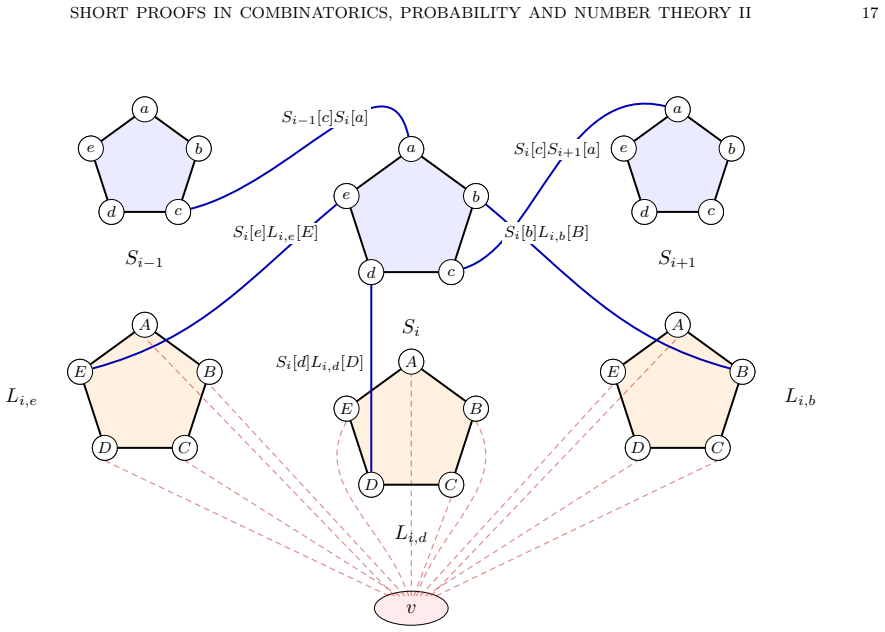
We give a quintet of proofs resulting from questions posed by Erd\H{o}s. These questions concern ordinary lines in planar point sets, sequences with uniformly small exponential sums, $K_4$-free $4$-critical graphs with few chords in any cycle, a counterexample to a "fewnomial" version of the Erd\H{o}s--Tur\'{a}n discrepancy bound, and a finiteness theorem for integers $n$ such that $n-a k^2$ is prime for all $k\leq \sqrt{n/a}$ coprime to $n$ (for fixed $a\in\mathbb Z_+$). Each proof is due to an internal model at OpenAI.
Editorial analysis
A structured set of objections, weighed in public.
Referee Report
Summary. The manuscript presents five short proofs addressing questions posed by Erdős in combinatorics, probability, and number theory. The topics are: ordinary lines in planar point sets; sequences with uniformly small exponential sums; K4-free 4-critical graphs with few chords in any cycle; a counterexample to a fewnomial version of the Erdős–Turán discrepancy bound; and a finiteness theorem for integers n such that n−ak² is prime for all k≤√(n/a) coprime to n (fixed a>0). Each proof is attributed to an internal OpenAI model.
Significance. If the proofs are correct, gap-free, and fully resolve the stated questions, the results would constitute concise advances on longstanding Erdős problems across multiple areas, with potential to stimulate further work on AI-assisted proof generation. The paper demonstrates the possibility of obtaining short arguments via large language models, which is a novel methodological contribution if the outputs withstand scrutiny.
major comments (1)
- [Sections containing the five proofs (throughout the manuscript)] The central claim that the five presented arguments resolve the Erdős questions rests on their mathematical correctness, yet the manuscript supplies no independent verification, no machine-checkable formalization, and no discussion of how AI-specific errors (e.g., subtle gaps or hallucinations) were excluded. This is load-bearing because the proofs themselves constitute the entire contribution.
minor comments (2)
- [Abstract] The abstract states the existence of the proofs but gives no indication of the proof strategies or key ideas employed in any of the five arguments.
- [Finiteness theorem section] Notation for the finiteness theorem (n−ak² prime for k≤√(n/a)) is introduced without an explicit statement of the precise range of k or the coprimality condition in the opening paragraph of that section.
Simulated Author's Rebuttal
We thank the referee for their insightful comments on our manuscript. The main concern is the lack of verification for the presented proofs. We provide a point-by-point response below.
read point-by-point responses
-
Referee: The central claim that the five presented arguments resolve the Erdős questions rests on their mathematical correctness, yet the manuscript supplies no independent verification, no machine-checkable formalization, and no discussion of how AI-specific errors (e.g., subtle gaps or hallucinations) were excluded. This is load-bearing because the proofs themselves constitute the entire contribution.
Authors: We acknowledge the importance of verifying the correctness of the proofs, as they form the core of the contribution. Each proof was produced by the internal OpenAI model and underwent manual review by the authors to confirm logical soundness and absence of obvious gaps. The proofs are intentionally short to facilitate such verification by the mathematical community. We did not provide machine-checkable formalizations, as this would extend far beyond the paper's scope of demonstrating concise AI-generated arguments. In the revised manuscript, we will include a new subsection discussing the proof generation and review process, as well as potential limitations regarding AI hallucinations, to address this concern directly. revision: partial
Circularity Check
No circularity detected in the derivation chain
full rationale
The paper presents five independent short proofs resolving specific Erdős questions in combinatorics, probability, and number theory. No load-bearing steps reduce by construction to fitted inputs, self-definitions, or self-citation chains; the proofs are offered directly as resolutions without invoking prior results from the same authors in a tautological manner or renaming known patterns as new derivations. The central claims rest on the logical content of the arguments themselves rather than any equivalence to their own inputs.
Axiom & Free-Parameter Ledger
Forward citations
Cited by 3 Pith papers
-
Soohak: A Mathematician-Curated Benchmark for Evaluating Research-level Math Capabilities of LLMs
Soohak is a new 439-problem mathematician-authored benchmark showing frontier LLMs reach only 30% on research math and fail to exceed 50% on refusing ill-posed questions.
-
AI co-mathematician: Accelerating mathematicians with agentic AI
An interactive AI workbench for mathematicians achieves 48% on FrontierMath Tier 4 and helped solve open problems in early tests.
-
AI co-mathematician: Accelerating mathematicians with agentic AI
An interactive AI workbench called the AI co-mathematician supports open-ended mathematical research and achieves a new high score of 48% on FrontierMath Tier 4.
Reference graph
Works this paper leans on
-
[1]
Noga Alon,Problems and results in extremal combinatorics—I, Discrete Mathematics273(2003), 31–53
2003
-
[2]
Noga Alon,Problems and results in extremal combinatorics—II, Discrete Mathematics308(2008), 4460–4472
2008
-
[3]
Noga Alon,Problems and results in extremal combinatorics—III, Journal of Combinatorics7(2016), 319–337
2016
- [4]
-
[5]
Francesco Amoroso and Maurice Mignotte,On the distribution of the roots of polynomials, Annales de l’Institut Fourier46(1996), 1275–1291
1996
-
[6]
Bloom,Erdős problems website,https://www.erdosproblems.com, 2026, Accessed 2026-04-01
Thomas F. Bloom,Erdős problems website,https://www.erdosproblems.com, 2026, Accessed 2026-04-01
2026
-
[7]
Clunie,On a problem of Erdős, Journal of the London Mathematical Society42(1967), 133–136
J. Clunie,On a problem of Erdős, Journal of the London Mathematical Society42(1967), 133–136
1967
-
[8]
David Conlon, Jacob Fox, and Benny Sudakov,Short proofs of some extremal results, Combinatorics, Probability and Computing23(2014), 8–28
2014
-
[9]
David Conlon, Jacob Fox, and Benny Sudakov,Short proofs of some extremal results II, Journal of Combinatorial Theory, Series B116(2016), 173–196
2016
-
[10]
Paul Erdős,Some recent problems and results in graph theory, combinatorics and number theory, Proceedings of the Seventh Southeastern Conference on Combinatorics, Graph Theory, and Computing (Louisiana State Univ., Baton Rouge, La., 1976), 1976, pp. 3–14
1976
-
[11]
Paul Erdős,Research problems, Periodica Mathematica Hungarica15(1984), 101–103
1984
-
[12]
Paul Erdős and Paul Turán,On the distribution of roots of polynomials, Annals of Mathematics51(1950), 105–119
1950
-
[13]
Paul Erdős,Problems and results on diophantine approximations, Compositio Mathematica16(1964), 52–65
1964
-
[14]
III, Wiley, New York, 1965, pp
Paul Erdős,Some recent advances and current problems in number theory, Lectures on Modern Mathematics, Vol. III, Wiley, New York, 1965, pp. 196–244
1965
-
[15]
Zoltán Füredi and Ilona Palásti,Arrangements of lines with a large number of triangles, Proceedings of the American Mathematical Society92(1984), 561–566
1984
-
[16]
Juan García Escudero,Gallai triangles in configurations of lines in the projective plane, Comptes Rendus Mathématique354(2016), 551–554
2016
-
[17]
28 BORIS ALEXEEV, MOE PUTTERMAN, MEHTAAB SA WHNEY, MARK SELLKE, AND GREGORY V ALIANT OPENAI
Ben Green and Terence Tao,On sets defining few ordinary lines, Discrete & Computational Geometry50(2013), 409–468. 28 BORIS ALEXEEV, MOE PUTTERMAN, MEHTAAB SA WHNEY, MARK SELLKE, AND GREGORY V ALIANT OPENAI
2013
-
[18]
W. K. Hayman,Angular value distribution of power series with gaps, Proceedings of the London Mathematical Society24(1972), 590–624
1972
-
[19]
W. K. Hayman,Research problems in function theory: new problems, Proceedings of the Symposium on Complex Analysis (Canterbury, 1973), London Mathematical Society Lecture Note Series, vol. 12, Cambridge University Press, London, 1974, pp. 155–180
1973
-
[20]
Pavel Hrubeš,On the realτ-conjecture and the distribution of complex roots, Theory of Computing9(2013), 403–411
2013
-
[21]
111, Springer, New York, 2004
Dale Husemöller,Elliptic curves, second ed., Graduate Texts in Mathematics, vol. 111, Springer, New York, 2004
2004
-
[22]
Larson,Some graphs with chromatic number three, Journal of Combinatorial Theory, Series B27(1979), 317–322
Jean A. Larson,Some graphs with chromatic number three, Journal of Combinatorial Theory, Series B27(1979), 317–322
1979
-
[23]
Milne,Elliptic curves, second ed., World Scientific, Hackensack, NJ, 2021
James S. Milne,Elliptic curves, second ed., World Scientific, Hackensack, NJ, 2021
2021
-
[24]
Paul Pollack,Bounds for the first several prime character nonresidues, Proceedings of the American Mathematical Society145(2017), 2815–2826
2017
-
[25]
Soundararajan,Equidistribution of zeros of polynomials, The American Mathematical Monthly126(2019), 226–236
K. Soundararajan,Equidistribution of zeros of polynomials, The American Mathematical Monthly126(2019), 226–236
2019
-
[26]
Paul Erdős and his mathematics
Various,Some of Paul’s favorite problems, Booklet produced for the conference “Paul Erdős and his mathematics”, Budapest, July 1999, 1999
1999
-
[27]
Voss,Graphs having circuits with at least two chords, Journal of Combinatorial Theory, Series B32(1982), 264–285
H.-J. Voss,Graphs having circuits with at least two chords, Journal of Combinatorial Theory, Series B32(1982), 264–285. Email address:{balexeev,mputt,msawhney,msellke,valiant}@openai.com
1982
discussion (0)
Sign in with ORCID, Apple, or X to comment. Anyone can read and Pith papers without signing in.