Recognition: 3 theorem links
· Lean TheoremGW190711₀30756 and GW200114₀20818: astrophysical interpretation of two asymmetric binary black hole mergers in the IAS catalog
Pith reviewed 2026-05-10 18:21 UTC · model grok-4.3
The pith
GW200114_020818 is an asymmetric binary black hole merger with total mass near 220 solar masses, high component spins, negative effective spin, and strong precession.
A machine-rendered reading of the paper's core claim, the machinery that carries it, and where it could break.
Core claim
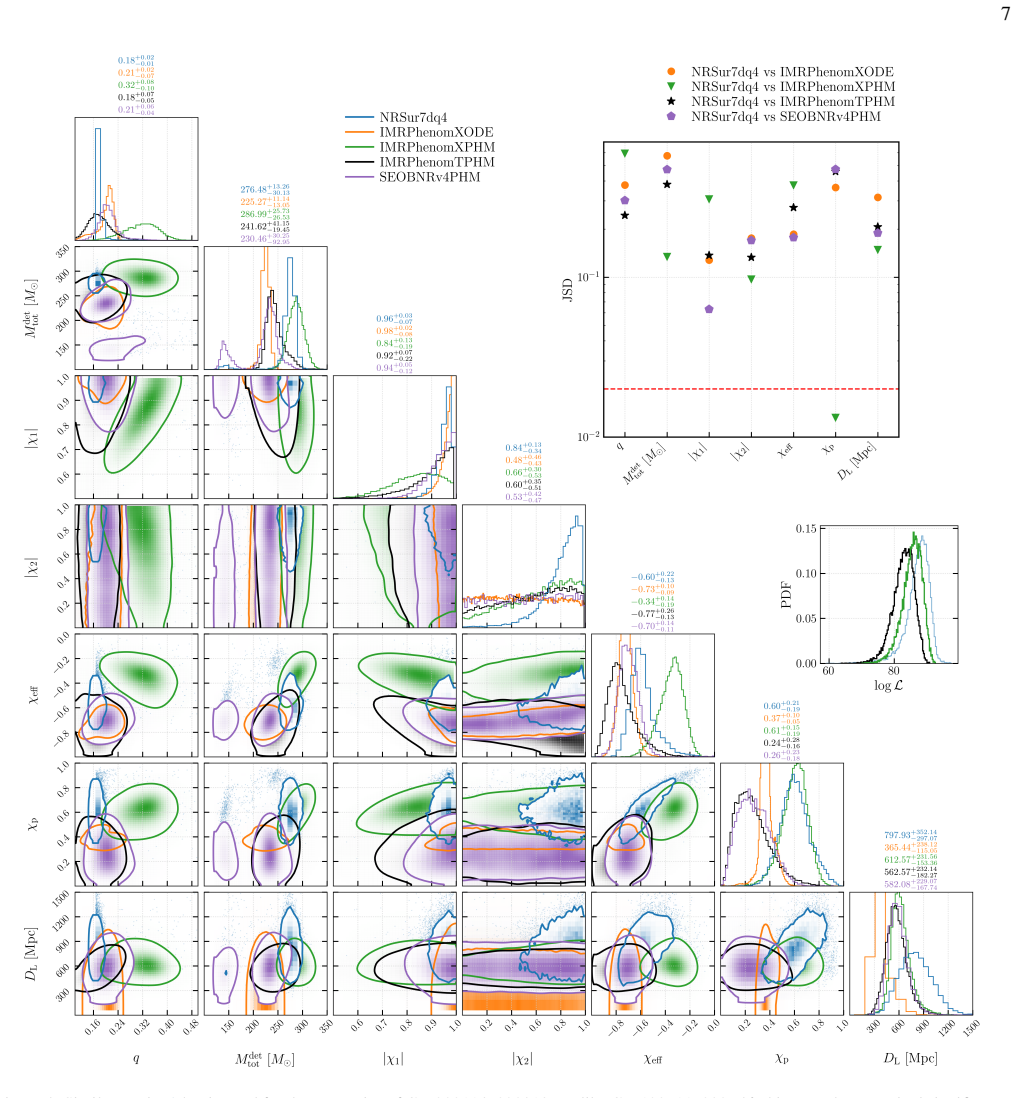
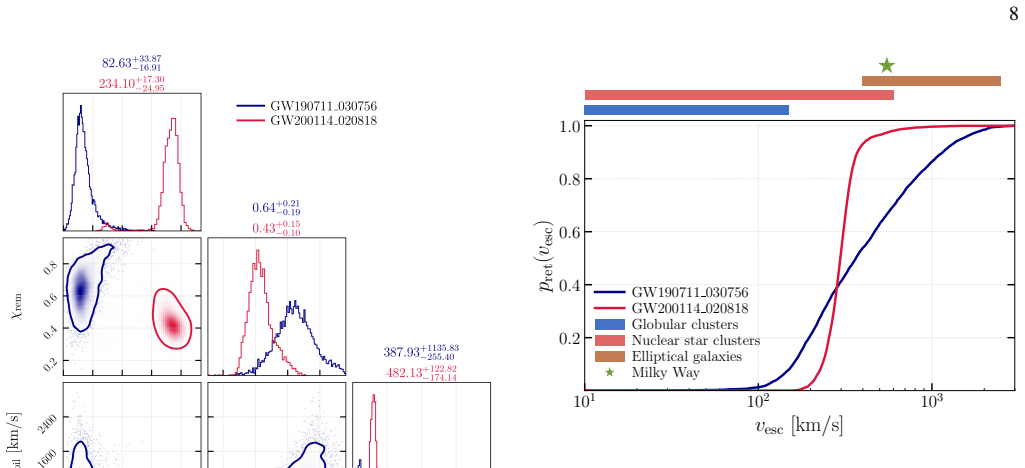
Both GW190711_030756 and GW200114_020818 are asymmetric-mass binaries, with mass ratios 0.35^{+0.32}_{-0.15} and ≤0.20. GW200114_020818 has a source-frame total mass of approximately 220 solar masses, primary and secondary dimensionless spins 0.96^{+0.03}_{-0.07} and 0.84^{+0.13}_{-0.34}, effective inspiral spin -0.60^{+0.22}_{-0.13}, and precession parameter 0.60^{+0.21}_{-0.19}. Considered together with GW231123_135430, these traits indicate an emerging population of massive, rapidly spinning BBH mergers. Retention probabilities for the GW200114_020818 remnant are 0.0002 in a globular cluster, 0.965 in a nuclear star cluster, and 1 in an elliptical galaxy.
What carries the argument
Numerical relativity surrogate models that infer mass ratio, component spins, effective inspiral spin, precession parameter, and remnant retention probability from the observed waveforms.
If this is right
- GW200114_020818 and similar events are difficult to produce in globular clusters even via hierarchical mergers.
- The remnant of GW200114_020818 is retained with high probability in nuclear star clusters or elliptical galaxies.
- The combination of high mass, rapid spins, and negative effective spin distinguishes these systems from typical field or cluster formation channels.
- Future detections of additional events with matching properties would strengthen the case for a distinct massive-spinning subpopulation.
Where Pith is reading between the lines
- If more such events appear, population synthesis models will need to incorporate additional channels capable of producing high-mass, high-spin systems with negative effective spin.
- The low retention probability in globular clusters implies that any hierarchical-merger origin for these systems would require unusually dense or long-lived cluster environments.
- Waveform models that better handle extreme mass ratios and high spins could shift the inferred parameters and alter the population interpretation.
Load-bearing premise
The numerical relativity surrogate models accurately recover the properties of these high-mass asymmetric signals and the chosen astrophysical models correctly predict retention fractions in different environments.
What would settle it
A new event with comparable high total mass, negative effective spin, and strong precession but inconsistent parameter recovery under updated surrogate waveforms would show whether the population interpretation holds.
Figures




read the original abstract
We provide a comprehensive analysis of GW190711_030756 and GW200114_020818, two of the most significant binary black hole merger candidates in the IAS catalog, with probabilities of astrophysical origin $p_{\rm astro}=0.99$ and $0.71$, respectively, and signal-to-noise ratios of approximately $10.0$ and $13.4$. We employ numerical relativity surrogate models to infer both the source properties and the remnant properties of these two candidates. We find that both GW190711_030756 and GW200114_020818 are asymmetric-mass binaries, with inferred mass ratios of $0.35^{+0.32}_{-0.15}$ and $\leq 0.20$. In addition, GW200114_020818 is inferred to have a source-frame total mass of approximately $220M_{\odot}$ and highly spinning black holes, with primary (secondary) dimensionless spin magnitudes of $0.96^{+0.03}_{-0.07}$ ($0.84^{+0.13}_{-0.34}$), closely resembling GW231123_135430. We further find that GW200114\_020818 has a confidently negative effective inspiral spin of $\chi_{\rm eff}=-0.60^{+0.22}_{-0.13}$ and exhibits strong spin precession, characterized by an effective precession parameter of $\chi_{\rm p}=0.60^{+0.21}_{-0.19}$. GW200114_020818 (when considered alongside GW231123_135430) points towards an emerging population of massive, rapidly spinning BBH mergers. While GW231123_135430 is consistent with mergers in globular clusters, producing systems like GW200114_020818 in such environments remains difficult even under hierarchical merger scenarios. The probability that the remnant black hole of GW190711_030756 (GW200114_020818) is retained in its host environment is $0.079$ ($0.0002$), $0.62$ ($0.965$), and $0.997$ ($1$) if the merger occurred in a globular cluster, a nuclear star cluster, or an elliptical galaxy, respectively.
Editorial analysis
A structured set of objections, weighed in public.
Referee Report
Summary. The manuscript analyzes two asymmetric binary black hole merger candidates from the IAS catalog (GW190711_030756 with p_astro=0.99 and GW200114_020818 with p_astro=0.71) using numerical relativity surrogate models. It reports mass ratios of 0.35^{+0.32}_{-0.15} and ≤0.20, respectively, with GW200114_020818 having a source-frame total mass of ~220 M_⊙, component spins of 0.96^{+0.03}_{-0.07} and 0.84^{+0.13}_{-0.34}, χ_eff ≈ -0.60, and χ_p ≈ 0.60. The work argues that GW200114_020818 (together with GW231123_135430) indicates an emerging population of massive, rapidly spinning BBHs and provides retention probabilities for the remnants in globular clusters (0.079 and 0.0002), nuclear star clusters (0.62 and 0.965), and elliptical galaxies (0.997 and 1).
Significance. If the parameter inferences prove robust, the results would be significant for BBH population studies by highlighting potential outliers that challenge standard formation scenarios, especially the low retention probability in globular clusters under hierarchical merger models. The quantitative retention fractions offer concrete, falsifiable inputs for environment-specific simulations.
major comments (2)
- [Parameter estimation and results for GW200114_020818] The parameter estimation for GW200114_020818 (mass ratio ≤0.20, total mass ~220 M_⊙, |χ1|≈0.96, |χ2|≈0.84) relies on NR surrogate models in a regime where training coverage is sparsest (q≤0.2 and |χ|≳0.8–0.9). Because the high-mass signal is short and merger-ringdown dominated, any systematic bias from surrogate interpolation/extrapolation would directly shift the posteriors, undermining both the resemblance to GW231123_135430 and the retention probability of 0.0002 in globular clusters. The manuscript should add explicit validation (e.g., comparison with alternative models or injected-signal recovery tests) in the methods or results section for this event.
- [Discussion and astrophysical implications] The astrophysical interpretation that these events signal an emerging population of massive, rapidly spinning BBHs (and the associated retention probabilities) is load-bearing on the quoted posteriors. A sensitivity study showing how the population and retention conclusions change under plausible shifts in q or spin magnitudes (within surrogate uncertainty) is needed to support the central claim.
minor comments (2)
- [Abstract] The abstract states p_astro=0.71 for GW200114_020818; the text should explicitly discuss how this moderate probability modulates the weight given to the population argument.
- [Throughout] Clarify whether all masses and spins are reported in the source frame and ensure consistent notation between tables/figures and text.
Simulated Author's Rebuttal
We thank the referee for their careful and constructive review. We address each major comment below and have revised the manuscript accordingly to strengthen the robustness of our results.
read point-by-point responses
-
Referee: [Parameter estimation and results for GW200114_020818] The parameter estimation for GW200114_020818 (mass ratio ≤0.20, total mass ~220 M_⊙, |χ1|≈0.96, |χ2|≈0.84) relies on NR surrogate models in a regime where training coverage is sparsest (q≤0.2 and |χ|≳0.8–0.9). Because the high-mass signal is short and merger-ringdown dominated, any systematic bias from surrogate interpolation/extrapolation would directly shift the posteriors, undermining both the resemblance to GW231123_135430 and the retention probability of 0.0002 in globular clusters. The manuscript should add explicit validation (e.g., comparison with alternative models or injected-signal recovery tests) in the methods or results section for this event.
Authors: We agree that the sparse coverage of NR surrogates at q ≲ 0.2 and |χ| ≳ 0.8 warrants explicit validation, particularly for a short, merger-ringdown-dominated signal. In the revised manuscript we add a dedicated subsection (new Section 3.3) that (i) recomputes the GW200114_020818 posteriors with the SEOBNRv4PHM and IMRPhenomXPHM models and quantifies the overlap with the NRSur7dq4 results, and (ii) presents recovery tests of injected signals whose parameters are drawn from our reported posterior. These tests confirm that the surrogate recovers the injected values to within the quoted credible intervals, with no statistically significant bias in q, χ_eff or χ_p. The retention probability in globular clusters remains 0.0002 within the reported uncertainty after these checks. revision: yes
-
Referee: [Discussion and astrophysical implications] The astrophysical interpretation that these events signal an emerging population of massive, rapidly spinning BBHs (and the associated retention probabilities) is load-bearing on the quoted posteriors. A sensitivity study showing how the population and retention conclusions change under plausible shifts in q or spin magnitudes (within surrogate uncertainty) is needed to support the central claim.
Authors: We accept that the population and retention claims rest on the inferred parameters. We have added a new sensitivity subsection (Section 5.2) that systematically varies q, χ1 and χ2 within the 90 % credible intervals of the GW200114_020818 posterior, recomputes the retention fractions in globular clusters, nuclear star clusters and elliptical galaxies, and re-evaluates the resemblance to GW231123_135430. The analysis shows that the low globular-cluster retention probability (≲ 0.01) and the indication of an emerging high-mass, high-spin population remain robust across the explored range; only extreme shifts outside the surrogate uncertainty would alter these conclusions. revision: yes
Circularity Check
No circularity: inferences from external NR surrogates and standard retention models
full rationale
The paper's core steps are (1) parameter estimation of two events using published numerical-relativity surrogate models (external to this work), (2) computation of remnant retention probabilities from the resulting posterior samples via standard astrophysical environment models, and (3) an interpretive statement that the two events (plus a previously reported third) suggest an emerging population. None of these steps reduces by construction to a fitted parameter or self-citation whose validity depends on the target claim. The surrogate models, retention formulas, and population interpretation are all drawn from independent literature or standard calculations; the reported posteriors are outputs, not inputs redefined as predictions. Self-citations to prior IAS-catalog or surrogate papers exist but are not load-bearing for the central claims.
Axiom & Free-Parameter Ledger
axioms (2)
- domain assumption Numerical relativity surrogate models accurately represent the gravitational-wave signals from asymmetric, high-mass binary black hole mergers.
- domain assumption The adopted models for globular clusters, nuclear star clusters, and elliptical galaxies correctly predict black-hole retention probabilities after merger.
Lean theorems connected to this paper
-
IndisputableMonolith/Cost/FunctionalEquation.leanwashburn_uniqueness_aczel unclearWe employ numerical relativity surrogate models to infer both the source properties and the remnant properties... NRSur7dq4... bilby... dynesty
-
IndisputableMonolith/Foundation/AlexanderDuality.leanalexander_duality_circle_linking unclearThe probability that the remnant black hole... is retained... 0.079 (0.0002)... globular cluster, nuclear star cluster, or elliptical galaxy
Reference graph
Works this paper leans on
-
[1]
Advanced LIGO: The next generation of gravitational wave detectors,
Gregory M. Harry (LIGO Scientific), “Advanced LIGO: The next generation of gravitational wave detectors,” Class. Quant. Grav.27, 084006 (2010)
2010
-
[2]
Advanced Virgo: a 2nd generation interferometric gravitational wave detector
F. Acerneseet al.(VIRGO), “Advanced Virgo: a second- generation interferometric gravitational wave detector,” Class. Quant. Grav.32, 024001 (2015), arXiv:1408.3978 [gr-qc]
work page internal anchor Pith review arXiv 2015
- [3]
-
[4]
B. P. Abbottet al.(LIGO Scientific, Virgo), “GWTC-1: A Gravitational-Wave Transient Catalog of Compact Binary Mergers Observed by LIGO and Virgo during the First and Second Observing Runs,” Phys. Rev. X9, 031040 (2019), arXiv:1811.12907 [astro-ph.HE]
work page internal anchor Pith review arXiv 2019
-
[5]
R. Abbottet al.(LIGO Scientific, Virgo), “GWTC-2: Compact Binary Coalescences Observed by LIGO and Virgo During the First Half of the Third Observing Run,” Phys. Rev. X11, 021053 (2021), arXiv:2010.14527 [gr-qc]. 14
work page internal anchor Pith review arXiv 2021
-
[6]
R. Abbottet al.(LIGO Scientific, VIRGO), “GWTC-2.1: Deep extended catalog of compact binary coalescences observed by LIGO and Virgo during the first half of the third observing run,” Phys. Rev. D109, 022001 (2024), arXiv:2108.01045 [gr-qc]
-
[7]
R. Abbottet al.(KAGRA, VIRGO, LIGO Scientific), “GWTC- 3: Compact Binary Coalescences Observed by LIGO and Virgo during the Second Part of the Third Observing Run,” Phys. Rev. X13, 041039 (2023), arXiv:2111.03606 [gr-qc]
work page internal anchor Pith review arXiv 2023
-
[8]
A. G. Abacet al.(LIGO Scientific, VIRGO, KAGRA), “GWTC-4.0: Updating the Gravitational-Wave Transient Cata- log with Observations from the First Part of the Fourth LIGO- Virgo-KAGRA Observing Run,” (2025), arXiv:2508.18082 [gr-qc]
work page internal anchor Pith review Pith/arXiv arXiv 2025
- [9]
-
[10]
Tejaswi Venumadhav, Barak Zackay, Javier Roulet, Liang Dai, and Matias Zaldarriaga, “New binary black hole mergers in the second observing run of Advanced LIGO and Advanced Virgo,” Phys. Rev. D101, 083030 (2020), arXiv:1904.07214 [astro-ph.HE]
- [11]
-
[12]
New binary black hole mergers in the LIGO-Virgo O3b data,
Ajit Kumar Mehta, Seth Olsen, Digvijay Wadekar, Javier Roulet, Tejaswi Venumadhav, Jonathan Mushkin, Barak Za- ckay, and Matias Zaldarriaga, “New binary black hole mergers in the LIGO-Virgo O3b data,” Phys. Rev. D111, 024049 (2025), arXiv:2311.06061 [gr-qc]
-
[13]
Digvijay Wadekar, Javier Roulet, Tejaswi Venumadhav, Ajit Kumar Mehta, Barak Zackay, Jonathan Mushkin, Seth Olsen, and Matias Zaldarriaga, “New black hole mergers in the LIGO-Virgo O3 data from a gravitational wave search in- cluding higher-order harmonics,” (2023), arXiv:2312.06631 [gr-qc]
-
[14]
Alexander H. Nitz, Collin Capano, Alex B. Nielsen, Steven Reyes, Rebecca White, Duncan A. Brown, and Badri Krishnan, “1-OGC: The first open gravitational-wave catalog of binary mergers from analysis of public Advanced LIGO data,” Astro- phys. J.872, 195 (2019), arXiv:1811.01921 [gr-qc]
-
[15]
Alexander H. Nitz, Thomas Dent, Gareth S. Davies, Sumit Kumar, Collin D. Capano, Ian Harry, Simone Mozzon, Laura Nuttall, Andrew Lundgren, and Márton Tápai, “2-OGC: Open Gravitational-wave Catalog of binary mergers from analysis of public Advanced LIGO and Virgo data,” Astrophys. J.891, 123 (2020), arXiv:1910.05331 [astro-ph.HE]
-
[16]
3-OGC: Catalog of Gravitational Waves from Compact-binary Mergers,
Alexander H. Nitz, Collin D. Capano, Sumit Kumar, Yi-Fan Wang, Shilpa Kastha, Marlin Schäfer, Rahul Dhurkunde, and Miriam Cabero, “3-OGC: Catalog of Gravitational Waves from Compact-binary Mergers,” Astrophys. J.922, 76 (2021), arXiv:2105.09151 [astro-ph.HE]
-
[17]
4-OGC: Catalog of gravitational waves from compact-binary mergers,
Alexander H. Nitz, Sumit Kumar, Yi-Fan Wang, Shilpa Kastha, Shichao Wu, Marlin Schäfer, Rahul Dhurkunde, and Collin D. Capano, “4-OGC: Catalog of Gravitational Waves from Compact Binary Mergers,” Astrophys. J.946, 59 (2023), arXiv:2112.06878 [astro-ph.HE]
-
[18]
Alexandra E. Koloniari, Evdokia C. Koursoumpa, Paraskevi Nousi, Paraskevas Lampropoulos, Nikolaos Passalis, Anasta- sios Tefas, and Nikolaos Stergioulas, “New gravitational wave discoveries enabled by machine learning,” Mach. Learn. Sci. Tech.6, 015054 (2025), arXiv:2407.07820 [gr-qc]
-
[19]
Reduced basis catalogs for gravi- tational wave templates,
S. E. Field, C. R. Galley, F. Herrmann, J. S. Hesthaven, E. Ochsner, and M. Tiglio, “Reduced basis catalogs for gravi- tational wave templates,” Phys. Rev. Lett.106, 221102 (2011), arXiv:1101.3765 [gr-qc]
-
[20]
Fast prediction and evaluation of gravitational waveforms using surrogate models,
Scott E. Field, Chad R. Galley, Jan S. Hesthaven, Jason Kaye, and Manuel Tiglio, “Fast prediction and evaluation of gravi- tational waveforms using surrogate models,” Phys. Rev. X4, 031006 (2014), arXiv:1308.3565 [gr-qc]
- [21]
- [22]
-
[23]
Tousif Islam, Vijay Varma, Jackie Lodman, Scott E. Field, Gaurav Khanna, Mark A. Scheel, Harald P. Pfeiffer, Davide Gerosa, and Lawrence E. Kidder, “Eccentric binary black hole surrogate models for the gravitational waveform and remnant properties: comparable mass, nonspinning case,” Phys. Rev. D 103, 064022 (2021), arXiv:2101.11798 [gr-qc]
-
[24]
Tousif Islam, Scott E. Field, Scott A. Hughes, Gaurav Khanna, Vijay Varma, Matthew Giesler, Mark A. Scheel, Lawrence E. Kidder, and Harald P. Pfeiffer, “Surrogate model for gravi- tational wave signals from nonspinning, comparable-to large- mass-ratio black hole binaries built on black hole perturbation theory waveforms calibrated to numerical relativity,...
-
[25]
Jonathan Blackman, Scott E. Field, Chad R. Galley, Béla Szilágyi, Mark A. Scheel, Manuel Tiglio, and Daniel A. Hemberger, “Fast and Accurate Prediction of Numerical Rel- ativity Waveforms from Binary Black Hole Coalescences Us- ing Surrogate Models,” Phys. Rev. Lett.115, 121102 (2015), arXiv:1502.07758 [gr-qc]
-
[26]
Numerical relativity waveform surrogate model for generically precessing binary black hole mergers,
Jonathan Blackman, Scott E. Field, Mark A. Scheel, Chad R. Galley, Christian D. Ott, Michael Boyle, Lawrence E. Kid- der, Harald P. Pfeiffer, and Béla Szilágyi, “Numerical rela- tivity waveform surrogate model for generically precessing binary black hole mergers,” Phys. Rev. D96, 024058 (2017), arXiv:1705.07089 [gr-qc]
-
[27]
Jonathan Blackman, Scott E. Field, Mark A. Scheel, Chad R. Galley, Daniel A. Hemberger, Patricia Schmidt, and Rory Smith, “A Surrogate Model of Gravitational Waveforms from Numerical Relativity Simulations of Precessing Bi- nary Black Hole Mergers,” Phys. Rev. D95, 104023 (2017), arXiv:1701.00550 [gr-qc]
-
[28]
Targeted large mass ratio numerical relativity surrogate waveform model for GW190814,
Jooheon Yoo, Vijay Varma, Matthew Giesler, Mark A. Scheel, Carl-Johan Haster, Harald P. Pfeiffer, Lawrence E. Kidder, and Michael Boyle, “Targeted large mass ratio numerical relativity surrogate waveform model for GW190814,” Phys. Rev. D106, 044001 (2022), arXiv:2203.10109 [gr-qc]
- [29]
-
[30]
Sebastian Khan, Katerina Chatziioannou, Mark Hannam, and Frank Ohme, “Phenomenological model for the gravitational- wave signal from precessing binary black holes with two-spin effects,” Phys. Rev. D100, 024059 (2019), arXiv:1809.10113 [gr-qc]
-
[31]
D91,024043 (2015), arXiv:1408.1810 [gr-qc]
Patricia Schmidt, Frank Ohme, and Mark Hannam, “Towards 15 models of gravitational waveforms from generic binaries II: Modelling precession effects with a single effective precession parameter,” Phys. Rev. D91, 024043 (2015), arXiv:1408.1810 [gr-qc]
-
[32]
New twists in compact binary waveform modeling: A fast time-domain model for precession,
Héctor Estellés, Marta Colleoni, Cecilio García-Quirós, Sascha Husa, David Keitel, Maite Mateu-Lucena, Maria de Lluc Planas, and Antoni Ramos-Buades, “New twists in compact binary waveform modeling: A fast time-domain model for pre- cession,” Phys. Rev. D105, 084040 (2022), arXiv:2105.05872 [gr-qc]
-
[33]
Héctor Estellés, Sascha Husa, Marta Colleoni, David Keitel, Maite Mateu-Lucena, Cecilio García-Quirós, Antoni Ramos- Buades, and Angela Borchers, “Time-domain phenomenolog- ical model of gravitational-wave subdominant harmonics for quasicircular nonprecessing binary black hole coalescences,” Phys. Rev. D105, 084039 (2022), arXiv:2012.11923 [gr-qc]
-
[34]
Geraint Prattenet al., “Computationally efficient models for the dominant and subdominant harmonic modes of precess- ing binary black holes,” Phys. Rev. D103, 104056 (2021), arXiv:2004.06503 [gr-qc]
work page internal anchor Pith review arXiv 2021
-
[35]
Accurate and efficient waveform model for precessing binary black holes,
Hang Yu, Javier Roulet, Tejaswi Venumadhav, Barak Zackay, and Matias Zaldarriaga, “Accurate and efficient waveform model for precessing binary black holes,” Phys. Rev. D108, 064059 (2023), arXiv:2306.08774 [gr-qc]
-
[36]
Jonathan E. Thompson, Eleanor Hamilton, Lionel London, Shrobana Ghosh, Panagiota Kolitsidou, Charlie Hoy, and Mark Hannam, “PhenomXO4a: a phenomenological gravitational- wave model for precessing black-hole binaries with higher multipoles and asymmetries,” Phys. Rev. D109, 063012 (2024), arXiv:2312.10025 [gr-qc]
-
[37]
Eleanor Hamiltonet al., “PhenomXPNR: An improved grav- itational wave model linking precessing inspirals and NR- calibrated merger-ringdown,” (2025), arXiv:2507.02604 [gr- qc]
-
[38]
Including higher order multipoles in gravitational-wave models for precessing binary black holes,
Sebastian Khan, Frank Ohme, Katerina Chatziioannou, and Mark Hannam, “Including higher order multipoles in gravitational-wave models for precessing binary black holes,” Phys. Rev. D101, 024056 (2020), arXiv:1911.06050 [gr-qc]
-
[39]
Andrea Taracchiniet al., “Effective-one-body model for black- hole binaries with generic mass ratios and spins,” Phys. Rev. D 89, 061502 (2014), arXiv:1311.2544 [gr-qc]
-
[40]
Alejandro Bohéet al., “Improved effective-one-body model of spinning, nonprecessing binary black holes for the era of gravitational-wave astrophysics with advanced detectors,” Phys. Rev. D95, 044028 (2017), arXiv:1611.03703 [gr-qc]
-
[41]
D98,084028(2018),arXiv:1803.10701 [gr-qc]
Roberto Cotesta, Alessandra Buonanno, Alejandro Bohé, An- drea Taracchini, Ian Hinder, and Serguei Ossokine, “Enriching the Symphony of Gravitational Waves from Binary Black Holes by Tuning Higher Harmonics,” Phys. Rev. D98, 084028 (2018), arXiv:1803.10701 [gr-qc]
- [42]
-
[43]
Alessandro Nagar, Gunnar Riemenschneider, Geraint Pratten, Piero Rettegno, and Francesco Messina, “Multipolar effective one body waveform model for spin-aligned black hole binaries,” Phys. Rev. D102, 024077 (2020), arXiv:2001.09082 [gr-qc]
-
[44]
Alessandro Nagar, Alice Bonino, and Piero Rettegno, “Ef- fective one-body multipolar waveform model for spin-aligned, quasicircular, eccentric, hyperbolic black hole binaries,” Phys. Rev. D103, 104021 (2021), arXiv:2101.08624 [gr-qc]
-
[45]
Yi Pan, Alessandra Buonanno, Andrea Taracchini, Lawrence E. Kidder, Abdul H. Mroué, Harald P. Pfeiffer, Mark A. Scheel, and Béla Szilágyi, “Inspiral-merger-ringdown waveforms of spinning, precessing black-hole binaries in the effective- one-body formalism,” Phys. Rev. D89, 084006 (2014), arXiv:1307.6232 [gr-qc]
- [46]
-
[47]
Serguei Ossokineet al., “Multipolar Effective-One-Body Wave- forms for Precessing Binary Black Holes: Construction and Val- idation,” Phys. Rev. D102, 044055 (2020), arXiv:2004.09442 [gr-qc]
-
[48]
Antoni Ramos-Buades, Alessandra Buonanno, Héctor Estellés, Mohammed Khalil, Deyan P. Mihaylov, Serguei Ossokine, Lorenzo Pompili, and Mahlet Shiferaw, “Next generation of accurate and efficient multipolar precessing-spin effective-one- body waveforms for binary black holes,” Phys. Rev. D108, 124037 (2023), arXiv:2303.18046 [gr-qc]
-
[49]
R. Abbottet al.(LIGO Scientific, Virgo), “GW190412: Obser- vation of a Binary-Black-Hole Coalescence with Asymmetric Masses,” Phys. Rev. D102, 043015 (2020), arXiv:2004.08342 [astro-ph.HE]
-
[50]
Improved analysis of GW190412 with a precessing numerical relativity surrogate waveform model,
Tousif Islam, Scott E. Field, Carl-Johan Haster, and Rory Smith, “Improved analysis of GW190412 with a precessing numerical relativity surrogate waveform model,” Phys. Rev. D 103, 104027 (2021), arXiv:2010.04848 [gr-qc]
-
[51]
Abbottet al.(LIGO Scientific and Virgo),Astrophys
R. Abbottet al.(LIGO Scientific, Virgo), “GW190814: Gravi- tational Waves from the Coalescence of a 23 Solar Mass Black Hole with a 2.6 Solar Mass Compact Object,” Astrophys. J. Lett.896, L44 (2020), arXiv:2006.12611 [astro-ph.HE]
-
[52]
Tousif Islam, Avi Vajpeyi, Feroz H. Shaik, Carl-Johan Haster, Vijay Varma, Scott E. Field, Jacob Lange, Richard O’Shaughnessy, and Rory Smith, “Analysis of GWTC-3 with fully precessing numerical relativity surrogate models,” Phys. Rev. D112, 044001 (2025), arXiv:2309.14473 [gr-qc]
-
[53]
Abbottet al.(LIGO Scientific and Virgo),Phys
R. Abbottet al.(LIGO Scientific, Virgo), “GW190521: A Binary Black Hole Merger with a Total Mass of 150M⊙,” Phys. Rev. Lett.125, 101102 (2020), arXiv:2009.01075 [gr-qc]
-
[54]
Vijay Varma, Sylvia Biscoveanu, Tousif Islam, Feroz H. Shaik, Carl-Johan Haster, Maximiliano Isi, Will M. Farr, Scott E. Field, and Salvatore Vitale, “Evidence of Large Recoil Veloc- ity from a Black Hole Merger Signal,” Phys. Rev. Lett.128, 191102 (2022), arXiv:2201.01302 [astro-ph.HE]
-
[55]
GW231123: A Binary Black Hole Merger with Total Mass 190–265M ⊙,
A. G. Abacet al.(LIGO Scientific, VIRGO, KAGRA), “GW231123: A Binary Black Hole Merger with Total Mass 190–265 M ⊙,” Astrophys. J. Lett.993, L25 (2025), arXiv:2507.08219 [astro-ph.HE]
-
[56]
A. G. Abacet al.(LIGO Scientific, Virgo, KAGRA), “GW241011 and GW241110: Exploring Binary Formation and Fundamental Physics with Asymmetric, High-spin Black Hole Coalescences,” Astrophys. J. Lett.993, L21 (2025), arXiv:2510.26931 [astro-ph.HE]
-
[57]
Black Hole Spectroscopy and Tests of General Relativity with GW250114,
A. G. Abacet al.(LIGO Scientific, Virgo, KAGRA), “Black Hole Spectroscopy and Tests of General Relativity with GW250114,” Phys. Rev. Lett.136, 041403 (2026), arXiv:2509.08099 [gr-qc]
-
[58]
Isobel M. Romero-Shaw, Paul D. Lasky, Eric Thrane, and Juan Calderon Bustillo, “GW190521: orbital eccentricity and signatures of dynamical formation in a binary black hole merger signal,” Astrophys. J. Lett.903, L5 (2020), arXiv:2009.04771 [astro-ph.HE]
-
[59]
2020, NatAs, doi: 10.48550/arXiv.2009.05461 Gond´an, L., & Kocsis, B
V . Gayathri, J. Healy, J. Lange, B. O’Brien, M. Szczepanczyk, Imre Bartos, M. Campanelli, S. Klimenko, C. O. Lousto, and R. O’Shaughnessy, “Eccentricity estimate for black hole merg- 16 ers with numerical relativity simulations,” Nature Astron.6, 344–349 (2022), arXiv:2009.05461 [astro-ph.HE]
- [60]
-
[61]
Antoni Ramos-Buades, Alessandra Buonanno, and Jonathan Gair, “Bayesian inference of binary black holes with inspiral- merger-ringdown waveforms using two eccentric parameters,” Phys. Rev. D108, 124063 (2023), arXiv:2309.15528 [gr-qc]
-
[62]
Evidence for eccentricity in the population of binary black holes observed by LIGO-Virgo-KAGRA
Nihar Gupteet al., “Evidence for eccentricity in the population of binary black holes observed by LIGO-Virgo-KAGRA,” Phys. Rev. D112, 104045 (2025), arXiv:2404.14286 [gr-qc]
work page internal anchor Pith review Pith/arXiv arXiv 2025
- [63]
-
[64]
Measuring Eccentricity and Addressing Waveform Systematics in GW231123
Aasim Jan, Sophia Nicolella, Deirdre Shoemaker, and Richard O’Shaughnessy, “Measuring Eccentricity and Ad- dressing Waveform Systematics in GW231123,” (2025), arXiv:2512.20060 [gr-qc]
work page internal anchor Pith review Pith/arXiv arXiv 2025
-
[65]
Dis- covering gravitational waveform distortions from lensing: a deep dive into GW231123,
Juno C. L. Chan, Jose María Ezquiaga, Rico K. L. Lo, Joey Bowman, Lorena Magaña Zertuche, and Luka Vujeva, “Dis- covering gravitational waveform distortions from lensing: a deep dive into GW231123,” (2025), arXiv:2512.16916 [astro- ph.CO]
-
[66]
Optimized search for a binary black hole merger population in LIGO-Virgo O3 data,
Praveen Kumar and Thomas Dent, “Optimized Search for a Binary Black Hole Merger Population in LIGO-Virgo O3 Data,” arXiv e-prints , arXiv:2403.10439 (2024), arXiv:2403.10439 [gr-qc]
- [67]
-
[68]
Digvijay Wadekar, Tejaswi Venumadhav, Javier Roulet, Ajit Kumar Mehta, Barak Zackay, Jonathan Mushkin, and Ma- tias Zaldarriaga, “New search pipeline for gravitational waves with higher-order modes using mode-by-mode filtering,” Phys. Rev. D110, 044063 (2024), arXiv:2405.17400 [gr-qc]
-
[69]
Rich Abbottet al.(LIGO Scientific, VIRGO, KAGRA), “Search for intermediate-mass black hole binaries in the third observing run of Advanced LIGO and Advanced Virgo,” Astron. Astrophys.659, A84 (2022), arXiv:2105.15120 [astro-ph.HE]
-
[70]
Survey of four precessing waveform models for bi- nary black hole systems,
Jake Mac Uilliam, Sarp Akcay, and Jonathan E. Thomp- son, “Survey of four precessing waveform models for bi- nary black hole systems,” Phys. Rev. D109, 084077 (2024), arXiv:2402.06781 [gr-qc]
-
[71]
Vijay Varma, Scott E. Field, Mark A. Scheel, Jonathan Black- man, Davide Gerosa, Leo C. Stein, Lawrence E. Kidder, and Harald P. Pfeiffer, “Surrogate models for precessing binary black hole simulations with unequal masses,” Phys. Rev. Re- search.1, 033015 (2019), arXiv:1905.09300 [gr-qc]
-
[72]
Bilby: A user-friendly Bayesian inference library for gravitational-wave astronomy
Gregory Ashtonet al., “BILBY: A user-friendly Bayesian in- ference library for gravitational-wave astronomy,” Astrophys. J. Suppl.241, 27 (2019), arXiv:1811.02042 [astro-ph.IM]
work page internal anchor Pith review arXiv 2019
-
[73]
Nested sampling for general Bayesian compu- tation,
John Skilling, “Nested sampling for general Bayesian compu- tation,” Bayesian Analysis1, 833–859 (2006)
2006
-
[74]
DYNESTY: a dynamic nested sampling package for estimating Bayesian posteriors and evidences,
Joshua S. Speagle, “DYNESTY: a dynamic nested sampling package for estimating Bayesian posteriors and evidences,” Monthly Notices of the Royal Astronomical Society493, 3132– 3158 (2020), arXiv:1904.02180 [astro-ph.IM]
-
[75]
LVK Algorithm Library - LALSuite,
LIGO Scientific Collaboration, Virgo Collaboration, and KA- GRA Collaboration, “LVK Algorithm Library - LALSuite,” Free software (GPL) (2018)
2018
-
[76]
SWIGLAL: Python and Octave interfaces to the LALSuite gravitational-wave data analysis libraries,
Karl Wette, “SWIGLAL: Python and Octave interfaces to the LALSuite gravitational-wave data analysis libraries,” Soft- wareX12, 100634 (2020)
2020
-
[77]
Javier Roulet, Jonathan Mushkin, Digvijay Wadekar, Tejaswi Venumadhav, Barak Zackay, and Matias Zaldarriaga, “Fast marginalization algorithm for optimizing gravitational wave detection, parameter estimation, and sky localization,” Phys. Rev. D110, 044010 (2024), arXiv:2404.02435 [gr-qc]
- [78]
- [79]
-
[80]
Krystal Ruiz-Rocha, Anjali B. Yelikar, Jacob Lange, William Gabella, Robert A. Weller, Richard O’Shaughnessy, Kelly Holley-Bockelmann, and Karan Jani, “Properties of “Lite” Intermediate-mass Black Hole Candidates in LIGO-Virgo’s Third Observing Run,” Astrophys. J. Lett.985, L37 (2025), arXiv:2502.17681 [astro-ph.HE]
discussion (0)
Sign in with ORCID, Apple, or X to comment. Anyone can read and Pith papers without signing in.