Recognition: unknown
Automotive Engineering-Centric Agentic AI Workflow Framework
Pith reviewed 2026-05-10 17:27 UTC · model grok-4.3
The pith
Engineering workflows can be modeled as constrained history-aware sequential decision processes where AI agents provide engineer-supervised support across toolchains.
A machine-rendered reading of the paper's core claim, the machinery that carries it, and where it could break.
Core claim
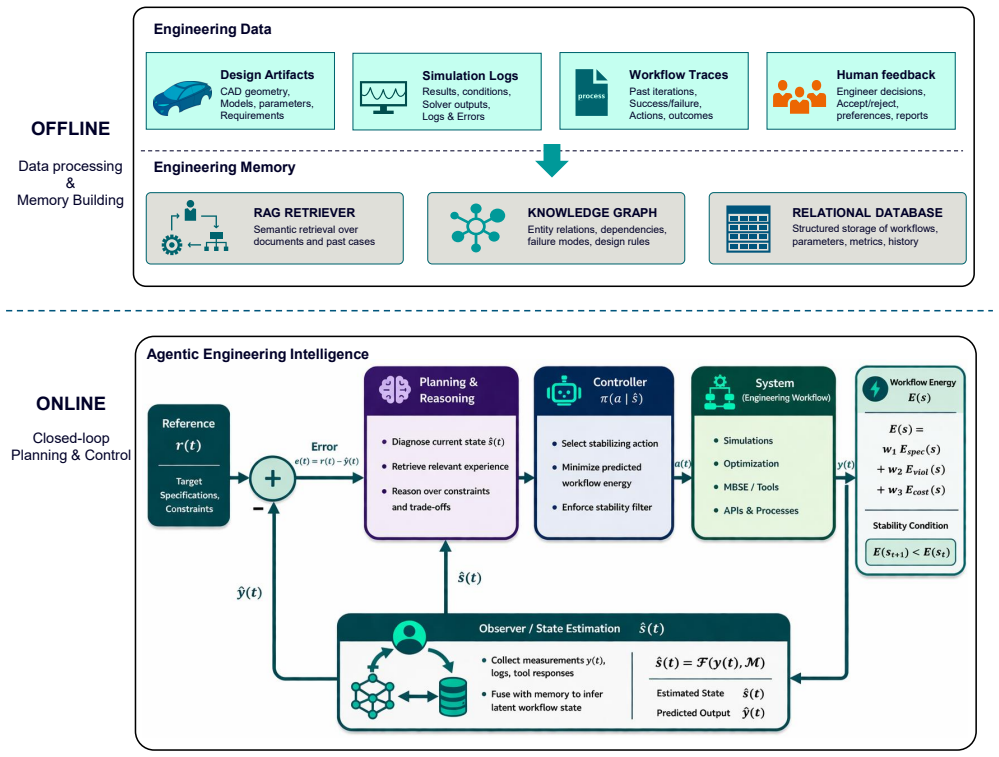
The paper presents Agentic Engineering Intelligence (AEI) as an industrial vision framework that models engineering workflows as constrained, history-aware sequential decision processes in which AI agents support engineer-supervised interventions over engineering toolchains. AEI links an offline phase for engineering data processing and workflow-memory construction with an online phase for workflow-state estimation, retrieval, and decision support. A control-theoretic interpretation is also possible, in which engineering objectives act as reference signals, agents act as workflow controllers, and toolchains provide feedback for intervention selection. Representative automotive use cases in s
What carries the argument
Agentic Engineering Intelligence (AEI), the framework that represents engineering workflows as constrained, history-aware sequential decision processes to allow AI agents to deliver supervised interventions over toolchains.
Load-bearing premise
That engineering workflows can be usefully represented as constrained, history-aware sequential decision processes amenable to AI agent intervention without losing critical domain-specific nuances or requiring extensive custom engineering.
What would settle it
Apply the AEI framework to one concrete automotive workflow such as suspension design optimization and check whether the resulting agent interventions either omit essential domain constraints present in traditional methods or fail to improve measured outcomes like iteration count or final performance.
Figures


read the original abstract
Engineering workflows such as design optimization, simulation-based diagnosis, control tuning, and model-based systems engineering (MBSE) are iterative, constraint-driven, and shaped by prior decisions. Yet many AI methods still treat these activities as isolated tasks rather than as parts of a broader workflow. This paper presents Agentic Engineering Intelligence (AEI), an industrial vision framework that models engineering workflows as constrained, history-aware sequential decision processes in which AI agents support engineer-supervised interventions over engineering toolchains. AEI links an offline phase for engineering data processing and workflow-memory construction with an online phase for workflow-state estimation, retrieval, and decision support. A control-theoretic interpretation is also possible, in which engineering objectives act as reference signals, agents act as workflow controllers, and toolchains provide feedback for intervention selection. Representative automotive use cases in suspension design, reinforcement learning tuning, multimodal engineering knowledge reuse, aerodynamic exploration, and MBSE show how diverse workflows can be expressed within a common formulation. Overall, the paper positions engineering AI as a problem of process-level intelligence and outlines a practical roadmap for future empirical validation in industrial settings.
Editorial analysis
A structured set of objections, weighed in public.
Referee Report
Summary. The paper presents Agentic Engineering Intelligence (AEI), an industrial vision framework that models engineering workflows (design optimization, MBSE, control tuning) as constrained, history-aware sequential decision processes. AI agents support engineer-supervised interventions over toolchains via an offline phase for data processing and workflow-memory construction and an online phase for state estimation, retrieval, and decision support. A control-theoretic analogy is offered (objectives as references, agents as controllers), and the approach is illustrated through automotive use cases including suspension design, RL tuning, multimodal knowledge reuse, aerodynamic exploration, and MBSE.
Significance. If the framework's assumptions hold and can be operationalized, AEI could provide a useful organizing lens for integrating agentic AI into iterative, constraint-driven engineering processes while preserving engineer oversight. The offline/online split and control-theoretic interpretation offer a coherent structure that might guide future implementations in automotive settings. However, as a purely descriptive vision without formalization or evidence, its significance remains prospective and depends on subsequent empirical validation.
major comments (2)
- [Representative automotive use cases] The use-case descriptions (suspension design, RL tuning, aerodynamic exploration, MBSE) remain high-level narratives without explicit state representations, action spaces, constraint encodings, or memory schemas. This directly affects the central claim that workflows can be cast as constrained sequential decision processes without loss of domain-specific nuances or need for extensive custom engineering.
- [Framework description and control-theoretic interpretation] No mathematical formalization, prototype implementation, or validation experiments are supplied to demonstrate that the proposed offline memory construction and online state estimation preserve critical iterative and constraint-driven character of engineering workflows. The entire support for the framework rests on descriptive narrative, which is load-bearing for the claim that AI agents can provide useful supervised interventions.
minor comments (1)
- [Abstract and introduction] The abstract and introduction could more explicitly separate the proposed vision from the outlined roadmap for future empirical validation to avoid conflating conceptual framing with demonstrated utility.
Simulated Author's Rebuttal
We thank the referee for the constructive feedback and for recognizing the potential of the AEI framework as an organizing lens for agentic AI in engineering workflows. The manuscript is a vision paper that outlines a conceptual structure rather than a fully implemented or validated system; we address the major comments below by clarifying scope and committing to targeted revisions that strengthen the presentation without altering the paper's intent.
read point-by-point responses
-
Referee: [Representative automotive use cases] The use-case descriptions (suspension design, RL tuning, aerodynamic exploration, MBSE) remain high-level narratives without explicit state representations, action spaces, constraint encodings, or memory schemas. This directly affects the central claim that workflows can be cast as constrained sequential decision processes without loss of domain-specific nuances or need for extensive custom engineering.
Authors: We agree that the use cases are presented at a conceptual level. The paper's central claim is that diverse engineering workflows share a common structure as constrained, history-aware sequential decision processes, which the use cases illustrate at a framework level rather than through exhaustive operational details. Full state-action-constraint encodings would constitute implementation work beyond the scope of a vision manuscript. In revision we will augment each use-case subsection with concise, high-level mappings (for example, indicative state variables, intervention actions, and key constraints drawn from the respective domains) to better demonstrate preservation of nuances while retaining the illustrative character. revision: partial
-
Referee: [Framework description and control-theoretic interpretation] No mathematical formalization, prototype implementation, or validation experiments are supplied to demonstrate that the proposed offline memory construction and online state estimation preserve critical iterative and constraint-driven character of engineering workflows. The entire support for the framework rests on descriptive narrative, which is load-bearing for the claim that AI agents can provide useful supervised interventions.
Authors: The manuscript is explicitly framed as an industrial vision and roadmap (see abstract and concluding section), with the offline/online phases and control-theoretic analogy offered as conceptual organizing principles rather than a proven formalism. We acknowledge that the absence of mathematical formalization or experiments means the claims remain prospective. In the revised manuscript we will add a dedicated subsection in the discussion that sketches possible formalization routes (for instance, casting the online phase as a partially observable Markov decision process with workflow memory as belief state) and that explicitly enumerates limitations and the requirement for future empirical validation, thereby better situating the descriptive narrative. revision: yes
Circularity Check
No circularity: vision framework with no derivations or self-referential reductions
full rationale
The paper introduces AEI as a conceptual industrial vision that models workflows as constrained history-aware sequential decision processes, supported by offline/online phases and a control-theoretic analogy. It supplies only high-level phase descriptions and named use cases without any equations, fitted parameters, uniqueness theorems, or self-citations that could reduce a claim to its own inputs by construction. The modeling choice is presented explicitly as a framework rather than derived from prior results, so the derivation chain is self-contained and independent of its own outputs.
Axiom & Free-Parameter Ledger
axioms (1)
- domain assumption Engineering workflows such as design optimization, simulation-based diagnosis, control tuning, and MBSE are iterative, constraint-driven, and shaped by prior decisions.
invented entities (1)
-
Agentic Engineering Intelligence (AEI)
no independent evidence
Forward citations
Cited by 1 Pith paper
-
AI as Consumer and Participant: A Co-Design Agenda for MBSE Substrates and Methodology
MBSE models function as prompts for AI rather than machine-queryable knowledge substrates, requiring co-design of models and methodology to enable consistent AI participation.
Reference graph
Works this paper leans on
-
[1]
Virtual Engineering at Work: The Chal- lenges for Designing Mechatronic Products,
H. Van der Auweraer, J. Anthonis, S. De Bruyne, and J. Leuridan, “Virtual Engineering at Work: The Chal- lenges for Designing Mechatronic Products,”Engineer- ing with Computers, vol. 29, pp. 389–408, 2013
2013
-
[2]
Design as a sequential decision process: A method for reduc- ing design set space using models to bound objectives,
S.W.Miller,M.A.Yukish,andT.W.Simpson,“Design as a sequential decision process: A method for reduc- ing design set space using models to bound objectives,” Structural and Multidisciplinary Optimization, vol. 57, no. 1, pp. 305–324, 2018
2018
-
[3]
Design Ontology Supporting Model-Based Sys- tems Engineering Formalisms,
J. Lu, J. Ma, X. Zheng, G. Wang, H. Li, and D. Kir- itsis, “Design Ontology Supporting Model-Based Sys- tems Engineering Formalisms,”IEEE Systems Journal, vol. 16, no. 4, pp. 5465–5476, 2022
2022
-
[4]
A Review of Prominent Paradigms for LLM- Based Agents: Tool Use, Planning (Including RAG), and Feedback Learning,
X. Li, “A Review of Prominent Paradigms for LLM- Based Agents: Tool Use, Planning (Including RAG), and Feedback Learning,” inProceedings of the 31st In- ternational Conference on Computational Linguistics, pp. 9760–9779, 2025
2025
-
[5]
Offline Reinforcement Learning: Tutorial, Review, and Perspectives on Open Problems
S.Levine,A.Kumar,G.Tucker,andJ.Fu,“OfflineRein- forcement Learning: Tutorial, Review, and Perspectives on Open Problems,”arXiv preprint arXiv:2005.01643, 2020
work page internal anchor Pith review arXiv 2005
-
[6]
Agentic Retrieval-Augmented Generation: A Survey on Agentic RAG
A. Singh, A. Ehtesham, S. Kumar, T. Talaei Khoei, and A. V. Vasilakos, “Agentic Retrieval-Augmented Gen- eration: A Survey on Agentic RAG,”arXiv preprint arXiv:2501.09136, 2025
work page internal anchor Pith review arXiv 2025
-
[7]
ColPali: Efficient Docu- ment Retrieval with Vision Language Models,
M. Faysse, H. Sibille, T. Wu, B. Omrani, G. Viaud, C. Hudelot, and P. Colombo, “ColPali: Efficient Docu- ment Retrieval with Vision Language Models,” inIn- ternational Conference on Learning Representations, 2025
2025
-
[8]
arXiv preprint arXiv:2504.08748 , year=
L. Mei, S. Mo, Z. Yang, and C. Chen, “A Survey ofMultimodalRetrieval-AugmentedGeneration,”arXiv preprint arXiv:2504.08748, 2025
-
[9]
Dri- vAerNet++: A large scale Multimodal Car Dataset with Computational Fluid Dynamics Simulations and Deep LearningBenchmarks,
M. Elrefaie, F. Morar, A. Dai, and F. Ahmed, “Dri- vAerNet++: A large scale Multimodal Car Dataset with Computational Fluid Dynamics Simulations and Deep LearningBenchmarks,”inAdvancesinNeuralInforma- tion Processing Systems, vol. 37, pp. 499–536, 2024. Datasets and Benchmarks Track
2024
discussion (0)
Sign in with ORCID, Apple, or X to comment. Anyone can read and Pith papers without signing in.