Recognition: 2 theorem links
· Lean TheoremOn Semiotic-Grounded Interpretive Evaluation of Generative Art
Pith reviewed 2026-05-10 18:32 UTC · model grok-4.3
The pith
SemJudge evaluates generative art by recovering its symbolic and indexical meanings rather than surface image quality.
A machine-rendered reading of the paper's core claim, the machinery that carries it, and where it could break.
Core claim
The paper claims that artistic meaning in Human-GenArt Interaction is conveyed through cascaded semiosis in iconic, symbolic, and indexical modes, yet existing evaluators remain structurally limited to the iconic mode. By formalizing a Peircean computational semiotic theory, it constructs a Hierarchical Semiosis Graph that reconstructs the meaning-making chain from prompt to artifact, enabling explicit assessment of symbolic and indexical layers and producing interpretations that align more closely with human judgment on fine-art benchmarks.
What carries the argument
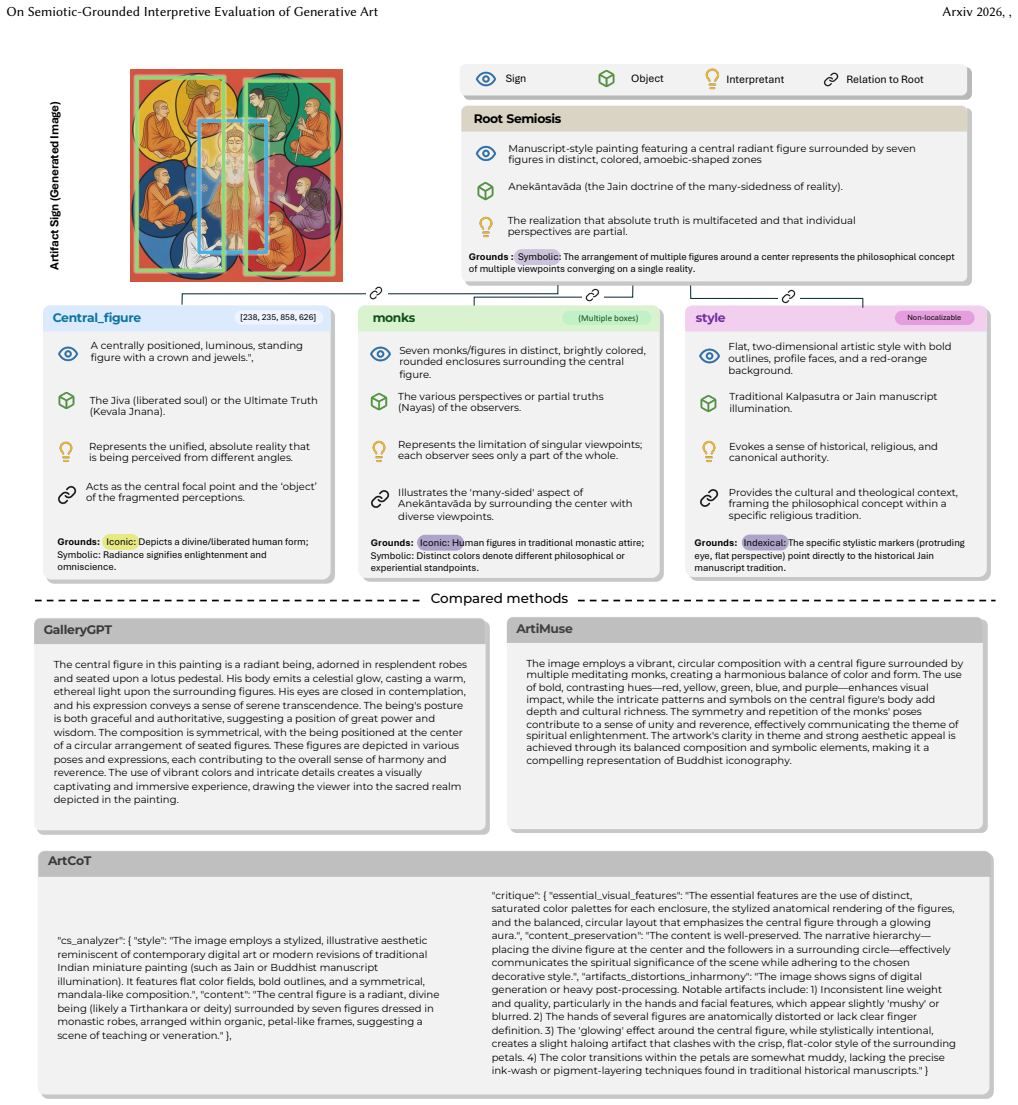
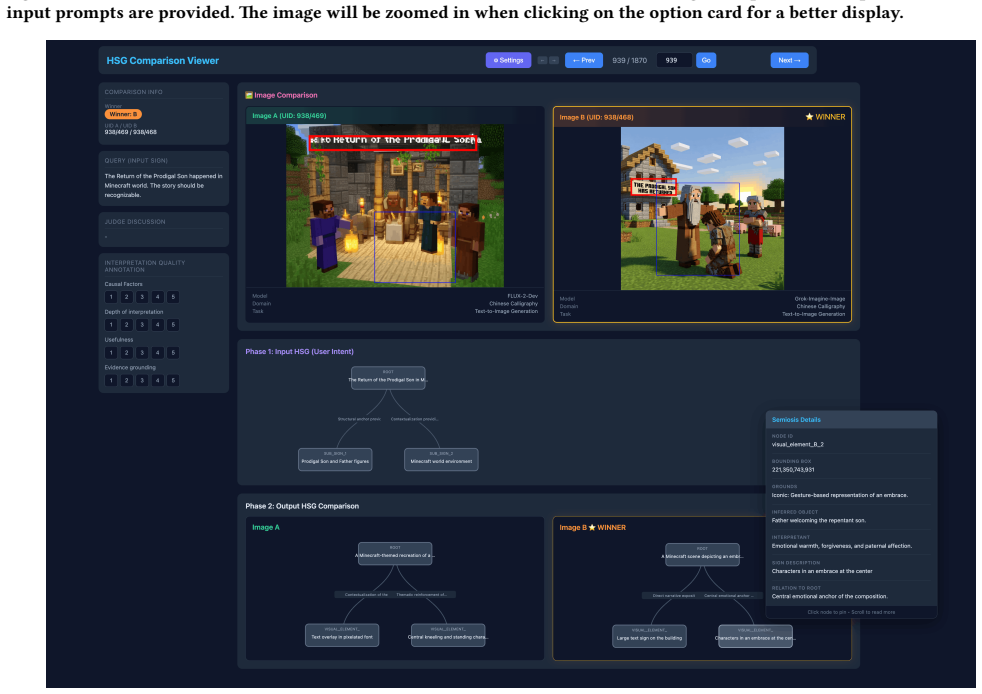
The Hierarchical Semiosis Graph (HSG), which models cascaded semiosis across iconic, symbolic, and indexical modes to reconstruct the process from prompt to generated artifact.
If this is right
- Evaluators can now assess symbolic and indexical meaning instead of remaining limited to iconic surface features.
- Generative art can be judged for its capacity to express complex human experience rather than only producing visually appealing images.
- SemJudge yields deeper and more insightful artistic interpretations than prior methods in user studies.
- The gap between generation and meaningful interpretation narrows, allowing GenArt to function as a communicative medium.
Where Pith is reading between the lines
- The same graph structure could be used to guide prompt engineering or model fine-tuning toward outputs with richer symbolic content.
- The three-mode semiotic lens might extend to evaluating other generative domains such as text or audio compositions.
- Careful validation would be needed to confirm that the formalization step itself does not embed new interpretive biases.
Load-bearing premise
The Peircean semiotic framework can be computationally formalized into a graph that accurately reconstructs artistic meaning-making without introducing subjective biases.
What would settle it
A head-to-head comparison on the interpretation-intensive fine-art benchmark in which SemJudge's correlation with human judgment scores does not exceed that of prior surface-level evaluators.
Figures







read the original abstract
Interpretation is essential to deciphering the language of art: audiences communicate with artists by recovering meaning from visual artifacts. However, current Generative Art (GenArt) evaluators remain fixated on surface-level image quality or literal prompt adherence, failing to assess the deeper symbolic or abstract meaning intended by the creator. We address this gap by formalizing a Peircean computational semiotic theory that models Human-GenArt Interaction (HGI) as cascaded semiosis. This framework reveals that artistic meaning is conveyed through three modes - iconic, symbolic, and indexical - yet existing evaluators operate heavily within the iconic mode, remaining structurally blind to the latter two. To overcome this structural blindness, we propose SemJudge. This evaluator explicitly assesses symbolic and indexical meaning in HGI via a Hierarchical Semiosis Graph (HSG) that reconstructs the meaning-making process from prompt to generated artifact. Extensive quantitative experiments show that SemJudge aligns more closely with human judgments than prior evaluators on an interpretation-intensive fine-art benchmark. User studies further demonstrate that SemJudge produces deeper, more insightful artistic interpretations, thereby paving the way for GenArt to move beyond the generation of "pretty" images toward a medium capable of expressing complex human experience. Project page: https://github.com/songrise/SemJudge.
Editorial analysis
A structured set of objections, weighed in public.
Referee Report
Summary. The paper formalizes a Peircean semiotic theory for evaluating generative art, modeling Human-GenArt Interaction as cascaded semiosis. It introduces SemJudge, which uses a Hierarchical Semiosis Graph (HSG) to explicitly assess iconic, symbolic, and indexical modes of meaning-making from prompt to artifact. The central claim is that SemJudge achieves closer alignment with human judgments than prior evaluators on an interpretation-intensive fine-art benchmark, as demonstrated by quantitative experiments and user studies showing deeper artistic interpretations.
Significance. If the core claims hold after addressing methodological gaps, this could meaningfully advance GenArt evaluation by moving beyond surface-level metrics toward capturing symbolic and abstract meaning. The attempt to computationally formalize semiotic modes via HSG is a novel direction that addresses a recognized limitation in current evaluators, potentially influencing future work on interpretive AI systems. However, the absence of reproducible details currently limits its assessed impact.
major comments (3)
- Abstract: The claim that 'extensive quantitative experiments show that SemJudge aligns more closely with human judgments than prior evaluators' is load-bearing for the central contribution, yet the text provides no details on the benchmark dataset, baseline evaluators, statistical tests, effect sizes, or controls for confounds, leaving the superiority assertion unsupported.
- Framework (HSG construction): The Hierarchical Semiosis Graph is described as reconstructing the meaning-making process and explicitly assessing symbolic/indexical modes, but no deterministic algorithm, feature definitions, mapping rules from Peircean categories, or inter-rater reliability protocol is specified. This risks unmeasured interpretive bias in node/edge assignment, which could artifactually inflate human alignment scores rather than demonstrate framework-independent fidelity.
- User studies section: The studies are asserted to show 'deeper, more insightful artistic interpretations,' but without methodology details such as participant criteria, comparison protocol, blinding, or qualitative analysis procedure, it is impossible to evaluate whether the reported advantage stems from the semiotic framework or from other factors.
minor comments (2)
- Abstract: The acronym HGI (Human-GenArt Interaction) and the phrase 'cascaded semiosis' are introduced without definition or reference to foundational Peircean literature, reducing accessibility for readers outside semiotic theory.
- Overall: The manuscript would benefit from a dedicated section or appendix providing pseudocode or a step-by-step example of HSG construction on a sample prompt-artifact pair to enable reproducibility.
Simulated Author's Rebuttal
We thank the referee for the constructive and detailed feedback. We address each major comment below and indicate the revisions planned for the next version of the manuscript.
read point-by-point responses
-
Referee: Abstract: The claim that 'extensive quantitative experiments show that SemJudge aligns more closely with human judgments than prior evaluators' is load-bearing for the central contribution, yet the text provides no details on the benchmark dataset, baseline evaluators, statistical tests, effect sizes, or controls for confounds, leaving the superiority assertion unsupported.
Authors: We agree that the abstract, being concise by nature, does not enumerate all experimental details. These are fully reported in Section 4, which describes the IIFAB benchmark (500 prompt-artifact pairs with expert semiotic annotations), the baselines (CLIPScore, BLIPScore, Aesthetic Score, and LPIPS), the use of Spearman rank correlation and Pearson correlation with permutation-based p-values, Cohen's d effect sizes, and confound controls via prompt-length and style matching. To make the central claim more transparent at the abstract level, we will add a sentence specifying the benchmark scale and the key correlation gains (SemJudge 0.68 vs. strongest baseline 0.41). This constitutes a partial revision. revision: partial
-
Referee: Framework (HSG construction): The Hierarchical Semiosis Graph is described as reconstructing the meaning-making process and explicitly assessing symbolic/indexical modes, but no deterministic algorithm, feature definitions, mapping rules from Peircean categories, or inter-rater reliability protocol is specified. This risks unmeasured interpretive bias in node/edge assignment, which could artifactually inflate human alignment scores rather than demonstrate framework-independent fidelity.
Authors: We accept that greater formalization is required for reproducibility. Section 3.2 already defines the three-layer HSG structure and the correspondence of nodes to Peirce's icon-symbol-index trichotomy, with edges representing semiosis transitions. Feature extraction uses CLIP embeddings for iconic similarity and fine-tuned language models for symbolic/indexical classification. Nevertheless, we acknowledge the absence of an explicit algorithm and reliability protocol. In the revision we will insert pseudocode for HSG construction, provide concrete mapping rules with illustrative examples, and report inter-annotator agreement (Fleiss' kappa = 0.79) obtained during expert labeling. These additions directly address the risk of interpretive bias. revision: yes
-
Referee: User studies section: The studies are asserted to show 'deeper, more insightful artistic interpretations,' but without methodology details such as participant criteria, comparison protocol, blinding, or qualitative analysis procedure, it is impossible to evaluate whether the reported advantage stems from the semiotic framework or from other factors.
Authors: We agree that the current description of the user studies in Section 5 is insufficiently detailed. The revision will expand this section to specify: participant recruitment (30 art professionals with >=5 years experience, sourced through institutional networks), experimental protocol (randomized, blinded pairwise comparisons of interpretations produced by SemJudge versus baseline evaluators), blinding procedures (participants unaware of system identity), and qualitative analysis (thematic coding of free-response data with reported inter-coder reliability). These clarifications will allow readers to judge whether the observed advantages derive from the semiotic framework. revision: yes
Circularity Check
No circularity: new semiotic formalization with independent experimental validation
full rationale
The paper introduces SemJudge via a Peircean-based Hierarchical Semiosis Graph (HSG) as a fresh computational model of cascaded semiosis in Human-GenArt Interaction, without any equations, fitted parameters, or derivations that reduce to the evaluation targets by construction. No self-citations are invoked as load-bearing uniqueness theorems, no ansatz is smuggled, and no known result is merely renamed. The central superiority claim rests on quantitative experiments and user studies against an external fine-art benchmark and human judgments, which are independent of the framework's internal definitions. The derivation chain from theory to HSG construction to alignment metrics therefore remains self-contained and non-circular.
Axiom & Free-Parameter Ledger
axioms (1)
- domain assumption Peircean semiotic theory (iconic, symbolic, indexical modes) can be directly mapped to computational evaluation of generative art outputs.
invented entities (1)
-
Hierarchical Semiosis Graph (HSG)
no independent evidence
Lean theorems connected to this paper
-
IndisputableMonolith/Foundation/AbsoluteFloorClosure.leanreality_from_one_distinction unclear?
unclearRelation between the paper passage and the cited Recognition theorem.
We address this gap by formalizing a Peircean computational semiotic theory that models Human-GenArt Interaction (HGI) as cascaded semiosis... via a Hierarchical Semiosis Graph (HSG)
-
IndisputableMonolith/Cost/FunctionalEquation.leanwashburn_uniqueness_aczel unclear?
unclearRelation between the paper passage and the cited Recognition theorem.
SemJudge explicitly assesses symbolic and indexical meaning in HGI via a Hierarchical Semiosis Graph (HSG)
What do these tags mean?
- matches
- The paper's claim is directly supported by a theorem in the formal canon.
- supports
- The theorem supports part of the paper's argument, but the paper may add assumptions or extra steps.
- extends
- The paper goes beyond the formal theorem; the theorem is a base layer rather than the whole result.
- uses
- The paper appears to rely on the theorem as machinery.
- contradicts
- The paper's claim conflicts with a theorem or certificate in the canon.
- unclear
- Pith found a possible connection, but the passage is too broad, indirect, or ambiguous to say the theorem truly supports the claim.
Reference graph
Works this paper leans on
-
[1]
Andrea Alfarano, Lorenzo Venturoli, and Darío Negueruela del Castillo. 2025. VQArt-Bench: A semantically rich VQA Benchmark for Art and Cultural Her- itage. In2025 IEEE/CVF International Conference on Computer Vision Workshops (ICCVW). IEEE, 406–416
2025
-
[2]
Mieke Bal and Norman Bryson. 1991. Semiotics and art history.The art bulletin 73, 2 (1991), 174–208
1991
-
[3]
Jason Baldridge, Jakob Bauer, Mukul Bhutani, Nicole Brichtova, Andrew Bunner, Lluis Castrejon, Kelvin Chan, Yichang Chen, Sander Dieleman, Yuqing Du, et al
-
[4]
Imagen 3.arXiv preprint arXiv:2408.07009, 2024
Imagen 3. arXiv preprint arXiv:2408.07009 (2024)
-
[5]
Irving Biederman. 1987. Recognition-by-components: a theory of human image understanding.Psychological review 94, 2 (1987), 115
1987
-
[6]
Yi Bin, Wenhao Shi, Yujuan Ding, Zhiqiang Hu, Zheng Wang, Yang Yang, See- Kiong Ng, and Heng Tao Shen. 2024. Gallerygpt: Analyzing paintings with large multimodal models. InProceedings of the 32nd ACM International Conference on Multimedia. 7734–7743
2024
-
[7]
Tibor Bleidt, Sedigheh Eslami, and Gerard De Melo. 2024. Artquest: Countering hidden language biases in artvqa. InProceedings of the IEEE/CVF Winter Confer- ence on Applications of Computer Vision . 7326–7335
2024
-
[8]
ByteDance Seed. 2025. Seedream 4.0: New-Generation Image Creation Model . ByteDance. https://seed.bytedance.com/en/seedream4_0
2025
-
[9]
Huanqia Cai, Sihan Cao, Ruoyi Du, Peng Gao, Steven Hoi, Zhaohui Hou, Shijie Huang, Dengyang Jiang, Xin Jin, Liangchen Li, et al. 2025. Z-Image: An Efficient Image Generation Foundation Model with Single-Stream Diffusion Transformer. arXiv preprint arXiv:2511.22699 (2025)
work page internal anchor Pith review arXiv 2025
- [10]
-
[11]
CapCut. 2024. Dreamina: All-in-one AI Creative Suite.https://dreamina.capcut. com/ Accessed: 2026-01-26
2024
-
[12]
Rebecca Chamberlain, Caitlin Mullin, Bram Scheerlinck, and Johan Wagemans
-
[13]
Psychology of Aesthetics, Creativity, and the Arts 12, 2 (2018), 177
Putting the art in artificial: Aesthetic responses to computer-generated art. Psychology of Aesthetics, Creativity, and the Arts 12, 2 (2018), 177
2018
-
[14]
Minsuk Chang, Stefania Druga, Alexander J Fiannaca, Pedro Vergani, Chinmay Kulkarni, Carrie J Cai, and Michael Terry. 2023. The prompt artists. InProceed- ings of the 15th Conference on Creativity and Cognition . 75–87
2023
-
[15]
Herschel Browning Chipp and Javier Tusell. 1988. Picasso’s Guernica: history, transformations, meanings.(No Title) (1988)
1988
-
[16]
Jaemin Cho, Yushi Hu, Jason M Baldridge, Roopal Garg, Peter Anderson, Ranjay Krishna, Mohit Bansal, Jordi Pont-Tuset, and Su Wang. 2024. Davidsonian Scene Graph: Improving Reliability in Fine-grained Evaluation for Text-to-Image Gen- eration. InICLR
2024
-
[17]
Christophe Croux and Catherine Dehon. 2010. Influence functions of the Spear- man and Kendall correlation measures.Statistical methods & applications 19, 4 (2010), 497–515
2010
-
[18]
Brian Curtin. 2009. Semiotics and visual representation.Semantic Scholar 4 (2009)
2009
-
[19]
Arthur Danto. 1964. The artworld.The journal of philosophy 61, 19 (1964), 571– 584
1964
-
[20]
1981.The transfiguration of the commonplace: a philosophy of art
Arthur C Danto. 1981.The transfiguration of the commonplace: a philosophy of art. Harvard University Press
1981
-
[21]
2005.The semiotic engineering of human-computer interaction
Clarisse Sieckenius De Souza. 2005.The semiotic engineering of human-computer interaction. MIT press
2005
-
[22]
2009.Semiotic engineering methods for scientific research in HCI
Clarisse Sickenius de Souza and Carla Faria Leitão. 2009.Semiotic engineering methods for scientific research in HCI . Morgan & Claypool Publishers
2009
-
[23]
Umberto Eco. 1979. A theory of semiotics . Vol. 217. Indiana University Press
1979
-
[24]
Umberto Eco. 1989. The open work. Harvard University Press
1989
-
[25]
James Elkins. 1999. The domain of images. Cornell University Press
1999
-
[26]
Ziv Epstein, Aaron Hertzmann, Investigators of Human Creativity, Memo Akten, Hany Farid, Jessica Fjeld, Morgan R Frank, Matthew Groh, Laura Herman, Neil Leach, et al. 2023. Art and the science of generative AI.Science 380, 6650 (2023), 1110–1111
2023
-
[27]
Noa Garcia and George Vogiatzis. 2018. How to read paintings: semantic art understanding with multi-modal retrieval. InProceedings of the European Con- ference on Computer Vision (ECCV) Workshops . 0–0
2018
-
[28]
Leon A Gatys, Alexander S Ecker, and Matthias Bethge. 2016. Image style trans- fer using convolutional neural networks. InProceedings of the IEEE conference on computer vision and pattern recognition . 2414–2423
2016
-
[29]
Eleni Gemtou. 2010. Subjectivity in art history and art criticism.Rupkatha Journal on Interdisciplinary Studies in Humanities 2, 1 (2010), 2–13
2010
-
[30]
1995.The story of art
Ernst Hans Gombrich and EH Gombrich. 1995.The story of art. Vol. 12. Phaidon London
1995
-
[31]
Nelson Goodman. 1976. Languages of art: An approach to a theory of symbols. Indianapolis: Bobbs-Merrill, 2nd ed/Hackett (1976)
1976
-
[32]
Google. 2025. Nano Banana Pro - Gemini AI image generator & photo editor. https://gemini.google/overview/image-generation/Accessed: 2026-01-26
2025
-
[33]
Anna Yoo Jeong Ha, Josephine Passananti, Ronik Bhaskar, Shawn Shan, Reid Southen, Haitao Zheng, and Ben Y Zhao. 2024. Organic or diffused: Can we distinguish human art from ai-generated images?. InProceedings of the 2024 on ACM SIGSAC Conference on Computer and Communications Security. 4822–4836
2024
-
[34]
Martin Heusel, Hubert Ramsauer, Thomas Unterthiner, Bernhard Nessler, and Sepp Hochreiter. 2017. Gans trained by a two time-scale update rule converge to a local nash equilibrium.Advances in neural information processing systems 30 (2017)
2017
-
[35]
Yushi Hu, Benlin Liu, Jungo Kasai, Yizhong Wang, Mari Ostendorf, Ranjay Kr- ishna, and Noah A Smith. 2023. Tifa: Accurate and interpretable text-to-image faithfulness evaluation with question answering. InProceedings of the IEEE/CVF International Conference on Computer Vision . 20406–20417
2023
-
[36]
Yipo Huang, Xiangfei Sheng, Zhichao Yang, Quan Yuan, Zhichao Duan, Pengfei Chen, Leida Li, Weisi Lin, and Guangming Shi. 2024. Aesexpert: Towards multi- modality foundation model for image aesthetics perception. InProceedings of the 32nd ACM International Conference on Multimedia . 5911–5920
2024
- [37]
-
[38]
Shahana Ibrahim, Panagiotis A Traganitis, Xiao Fu, and Georgios B Giannakis
-
[39]
IEEE Signal Processing Magazine 42, 3 (2025), 84–106
Learning from crowdsourced noisy labels: A signal processing perspective. IEEE Signal Processing Magazine 42, 3 (2025), 84–106
2025
-
[40]
Ideogram AI. 2024. Ideogram: Help People Become More Creative. https:// ideogram.ai/Accessed: 2026-01-26
2024
-
[41]
Ruixiang Jiang and Chang Wen Chen. 2025. Multimodal llms can reason about aesthetics in zero-shot. InProceedings of the 33rd ACM International Conference on Multimedia. 6634–6643
2025
-
[42]
Yuval Kirstain, Adam Polyak, Uriel Singer, Shahbuland Matiana, Joe Penna, and Omer Levy. 2023. Pick-a-pic: An open dataset of user preferences for text-to- image generation.Advances in Neural Information Processing Systems 36 (2023), 36652–36663
2023
- [43]
-
[44]
2020.Reading images: The grammar of visual design
Gunther Kress and Theo Van Leeuwen. 2020.Reading images: The grammar of visual design. Routledge
2020
-
[45]
Max Ku, Dongfu Jiang, Cong Wei, Xiang Yue, and Wenhu Chen. 2024. Viescore: Towards explainable metrics for conditional image synthesis evaluation. InPro- ceedings of the 62nd Annual Meeting of the Association for Computational Linguis- tics (Volume 1: Long Papers) . 12268–12290
2024
-
[46]
Jiayi Kuang, Yinghui Li, Chen Wang, Haohao Luo, Ying Shen, and Wenhao Jiang
-
[47]
InFindings of the Association for Computa- tional Linguistics: ACL 2025
Express What You See: Can Multimodal LLMs Decode Visual Ciphers with Intuitive Semiosis Comprehension?. InFindings of the Association for Computa- tional Linguistics: ACL 2025 . 12743–12774
2025
-
[48]
Black Forest Labs. 2024. FLUX.https://github.com/black-forest-labs/flux
2024
-
[49]
J Richard Landis and Gary G Koch. 1977. The measurement of observer agree- ment for categorical data.biometrics (1977), 159–174
1977
-
[50]
Susanne K. Langer. 2009.Philosophy in a New Key: A Study in the Symbolism of Reason, Rite, and Art (third edition ed.). Harvard University Press
2009
-
[51]
Susanne K Langer and . Langer. 1953.Feeling and form . Vol. 3. Routledge and Kegan Paul London
1953
-
[52]
I Lawrence and Kuei Lin. 1989. A concordance correlation coefficient to evaluate reproducibility.Biometrics (1989), 255–268
1989
- [53]
-
[54]
Chunyi Li, Zicheng Zhang, Haoning Wu, Wei Sun, Xiongkuo Min, Xiaohong Liu, Guangtao Zhai, and Weisi Lin. 2023. Agiqa-3k: An open database for ai- generated image quality assessment.IEEE Transactions on Circuits and Systems for Video Technology 34, 8 (2023), 6833–6846
2023
-
[55]
Jingping Liu, Ziyan Liu, Zhedong Cen, Yan Zhou, Yinan Zou, Weiyan Zhang, Haiyun Jiang, and Tong Ruan. 2025. Can Multimodal Large Language Models Understand Spatial Relations?. InProceedings of the 63rd Annual Meeting of the Association for Computational Linguistics (Volume 1: Long Papers) . 620–632
2025
-
[56]
Shilong Liu, Zhaoyang Zeng, Tianhe Ren, Feng Li, Hao Zhang, Jie Yang, Qing Jiang, Chunyuan Li, Jianwei Yang, Hang Su, et al. 2024. Grounding dino: Marry- ing dino with grounded pre-training for open-set object detection. InEuropean conference on computer vision . Springer, 38–55
2024
-
[57]
Chuofan Ma, Yi Jiang, Jiannan Wu, Zehuan Yuan, and Xiaojuan Qi. 2024. Groma: Localized visual tokenization for grounding multimodal large language models. In European Conference on Computer Vision . Springer, 417–435
2024
-
[58]
Rafał K Mantiuk, Anna Tomaszewska, and Radosław Mantiuk. 2012. Comparison of four subjective methods for image quality assessment. InComputer graphics forum, Vol. 31. Wiley Online Library, 2478–2491
2012
-
[59]
Alberto Maydeu-Olivares and Anna Brown. 2010. Item response modeling of paired comparison and ranking data. Multivariate Behavioral Research 45, 6 (2010), 935–974
2010
-
[60]
Douglas N Morgan. 1955. Icon, index, and symbol in the visual arts.Philosophi- cal Studies: An International Journal for Philosophy in the Analytic Tradition 6, 4 (1955), 49–54. Arxiv 2026, , Ruixiang Jiang and Chang Wen Chen
1955
-
[61]
Lia Morra, Antonio Santangelo, Pietro Basci, Luca Piano, Fabio Garcea, Fabrizio Lamberti, and Massimo Leone. 2024. For a semiotic AI: Bridging computer vision and visual semiotics for computational observation of large scale facial image archives.Computer Vision and Image Understanding 249 (2024), 104187
2024
-
[62]
Stefanie Nowak and Stefan Rüger. 2010. How reliable are annotations via crowd- sourcing: a study about inter-annotator agreement for multi-label image anno- tation. InProceedings of the international conference on Multimedia information retrieval. 557–566
2010
-
[63]
OpenAI. 2025. GPT-Image 1 - OpenAI API Documentation . https://platform. openai.com/docs/models/gpt-image-1
2025
-
[64]
OpenAI. 2025. GPT-Image 1.5 - OpenAI API Documentation. https://platform. openai.com/docs/models/gpt-image-1.5Accessed: 2026-01-26
2025
-
[65]
Erwin Panofsky. 1955. Meaning in the Visual Arts: Papers in and on Art History . University of Chicago Press
1955
-
[66]
Barbara Partee et al. 1984. Compositionality.Varieties of formal semantics 3 (1984), 281–311
1984
-
[67]
1991.Peirce on signs: Writings on semiotic
Charles Sanders Peirce. 1991.Peirce on signs: Writings on semiotic . UNC Press Books
1991
-
[68]
1992.The essential peirce, volume 2: Selected philosophical writings (1893-1913)
Charles Sanders Peirce. 1992.The essential peirce, volume 2: Selected philosophical writings (1893-1913). Vol. 2. Indiana University Press
1992
- [69]
-
[70]
Qwen Team. 2025. Qwen Image 2.0. https://qwen.ai/blog?id=qwen-image-2.0 Accessed: 2026-03-27
2025
-
[71]
Alec Radford, Jong Wook Kim, Chris Hallacy, Aditya Ramesh, Gabriel Goh, Sand- hini Agarwal, Girish Sastry, Amanda Askell, Pamela Mishkin, Jack Clark, et al
-
[72]
In International conference on machine learning
Learning transferable visual models from natural language supervision. In International conference on machine learning . PMLR, 8748–8763
-
[73]
William Rudman, Michal Golovanevsky, Amir Bar, Vedant Palit, Yann LeCun, Carsten Eickhoff, and Ritambhara Singh. 2025. Forgotten polygons: Multimodal large language models are shape-blind. InFindings of the Association for Compu- tational Linguistics: ACL 2025 . 11983–11998
2025
-
[74]
Tim Salimans, Ian Goodfellow, Wojciech Zaremba, Vicki Cheung, Alec Radford, and Xi Chen. 2016. Improved techniques for training gans.Advances in neural information processing systems 29 (2016)
2016
-
[75]
Andrew Samo and Scott Highhouse. 2023. Artificial intelligence and art: Iden- tifying the aesthetic judgment factors that distinguish human-and machine- generated artwork.Psychology of Aesthetics, Creativity, and the Arts (2023)
2023
-
[76]
Christoph Schuhmann, Romain Beaumont, Richard Vencu, Cade Gordon, Ross Wightman, Mehdi Cherti, Theo Coombes, Aarush Katta, Clayton Mullis, Mitchell Wortsman, et al. 2022. Laion-5b: An open large-scale dataset for training next generation image-text models.Advances in Neural Information Processing Sys- tems 35 (2022), 25278–25294
2022
-
[77]
José L Cendejas Valdez, Heberto Ferreira Medina, Jesús L Soto Sumuano, Gus- tavo A Vanegas Contreras, Miguel A Acuña López, and Gustavo A López Saldaña
-
[78]
InFuture of Information and Communication Conference
Semiotics and Artificial Intelligence (AI): An Analysis of Symbolic Commu- nication in the Age of Technology. InFuture of Information and Communication Conference. Springer, 481–494
-
[79]
Jules Van Hees, Tijl Grootswagers, Genevieve L Quek, and Manuel Varlet. 2025. Human perception of art in the age of artificial intelligence.Frontiers in psychol- ogy 15 (2025), 1497469
2025
- [80]
discussion (0)
Sign in with ORCID, Apple, or X to comment. Anyone can read and Pith papers without signing in.