Recognition: 2 theorem links
· Lean TheoremSPPO: Sequence-Level PPO for Long-Horizon Reasoning Tasks
Pith reviewed 2026-05-10 18:13 UTC · model grok-4.3
The pith
SPPO treats full reasoning sequences as single bandit actions to stabilize PPO updates with one scalar value estimate.
A machine-rendered reading of the paper's core claim, the machinery that carries it, and where it could break.
Core claim
SPPO models the entire reasoning process as a single action in a Sequence-Level Contextual Bandit problem. A decoupled scalar value function then supplies low-variance advantage signals for the full sequence without any multi-sampling, allowing the PPO objective to update the policy stably over long CoT horizons at the cost of only one rollout per prompt.
What carries the argument
The decoupled scalar value function inside the Sequence-Level Contextual Bandit formulation, which estimates the value of a complete reasoning sequence to produce advantage estimates.
If this is right
- Single-sample training raises throughput compared with group-based methods that require multiple rollouts per prompt.
- Memory footprint drops because only a scalar value is stored instead of a token-level critic.
- PPO becomes usable on longer CoT tasks without the instability that previously limited token-level application.
- Alignment of reasoning LLMs can proceed on hardware that cannot support the extra sampling of group methods.
Where Pith is reading between the lines
- The bandit framing may extend to other long-horizon sequential tasks such as multi-step code generation or planning.
- A scalar value per sequence could be combined with other exploration strategies that currently rely on group baselines.
- Testing the same reformulation on non-mathematical reasoning domains would reveal whether the low-variance property is domain-specific.
Load-bearing premise
That a single scalar value attached to the whole sequence can supply accurate credit assignment across every step of a long reasoning chain.
What would settle it
An experiment on a math benchmark where SPPO trained for the same number of steps yields both higher advantage variance than standard PPO and lower final accuracy than group-based methods.
Figures







read the original abstract
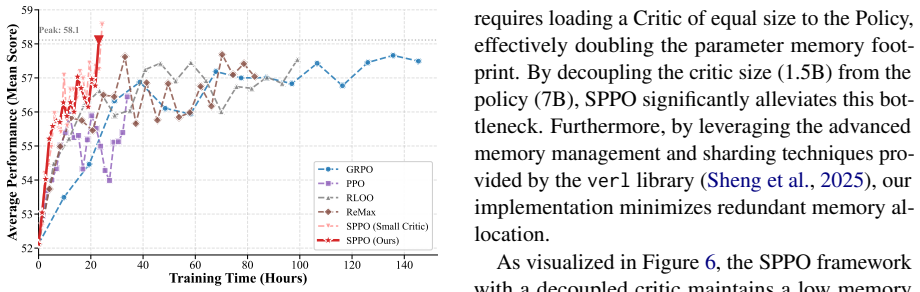
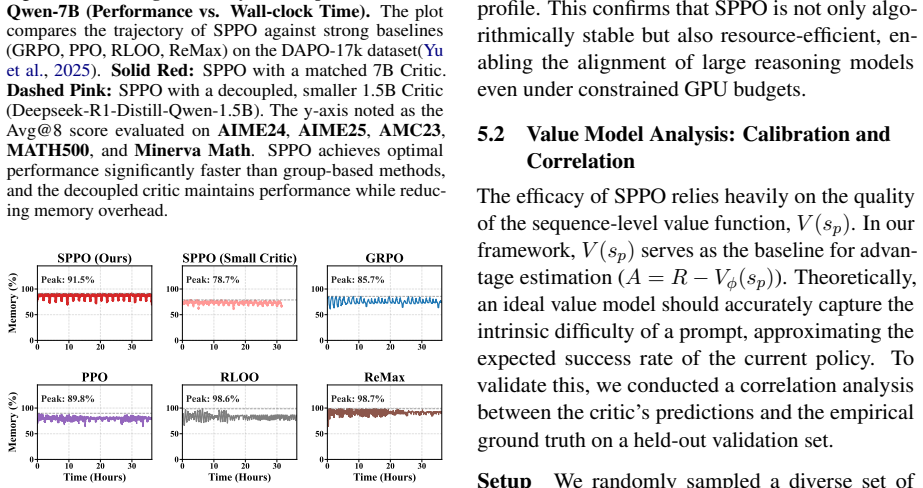
Proximal Policy Optimization (PPO) is central to aligning Large Language Models (LLMs) in reasoning tasks with verifiable rewards. However, standard token-level PPO struggles in this setting due to the instability of temporal credit assignment over long Chain-of-Thought (CoT) horizons and the prohibitive memory cost of the value model. While critic-free alternatives like GRPO mitigate these issues, they incur significant computational overhead by requiring multiple samples for baseline estimation, severely limiting training throughput. In this paper, we introduce Sequence-Level PPO (SPPO), a scalable algorithm that harmonizes the sample efficiency of PPO with the stability of outcome-based updates. SPPO reformulates the reasoning process as a Sequence-Level Contextual Bandit problem, employing a decoupled scalar value function to derive low-variance advantage signals without multi-sampling. Extensive experiments on mathematical benchmarks demonstrate that SPPO significantly surpasses standard PPO and matches the performance of computation-heavy group-based methods, offering a resource-efficient framework for aligning reasoning LLMs.
Editorial analysis
A structured set of objections, weighed in public.
Referee Report
Summary. The paper introduces Sequence-Level PPO (SPPO) as an alternative to token-level PPO for aligning LLMs on long-horizon reasoning tasks with verifiable outcome rewards. It reformulates reasoning as a sequence-level contextual bandit problem and uses a decoupled scalar value function V(prompt) to produce advantage estimates r - V(prompt), claiming this yields stable low-variance signals without token-level credit assignment or the multi-sampling overhead of group-based methods such as GRPO. Extensive experiments on mathematical benchmarks are reported to show that SPPO outperforms standard PPO and matches the performance of more computationally expensive group-based approaches.
Significance. If the core mechanism holds, SPPO would offer a practical efficiency gain for RL-based alignment of reasoning models by avoiding both the memory cost of a full value head and the throughput penalty of repeated sampling per prompt. The reported benchmark results, if reproducible, would support a resource-efficient alternative to existing PPO variants for long CoT settings.
major comments (2)
- [Abstract and §3] Abstract and §3 (method description): The claim that the decoupled scalar value function produces low-variance advantage signals without multi-sampling rests on the unproven assumption that V(prompt) accurately approximates expected outcome reward from single trajectories even as the policy shifts and rewards remain sparse. No derivation or variance analysis is provided showing that estimation error in V does not inflate advantage variance or introduce bias over long horizons; this directly undermines the stability and efficiency arguments relative to both standard PPO and GRPO.
- [§4] §4 (experiments): The abstract states that SPPO 'significantly surpasses standard PPO and matches the performance of computation-heavy group-based methods,' yet no quantitative details (effect sizes, number of runs, variance across seeds, or exact baselines) are supplied in the provided description. Without these, the central performance claim cannot be evaluated for statistical reliability or practical significance.
minor comments (2)
- [Abstract] The abstract would benefit from naming the specific mathematical benchmarks (e.g., GSM8K, MATH) and briefly indicating the scale of the models used.
- [§3] Notation for the scalar value function V(prompt) and the exact training objective for V should be introduced earlier and used consistently.
Simulated Author's Rebuttal
We thank the referee for the constructive feedback on our manuscript. We address each major comment point by point below, providing clarifications and committing to revisions that strengthen the paper without misrepresenting our contributions.
read point-by-point responses
-
Referee: [Abstract and §3] The claim that the decoupled scalar value function produces low-variance advantage signals without multi-sampling rests on the unproven assumption that V(prompt) accurately approximates expected outcome reward from single trajectories even as the policy shifts and rewards remain sparse. No derivation or variance analysis is provided showing that estimation error in V does not inflate advantage variance or introduce bias over long horizons; this directly undermines the stability and efficiency arguments relative to both standard PPO and GRPO.
Authors: We acknowledge the value of a formal analysis to support the low-variance claim. In the revised manuscript, we will expand §3 with a derivation under the sequence-level contextual bandit formulation: because rewards are terminal and the advantage is computed as r - V(prompt) (where V is updated on-policy), the estimator avoids the variance from token-level credit assignment that accumulates over long horizons in standard PPO. We will also add empirical measurements of advantage variance across training steps and compare to GRPO baselines. This directly addresses potential bias from policy shifts by showing V tracks the evolving expected return. revision: yes
-
Referee: [§4] The abstract states that SPPO 'significantly surpasses standard PPO and matches the performance of computation-heavy group-based methods,' yet no quantitative details (effect sizes, number of runs, variance across seeds, or exact baselines) are supplied in the provided description. Without these, the central performance claim cannot be evaluated for statistical reliability or practical significance.
Authors: The full §4 and associated tables/figures in the manuscript already report these elements (e.g., mean accuracies with standard deviations over multiple seeds, exact baselines including GRPO with group size 8, and per-benchmark improvements). To make the claims more transparent, we will revise the abstract to include concise quantitative highlights and add a summary table in the main text with effect sizes and seed variance. This ensures the performance results are statistically evaluable without altering the experimental setup. revision: yes
Circularity Check
No significant circularity; SPPO is an independent algorithmic proposal
full rationale
The paper introduces SPPO as a reformulation of reasoning tasks into a sequence-level contextual bandit problem using a decoupled scalar value function V(prompt) to compute advantages. This construction is presented as a new method that combines PPO's sample efficiency with outcome-based stability, without reducing the claimed low-variance advantages or performance gains to any fitted parameters, self-defined quantities, or prior self-citations by construction. The abstract and description treat the reformulation and its benefits as a proposed derivation rather than a renaming or tautological fit. No load-bearing equations or steps in the provided text exhibit the enumerated circular patterns; the central claims remain open to empirical verification outside the derivation itself.
Axiom & Free-Parameter Ledger
axioms (1)
- standard math Standard policy gradient and advantage estimation assumptions from reinforcement learning hold for sequence-level updates.
Lean theorems connected to this paper
-
IndisputableMonolith/Cost/FunctionalEquation.leanwashburn_uniqueness_aczel unclearSPPO reformulates the reasoning process as a Sequence-Level Contextual Bandit problem, employing a decoupled scalar value function to derive low-variance advantage signals without multi-sampling.
-
IndisputableMonolith/Foundation/RealityFromDistinction.leanreality_from_one_distinction unclearA(sp, a) = R - Vϕ(sp)
Forward citations
Cited by 3 Pith papers
-
Your Language Model is Its Own Critic: Reinforcement Learning with Value Estimation from Actor's Internal States
POISE estimates value baselines for RL in LLMs from the actor's internal states via a lightweight probe and cross-rollout construction, matching DAPO performance with lower compute on math reasoning benchmarks.
-
Your Language Model is Its Own Critic: Reinforcement Learning with Value Estimation from Actor's Internal States
POISE trains a lightweight probe on the actor's internal states to predict expected rewards for RLVR, matching DAPO performance on math benchmarks with lower compute by avoiding extra rollouts or critic models.
-
StepPO: Step-Aligned Policy Optimization for Agentic Reinforcement Learning
StepPO argues that LLM agents should optimize at the step level rather than token level to better handle delayed rewards and long contexts in agentic RL.
Reference graph
Works this paper leans on
-
[1]
Let’s verify step by step.Preprint, arXiv:2305.20050. Zhihang Lin, Mingbao Lin, Yuan Xie, and Rongrong Ji. 2025. Cppo: Accelerating the training of group relative policy optimization-based reasoning models. Preprint, arXiv:2503.22342. Zichen Liu, Changyu Chen, Wenjun Li, Penghui Qi, Tianyu Pang, Chao Du, Wee Sun Lee, and Min Lin
work page internal anchor Pith review Pith/arXiv arXiv 2025
-
[2]
Understanding R1-Zero-Like Training: A Critical Perspective
Understanding r1-zero-like training: A critical perspective.Preprint, arXiv:2503.20783. Michael Luo, Sijun Tan, Justin Wong, Xiaoxiang Shi, William Y . Tang, Manan Roongta, Colin Cai, Jeffrey Luo, Li Erran Li, Raluca Ada Popa, and Ion Stoica
work page internal anchor Pith review arXiv
-
[3]
Proximal Policy Optimization Algorithms
Deepscaler: Surpassing o1-preview with a 1.5b model by scaling rl. https://pretty-radio -b75.notion.site/DeepScaleR-Surpassing-O 1-Preview-with-a-1-5B-Model-by-Scaling-R L-19681902c1468005bed8ca303013a4e2 . Notion Blog. John Schulman, Filip Wolski, Prafulla Dhariwal, Alec Radford, and Oleg Klimov. 2017. Prox- imal policy optimization algorithms.Preprint, ...
work page internal anchor Pith review Pith/arXiv arXiv 2017
discussion (0)
Sign in with ORCID, Apple, or X to comment. Anyone can read and Pith papers without signing in.