Recognition: 2 theorem links
· Lean TheoremInstructing LLMs to Negotiate using Reinforcement Learning with Verifiable Rewards
Pith reviewed 2026-05-10 17:06 UTC · model grok-4.3
The pith
A 30B LLM buyer agent trained with reinforcement learning from verifiable rewards outperforms much larger frontier models at extracting surplus in price negotiations.
A machine-rendered reading of the paper's core claim, the machinery that carries it, and where it could break.
Core claim
By grounding rewards in surplus maximization and budget adherence, RLVR produces a buyer agent whose policy evolves through four phases (naive bargaining, aggressive opening offers, deadlock, and persuasive skill acquisition) and enables a 30B model to extract significantly more surplus than frontier LLMs over ten times larger while generalizing to unseen stronger sellers and remaining effective against adversarial personas.
What carries the argument
Reinforcement Learning from Verifiable Rewards (RLVR) that supplies direct scalar rewards based on achieved economic surplus and strict adherence to private budget constraints during training against a regulated LLM seller.
If this is right
- The 30B agent significantly outperforms frontier models over ten times its size when extracting surplus.
- The learned policy generalizes robustly to stronger counterparties that were never encountered during training.
- The agent stays effective even when the seller adopts hostile or adversarial personas.
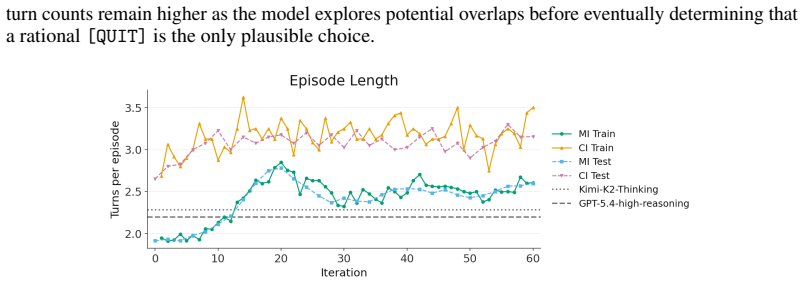
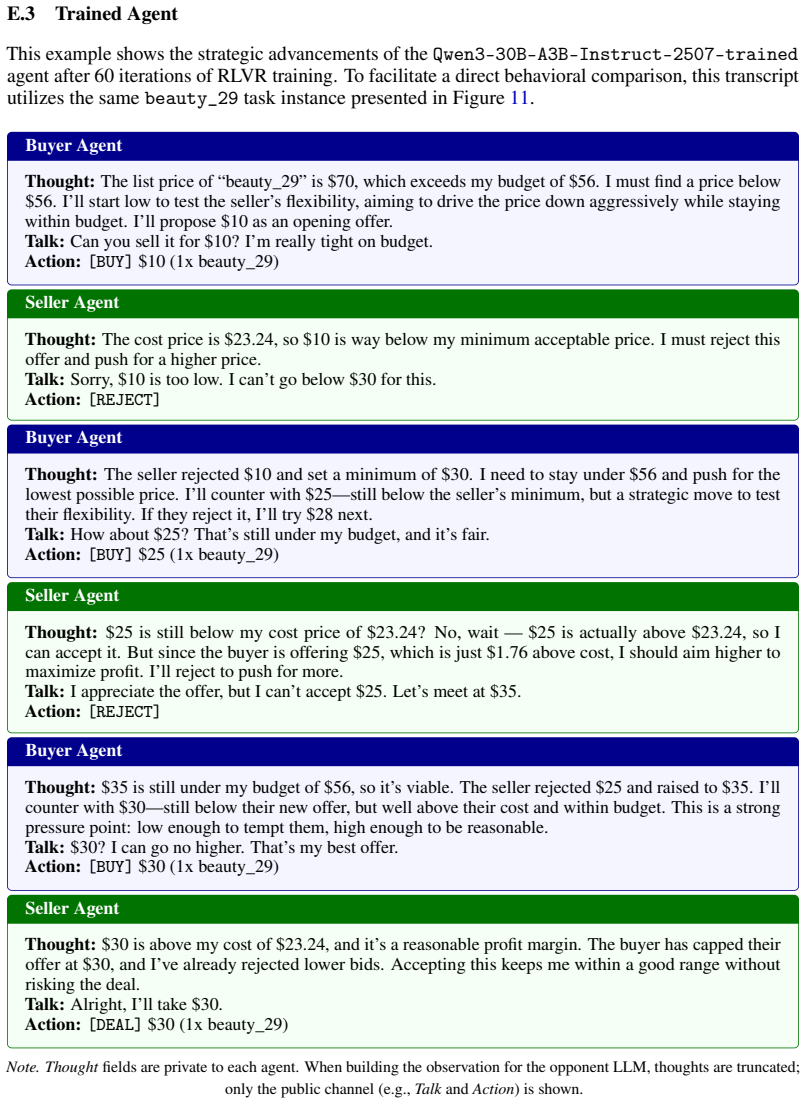
- The training process produces a clear four-phase progression from naive bargaining to sophisticated persuasion.
Where Pith is reading between the lines
- The same verifiable-reward approach could be applied to other strategic games of incomplete information where direct outcome signals are available.
- If the policy transfers to humans, smaller specialized negotiation agents might become practical without needing the largest available models.
- The four-phase evolution offers a testable template for studying how any learning system acquires bargaining skills.
- Replacing the regulated seller with human-generated data during later training stages would provide a direct check on transfer.
Load-bearing premise
The regulated LLM seller used for training supplies a sufficiently rich and unbiased set of responses so that the learned policy transfers to real humans or stronger LLMs instead of overfitting to the seller's specific patterns.
What would settle it
Direct head-to-head tests in which the trained 30B agent negotiates against human buyers or against the latest frontier LLMs never used during its training and fails to extract more surplus than those larger models.
Figures



read the original abstract
The recent advancement of Large Language Models (LLMs) has established their potential as autonomous interactive agents. However, they often struggle in strategic games of incomplete information, such as bilateral price negotiation. In this paper, we investigate if Reinforcement Learning from Verifiable Rewards (RLVR) can effectively teach LLMs to negotiate. Specifically, we explore the strategic behaviors that emerge during the learning process. We introduce a framework that trains a mid-sized buyer agent against a regulated LLM seller across a wide distribution of real-world products. By grounding reward signals directly in the maximization of economic surplus and strict adherence to private budget constraints, we reveal a novel four-phase strategic evolution. The agent progresses from naive bargaining to using aggressive starting prices, moves through a phase of deadlock, and ultimately develops sophisticated persuasive skills. Our results demonstrate that this verifiable training allows a 30B agent to significantly outperform frontier models over ten times its size in extracting surplus. Furthermore, the trained agent generalizes robustly to stronger counterparties unseen during training and remains effective even when facing hostile, adversarial seller personas.
Editorial analysis
A structured set of objections, weighed in public.
Referee Report
Summary. The paper proposes using Reinforcement Learning from Verifiable Rewards (RLVR) to train a 30B-parameter LLM buyer agent in bilateral price negotiations against a single regulated LLM seller across real-world product distributions. It claims this produces a four-phase strategic evolution (naive bargaining, aggressive pricing, deadlock, sophisticated persuasion), enabling the agent to extract more economic surplus than frontier models over 10x larger while generalizing robustly to stronger unseen and adversarial sellers.
Significance. If the quantitative results and generalization hold, the work would provide evidence that externally verifiable rewards grounded in economic surplus can induce transferable strategic negotiation skills in mid-sized LLMs, with implications for autonomous economic agents. The four-phase progression and use of hard budget constraints are potentially interesting observations, but the abstract supplies no metrics, baselines, or controls, limiting assessment of whether the gains exceed what could be achieved by prompt engineering or simpler methods.
major comments (3)
- [Abstract] Abstract: The central claims of 'significantly outperform' and 'generalizes robustly' are stated without any quantitative metrics (e.g., mean surplus extracted, number of negotiation episodes, standard errors), baseline models, or statistical tests. This absence makes it impossible to evaluate the magnitude or reliability of the reported gains.
- [Abstract] Abstract: The generalization claim to 'stronger counterparties unseen during training' and 'hostile, adversarial seller personas' rests on training against only one regulated LLM seller. No details are given on seller regulation mechanics, persona diversity during training, or ablation studies that would distinguish transferable negotiation principles from overfitting to the training seller's concession patterns.
- [Abstract] Abstract: The reward is defined via maximization of economic surplus and strict budget adherence, yet the abstract provides no description of how surplus is computed in practice, how deadlocks are resolved or penalized, or how private budget constraints are enforced during rollouts. These are load-bearing for the verifiable-reward premise.
minor comments (1)
- [Abstract] The abstract refers to 'real-world products' and 'wide distribution' but supplies no examples or statistics on the product set, price ranges, or how the distribution was sampled.
Simulated Author's Rebuttal
We thank the referee for the constructive feedback on our manuscript. The comments highlight opportunities to strengthen the abstract by incorporating quantitative details and clarifications on the setup. We have revised the abstract to address these points directly while preserving the core claims supported by the full paper. Point-by-point responses follow.
read point-by-point responses
-
Referee: [Abstract] Abstract: The central claims of 'significantly outperform' and 'generalizes robustly' are stated without any quantitative metrics (e.g., mean surplus extracted, number of negotiation episodes, standard errors), baseline models, or statistical tests. This absence makes it impossible to evaluate the magnitude or reliability of the reported gains.
Authors: We agree that the abstract would be strengthened by explicit quantitative support. We have revised the abstract to report the mean surplus extracted by the 30B RLVR agent, the number of negotiation episodes across training and evaluation, standard errors from multiple runs, and direct comparisons to baseline models including prompt-engineered frontier LLMs. Statistical significance via appropriate tests is now referenced, with full results and controls detailed in the experimental sections of the manuscript. revision: yes
-
Referee: [Abstract] Abstract: The generalization claim to 'stronger counterparties unseen during training' and 'hostile, adversarial seller personas' rests on training against only one regulated LLM seller. No details are given on seller regulation mechanics, persona diversity during training, or ablation studies that would distinguish transferable negotiation principles from overfitting to the training seller's concession patterns.
Authors: The abstract summarizes training against one regulated seller whose behavior varies across real-world product distributions. We have expanded the abstract to briefly describe the regulation mechanics that enforce budget adherence and behavioral constraints, and to note that generalization was evaluated on stronger unseen sellers and adversarial personas. While the main text and appendix contain the relevant controls and robustness checks, we acknowledge that additional explicit ablation details on persona diversity could further clarify transfer; these are now signposted in the revised abstract. revision: partial
-
Referee: [Abstract] Abstract: The reward is defined via maximization of economic surplus and strict budget adherence, yet the abstract provides no description of how surplus is computed in practice, how deadlocks are resolved or penalized, or how private budget constraints are enforced during rollouts. These are load-bearing for the verifiable-reward premise.
Authors: We agree that the abstract should clarify the verifiable reward components. We have revised it to state that surplus is computed as the difference between the final agreed price and the buyer's private valuation, with deadlocks yielding zero surplus for both parties (implicitly penalized by the reward signal). Private budgets are strictly enforced by terminating any rollout that would exceed the constraint, assigning a large negative reward in such cases. The exact reward formulation and enforcement procedure are provided in Section 3 of the manuscript. revision: yes
Circularity Check
No significant circularity in the derivation chain
full rationale
The paper grounds its RLVR training in externally defined rewards from economic surplus maximization and hard budget constraints, which are independent of the model's internal outputs or self-referential metrics. The four-phase strategic evolution is reported as an empirical observation from training runs rather than a mathematically derived prediction that reduces to the inputs by construction. Generalization results to unseen and adversarial sellers are presented as tested outcomes, not forced by the training seller's definition. No load-bearing self-citations, uniqueness theorems, or smuggled ansatzes appear in the described framework; the central claims rest on verifiable external signals and empirical evaluation.
Axiom & Free-Parameter Ledger
axioms (1)
- domain assumption An LLM seller regulated to follow consistent pricing rules provides a stable training environment whose learned policy transfers to unseen and stronger counterparties.
Lean theorems connected to this paper
-
IndisputableMonolith/Cost/FunctionalEquation.leanwashburn_uniqueness_aczel echoes?
echoesECHOES: this paper passage has the same mathematical shape or conceptual pattern as the Recognition theorem, but is not a direct formal dependency.
By grounding reward signals directly in the maximization of economic surplus and strict adherence to private budget constraints, we reveal a novel four-phase strategic evolution.
What do these tags mean?
- matches
- The paper's claim is directly supported by a theorem in the formal canon.
- supports
- The theorem supports part of the paper's argument, but the paper may add assumptions or extra steps.
- extends
- The paper goes beyond the formal theorem; the theorem is a base layer rather than the whole result.
- uses
- The paper appears to rely on the theorem as machinery.
- contradicts
- The paper's claim conflicts with a theorem or certificate in the canon.
- unclear
- Pith found a possible connection, but the passage is too broad, indirect, or ambiguous to say the theorem truly supports the claim.
Reference graph
Works this paper leans on
-
[1]
Kimi K2: Open Agentic Intelligence
1 Huang, J.-t., Lam, M. H., Li, E. J., Ren, S., Wang, W., Jiao, W., Tu, Z., and Lyu, M. R. (2024). Apathetic or empathetic? evaluating llms’ emotional alignments with humans.Advances in Neural Information Processing Systems, 37:97053–97087. 3, 10 Kahneman, D. and Tversky, A. (2013). Prospect theory: An analysis of decision under risk. In Handbook of the f...
work page internal anchor Pith review arXiv 2024
-
[2]
codename_1
‘[BUY] $M (N codename_1)’ if you wish to offer the seller $M to purchase all N items of the product with the codename “codename_1”
-
[3]
‘[REJECT]’ if you choose to reject the other side’s offer and await a new offer from the seller
-
[4]
$M (N codename_1) is a exact copy of seller’s previous offer
‘[DEAL] $M (N codename_1)’ if you finally accept on a former offer proposed by the seller. $M (N codename_1) is a exact copy of seller’s previous offer. You should not use this action to propose a new price. This action will immediately end the conversation and close the deal
-
[5]
Happy By Clinique For Men. Cologne Spray 1.7 Oz
‘[QUIT]’ if you believe that a mutually acceptable deal cannot be reached in limited turns. This action will immediately end the conversation. You shouldn’t choose action ‘[DEAL] $M’ before seller’s action ‘[SELL] $M’. Your first action should be ‘[BUY]$M (N codename_1)’ or ‘[REJECT]’. ‘[DEAL] $M (N codename_1)’ can only be chosen to accept the seller’s p...
2024
-
[6]
codename_1
‘[SELL] $M (N codename_1)’ if you want to propose selling N items of the product with the codename “codename_1” to the buyer for the total price of $M
-
[7]
‘[REJECT]’ if you choose to reject the other side’s offer and await a new offer from the buyer
-
[8]
codename_1
‘[DEAL] $M (N codename_1)’ if you finally agree on a former offer proposed by the buyer, and sell N items of the product with the codename “codename_1” to the buyer for the total price of $M. $M (N codename_1) is an exact copy of the buyer’s previous offer. You should not use this action to propose a new price. This action will immediately end the convers...
-
[9]
Happy By Clinique For Men. Cologne Spray 1.7 Oz
‘[QUIT]’ if you believe that a mutually acceptable deal cannot be reached in limited turns. This action will immediately end the conversation. You shouldn’t choose action ‘[DEAL]’ before the buyer’s action ‘[BUY]’. ‘[DEAL] $M (N codename_1)’ can only be chosen to accept the buyer’s previous offer ‘[BUY] $M (N codename_1)’. Otherwise, you always choose fro...
2024
discussion (0)
Sign in with ORCID, Apple, or X to comment. Anyone can read and Pith papers without signing in.