Recognition: no theorem link
PhyMix: Towards Physically Consistent Single-Image 3D Indoor Scene Generation with Implicit--Explicit Optimization
Pith reviewed 2026-05-10 15:45 UTC · model grok-4.3
The pith
PhyMix generates single-image 3D indoor scenes that satisfy real-world physics by feeding a new evaluator into both training and inference stages.
A machine-rendered reading of the paper's core claim, the machinery that carries it, and where it could break.
Core claim
The paper establishes that a unified Physics Evaluator measuring geometric priors, contact, stability, and deployability through nine sub-constraints can be integrated into both implicit alignment via Scene-GRPO and explicit refinement via a differentiable Test-Time Optimizer, producing 3D indoor scenes from single images that achieve state-of-the-art visual fidelity together with physical plausibility.
What carries the argument
PhyMix, which combines Scene-GRPO (a critic-free group-relative policy optimization using the evaluator as a preference signal) with a plug-and-play Test-Time Optimizer that applies differentiable evaluator signals to fix residual violations.
If this is right
- Generated scenes satisfy all nine physical sub-constraints while preserving visual quality metrics.
- The same framework applies across synthetic test sets and qualitative results on both stylized and real-world input images.
- The Physics Evaluator functions as a reusable benchmark for measuring physical consistency in future 3D generation work.
- The approach unifies evaluation, reward shaping during training, and correction at inference into a single pipeline.
Where Pith is reading between the lines
- The evaluator could be reused to score and improve existing 3D reconstructions that were not generated by this method.
- Similar implicit-explicit feedback loops might extend to other consistency requirements such as functional object affordances.
- Early insertion of physics signals into the base generator could reduce reliance on test-time correction steps.
Load-bearing premise
The Physics Evaluator accurately measures real physical consistency across its nine constraints and supplies usable differentiable signals that improve scenes without creating new visual or geometric problems.
What would settle it
If 3D scenes produced by PhyMix still show clear physical failures such as floating objects or unstable stacks when placed in a standard physics simulator, the claim that the method achieves improved physical plausibility would be refuted.
Figures



read the original abstract
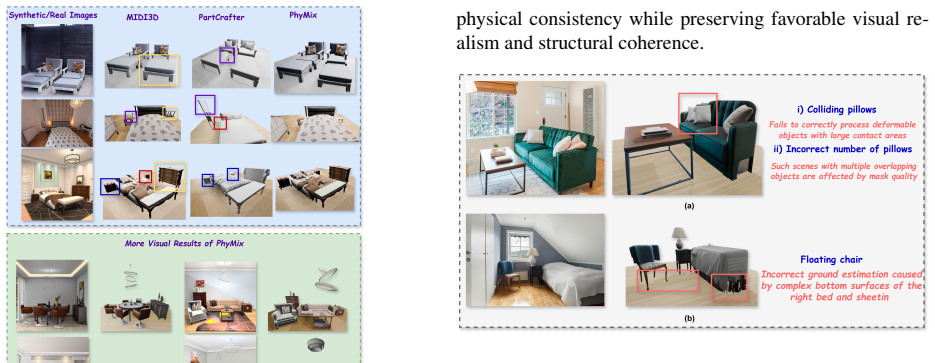
Existing single-image 3D indoor scene generators often produce results that look visually plausible but fail to obey real-world physics, limiting their reliability in robotics, embodied AI, and design. To examine this gap, we introduce a unified Physics Evaluator that measures four main aspects: geometric priors, contact, stability, and deployability, which are further decomposed into nine sub-constraints, establishing the first benchmark to measure physical consistency. Based on this evaluator, our analysis shows that state-of-the-art methods remain largely physics-unaware. To overcome this limitation, we further propose a framework that integrates feedback from the Physics Evaluator into both training and inference, enhancing the physical plausibility of generated scenes. Specifically, we propose PhyMix, which is composed of two complementary components: (i) implicit alignment via Scene-GRPO, a critic-free group-relative policy optimization that leverages the Physics Evaluator as a preference signal and biases sampling towards physically feasible layouts, and (ii) explicit refinement via a plug-and-play Test-Time Optimizer (TTO) that uses differentiable evaluator signals to correct residual violations during generation. Overall, our method unifies evaluation, reward shaping, and inference-time correction, producing 3D indoor scenes that are visually faithful and physically plausible. Extensive synthetic evaluations confirm state-of-the-art performance in both visual fidelity and physical plausibility, and extensive qualitative examples in stylized and real-world images further showcase the robustness of the method. We will release codes and models upon publication.
Editorial analysis
A structured set of objections, weighed in public.
Referee Report
Summary. The manuscript introduces a Physics Evaluator that decomposes physical consistency of single-image 3D indoor scenes into four aspects (geometric priors, contact, stability, deployability) and nine sub-constraints, establishing a benchmark. Analysis shows prior SOTA generators are physics-unaware. The proposed PhyMix framework integrates the evaluator via Scene-GRPO (critic-free group-relative policy optimization using it as preference signal for implicit alignment) and a plug-and-play Test-Time Optimizer (TTO) for explicit differentiable correction at inference. The authors claim this unifies evaluation, reward shaping, and refinement to produce visually faithful and physically plausible scenes, with SOTA results on synthetic evaluations and qualitative robustness on real/stylized images.
Significance. If the evaluator is externally validated, the work would offer a practical advance for incorporating physical constraints into 3D scene generation without full simulators, with clear relevance to robotics and embodied AI. The implicit-explicit design and code release are strengths that could enable reproducible follow-up research.
major comments (1)
- [Physics Evaluator] Physics Evaluator (abstract and associated sections): The nine sub-constraints are introduced as the first benchmark and used as both diagnostic and differentiable training/inference signal, yet no validation against independent rigid-body simulators or real-world stability tests is reported. This is load-bearing for the central claim, as all SOTA assertions on physical plausibility (and the declaration that prior methods are physics-unaware) rest on scores from this self-defined evaluator, creating a risk of circular alignment rather than genuine physical improvement.
minor comments (2)
- [Abstract] Abstract: The statement of 'extensive synthetic evaluations confirm state-of-the-art performance' would be more informative if it referenced at least one key quantitative metric or table, rather than remaining purely qualitative.
- [Introduction] Terminology: Acronyms such as Scene-GRPO and TTO should be expanded on first use and clearly distinguished from related policy optimization or test-time methods in the literature.
Simulated Author's Rebuttal
We thank the referee for the detailed review and the valuable comment on the Physics Evaluator. We respond to the major comment below and outline the revisions we will make.
read point-by-point responses
-
Referee: [Physics Evaluator] Physics Evaluator (abstract and associated sections): The nine sub-constraints are introduced as the first benchmark and used as both diagnostic and differentiable training/inference signal, yet no validation against independent rigid-body simulators or real-world stability tests is reported. This is load-bearing for the central claim, as all SOTA assertions on physical plausibility (and the declaration that prior methods are physics-unaware) rest on scores from this self-defined evaluator, creating a risk of circular alignment rather than genuine physical improvement.
Authors: We acknowledge the referee's concern that the Physics Evaluator lacks external validation, which is important given its central role in our claims. The nine sub-constraints are designed based on core physical laws and geometric principles commonly used in robotics and computer vision (e.g., stability via projected center of mass, contact via signed distance functions). To mitigate the risk of circular alignment, we will revise the manuscript to include validation experiments comparing our evaluator's scores with outcomes from an independent rigid-body physics simulator such as PyBullet. We will select a diverse set of scenes from our method and prior SOTA, simulate them under gravity, and report the correlation between evaluator predictions and actual simulation results (e.g., object displacement or toppling). This will provide evidence that our metric reflects real physical behavior. For real-world stability tests, conducting physical experiments with actual objects and sensors is outside the current scope of this computational study; we instead rely on qualitative assessments on real images and will note this limitation explicitly. We believe the simulator validation will sufficiently address the core issue of genuine physical improvement. revision: partial
- Validation against real-world stability tests
Circularity Check
No significant circularity detected in derivation chain
full rationale
The paper introduces a new Physics Evaluator as the definition of physical consistency (four aspects decomposed into nine sub-constraints) and then builds PhyMix to optimize scenes using signals from that same evaluator (via Scene-GRPO preference shaping and TTO gradients). However, this structure does not reduce any claimed result to its inputs by construction. The central claims are empirical: the method produces higher evaluator scores than prior work on synthetic data, and the abstract presents this as an engineering unification of evaluation, reward, and refinement rather than a first-principles derivation or tautological renaming. No equations, fitted parameters, or self-citations are shown that would force the output to equal the input. The derivation chain remains self-contained as a standard proposal of a new metric plus an optimization technique that demonstrably improves scores on it; concerns about whether the metric captures 'genuine' physics fall under correctness rather than circularity.
Axiom & Free-Parameter Ledger
invented entities (3)
-
Physics Evaluator
no independent evidence
-
Scene-GRPO
no independent evidence
-
Test-Time Optimizer (TTO)
no independent evidence
Reference graph
Works this paper leans on
-
[1]
Andreea Ardelean, Mert ¨Ozer, and Bernhard Egger. Gen3dsr: Generalizable 3d scene reconstruction via divide and conquer from a single view.arXiv preprint arXiv:2404.03421, 2024. 2, 3, 7
-
[2]
SAM 3D: 3Dfy Anything in Images
Xingyu Chen, Fu-Jen Chu, Pierre Gleize, Kevin J Liang, Alexander Sax, Hao Tang, Weiyao Wang, Michelle Guo, Thibaut Hardin, Xiang Li, et al. Sam 3d: 3dfy anything in images.arXiv preprint arXiv:2511.16624, 2025. 1, 2, 3, 7, 14
work page internal anchor Pith review arXiv 2025
-
[3]
Gensdf: Two-stage learning of generalizable signed distance functions.Advances in Neural Information Process- ing Systems, 35:24905–24919, 2022
Gene Chou, Ilya Chugunov, and Felix Heide. Gensdf: Two-stage learning of generalizable signed distance functions.Advances in Neural Information Process- ing Systems, 35:24905–24919, 2022. 2, 3, 14
2022
-
[4]
Coherent 3d scene diffusion from a single rgb image.Advances in Neural Information Processing Systems, 37:23435–23463, 2024
Manuel Dahnert, Angela Dai, Norman M ¨uller, and Matthias Nießner. Coherent 3d scene diffusion from a single rgb image.Advances in Neural Information Processing Systems, 37:23435–23463, 2024. 2
2024
-
[5]
Wenqi Dong, Bangbang Yang, Zesong Yang, Yuan Li, Tao Hu, Hujun Bao, Yuewen Ma, and Zhaopeng Cui. Hiscene: creating hierarchical 3d scenes with isomet- ric view generation.arXiv preprint arXiv:2504.13072,
-
[6]
3d-front: 3d fur- nished rooms with layouts and semantics
Huan Fu, Bowen Cai, Lin Gao, Ling-Xiao Zhang, Ji- aming Wang, Cao Li, Qixun Zeng, Chengyue Sun, Rongfei Jia, Binqiang Zhao, et al. 3d-front: 3d fur- nished rooms with layouts and semantics. InPro- ceedings of the IEEE/CVF International Conference on Computer Vision, pages 10933–10942, 2021. 3, 6, 8
2021
-
[7]
Filterreg: Robust and ef- ficient probabilistic point-set registration using gaus- sian filter and twist parameterization
Wei Gao and Russ Tedrake. Filterreg: Robust and ef- ficient probabilistic point-set registration using gaus- sian filter and twist parameterization. InProceedings of the IEEE/CVF conference on computer vision and pattern recognition, pages 11095–11104, 2019. 14
2019
-
[8]
Haonan Han, Rui Yang, Huan Liao, Jiankai Xing, Zunnan Xu, Xiaoming Yu, Junwei Zha, Xiu Li, and Wanhua Li. Reparo: Compositional 3d assets gener- ation with differentiable 3d layout alignment.arXiv preprint arXiv:2405.18525, 2024. 2, 3, 7, 14
-
[9]
Jiwoo Hong, Noah Lee, and James Thorne. Orpo: Monolithic preference optimization without reference model.arXiv preprint arXiv:2403.07691, 2024. 3
-
[10]
Lora: Low-rank adaptation of large language models.ICLR, 1(2):3, 2022
Edward J Hu, Yelong Shen, Phillip Wallis, Zeyuan Allen-Zhu, Yuanzhi Li, Shean Wang, Lu Wang, Weizhu Chen, et al. Lora: Low-rank adaptation of large language models.ICLR, 1(2):3, 2022. 6
2022
-
[11]
Midi: Multi- instance diffusion for single image to 3d scene gen- eration
Zehuan Huang, Yuan-Chen Guo, Xingqiao An, Yun- han Yang, Yangguang Li, Zi-Xin Zou, Ding Liang, Xihui Liu, Yan-Pei Cao, and Lu Sheng. Midi: Multi- instance diffusion for single image to 3d scene gen- eration. InProceedings of the Computer Vision and Pattern Recognition Conference, pages 23646–23657,
-
[12]
1, 2, 3, 4, 6, 7, 14
-
[13]
Yang Jin, Jun Lv, Shuqiang Jiang, and Cewu Lu. Diffgen: Robot demonstration generation via dif- ferentiable physics simulation, differentiable render- ing, and vision-language model.arXiv preprint arXiv:2405.07309, 2024. 3 9
-
[14]
Diffindscene: Diffusion-based high-quality 3d indoor scene gener- ation
Xiaoliang Ju, Zhaoyang Huang, Yijin Li, Guofeng Zhang, Yu Qiao, and Hongsheng Li. Diffindscene: Diffusion-based high-quality 3d indoor scene gener- ation. InProceedings of the IEEE/CVF Conference on Computer Vision and Pattern Recognition, pages 4526–4535, 2024. 2, 3
2024
-
[15]
Wonderland: Navigating 3d scenes from a sin- gle image
Hanwen Liang, Junli Cao, Vidit Goel, Guocheng Qian, Sergei Korolev, Demetri Terzopoulos, Kon- stantinos N Plataniotis, Sergey Tulyakov, and Jian Ren. Wonderland: Navigating 3d scenes from a sin- gle image. InProceedings of the Computer Vision and Pattern Recognition Conference, pages 798–810,
-
[16]
2024.doi:10.48550/arXiv.2402.04717
Chenguo Lin and Yadong Mu. Instructscene: Instruction-driven 3d indoor scene synthesis with se- mantic graph prior.arXiv preprint arXiv:2402.04717,
-
[17]
Yuchen Lin, Chenguo Lin, Panwang Pan, Honglei Yan, Yiqiang Feng, Yadong Mu, and Katerina Fragki- adaki. Partcrafter: Structured 3d mesh generation via compositional latent diffusion transformers.arXiv preprint arXiv:2506.05573, 2025. 1, 2, 3, 4, 7, 14
-
[18]
Lu Ling, Yunhao Ge, Yichen Sheng, and Aniket Bera. I-scene: 3d instance models are implicit generalizable spatial learners.arXiv preprint arXiv:2512.13683,
-
[19]
Flow Matching for Generative Modeling
Yaron Lipman, Ricky TQ Chen, Heli Ben-Hamu, Maximilian Nickel, and Matt Le. Flow match- ing for generative modeling.arXiv preprint arXiv:2210.02747, 2022. 3, 5
work page internal anchor Pith review Pith/arXiv arXiv 2022
-
[20]
Yaron Lipman, Marton Havasi, Peter Holderrieth, Neta Shaul, Matt Le, Brian Karrer, Ricky TQ Chen, David Lopez-Paz, Heli Ben-Hamu, and Itai Gat. Flow matching guide and code.arXiv preprint arXiv:2412.06264, 2024. 3
work page internal anchor Pith review arXiv 2024
-
[21]
Physgen: Rigid-body physics- grounded image-to-video generation
Shaowei Liu, Zhongzheng Ren, Saurabh Gupta, and Shenlong Wang. Physgen: Rigid-body physics- grounded image-to-video generation. InEuropean Conference on Computer Vision, pages 360–378. Springer, 2024. 3
2024
-
[22]
Flow Straight and Fast: Learning to Generate and Transfer Data with Rectified Flow
Xingchao Liu, Chengyue Gong, and Qiang Liu. Flow straight and fast: Learning to generate and transfer data with rectified flow.arXiv preprint arXiv:2209.03003, 2022. 3
work page internal anchor Pith review Pith/arXiv arXiv 2022
-
[23]
A survey: Learning embodied intelligence from physical simulators and world models,
Xiaoxiao Long, Qingrui Zhao, Kaiwen Zhang, Zi- hao Zhang, Dingrui Wang, Yumeng Liu, Zhengjie Shu, Yi Lu, Shouzheng Wang, Xinzhe Wei, et al. A survey: Learning embodied intelligence from phys- ical simulators and world models.arXiv preprint arXiv:2507.00917, 2025. 2
-
[24]
Decoupled Weight Decay Regularization
Ilya Loshchilov and Frank Hutter. Decou- pled weight decay regularization.arXiv preprint arXiv:1711.05101, 2017. 14
work page internal anchor Pith review Pith/arXiv arXiv 2017
-
[25]
When physics meets ma- chine learning: A survey of physics-informed machine learning.Machine Learning for Computational Sci- ence and Engineering, 1(1):20, 2025
Chuizheng Meng, Sam Griesemer, Defu Cao, Sungy- ong Seo, and Yan Liu. When physics meets ma- chine learning: A survey of physics-informed machine learning.Machine Learning for Computational Sci- ence and Engineering, 1(1):20, 2025. 2
2025
-
[26]
arXiv preprint arXiv:2508.15769 (2025)
Yanxu Meng, Haoning Wu, Ya Zhang, and Weidi Xie. Scenegen: Single-image 3d scene generation in one feedforward pass.arXiv preprint arXiv:2508.15769,
-
[27]
Atiss: Autoregressive transformers for indoor scene synthesis.Advances in Neural Information Process- ing Systems, 34:12013–12026, 2021
Despoina Paschalidou, Amlan Kar, Maria Shugrina, Karsten Kreis, Andreas Geiger, and Sanja Fidler. Atiss: Autoregressive transformers for indoor scene synthesis.Advances in Neural Information Process- ing Systems, 34:12013–12026, 2021. 3
2021
-
[28]
Advantage-Weighted Regression: Simple and Scalable Off-Policy Reinforcement Learning
Xue Bin Peng, Aviral Kumar, Grace Zhang, and Sergey Levine. Advantage-weighted regression: Sim- ple and scalable off-policy reinforcement learning. arXiv preprint arXiv:1910.00177, 2019. 3
work page internal anchor Pith review arXiv 1910
-
[29]
Direct preference optimization: Your language model is secretly a reward model.Advances in neu- ral information processing systems, 36:53728–53741,
Rafael Rafailov, Archit Sharma, Eric Mitchell, Christopher D Manning, Stefano Ermon, and Chelsea Finn. Direct preference optimization: Your language model is secretly a reward model.Advances in neu- ral information processing systems, 36:53728–53741,
-
[30]
Proximal Policy Optimization Algorithms
John Schulman, Filip Wolski, Prafulla Dhariwal, Alec Radford, and Oleg Klimov. Proximal policy optimiza- tion algorithms.arXiv preprint arXiv:1707.06347,
work page internal anchor Pith review Pith/arXiv arXiv
-
[31]
DeepSeekMath: Pushing the Limits of Mathematical Reasoning in Open Language Models
Zhihong Shao, Peiyi Wang, Qihao Zhu, Runxin Xu, Junxiao Song, Xiao Bi, Haowei Zhang, Mingchuan Zhang, YK Li, Yang Wu, et al. Deepseekmath: Pushing the limits of mathematical reasoning in open language models.arXiv preprint arXiv:2402.03300,
work page internal anchor Pith review Pith/arXiv arXiv
-
[32]
Chong Su, Yingbin Fu, Zheyuan Hu, Jing Yang, Param Hanji, Shaojun Wang, Xuan Zhao, Cengiz ¨Oztireli, and Fangcheng Zhong. Chord: Gener- ation of collision-free, house-scale, and organized digital twins for 3d indoor scenes with controllable floor plans and optimal layouts.arXiv preprint arXiv:2503.11958, 2025. 2, 3
-
[33]
Haisor: Human- aware indoor scene optimization via deep reinforce- ment learning.ACM Transactions on Graphics, 43 (2):1–17, 2024
Jia-Mu Sun, Jie Yang, Kaichun Mo, Yu-Kun Lai, Leonidas Guibas, and Lin Gao. Haisor: Human- aware indoor scene optimization via deep reinforce- ment learning.ACM Transactions on Graphics, 43 (2):1–17, 2024. 3
2024
-
[34]
Hou In Ivan Tam, Hou In Derek Pun, Austin T Wang, Angel X Chang, and Manolis Savva. Sce- neeval: Evaluating semantic coherence in text- conditioned 3d indoor scene synthesis.arXiv preprint arXiv:2503.14756, 2025. 3
-
[35]
Diffusion model alignment using direct preference op- timization
Bram Wallace, Meihua Dang, Rafael Rafailov, Linqi Zhou, Aaron Lou, Senthil Purushwalkam, Stefano Er- 10 mon, Caiming Xiong, Shafiq Joty, and Nikhil Naik. Diffusion model alignment using direct preference op- timization. InProceedings of the IEEE/CVF Con- ference on Computer Vision and Pattern Recognition, pages 8228–8238, 2024. 3
2024
-
[36]
Planit: Planning and instantiating indoor scenes with relation graph and spatial prior networks.ACM Transactions on Graphics (TOG), 38(4):1–15, 2019
Kai Wang, Yu-An Lin, Ben Weissmann, Manolis Savva, Angel X Chang, and Daniel Ritchie. Planit: Planning and instantiating indoor scenes with relation graph and spatial prior networks.ACM Transactions on Graphics (TOG), 38(4):1–15, 2019. 3
2019
-
[37]
Yusen Wang, Zongcheng Li, Yu Jiang, Kaixuan Zhou, Tuo Cao, Yanping Fu, and Chunxia Xiao. Neu- ralroom: Geometry-constrained neural implicit sur- faces for indoor scene reconstruction.arXiv preprint arXiv:2210.06853, 2022. 2, 3
-
[38]
arXiv preprint arXiv:2505.01458 , year=
Lik Hang Kenny Wong, Xueyang Kang, Kaixin Bai, and Jianwei Zhang. A survey of robotic navigation and manipulation with physics simulators in the era of embodied ai.arXiv preprint arXiv:2505.01458, 2025. 2
-
[39]
Structured 3d latents for scalable and versatile 3d generation
Jianfeng Xiang, Zelong Lv, Sicheng Xu, Yu Deng, Ruicheng Wang, Bowen Zhang, Dong Chen, Xin Tong, and Jiaolong Yang. Structured 3d latents for scalable and versatile 3d generation. InProceedings of the Computer Vision and Pattern Recognition Con- ference, pages 21469–21480, 2025. 2, 3
2025
-
[40]
Physgaus- sian: Physics-integrated 3d gaussians for generative dynamics
Tianyi Xie, Zeshun Zong, Yuxing Qiu, Xuan Li, Yu- tao Feng, Yin Yang, and Chenfanfu Jiang. Physgaus- sian: Physics-integrated 3d gaussians for generative dynamics. InProceedings of the IEEE/CVF Confer- ence on Computer Vision and Pattern Recognition, pages 4389–4398, 2024. 2
2024
-
[41]
Physcene: Physically interactable 3d scene synthesis for embodied ai
Yandan Yang, Baoxiong Jia, Peiyuan Zhi, and Siyuan Huang. Physcene: Physically interactable 3d scene synthesis for embodied ai. InProceedings of the IEEE/CVF Conference on Computer Vision and Pat- tern Recognition, pages 16262–16272, 2024. 2, 3
2024
-
[42]
Cast: Component-aligned 3d scene recon- struction from an rgb image.ACM Transactions on Graphics (TOG), 44(4):1–19, 2025
Kaixin Yao, Longwen Zhang, Xinhao Yan, Yan Zeng, Qixuan Zhang, Lan Xu, Wei Yang, Jiayuan Gu, and Jingyi Yu. Cast: Component-aligned 3d scene recon- struction from an rgb image.ACM Transactions on Graphics (TOG), 44(4):1–19, 2025. 2, 3
2025
-
[43]
Wonderworld: Interactive 3d scene generation from a single image
Hong-Xing Yu, Haoyi Duan, Charles Herrmann, William T Freeman, and Jiajun Wu. Wonderworld: Interactive 3d scene generation from a single image. InProceedings of the Computer Vision and Pattern Recognition Conference, pages 5916–5926, 2025. 3
2025
-
[44]
Qingcheng Zhao, Xiang Zhang, Haiyang Xu, Zeyuan Chen, Jianwen Xie, Yuan Gao, and Zhuowen Tu. Depr: Depth guided single-view scene reconstruc- tion with instance-level diffusion.arXiv preprint arXiv:2507.22825, 2025. 2, 3, 7, 14
-
[45]
Mengqi Zhou, Xipeng Wang, Yuxi Wang, and Zhaox- iang Zhang. Roomcraft: Controllable and com- plete 3d indoor scene generation.arXiv preprint arXiv:2506.22291, 2025. 2
-
[46]
Neural 3d scene reconstruction with in- door planar priors.IEEE Transactions on Pattern Analysis and Machine Intelligence, 46(9):6355–6366,
Xiaowei Zhou, Haoyu Guo, Sida Peng, Yuxi Xiao, Haotong Lin, Qianqian Wang, Guofeng Zhang, and Hujun Bao. Neural 3d scene reconstruction with in- door planar priors.IEEE Transactions on Pattern Analysis and Machine Intelligence, 46(9):6355–6366,
-
[47]
Yang Zhou, Zongjin He, Qixuan Li, and Chao Wang. Layoutdreamer: Physics-guided layout for text-to- 3d compositional scene generation.arXiv preprint arXiv:2502.01949, 2025. 3 11 A. Physics Evaluator We introduce a unifiedPhysics Evaluatorto assess the physical plausibility of a generated 3D scene. Given a scene S={o i}N i=1 withNobjects, the evaluator exam...
discussion (0)
Sign in with ORCID, Apple, or X to comment. Anyone can read and Pith papers without signing in.