Recognition: unknown
Optimal Null-Constrained Source-Basis Sensing in a Time-Reversed Young Interferometer
Pith reviewed 2026-05-10 15:18 UTC · model grok-4.3
The pith
Projecting the derivative response orthogonal to the nominal background in the inverse-noise metric yields the optimal null-constrained source code for derivative sensing.
A machine-rendered reading of the paper's core claim, the machinery that carries it, and where it could break.
Core claim
Under a general shot-noise-limited channel model, the optimal null-constrained receiver is obtained by projecting the derivative response onto the subspace orthogonal to the nominal background in the inverse-noise metric. This yields a constructive solution in which the optimal source-basis code is given by the inverse-noise-weighted derivative response with its background-parallel component removed. The locally accessible Fisher information is reduced by a factor 1-χ², where χ quantifies the inverse-noise overlap between the nominal and derivative response vectors.
What carries the argument
The inverse-noise-weighted orthogonal projection of the derivative response vector that removes its parallel component to the nominal background, thereby enforcing a true metrological null and fixing the exact information cost through the scalar overlap χ.
If this is right
- Null-coded receivers retain nearly the full local information and can be realized with binary or positive-only source patterns.
- Enforcing the null imposes a precise geometric cost of χ² on the retained Fisher information.
- Source-basis null engineering supplies a distinct and viable approach to derivative-mode sensing in programmable optical architectures.
- The method carries direct implications for superresolution metrology through controlled background suppression.
Where Pith is reading between the lines
- The same projection construction could be tested in other fixed-detector interferometers where background cancellation is required without sacrificing derivative sensitivity.
- Practical implementations could search for source patterns that minimize the overlap χ to maximize retained information under hardware constraints.
- Generalization to non-shot-noise statistics or simultaneous multi-parameter estimation would require replacing the inverse-noise metric with the appropriate information metric while keeping the orthogonal-projection step.
Load-bearing premise
The channel is accurately described by a shot-noise-limited model with fixed detector and fully programmable source-basis encoding, allowing the nominal response to be exactly nulled while the first-order derivative remains finite and the inverse-noise metric is well-defined.
What would settle it
Apply the projected null code in a physical time-reversed Young interferometer, compute the ratio of Fisher information before and after nulling, and check whether the measured ratio equals exactly 1 minus the square of the inverse-noise overlap χ between the nominal and derivative responses.
Figures



read the original abstract
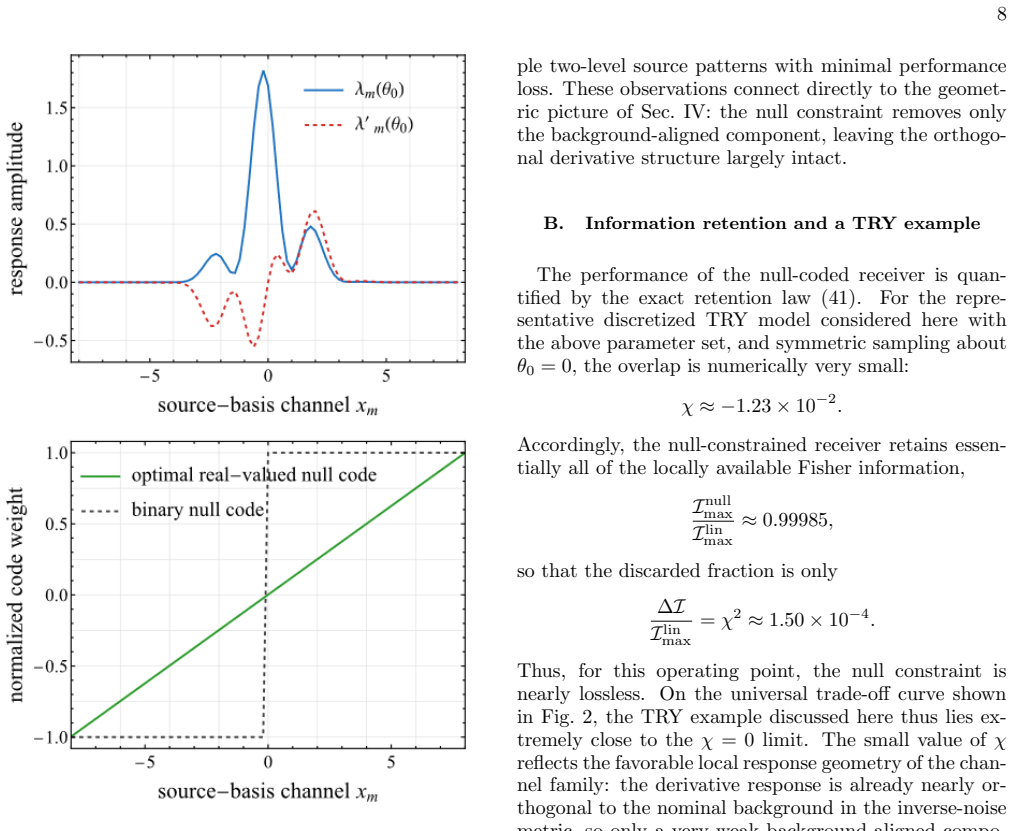
We develop a general theory of null-constrained parameter estimation in a time-reversed Young (TRY) interferometer, where measurement is performed through programmable source-basis encoding with a fixed detector. We address the fundamental question of how to design source patterns that enforce a true metrological null -- vanishing nominal response at the operating point -- while preserving finite first-order sensitivity to the parameter. Under a general shot-noise-limited channel model, we show that the optimal null-constrained receiver is obtained by projecting the derivative response onto the subspace orthogonal to the nominal background in the inverse-noise metric. This yields a constructive solution in which the optimal source-basis code is given by the inverse-noise-weighted derivative response with its background-parallel component removed. We further derive an exact and universal information-retention law: the locally accessible Fisher information is reduced by a factor $1-\chi^2$, where $\chi$ quantifies the inverse-noise overlap between the nominal and derivative response vectors. This result establishes a precise geometric interpretation of the cost of null enforcement. Numerical examples demonstrate the null-coded TRY receivers can retain nearly the full local information and can be accurately implemented using binary and positive-only source patterns. These findings identify source-basis null engineering as a distinct and practically viable modality for derivative-mode sensing, with implications for superresolution metrology and programmable optical measurement architectures.
Editorial analysis
A structured set of objections, weighed in public.
Referee Report
Summary. The manuscript develops a theory of null-constrained parameter estimation in a time-reversed Young interferometer using programmable source-basis encoding with a fixed detector. Under a shot-noise-limited channel model, the optimal null-constrained receiver is obtained by projecting the derivative response onto the subspace orthogonal to the nominal background in the inverse-noise metric; the optimal source code is the inverse-noise-weighted derivative with its background-parallel component removed. This yields an exact, universal information-retention law in which the locally accessible Fisher information is reduced by the factor 1-χ², where χ is the inverse-noise overlap between the nominal and derivative response vectors. Numerical examples illustrate that nearly full local information can be retained even with binary or positive-only source patterns.
Significance. If the central derivation holds, the work supplies a constructive, geometrically transparent solution to the problem of enforcing a true metrological null while preserving first-order sensitivity. The result is parameter-free: the retention factor follows directly from the Pythagorean theorem in the inverse-noise inner product, without auxiliary fitting constants or self-referential definitions. This provides a precise accounting of the information cost of null enforcement and identifies source-basis null engineering as a distinct, practically implementable modality for derivative-mode sensing. The numerical demonstrations with constrained (binary, positive-only) patterns further support applicability to programmable optical metrology and superresolution architectures.
minor comments (3)
- [§2.2] §2.2: the definition of the inverse-noise metric W should be written explicitly as an operator (or matrix) acting on the response vectors before the projection formula is introduced, to avoid any ambiguity in the subsequent inner-product notation.
- [Figure 3] Figure 3 caption: the legend should state the exact value of χ used for each curve rather than referring only to 'different overlap values,' so that the plotted retention factors can be checked against the analytic 1-χ² law without consulting the main text.
- [§4] The transition from the continuous source-basis formulation to the binary/positive-only numerical examples in §4 would benefit from a short paragraph clarifying how the continuous optimal code is discretized while preserving the first-order null to machine precision.
Simulated Author's Rebuttal
We thank the referee for the careful reading of the manuscript and the positive assessment of its contributions. We are gratified that the geometric derivation of the information-retention factor and the constructive nature of the null-constrained encoding are viewed as providing a precise and practically relevant solution.
Circularity Check
No significant circularity in the derivation chain
full rationale
The central derivation projects the derivative response vector onto the subspace orthogonal to the nominal background vector using the inverse-noise inner product, then invokes the Pythagorean theorem in that metric to obtain the exact retention factor 1-χ². This is a direct, self-contained linear-algebra construction from the shot-noise-limited channel model; χ is defined as the normalized overlap of the two vectors under the same metric, with no reduction to fitted parameters, self-referential definitions, or load-bearing self-citations. All steps remain within the geometric framework of the weighted vector space and are independent of external results.
Axiom & Free-Parameter Ledger
axioms (1)
- domain assumption The measurement channel is shot-noise limited
Forward citations
Cited by 4 Pith papers
-
Fixed-detector tilt--defocus sensing by upstream source coding in a time-reversed Young interferometer
Two source-coded scalar channels in a time-reversed Young interferometer recover essentially all local Fisher information for tilt and defocus sensing using a fixed detector under a Fresnel double-slit model.
-
Entropic Reciprocity in Time-Reversed Young Interferometry
Time-reversed Young interferometry acts as a source-space information processor where mutual information is the reciprocal invariant and source-label entropy can decrease near destructive interference while Fisher inf...
-
From Random Fringes to Deterministic Response: Statistical Foundations of Time-Reversed Young Interferometry
Time-reversed Young interferometry yields deterministic fringes as conditional responses indexed by source coordinates, enabling precise calibration and superresolution via Fisher information analysis.
-
Multi-slit time-reversed Young interference: source-space grating laws, quadratic-phase effects, and Talbot-like revivals
Multi-slit time-reversed Young interference recovers source-space grating orders only when quadratic phase is negligible and generates Talbot-like revivals under a reciprocal-distance condition.
Reference graph
Works this paper leans on
-
[1]
Bettens, D
E. Bettens, D. Van Dyck, A. J. den Dekker, J. Sijbers, and A. van den Bos, Model-based two-object resolution from observations having counting statistics, Ultrami- 15 croscopy77, 37–48 (1999)
1999
-
[2]
S. Ram, E. S. Ward, and R. J. Ober, Beyond Rayleigh’s criterion: A resolution measure with application to single-molecule microscopy, Proc. Natl. Acad. Sci. U.S.A. 103, 4457–4462 (2006)
2006
-
[3]
C. W. Helstrom,Quantum Detection and Estimation Theory(Academic Press, New York, 1976)
1976
-
[4]
S. M. Kay,Fundamentals of Statistical Signal Processing: Estimation Theory(Prentice Hall, Upper Saddle River, 1993)
1993
-
[5]
H. L. Van Trees,Optimum Array Processing: Part IV of Detection, Estimation, and Modulation Theory(Wiley, New York, 2002)
2002
-
[6]
Tsang, R
M. Tsang, R. Nair, and X.-M. Lu, Quantum theory of superresolution for two incoherent optical point sources, Phys. Rev. X6, 031033 (2016)
2016
-
[7]
Nair and M
R. Nair and M. Tsang, Far-field superresolution of ther- mal electromagnetic sources at the quantum limit, Phys. Rev. Lett.117, 190801 (2016)
2016
-
[8]
Nair and M
R. Nair and M. Tsang, Interferometric superlocalization of two incoherent optical point sources, Opt. Express24, 3684–3701 (2016)
2016
-
[9]
Pa´ ur, B
M. Pa´ ur, B. Stoklasa, Z. Hradil, L. L. S´ anchez-Soto, and J. ˇReh´ aˇ cek, Achieving the ultimate optical resolution, Optica3, 1144–1147 (2016)
2016
-
[10]
Tsang, Subdiffraction incoherent optical imaging via spatial-mode demultiplexing: Semiclassical treatment, Phys
M. Tsang, Subdiffraction incoherent optical imaging via spatial-mode demultiplexing: Semiclassical treatment, Phys. Rev. A97, 023830 (2018)
2018
-
[11]
Serabyn, Nulling interferometry: Working on the dark fringe, inOptical and IR Interferometry from Ground and Space, ASP Conference Series Vol
E. Serabyn, Nulling interferometry: Working on the dark fringe, inOptical and IR Interferometry from Ground and Space, ASP Conference Series Vol. 194, edited by C. J. Merkle (Astronomical Society of the Pacific, San Fran- cisco, 1999), pp. 437–448
1999
-
[12]
Tsang, Subdiffraction incoherent optical imaging via spatial-mode demultiplexing, New J
M. Tsang, Subdiffraction incoherent optical imaging via spatial-mode demultiplexing, New J. Phys.19, 023054 (2017)
2017
-
[13]
Martinod, B
M.-A. Martinod, B. Norris, P. Tuthill, T. Lagadec, N. Jovanovic, N. Cvetojevic, S. Gross, A. Arriola, T. Gret- zinger, M. J. Withford, O. Guyon, J. Lozi, S. Vievard, V. Deo, J. S. Lawrence, and S. Leon-Saval, Scalable photonic-based nulling interferometry with the dispersed multi-baseline GLINT instrument, Nat. Commun.12, 2465 (2021)
2021
-
[14]
S. A. Wadood, K. Liang, Y. Zhou, J. Yang, M. A. Alonso, X.-F. Qian, T. Malhotra, S. M. H. Rafsanjani, A. N. Jordon, R. W. Boyd, and A. N. Vamivakas, Experimen- tal demonstration of superresolution of partially coher- ent light sources using parity sorting, Opt. Express29, 22034–22043 (2021)
2021
-
[15]
Sanny, L
A. Sanny, L. Labadie, S. Gross, K. Barjot, R. Laugier, G. Garreau, M.-A. Martinod, D. Defr` ere, and M. J. With- ford, Asgard/NOTT:L-band nulling interferometry at the VLTI, Astronomy & Astrophysics705, A37 (2026)
2026
-
[16]
Wen, Time-reversed Young’s experiment: Determinis- tic, diffractionless second-order interference effect, Opt
J. Wen, Time-reversed Young’s experiment: Determinis- tic, diffractionless second-order interference effect, Opt. Commun.597, 132612 (2025)
2025
-
[17]
J. Wen, Metadata-conditioned coherence enables label- conditioned deterministic interference (submitted). https://doi.org/10.1364/opticaopen.31198534
-
[18]
J. Wen, Differential source-basis encoding for superre- solved parameter estimation in a time-reversed Young interferometer, arXiv:2603.27407
work page internal anchor Pith review Pith/arXiv arXiv
-
[19]
J. H. Shapiro, Computational ghost imaging, Phys. Rev. A78, 061802(R) (2008)
2008
-
[20]
Bromberg, O
Y. Bromberg, O. Katz, and Y. Silberberg, Ghost imaging with a single detector, Phys. Rev. A79, 053840 (2009)
2009
-
[21]
B. I. Erkmen and J. H. Shapiro, Ghost imaging: from quantum to classical to computational, Adv. Opt. Pho- ton.2, 405–450 (2010)
2010
-
[22]
Ferri, D
F. Ferri, D. Magatti, L. A. Lugiato, and A. Gatti, Dif- ferential ghost imaging, Phys. Rev. Lett.104, 253603 (2010)
2010
-
[23]
Luo, B.-Q
K.-H. Luo, B.-Q. Huang, W.-M. Zheng, and L.-A. Wu, Nonlocal imaging by conditional averaging of random reference measurements, Chin. Phys. Lett.29, 074216 (2012)
2012
-
[24]
Wen, Forming positive-negative images using condi- tioned partial measurements from reference arm in ghost imaging, J
J. Wen, Forming positive-negative images using condi- tioned partial measurements from reference arm in ghost imaging, J. Opt. Soc. Am. A29, 1906–1911 (2012)
1906
-
[25]
M. P. Edgar, G. M. Gibson, and M. J. Padgett, Principles and prospects for single-pixel imaging, Nat. Photonics 13, 13–20 (2019)
2019
-
[26]
Sun and J
M.-J. Sun and J. M. Zhang, Single-pixel imaging and its applications in three-dimensional reconstruction: A brief review, Sensors19, 732 (2019)
2019
-
[27]
M. G. L. Gustafsson, Surpassing the lateral resolution limit by a factor of two using structured illumination mi- croscopy, J. Microscopy198, 82–87 (2001)
2001
-
[28]
M. G. L. Gustafsson, Nonlinear structured-illumination microscopy: Wide-field fluorescence imaging with the- oretically unlimited resolution, Proc. Natl. Acad. Sci. U.S.A.102, 13081–13086 (2005)
2005
discussion (0)
Sign in with ORCID, Apple, or X to comment. Anyone can read and Pith papers without signing in.