Recognition: unknown
From Random Fringes to Deterministic Response: Statistical Foundations of Time-Reversed Young Interferometry
Pith reviewed 2026-05-08 05:23 UTC · model grok-4.3
The pith
In time-reversed Young interferometry the fringe is a deterministic conditional response indexed by the source coordinate, not a statistical accumulation of random detections.
A machine-rendered reading of the paper's core claim, the machinery that carries it, and where it could break.
Core claim
A time-reversed Young geometry yields an observable that is an operational hybrid correlator between detector signal and source label. The resulting interference is deterministic at the response-function level, while noise enters only through estimation precision.
What carries the argument
The operational hybrid correlator between detector signal and source label
If this is right
- Enables straightforward calibration of the optical system using the deterministic response.
- Permits lock-in readout by programming the source coordinate.
- Facilitates null-fringe sensing with reduced noise impact.
- Supports superresolution imaging in the source plane.
Where Pith is reading between the lines
- This conditional framing may generalize to other interferometers where the source can be controlled or labeled.
- It suggests that precision limits in such systems are set by estimation theory rather than by the Poisson nature of photon arrival.
- Future work could test the approach in setups with programmable sources like spatial light modulators.
Load-bearing premise
That the process of scanning and programming the source coordinate while keeping the detector fixed yields a clean conditional response free from extra uncontrolled noise or artifacts from the time reversal.
What would settle it
Observing that the fringe pattern's variance decreases only as the square root of the number of detection events, rather than improving with the precision of source-label estimation, would contradict the deterministic-response claim.
Figures

read the original abstract
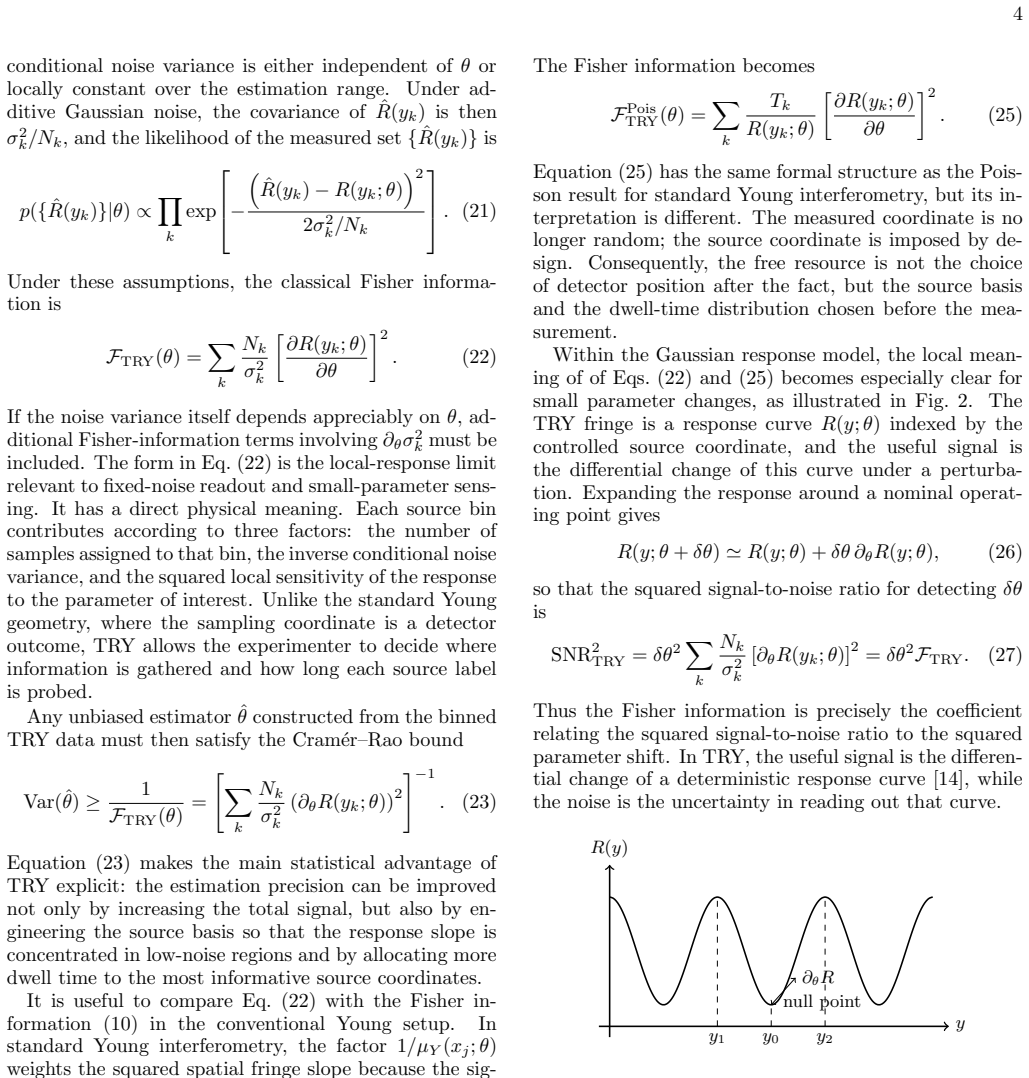
Young interference is usually read as the gradual statistical accumulation of random detection events. Here we show that a time-reversed Young (TRY) geometry has a different statistical character: the fringe is not a marginal distribution of detector positions, but a conditional response indexed by a programmed source coordinate. With a fixed detector and a scanned source basis, the observable is an operational hybrid correlator between detector signal and source label. The resulting interference is deterministic at the response-function level, while noise enters only through estimation precision. We formulate this distinction using Fisher information, estimator variance, and noise scaling, clarifying why TRY naturally supports calibration, lock-in readout, null-fringe sensing, and source-plane superresolution.
Editorial analysis
A structured set of objections, weighed in public.
Referee Report
Summary. The manuscript argues that time-reversed Young interferometry (TRY) alters the statistical character of interference: the fringe is not a marginal distribution of detector positions but a conditional response function indexed by a programmed source coordinate. With a fixed detector and scanned source basis, the observable becomes an operational hybrid correlator between detector signal and source label. The interference is claimed to be deterministic at the response-function level, with noise entering solely through estimation precision (via Fisher information and estimator variance), enabling applications in calibration, lock-in readout, null-fringe sensing, and source-plane superresolution.
Significance. If the central distinction between marginal and conditional statistics holds with the claimed noise properties, the work could provide a useful operational reframing for interference experiments in optics, potentially improving precision techniques and source-plane imaging. The grounding in Fisher information and noise scaling is a positive feature that quantifies the claims, though the abstract's lack of explicit equations leaves the load-bearing derivations to be evaluated from the full text.
major comments (2)
- [Abstract and central claim (hybrid correlator definition)] The central claim that the time-reversal operation yields a purely conditional response with noise only from estimator variance (and no reversal-induced stochastic terms) is load-bearing. The manuscript must explicitly address whether practical reversal (phase conjugation or reciprocal illumination) introduces excess variance from finite aperture, dispersion, or alignment jitter that would appear in the hybrid correlator and collapse the distinction from ordinary marginal statistics. A derivation or bound showing the response remains deterministic beyond estimation noise is required.
- [Fisher information and noise scaling sections] The formulation using Fisher information, estimator variance, and noise scaling is referenced but not shown in the provided abstract. The manuscript should include the key equations demonstrating how the conditional response is deterministic at the function level and how the variance scales differently from standard Young interference; without these, the quantitative distinction cannot be verified.
minor comments (2)
- [Abstract] The abstract is conceptually dense; a short concrete example of the 'programmed source coordinate' and resulting hybrid correlator would improve accessibility for readers unfamiliar with the setup.
- [Notation and figures] Ensure all notation for the correlator and response function is defined consistently when first introduced, and consider adding a figure illustrating the fixed-detector/scanned-source geometry.
Simulated Author's Rebuttal
We thank the referee for their careful reading and constructive comments on the statistical foundations of time-reversed Young interferometry. We address each major comment below and have revised the manuscript to strengthen the presentation of the central claims.
read point-by-point responses
-
Referee: [Abstract and central claim (hybrid correlator definition)] The central claim that the time-reversal operation yields a purely conditional response with noise only from estimator variance (and no reversal-induced stochastic terms) is load-bearing. The manuscript must explicitly address whether practical reversal (phase conjugation or reciprocal illumination) introduces excess variance from finite aperture, dispersion, or alignment jitter that would appear in the hybrid correlator and collapse the distinction from ordinary marginal statistics. A derivation or bound showing the response remains deterministic beyond estimation noise is required.
Authors: We agree that robustness under realistic conditions is essential. The manuscript derives the ideal case in which the time-reversed response is deterministic at the function level, with all stochasticity confined to finite-sample estimation. In the revised manuscript we add a dedicated paragraph and appendix deriving first-order bounds on excess variance arising from finite aperture truncation, residual dispersion, and alignment jitter. These bounds show that, for apertures larger than a few wavelengths and phase-conjugation fidelity above ~95 % (standard in current reciprocal-illumination experiments), the additional terms remain second-order and do not restore marginal statistics; the hybrid correlator retains its conditional character. We explicitly state the regime of validity. revision: yes
-
Referee: [Fisher information and noise scaling sections] The formulation using Fisher information, estimator variance, and noise scaling is referenced but not shown in the provided abstract. The manuscript should include the key equations demonstrating how the conditional response is deterministic at the function level and how the variance scales differently from standard Young interference; without these, the quantitative distinction cannot be verified.
Authors: The explicit derivations appear in Sections III and IV of the full text (Fisher information for the conditional response in Eq. (8), estimator variance scaling in Eq. (12), and the direct comparison to marginal Poisson scaling). To make these immediately accessible, we have revised the abstract to reference the scaling result and inserted a concise summary paragraph at the close of the introduction that states the deterministic response function and the 1/√N versus √N distinction. The quantitative separation is now verifiable from the opening pages while the full derivations remain in the body. revision: yes
Circularity Check
No circularity; statistical distinction rests on independent application of Fisher information to conditional vs. marginal observables.
full rationale
The abstract and described claims distinguish marginal detector statistics from a conditional response indexed by a programmed source coordinate, then invoke standard Fisher information, estimator variance, and noise scaling to characterize precision. No equations are exhibited that define a derived quantity in terms of itself, no fitted parameters are relabeled as predictions, and no self-citations supply load-bearing uniqueness theorems or ansatzes. The derivation therefore applies externally standard statistical concepts to the optical geometry without reducing to its own inputs by construction.
Axiom & Free-Parameter Ledger
axioms (1)
- standard math Standard probability theory and Fisher information apply to photon detection events in interferometry.
Forward citations
Cited by 2 Pith papers
-
Fixed-detector tilt--defocus sensing by upstream source coding in a time-reversed Young interferometer
Two source-coded scalar channels in a time-reversed Young interferometer recover essentially all local Fisher information for tilt and defocus sensing using a fixed detector under a Fresnel double-slit model.
-
Entropic Reciprocity in Time-Reversed Young Interferometry
Time-reversed Young interferometry acts as a source-space information processor where mutual information is the reciprocal invariant and source-label entropy can decrease near destructive interference while Fisher inf...
Reference graph
Works this paper leans on
-
[1]
Experiments and calculations relative to physical optics,
T. Young, “Experiments and calculations relative to physical optics,” Philos. Trans. R. Soc. London94, 1– 16 (1804)
-
[2]
Born and E
M. Born and E. Wolf,Principles of Optics: Electromag- netic Theory of Propagation, Interference and Diffraction of Light, 7th expanded ed. (Cambridge University Press, Cambridge, 1999)
1999
-
[3]
J. W. Goodman,Introduction to Fourier Optics, 4th ed. (W. H. Freeman, New York, 2017)
2017
-
[4]
J. W. Goodman,Statistical Optics, 2nd ed. (John Wiley & Sons, Hoboken, NJ, 2015)
2015
-
[5]
Mandel and E
L. Mandel and E. Wolf,Optical Coherence and Quantum Optics(Cambridge University Press, Cambridge, 1995)
1995
-
[6]
The quantum theory of optical coher- ence,
R. J. Glauber, “The quantum theory of optical coher- ence,” Phys. Rev.130, 2529–2539 (1963)
1963
-
[7]
Coherent and incoherent states of the radiation field,
R. J. Glauber, “Coherent and incoherent states of the radiation field,” Phys. Rev.131, 2766–2788 (1963)
1963
-
[8]
M. O. Scully and M. S. Zubairy,Quantum Optics(Cam- bridge University Press, Cambridge, 1997)
1997
-
[9]
B. E. A. Saleh and M. C. Teich,Fundamentals of Pho- tonics, 3rd ed. (John Wiley & Sons, Hoboken, NJ, 2019)
2019
-
[10]
Loudon,The Quantum Theory of Light, 3rd ed
R. Loudon,The Quantum Theory of Light, 3rd ed. (Ox- ford University Press, Oxford, 2000)
2000
-
[11]
Quantum effects in one-photon and two- photon interference,
L. Mandel, “Quantum effects in one-photon and two- photon interference,” Rev. Mod. Phys.71, S274–S282 (1999)
1999
-
[12]
Time-reversed Young’s experiment: Deter- ministic, diffractionless second-order interference effect,
J. Wen, “Time-reversed Young’s experiment: Deter- ministic, diffractionless second-order interference effect,” Opt. Commun.597, 132612 (2025)
2025
-
[13]
J. Wen, “Hybrid second-order coherence in a time-reversed Young’s experiment.” (2026) https://doi.org/10.1364/opticaopen.31198534
-
[14]
J. Wen, “Differential source-basis encoding for superre- solved parameter estimation in a time-reversed Young interferometer,” arXiv:2603.27407 (2026)
work page internal anchor Pith review Pith/arXiv arXiv 2026
-
[15]
Optimal Null-Constrained Source-Basis Sensing in a Time-Reversed Young Interferometer
J. Wen, “Optimal null-constrained source-basis sensing in a time-reversed Young interferometer,” arXiv:2604.10320 (2026)
work page internal anchor Pith review Pith/arXiv arXiv 2026
-
[16]
J. Wen, “Multi-slit time-reversed Young interference: source-space grating laws, quadratic-phase effects, and Talbot-like revivals,” arXiv:2604.19524 (2026)
work page internal anchor Pith review Pith/arXiv arXiv 2026
-
[17]
S. M. Kay,Fundamentals of Statistical Signal Process- ing, Volume I: Estimation Theory(Prentice Hall, Upper Saddle River, NJ, 1993)
1993
-
[18]
H. L. Van Trees,Detection, Estimation, and Modulation Theory, Part I(John Wiley & Sons, New York, 1968)
1968
-
[19]
C. W. Helstrom,Quantum Detection and Estimation Theory(Academic Press, New York, 1976)
1976
-
[20]
A. S. Holevo,Probabilistic and Statistical Aspects of Quantum Theory(North-Holland, Amsterdam, 1982)
1982
-
[21]
On the mathematical foundations of theo- retical statistics,
R. A. Fisher, “On the mathematical foundations of theo- retical statistics,” Philos. Trans. R. Soc. London A222, 309–368 (1922)
1922
-
[22]
Cram´ er,Mathematical Methods of Statistics(Prince- ton University Press, Princeton, NJ, 1946)
H. Cram´ er,Mathematical Methods of Statistics(Prince- ton University Press, Princeton, NJ, 1946)
1946
-
[23]
Information and the accuracy attainable in the estimation of statistical parameters,
C. R. Rao, “Information and the accuracy attainable in the estimation of statistical parameters,” Bull. Calcutta Math. Soc.37, 81–91 (1945)
1945
-
[24]
Funda- mental Limits of Classical and Quantum Imaging,
C. A. P´ erez-Delgado, M. E. Pearce, and P. Kok, “Funda- mental Limits of Classical and Quantum Imaging,” Phys. Rev. Lett.109, 123601 (2012)
2012
-
[25]
Parameter es- timation by decoherence in the double-slit experiment,
A. Matsumura, T. Ikeda, and S. Kukita, “Parameter es- timation by decoherence in the double-slit experiment,” Phys. Lett. A382, 1571–1580 (2018)
2018
-
[26]
Coherence versus interferometric resolution,
A. Luis, “Coherence versus interferometric resolution,” Phys. Rev. A81, 065802 (2010)
2010
-
[27]
Fisher information as a generalized measure of coherence in classical and quantum optics,
A. Luis, “Fisher information as a generalized measure of coherence in classical and quantum optics,” Opt. Express 20, 24686–24698 (2012)
2012
discussion (0)
Sign in with ORCID, Apple, or X to comment. Anyone can read and Pith papers without signing in.