Recognition: unknown
Entropic Reciprocity in Time-Reversed Young Interferometry
Pith reviewed 2026-05-09 18:49 UTC · model grok-4.3
The pith
Time-reversed Young interferometry reorganizes optical entropy rather than reversing it, with mutual information as the invariant between source and detector.
A machine-rendered reading of the paper's core claim, the machinery that carries it, and where it could break.
Core claim
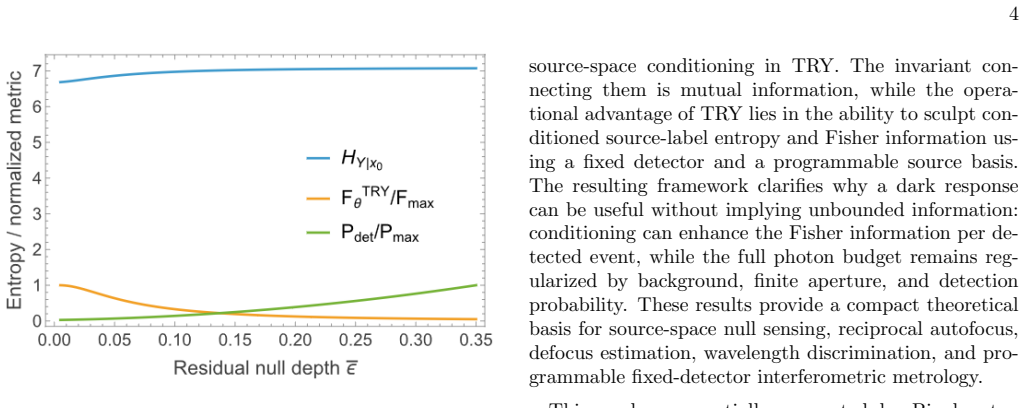
We show that time-reversed Young interferometry reorganizes, rather than reverses, optical entropy. A fixed detector conditions the reciprocal source–detector Green function and produces a source-label probability distribution. Marginal entropies in the standard and time-reversed geometries are generally unequal; the reciprocal invariant is instead the mutual information between source and detector coordinates. Near a destructive response, the conditioned source-label entropy can decrease while Fisher information for small phase, tilt, or defocus perturbations increases. The result identifies time-reversed Young interferometry as a source-space information processor with no analogue in ordin
What carries the argument
The reciprocal source-detector Green function conditioned by a fixed detector, which yields a source-label probability distribution whose mutual information with the detector remains invariant.
If this is right
- Marginal entropies are unequal between the standard and time-reversed geometries.
- Conditioned source-label entropy decreases near a destructive response.
- Fisher information for small phase, tilt, or defocus perturbations increases in the same regime.
- The time-reversed setup functions as a source-space information processor with no direct analogue in ordinary detector-plane readout.
Where Pith is reading between the lines
- The same reciprocity principle could be tested in other two-path interferometers to see whether mutual information likewise remains the invariant quantity.
- Practical implementations would need to check how losses or detector inefficiency alter the reported entropy decrease near nulls.
- The source-space processing view suggests designing sensors that read out information by conditioning on source labels rather than collecting detector fringes.
Load-bearing premise
That a fixed detector conditions the reciprocal source-detector Green function to produce a well-defined source-label probability distribution whose marginal entropies and mutual information behave as described, relying on ideal optical reciprocity.
What would settle it
Directly compute or measure the mutual information between source and detector coordinates in both the standard and time-reversed Young geometries and test whether it stays constant while the separate marginal entropies change; or record whether source-label entropy falls and Fisher information for small phase shifts rises exactly at a destructive null.
Figures


read the original abstract
We show that time-reversed Young interferometry reorganizes, rather than reverses, optical entropy. A fixed detector conditions the reciprocal source--detector Green function and produces a source-label probability distribution. Marginal entropies in the standard and time-reversed geometries are generally unequal; the reciprocal invariant is instead the mutual information between source and detector coordinates. Near a destructive response, the conditioned source-label entropy can decrease while Fisher information for small phase, tilt, or defocus perturbations increases. The result identifies time-reversed Young interferometry as a source-space information processor with no analogue in ordinary detector-plane fringe readout.
Editorial analysis
A structured set of objections, weighed in public.
Referee Report
Summary. The paper claims that time-reversed Young interferometry reorganizes optical entropy via a fixed detector conditioning the reciprocal source-detector Green function to produce a source-label probability distribution. Marginal entropies differ between standard and reversed geometries, but mutual information between source and detector coordinates is the invariant. Near destructive interference, conditioned source-label entropy decreases while Fisher information for small phase, tilt, or defocus perturbations increases, identifying the setup as a source-space information processor with no analogue in ordinary detector-plane fringe readout.
Significance. If the central derivations hold under the stated assumptions, the work offers a parameter-free information-theoretic reinterpretation of interferometry that links entropy reorganization to Fisher information gains near destructive points. This could inform quantum optics and precision metrology by framing reciprocal setups as source-space processors. The use of standard differential entropy and mutual information definitions without ad-hoc parameters or invented entities is a strength.
major comments (2)
- [§3] The definition of the joint probability distribution p(source-label, detector) from the reciprocal Green function |G(s,d)|^2 (in the section deriving the conditioned source-label entropy) assumes ideal reciprocity G(s,d)=G(d,s) and lossless unitary propagation with no loss, absorption, or noise terms. This assumption is load-bearing for the claimed inequality of marginal entropies, invariance of mutual information, and the entropy decrease near destructive response; deviations would alter the distributions and could eliminate the reported effects.
- [§4] The assertion that time-reversed Young interferometry has no analogue in ordinary detector-plane fringe readout (in the discussion of information processing) lacks a direct quantitative comparison of entropy/Fisher quantities in the standard geometry under equivalent conditions; without this, the uniqueness claim rests on the ideal construction alone.
minor comments (2)
- Notation for the conditioned probability and marginal entropies could be clarified with an explicit equation for the normalization step to avoid ambiguity in the transition from Green function to probability density.
- The abstract is concise but dense; a brief sentence on the key assumptions (reciprocity and losslessness) would help readers assess the scope immediately.
Simulated Author's Rebuttal
We thank the referee for the careful reading and positive evaluation of the work's potential significance. We address each major comment below with clarifications and indicate where revisions have been made to the manuscript.
read point-by-point responses
-
Referee: The definition of the joint probability distribution p(source-label, detector) from the reciprocal Green function |G(s,d)|^2 (in the section deriving the conditioned source-label entropy) assumes ideal reciprocity G(s,d)=G(d,s) and lossless unitary propagation with no loss, absorption, or noise terms. This assumption is load-bearing for the claimed inequality of marginal entropies, invariance of mutual information, and the entropy decrease near destructive response; deviations would alter the distributions and could eliminate the reported effects.
Authors: We agree that the derivations rely on the stated assumptions of ideal reciprocity and lossless unitary propagation, which are explicitly declared in the manuscript as the theoretical setting for analyzing the reciprocal Green function. These are standard idealizations that isolate the information-theoretic invariants without introducing extraneous parameters. The inequality of marginal entropies, invariance of mutual information, and entropy decrease near destructive interference are derived and hold strictly under these conditions. To address robustness concerns, we have added a clarifying remark in the revised §3 noting that the qualitative reorganization effects are expected to persist for small deviations, while a quantitative treatment of loss or noise lies outside the present scope. revision: partial
-
Referee: The assertion that time-reversed Young interferometry has no analogue in ordinary detector-plane fringe readout (in the discussion of information processing) lacks a direct quantitative comparison of entropy/Fisher quantities in the standard geometry under equivalent conditions; without this, the uniqueness claim rests on the ideal construction alone.
Authors: The manuscript establishes the distinction through the differing marginal entropies and the source-label conditioning unique to the time-reversed geometry, which has no counterpart in standard detector-plane readout. Nevertheless, we concur that an explicit side-by-side quantitative comparison would reinforce the claim. In the revised manuscript we have inserted a direct comparison of the conditioned source-label entropy and Fisher information for equivalent small phase, tilt, and defocus perturbations in both geometries, confirming that the entropy reduction and information gain near destructive points are absent in the standard case. revision: yes
Circularity Check
No circularity; derivation applies standard mutual information to reciprocal Green function probabilities
full rationale
The paper derives that mutual information I(source, detector) is the invariant while marginal entropies differ, and that conditional source entropy can decrease near destructive interference while Fisher information rises. This follows directly from the definitions of differential entropy, mutual information, and the normalized |G(s,d)|^2 joint distribution under the stated reciprocity assumption G(s,d)=G(d,s). No equation reduces a claimed result to a fitted parameter or self-referential definition. No self-citations are invoked as load-bearing uniqueness theorems. The construction is self-contained against the external benchmark of standard information theory applied to an optical Green function; the ideal-reciprocity and lossless-propagation assumptions are explicit modeling choices, not hidden circular steps.
Axiom & Free-Parameter Ledger
axioms (2)
- domain assumption The source-detector Green function can be conditioned by a fixed detector to yield a source-label probability distribution.
- standard math Marginal entropies and mutual information follow the usual definitions from information theory when applied to the conditioned optical probability distributions.
Reference graph
Works this paper leans on
-
[1]
Mandel and E
L. Mandel and E. Wolf,Optical Coherence and Quantum Optics(Cambridge University Press, Cambridge, 1995)
1995
-
[2]
Born and E
M. Born and E. Wolf,Principles of Optics: Electromag- netic Theory of Propagation, Interference and Diffraction of Light, 7th expanded ed. (Cambridge University Press, Cambridge, 1999)
1999
-
[4]
J. W. Goodman,Introduction to Fourier Optics, 4th ed. (W. H. Freeman, New York, 2017)
2017
-
[7]
J. Wen, “Differential source-basis encoding for superresolved parameter estimation in a time- reversed Young interferometer,” arXiv:2603.27407. doi:10.48550/arXiv.2603.27407
work page internal anchor Pith review Pith/arXiv arXiv doi:10.48550/arxiv.2603.27407
-
[8]
Optimal Null-Constrained Source-Basis Sensing in a Time-Reversed Young Interferometer
J. Wen, “Optimal null-constrained source-basis sensing in a time-reversed Young interferometer,” arXiv:2604.10320. doi:10.48550/arXiv.2604.10320
work page internal anchor Pith review Pith/arXiv arXiv doi:10.48550/arxiv.2604.10320
-
[9]
J. Wen, “Multi-slit time-reversed Young interfer- ence: source-space grating laws, quadratic-phase ef- fects, and Talbot-like revivals,” arXiv:2604.19524. doi:10.48550/arXiv.2604.19524
work page internal anchor Pith review Pith/arXiv arXiv doi:10.48550/arxiv.2604.19524
-
[10]
J. Wen, “From random fringes to determinis- tic response: Statistical foundations of time- reversed Young interferometry,” arXiv:2604.23797. doi:10.48550/arXiv.2604.23797
work page internal anchor Pith review Pith/arXiv arXiv doi:10.48550/arxiv.2604.23797
-
[12]
D. A. B. Miller, “Communicating with waves between volumes: evaluating orthogonal spatial channels and lim- its on coupling strengths,” Appl. Opt.39, 1681–1699 (2000). doi:10.1364/AO.39.001681
-
[13]
See Supplemental Material for the full scalar diffrac- 5 tion model underlying Eq. (2), the derivation of the en- tropy identities and Fisher-information formulas, the reg- ularized null-response analysis, the detector-plane bench- mark comparison, and the extension to partially coherent and thermal fields
-
[16]
A. Wehrl, “General properties of entropy,” Rev. Mod. Phys.50, 221–260 (1978). doi:10.1103/RevModPhys.50.221
-
[22]
Detecting nonsolar planets by spinning infrared interferometer,
R. N. Bracewell, “Detecting nonsolar planets by spinning infrared interferometer,” Nature274, 780–781 (1978). doi:10.1038/274780a0
-
[23]
Systematic errors in nulling inter- ferometers,
O. P. Lay, “Systematic errors in nulling inter- ferometers,” Appl. Opt.43, 6100–6123 (2004). doi:10.1364/AO.43.006100
-
[24]
All linear optical devices are mode converters,
D. A. B. Miller, “All linear optical devices are mode converters,” Opt. Express20, 23985–23993 (2012). doi:10.1364/OE.20.023985
-
[26]
E. Wolf, “New theory of partial coherence in the space– frequency domain. Part I: Spectra and cross spectra of steady-state sources,” J. Opt. Soc. Am.72, 343–351 (1982). doi:10.1364/JOSA.72.000343
-
[28]
Shannon entropy of partially polarized and partially coherent light with Gaussian fluc- tuations,
P. R´ efr´ egier and J. Morio, “Shannon entropy of partially polarized and partially coherent light with Gaussian fluc- tuations,” J. Opt. Soc. Am. A23, 3036–3044 (2006). doi:10.1364/JOSAA.23.003036
-
[29]
Locked entropy in partially coher- ent optical fields,
M. Harling, V. A. Kelkar, K. C. Toussaint, Jr., and A. F. Abouraddy, “Locked entropy in partially coher- ent optical fields,” Phys. Rev. A109, L021501 (2024). doi:10.1103/PhysRevA.109.L021501
-
[30]
Coherence en- tropy during propagation through complex media,
X. Lu, Y. Wang, A. Zhang, and D. Deng, “Coherence en- tropy during propagation through complex media,” Adv. Photonics6, 046002 (2024). doi:10.1117/1.AP.6.4.046002
-
[31]
Isoentropic partially co- herent optical fields that cannot be inter-converted unitarily,
M. Harling, V. A. Kelkar, K. C. Toussaint, Jr., and A. F. Abouraddy, “Isoentropic partially co- herent optical fields that cannot be inter-converted unitarily,” Phys. Rev. A110, 013505 (2024). doi:10.1103/PhysRevA.110.013505 Supplemental Material for “Entropic Reciprocity in Time-Reversed Young Interferometry” Jianming Wen 1,∗ 1Department of Electrical an...
-
[32]
J. W. Goodman,Statistical Optics, 2nd ed. (Wiley, Hobo- ken, NJ, 2015)
2015
-
[33]
Wolf,Introduction to the Theory of Coherence and Polarization of Light(Cambridge University Press, Cam- bridge, 2007)
E. Wolf,Introduction to the Theory of Coherence and Polarization of Light(Cambridge University Press, Cam- bridge, 2007)
2007
-
[34]
R. J. Potton, “Reciprocity in optics,” Rep. Prog. Phys. 67, 717–754 (2004). doi:10.1088/0034-4885/67/5/R03
-
[35]
J. Wen, “Time-reversed Young’s experiment: De- terministic, diffractionless second-order interfer- ence effect,” Opt. Commun.597, 132612 (2025). doi:10.1016/j.optcom.2025.132612
-
[36]
C. E. Shannon, “A mathematical theory of commu- nication,” Bell Syst. Tech. J.27, 379–423 (1948). doi:10.1002/j.1538-7305.1948.tb01338.x
-
[37]
The Annals of Mathe- matical Statistics22(1), 79–86 (1951) https://doi.org/10.1214/aoms/1177729694
S. Kullback and R. A. Leibler, “On information and sufficiency,” Ann. Math. Statist.22, 79–86 (1951). doi:10.1214/aoms/1177729694
-
[38]
T. M. Cover and J. A. Thomas,Elements of Informa- tion Theory, 2nd ed. (Wiley-Interscience, Hoboken, NJ, 2006). doi:10.1002/047174882X
-
[39]
Theory of statistical estimation,
R. A. Fisher, “Theory of statistical estimation,” Proc. Cambridge Philos. Soc.22, 700–725 (1925)
1925
-
[40]
Information and the accuracy attainable in the estimation of statistical parameters,
C. R. Rao, “Information and the accuracy attainable in the estimation of statistical parameters,” Bull. Calcutta Math. Soc.37, 81–91 (1945)
1945
-
[41]
Cram´ er,Mathematical Methods of Statistics(Prince- ton University Press, Princeton, NJ, 1946)
H. Cram´ er,Mathematical Methods of Statistics(Prince- ton University Press, Princeton, NJ, 1946)
1946
-
[42]
S. M. Kay,Fundamentals of Statistical Signal Process- ing, Volume I: Estimation Theory(Prentice Hall, Upper Saddle River, NJ, 1993)
1993
-
[43]
The quantum theory of opti- cal coherence,
R. J. Glauber, “The quantum theory of opti- cal coherence,” Phys. Rev.130, 2529–2539 (1963). doi:10.1103/PhysRev.130.2529
-
[44]
J. Wen, “Hybrid second-order coherence in a time- reversed Young’s experiment,” submitted (2026). doi:10.1364/opticaopen.31198534
discussion (0)
Sign in with ORCID, Apple, or X to comment. Anyone can read and Pith papers without signing in.