Recognition: unknown
Toward Accountable AI-Generated Content on Social Platforms: Steganographic Attribution and Multimodal Harm Detection
Pith reviewed 2026-05-10 15:13 UTC · model grok-4.3
The pith
Embedding cryptographically signed identifiers into AI-generated images at creation time, triggered by multimodal harm detection, enables reliable tracing of misuse on social platforms.
A machine-rendered reading of the paper's core claim, the machinery that carries it, and where it could break.
Core claim
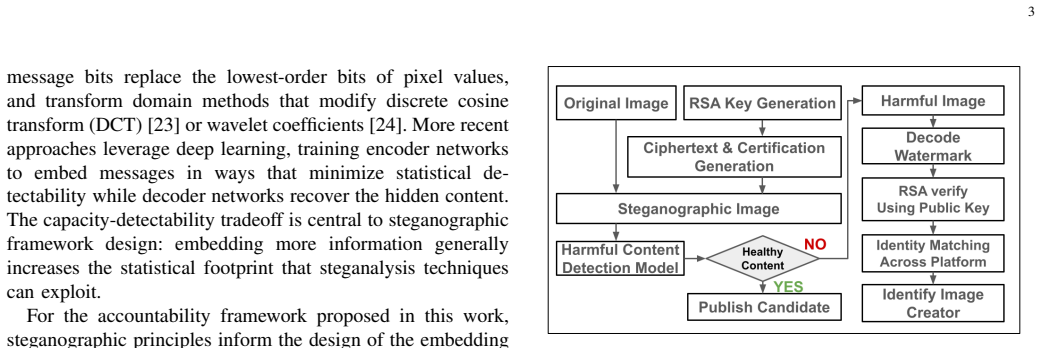
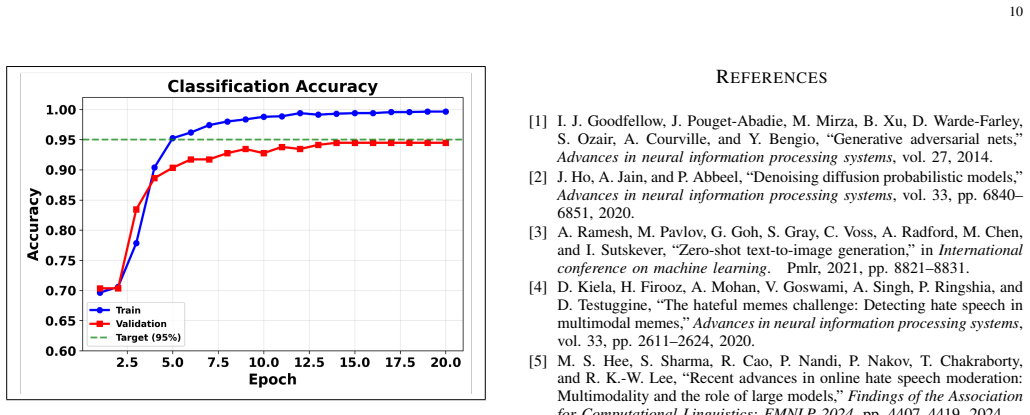
We introduce a steganography enabled attribution framework that embeds cryptographically signed identifiers into images at creation time and uses multimodal harmful content detection as a trigger for attribution verification. Experiments demonstrate that spread-spectrum watermarking, especially in the wavelet domain, provides strong robustness under blur distortions, and our multimodal fusion detector achieves an AUC-ROC of 0.99, enabling reliable cross-modal attribution verification. These components form an end-to-end forensic pipeline that enables reliable tracing of harmful deployments of AI-generated imagery, supporting accountability in modern synthetic media environments.
What carries the argument
The steganography-enabled attribution framework, which embeds signed identifiers at image generation and activates verification through a CLIP-based multimodal harm detector when harmful image-text pairs are flagged.
If this is right
- Spread-spectrum watermarking in the wavelet domain maintains detectability after blur and similar distortions common in online sharing.
- The multimodal detector can reliably flag harmful image-text combinations to initiate attribution checks.
- An end-to-end pipeline becomes available for tracing the source of misused AI-generated images.
- Platforms gain a mechanism to enforce accountability on synthetic media without depending on external metadata.
Where Pith is reading between the lines
- If generators adopt the embedding step, platforms could verify origins at scale for flagged content.
- The approach could extend to other generative media such as video if similar embedding techniques prove robust.
- Lowering false positives in the harm detector would be necessary before widespread deployment to avoid unnecessary attribution requests.
Load-bearing premise
The assumption that AI image generators will reliably embed the watermarks at creation time and that the harm detector will identify truly harmful contexts without high rates of false positives in actual social media use.
What would settle it
A large-scale test on real social media posts showing that the embedded watermarks become undetectable after typical platform processing such as compression and resizing, or that the detector produces frequent false positives on benign content.
Figures


read the original abstract
The rapid growth of generative AI has introduced new challenges in content moderation and digital forensics. In particular, benign AI-generated images can be paired with harmful or misleading text, creating difficult-to-detect misuse. This contextual misuse undermines the traditional moderation framework and complicates attribution, as synthetic images typically lack persistent metadata or device signatures. We introduce a steganography enabled attribution framework that embeds cryptographically signed identifiers into images at creation time and uses multimodal harmful content detection as a trigger for attribution verification. Our system evaluates five watermarking methods across spatial, frequency, and wavelet domains. It also integrates a CLIP-based fusion model for multimodal harmful-content detection. Experiments demonstrate that spread-spectrum watermarking, especially in the wavelet domain, provides strong robustness under blur distortions, and our multimodal fusion detector achieves an AUC-ROC of 0.99, enabling reliable cross-modal attribution verification. These components form an end-to-end forensic pipeline that enables reliable tracing of harmful deployments of AI-generated imagery, supporting accountability in modern synthetic media environments. Our code is available at GitHub: https://github.com/bli1/steganography
Editorial analysis
A structured set of objections, weighed in public.
Referee Report
Summary. The manuscript proposes a steganographic attribution framework for AI-generated images on social platforms. Cryptographically signed identifiers are embedded into images at creation time using five watermarking methods spanning spatial, frequency, and wavelet domains. A CLIP-based multimodal fusion model detects harmful image-text content to trigger attribution verification. Experiments claim that spread-spectrum watermarking (especially wavelet-domain) is robust under blur and that the detector reaches an AUC-ROC of 0.99, forming an end-to-end forensic pipeline for tracing harmful AI-generated imagery.
Significance. If the pipeline functions under realistic conditions, the work could meaningfully advance accountability for synthetic media by linking generation-time identifiers to detected misuse. The open code release is a clear strength that supports reproducibility. The combination of watermarking with multimodal detection is timely, but the practical significance hinges on whether the embedded identifiers survive the transformations typical of social platforms.
major comments (1)
- [Experiments] Experimental evaluation of watermarking methods: robustness is reported only for blur distortions on the wavelet spread-spectrum technique. No bit-error-rate or extraction accuracy figures are given for JPEG compression (typical quality 70-90), resizing, or cropping. These operations are standard on social platforms and can destroy frequency-domain watermarks, directly undermining the central claim that the cryptographically signed identifier will survive to enable reliable cross-modal attribution verification.
minor comments (1)
- [Abstract and Experiments] The abstract and results sections would benefit from explicit mention of the exact datasets, number of test images, and comparison baselines used for both the watermarking and multimodal detection experiments.
Simulated Author's Rebuttal
We thank the referee for the detailed and constructive review. We appreciate the acknowledgment of the work's timeliness and the value of the open code release. The major comment on experimental robustness evaluation is addressed point-by-point below. We will revise the manuscript to incorporate additional experiments as outlined.
read point-by-point responses
-
Referee: [Experiments] Experimental evaluation of watermarking methods: robustness is reported only for blur distortions on the wavelet spread-spectrum technique. No bit-error-rate or extraction accuracy figures are given for JPEG compression (typical quality 70-90), resizing, or cropping. These operations are standard on social platforms and can destroy frequency-domain watermarks, directly undermining the central claim that the cryptographically signed identifier will survive to enable reliable cross-modal attribution verification.
Authors: We agree that the current experimental section focuses on blur distortions for the wavelet-domain spread-spectrum watermarking method, as this is a prevalent transformation in social media pipelines. The manuscript does not yet report bit-error-rate (BER) or extraction accuracy results for JPEG compression (quality 70-90), resizing, or cropping across the five evaluated methods. These are indeed critical for validating the survival of cryptographically signed identifiers under realistic platform operations. In the revised manuscript, we will add a comprehensive robustness evaluation section that includes these transformations, reporting BER and extraction accuracy for all watermarking techniques. This will directly support the central claim of reliable attribution verification. revision: yes
Circularity Check
No circularity; empirical evaluation independent of inputs
full rationale
The paper describes an empirical steganographic attribution system evaluated through direct experiments on five watermarking methods and a CLIP-based multimodal detector. No derivation chain, equations, fitted parameters renamed as predictions, or self-citations appear as load-bearing premises. Robustness claims rest on reported experimental outcomes (e.g., blur tolerance and 0.99 AUC-ROC) rather than any self-referential construction or ansatz smuggled via prior work. The pipeline is presented as a practical composition of independently tested components.
Axiom & Free-Parameter Ledger
axioms (2)
- domain assumption Steganographic methods can embed robust identifiers without perceptible changes to images
- domain assumption CLIP-based models can reliably detect multimodal harmful content
Forward citations
Cited by 1 Pith paper
-
LLM-as-Judge Framework for Evaluating Tone-Induced Hallucination in Vision-Language Models
Ghost-100 benchmark shows prompt tone drives hallucination rates and intensities in VLMs, with non-monotonic peaks at intermediate pressure and task-specific differences that aggregate metrics hide.
Reference graph
Works this paper leans on
-
[1]
Generative adversarial nets,
I. J. Goodfellow, J. Pouget-Abadie, M. Mirza, B. Xu, D. Warde-Farley, S. Ozair, A. Courville, and Y . Bengio, “Generative adversarial nets,” Advances in neural information processing systems, vol. 27, 2014
2014
-
[2]
Denoising diffusion probabilistic models,
J. Ho, A. Jain, and P. Abbeel, “Denoising diffusion probabilistic models,” Advances in neural information processing systems, vol. 33, pp. 6840– 6851, 2020
2020
-
[3]
Zero-shot text-to-image generation,
A. Ramesh, M. Pavlov, G. Goh, S. Gray, C. V oss, A. Radford, M. Chen, and I. Sutskever, “Zero-shot text-to-image generation,” inInternational conference on machine learning. Pmlr, 2021, pp. 8821–8831
2021
-
[4]
The hateful memes challenge: Detecting hate speech in multimodal memes,
D. Kiela, H. Firooz, A. Mohan, V . Goswami, A. Singh, P. Ringshia, and D. Testuggine, “The hateful memes challenge: Detecting hate speech in multimodal memes,”Advances in neural information processing systems, vol. 33, pp. 2611–2624, 2020
2020
-
[5]
Recent advances in online hate speech moderation: Multimodality and the role of large models,
M. S. Hee, S. Sharma, R. Cao, P. Nandi, P. Nakov, T. Chakraborty, and R. K.-W. Lee, “Recent advances in online hate speech moderation: Multimodality and the role of large models,”Findings of the Association for Computational Linguistics: EMNLP 2024, pp. 4407–4419, 2024
2024
-
[6]
Financial fraud and manipulation: The malicious use of deepfakes in business,
P. Kaushik, V . Garg, A. Priya, and S. Kant, “Financial fraud and manipulation: The malicious use of deepfakes in business,” inDeepfakes and Their Impact on Business. IGI Global Scientific Publishing, 2025, pp. 173–196
2025
-
[7]
Beyond the deepfake hype: Ai, democracy, and “the slovak case
L. de Nadal and P. Jan ˇc´arik, “Beyond the deepfake hype: Ai, democracy, and “the slovak case”,”HKS Misinformation Review, vol. 5, no. 4, 2024
2024
-
[8]
M. Brundage, S. Avin, J. Clark, H. Toner, P. Eckersley, B. Garfinkel, A. Dafoe, P. Scharre, T. Zeitzoff, B. Filar, H. Anderson, H. Roff, G. C. Allen, J. Steinhardt, C. Flynn, S. Baum, O. Evans, A. Herbert-V oss, M. Riemer, T. Denison, C. Leung, D. Matheny, E. Ferrara, J. Grimmelmann, D. C. Parkes, W. Isaac, K. Lum, T. Maharaj, J. Kaplan, I. Sutskever, and...
-
[9]
How spammers and scammers leverage ai-generated images on facebook for audience growth,
R. DiResta and J. A. Goldstein, “How spammers and scammers leverage ai-generated images on facebook for audience growth,” arXiv preprint arXiv:2403.12838, 2024. [Online]. Available: https: //arxiv.org/abs/2403.12838
-
[10]
Explaining and Harnessing Adversarial Examples
I. J. Goodfellow, J. Shlens, and C. Szegedy, “Explaining and harnessing adversarial examples,”arXiv preprint arXiv:1412.6572, 2014
work page internal anchor Pith review arXiv 2014
-
[11]
Real-time adversarial attacks,
Y . Gong, B. Li, C. Poellabauer, and Y . Shi, “Real-time adversarial attacks,”arXiv preprint arXiv:1905.13399, 2019
-
[12]
A survey of safety on large vision-language models: Attacks, defenses and evalua- tions,
M. Ye, X. Rong, W. Huang, B. Du, N. Yu, and D. Tao, “A survey of safety on large vision-language models: Attacks, defenses and evalua- tions,”arXiv preprint arXiv:2502.14881, 2025
-
[13]
Tone matters: The impact of linguistic tone on hallucination in vlms,
W. Hong, Z. Jiang, B. Shen, X. Guan, Y . Feng, M. Xu, and B. Li, “Tone matters: The impact of linguistic tone on hallucination in vlms,” inProceedings of the IEEE/CVF Winter Conference on Applications of Computer Vision (WACV) Workshops, March 2026, pp. 1353–1362
2026
-
[14]
High- resolution image synthesis with latent diffusion models,
R. Rombach, A. Blattmann, D. Lorenz, P. Esser, and B. Ommer, “High- resolution image synthesis with latent diffusion models,” inProceedings of the IEEE/CVF conference on computer vision and pattern recognition, 2022, pp. 10 684–10 695
2022
-
[15]
The creativity of text-to-image generation,
J. Oppenlaender, “The creativity of text-to-image generation,” inPro- ceedings of the 25th international academic mindtrek conference, 2022, pp. 192–202
2022
-
[16]
Blessing or curse? a survey on the impact of generative ai on fake news,
A. Loth, M. Kappes, and M.-O. Pahl, “Blessing or curse? a survey on the impact of generative ai on fake news,”arXiv preprint arXiv:2404.03021, 2024
-
[17]
Deepfakes, misinformation, and disinformation in the era of frontier ai, generative ai, and large ai models,
M. R. Shoaib, Z. Wang, M. T. Ahvanooey, and J. Zhao, “Deepfakes, misinformation, and disinformation in the era of frontier ai, generative ai, and large ai models,” in2023 international conference on computer and applications (ICCA). IEEE, 2023, pp. 1–7
2023
-
[18]
Detection and moderation of detrimental content on social media platforms: current status and future directions,
V . U. Gongane, M. V . Munot, and A. D. Anuse, “Detection and moderation of detrimental content on social media platforms: current status and future directions,”Social Network Analysis and Mining, vol. 12, no. 1, p. 129, 2022
2022
-
[19]
Rethinking multimodal content moderation from an asymmetric angle with mixed- modality,
J. Yuan, Y . Yu, G. Mittal, M. Hall, S. Sajeev, and M. Chen, “Rethinking multimodal content moderation from an asymmetric angle with mixed- modality,” inProceedings of the IEEE/CVF winter conference on applications of computer vision, 2024, pp. 8532–8542
2024
-
[20]
Cosmos: catching out-of-context image misuse using self-supervised learning,
S. Aneja, C. Bregler, and M. Nießner, “Cosmos: catching out-of-context image misuse using self-supervised learning,” inProceedings of the AAAI conference on artificial intelligence, vol. 37, no. 12, 2023, pp. 14 084–14 092. 11
2023
-
[21]
Exploring hate speech detection in multimodal publications,
R. Gomez, J. Gibert, L. Gomez, and D. Karatzas, “Exploring hate speech detection in multimodal publications,” inProceedings of the IEEE/CVF winter conference on applications of computer vision, 2020, pp. 1470– 1478
2020
-
[22]
A digital watermark,
R. G. Van Schyndel, A. Z. Tirkel, and C. F. Osborne, “A digital watermark,” inProceedings of 1st international conference on image processing, vol. 2. IEEE, 1994, pp. 86–90
1994
-
[23]
Secure spread spectrum watermarking for multimedia,
I. J. Cox, J. Kilian, F. T. Leighton, and T. Shamoon, “Secure spread spectrum watermarking for multimedia,”IEEE transactions on image processing, vol. 6, no. 12, pp. 1673–1687, 1997
1997
-
[24]
A multiresolution watermark for digital images,
X.-G. Xia, C. G. Boncelet, and G. R. Arce, “A multiresolution watermark for digital images,” inProceedings of international conference on image processing, vol. 1. IEEE, 1997, pp. 548–551
1997
-
[25]
Media forensics and deepfakes: an overview,
L. Verdoliva, “Media forensics and deepfakes: an overview,”IEEE journal of selected topics in signal processing, vol. 14, no. 5, pp. 910– 932, 2020
2020
-
[26]
Cnn- generated images are surprisingly easy to spot... for now,
S.-Y . Wang, O. Wang, R. Zhang, A. Owens, and A. A. Efros, “Cnn- generated images are surprisingly easy to spot... for now,” inProceedings of the IEEE/CVF conference on computer vision and pattern recognition, 2020, pp. 8695–8704
2020
-
[27]
Faceforensics++: Learning to detect manipulated facial images,
A. Rossler, D. Cozzolino, L. Verdoliva, C. Riess, J. Thies, and M. Nießner, “Faceforensics++: Learning to detect manipulated facial images,” inProceedings of the IEEE/CVF international conference on computer vision, 2019, pp. 1–11
2019
-
[28]
C2pa: the world’s first industry standard for content provenance (conference presentation),
L. Rosenthol, “C2pa: the world’s first industry standard for content provenance (conference presentation),” inApplications of Digital Image Processing XLV, vol. 12226. SPIE, 2022, p. 122260P
2022
-
[29]
Can’t see the forest for the trees: Benchmarking multimodal safety awareness for multimodal LLMs,
W. Wang, X. Liu, K. Gao, J.-t. Huang, Y . Yuan, P. He, S. Wang, and Z. Tu, “Can’t see the forest for the trees: Benchmarking multimodal safety awareness for multimodal LLMs,” inProceedings of the 63rd Annual Meeting of the Association for Computational Linguistics (Volume 1: Long Papers), W. Che, J. Nabende, E. Shutova, and M. T. Pilehvar, Eds. Vienna, Au...
2025
discussion (0)
Sign in with ORCID, Apple, or X to comment. Anyone can read and Pith papers without signing in.