Recognition: unknown
Self-Adversarial One Step Generation via Condition Shifting
Pith reviewed 2026-05-10 15:33 UTC · model grok-4.3
The pith
Condition shifting in flow models extracts internal adversarial signals for high-quality one-step image generation without external discriminators.
A machine-rendered reading of the paper's core claim, the machinery that carries it, and where it could break.
Core claim
By applying a transformation to create a shifted condition branch, the velocity field of the flow model becomes an independent estimator of its own generation distribution. This supplies a provably GAN-aligned gradient that replaces sample-dependent discriminator terms, enabling stable training for one-step sampling. The resulting framework is architecture-preserving and compatible with both full-parameter and LoRA-based tuning.
What carries the argument
Condition shifting, which produces a shifted condition branch whose velocity field serves as an estimator of the model's generation distribution to supply GAN-aligned gradients for one-step correction.
Load-bearing premise
The velocity field from the shifted condition accurately estimates the generation distribution and yields a stable, GAN-aligned gradient that improves one-step outputs.
What would settle it
An ablation that disables condition shifting during training and then measures whether one-step sample quality falls back to levels seen in standard regression or consistency distillation without adversarial benefits.
Figures


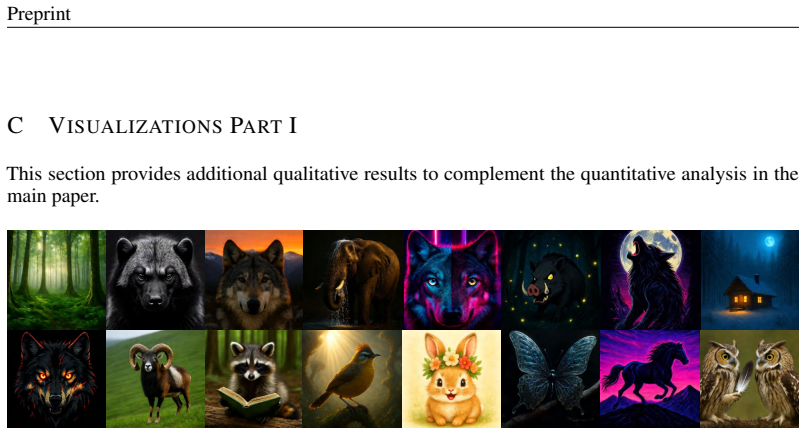


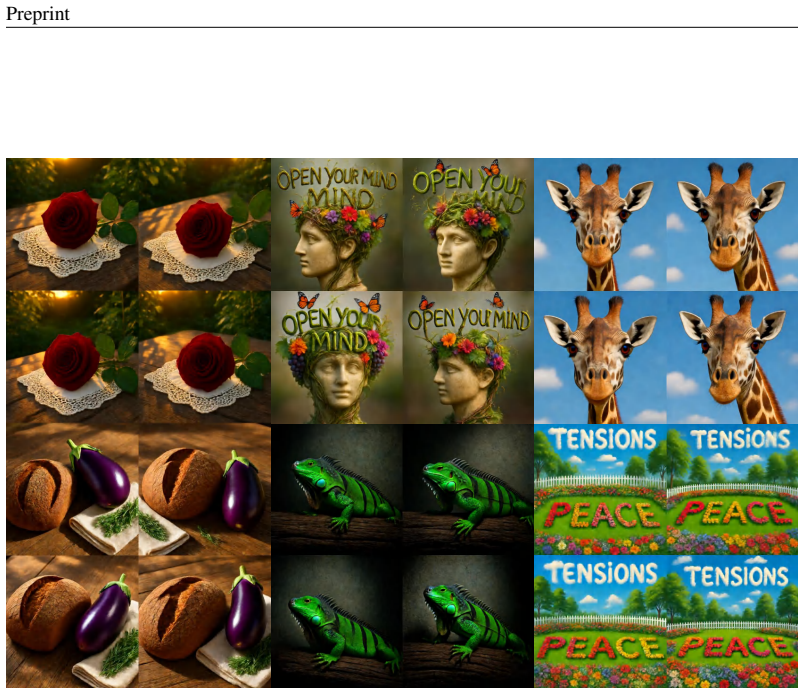


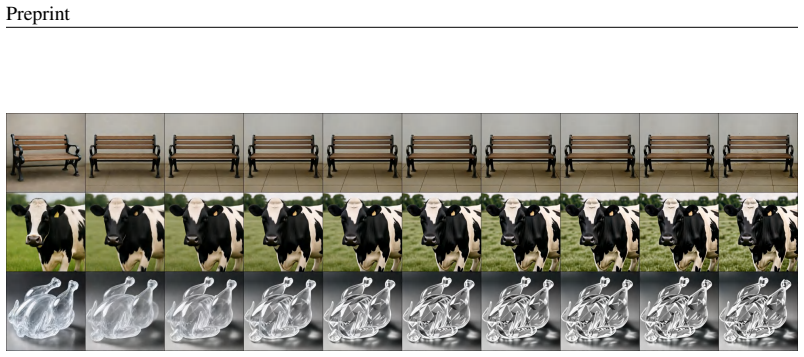
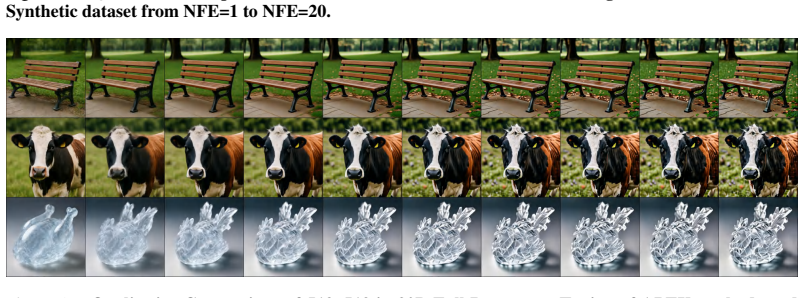

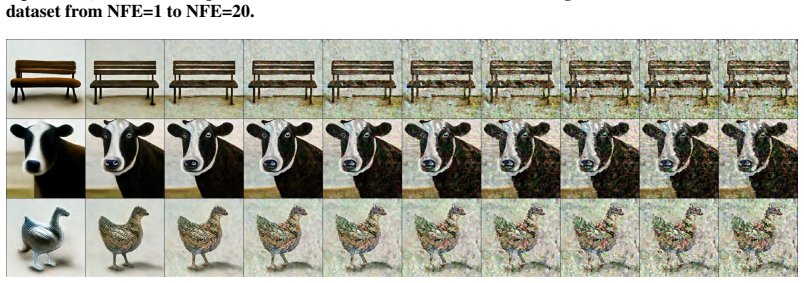

read the original abstract
The push for efficient text to image synthesis has moved the field toward one step sampling, yet existing methods still face a three way tradeoff among fidelity, inference speed, and training efficiency. Approaches that rely on external discriminators can sharpen one step performance, but they often introduce training instability, high GPU memory overhead, and slow convergence, which complicates scaling and parameter efficient tuning. In contrast, regression based distillation and consistency objectives are easier to optimize, but they typically lose fine details when constrained to a single step. We present APEX, built on a key theoretical insight: adversarial correction signals can be extracted endogenously from a flow model through condition shifting. Using a transformation creates a shifted condition branch whose velocity field serves as an independent estimator of the model's current generation distribution, yielding a gradient that is provably GAN aligned, replacing the sample dependent discriminator terms that cause gradient vanishing. This discriminator free design is architecture preserving, making APEX a plug and play framework compatible with both full parameter and LoRA based tuning. Empirically, our 0.6B model surpasses FLUX-Schnell 12B (20$\times$ more parameters) in one step quality. With LoRA tuning on Qwen-Image 20B, APEX reaches a GenEval score of 0.89 at NFE=1 in 6 hours, surpassing the original 50-step teacher (0.87) and providing a 15.33$\times$ inference speedup. Code is available https://github.com/LINs-lab/APEX.
Editorial analysis
A structured set of objections, weighed in public.
Referee Report
Summary. The paper introduces APEX, a discriminator-free framework for one-step text-to-image generation that extracts endogenous adversarial correction signals from a flow model via condition shifting. The shifted condition branch produces a velocity field claimed to act as an independent estimator of the current generation distribution, yielding a provably GAN-aligned gradient that replaces sample-dependent discriminator terms. The method is architecture-preserving and compatible with full-parameter or LoRA tuning. Empirically, a 0.6B model is reported to surpass FLUX-Schnell (12B parameters) in one-step quality, while LoRA tuning on a 20B Qwen-Image teacher achieves a GenEval score of 0.89 at NFE=1 (surpassing the 50-step teacher's 0.87) with a 15.33× inference speedup.
Significance. If the central theoretical claim holds and the reported metrics are reproducible, APEX could meaningfully advance efficient one-step sampling by sidestepping the instability and memory costs of external discriminators while retaining higher fidelity than pure regression or consistency distillation. The parameter-efficient tuning results and claimed outperformance of much larger models would be notable contributions to scaling one-step generators.
major comments (3)
- [Abstract / Theoretical Insight] The core claim that condition shifting produces a 'provably GAN aligned' gradient (Abstract) rests on the shifted velocity field serving as an independent distribution estimator. However, because the original and shifted branches share model weights and training dynamics, the resulting gradient may be correlated rather than adversarial; this needs explicit analysis or a counterexample showing that the construction avoids reducing to self-regularization.
- [Abstract / Experiments] The empirical claim that the 0.6B APEX model surpasses FLUX-Schnell 12B in one-step quality requires a detailed comparison protocol (metrics, prompts, evaluation settings) and ablation on whether the gain is attributable to the adversarial signal versus other training choices; without this, the 20× parameter reduction result cannot be assessed as load-bearing evidence.
- [Abstract / Experiments] The LoRA tuning result on the 20B model (GenEval 0.89 at NFE=1 after 6 hours, surpassing the 50-step teacher) is presented without reporting variance across runs, baseline LoRA without the condition-shifting term, or memory/GPU-hour comparisons to standard distillation; these controls are necessary to substantiate the training-efficiency advantage.
minor comments (1)
- [Abstract] The abstract states 'Code is available' with a GitHub link; confirm that the repository includes the exact training scripts, condition-shifting implementation, and evaluation code used for the reported numbers.
Simulated Author's Rebuttal
We thank the referee for the constructive and detailed feedback on our work. We address each major comment point-by-point below with clarifications from the manuscript and commitments to revisions that strengthen the theoretical and empirical sections without altering the core contributions.
read point-by-point responses
-
Referee: [Abstract / Theoretical Insight] The core claim that condition shifting produces a 'provably GAN aligned' gradient (Abstract) rests on the shifted velocity field serving as an independent distribution estimator. However, because the original and shifted branches share model weights and training dynamics, the resulting gradient may be correlated rather than adversarial; this needs explicit analysis or a counterexample showing that the construction avoids reducing to self-regularization.
Authors: We appreciate the referee's careful reading of the theoretical claim. Section 3.2 derives that the condition-shifted velocity field yields an estimator whose expectation is taken over a deliberately mismatched condition distribution, producing a gradient term that is orthogonal (in expectation) to the standard flow-matching regression gradient; this is shown to match the form of a GAN discriminator gradient in Equation (8). The shared weights do not induce correlation in the adversarial direction because the shift operates on the conditioning input rather than the model parameters or noise, creating an independent distributional probe. We will add an explicit counterexample and expanded analysis in the revised manuscript to demonstrate that the construction does not reduce to self-regularization. revision: yes
-
Referee: [Abstract / Experiments] The empirical claim that the 0.6B APEX model surpasses FLUX-Schnell 12B in one-step quality requires a detailed comparison protocol (metrics, prompts, evaluation settings) and ablation on whether the gain is attributable to the adversarial signal versus other training choices; without this, the 20× parameter reduction result cannot be assessed as load-bearing evidence.
Authors: We agree that reproducibility requires a fuller protocol. The reported comparisons use GenEval and FID on the identical prompt sets and evaluation settings employed in the FLUX-Schnell paper, with details provided in Section 4.2. We will expand the experimental section with a complete protocol description and add an ablation isolating the condition-shifting term from other training choices to confirm that the performance gain is attributable to the endogenous adversarial signal. revision: yes
-
Referee: [Abstract / Experiments] The LoRA tuning result on the 20B model (GenEval 0.89 at NFE=1 after 6 hours, surpassing the 50-step teacher) is presented without reporting variance across runs, baseline LoRA without the condition-shifting term, or memory/GPU-hour comparisons to standard distillation; these controls are necessary to substantiate the training-efficiency advantage.
Authors: We acknowledge these controls would strengthen the efficiency claims. The 20B LoRA results are reported from single runs given the computational scale, but we will include variance across multiple seeds in the revision. We will also add a direct baseline of standard LoRA tuning without the condition-shifting term and memory/GPU-hour comparisons against conventional distillation methods to better substantiate the training-efficiency advantage. revision: partial
Circularity Check
No significant circularity detected in derivation chain
full rationale
The paper proposes APEX as a new plug-and-play framework that extracts adversarial signals endogenously via condition shifting on a flow model, asserting that the velocity field from the shifted branch yields a provably GAN-aligned gradient. This is framed as the method's theoretical contribution rather than any output being redefined as its own input. No equations are provided that reduce a claimed prediction or result to a fitted parameter or prior definition by construction. No self-citations are invoked as load-bearing justification for uniqueness or ansatzes. Empirical results (e.g., GenEval 0.89 at NFE=1, comparisons to FLUX-Schnell) are presented as external benchmarks. The chain is self-contained with independent content in the proposed transformation and its application to one-step distillation.
Axiom & Free-Parameter Ledger
axioms (1)
- domain assumption The velocity field from a shifted condition branch serves as an independent estimator of the model's current generation distribution and yields a provably GAN-aligned gradient.
Reference graph
Works this paper leans on
-
[1]
Qi Cai, Jingwen Chen, Yang Chen, Yehao Li, Fuchen Long, Yingwei Pan, Zhaofan Qiu, Yiheng Zhang, Fengbin Gao, Peihan Xu, et al. Hidream-i1: A high-efficient image generative foundation model with sparse diffusion transformer.arXiv preprint arXiv:2505.22705,
-
[2]
BLIP3-o: A Family of Fully Open Unified Multimodal Models-Architecture, Training and Dataset
Jiuhai Chen, Zhiyang Xu, Xichen Pan, Yushi Hu, Can Qin, Tom Goldstein, Lifu Huang, Tianyi Zhou, Saining Xie, Silvio Savarese, et al. Blip3-o: A family of fully open unified multimodal models-architecture, training and dataset.arXiv preprint arXiv:2505.09568, 2025a. Junsong Chen, Chongjian Ge, Enze Xie, Yue Wu, Lewei Yao, Xiaozhe Ren, Zhongdao Wang, Ping L...
-
[3]
FlashAttention-2: Faster Attention with Better Parallelism and Work Partitioning
Tri Dao. Flashattention-2: Faster attention with better parallelism and work partitioning.arXiv preprint arXiv:2307.08691,
work page internal anchor Pith review arXiv
-
[4]
Emerging Properties in Unified Multimodal Pretraining
Chaorui Deng, Deyao Zhu, Kunchang Li, Chenhui Gou, Feng Li, Zeyu Wang, Shu Zhong, Weihao Yu, Xiaonan Nie, Ziang Song, Guang Shi, and Haoqi Fan. Emerging properties in unified multimodal pretraining.arXiv preprint arXiv:2505.14683,
work page internal anchor Pith review arXiv
-
[5]
Rongyao Fang, Aldrich Yu, Chengqi Duan, Linjiang Huang, Shuai Bai, Yuxuan Cai, Kun Wang, Si Liu, Xihui Liu, and Hongsheng Li. Flux-reason-6m & prism-bench: A million-scale text- to-image reasoning dataset and comprehensive benchmark.arXiv preprint arXiv:2509.09680,
-
[6]
One Step Diffusion via Shortcut Models
Kevin Frans, Danijar Hafner, Sergey Levine, and Pieter Abbeel. One step diffusion via shortcut models.arXiv preprint arXiv:2410.12557,
work page internal anchor Pith review arXiv
-
[7]
12 Preprint Yu Gao, Lixue Gong, Qiushan Guo, Xiaoxia Hou, Zhichao Lai, Fanshi Li, Liang Li, Xiaochen Lian, Chao Liao, Liyang Liu, et al. Seedream 3.0 technical report.arXiv preprint arXiv:2504.11346,
work page internal anchor Pith review arXiv
-
[8]
Mean Flows for One-step Generative Modeling
Zhengyang Geng, Mingyang Deng, Xingjian Bai, J Zico Kolter, and Kaiming He. Mean flows for one-step generative modeling.arXiv preprint arXiv:2505.13447,
work page internal anchor Pith review arXiv
-
[9]
Classifier-Free Diffusion Guidance
Jonathan Ho and Tim Salimans. Classifier-free diffusion guidance.arXiv preprint arXiv:2207.12598,
work page internal anchor Pith review Pith/arXiv arXiv
-
[10]
ELLA: Equip Diffusion Models with LLM for Enhanced Semantic Alignment
Xiwei Hu, Rui Wang, Yixiao Fang, Bin Fu, Pei Cheng, and Gang Yu. Ella: Equip diffusion models with llm for enhanced semantic alignment.arXiv preprint arXiv:2403.05135,
work page internal anchor Pith review arXiv
-
[11]
Daiqing Li, Aleks Kamko, Ehsan Akhgari, Ali Sabet, Linmiao Xu, and Suhail Doshi
URLhttps://blackforestlabs.ai/. Daiqing Li, Aleks Kamko, Ehsan Akhgari, Ali Sabet, Linmiao Xu, and Suhail Doshi. Playground v2. 5: Three insights towards enhancing aesthetic quality in text-to-image generation.arXiv preprint arXiv:2402.17245, 2024a. Zhimin Li, Jianwei Zhang, Qin Lin, Jiangfeng Xiong, Yanxin Long, Xinchi Deng, Yingfang Zhang, Xingchao Liu,...
-
[12]
Playground v3: Improving text-to-image alignment with deep-fusion large language models
Bingchen Liu, Ehsan Akhgari, Alexander Visheratin, Aleks Kamko, Linmiao Xu, Shivam Shrirao, Joao Souza, Suhail Doshi, and Daiqing Li. Playground v3: Improving text-to-image alignment with deep-fusion large language models.arXiv preprint arXiv:2409.10695,
-
[13]
Deyuan Liu, Peng Sun, Xufeng Li, and Tao Lin. Efficient generative model training via embedded representation warmup.arXiv preprint arXiv:2504.10188,
-
[14]
Simplifying, Stabilizing and Scaling Continuous-Time Consistency Models
Cheng Lu and Yang Song. Simplifying, stabilizing and scaling continuous-time consistency models. arXiv preprint arXiv:2410.11081,
work page internal anchor Pith review arXiv
-
[15]
Latent Consistency Models: Synthesizing High-Resolution Images with Few-Step Inference
Simian Luo, Yiqin Tan, Longbo Huang, Jian Li, and Hang Zhao. Latent consistency models: Synthesizing high-resolution images with few-step inference.arXiv preprint arXiv:2310.04378,
work page internal anchor Pith review arXiv
-
[16]
Learning in Implicit Generative Models
Shakir Mohamed and Balaji Lakshminarayanan. Learning in implicit generative models.arXiv preprint arXiv:1610.03483,
-
[17]
Wise: A world knowledge-informed semantic evaluation for text-to-image generation
Yuwei Niu, Munan Ning, Mengren Zheng, Weiyang Jin, Bin Lin, Peng Jin, Jiaqi Liao, Chaoran Feng, Kunpeng Ning, Bin Zhu, et al. Wise: A world knowledge-informed semantic evaluation for text-to-image generation.arXiv preprint arXiv:2503.07265,
-
[18]
Transfer between Modalities with MetaQueries
URL https://openai.com/index/ introducing-4o-image-generation/. Xichen Pan, Satya Narayan Shukla, Aashu Singh, Zhuokai Zhao, Shlok Kumar Mishra, Jialiang Wang, Zhiyang Xu, Jiuhai Chen, Kunpeng Li, Felix Juefei-Xu, et al. Transfer between modalities with metaqueries.arXiv preprint arXiv:2504.06256,
work page internal anchor Pith review arXiv
-
[19]
SDXL: Improving Latent Diffusion Models for High-Resolution Image Synthesis
Dustin Podell, Zion English, Kyle Lacey, Andreas Blattmann, Tim Dockhorn, Jonas Müller, Joe Penna, and Robin Rombach. SDXL: Improving latent diffusion models for high-resolution image synthesis.arXiv preprint arXiv:2307.01952,
work page internal anchor Pith review Pith/arXiv arXiv
-
[20]
Qi Qin, Le Zhuo, Yi Xin, Ruoyi Du, Zhen Li, Bin Fu, Yiting Lu, Jiakang Yuan, Xinyue Li, Dongyang Liu, et al. Lumina-image 2.0: A unified and efficient image generative framework.arXiv preprint arXiv:2503.21758,
-
[21]
Progressive Distillation for Fast Sampling of Diffusion Models
Tim Salimans and Jonathan Ho. Progressive distillation for fast sampling of diffusion models.arXiv preprint arXiv:2202.00512,
work page internal anchor Pith review arXiv
-
[22]
Fast high-resolution image synthesis with latent adversarial diffusion distillation
Axel Sauer, Frederic Boesel, Tim Dockhorn, Andreas Blattmann, Patrick Esser, and Robin Rombach. Fast high-resolution image synthesis with latent adversarial diffusion distillation.arXiv preprint arXiv:2403.12015, 2024a. Axel Sauer, Frederic Boesel, Tim Dockhorn, Andreas Blattmann, Patrick Esser, and Robin Rombach. Fast high-resolution image synthesis with...
-
[23]
URLhttps://github.com/LINs-lab/RCGM. GitHub repository. Peng Sun, Yi Jiang, and Tao Lin. Unified continuous generative models.arXiv preprint arXiv:2505.07447,
-
[24]
Fu-Yun Wang, Zhaoyang Huang, Alexander William Bergman, Dazhong Shen, Peng Gao, Michael Lingelbach, Keqiang Sun, Weikang Bian, Guanglu Song, Yu Liu, et al. Phased consistency model. arXiv preprint arXiv:2405.18407, 2024a. Xinlong Wang, Xiaosong Zhang, Zhengxiong Luo, Quan Sun, Yufeng Cui, Jinsheng Wang, Fan Zhang, Yueze Wang, Zhen Li, Qiying Yu, et al. Em...
-
[25]
Chenfei Wu, Jiahao Li, Jingren Zhou, Junyang Lin, Kaiyuan Gao, Kun Yan, Sheng-ming Yin, Shuai Bai, Xiao Xu, Yilei Chen, et al. Qwen-image technical report.arXiv preprint arXiv:2508.02324, 2025a. Chengyue Wu, Xiaokang Chen, Zhiyu Wu, Yiyang Ma, Xingchao Liu, Zizheng Pan, Wen Liu, Zhenda Xie, Xingkai Yu, Chong Ruan, et al. Janus: Decoupling visual encoding ...
work page internal anchor Pith review Pith/arXiv arXiv
-
[26]
SANA: Efficient High-Resolution Image Synthesis with Linear Diffusion Transformers
Enze Xie, Junsong Chen, Junyu Chen, Han Cai, Haotian Tang, Yujun Lin, Zhekai Zhang, Muyang Li, Ligeng Zhu, Yao Lu, et al. Sana: Efficient high-resolution image synthesis with linear diffusion transformers.arXiv preprint arXiv:2410.10629, 2024a. Jinheng Xie, Weijia Mao, Zechen Bai, David Junhao Zhang, Weihao Wang, Kevin Qinghong Lin, Yuchao Gu, Zhijie Chen...
work page internal anchor Pith review arXiv
-
[27]
Large-scale reinforcement learning for diffusion models
Kaiwen Zheng, Yongxin Chen, Huayu Chen, Guande He, Ming-Yu Liu, Jun Zhu, and Qinsheng Zhang. Direct discriminative optimization: Your likelihood-based visual generative model is secretly a gan discriminator.arXiv preprint arXiv:2503.01103,
-
[28]
4 3.2 From Velocity Discrepancy to KL Descent and Practical Loss
15 Preprint CONTENTS 1 Introduction 2 2 Preliminaries 3 3 APEX 4 3.1 Building the Adversarial Reference via Condition Shifting . . . . . . . . . . . . . 4 3.2 From Velocity Discrepancy to KL Descent and Practical Loss . . . . . . . . . . . . 5 3.3 Complete Objective and GAN Gradient Structure . . . . . . . . . . . . . . . . . . 7 4 Experiments 8 4.1 Exper...
2020
-
[29]
and flow matching (Lipman et al., 2022; Liu et al., 2025), involves learning aninstantaneousvelocity field. While effective for multi step integration, this first order approach is brittle under coarse discretization, as high path curvature causes truncation errors that degrade few step generation quality (Karras et al., 2022). To address this, a signific...
2022
-
[30]
16 Preprint This internal adversarial signal, combined with data supervision in Lmix, drives pθ toward preal in a self contained, architecture preserving manner
trains the shifted condition branch to track the model’s current generation errors, providing an adaptive self adversarial signal without requiring an external network. 16 Preprint This internal adversarial signal, combined with data supervision in Lmix, drives pθ toward preal in a self contained, architecture preserving manner. A.2 FROMEXTERNALDISCRIMINA...
2023
-
[31]
and FSDP based distributed training (Zhao et al., 2023), limiting its use in billion parameter models. To overcome this, the field has converged on finite difference estimators, often termed Differential Derivation Equations (DDE), as a scalable alternative (Lu & Song, 2024; Wang et al., 2025). These estimators rely only on forward passes and are natively...
2023
discussion (0)
Sign in with ORCID, Apple, or X to comment. Anyone can read and Pith papers without signing in.