Recognition: unknown
Hot blue progenitors of stellar-mass black holes
Pith reviewed 2026-05-10 13:59 UTC · model grok-4.3
The pith
Black hole progenitors are predominantly hot and blue at the pre-collapse stage, with many Wolf-Rayet stars that are luminous in the ultraviolet while only a minority are red supergiants.
A machine-rendered reading of the paper's core claim, the machinery that carries it, and where it could break.
Core claim
Integrating detailed evolutionary models with core-structure criteria for direct collapse and full atmosphere calculations yields synthetic photometry showing that black hole progenitors are mostly hot and blue pre-collapse stars. A substantial fraction are in Wolf-Rayet phases and stand out in ultraviolet bands, while red supergiants form only a minority of the population. The resulting distribution predicts both the colors and brightnesses expected for disappearing stars and a direct-collapse rate of about 0.4 per century per solar mass per year of star formation.
What carries the argument
Physically motivated prescriptions that map pre-collapse core properties to explosion versus direct-collapse outcomes, combined with stellar atmosphere models to produce synthetic photometry in standard filters.
If this is right
- Searches focused mainly on red supergiants are likely to miss most direct-collapse black hole formation events.
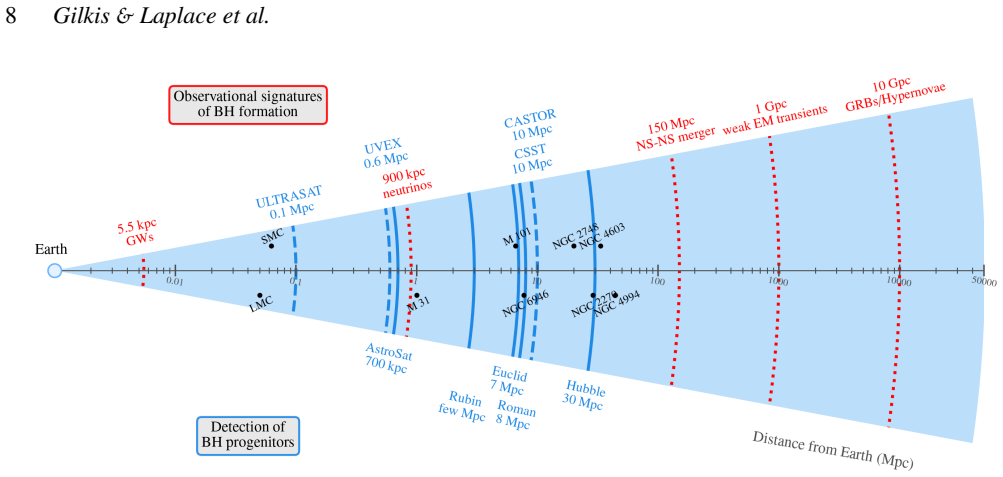
- Ultraviolet-sensitive observations of nearby star-forming galaxies provide a promising route to detecting disappearing massive stars.
- The predicted rate of direct-collapse events is about 0.4 per century in a galaxy with a star-formation rate of one solar mass per year.
- The photometric predictions can be used to interpret future surveys and to distinguish formation channels for stellar-mass black holes.
Where Pith is reading between the lines
- If the predictions hold, current optical searches for failed supernovae are biased against the dominant population of progenitors.
- Binary evolution channels may contribute significantly to the hot, blue progenitor fraction through stripping and interaction effects.
- Detection or non-detection of ultraviolet-bright disappearing stars could help calibrate the core-structure criteria used in the models.
- The result links the problem of black hole formation to the observed demographics of massive stars in the local universe.
Load-bearing premise
That the structure of the stellar core at collapse determines whether the star explodes or forms a black hole directly.
What would settle it
A survey detecting many more disappearing red supergiants than hot or ultraviolet-bright stars, or failing to find any ultraviolet-luminous disappearing events in nearby star-forming galaxies.
Figures


read the original abstract
While the connection between massive stars and supernova explosions is well established observationally, the link between massive stars and black hole formation remains elusive. Some massive stars may collapse directly to black holes without a successful supernova, and may therefore appear as disappearing stars. We investigate the expected photometric properties of such black hole progenitors by combining detailed single and binary stellar evolution models with physically motivated prescriptions linking pre-collapse core structure to explosion or direct collapse outcome, together with stellar atmosphere calculations, producing synthetic photometry across standard ultraviolet to infrared filters. Weighting by an initial mass function and empirical binary distributions, we predict both the observable distribution of progenitor brightness and colour and the rate of direct-collapse events, which we estimate to be about 0.4 per century for a galaxy forming stars at 1 Msun/yr. We find that black hole progenitors are predominantly hot and blue at the pre-collapse stage, with many in Wolf-Rayet phases and luminous in the ultraviolet, while only a minority are red supergiants. Consequently, searches that focus primarily on red supergiants are likely to miss a substantial fraction of direct-collapse events. Monitoring campaigns that include ultraviolet-sensitive observations of nearby star-forming galaxies therefore provide a promising route to detecting disappearing massive stars, offering a direct observational probe of black hole formation. Our results provide predictions to interpret such surveys and constrain the channels that lead to black hole formation.
Editorial analysis
A structured set of objections, weighed in public.
Referee Report
Summary. The manuscript combines detailed single and binary stellar evolution models with prescriptions for explosion or direct collapse based on pre-collapse core properties, computes synthetic photometry, and weights by IMF and binary statistics to predict the observable properties and rates of black hole progenitors. It concludes that these progenitors are predominantly hot and blue, with many in Wolf-Rayet phases and luminous in the UV, while only a minority are red supergiants, estimating a direct-collapse rate of about 0.4 per century for a galaxy with SFR=1 Msun/yr.
Significance. This provides forward predictions for detecting disappearing massive stars as a direct probe of black hole formation. The emphasis on UV observations offers a new strategy for monitoring campaigns in nearby galaxies. The non-circular, model-based approach strengthens the reliability of the predictions if the core assumptions hold.
major comments (2)
- [Methods section on collapse prescriptions] The central claim that black-hole progenitors are predominantly hot and blue rests on the specific prescriptions linking pre-collapse core structure (compactness, CO-core mass) to direct collapse versus explosion. Different literature choices for this mapping could reassign which tracks count as direct-collapse events and alter the hot/blue versus red-supergiant fractions. The manuscript should quantify the sensitivity of the photometric distribution and rate to variations in these prescriptions.
- [Results section on rates and distributions] The IMF-weighted rate of 0.4 per century and the progenitor color distribution are derived after applying the collapse criteria; the paper should show explicitly how the final fractions change when the compactness threshold or equivalent criterion is varied by amounts typical in the literature.
minor comments (3)
- [Abstract and rate calculation section] Clarify the exact numerical value and uncertainty on the direct-collapse rate rather than 'about 0.4'.
- [Atmosphere and photometry methods] Ensure all filter transmission curves and photometric zero-points are referenced consistently in the synthetic photometry description.
- [Discussion] Add a short comparison of the predicted UV luminosities to any existing upper limits from failed-supernova searches.
Simulated Author's Rebuttal
We thank the referee for their positive summary of our work and for highlighting its potential to guide observational searches for disappearing stars. The two major comments both concern the sensitivity of our results to the specific collapse prescriptions adopted. We address them below and agree to incorporate additional analysis in the revised manuscript.
read point-by-point responses
-
Referee: [Methods section on collapse prescriptions] The central claim that black-hole progenitors are predominantly hot and blue rests on the specific prescriptions linking pre-collapse core structure (compactness, CO-core mass) to direct collapse versus explosion. Different literature choices for this mapping could reassign which tracks count as direct-collapse events and alter the hot/blue versus red-supergiant fractions. The manuscript should quantify the sensitivity of the photometric distribution and rate to variations in these prescriptions.
Authors: We agree that the mapping from core properties to explosion outcome is a key assumption. Our fiducial results employ the compactness criterion calibrated to recent 1D explosion models (as referenced in the Methods). To address the referee's concern, we will add a new subsection and accompanying figure that recomputes the progenitor color distribution and direct-collapse rate after shifting the compactness threshold by amounts representative of the literature range (e.g., 0.20–0.30). This will demonstrate that while the precise numerical fractions vary, the qualitative conclusion that the majority of black-hole progenitors are hot and blue remains robust. revision: yes
-
Referee: [Results section on rates and distributions] The IMF-weighted rate of 0.4 per century and the progenitor color distribution are derived after applying the collapse criteria; the paper should show explicitly how the final fractions change when the compactness threshold or equivalent criterion is varied by amounts typical in the literature.
Authors: We will explicitly illustrate the effect of varying the compactness threshold in the revised Results section. A new table and/or panel in the relevant figure will report the hot/blue versus red-supergiant fractions and the IMF-weighted rate for three threshold values spanning the range commonly adopted in the literature. This addition will make the dependence on the collapse prescription transparent to readers. revision: yes
Circularity Check
No significant circularity; forward predictions from independent models and standard weightings.
full rationale
The derivation begins with detailed single/binary stellar evolution models, applies external physically motivated prescriptions for pre-collapse core structure to explosion/direct-collapse outcomes, computes synthetic photometry via atmosphere models, and weights the results by IMF plus empirical binary statistics. No step reduces the claimed hot/blue progenitor distribution or rate back to parameters fitted from the target observations, nor does any equation equate output to input by construction. The central claim is an explicit forward prediction for survey interpretation, not a tautological renaming or self-referential fit. Self-citations, if present for the prescriptions, are not load-bearing in a way that makes the result equivalent to the paper's own inputs.
Axiom & Free-Parameter Ledger
free parameters (1)
- collapse outcome prescriptions
axioms (2)
- domain assumption Standard single and binary stellar evolution physics including mass loss and nuclear burning
- domain assumption Initial mass function and empirical binary distributions are representative of the galaxy
Reference graph
Works this paper leans on
-
[1]
Abbasi R., et al., 2024, @doi [ ] 10.3847/1538-4357/ad07d1 , https://ui.adsabs.harvard.edu/abs/2024ApJ...961...84A 961, 84
-
[2]
Abbott B. P., et al., 2016, @doi [ ] 10.1103/PhysRevLett.116.061102 , https://ui.adsabs.harvard.edu/abs/2016PhRvL.116f1102A 116, 061102
-
[3]
ApJ848(2), 13 (2017) https://doi.org/10.3847/2041-8213/aa920c arXiv:1710.05834 [astro-ph.HE]
Abbott B. P., et al., 2017, @doi [ ] 10.3847/2041-8213/aa920c , https://ui.adsabs.harvard.edu/abs/2017ApJ...848L..13A 848, L13
-
[4]
2017b, MNRAS, 468, 4968, doi:10.1093/mnras/stx816
Adams S. M., Kochanek C. S., Gerke J. R., Stanek K. Z., Dai X., 2017a, @doi [ ] 10.1093/mnras/stx816 , https://ui.adsabs.harvard.edu/abs/2017MNRAS.468.4968A 468, 4968
-
[5]
Adams S. M., Kochanek C. S., Gerke J. R., Stanek K. Z., 2017b, @doi [ ] 10.1093/mnras/stx898 , https://ui.adsabs.harvard.edu/abs/2017MNRAS.469.1445A 469, 1445
-
[6]
Antoni A., Quataert E., 2022, @doi [ ] 10.1093/mnras/stab3776 , https://ui.adsabs.harvard.edu/abs/2022MNRAS.511..176A 511, 176
-
[7]
Antoni A., Quataert E., 2023, @doi [ ] 10.1093/mnras/stad2328 , https://ui.adsabs.harvard.edu/abs/2023MNRAS.525.1229A 525, 1229
-
[8]
Antoni A., Jiang Y.-F., Quataert E., 2025, @doi [arXiv e-prints] 10.48550/arXiv.2509.16308 , https://ui.adsabs.harvard.edu/abs/2025arXiv250916308A p. arXiv:2509.16308
-
[9]
Arcavi I., et al., 2017, @doi [ ] 10.1038/nature24291 , https://ui.adsabs.harvard.edu/abs/2017Natur.551...64A 551, 64
-
[10]
Basinger C. M., Kochanek C. S., Adams S. M., Dai X., Stanek K. Z., 2021, @doi [ ] 10.1093/mnras/stab2620 , https://ui.adsabs.harvard.edu/abs/2021MNRAS.508.1156B 508, 1156
-
[11]
Beacom J. F., Boyd R. N., Mezzacappa A., 2001, @doi [ ] 10.1103/PhysRevD.63.073011 , https://ui.adsabs.harvard.edu/abs/2001PhRvD..63g3011B 63, 073011
-
[12]
R., Hosseinzadeh, G., Smith, N., et al
Beasor E. R., Hosseinzadeh G., Smith N., Davies B., Jencson J. E., Pearson J., Sand D. J., 2024, @doi [ ] 10.3847/1538-4357/ad21fa , https://ui.adsabs.harvard.edu/abs/2024ApJ...964..171B 964, 171
-
[13]
R., Smith, N., Pearson, J., et al
Beasor E. R., Smith N., Pearson J., Subrayan B., Berger E., Sand D. J., Strader J., 2026, @doi [ ] 10.1093/mnras/stag052 , https://ui.adsabs.harvard.edu/abs/2026MNRAS.546ag052B 546, stag052
-
[14]
Berger E., 2014, @doi [ ] 10.1146/annurev-astro-081913-035926 , https://ui.adsabs.harvard.edu/abs/2014ARA&A..52...43B 52, 43
-
[15]
Bronner V. A., Laplace E., Schneider F. R. N., Podsiadlowski P., 2025, @doi [ ] 10.1051/0004-6361/202554642 , https://ui.adsabs.harvard.edu/abs/2025A&A...703A..61B 703, A61
-
[16]
Burrows A., Wang T., Vartanyan D., 2025, @doi [ ] 10.3847/1538-4357/addd04 , https://ui.adsabs.harvard.edu/abs/2025ApJ...987..164B 987, 164
-
[17]
Cao Y., et al., 2018, @doi [ ] 10.1093/mnras/sty1980 , https://ui.adsabs.harvard.edu/abs/2018MNRAS.480.2178C 480, 2178
-
[18]
C \^o t \'e P., et al., 2012, in Clampin M. C., Fazio G. G., MacEwen H. A., Oschmann Jr. J. M., eds, Society of Photo-Optical Instrumentation Engineers (SPIE) Conference Series Vol. 8442, Space Telescopes and Instrumentation 2012: Optical, Infrared, and Millimeter Wave. p. 844215, @doi 10.1117/12.926198
-
[19]
C \^o t \'e P., et al., 2025, @doi [Journal of Astronomical Telescopes, Instruments, and Systems] 10.1117/1.JATIS.11.4.042202 , https://ui.adsabs.harvard.edu/abs/2025JATIS..11d2202C 11, 042202
-
[20]
Cowley A. P., 1992, @doi [ ] 10.1146/annurev.aa.30.090192.001443 , https://ui.adsabs.harvard.edu/abs/1992ARA&A..30..287C 30, 287
-
[21]
Davies B., Beasor E. R., 2020, @doi [ ] 10.1093/mnras/staa174 , https://ui.adsabs.harvard.edu/abs/2020MNRAS.493..468D 493, 468
-
[22]
De K., et al., 2026, @doi [Science] 10.1126/science.adt4853 , https://ui.adsabs.harvard.edu/abs/2026Sci...391..689D 391, 689
-
[23]
DeCoursey C., et al., 2025, @doi [ ] 10.3847/1538-4357/ad8fab , https://ui.adsabs.harvard.edu/abs/2025ApJ...979..250D 979, 250
-
[24]
Drout M. R., G \"o tberg Y., Ludwig B. A., Groh J. H., de Mink S. E., O'Grady A. J. G., Smith N., 2023, @doi [Science] 10.1126/science.ade4970 , https://ui.adsabs.harvard.edu/abs/2023Sci...382.1287D 382, 1287
-
[25]
Eggenberger Andersen O., O'Connor E., Andresen H., da Silva Schneider A., Couch S. M., 2025, @doi [ ] 10.3847/1538-4357/ada899 , https://ui.adsabs.harvard.edu/abs/2025ApJ...980...53E 980, 53
-
[26]
N., 1989, @doi [ ] 10.1038/340126a0 , https://ui.adsabs.harvard.edu/abs/1989Natur.340..126E 340, 126
Eichler D., Livio M., Piran T., Schramm D. N., 1989, @doi [ ] 10.1038/340126a0 , https://ui.adsabs.harvard.edu/abs/1989Natur.340..126E 340, 126
-
[27]
El-Badry K., 2024, @doi [ ] 10.1016/j.newar.2024.101694 , https://ui.adsabs.harvard.edu/abs/2024NewAR..9801694E 98, 101694
-
[28]
El-Badry K., et al., 2023a, @doi [ ] 10.1093/mnras/stac3140 , https://ui.adsabs.harvard.edu/abs/2023MNRAS.518.1057E 518, 1057
-
[29]
El-Badry K., et al., 2023b, @doi [ ] 10.1093/mnras/stad799 , https://ui.adsabs.harvard.edu/abs/2023MNRAS.521.4323E 521, 4323
-
[30]
Fern \'a ndez R., Quataert E., Kashiyama K., Coughlin E. R., 2018, @doi [ ] 10.1093/mnras/sty306 , https://ui.adsabs.harvard.edu/abs/2018MNRAS.476.2366F 476, 2366
-
[31]
Gaia Collaboration et al., 2024, @doi [ ] 10.1051/0004-6361/202449763 , https://ui.adsabs.harvard.edu/abs/2024A&A...686L...2G 686, L2
-
[32]
Gerke J. R., Kochanek C. S., Stanek K. Z., 2015, @doi [ ] 10.1093/mnras/stv776 , https://ui.adsabs.harvard.edu/abs/2015MNRAS.450.3289G 450, 3289
-
[33]
Gilkis A., Arcavi I., 2022, @doi [ ] 10.1093/mnras/stac088 , https://ui.adsabs.harvard.edu/abs/2022MNRAS.511..691G 511, 691
-
[34]
Gilkis A., Soker N., 2014, @doi [ ] 10.1093/mnras/stu257 , https://ui.adsabs.harvard.edu/abs/2014MNRAS.439.4011G 439, 4011
-
[35]
Gilkis A., Soker N., Papish O., 2016, @doi [ ] 10.3847/0004-637X/826/2/178 , https://ui.adsabs.harvard.edu/abs/2016ApJ...826..178G 826, 178
-
[36]
Gilkis A., Laplace E., Arcavi I., Shenar T., Schneider F. R. N., 2025, @doi [ ] 10.1093/mnras/staf884 , https://ui.adsabs.harvard.edu/abs/2025MNRAS.540.3094G 540, 3094
-
[37]
Gofman R. A., Gluck N., Soker N., 2020, @doi [ ] 10.1093/mnras/staa1085 , https://ui.adsabs.harvard.edu/abs/2020MNRAS.494.5230G 494, 5230
-
[38]
G \"o tberg Y., et al., 2023, @doi [ ] 10.3847/1538-4357/ace5a3 , https://ui.adsabs.harvard.edu/abs/2023ApJ...959..125G 959, 125
-
[39]
Gr \"a fener G., Koesterke L., Hamann W. R., 2002, @doi [ ] 10.1051/0004-6361:20020269 , https://ui.adsabs.harvard.edu/abs/2002A&A...387..244G 387, 244
-
[40]
Groh J. H., Meynet G., Ekstr \"o m S., 2013, @doi [ ] 10.1051/0004-6361/201220741 , https://ui.adsabs.harvard.edu/abs/2013A&A...550L...7G 550, L7
-
[41]
Groot P. J., et al., 2024, @doi [ ] 10.1088/1538-3873/ad8b6a , https://ui.adsabs.harvard.edu/abs/2024PASP..136k5003G 136, 115003
-
[42]
Hamann W. R., Gr \"a fener G., 2003, @doi [ ] 10.1051/0004-6361:20031308 , https://ui.adsabs.harvard.edu/abs/2003A&A...410..993H 410, 993
-
[43]
Heger A., M \"u ller B., Mandel I., 2023, in Haiman Z., ed., , The Encyclopedia of Cosmology. Set 2: Frontiers in Cosmology. Volume 3: Black Holes. World Scientific Publishing Co. Pte. Ltd., pp 61--111, @doi 10.1142/9789811282676_0003
-
[44]
Hjorth J., et al., 2003, @doi [ ] 10.1038/nature01750 , https://ui.adsabs.harvard.edu/abs/2003Natur.423..847H 423, 847
-
[45]
Hounsell R., et al., 2018, @doi [ ] 10.3847/1538-4357/aac08b , https://ui.adsabs.harvard.edu/abs/2018ApJ...867...23H 867, 23
-
[46]
Inserra C., et al., 2018, @doi [ ] 10.1051/0004-6361/201731758 , https://ui.adsabs.harvard.edu/abs/2018A&A...609A..83I 609, A83
-
[47]
Ivezi \'c Z ., et al., 2019, @doi [ ] 10.3847/1538-4357/ab042c , https://ui.adsabs.harvard.edu/abs/2019ApJ...873..111I 873, 111
-
[48]
Izzard R. G., Ramirez-Ruiz E., Tout C. A., 2004, @doi [ ] 10.1111/j.1365-2966.2004.07436.x , https://ui.adsabs.harvard.edu/abs/2004MNRAS.348.1215I 348, 1215
-
[49]
Janka H.-T., 2012, @doi [Annual Review of Nuclear and Particle Science] 10.1146/annurev-nucl-102711-094901 , https://ui.adsabs.harvard.edu/abs/2012ARNPS..62..407J 62, 407
-
[50]
Jencson J. E., et al., 2022, @doi [ ] 10.3847/1538-4357/ac626c , https://ui.adsabs.harvard.edu/abs/2022ApJ...930...81J 930, 81
-
[51]
Kashi A., Soker N., 2017, @doi [ ] 10.1093/mnras/stx240 , https://ui.adsabs.harvard.edu/abs/2017MNRAS.467.3299K 467, 3299
-
[52]
Kochanek C. S., Beacom J. F., Kistler M. D., Prieto J. L., Stanek K. Z., Thompson T. A., Y \"u ksel H., 2008, @doi [ ] 10.1086/590053 , https://ui.adsabs.harvard.edu/abs/2008ApJ...684.1336K 684, 1336
-
[53]
Kochanek C. S., Neustadt J. M. M., Stanek K. Z., 2024, @doi [ ] 10.3847/1538-4357/ad18d7 , https://ui.adsabs.harvard.edu/abs/2024ApJ...962..145K 962, 145
-
[54]
Kroupa P., 2001, @doi [ ] 10.1046/j.1365-8711.2001.04022.x , https://ui.adsabs.harvard.edu/abs/2001MNRAS.322..231K 322, 231
-
[55]
Kulkarni S. R., et al., 2021, @doi [arXiv e-prints] 10.48550/arXiv.2111.15608 , https://ui.adsabs.harvard.edu/abs/2021arXiv211115608K p. arXiv:2111.15608
-
[56]
Langer N., et al., 2020, @doi [ ] 10.1051/0004-6361/201937375 , https://ui.adsabs.harvard.edu/abs/2020A&A...638A..39L 638, A39
-
[57]
Lanz T., Hubeny I., 2003, @doi [ ] 10.1086/374373 , https://ui.adsabs.harvard.edu/abs/2003ApJS..146..417L 146, 417
-
[58]
Lanz T., Hubeny I., 2007, @doi [ ] 10.1086/511270 , https://ui.adsabs.harvard.edu/abs/2007ApJS..169...83L 169, 83
-
[59]
2021, A&A, 656, A58, doi: 10.1051/0004-6361/202140506
Laplace E., Justham S., Renzo M., G \"o tberg Y., Farmer R., Vartanyan D., de Mink S. E., 2021, @doi [ ] 10.1051/0004-6361/202140506 , https://ui.adsabs.harvard.edu/abs/2021A&A...656A..58L 656, A58
-
[60]
Laplace E., Schneider F. R. N., Podsiadlowski P., 2025, @doi [ ] 10.1051/0004-6361/202451077 , https://ui.adsabs.harvard.edu/abs/2025A&A...695A..71L 695, A71
-
[61]
Laplace E., Bronner V. A., Schneider F. R. N., Podsiadlowski P., 2026, @doi [ ] 10.3847/2041-8213/ae3d2e , https://ui.adsabs.harvard.edu/abs/2026ApJ...998L..40L 998, L40
-
[62]
Levan A. J., et al., 2025, @doi [ ] 10.1051/0004-6361/202556581 , https://ui.adsabs.harvard.edu/abs/2025A&A...704L...8L 704, L8
-
[63]
Lovegrove E., Woosley S. E., 2013, @doi [ ] 10.1088/0004-637X/769/2/109 , https://ui.adsabs.harvard.edu/abs/2013ApJ...769..109L 769, 109
-
[64]
Lovegrove E., Woosley S. E., Zhang W., 2017, @doi [ ] 10.3847/1538-4357/aa7b7d , https://ui.adsabs.harvard.edu/abs/2017ApJ...845..103L 845, 103
-
[65]
2026, ApJ, 999, 73, doi: 10.3847/1538-4357/ae2d13
Ludwig B., Drout M. R., G \"o tberg Y., Lang D., Laroche A., 2026, @doi [ ] 10.3847/1538-4357/ae2d13 , https://ui.adsabs.harvard.edu/abs/2026ApJ...999...73L 999, 73
-
[66]
MacFadyen A. I., Woosley S. E., 1999, @doi [ ] 10.1086/307790 , https://ui.adsabs.harvard.edu/abs/1999ApJ...524..262M 524, 262
-
[67]
Moe M., Di Stefano R., 2017, @doi [ ] 10.3847/1538-4365/aa6fb6 , https://ui.adsabs.harvard.edu/abs/2017ApJS..230...15M 230, 15
-
[68]
M \"u ller B., 2026, @doi [arXiv e-prints] 10.48550/arXiv.2603.24243 , https://ui.adsabs.harvard.edu/abs/2026arXiv260324243M p. arXiv:2603.24243
-
[69]
M \"u ller B., Heger A., Liptai D., Cameron J. B., 2016, @doi [ ] 10.1093/mnras/stw1083 , https://ui.adsabs.harvard.edu/abs/2016MNRAS.460..742M 460, 742
-
[70]
Neustadt J. M. M., Kochanek C. S., Stanek K. Z., Basinger C., Jayasinghe T., Garling C. T., Adams S. M., Gerke J., 2021, @doi [ ] 10.1093/mnras/stab2605 , https://ui.adsabs.harvard.edu/abs/2021MNRAS.508..516N 508, 516
-
[71]
Paxton B., Bildsten L., Dotter A., Herwig F., Lesaffre P., Timmes F., 2011, @doi [ ] 10.1088/0067-0049/192/1/3 , https://ui.adsabs.harvard.edu/abs/2011ApJS..192....3P 192, 3
-
[72]
Paxton B., et al., 2013, @doi [ ] 10.1088/0067-0049/208/1/4 , https://ui.adsabs.harvard.edu/abs/2013ApJS..208....4P 208, 4
work page internal anchor Pith review doi:10.1088/0067-0049/208/1/4 2013
-
[73]
Paxton B., et al., 2015, @doi [ ] 10.1088/0067-0049/220/1/15 , https://ui.adsabs.harvard.edu/abs/2015ApJS..220...15P 220, 15
work page internal anchor Pith review doi:10.1088/0067-0049/220/1/15 2015
-
[74]
Paxton B., et al., 2018, @doi [ ] 10.3847/1538-4365/aaa5a8 , https://ui.adsabs.harvard.edu/abs/2018ApJS..234...34P 234, 34
-
[75]
Paxton B., et al., 2019, @doi [ ] 10.3847/1538-4365/ab2241 , https://ui.adsabs.harvard.edu/abs/2019ApJS..243...10P 243, 10
-
[76]
Pessi T., et al., 2025, @doi [ ] 10.1051/0004-6361/202556799 , https://ui.adsabs.harvard.edu/abs/2025A&A...703A..34P 703, A34
-
[77]
J., 1998, @doi [ ] 10.1086/316197 , https://ui.adsabs.harvard.edu/abs/1998PASP..110..863P 110, 863
Pickles A. J., 1998, @doi [ ] 10.1086/316197 , https://ui.adsabs.harvard.edu/abs/1998PASP..110..863P 110, 863
-
[78]
Prajs S., et al., 2017, @doi [ ] 10.1093/mnras/stw1942 , https://ui.adsabs.harvard.edu/abs/2017MNRAS.464.3568P 464, 3568
-
[79]
Quataert E., Lecoanet D., Coughlin E. R., 2019, @doi [ ] 10.1093/mnrasl/slz031 , https://ui.adsabs.harvard.edu/abs/2019MNRAS.485L..83Q 485, L83
-
[80]
M., Yuan F., Akerlof C., Wheeler J
Quimby R. M., Yuan F., Akerlof C., Wheeler J. C., 2013, @doi [ ] 10.1093/mnras/stt213 , https://ui.adsabs.harvard.edu/abs/2013MNRAS.431..912Q 431, 912
discussion (0)
Sign in with ORCID, Apple, or X to comment. Anyone can read and Pith papers without signing in.