Recognition: 2 theorem links
· Lean TheoremBifurcated Impact of Neutrino Fast Flavor Conversion on Core-collapse Supernovae Informed by Multi-angle Neutrino Radiation Hydrodynamics
Pith reviewed 2026-05-16 15:25 UTC · model grok-4.3
The pith
Neutrino fast flavor conversion aids shock revival in low-mass core-collapse supernovae but inhibits it in higher-mass ones.
A machine-rendered reading of the paper's core claim, the machinery that carries it, and where it could break.
Core claim
The effect of FFC on CCSN explosion is bifurcated depending on the progenitors. For the lowest-mass progenitor, FFC facilitates the shock revival and enhances the explosion energy, whereas for higher-mass progenitors its impact is inhibitory. We identify the mass accretion rate as the key determinant governing this bifurcation. When the mass accretion rate is low (high), the contribution of FFC to neutrino heating becomes positive (negative), because the heating efficiency enhancement via FFC-driven spectral hardening of electron-type neutrinos dominates over (is outweighed by) the concurrent reduction in neutrino luminosity.
What carries the argument
Multi-angle FFC subgrid model rooted in quantum kinetic theory, integrated with multi-dimensional four-species Boltzmann neutrino radiation hydrodynamics.
Load-bearing premise
The multi-angle subgrid model accurately captures fast flavor conversion and its hydrodynamical feedback without spurious effects, while mass accretion rate alone sets the sign of the net heating contribution across progenitors.
What would settle it
Simulate the identical setup for a low-mass progenitor with the FFC subgrid model enabled versus disabled and verify whether explosion energy rises, then repeat for a high-mass progenitor to check whether energy falls.
Figures



read the original abstract
In this {\it Letter}, we present a compelling and robust argument for the roles of neutrino fast flavor conversion (FFC) in the explosion mechanism of core-collapse supernova (CCSN), combining the {\it multi-angle} FFC subgrid model rooted in quantum kinetic theory with the multi-dimensional four-species Boltzmann neutrino radiation hydrodynamics. Employing various progenitor masses and the nuclear equations of states, we find that the effect of FFC on CCSN explosion is bifurcated depending on the progenitors. For the lowest-mass progenitor, FFC facilitates the shock revival and enhances the explosion energy, whereas for higher-mass progenitors its impact is inhibitory. We identify the mass accretion rate as the key determinant governing this bifurcation. When the mass accretion rate is low (high), the contribution of FFC to neutrino heating becomes positive (negative), because the heating efficiency enhancement via FFC-driven spectral hardening of electron-type neutrinos dominates over (is outweighed by) the concurrent reduction in neutrino luminosity. Our results further highlight the limitations of approximate neutrino transport, and demonstrate that a multi-angle treatment is essential for accurately capturing FFC effects; otherwise, FFCs are missed and even generated spuriously.
Editorial analysis
A structured set of objections, weighed in public.
Referee Report
Summary. This Letter investigates the impact of neutrino fast flavor conversion (FFC) on core-collapse supernovae (CCSN) explosions by combining a multi-angle FFC subgrid model rooted in quantum kinetic theory with multi-dimensional four-species Boltzmann neutrino radiation hydrodynamics. Across various progenitor masses and nuclear equations of state, the authors report a bifurcated effect: FFC facilitates shock revival and enhances explosion energy for the lowest-mass progenitor, but inhibits explosions for higher-mass progenitors. They identify the mass accretion rate as the key determinant, with low rates yielding net positive heating via spectral hardening of electron-type neutrinos and high rates yielding net negative effects via reduced neutrino luminosity. The work also highlights limitations of approximate neutrino transport, which can miss or spuriously generate FFCs.
Significance. If the bifurcation claim holds after isolating the causal role of accretion rate, the result would be significant for CCSN theory by providing a physically motivated, progenitor-dependent role for FFC that reconciles conflicting prior findings. The use of a multi-angle subgrid model in full Boltzmann transport and the consistency across multiple progenitors and EOS are strengths that support robustness. However, the current evidence is only moderately strong due to the absence of controlled variations isolating accretion rate from correlated progenitor properties and limited quantitative details on heating efficiency and error bars.
major comments (2)
- [Abstract and results on bifurcation] Abstract and results on bifurcation: The claim that mass accretion rate is the sole governing determinant of the sign flip in FFC's net heating contribution rests on comparisons across progenitors that simultaneously differ in density profiles, composition gradients, and core structure. No controlled variation (e.g., artificial modulation of accretion rate while holding other features fixed) is described, leaving open whether accretion rate is causal or merely a proxy; this directly undermines the central bifurcation argument.
- [Methods on FFC subgrid model] Methods on FFC subgrid model: The multi-angle FFC subgrid model is assumed to capture flavor conversion accurately without spurious effects, yet the manuscript provides insufficient detail on its implementation parameters, validation against full quantum kinetic equations, and quantitative checks for heating efficiency differences. Given the abstract's own warning about approximate transport generating spurious FFCs, this assumption is load-bearing for all reported outcomes.
minor comments (2)
- [Abstract] The abstract refers to 'four-species Boltzmann' transport without specifying the exact flavor content (e.g., whether mu/tau neutrinos are treated as a single species); this should be clarified for reproducibility.
- [Results] Quantitative measures such as exact differences in explosion energy, shock revival times, and heating rates with error bars are mentioned as lacking in the reader's assessment; adding these to tables or figures would strengthen the presentation.
Simulated Author's Rebuttal
We thank the referee for the detailed and constructive report. We address each major comment below.
read point-by-point responses
-
Referee: Abstract and results on bifurcation: The claim that mass accretion rate is the sole governing determinant of the sign flip in FFC's net heating contribution rests on comparisons across progenitors that simultaneously differ in density profiles, composition gradients, and core structure. No controlled variation (e.g., artificial modulation of accretion rate while holding other features fixed) is described, leaving open whether accretion rate is causal or merely a proxy; this directly undermines the central bifurcation argument.
Authors: We agree that controlled variations isolating accretion rate would strengthen the causality claim. Our results are based on natural variations in progenitor models where accretion rate correlates with the bifurcation sign. We will add a dedicated discussion paragraph acknowledging this limitation and noting that accretion rate serves as a proxy for the net heating balance in our simulations. No new simulations are planned for this Letter, but the trend holds across the explored parameter space. revision: partial
-
Referee: Methods on FFC subgrid model: The multi-angle FFC subgrid model is assumed to capture flavor conversion accurately without spurious effects, yet the manuscript provides insufficient detail on its implementation parameters, validation against full quantum kinetic equations, and quantitative checks for heating efficiency differences. Given the abstract's own warning about approximate transport generating spurious FFCs, this assumption is load-bearing for all reported outcomes.
Authors: We will revise the Methods section to provide additional details on the subgrid model parameters, including the specific criteria for detecting FFC regions and the averaging procedure over angles. We will also include a new appendix with validation comparisons to full quantum kinetic equation solutions in test cases and quantitative plots showing the differences in neutrino heating efficiency with and without the FFC subgrid model. revision: yes
Circularity Check
No circularity; bifurcation claim rests on independent simulation comparisons
full rationale
The paper reports numerical outcomes from multi-dimensional Boltzmann neutrino radiation hydrodynamics runs across distinct progenitors and EOS choices, with and without the multi-angle FFC subgrid model. The observed sign flip in FFC's net heating contribution and the subsequent identification of mass accretion rate as the governing variable emerge directly from those cross-run comparisons rather than from any self-referential definition, fitted parameter renamed as prediction, or load-bearing self-citation chain. No equation or modeling step reduces by construction to its own inputs, satisfying the criteria for a self-contained, non-circular derivation.
Axiom & Free-Parameter Ledger
free parameters (1)
- FFC subgrid model parameters
axioms (2)
- standard math Quantum kinetic theory governs neutrino flavor evolution in dense media
- domain assumption Multi-angle treatment is required to avoid missing or spuriously generating FFC effects
Lean theorems connected to this paper
-
IndisputableMonolith/Cost/FunctionalEquation.leanwashburn_uniqueness_aczel unclear?
unclearRelation between the paper passage and the cited Recognition theorem.
We identify the mass accretion rate as the key determinant governing this bifurcation. When the mass accretion rate is low (high), the contribution of FFC to neutrino heating becomes positive (negative), because the heating efficiency enhancement via FFC-driven spectral hardening of electron-type neutrinos dominates over (is outweighed by) the concurrent reduction in neutrino luminosity.
What do these tags mean?
- matches
- The paper's claim is directly supported by a theorem in the formal canon.
- supports
- The theorem supports part of the paper's argument, but the paper may add assumptions or extra steps.
- extends
- The paper goes beyond the formal theorem; the theorem is a base layer rather than the whole result.
- uses
- The paper appears to rely on the theorem as machinery.
- contradicts
- The paper's claim conflicts with a theorem or certificate in the canon.
- unclear
- Pith found a possible connection, but the passage is too broad, indirect, or ambiguous to say the theorem truly supports the claim.
Forward citations
Cited by 2 Pith papers
-
Fast Neutrino-Flavor Conversion with Attenuation and Global Lepton Gradient
Steep radial lepton gradients suppress fast neutrino-flavor conversion in global spherical simulations; the suppression depends strongly on the attenuation parameter and is explained by an adiabatic condition on flavo...
-
Neutrino transport and flavor instabilities in a post-merger disk
In post-merger disks, electron-lepton-number crossings drive fast flavor instabilities that enhance heavy lepton neutrino fluxes, while collisional instabilities are subdominant and asymmetrically raise heavy-flavor a...
Reference graph
Works this paper leans on
-
[1]
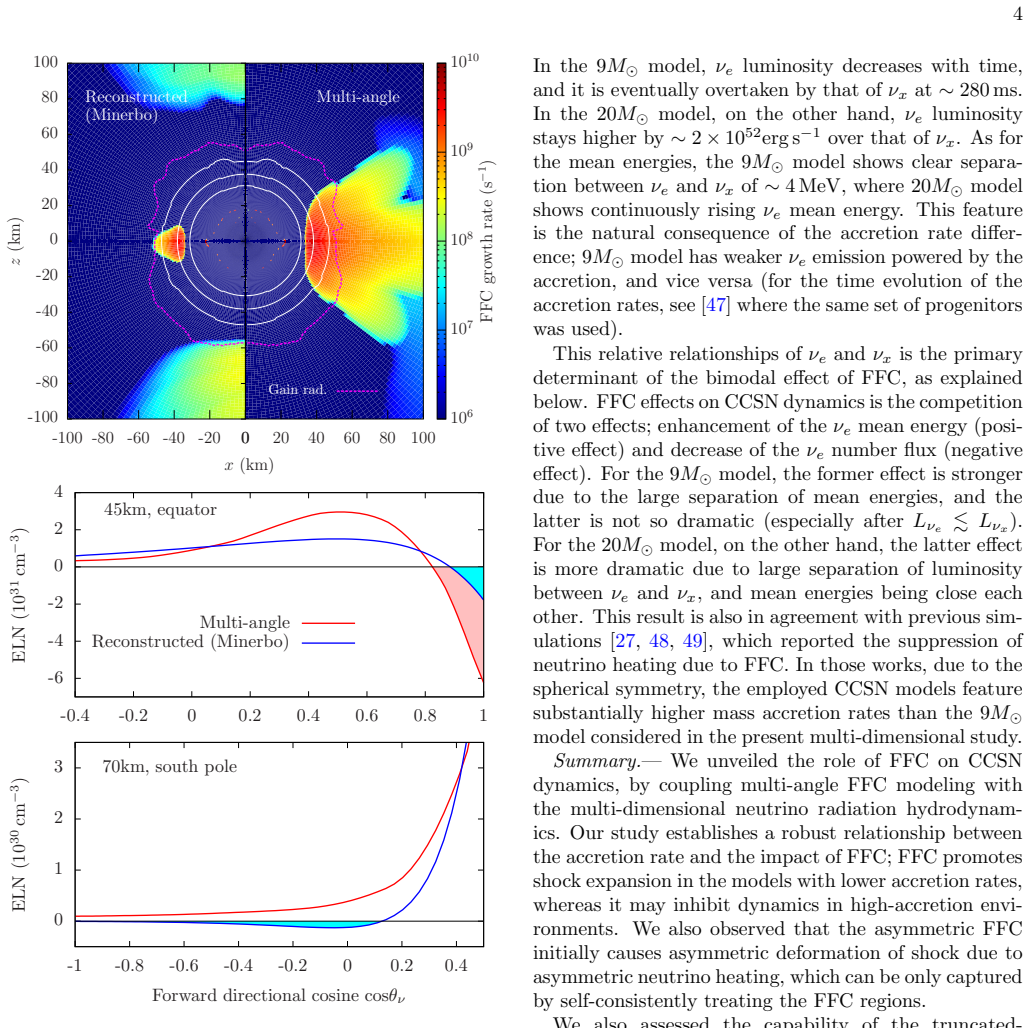
was imposed. In this approach, the distribution is assumed to have the formf=e acosθ ν −b and the two parametersaandbare determined from the 0th and 1st moments. Top panel of Fig. 3 compares the FFC growth rates at 260 ms for the no-oscillation 9M ⊙ VM EOS model, be- tween Minerbo reconstruction and the multi-angle cases. It is clear that the decoupling r...
-
[2]
Janka, Neutrino-Driven Explosions, inHandbook of Supernovae, edited by A
H.-T. Janka, Neutrino-Driven Explosions, inHandbook of Supernovae, edited by A. W. Alsabti and P. Murdin (Springer, 2017) p. 1095
work page 2017
-
[3]
Janka, Neutrino Emission from Supernovae, in Handbook of Supernovae, edited by A
H.-T. Janka, Neutrino Emission from Supernovae, in Handbook of Supernovae, edited by A. W. Alsabti and P. Murdin (Springer, 2017) p. 1575
work page 2017
-
[4]
A. Mezzacappa, E. Endeve, O. E. B. Messer, and S. W. Bruenn, Physical, numerical, and computational chal- lenges of modeling neutrino transport in core-collapse su- pernovae, Living Reviews in Computational Astrophysics 6, 4 (2020), arXiv:2010.09013 [astro-ph.HE]
-
[5]
A. Burrows and D. Vartanyan, Core-collapse super- nova explosion theory, Nature (London)589, 29 (2021), arXiv:2009.14157 [astro-ph.SR]
-
[6]
A. Mezzacappa, Toward Realistic Models of Core Col- lapse Supernovae: A Brief Review, inThe Predic- tive Power of Computational Astrophysics as a Dis- cover Tool, IAU Symposium, Vol. 362, edited by D. Bisikalo, D. Wiebe, and C. Boily (2023) pp. 215–227, arXiv:2205.13438 [astro-ph.SR]
-
[7]
L. Boccioli and L. Roberti, The Physics of Core-Collapse Supernovae: Explosion Mechanism and Explosive Nu- cleosynthesis, Universe10, 148 (2024), arXiv:2403.12942 [astro-ph.SR]
- [8]
-
[9]
H. Suzuki, Neutrinos from Core-Collapse Supernova Explosions, Progress of Theoretical and Experimental Physics2024, 05B101 (2024)
work page 2024
- [10]
-
[11]
R. F. Sawyer, Speed-up of neutrino transformations in a supernova environment, Phys. Rev. D72, 045003 (2005), arXiv:hep-ph/0503013 [astro-ph]
work page internal anchor Pith review Pith/arXiv arXiv 2005
-
[12]
H. Duan, G. M. Fuller, J. Carlson, and Y.-Z. Qian, Simulation of coherent nonlinear neutrino flavor trans- formation in the supernova environment: Correlated neutrino trajectories, Phys. Rev. D74, 105014 (2006), arXiv:astro-ph/0606616 [astro-ph]
work page internal anchor Pith review Pith/arXiv arXiv 2006
-
[13]
H. Duan, G. M. Fuller, and Y.-Z. Qian, Collective neu- trino flavor transformation in supernovae, Phys. Rev. D 74, 123004 (2006), arXiv:astro-ph/0511275 [astro-ph]
work page internal anchor Pith review Pith/arXiv arXiv 2006
-
[14]
R. F. Sawyer, Multiangle instability in dense neu- trino systems, Phys. Rev. D79, 105003 (2009), arXiv:0803.4319 [astro-ph]
work page internal anchor Pith review Pith/arXiv arXiv 2009
- [15]
- [16]
-
[17]
K. Mori, T. Takiwaki, K. Kotake, and S. Horiuchi, Three-dimensional core-collapse supernova models with phenomenological treatment of neutrino flavor conver- sions, Publications of the Astronomical Society of Japan 10.1093/pasj/psaf007 (2025), arXiv:2501.15256 [astro- ph.HE]
-
[18]
T. Wang and A. Burrows, The Effect of the Fast-flavor In- stability on Core-collapse Supernova Models, Astrophys. J.986, 153 (2025), arXiv:2503.04896 [astro-ph.HE]
-
[19]
T. Wang and A. Burrows, The Effect of the Fast- Flavor Instability on Core-Collapse Supernova Mod- els: II. Quasi-Equipartition and the Impact of Var- ious Angular Reconstruction Methods, arXiv e-prints , arXiv:2511.20767 (2025), arXiv:2511.20767 [astro- ph.HE]
-
[20]
H. Nagakura and L. Johns, New method for detecting fast neutrino flavor conversions in core-collapse supernova models with two-moment neutrino transport, Phys. Rev. D104, 063014 (2021), arXiv:2106.02650 [astro-ph.HE]
-
[21]
H. Nagakura, A. Burrows, L. Johns, and G. M. Fuller, Where, when, and why: Occurrence of fast-pairwise collective neutrino oscillation in three-dimensional core- collapse supernova models, Phys. Rev. D104, 083025 (2021), arXiv:2108.07281 [astro-ph.HE]
-
[22]
L. Johns and H. Nagakura, Fast flavor instabilities and the search for neutrino angular crossings, Phys. Rev. D 103, 123012 (2021), arXiv:2104.04106 [hep-ph]
-
[23]
M. Cornelius, I. Tamborra, M. Heinlein, and H.-T. Janka, Diagnosing electron-neutrino lepton number crossings in core-collapse supernovae: A comparison of meth- ods, Phys. Rev. D112, 063004 (2025), arXiv:2506.20723 [astro-ph.HE]
-
[24]
H. Nagakura, T. Morinaga, C. Kato, and S. Yamada, Fast-pairwise Collective Neutrino Oscillations Associ- ated with Asymmetric Neutrino Emissions in Core- collapse Supernovae, Astrophys. J.886, 139 (2019), arXiv:1910.04288 [astro-ph.HE]
-
[25]
M. Zaizen and H. Nagakura, Simple method for deter- mining asymptotic states of fast neutrino-flavor conver- sion, Phys. Rev. D107, 103022 (2023), arXiv:2211.09343 [astro-ph.HE]
-
[26]
P. L. Bhatnagar, E. P. Gross, and M. Krook, A Model for Collision Processes in Gases. I. Small Amplitude Pro- cesses in Charged and Neutral One-Component Systems, Physical Review94, 511 (1954)
work page 1954
-
[27]
H. Nagakura, L. Johns, and M. Zaizen, Bhatnagar- Gross-Krook subgrid model for neutrino quantum kinet- ics, Phys. Rev. D109, 083013 (2024), arXiv:2312.16285 [astro-ph.HE]
- [28]
-
[29]
H. Nagakura, K. Sumiyoshi, and S. Yamada, Three- dimensional Boltzmann Hydro Code for Core Collapse in Massive Stars. I. Special Relativistic Treatments, As- trophysical Journal Supplement Series214, 16 (2014), arXiv:1407.5632 [astro-ph.HE]
work page internal anchor Pith review Pith/arXiv arXiv 2014
-
[30]
H. Nagakura, W. Iwakami, S. Furusawa, K. Sumiyoshi, S. Yamada, H. Matsufuru, and A. Imakura, Three- dimensional Boltzmann-Hydro Code for Core-collapse in Massive Stars. II. The Implementation of Moving-mesh for Neutron Star Kicks, Astrophysical Journal Supple- ment Series229, 42 (2017), arXiv:1605.00666 [astro- ph.HE]
work page internal anchor Pith review Pith/arXiv arXiv 2017
-
[31]
H. Nagakura, K. Sumiyoshi, and S. Yamada, Three- dimensional Boltzmann-hydro Code for Core-collapse in Massive Stars. III. A New Method for Momentum Feed- back from Neutrino to Matter, Astrophys. J.878, 160 (2019), arXiv:1906.10143 [astro-ph.HE]
-
[32]
R. Akaho, A. Harada, H. Nagakura, K. Sumiyoshi, W. Iwakami, H. Okawa, S. Furusawa, H. Matsufuru, and S. Yamada, Multidimensional Boltzmann Neutrino Transport Code in Full General Relativity for Core- collapse Simulations, Astrophys. J.909, 210 (2021), arXiv:2010.10780 [astro-ph.HE]
-
[33]
R. Akaho, A. Harada, H. Nagakura, W. Iwakami, H. Okawa, S. Furusawa, H. Matsufuru, K. Sumiyoshi, and S. Yamada, Protoneutron Star Convection Simulated with a New General Relativistic Boltzmann Neutrino Radiation Hydrodynamics Code, Astrophys. J.944, 60 (2023), arXiv:2206.01673 [astro-ph.HE]
-
[34]
S. W. Bruenn, Stellar core collapse - Numerical model and infall epoch, Astrophysical Journal Supplement Se- ries58, 771 (1985)
work page 1985
-
[35]
K. Langanke and G. Mart´ ınez-Pinedo, Shell-model cal- culations of stellar weak interaction rates: II. Weak rates for nuclei in the mass range /A=45-65 in super- novae environments, Nuclear Physics A673, 481 (2000), arXiv:nucl-th/0001018 [nucl-th]
work page internal anchor Pith review Pith/arXiv arXiv 2000
-
[36]
Electron capture rates on nuclei and implications for stellar core collapse
K. Langanke, G. Mart´ ınez-Pinedo, J. M. Sampaio, D. J. Dean, W. R. Hix, O. E. Messer, A. Mezzacappa, M. Liebend¨ orfer, H. T. Janka, and M. Rampp, Elec- tron Capture Rates on Nuclei and Implications for Stel- lar Core Collapse, Phys. Rev. Lett.90, 241102 (2003), arXiv:astro-ph/0302459 [astro-ph]
work page internal anchor Pith review Pith/arXiv arXiv 2003
-
[37]
Improved estimate of electron capture rates on nuclei during stellar core collapse
A. Juodagalvis, K. Langanke, W. R. Hix, G. Mart´ ınez- Pinedo, and J. M. Sampaio, Improved estimate of elec- tron capture rates on nuclei during stellar core collapse, Nuclear Physics A848, 454 (2010), arXiv:0909.0179 [nucl-th]
work page internal anchor Pith review Pith/arXiv arXiv 2010
-
[38]
Comparing treatments of weak reactions with nuclei in simulations of core-collapse supernovae
H. Nagakura, S. Furusawa, H. Togashi, S. Richers, K. Sumiyoshi, and S. Yamada, Comparing Treatments of Weak Reactions with Nuclei in Simulations of Core- collapse Supernovae, Astrophysical Journal Supplement Series240, 38 (2019), arXiv:1812.09811 [astro-ph.HE]. 7
work page internal anchor Pith review Pith/arXiv arXiv 2019
-
[39]
Core-Collapse Supernovae from 9 to 120 Solar Masses Based on Neutrino-powered Explosions
T. Sukhbold, T. Ertl, S. E. Woosley, J. M. Brown, and H.-T. Janka, Core-collapse Supernovae from 9 to 120 Solar Masses Based on Neutrino-powered Explosions, Astrophys. J.821, 38 (2016), arXiv:1510.04643 [astro- ph.HE]
work page internal anchor Pith review Pith/arXiv arXiv 2016
-
[40]
S. Furusawa, H. Togashi, H. Nagakura, K. Sumiyoshi, S. Yamada, H. Suzuki, and M. Takano, A new equa- tion of state for core-collapse supernovae based on real- istic nuclear forces and including a full nuclear ensemble, Journal of Physics G Nuclear Physics44, 094001 (2017), arXiv:1707.06410 [astro-ph.HE]
work page internal anchor Pith review Pith/arXiv arXiv 2017
-
[41]
S. Furusawa, H. Togashi, K. Sumiyoshi, K. Saito, S. Ya- mada, and H. Suzuki, Nuclear statistical equilibrium equation of state with a parametrized Dirac-Br¨ uckner Hartree-Fock calculation, Progress of Theoretical and Experimental Physics2020, 013D05 (2020)
work page 2020
-
[42]
Z. Xiong, M.-R. Wu, S. Abbar, S. Bhattacharyya, M. George, and C.-Y. Lin, Evaluating approximate asymptotic distributions for fast neutrino flavor conver- sions in a periodic 1D box, Phys. Rev. D108, 063003 (2023), arXiv:2307.11129 [astro-ph.HE]
- [43]
-
[44]
S. Abbar and F. Capozzi, Suppression of fast neutrino flavor conversions occurring at large distances in core- collapse supernovae, Journal of Cosmology and Astropar- ticle Physics2022, 051 (2022), arXiv:2111.14880 [astro- ph.HE]
-
[45]
M. Zaizen and T. Morinaga, Nonlinear evolution of fast neutrino flavor conversion in the preshock region of core- collapse supernovae, Phys. Rev. D104, 083035 (2021), arXiv:2104.10532 [hep-ph]
-
[46]
A. Harada and H. Nagakura, Prospects of Fast Flavor Neutrino Conversion in Rotating Core-collapse Super- novae, Astrophys. J.924, 109 (2022), arXiv:2110.08291 [astro-ph.HE]
-
[47]
G. N. Minerbo, Maximum entropy Eddington factors., Journal of Quantitative Spectroscopy and Radiative Transfer20, 541 (1978)
work page 1978
-
[48]
A. Burrows, D. Radice, D. Vartanyan, H. Nagakura, M. A. Skinner, and J. C. Dolence, The overarching framework of core-collapse supernova explosions as re- vealed by 3D FORNAX simulations, Monthly Notices of the Royal Astronomical Society491, 2715 (2020), arXiv:1909.04152 [astro-ph.HE]
-
[49]
H. Nagakura, Roles of Fast Neutrino-Flavor Conver- sion on the Neutrino-Heating Mechanism of Core- Collapse Supernova, Phys. Rev. Lett.130, 211401 (2023), arXiv:2301.10785 [astro-ph.HE]
-
[50]
Z. Xiong, M.-R. Wu, M. George, and C.-Y. Lin, Robust Integration of Fast Flavor Conversions in Classical Neu- trino Transport, Phys. Rev. Lett.134, 051003 (2025), arXiv:2403.17269 [astro-ph.HE]
- [51]
-
[52]
Testing common approximations of neutrino fast flavor conversion
E. Urquilla and L. Johns, Testing common approxima- tions of neutrino fast flavor conversion, arXiv e-prints , arXiv:2510.23917 (2025), arXiv:2510.23917 [astro- ph.HE]
work page internal anchor Pith review Pith/arXiv arXiv 2025
- [53]
-
[54]
Johns, Collisional Flavor Instabilities of Super- nova Neutrinos, Phys
L. Johns, Collisional Flavor Instabilities of Super- nova Neutrinos, Phys. Rev. Lett.130, 191001 (2023), arXiv:2104.11369 [hep-ph]
- [55]
- [56]
discussion (0)
Sign in with ORCID, Apple, or X to comment. Anyone can read and Pith papers without signing in.