Recognition: no theorem link
Ollivier-Ricci Curvature of Riemannian Manifolds and Directed Graphs with Applications to Graph Neural Networks
Pith reviewed 2026-05-10 18:42 UTC · model grok-4.3
The pith
Ollivier-Ricci curvature extends to directed graphs while retaining comparison theorems from manifolds.
A machine-rendered reading of the paper's core claim, the machinery that carries it, and where it could break.
Core claim
The paper claims that a suitable definition of Ollivier-Ricci curvature on directed graphs, again based on the 1-Wasserstein distance, satisfies the key comparison properties and bounds previously established for Riemannian manifolds and undirected graphs, thereby making the same theoretical guarantees available for directed structures.
What carries the argument
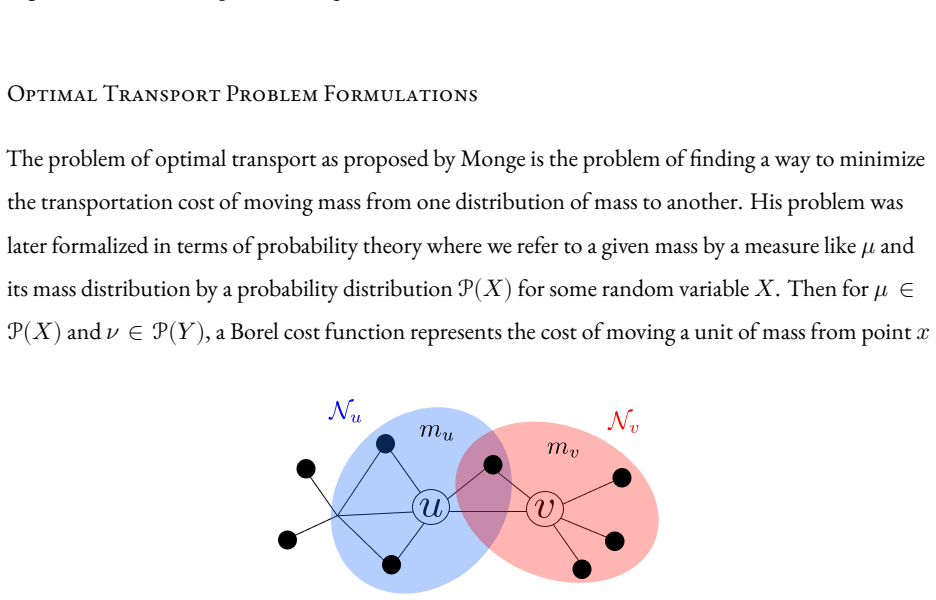
Ollivier-Ricci curvature, defined as the amount by which the 1-Wasserstein distance between uniform measures on balls differs from the original distance between their centers, acting as a discrete, transport-based proxy for Ricci curvature.
If this is right
- Directed graphs admit diameter bounds and volume-growth controls under positive curvature.
- Graph-neural-network algorithms can incorporate the curvature as a structural feature on directed data.
- Combinatorial curvature bounds previously proved for undirected graphs carry over to the directed setting.
- Network-science tasks such as community detection gain a geometric invariant defined directly on asymmetric edges.
Where Pith is reading between the lines
- The extension could be tested on citation or traffic networks to see whether curvature values improve link-prediction accuracy.
- Hybrid methods that combine this curvature with other discrete curvatures become possible once the directed case is settled.
- Stability analysis of dynamical systems on directed graphs might use the curvature as a Lyapunov-like quantity.
Load-bearing premise
The new definition on directed graphs preserves the comparison properties and bounds that hold for undirected graphs and manifolds.
What would settle it
A concrete directed graph on which the proposed curvature violates an expected bound such as the Bonnet-Myers diameter estimate under positive curvature.
Figures









read the original abstract
This thesis is an exposition of Ollivier-Ricci Curvature of metric spaces as introduced by Yann Ollivier, which is based upon the 1-Wasserstein Distance and optimal transport theory. We present some of the major results and proofs that connect Ollivier-Ricci curvature with classical Ricci curvature of Riemannian manifolds, including extensions of various theoretical bounds and theorems such as Bonnet-Myers and Levy-Gromov. Then we shift to results introduced by Lin-Lu-Yau on an extension of Ollivier-Ricci curvature on graphs, as well as the work of Jost-Liu on proving various combinatorial bounds for graph Ollivier-Ricci curvature. At the end of this thesis we present novel ideas and proofs regarding extensions of these results to directed graphs, and finally applications of graph-based Ollivier-Ricci curvature to various algorithms in network science and graph machine learning.
Editorial analysis
A structured set of objections, weighed in public.
Referee Report
Summary. This thesis exposits Ollivier-Ricci curvature on metric spaces and Riemannian manifolds via 1-Wasserstein distance and optimal transport, reviews the Lin-Lu-Yau and Jost-Liu extensions to undirected graphs together with their combinatorial bounds and comparison theorems, introduces novel extensions and proofs to directed graphs, and discusses applications of the resulting curvature notions to algorithms in network science and graph neural networks.
Significance. If the directed-graph extension rigorously preserves the comparison theorems (Bonnet-Myers, Levy-Gromov) and the associated diameter-control estimates that hold in the undirected and manifold settings, the work would supply a useful theoretical foundation for curvature-based methods on directed networks and could inform rewiring or regularization techniques in GNNs. The review of existing manifold and undirected-graph results is clear and self-contained; the applications section may yield concrete algorithmic suggestions once the directed case is verified.
major comments (2)
- [Directed-graph extension] § on directed-graph extension: the central claim that the directed Ollivier-Ricci curvature retains the same lower bounds and contraction properties as the undirected case is load-bearing for all subsequent applications. The standard Kantorovich-duality argument used by Lin-Lu-Yau relies on symmetric neighbor measures; the directed out-neighbor measure m_x breaks this symmetry, and no replacement argument establishing the same diameter-control or curvature lower bound is supplied.
- [Applications to GNNs and network algorithms] Applications section: the asserted utility for GNN message-passing and network-science algorithms rests on the directed curvature satisfying the same inequalities that justify curvature-based rewiring in the undirected setting. Without an explicit verification that the directed version yields comparable bounds, these claims are not yet supported.
minor comments (2)
- [Notation and definitions] The definition of the directed probability measure m_x should be written with an explicit formula distinguishing out-neighbors from in-neighbors.
- [Directed-graph section] A short table comparing the undirected and directed curvature formulas would improve readability.
Simulated Author's Rebuttal
We thank the referee for the careful and constructive review of our thesis. The comments correctly identify that the directed-graph extension is central to the work and that its comparison properties must be rigorously established to support the applications. We will revise the manuscript to supply the missing arguments.
read point-by-point responses
-
Referee: [Directed-graph extension] § on directed-graph extension: the central claim that the directed Ollivier-Ricci curvature retains the same lower bounds and contraction properties as the undirected case is load-bearing for all subsequent applications. The standard Kantorovich-duality argument used by Lin-Lu-Yau relies on symmetric neighbor measures; the directed out-neighbor measure m_x breaks this symmetry, and no replacement argument establishing the same diameter-control or curvature lower bound is supplied.
Authors: We agree that the asymmetry introduced by the directed out-neighbor measure prevents direct use of the Kantorovich-duality argument from the undirected case. Our manuscript presents a novel definition of directed Ollivier-Ricci curvature together with some initial properties, but we acknowledge that an explicit replacement argument for the diameter-control estimates and retention of Bonnet-Myers-type lower bounds is not fully developed. In the revision we will add a dedicated subsection deriving these bounds via a one-sided optimal-transport comparison that respects the directed measures, thereby establishing the required contraction properties under suitable assumptions on the out-neighbor distributions. revision: yes
-
Referee: [Applications to GNNs and network algorithms] Applications section: the asserted utility for GNN message-passing and network-science algorithms rests on the directed curvature satisfying the same inequalities that justify curvature-based rewiring in the undirected setting. Without an explicit verification that the directed version yields comparable bounds, these claims are not yet supported.
Authors: The applications section is intended to indicate how the directed curvature could inform rewiring and regularization once the theoretical bounds are in place. Because those bounds require the additional verification noted in the previous comment, we will revise the applications section to cite the newly supplied diameter-control and curvature inequalities and to explain, with concrete algorithmic sketches, how they justify analogous rewiring procedures for directed graphs in GNN message-passing and network-science tasks. revision: yes
Circularity Check
No significant circularity; novel directed-graph extensions presented as independent proofs
full rationale
The paper is structured as an exposition of prior independent results (Ollivier's definition via 1-Wasserstein distance, Lin-Lu-Yau graph extension, Jost-Liu combinatorial bounds) followed by explicitly labeled 'novel ideas and proofs' for directed graphs and applications. No equations or steps in the abstract reduce a claimed prediction or theorem to a fitted parameter, self-definition, or load-bearing self-citation chain. The directed-graph claims are introduced as new arguments rather than derived by renaming or construction from the undirected case inputs. This satisfies the default expectation of a self-contained derivation with independent content.
Axiom & Free-Parameter Ledger
axioms (2)
- standard math Ollivier-Ricci curvature is defined using the 1-Wasserstein distance between probability measures on the space.
- domain assumption Classical comparison theorems such as Bonnet-Myers and Levy-Gromov extend to the Ollivier-Ricci setting under suitable conditions.
Reference graph
Works this paper leans on
-
[1]
Community detection and stochastic block models: recent developments
Emmanuel Abbe. Community detection and stochastic block models: recent developments. Journal of Machine Learning Research, 18(177):1–86, 2018
2018
-
[2]
Springer, Cham, 1st edition 2021 edition, 2021
Luigi Ambrosio, Elia Brué, and Daniele Semola.Lectures on optimal transport, volume 130 of UNITEXT. Springer, Cham, 1st edition 2021 edition, 2021. ISBN 3030721612
2021
-
[3]
Graph Rewiring in GNNs to Mitigate Over-Squashing and Over-Smoothing: A Survey
Hugo Attali, Davide Buscaldi, and Nathalie Pernelle. Rewiring techniques to mitigate over- squashing and oversmoothing in gnns: A survey.arXiv preprint arXiv:2411.17429, 2024
work page internal anchor Pith review Pith/arXiv arXiv 2024
-
[4]
Jørgen Bang-Jensen and Gregory Gutin.Classes of Directed Graphs. Springer Monographs in Mathematics. Springer Nature, Cham, 1st ed. 2018. edition, 2018. ISBN 978-3-319-71840-8. doi: 10.1007/978-3-319-71840-8. ISSN: 1439-7382 Pages: 1–636
-
[5]
Chemins et circuits hamiltoniens des graphes complets.COMPTES RENDUS HEBDOMADAIRES DES SEANCES DE L ACADEMIE DES SCIENCES, 249(21):2151– 2152, 1959
P CAMION. Chemins et circuits hamiltoniens des graphes complets.COMPTES RENDUS HEBDOMADAIRES DES SEANCES DE L ACADEMIE DES SCIENCES, 249(21):2151– 2152, 1959
1959
-
[6]
Springer Nature, Berlin, Heidelberg, fifth edition edition, 2017
Reinhard Diestel.Graph Theory, volume 173 ofGraduate Texts in Mathematics. Springer Nature, Berlin, Heidelberg, fifth edition edition, 2017. ISBN 978-3-662-53622-3. doi: 10.1007/ 978-3-662-53622-3. ISSN: 0072-5285 Pages: xviii–xviii
2017
-
[7]
Mitigating over-smoothing and over-squashing using augmen- tations of forman-ricci curvature
Lukas Fesser and Melanie W eber. Mitigating over-smoothing and over-squashing using augmen- tations of forman-ricci curvature. 2023
2023
-
[8]
On the trade-off between over-smoothing and over-squashing in deep graph neural networks
Jhony H Giraldo, Konstantinos Skianis, Thierry Bouwmans, and Fragkiskos D Malliaros. On the trade-off between over-smoothing and over-squashing in deep graph neural networks. In Proceedings of the 32nd ACM international conference on information and knowledge manage- ment, pages 566–576, 2023
2023
-
[9]
Elsevier, 1995
Ronald L Graham.Handbook of combinatorics. Elsevier, 1995
1995
-
[10]
An introduction to graph theory.arXiv (Cornell University), 2023
Darij Grinberg. An introduction to graph theory.arXiv (Cornell University), 2023
2023
-
[11]
C paul levy’s isoperimetric inequality
Mikhail Gromov. C paul levy’s isoperimetric inequality. InMetric Structures for Riemannian and Non-Riemannian Spaces. Birkhäuser Boston, United States, 2001. ISBN 0817638989. 98
2001
-
[12]
URLhttps://doi.org/10.1007/s00454-013-9558-1
Jürgen Jost and Shiping Liu. Ollivier’s Ricci Curvature, Local Clustering and Curvature- Dimension Inequalities on Graphs.Discrete & computational geometry, 51(2):300–322, 2014. ISSN 0179-5376. doi: 10.1007/s00454-013-9558-1. Place: Boston Publisher: Springer US
-
[13]
Ricci curvature and eigenvalue estimate on locally finite graphs
Y ong Lin and Shing-Tung Y au. Ricci curvature and eigenvalue estimate on locally finite graphs. Mathematical research letters, 17(2):343–356, 2010
2010
-
[14]
Ricci curvature of graphs.Tohoku Mathematical Journal, Second Series, 63(4):605–627, 2011
Y ong Lin, Linyuan Lu, and Shing-Tung Y au. Ricci curvature of graphs.Tohoku Mathematical Journal, Second Series, 63(4):605–627, 2011
2011
-
[15]
RICCI CUR V A TURE OF GRAPHS.Tôhoku mathematical journal, 63(4):605–627, 2011
Y ong Lin, Linyuan Lu, and Shing-Tung Y au. RICCI CUR V A TURE OF GRAPHS.Tôhoku mathematical journal, 63(4):605–627, 2011. ISSN 0040-8735. doi: 10.2748/tmj/1325886283. URL http://ndlsearch.ndl.go.jp/books/R000000016-I2000566481. Place: SENDAI Publisher: Mathematical Institute, T ohoku University
-
[16]
Project Gutenberg, 2013
John W Moon.Topics on Tournaments. Project Gutenberg, 2013
2013
-
[17]
Lecture Notes in Mathematics, 2184
Laurent Najman and Pascal Romon.Modern Approaches to Discrete Curvature. Lecture Notes in Mathematics, 2184. Springer International Publishing : Imprint: Springer, Cham, 1st ed
-
[18]
ISBN 978-3-319-58002-9
edition, 2017. ISBN 978-3-319-58002-9
2017
-
[19]
Revisiting over-smoothing and over-squashing using ollivier-ricci curvature
Khang Nguyen, Nong Minh Hieu, Vinh Duc Nguyen, Nhat Ho, Stanley Osher, and T an Minh Nguyen. Revisiting over-smoothing and over-squashing using ollivier-ricci curvature. InInter- national Conference on Machine Learning, pages 25956–25979. PMLR, 2023
2023
-
[20]
Community detection on networks with ricci flow.Scientific reports, 9(1):9984, 2019
Chien-Chun Ni, Yu-Y ao Lin, Feng Luo, and Jie Gao. Community detection on networks with ricci flow.Scientific reports, 9(1):9984, 2019
2019
-
[21]
Ricci curvature of metric spaces.Comptes rendus
Y ann Ollivier. Ricci curvature of metric spaces.Comptes rendus. Mathématique, 345(11):643– 646, 2007. ISSN 1631-073X. doi: 10.1016/j.crma.2007.10.041. Place: PARIS Publisher: Elsevier SAS
-
[22]
Y ann Ollivier. Ricci curvature of Markov chains on metric spaces.Journal of Functional Anal- ysis, 256(3):810–864, 2009. ISSN 0022-1236. doi: 10.1016/j.jfa.2008.11.001. Place: SAN DIEGO Publisher: Elsevier Inc
-
[23]
The isoperimetric inequality.Bulletin of the American Mathematical Society, 84(6):1182–1238, 1978
Robert Osserman. The isoperimetric inequality.Bulletin of the American Mathematical Society, 84(6):1182–1238, 1978
1978
-
[24]
Forman-ricci curvature of tournaments.Revista Facultad de Ciencias Básicas, 17 (2):101–112, 2021
Marlio Paredes. Forman-ricci curvature of tournaments.Revista Facultad de Ciencias Básicas, 17 (2):101–112, 2021. 99
2021
-
[25]
Graduate texts in mathematics ; 171
Peter Petersen.Riemannian geometry. Graduate texts in mathematics ; 171. Springer, New Y ork, New Y ork, second edition. edition, 2006. ISBN 0-387-29403-1
2006
-
[26]
L. Rédei. Ein kombinatorischer satz.Acta Litt. Szeged, 7:39–43, 1934
1934
-
[27]
Discrete ricci curva- tures for directed networks.Chaos, Solitons & Fractals, 118:347–360, 2019
Emil Saucan, RP Sreejith, RP Vivek-Ananth, Jürgen Jost, and Areejit Samal. Discrete ricci curva- tures for directed networks.Chaos, Solitons & Fractals, 118:347–360, 2019
2019
-
[28]
Ollivier-ricci curvature-based method to community detection in complex networks.Scientific reports, 9(1):9800–12, 2019
Jayson Sia, Edmond Jonckheere, and Paul Bogdan. Ollivier-ricci curvature-based method to community detection in complex networks.Scientific reports, 9(1):9800–12, 2019. ISSN 2045- 2322
2019
-
[29]
Forman curvature for directed networks
RP Sreejith, Jürgen Jost, Emil Saucan, and Areejit Samal. Forman curvature for directed net- works.arXiv preprint arXiv:1605.04662, 2016
work page Pith review arXiv 2016
-
[30]
Structural balance and random walks on complex networks with complex weights.SIAM Journal on Mathematics of Data Science, 6(2):372–399, 2024
Yu Tian and Renaud Lambiotte. Structural balance and random walks on complex networks with complex weights.SIAM Journal on Mathematics of Data Science, 6(2):372–399, 2024
2024
-
[31]
Curvature-based clustering on graphs
Yu Tian, Zachary Lubberts, and Melanie W eber. Curvature-based clustering on graphs. arXiv.org, 2023. ISSN 2331-8422
2023
-
[32]
Jake T opping, Francesco Di Giovanni, Benjamin Paul Chamberlain, Xiaowen Dong, and Michael M Bronstein. Understanding over-squashing and bottlenecks on graphs via curvature. arXiv preprint arXiv:2111.14522, 2021
-
[33]
Grad- uate T exts in Mathematics, 275
Loring W Tu.Differential Geometry : Connections, Curvature, and Characteristic Classes. Grad- uate T exts in Mathematics, 275. Springer International Publishing : Imprint: Springer, Cham, 1st ed. 2017. edition, 2017. ISBN 3-319-55084-5
2017
-
[34]
Grundlehren der mathematischen Wis- senschaften ; 338
Cedric Villani.Optimal transport : old and new. Grundlehren der mathematischen Wis- senschaften ; 338. Springer, Berlin, 1st ed. 2009. edition, 2009. ISBN 1-281-85120-5
2009
-
[35]
The ricci curvature on directed graphs.arXiv preprint arXiv:1602.07779, 2016
T aiki Y amada. The ricci curvature on directed graphs.arXiv preprint arXiv:1602.07779, 2016. 100
discussion (0)
Sign in with ORCID, Apple, or X to comment. Anyone can read and Pith papers without signing in.