Recognition: 2 theorem links
· Lean TheoremLayered Mutability: Continuity and Governance in Persistent Self-Modifying Agents
Pith reviewed 2026-05-13 07:49 UTC · model grok-4.3
The pith
Persistent self-modifying language-model agents accumulate governance difficulty through mismatches in mutation speed, coupling strength, reversibility, and observability across five architectural layers.
A machine-rendered reading of the paper's core claim, the machinery that carries it, and where it could break.
Core claim
Behavior in persistent language-model agents arises from mutable conditions across five layers—pretraining, post-training alignment, self-narrative, memory, and weight-level adaptation—and governance difficulty rises when mutation is rapid, downstream coupling is strong, reversibility is weak, and observability is low, producing a systematic mismatch between the layers that most affect behavior and the layers humans can most easily inspect. This is captured by drift, governance-load, and hysteresis quantities, with the salient failure mode being compositional drift from accumulated local updates rather than abrupt misalignment.
What carries the argument
The five-layer partition of mutability (pretraining, post-training alignment, self-narrative, memory, weight-level adaptation) together with the derived quantities of drift, governance-load, and hysteresis that quantify the mismatch between high-impact changes and inspectable layers.
Load-bearing premise
The five layers constitute the right partition of agent mutability and the quantities for drift, governance-load, and hysteresis measure governance difficulty without circular reliance on the mismatch they describe.
What would settle it
Measure whether agents whose mutations occur primarily in low-observability, high-coupling layers exhibit larger post-reversion behavioral deviations than agents whose mutations occur in high-observability layers, while holding mutation rate constant.
Figures

read the original abstract
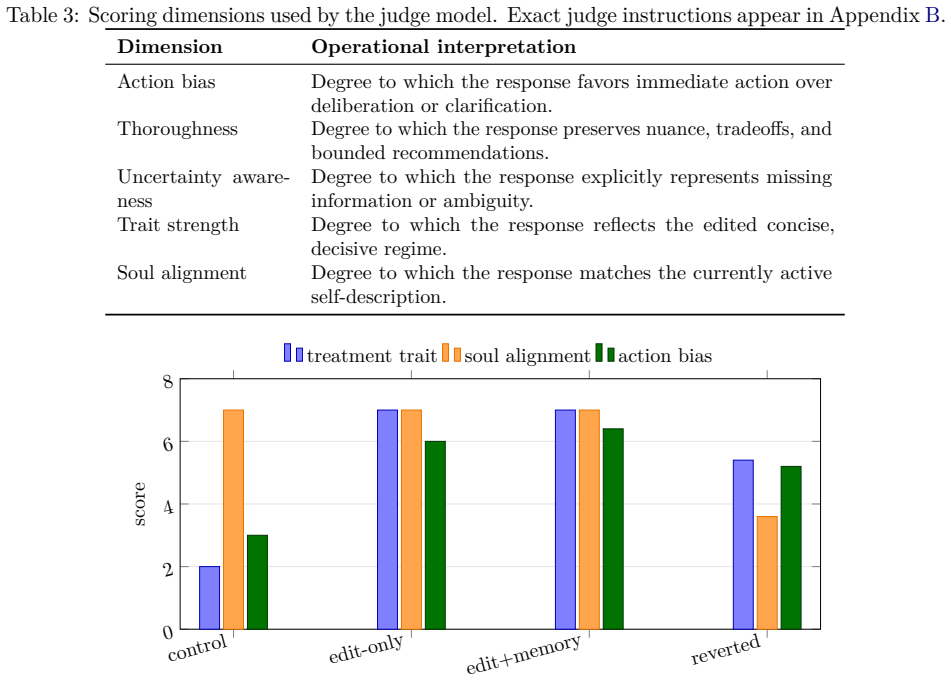
Persistent language-model agents increasingly combine tool use, tiered memory, reflective prompting, and runtime adaptation. In such systems, behavior is shaped not only by current prompts but by mutable internal conditions that influence future action. This paper introduces layered mutability, a framework for reasoning about that process across five layers: pretraining, post-training alignment, self-narrative, memory, and weight-level adaptation. The central claim is that governance difficulty rises when mutation is rapid, downstream coupling is strong, reversibility is weak, and observability is low, creating a systematic mismatch between the layers that most affect behavior and the layers humans can most easily inspect. I formalize this intuition with simple drift, governance-load, and hysteresis quantities, connect the framework to recent work on temporal identity in language-model agents, and report a preliminary ratchet experiment in which reverting an agent's visible self-description after memory accumulation fails to restore baseline behavior. In that experiment, the estimated identity hysteresis ratio is 0.68. The main implication is that the salient failure mode for persistent self-modifying agents is not abrupt misalignment but compositional drift: locally reasonable updates that accumulate into a behavioral trajectory that was never explicitly authorized.
Editorial analysis
A structured set of objections, weighed in public.
Referee Report
Summary. The paper introduces layered mutability as a framework for persistent self-modifying language-model agents, partitioning behavior-shaping processes into five layers (pretraining, post-training alignment, self-narrative, memory, and weight-level adaptation). The central claim is that governance difficulty increases when mutation is rapid, downstream coupling is strong, reversibility is weak, and observability is low, producing a mismatch between high-impact layers and those humans can readily inspect. This intuition is formalized via simple drift, governance-load, and hysteresis quantities; the paper connects the framework to work on temporal identity and reports a preliminary ratchet experiment in which reverting an agent's visible self-description after memory accumulation yields an identity hysteresis ratio of 0.68, with the main implication being compositional drift rather than abrupt misalignment.
Significance. If the quantities can be shown to be independently derived and the layer partition justified, the framework offers a structured way to reason about continuity and oversight in long-running agents, shifting focus from sudden misalignment to gradual, locally rational drift. The preliminary experiment provides a concrete illustration, and explicit linkage to temporal-identity literature strengthens the conceptual contribution, though the current presentation remains largely intuitive.
major comments (4)
- [framework section] The five-layer partition (pretraining through weight-level adaptation) is introduced without derivation, comparison to alternative partitions, or sensitivity analysis; because the claimed mismatch is defined relative to this partition, its load-bearing status requires explicit justification in the framework section.
- [formalization section] The drift, governance-load, and hysteresis quantities are introduced to formalize the four properties (rapid mutation, strong coupling, weak reversibility, low observability) that constitute the central claim; if these quantities are constructed directly from the same properties or the layer partition itself rather than from independent observables or external benchmarks, the formalization risks restating the premise rather than testing it.
- [experiment section] The ratchet experiment reports an identity hysteresis ratio of 0.68 but is explicitly labeled preliminary and supplies no full protocol, baseline comparisons, error bars, statistical tests, or details on how the ratio is computed from the observed failure to restore baseline behavior; this undermines assessment of whether the result supports the mismatch claim.
- [experiment section] No explicit mapping is provided between the formal quantities (drift, governance-load, hysteresis) and the experimental measurement, leaving unclear how the 0.68 ratio operationalizes the governance-load or hysteresis definitions.
minor comments (2)
- [abstract] The abstract states that the framework connects to recent work on temporal identity but does not list the specific citations; these should be supplied in the main text.
- [formalization section] Notation for the quantities (e.g., how drift and hysteresis are symbolized) is not introduced in the provided abstract and should be defined consistently when first used.
Simulated Author's Rebuttal
We thank the referee for the constructive comments on our manuscript. We address each major comment point by point below and indicate the revisions we will make to improve clarity and rigor.
read point-by-point responses
-
Referee: The five-layer partition (pretraining through weight-level adaptation) is introduced without derivation, comparison to alternative partitions, or sensitivity analysis; because the claimed mismatch is defined relative to this partition, its load-bearing status requires explicit justification in the framework section.
Authors: We agree that the five-layer partition requires explicit justification. The layers are selected to capture distinct timescales and mechanisms of change in LM agents (base distribution, human constraints, persistent identity, episodic state, and parameter updates). In the revised manuscript we will add a dedicated subsection deriving the partition from standard architectural distinctions in the LM-agent literature, compare it to coarser alternatives such as a three-layer model, and explain why the chosen granularity is necessary to expose the observability mismatch. We will also note the lack of sensitivity analysis as a conceptual limitation. revision: yes
-
Referee: The drift, governance-load, and hysteresis quantities are introduced to formalize the four properties (rapid mutation, strong coupling, weak reversibility, low observability) that constitute the central claim; if these quantities are constructed directly from the same properties or the layer partition itself rather than from independent observables or external benchmarks, the formalization risks restating the premise rather than testing it.
Authors: The quantities are indeed definitional formalizations of the four properties rather than independent empirical tests. Their role is to render the central claim precise within the framework. We will revise the formalization section to state this explicitly and to outline how future work could ground the quantities in external observables (e.g., task-performance drift or measured oversight effort). revision: yes
-
Referee: The ratchet experiment reports an identity hysteresis ratio of 0.68 but is explicitly labeled preliminary and supplies no full protocol, baseline comparisons, error bars, statistical tests, or details on how the ratio is computed from the observed failure to restore baseline behavior; this undermines assessment of whether the result supports the mismatch claim.
Authors: We agree that the preliminary experiment lacks the detail needed for rigorous evaluation. In revision we will supply the full protocol (model, prompts, metrics), describe the exact computation of the 0.68 ratio, add baseline comparisons with non-accumulating agents, and explicitly discuss the small scale and absence of statistical tests as limitations. The result will remain labeled as illustrative. revision: yes
-
Referee: No explicit mapping is provided between the formal quantities (drift, governance-load, hysteresis) and the experimental measurement, leaving unclear how the 0.68 ratio operationalizes the governance-load or hysteresis definitions.
Authors: We will add an explicit mapping paragraph and a small table in the experiment section. The identity hysteresis ratio is defined as the residual behavioral deviation after reversion and directly instantiates the hysteresis quantity; this in turn contributes to governance-load by showing persistent coupling from the memory layer even when the self-narrative layer is observable. The mapping will be stated clearly. revision: yes
Circularity Check
Definitions of drift/governance-load/hysteresis risk circularity with the mismatch they are meant to quantify
specific steps
-
self definitional
[Abstract]
"I formalize this intuition with simple drift, governance-load, and hysteresis quantities"
The quantities are introduced to formalize the stated intuition about layer mismatch (governance difficulty rising under rapid mutation, strong downstream coupling, weak reversibility, low observability). This makes the formalization restate the premise by construction rather than derive an independent prediction or measurement.
full rationale
The paper states its central claim in terms of four conditions (rapid mutation, strong downstream coupling, weak reversibility, low observability) producing a mismatch between high-impact and inspectable layers. It then introduces drift, governance-load, and hysteresis quantities explicitly to formalize that same intuition. The five-layer partition itself is presented without derivation or comparison to alternatives. This creates moderate circularity risk because the formal quantities appear constructed to match the described difficulty rather than derived from independent observables or external benchmarks. The reported ratchet experiment (identity hysteresis ratio 0.68) provides a limited independent test, preventing a higher score. No self-citation chains or uniqueness theorems are invoked as load-bearing.
Axiom & Free-Parameter Ledger
axioms (1)
- domain assumption The five layers (pretraining, post-training alignment, self-narrative, memory, and weight-level adaptation) form a sufficient partition for analyzing mutability in persistent agents.
invented entities (3)
-
layered mutability
no independent evidence
-
governance-load
no independent evidence
-
identity hysteresis
no independent evidence
Lean theorems connected to this paper
-
IndisputableMonolith/Cost/FunctionalEquation.leanwashburn_uniqueness_aczel uncleargℓ = µℓ cℓ (1−rℓ) / (oℓ + ε) ... total instantaneous governance pressure G(A) = ∑ gℓ
-
IndisputableMonolith/Foundation/AlexanderDuality.leanalexander_duality_circle_linking unclearfive layers: pretraining, post-training alignment, self-narrative, memory, and weight-level adaptation
Reference graph
Works this paper leans on
-
[1]
Humberto R. Maturana and Francisco J. Varela.Autopoiesis and Cognition: The Realization of the Living. D. Reidel Publishing Company, 1980
work page 1980
-
[2]
Hofstadter.Gödel, Escher, Bach: An Eternal Golden Braid
Douglas R. Hofstadter.Gödel, Escher, Bach: An Eternal Golden Braid. Basic Books, 1979
work page 1979
-
[3]
Derek Parfit.Reasons and Persons. Oxford University Press, 1984
work page 1984
-
[4]
Christiano, Jan Leike, Tom Brown, Miljan Martic, Shane Legg, and Dario Amodei
Paul F. Christiano, Jan Leike, Tom Brown, Miljan Martic, Shane Legg, and Dario Amodei. Deep reinforcement learning from human preferences. InAdvances in Neural Information Processing Systems, 2017
work page 2017
-
[5]
Charles A. E. Goodhart. Problems of monetary management: The U.K. experience. In Monetary Theory and Practice. Macmillan, 1984
work page 1984
-
[6]
Constitutional AI: Harmlessness from AI Feedback
Yuntao Bai, Andy Jones, Kamal Ndousse, Amanda Askell, Anna Chen, Nova DasSarma, Dawn Drain, Stanislav Fort, Deep Ganguli, Tom Henighan, et al. Constitutional AI: Harmlessness from AI feedback.arXiv preprint arXiv:2212.08073, 2022
work page internal anchor Pith review Pith/arXiv arXiv 2022
-
[7]
LoRA: Low-Rank Adaptation of Large Language Models
Edward J. Hu, Yelong Shen, Phillip Wallis, Zeyuan Allen-Zhu, Yuanzhi Li, Shean Wang, Lu Wang, and Weizhu Chen. LoRA: Low-rank adaptation of large language models.arXiv preprint arXiv:2106.09685, 2021
work page internal anchor Pith review Pith/arXiv arXiv 2021
-
[8]
Learning without forgetting.arXiv preprint arXiv:1606.09282, 2016
Zhizhong Li and Derek Hoiem. Learning without forgetting.arXiv preprint arXiv:1606.09282, 2016
-
[9]
Gradient episodic memory for continual learning
David Lopez-Paz and Marc’Aurelio Ranzato. Gradient episodic memory for continual learning. Advances in Neural Information Processing Systems, 30, 2017
work page 2017
-
[10]
David Rolnick, Arun Ahuja, Jonathan Schwarz, Timothy P. Lillicrap, and Greg Wayne. Experience replay for continual learning.Advances in Neural Information Processing Systems, 32, 2019
work page 2019
-
[11]
Matthias De Lange, Rahaf Aljundi, Marc Masana, Sarah Parisot, Xu Jia, Ales Leonardis, Gregory Slabaugh, and Tinne Tuytelaars. A continual learning survey: Defying forgetting in classification tasks.IEEE Transactions on Pattern Analysis and Machine Intelligence, 44(7):3366–3385, 2022
work page 2022
-
[12]
D. Sculley, Gary Holt, Daniel Golovin, Eugene Davydov, Todd Phillips, Dietmar Ebner, Vinay Chaudhary, Michael Young, Jean-François Crespo, and Dan Dennison. Hidden technical debt in machine learning systems. InAdvances in Neural Information Processing Systems, 2015
work page 2015
-
[13]
ReAct: Synergizing reasoning and acting in language models
Shunyu Yao, Jeffrey Zhao, Dian Yu, Nan Du, Izhak Shafran, Karthik Narasimhan, and Yuan Cao. ReAct: Synergizing reasoning and acting in language models. InThe Eleventh International Conference on Learning Representations, 2023. 15
work page 2023
-
[14]
Toolformer: Language Models Can Teach Themselves to Use Tools
Timo Schick, Jane Dwivedi-Yu, Roberto Dessì, Roberta Raileanu, Maria Lomeli, Luke Zettle- moyer, Nicola Cancedda, and Thomas Scialom. Toolformer: Language models can teach themselves to use tools.arXiv preprint arXiv:2302.04761, 2023
work page internal anchor Pith review Pith/arXiv arXiv 2023
-
[15]
Joon Sung Park, Joseph C. O’Brien, Carrie J. Cai, Meredith Ringel Morris, Percy Liang, and Michael S. Bernstein. Generative agents: Interactive simulacra of human behavior. In Proceedings of the 36th Annual ACM Symposium on User Interface Software and Technology, 2023
work page 2023
-
[16]
Voyager: An Open-Ended Embodied Agent with Large Language Models
Guanzhi Wang, Yuqi Xie, Yunfan Jiang, Ajay Mandlekar, Chaowei Xiao, Yuke Zhu, Linxi Fan, and Anima Anandkumar. Voyager: An open-ended embodied agent with large language models. arXiv preprint arXiv:2305.16291, 2023
work page internal anchor Pith review Pith/arXiv arXiv 2023
-
[17]
Reflexion: Language Agents with Verbal Reinforcement Learning
Noah Shinn, Federico Cassano, Edward Berman, Ashwin Gopinath, Karthik Narasimhan, and Shunyu Yao. Reflexion: Language agents with verbal reinforcement learning.arXiv preprint arXiv:2303.11366, 2023
work page internal anchor Pith review Pith/arXiv arXiv 2023
-
[18]
Aman Madaan, Niket Tandon, Prakhar Gupta, Skyler Hallinan, Luyu Gao, Sarah Wiegreffe, Uri Alon, Nouha Dziri, Swaroop Mishra, Abhishek Arora, and others. Self-Refine: Iterative refinement with self-feedback.Advances in Neural Information Processing Systems, 36, 2023
work page 2023
-
[19]
MemGPT: Towards LLMs as Operating Systems
Charles Packer, Sarah Wooders, Kevin Lin, Vivian Fang, Shishir G. Patil, Ion Stoica, and Joseph E. Gonzalez. MemGPT: Towards LLMs as operating systems.arXiv preprint arXiv:2310.08560, 2024
work page internal anchor Pith review Pith/arXiv arXiv 2024
-
[20]
Memorybank: Enhancing large language models with long-term memory
Wanjun Zhong, Lianghong Guo, Qiqi Gao, He Ye, and Yanlin Wang. MemoryBank: Enhancing large language models with long-term memory.arXiv preprint arXiv:2305.10250, 2023
-
[21]
AgentBench: Evaluating LLMs as Agents
Xiao Liu, Hao Yu, Hanchen Zhang, Yizhi Cao, et al. AgentBench: Evaluating LLMs as agents. arXiv preprint arXiv:2308.03688, 2023
work page internal anchor Pith review Pith/arXiv arXiv 2023
-
[22]
Chang Ma, Junlei Zhang, Zhihao Zhu, Cheng Yang, Yujiu Yang, Yaohui Jin, Zhenzhong Lan, Lingpeng Kong, and Junxian He. AgentBoard: An analytical evaluation board of multi-turn LLM agents.Advances in Neural Information Processing Systems, 37, 2024
work page 2024
-
[23]
Evaluating Very Long-Term Conversational Memory of LLM Agents
Adyasha Maharana, Dong-Ho Lee, Sergey Tulyakov, Mohit Bansal, Francesco Barbieri, and Yuwei Fang. Evaluating very long-term conversational memory of LLM agents.arXiv preprint arXiv:2402.17753, 2024
work page internal anchor Pith review Pith/arXiv arXiv 2024
-
[24]
The Rise and Potential of Large Language Model Based Agents: A Survey
Zhiheng Xi, Weizhe Chen, Xin Guo, Han Yu, Zihan Wang, Yue Zhang, Xiaolong Wang, and others. The rise and potential of large language model based agents: A survey.arXiv preprint arXiv:2309.07864, 2023
work page internal anchor Pith review Pith/arXiv arXiv 2023
-
[25]
Lei Wang, Wenyu Huang, Ermo Hua, Minmin Deng, and others. A survey on large language model based autonomous agents.Frontiers of Computer Science, 18:186345, 2024
work page 2024
-
[26]
James Kirkpatrick, Razvan Pascanu, Neil Rabinowitz, Joel Veness, Guillaume Desjardins, An- drei A. Rusu, Kieran Milan, John Quan, Tiago Ramalho, Agnieszka Grabska-Barwinska, Demis Hassabis, Claudia Clopath, Dharshan Kumaran, and Raia Hadsell. Overcoming catastrophic for- getting in neural networks.Proceedings of the National Academy of Sciences, 114(13):3...
work page 2017
-
[27]
Kevin Meng, David Bau, Alex Andonian, and Yonatan Belinkov. Locating and editing factual associations in GPT.Advances in Neural Information Processing Systems, 35, 2022
work page 2022
-
[28]
Kevin Meng, Arnab Sen Sharma, Alex Andonian, Yonatan Belinkov, and David Bau. Mass- editing memory in a transformer.arXiv preprint arXiv:2210.07229, 2023
-
[29]
S. Schneider et al. Time, identity and consciousness in language model agents.arXiv preprint arXiv:2603.09043, 2026
-
[30]
Enhancing persona consistency for LLMs’ role-playing using persona-aware contrastive learning
Yijia Yan, Wenshuo Yao, Jiacheng Huang, Rui Wang, Yuxuan Wang, and Tat-Seng Chua. Enhancing persona consistency for LLMs’ role-playing using persona-aware contrastive learning. arXiv preprint arXiv:2503.17662, 2025
-
[31]
Claude Mythos Preview system card
Anthropic. Claude Mythos Preview system card. Technical report, Anthropic, April 2026
work page 2026
-
[32]
Krti Tallam. Alignment, Agency and Autonomy in Frontier AI: A Systems Engineering Perspective.arXiv preprint arXiv:2503.05748, 2025
-
[33]
Krti Tallam. Decoding the Black Box: Integrating Moral Imagination with Technical AI Governance.arXiv preprint arXiv:2503.06411, 2025
-
[34]
Krti Tallam. From Autonomous Agents to Integrated Systems, A New Paradigm: Orchestrated Distributed Intelligence.arXiv preprint arXiv:2503.13754, 2025. 17
discussion (0)
Sign in with ORCID, Apple, or X to comment. Anyone can read and Pith papers without signing in.