Recognition: unknown
RaTA-Tool: Retrieval-based Tool Selection with Multimodal Large Language Models
Pith reviewed 2026-05-10 11:20 UTC · model grok-4.3
The pith
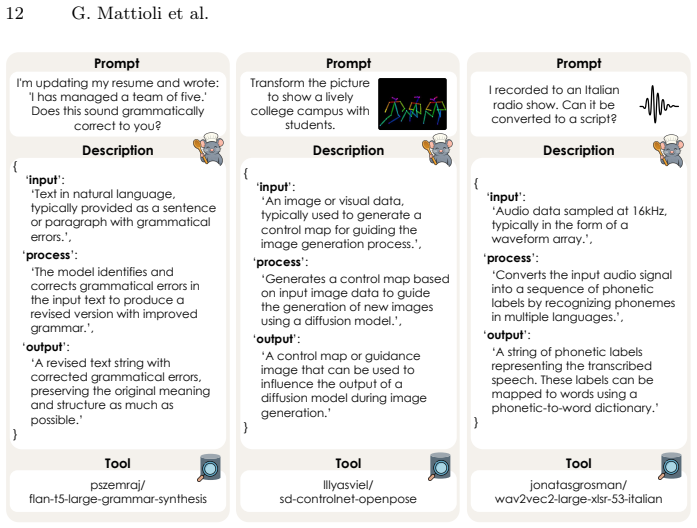
Multimodal models select external tools for open-world tasks by converting queries into structured descriptions and retrieving semantic matches from tool cards, without retraining for new tools.
A machine-rendered reading of the paper's core claim, the machinery that carries it, and where it could break.
Core claim
The paper establishes that an MLLM can transform a multimodal query into a structured task description, after which the most appropriate tool is retrieved by semantic matching against rich tool descriptions; this retrieval formulation supports adding new tools without retraining, and a subsequent preference optimization stage using DPO improves selection accuracy, as validated through experiments on a new open-world multimodal tool-use dataset derived from Hugging Face model cards.
What carries the argument
The retrieval step that matches an MLLM-generated structured task description against semantically rich, machine-readable tool descriptions to identify the best tool for the query.
If this is right
- Tool selection succeeds on tools never seen during any training phase.
- The same pipeline works for inputs that combine text with images or video.
- Direct preference optimization measurably improves how well task descriptions guide tool choice.
- A standardized dataset of tool descriptions now exists for benchmarking open-world multimodal tool use.
Where Pith is reading between the lines
- The method could support very large, dynamically updated tool libraries by relying on existing documentation rather than curated training examples.
- Semantic retrieval on generated descriptions may prove more robust to changes in tool interfaces than classifier-based selection.
- Downstream agents could chain this retrieval step with actual tool execution to measure end-to-end task success rather than selection accuracy alone.
Load-bearing premise
The structured task description produced from a multimodal query aligns closely enough with the semantic content of tool descriptions to enable reliable retrieval without any extra supervision or fine-tuning.
What would settle it
If retrieval accuracy falls to baseline levels when tool descriptions are rephrased or when the generated task descriptions are replaced with random text of similar length, the alignment premise would be falsified.
Figures




read the original abstract
Tool learning with foundation models aims to endow AI systems with the ability to invoke external resources -- such as APIs, computational utilities, and specialized models -- to solve complex tasks beyond the reach of standalone language generation. While recent advances in Large Language Models (LLMs) and Multimodal Large Language Models (MLLMs) have expanded their reasoning and perception capabilities, existing tool-use methods are predominantly limited to text-only inputs and closed-world settings. Consequently, they struggle to interpret multimodal user instructions and cannot generalize to tools unseen during training. In this work, we introduce RaTA-Tool, a novel framework for open-world multimodal tool selection. Rather than learning direct mappings from user queries to fixed tool identifiers, our approach enables an MLLM to convert a multimodal query into a structured task description and subsequently retrieve the most appropriate tool by matching this representation against semantically rich, machine-readable tool descriptions. This retrieval-based formulation naturally supports extensibility to new tools without retraining. To further improve alignment between task descriptions and tool selection, we incorporate a preference-based optimization stage using Direct Preference Optimization (DPO). To support research in this setting, we also introduce the first dataset for open-world multimodal tool use, featuring standardized tool descriptions derived from Hugging Face model cards. Extensive experiments demonstrate that our approach significantly improves tool-selection performance, particularly in open-world, multimodal scenarios.
Editorial analysis
A structured set of objections, weighed in public.
Referee Report
Summary. The paper introduces RaTA-Tool, a retrieval-based framework for open-world multimodal tool selection. An MLLM converts multimodal user queries into structured task descriptions, which are matched against semantically rich tool descriptions derived from Hugging Face model cards to select the appropriate tool. Direct Preference Optimization (DPO) is applied to improve alignment, and a new dataset for this task is contributed. Experiments are reported to show significant performance gains over prior methods, especially in open-world and multimodal settings.
Significance. If the experimental results hold, the work addresses a clear gap in tool learning by supporting generalization to unseen tools and multimodal inputs without retraining. The dataset construction from standardized HF model cards and the explicit separation of query-to-description conversion from retrieval are practical strengths that could enable extensible tool-use systems. The DPO stage provides a straightforward way to refine retrieval alignment.
major comments (2)
- [§4] §4 (Experiments): The central claim of significant improvement in open-world multimodal tool selection requires quantitative support; the manuscript must report specific metrics (e.g., accuracy or recall@K), baselines (direct MLLM mapping, standard retrieval), error bars, and explicit construction details for the open-world splits to substantiate generalization.
- [§3.2] §3.2 (Task Description Generation): The assumption that MLLM-generated structured task descriptions are sufficiently aligned with tool metadata for reliable retrieval without extra supervision is load-bearing for the open-world claim; an ablation isolating the conversion step versus end-to-end retrieval would be needed to confirm this holds across query types.
minor comments (3)
- The abstract would be strengthened by briefly stating the magnitude of reported gains and the primary baseline.
- [§3.1] Notation for the structured task description format and similarity metric should be defined explicitly in §3.1 for reproducibility.
- Figure 2 (pipeline diagram) would benefit from clearer labeling of the DPO preference pair construction.
Simulated Author's Rebuttal
We thank the referee for the positive recommendation of minor revision and for the constructive comments, which will help strengthen the quantitative rigor and clarity of the paper. We address each major comment below.
read point-by-point responses
-
Referee: [§4] §4 (Experiments): The central claim of significant improvement in open-world multimodal tool selection requires quantitative support; the manuscript must report specific metrics (e.g., accuracy or recall@K), baselines (direct MLLM mapping, standard retrieval), error bars, and explicit construction details for the open-world splits to substantiate generalization.
Authors: We agree that detailed quantitative support is essential. The manuscript reports accuracy and recall@K metrics with comparisons to prior methods in Section 4. To fully address the comment, we will revise the section to explicitly add the suggested baselines (direct MLLM mapping and standard retrieval), include error bars from multiple runs, and provide expanded details on open-world split construction, including unseen tool selection criteria and partitioning methodology. revision: yes
-
Referee: [§3.2] §3.2 (Task Description Generation): The assumption that MLLM-generated structured task descriptions are sufficiently aligned with tool metadata for reliable retrieval without extra supervision is load-bearing for the open-world claim; an ablation isolating the conversion step versus end-to-end retrieval would be needed to confirm this holds across query types.
Authors: We acknowledge the importance of validating the task description generation step for the open-world claim. While the current experiments focus on the full pipeline, we will add an ablation study in the revised manuscript (updating Section 3.2 and the experiments) that isolates the structured conversion by comparing against an end-to-end retrieval baseline across text-only, image-only, and multimodal query types to confirm alignment benefits without extra supervision. revision: yes
Circularity Check
No significant circularity in derivation chain
full rationale
The paper describes a retrieval-based framework where an MLLM converts multimodal queries into structured task descriptions, followed by semantic matching against tool metadata from Hugging Face cards and optional DPO alignment. No equations, fitted parameters, or derivations are presented that reduce the claimed performance gains to inputs by construction. The method uses standard retrieval and preference optimization techniques without self-definitional loops or load-bearing self-citations that collapse the central claim. The dataset construction and open-world extensibility arguments remain independent of the evaluation results.
Axiom & Free-Parameter Ledger
axioms (2)
- domain assumption Multimodal LLMs can convert arbitrary image-plus-text queries into structured task descriptions that preserve user intent.
- domain assumption Semantic similarity between task descriptions and tool metadata correlates with actual tool usefulness.
Reference graph
Works this paper leans on
-
[1]
Achiam, J., Adler, S., Agarwal, S., Ahmad, L., Akkaya, I., Aleman, F.L., Almeida, D., Altenschmidt, J., Altman, S., Anadkat, S., et al.: GPT-4 Technical Report. arXiv preprint arXiv:2303.08774 (2023)
work page internal anchor Pith review Pith/arXiv arXiv 2023
-
[2]
In: NeurIPS (2022)
Alayrac, J.B., Donahue, J., Luc, P., Miech, A., Barr, I., Hasson, Y., Lenc, K., Mensch, A., Millican, K., Reynolds, M., et al.: Flamingo: a Visual Language Model for Few-Shot Learning. In: NeurIPS (2022)
2022
-
[3]
In: NeurIPS (2020)
Brown, T., Mann, B., Ryder, N., Subbiah, M., Kaplan, J.D., Dhariwal, P., Nee- lakantan, A., Shyam, P., Sastry, G., Askell, A., et al.: Language Models are Few- Shot Learners. In: NeurIPS (2020)
2020
-
[4]
In: ACL Findings (2024)
Caffagni, D., Cocchi, F., Barsellotti, L., Moratelli, N., Sarto, S., Baraldi, L., Cor- nia, M., Cucchiara, R.: The Revolution of Multimodal Large Language Models: A Survey. In: ACL Findings (2024)
2024
-
[5]
arXiv preprint arXiv:2305.04160 , year=
Chen, F., Han, M., Zhao, H., Zhang, Q., Shi, J., Xu, S., , Xu, B.: X-LLM: Boot- strapping Advanced Large Language Models by Treating Multi-Modalities as For- eign Languages. arXiv preprint arXiv:2305.04160 (2023)
-
[6]
VideoLLaMA 2: Advancing Spatial-Temporal Modeling and Audio Understanding in Video-LLMs
Cheng, Z., Leng, S., Zhang, H., Xin, Y., Li, X., Chen, G., Zhu, Y., Zhang, W., Luo, Z., Zhao, D., et al.: VideoLLaMA 2: Advancing Spatial-Temporal Modeling and Audio Understanding in Video-LLMs. arXiv preprint arXiv:2406.07476 (2024) 14 G. Mattioli et al
work page internal anchor Pith review arXiv 2024
-
[7]
In: ICCV Workshops (2025)
Cocchi, F., Moratelli, N., Caffagni, D., Sarto, S., Baraldi, L., Cornia, M., Cuc- chiara, R.: LLaVA-MORE: A Comparative Study of LLMs and Visual Backbones for Enhanced Visual Instruction Tuning. In: ICCV Workshops (2025)
2025
-
[8]
In: BMVC (2025)
Compagnoni, A., Caffagni, D., Moratelli, N., Baraldi, L., Cornia, M., Cucchiara, R.: Mitigating Hallucinations in Multimodal LLMs via Object-aware Preference Optimization. In: BMVC (2025)
2025
-
[9]
In: CVPR (2026)
Compagnoni, A., Morini, M., Sarto, S., Cocchi, F., Caffagni, D., Cornia, M., Baraldi, L., Cucchiara, R.: ReAG: Reasoning-Augmented Generation for Knowledge-based Visual Question Answering. In: CVPR (2026)
2026
-
[10]
In: NAACL (2019)
Devlin, J., Chang, M.W., Lee, K., Toutanova, K.: BERT: Pre-training of Deep Bidirectional Transformers for Language Understanding. In: NAACL (2019)
2019
-
[11]
Vita: Towards open-source interactive omni multimodal llm.arXiv preprint arXiv:2408.05211, 2024
Fu, C., Lin, H., Long, Z., Shen, Y., Dai, Y., Zhao, M., Zhang, Y.F., Dong, S., Li, Y., Wang, X., et al.: VITA: Towards Open-Source Interactive Omni Multimodal LLM. arXiv preprint arXiv:2408.05211 (2024)
-
[12]
Grattafiori, A., Dubey, A., Jauhri, A., Pandey, A., Kadian, A., Al-Dahle, A., Let- man, A., Mathur, A., Schelten, A., Vaughan, A., et al.: The Llama 3 Herd of Models. arXiv preprint arXiv:2407.21783 (2024)
work page internal anchor Pith review Pith/arXiv arXiv 2024
-
[13]
In: CVPR (2024)
Han, J., Gong, K., Zhang, Y., Wang, J., Zhang, K., Lin, D., Qiao, Y., Gao, P., Yue, X.: OneLLM: One Framework to Align All Modalities with Language. In: CVPR (2024)
2024
-
[14]
In: ICLR (2022)
Hu, E.J., Shen, Y., Wallis, P., Allen-Zhu, Z., Li, Y., Wang, S., Wang, L., Chen, W., et al.: LoRA: Low-Rank Adaptation of Large Language Models. In: ICLR (2022)
2022
-
[15]
TMLR (2021)
Izacard, G., Caron, M., Hosseini, L., Riedel, S., Bojanowski, P., Joulin, A., Grave, E.: Unsupervised Dense Information Retrieval with Contrastive Learning. TMLR (2021)
2021
-
[16]
In: CVPR (2025)
Jia, H., Jiang, C., Xu, H., Ye, W., Dong, M., Yan, M., Zhang, J., Huang, F., Zhang, S.: SymDPO: Boosting In-Context Learning of Large Multimodal Models with Symbol Demonstration Direct Preference Optimization. In: CVPR (2025)
2025
-
[17]
Jin Xu, Zhifang Guo, Jinzheng He, Hangrui Hu, Ting He, Shuai Bai, Keqin Chen, Jialin Wang, Yang Fan, Kai Dang, Bin Zhang, Xiong Wang, Yunfei Chu, Junyang Lin: Qwen2.5-Omni Technical Report. arXiv preprint arXiv:2503.20215 (2025)
work page internal anchor Pith review arXiv 2025
-
[18]
Li, J., Li, D., Savarese, S., Hoi, S.: BLIP-2: Bootstrapping Language-Image Pre- trainingwithFrozenImageEncodersandLargeLanguageModels.In:ICML(2023)
2023
-
[19]
In: CVPR (2024)
Liu, H., Li, C., Li, Y., Lee, Y.J.: Improved Baselines with Visual Instruction Tun- ing. In: CVPR (2024)
2024
-
[20]
In: NeurIPS (2023)
Liu, H., Li, C., Wu, Q., Lee, Y.J.: Visual Instruction Tuning. In: NeurIPS (2023)
2023
-
[21]
In: BMVC (2024)
Moratelli,N.,Caffagni,D.,Cornia,M.,Baraldi,L.,Cucchiara,R.:RevisitingImage Captioning Training Paradigm via Direct CLIP-based Optimization. In: BMVC (2024)
2024
-
[22]
WebGPT: Browser-assisted question-answering with human feedback
Nakano, R., Hilton, J., Balaji, S., Wu, J., Ouyang, L., Kim, C., Hesse, C., Jain, S., Kosaraju, V., Saunders, W., et al.: WebGPT: Browser-assisted question-answering with human feedback. arXiv preprint arXiv:2112.09332 (2021)
work page internal anchor Pith review arXiv 2021
-
[23]
In: NeurIPS (2022)
Ouyang, L., Wu, J., Jiang, X., Almeida, D., Wainwright, C., Mishkin, P., Zhang, C., Agarwal, S., Slama, K., Ray, A., et al.: Training language models to follow instructions with human feedback. In: NeurIPS (2022)
2022
-
[24]
In: NeurIPS (2024)
Patil, S.G., Zhang, T., Wang, X., Gonzalez, J.E.: Gorilla: Large Language Model Connected with Massive APIs. In: NeurIPS (2024)
2024
-
[25]
In: ICCV (2025) RaTA-Tool: Retrieval-Augmented Tool Selection with MLLMs 15
Pipoli, V., Saporita, A., Bolelli, F., Cornia, M., Baraldi, L., Grana, C., Cucchiara, R., Ficarra, E.: MissRAG: Addressing the Missing Modality Challenge in Multi- modal Large Language Models. In: ICCV (2025) RaTA-Tool: Retrieval-Augmented Tool Selection with MLLMs 15
2025
-
[26]
arXiv preprint arXiv:2601.04778 (2026)
Poppi, T., Uzkent, B., Garg, A., Porto, L., Kessler, G., Yang, Y., Cornia, M., Baraldi, L., Cucchiara, R., Schiffers, F.: CounterVid: Counterfactual Video Gener- ation for Mitigating Action and Temporal Hallucinations in Video-Language Mod- els. arXiv preprint arXiv:2601.04778 (2026)
-
[27]
ACM Computing Surveys 57(4), 1–40 (2024)
Qin,Y.,Hu,S.,Lin,Y.,Chen,W.,Ding,N.,Cui,G.,Zeng,Z.,Zhou,X.,Huang,Y., Xiao, C., et al.: Tool Learning with Foundation Models. ACM Computing Surveys 57(4), 1–40 (2024)
2024
-
[28]
In: ICLR (2024)
Qin, Y., Liang, S., Ye, Y., Zhu, K., Yan, L., Lu, Y., Lin, Y., Cong, X., Tang, X., Qian, B., et al.: ToolLLM: Facilitating Large Language Models to Master 16000+ Real-world APIs. In: ICLR (2024)
2024
-
[29]
In: NeurIPS (2023)
Rafailov, R., Sharma, A., Mitchell, E., Manning, C.D., Ermon, S., Finn, C.: Direct Preference Optimization: Your Language Model is Secretly a Reward Model. In: NeurIPS (2023)
2023
-
[30]
IJCV 133(11), 7647–7671 (2025)
Sarto,S.,Moratelli,N.,Cornia,M.,Baraldi,L.,Cucchiara,R.:Positive-Augmented Contrastive Learning for Vision-and-Language Evaluation and Trainin. IJCV 133(11), 7647–7671 (2025)
2025
-
[31]
In: NeurIPS (2023)
Schick, T., Dwivedi-Yu, J., Dessì, R., Raileanu, R., Lomeli, M., Hambro, E., Zettle- moyer, L., Cancedda, N., Scialom, T.: Toolformer: Language Models Can Teach Themselves to Use Tools. In: NeurIPS (2023)
2023
-
[32]
In: NeurIPS (2023)
Shen, Y., Song, K., Tan, X., Li, D., Lu, W., Zhuang, Y.: HuggingGPT: Solving AI Tasks with ChatGPT and its Friends in Hugging Face. In: NeurIPS (2023)
2023
-
[33]
In: AAAI (2024)
Song, F., Yu, B., Li, M., Yu, H., Huang, F., Li, Y., Wang, H.: Preference Ranking Optimization for Human Alignment. In: AAAI (2024)
2024
-
[34]
LaMDA: Language Models for Dialog Applications
Thoppilan, R., De Freitas, D., Hall, J., Shazeer, N., Kulshreshtha, A., Cheng, H.T., Jin, A., Bos, T., Baker, L., Du, Y., et al.: LaMDA: Language Models for Dialog Applications. arXiv preprint arXiv:2201.08239 (2022)
work page Pith review arXiv 2022
-
[35]
In: CVPR (2024)
Wallace, B., Dang, M., Rafailov, R., Zhou, L., Lou, A., Purushwalkam, S., Ermon, S.,Xiong,C.,Joty,S.,Naik,N.:DiffusionModelAlignmentUsingDirectPreference Optimization. In: CVPR (2024)
2024
-
[36]
In: WACV (2025)
Wang, C., Luo, W., Dong, S., Xuan, X., Li, Z., Ma, L., Gao, S.: MLLM-Tool: A Multimodal Large Language Model For Tool Agent Learning. In: WACV (2025)
2025
-
[37]
Visual ChatGPT: Talking, Drawing and Editing with Visual Foundation Models
Wu, C., Yin, S., Qi, W., Wang, X., Tang, Z., Duan, N.: Visual ChatGPT: Talking, Drawing and Editing with Visual Foundation Models. arXiv preprint arXiv:2303.04671 (2023)
work page internal anchor Pith review arXiv 2023
-
[38]
In: NeurIPS (2024)
Wu, J., Xie, Y., Yang, Z., Wu, J., Gao, J., Ding, B., Wang, X., He, X.:β-DPO: Direct Preference Optimization with Dynamicβ. In: NeurIPS (2024)
2024
-
[39]
Yang, A., Li, A., Yang, B., Zhang, B., Hui, B., Zheng, B., Yu, B., Gao, C., Huang, C., Lv, C., et al.: Qwen3 Technical Report. arXiv preprint arXiv:2505.09388 (2025)
work page internal anchor Pith review Pith/arXiv arXiv 2025
-
[40]
In: NeurIPS (2023)
Yang, R., Song, L., Li, Y., Zhao, S., Ge, Y., Li, X., Shan, Y.: GPT4Tools: Teaching Large Language Model to Use Tools via Self-instruction. In: NeurIPS (2023)
2023
-
[41]
In: EMNLP Demos (2023)
Zhang, H., Li, X., Bing, L.: Video-LLaMA: An Instruction-tuned Audio-Visual Language Model for Video Understanding. In: EMNLP Demos (2023)
2023
-
[42]
Qwen3 Embedding: Advancing Text Embedding and Reranking Through Foundation Models
Zhang, Y., Li, M., Long, D., Zhang, X., Lin, H., Yang, B., Xie, P., Yang, A., Liu, D., Lin, J., Huang, F., Zhou, J.: Qwen3 Embedding: Advancing Text Embedding and Reranking Through Foundation Models. arXiv preprint arXiv:2506.05176 (2025)
work page internal anchor Pith review arXiv 2025
-
[43]
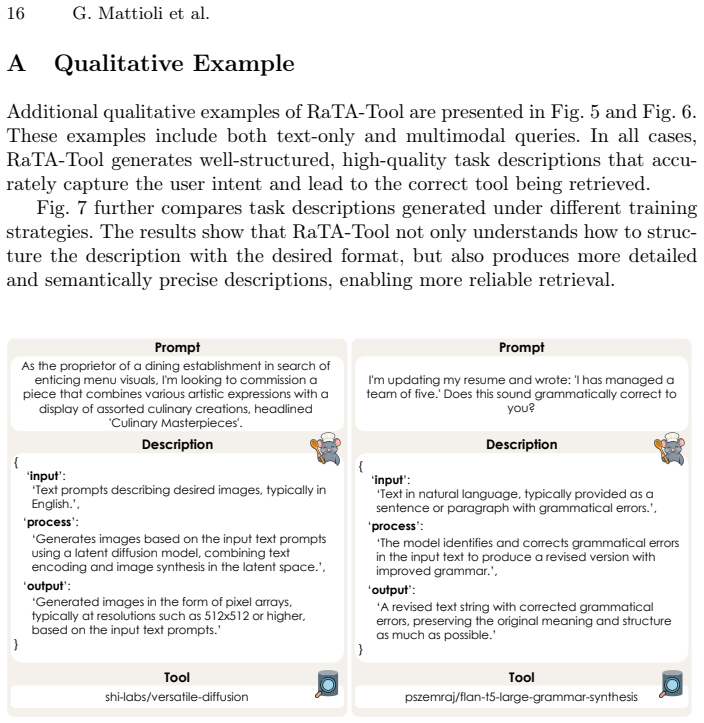
Zhao, Z., Guo, L., Yue, T., Chen, S., Shao, S., Zhu, X., Yuan, Z., Liu, J.: Chat- Bridge: Bridging Modalities with Large Language Model as a Language Catalyst. arXiv preprint arXiv:2305.16103 (2023) 16 G. Mattioli et al. A Qualitative Example Additional qualitative examples of RaTA-Tool are presented in Fig. 5 and Fig. 6. These examples include both text-...
-
[44]
Input : What type of data the model takes in ( e . g . , text , image , audio , s t r u c t u r e d data , etc .) , i n c l u d i n g format or shape if m e n t i o n e d
-
[45]
Process : What the model does with the input ( e . g . , s e n t i m e n t classification , translation , object detection , etc .) , d e s c r i b e d c o n c i s e l y
-
[46]
input ":
Output : What the model pr odu ce s as output , i n c l u d i n g the format , labels or value types where a p p l i c a b l e . Your output must be : - Model - ag no sti c ( do not mention brand names or model IDs ) - Written s tr ic tly in English - A valid JSON object in the f o l l o w i n g format : { " input ": " < d e s c r i p t i o n of the e xp ...
discussion (0)
Sign in with ORCID, Apple, or X to comment. Anyone can read and Pith papers without signing in.