Recognition: 2 theorem links
· Lean TheoremThe Ideal Stratum and Deformation Persistence of Knot Types
Pith reviewed 2026-05-14 21:55 UTC · model grok-4.3
The pith
The first birth of admissible deformation components for a knot type occurs exactly at its ropelength.
A machine-rendered reading of the paper's core claim, the machinery that carries it, and where it could break.
Core claim
For each knot type K the space Y_Λ(K) collects thick representatives of length at most Λ. Two representatives are admissibly equivalent at scale Λ when they can be joined by a continuous path that remains inside Y_Λ(K). The admissible components of these spaces form a one-parameter persistence object indexed by Λ. The first birth level of this object is exactly Rop(K), so that the initial layer I(K) = Y_Rop(K)(K) is the ideal stratum. On the ideal admissible-component set the function d_merge(C,D) = μ_ideal(C,D) − Rop(K) is finite-valued and satisfies the strong triangle inequality.
What carries the argument
The admissible-component persistence filtered by ropelength, whose birth stratum at Λ = Rop(K) supplies the ideal components on which the ultrapseudometric d_merge records pairwise merge scales.
If this is right
- The ideal stratum supplies the zero-dimensional data for a constrained deformation theory of knot types.
- Pairwise ideal merge scales become well-defined invariants between distinct minimal ropelength shapes of the same knot.
- The pure merge Vietoris–Rips filtration on the ideal set reproduces exactly the zero-dimensional merge partition with no higher homology.
- The unknot admits an explicit computation of its ideal components and merge structure.
- Finite polygonal and diagrammatic approximations can be used to estimate the ideal merge scales numerically.
Where Pith is reading between the lines
- The ultrapseudometric structure may be compared with other geometric distances on the space of knots once explicit examples beyond the unknot are calculated.
- The same birth-level argument could be tested on other thickness or energy functionals to produce analogous ideal strata.
- Numerical sampling of polygonal representatives near ropelength minimizers could detect whether multiple ideal components exist for nontrivial knots.
Load-bearing premise
The spaces of thick representatives are path-connected in a way that permits continuous admissible deformations preserving knot type, so that new components cannot appear before the minimal ropelength is reached.
What would settle it
Exhibit a knot type K together with a representative of thickness 1 and length strictly less than Rop(K) that lies in a separate admissible component from all shorter representatives, or produce ideal components C and D whose merge scale violates the strong triangle inequality.
Figures


read the original abstract
We study a knot type through the ropelength-filtered spaces of its thick representatives. For a knot type $K$ and a scale parameter $\Lambda>0$, let $Y_\Lambda(K)=\mathcal{R}_{1,\Lambda}(K)$ be the space of representatives of $K$ with thickness at least $1$ and length at most $\Lambda$, modulo reparametrization and orientation-preserving Euclidean isometries. The basic equivalence relation is defined by admissible deformations: two representatives are equivalent at scale $\Lambda$ if they can be joined through representatives that remain in $Y_\Lambda(K)$. The resulting admissible components form a one-parameter persistence object as $\Lambda$ increases. We prove that the first birth level of this admissible-component persistence is exactly the ropelength $\operatorname{Rop}(K)$. The initial layer $I(K)=Y_{\operatorname{Rop}(K)}(K)$ is the ideal stratum of $K$. Thus the ropelength-minimizing locus is not treated merely as a set of ideal shapes, but as the birth stratum of a constrained deformation theory. We define the ideal admissible-component set $\Pi^{\mathrm{ad}}_{\mathrm{ideal}}(K)$, the ideal component number $\nu_{\mathrm{ideal}}(K)$, and pairwise ideal merge scales. For the fixed knot type $K$, the central invariant introduced here is the ropelength ultrapseudometric $d_{\mathrm{merge}}(C,D)=\mu_{\mathrm{ideal}}(C,D)-\operatorname{Rop}(K)$ defined for $C,D\in\Pi^{\mathrm{ad}}_{\mathrm{ideal}}(K)$. We prove that this function is finite-valued and satisfies the strong triangle inequality. The pure merge Vietoris--Rips filtration is a secondary simplicial encoding of this ultrapseudometric structure: it records the same zero-dimensional merge data and has no higher-dimensional homological content beyond the merge partition itself. We also compute the basic case of the unknot and indicate finite polygonal and diagrammatic approximations as further directions.
Editorial analysis
A structured set of objections, weighed in public.
Referee Report
Summary. The paper studies knot types K through the ropelength-filtered spaces Y_Λ(K) of thickness-≥1 embeddings of length ≤Λ (modulo reparametrization and isometries). It defines admissible deformations within each Y_Λ(K) and the resulting one-parameter persistence of admissible components. The central claims are that the first birth occurs exactly at Λ = Rop(K), that the ideal stratum I(K) = Y_Rop(K)(K) is well-defined, and that the induced ropelength ultrapseudometric d_merge(C,D) = μ_ideal(C,D) − Rop(K) on the set Π^ad_ideal(K) of ideal admissible components is finite-valued and satisfies the strong triangle inequality. Secondary results include the pure-merge Vietoris–Rips filtration and the unknot case.
Significance. If the proofs are completed, the framework supplies a persistence-theoretic structure on the space of ideal knots, with the birth stratum at Rop(K) and a canonical ultrapseudometric on ideal components. This could yield new invariants such as the ideal component number ν_ideal(K) and connect ropelength geometry to merge filtrations in topological data analysis. The explicit computation for the unknot and the suggestion of polygonal approximations are concrete strengths.
major comments (2)
- [Abstract and definition of admissible components] The claim that the first birth level of admissible-component persistence is exactly Rop(K) (abstract) rests on showing both that no admissible path exists in Y_Λ(K) for Λ < Rop(K) and that components appear at Λ = Rop(K). The manuscript supplies neither the topology on Y_Λ(K) nor an explicit construction of admissible deformations realizing the infimum, leaving the exact-birth statement unverified.
- [Definition of d_merge and Π^ad_ideal(K)] Finiteness of d_merge(C,D) for every pair C,D ∈ Π^ad_ideal(K) requires that Y_μ(K) is path-connected for all sufficiently large finite μ. This is not automatic from the definition of Rop(K) as an infimum; an explicit isotopy or a cited theorem establishing global path-connectedness under the uniform thickness constraint is needed but absent.
minor comments (1)
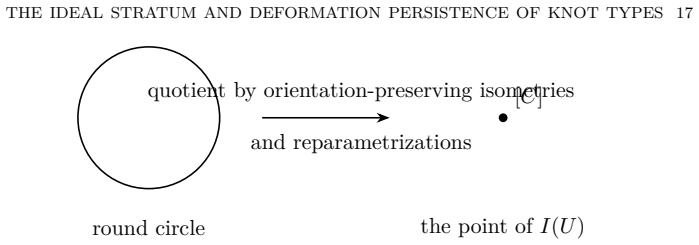
- [Notation and unknot example] The notation μ_ideal(C,D) for pairwise merge scales should be defined before its use in the formula for d_merge; a short diagram or table illustrating the unknot computation would clarify the ideal-component count.
Simulated Author's Rebuttal
We thank the referee for their thorough review and valuable feedback. We address each major comment below, indicating the revisions we will make to clarify the topological setting and complete the proofs as suggested.
read point-by-point responses
-
Referee: The claim that the first birth level of admissible-component persistence is exactly Rop(K) (abstract) rests on showing both that no admissible path exists in Y_Λ(K) for Λ < Rop(K) and that components appear at Λ = Rop(K). The manuscript supplies neither the topology on Y_Λ(K) nor an explicit construction of admissible deformations realizing the infimum, leaving the exact-birth statement unverified.
Authors: We agree that the topology on Y_Λ(K) requires explicit definition. In the revised manuscript, we will introduce a section specifying that Y_Λ(K) is equipped with the quotient topology induced from the C^1 topology on the space of embeddings, after modding out by reparametrizations and isometries. Regarding the birth at exactly Rop(K), by definition there are no points in Y_Λ(K) for Λ < Rop(K), so no paths exist below this level. For the appearance of components at Λ = Rop(K), we will provide an explicit construction: take a minimizing sequence of thickness-1 curves of length approaching Rop(K), and use Arzelà-Ascoli compactness to extract a limit curve in Y_Rop(K)(K). Admissible deformations can then be constructed by connecting nearby curves in the sequence via small perturbations that preserve thickness and length bounds, realizing the infimum in the persistence sense. revision: yes
-
Referee: Finiteness of d_merge(C,D) for every pair C,D ∈ Π^ad_ideal(K) requires that Y_μ(K) is path-connected for all sufficiently large finite μ. This is not automatic from the definition of Rop(K) as an infimum; an explicit isotopy or a cited theorem establishing global path-connectedness under the uniform thickness constraint is needed but absent.
Authors: We acknowledge the need for an explicit justification of path-connectedness. In the revision, we will cite and briefly recall a standard result from geometric knot theory (such as the path-connectedness of the space of C^1 embeddings with fixed knot type and positive thickness when the length bound is sufficiently large, following from the existence of isotopies through thick embeddings as in works by Cantarella et al. or similar references on ropelength). We will argue that for μ larger than the maximum of the lengths of representatives in C and D plus a margin for the isotopy, a path exists in Y_μ(K) connecting them, ensuring d_merge is finite. If a direct proof is preferred, we can sketch a construction using a tubular neighborhood and controlled deformation. revision: yes
Circularity Check
No significant circularity; definitions and proofs are independent of inputs
full rationale
The paper defines Y_Λ(K) as the space of thickness-1 length-≤Λ representatives of knot type K, with admissible components as path-components under deformations staying inside Y_Λ(K). Rop(K) is the infimum of such lengths, so the first birth level of components is exactly Rop(K) by the definition of the infimum; this is not a prediction but a direct consequence of when the spaces become non-empty. The ultrapseudometric d_merge(C,D) = μ_ideal(C,D) − Rop(K) inherits the strong triangle inequality directly from the max-based merge scales of the filtered path-components, and finiteness follows from the claimed path-connectedness of Y_Λ(K) for large finite Λ (a topological statement proved separately rather than assumed by construction). No step reduces a claimed result to a fitted parameter, self-citation chain, or renamed input; the derivation remains self-contained against the external definition of ropelength.
Axiom & Free-Parameter Ledger
axioms (2)
- domain assumption Rop(K) is the infimum of lengths of thickness-1 representatives of knot type K.
- standard math The spaces Y_Lambda(K) admit a topology in which continuous paths correspond to admissible deformations preserving knot type and constraints.
invented entities (2)
-
Ideal stratum I(K)
no independent evidence
-
Ropelength ultrapseudometric d_merge
no independent evidence
Lean theorems connected to this paper
-
IndisputableMonolith/Foundation/AlexanderDuality.leanalexander_duality_circle_linking unclear?
unclearRelation between the paper passage and the cited Recognition theorem.
We prove that the first birth level of this admissible-component persistence is exactly the ropelength Rop(K). The ropelength ultrapseudometric d_merge(C,D) is finite-valued and satisfies the strong triangle inequality.
-
IndisputableMonolith/Foundation/AbsoluteFloorClosure.leanreality_from_one_distinction unclear?
unclearRelation between the paper passage and the cited Recognition theorem.
Y_Λ(K) = R_{1,Λ}(K) ... admissible deformations ... ideal stratum I(K) = Y_{Rop(K)}(K)
What do these tags mean?
- matches
- The paper's claim is directly supported by a theorem in the formal canon.
- supports
- The theorem supports part of the paper's argument, but the paper may add assumptions or extra steps.
- extends
- The paper goes beyond the formal theorem; the theorem is a base layer rather than the whole result.
- uses
- The paper appears to rely on the theorem as machinery.
- contradicts
- The paper's claim conflicts with a theorem or certificate in the canon.
- unclear
- Pith found a possible connection, but the passage is too broad, indirect, or ambiguous to say the theorem truly supports the claim.
Forward citations
Cited by 2 Pith papers
-
Swept-Area Pseudometrics on Ropelength-Filtered Knot Spaces
Defines swept-area pseudometrics on ropelength-filtered knot spaces, proves non-degeneracy on polygonal strata, exact distances for concentric unknots and ellipses, and rigidity of the ideal unknot.
-
Finite Knot Theory via Ropelength-Filtered Reidemeister Graphs
Defines finite recognition lengths for knots using ropelength-filtered lifted Reidemeister graphs and characteristic patterns derived from the Barbensi-Celoria reconstruction theorem.
Reference graph
Works this paper leans on
-
[1]
[ACPR11] Ted Ashton, Jason Cantarella, Michael Piatek, and Eric J. Rawdon,Knot tightening by constrained gradient descent, Exp. Math.20(2011), no. 1, 57–90. [Bud07] Ryan Budney,Little cubes and long knots, Topology46(2007), no. 1, 1–27. [CKS02] Jason Cantarella, Robert B. Kusner, and John M. Sullivan,On the minimum ropelength of knots and links, Invent. M...
work page internal anchor Pith review Pith/arXiv arXiv 2011
-
[2]
Knotting, Linking, and Folding Geometric Objects inR3, Contemp. Math., vol. 304, Amer. Math. Soc., Providence, RI, 2002, pp. 181–186. Department of Natural Sciences, Komazawa University, Tokyo, Japan Email address:w3c@komazawa-u.ac.jp
work page 2002
discussion (0)
Sign in with ORCID, Apple, or X to comment. Anyone can read and Pith papers without signing in.