Recognition: unknown
Finite Knot Theory via Ropelength-Filtered Reidemeister Graphs
Pith reviewed 2026-05-07 13:22 UTC · model grok-4.3
The pith
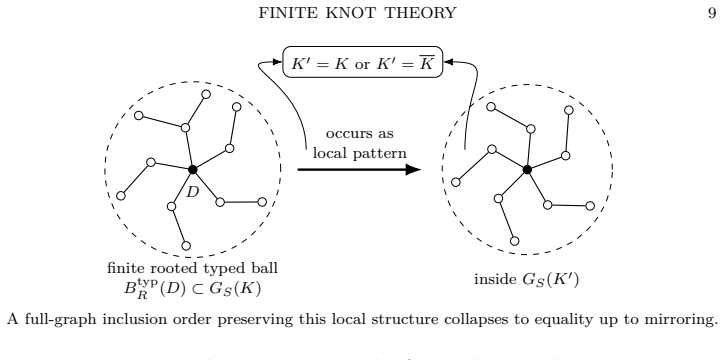
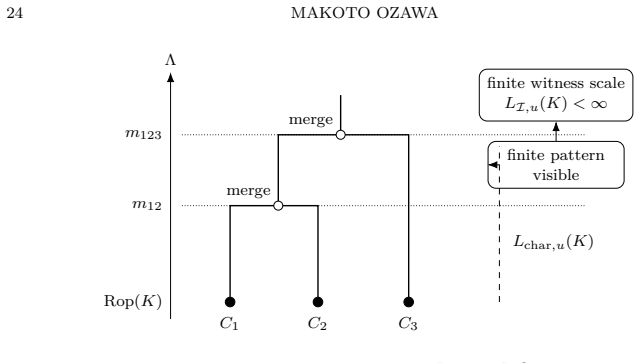
Each knot type is recognized up to mirroring by a finite characteristic Reidemeister pattern that first appears in its ropelength-filtered lifted graph at scale L_char,u(K).
A machine-rendered reading of the paper's core claim, the machinery that carries it, and where it could break.
Core claim
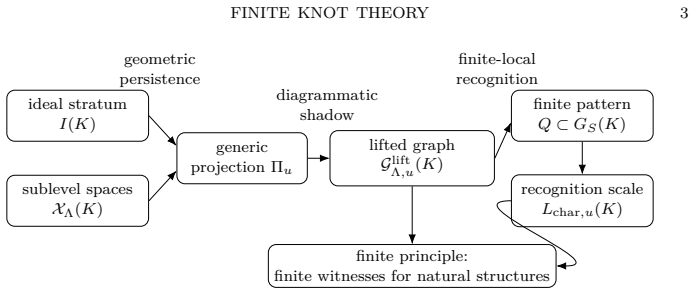
For each knot K and projection direction u, the ropelength-filtered lifted Reidemeister graph G^lifts_Λ,u(K) records all diagram data and Reidemeister moves that lift to admissible thick deformations at ropelength levels below Λ. Using the finite-local reconstruction theorem, characteristic Reidemeister patterns are identified, and the finite recognition length L_char,u(K) is the first such Λ at which a recognizing pattern for K, up to mirroring, appears in the graph.
What carries the argument
The ropelength-filtered lifted Reidemeister graphs G^lifts_Λ,u(K) that encode diagram data together with Reidemeister moves liftable to thick deformations below level Λ.
Load-bearing premise
The corresponding statements for the full C^{1,1} ropelength-sublevel space require explicitly isolated projection-Cerf tameness and coherent finite-pattern thick-movie liftability.
What would settle it
An explicit knot K together with a direction u for which no finite recognizing pattern ever appears in G^lifts_Λ,u(K) at any finite Λ would falsify the recognition claim.
Figures

read the original abstract
This paper develops a form of finite knot theory as a diagrammatic sequel to the ideal-stratum and deformation-persistence framework for knot types. Thick representatives in bounded ropelength sublevel spaces are studied through the finite Reidemeister data visible in generic projections. For each projection direction $u$, we introduce the ropelength-filtered lifted Reidemeister graphs $\mathcal{G}^{\mathrm{lift}}_{\Lambda,u}(K)$, for $\Lambda\ge \mathrm{Rop}(K)$, recording diagram data and Reidemeister moves that lift to admissible thick deformations below the ropelength level $\Lambda$. Using the finite-local reconstruction theorem of Barbensi--Celoria, we define characteristic Reidemeister patterns and the finite recognition length $L_{\mathrm{char},u}(K)$, the first ropelength scale at which a finite pattern recognizing $K$, up to mirroring, appears in the lifted graph. The finite-local graph-theoretic part is unconditional; finite-dimensional and polygonal models provide controlled settings; the corresponding statements for the full $C^{1,1}$ ropelength-sublevel space are conditional on explicitly isolated projection--Cerf tameness and coherent finite-pattern thick-movie liftability hypotheses.
Editorial analysis
A structured set of objections, weighed in public.
Referee Report
Summary. The manuscript develops a diagrammatic approach to finite knot theory by constructing ropelength-filtered lifted Reidemeister graphs G^lift_Λ,u(K) for thick knots. It defines characteristic Reidemeister patterns and the finite recognition length L_char,u(K) as the smallest ropelength at which a pattern recognizing the knot type (up to mirror) appears in the graph, leveraging the Barbensi-Celoria finite-local reconstruction theorem. The construction is unconditional for polygonal and finite-dimensional models but conditional on two tameness hypotheses for the full C^{1,1} ropelength sublevel spaces.
Significance. If the two hypotheses hold, the work could offer a novel way to characterize knot types through finite combinatorial data extracted from projections at controlled ropelength scales, bridging geometric ropelength studies with Reidemeister move graphs. The clear distinction between unconditional polygonal results and conditional smooth results is a positive feature, as is the reliance on an established reconstruction theorem rather than ad-hoc constructions. However, the absence of any computed examples or verification of the hypotheses limits the immediate impact.
major comments (2)
- [Abstract] Abstract: The central definitions of characteristic Reidemeister patterns and L_char,u(K) for C^{1,1} knots are stated to rest on the two unverified hypotheses ('explicitly isolated projection--Cerf tameness' and 'coherent finite-pattern thick-movie liftability'), yet the manuscript supplies neither proofs, counterexamples, nor even a plausibility argument for these assumptions; this directly affects whether the finite recognition length is well-defined in the smooth setting that motivates the paper.
- [Definition of lifted graphs] The paragraph following the definition of G^lift_Λ,u(K): No explicit construction or reference is provided for how generic projections of thick C^{1,1} knots yield only isolated Cerf singularities inside each ropelength sublevel, leaving the first hypothesis as an unexamined prerequisite for the lifted-graph construction itself.
minor comments (2)
- The notation G^lift_Λ,u(K) and L_char,u(K) is introduced clearly but would benefit from an accompanying schematic diagram showing the filtration and lifting process for a simple knot.
- Consider adding a short table contrasting the unconditional polygonal results with the conditional C^{1,1} statements to improve readability.
Simulated Author's Rebuttal
We thank the referee for the careful reading and for emphasizing the conditional character of the smooth-case results. We respond point by point to the major comments and indicate the changes we will make.
read point-by-point responses
-
Referee: [Abstract] Abstract: The central definitions of characteristic Reidemeister patterns and L_char,u(K) for C^{1,1} knots are stated to rest on the two unverified hypotheses ('explicitly isolated projection--Cerf tameness' and 'coherent finite-pattern thick-movie liftability'), yet the manuscript supplies neither proofs, counterexamples, nor even a plausibility argument for these assumptions; this directly affects whether the finite recognition length is well-defined in the smooth setting that motivates the paper.
Authors: The manuscript states explicitly, both in the abstract and in the body, that the definitions and recognition-length statements for C^{1,1} knots are conditional on the two named hypotheses. The unconditional core of the work consists of the constructions and the finite-local reconstruction for polygonal and finite-dimensional models; these parts do not invoke the hypotheses. In the revision we will add a short paragraph after the statement of the hypotheses that sketches their plausibility by appealing to (i) uniform approximation of C^{1,1} knots by polygons whose ropelength is controlled and (ii) standard genericity results for projections of smooth curves. We do not claim to prove the hypotheses. revision: partial
-
Referee: [Definition of lifted graphs] The paragraph following the definition of G^lift_Λ,u(K): No explicit construction or reference is provided for how generic projections of thick C^{1,1} knots yield only isolated Cerf singularities inside each ropelength sublevel, leaving the first hypothesis as an unexamined prerequisite for the lifted-graph construction itself.
Authors: The lifted-graph construction for the full C^{1,1} ropelength sublevel space indeed presupposes the first hypothesis (explicitly isolated projection–Cerf tameness). For the polygonal case the construction is direct and unconditional: each diagram has finitely many crossings, and admissible moves are enumerated explicitly. In the revision we will insert a reference to the classical results on generic projections of smooth curves (e.g., the density of Morse and Cerf singularities in the space of projections) and will clarify that the hypothesis is precisely the statement that guarantees the lifted graph remains locally finite at each ropelength level. revision: partial
- Verification (or counterexamples) of the two tameness hypotheses for the full C^{1,1} ropelength sublevel spaces.
Circularity Check
No significant circularity; central objects are explicit definitions relying on an external theorem
full rationale
The paper constructs the lifted Reidemeister graphs G^lift_Λ,u(K) directly from generic projections and admissible thick deformations below a given ropelength level, then defines L_char,u(K) as the infimum of scales at which a finite pattern recognizing K (up to mirror) appears in that graph, invoking the Barbensi–Celoria finite-local reconstruction theorem only as an external tool to guarantee that such a pattern exists and reconstructs the knot type. This is a definitional step, not a prediction or derivation that reduces to its own inputs by construction. The text explicitly separates the unconditional finite-dimensional/polygonal case from the C^{1,1} case, which rests on two stated hypotheses rather than on any self-referential equation or fitted parameter. No self-citations are load-bearing, no ansatz is smuggled, and no known empirical pattern is merely renamed. The derivation chain therefore remains self-contained against the cited external theorem and the paper's own explicit constructions.
Axiom & Free-Parameter Ledger
axioms (2)
- ad hoc to paper explicitly isolated projection--Cerf tameness
- ad hoc to paper coherent finite-pattern thick-movie liftability hypotheses
invented entities (3)
-
ropelength-filtered lifted Reidemeister graphs G^lift_Λ,u(K)
no independent evidence
-
characteristic Reidemeister patterns
no independent evidence
-
finite recognition length L_char,u(K)
no independent evidence
Forward citations
Cited by 1 Pith paper
-
Swept-Area Pseudometrics on Ropelength-Filtered Knot Spaces
Defines swept-area pseudometrics on ropelength-filtered knot spaces, proves non-degeneracy on polygonal strata, exact distances for concentric unknots and ellipses, and rigidity of the ideal unknot.
Reference graph
Works this paper leans on
-
[1]
V. I. Arnold,Plane curves, their invariants, perestroikas and classifications, inSingu- larities and Bifurcations, Adv. Soviet Math.21, Amer. Math. Soc., Providence, RI, 1994, 33–91
1994
-
[2]
Baranska, P
J. Baranska, P. Pieranski, and A. Stasiak,Length of the tightest trefoil knot, Phys. Rev. E70(2004), 051810
2004
-
[3]
A. Barbensi and D. Celoria,The Reidemeister graph is a complete knot invariant, Algebr. Geom. Topol.20(2020), no. 2, 643–698. doi:10.2140/agt.2020.20.643
-
[4]
Cantarella, R
J. Cantarella, R. B. Kusner, and J. M. Sullivan,On the minimum ropelength of knots and links, Invent. Math.150(2002), 257–286
2002
-
[5]
Cerf,La stratification naturelle des espaces de fonctions différentiables réelles et le théorème de la pseudo-isotopie, Inst
J. Cerf,La stratification naturelle des espaces de fonctions différentiables réelles et le théorème de la pseudo-isotopie, Inst. Hautes Études Sci. Publ. Math.39(1970), 5–173. FINITE KNOT THEORY 29
1970
-
[6]
Cohen-Steiner, H
D. Cohen-Steiner, H. Edelsbrunner, and J. Harer,Stability of persistence diagrams, Discrete Comput. Geom.37(2007), 103–120
2007
-
[7]
Denne, Y
E. Denne, Y. Diao, and J. M. Sullivan,Quadrisecants give new lower bounds for the ropelength of a knot, Geom. Topol.10(2006), 1–26
2006
-
[8]
Edelsbrunner and J
H. Edelsbrunner and J. Harer,Computational Topology: An Introduction, American Mathematical Society, Providence, RI, 2010
2010
-
[9]
Federer,Curvature measures, Trans
H. Federer,Curvature measures, Trans. Amer. Math. Soc.93(1959), 418–491
1959
-
[10]
Fenchel,Über Krümmung und Windung geschlossener Raumkurven, Math
W. Fenchel,Über Krümmung und Windung geschlossener Raumkurven, Math. Ann. 101(1929), 238–252
1929
-
[11]
R. A. Litherland, J. Simon, O. Durumeric, and E. Rawdon,Thickness of knots, Topology Appl.91(1999), 233–244
1999
-
[12]
Milnor,Morse Theory, Annals of Mathematics Studies, No
J. Milnor,Morse Theory, Annals of Mathematics Studies, No. 51, Princeton Univer- sity Press, Princeton, NJ, 1963
1963
-
[13]
The Ideal Stratum and Deformation Persistence of Knot Types
M. Ozawa,The ideal stratum and deformation persistence of knot types, preprint, arXiv:2604.17905v2 [math.GT], 2026
work page internal anchor Pith review Pith/arXiv arXiv 2026
-
[14]
Polyak,Invariants of curves and fronts via Gauss diagrams, Topology37(1998), no
M. Polyak,Invariants of curves and fronts via Gauss diagrams, Topology37(1998), no. 5, 989–1009. doi:10.1016/S0040-9383(97)00013-X
-
[15]
E. J. Rawdon,Approximating the thickness of a knot, inIdeal Knots, Ser. Knots Everything19, World Scientific, 1998, 143–150
1998
-
[16]
Reidemeister,Knotentheorie, Ergebnisse der Mathematik und ihrer Grenzgebiete, Springer, Berlin, 1932
K. Reidemeister,Knotentheorie, Ergebnisse der Mathematik und ihrer Grenzgebiete, Springer, Berlin, 1932
1932
-
[17]
Rolfsen,Knots and Links, Publish or Perish, Berkeley, 1976
D. Rolfsen,Knots and Links, Publish or Perish, Berkeley, 1976. Department of Natural Sciences, F aculty of Arts and Sciences, Komazawa University, Tokyo, Japan Email address:w3c@komazawa-u.ac.jp
1976
discussion (0)
Sign in with ORCID, Apple, or X to comment. Anyone can read and Pith papers without signing in.