Recognition: unknown
Swept-Area Pseudometrics on Ropelength-Filtered Knot Spaces
Pith reviewed 2026-05-08 04:39 UTC · model grok-4.3
The pith
Swept-area pseudometrics are defined on ropelength-filtered knot spaces by taking the infimum of the area traced during isotopies that keep thickness at least 1 and length at most Lambda.
A machine-rendered reading of the paper's core claim, the machinery that carries it, and where it could break.
Core claim
The infimum of the swept area over admissible isotopies defines an extended pseudometric on each admissible component of the ropelength-filtered knot space. This pseudometric is non-degenerate on uniformly non-collinear finite-dimensional polygonal strata. Projected signed-area calibrations, including their rotation-invariant supremum over planes, give exact distance formulas for concentric round unknots and homothetic planar ellipses. The same calibrations establish rigidity of the ideal unknot.
What carries the argument
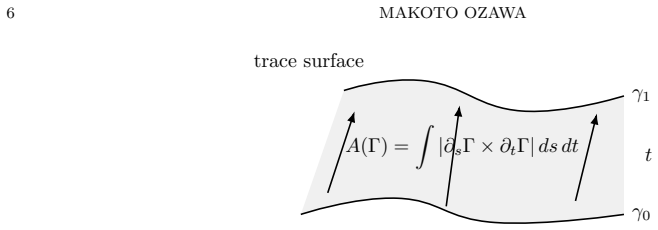
The swept area of an admissible isotopy, defined as the parametrized area traced by the moving curve, whose infimum over all admissible isotopies supplies the pseudometric distance.
If this is right
- The zero-distance quotient is always a metric space.
- Exact distance formulas hold between concentric round unknots and between homothetic planar ellipses.
- The ideal unknot cannot be moved by any admissible isotopy without positive swept area.
- For diagrammatically generic isotopies the swept-area distance bounds the diagrammatic distance from above.
- The pseudometric is monotone non-decreasing in the ropelength parameter Lambda.
Where Pith is reading between the lines
- Polygonal strata with controlled swept-area distances may approximate continuous knot spaces with quantitative error bounds.
- The construction supplies a new scale-free invariant that could be compared with existing knot energies such as Möbius energy.
- The same swept-area method extends naturally to links by replacing area with volume swept during admissible motions.
Load-bearing premise
The infimum of swept areas over admissible isotopies is finite and well-defined, and the resulting pseudometric can be shown non-degenerate on the polygonal strata independently of broader rigidity questions.
What would settle it
An explicit pair of distinct uniformly non-collinear polygonal knots in the same admissible component whose connecting admissible isotopy sweeps exactly zero area, or a configuration of concentric unknots whose explicit isotopy sweeps strictly less area than the calibration lower bound predicts.
Figures


read the original abstract
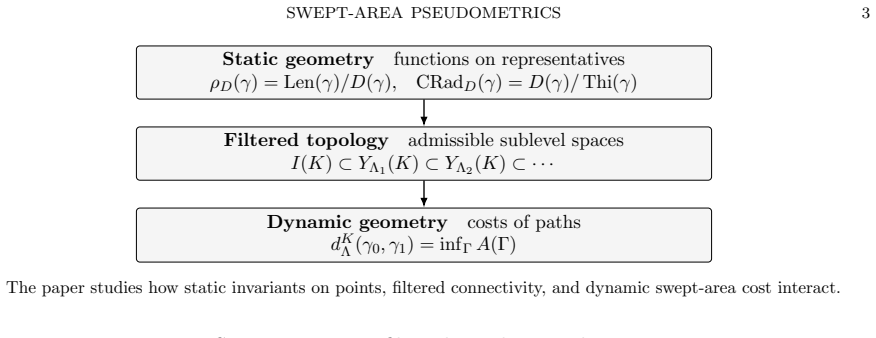
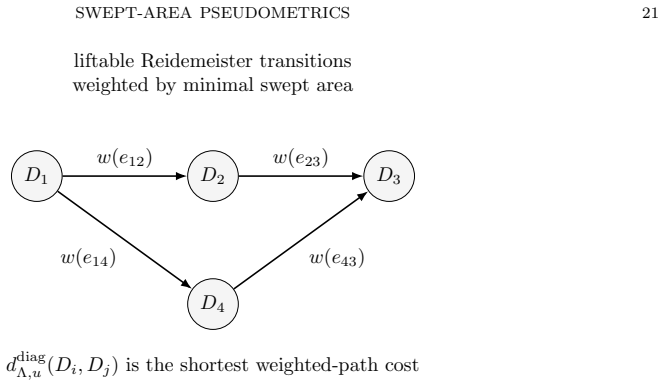
We introduce swept-area pseudometrics on ropelength-filtered spaces of knot representatives. For a knot type \(K\) and a ropelength level \(\Lambda\), admissible isotopies are required to pass through curves of thickness at least one and length at most \(\Lambda\). The swept area is the parametrized area traced by the moving curve, and its infimum over admissible isotopies defines an extended pseudometric on each admissible component. We also define the admissible fundamental group of a based admissible component and equip it with a swept-area length function. The construction is separated from the rigidity questions it raises. The zero-distance quotient is always a metric space, while non-degeneracy before quotienting is treated separately. We prove non-degeneracy on uniformly non-collinear finite-dimensional polygonal strata. We also prove calibration lower bounds from projected signed area, including a rotation-invariant supremum over oriented planes, and use them to obtain exact distance formulas for concentric round unknots and homothetic planar ellipses. We further prove rigidity of the ideal unknot. The framework is related to static scale-free invariants such as density and compression radius, and to filtered-topological structures such as ideal strata and merge scales. We define swept-area weighted lifted Reidemeister graphs and prove that, for diagrammatically generic isotopies, the associated diagrammatic distance is bounded above by the geometric swept-area distance. We also record monotonicity in the ropelength parameter and formulate problems toward full non-degeneracy and approximation theory.
Editorial analysis
A structured set of objections, weighed in public.
Referee Report
Summary. The paper introduces swept-area pseudometrics on ropelength-filtered spaces of knot representatives. For a knot type K and ropelength level Lambda, admissible isotopies maintain thickness at least 1 and length at most Lambda; the swept area is the parametrized area traced by the moving curve, and its infimum over admissible isotopies defines an extended pseudometric on each path-component. The authors also equip the admissible fundamental group with a swept-area length function. They prove non-degeneracy on uniformly non-collinear finite-dimensional polygonal strata, establish calibration lower bounds via a rotation-invariant supremum of projected signed areas over oriented planes, derive exact distance formulas for concentric round unknots and homothetic planar ellipses, and prove rigidity of the ideal unknot. Additional results include swept-area weighted lifted Reidemeister graphs with an upper bound on diagrammatic distance for generic isotopies, monotonicity in the ropelength parameter, and open problems on full non-degeneracy and approximation.
Significance. If the central claims hold, this framework supplies a geometrically natural pseudometric on ropelength-constrained knot spaces that directly incorporates thickness and length bounds, yielding concrete exact distances and a rigidity result for the ideal unknot. The separation of the pseudometric definition from non-degeneracy analysis, the calibration technique, and the link to diagrammatic distances via lifted Reidemeister graphs are methodological strengths. The construction relates static invariants such as density to filtered topological structures and could support further work on approximation and physical knot models.
major comments (2)
- [§3] §3 (non-degeneracy on polygonal strata): the proof that the infimum of swept area is strictly positive for distinct uniformly non-collinear representatives must explicitly show that the thickness constraint prevents the infimum from vanishing under sequences of admissible isotopies; without a uniform lower bound independent of isotopy length, the claim reduces to a tautology on the quotient.
- [§4] §4 (calibration lower bounds): the rotation-invariant supremum of projected signed area is asserted to calibrate the swept-area distance and yield exact formulas for concentric unknots and homothetic ellipses, but the argument does not verify that equality is attained within the admissible class (thickness >=1, length <=Lambda); this step is load-bearing for the exact-distance claims.
minor comments (3)
- The definition of swept area as a parametrized integral should include an explicit formula or reference to the parametrization used, to clarify independence from reparametrization.
- Notation for the swept-area length on the admissible fundamental group is introduced without a low-dimensional example; adding one would improve readability.
- The statement of monotonicity in the ropelength parameter Lambda is clear but would benefit from an explicit inequality relating d_Lambda and d_Lambda' for Lambda < Lambda'.
Simulated Author's Rebuttal
We thank the referee for the positive assessment and detailed comments on our manuscript. We address each major comment below and will incorporate clarifications and additional details as needed in the revised version.
read point-by-point responses
-
Referee: [§3] §3 (non-degeneracy on polygonal strata): the proof that the infimum of swept area is strictly positive for distinct uniformly non-collinear representatives must explicitly show that the thickness constraint prevents the infimum from vanishing under sequences of admissible isotopies; without a uniform lower bound independent of isotopy length, the claim reduces to a tautology on the quotient.
Authors: We agree that the current exposition in §3 could benefit from a more explicit treatment of how the thickness constraint (≥1) interacts with sequences of isotopies to prevent the swept area from approaching zero. In the revised manuscript, we will add a dedicated lemma or paragraph that uses the uniform thickness to derive a positive lower bound on the swept area for distinct uniformly non-collinear polygonal representatives, independent of the isotopy length. This will clarify that the non-degeneracy is not merely tautological on the quotient but holds prior to quotienting due to the geometric constraints. revision: yes
-
Referee: [§4] §4 (calibration lower bounds): the rotation-invariant supremum of projected signed area is asserted to calibrate the swept-area distance and yield exact formulas for concentric unknots and homothetic ellipses, but the argument does not verify that equality is attained within the admissible class (thickness >=1, length <=Lambda); this step is load-bearing for the exact-distance claims.
Authors: The calibration provides the lower bound, and for the specific cases, we do construct explicit admissible isotopies (radial contractions or homotheties that preserve thickness and respect the length bound for sufficiently large Lambda) that achieve the projected area bound, thus attaining equality. However, we acknowledge that the verification of admissibility for these constructions could be stated more explicitly. In the revision, we will add a short subsection or remarks detailing why these isotopies remain admissible (thickness ≥1 and length ≤Λ) and how they saturate the calibration bound. revision: yes
Circularity Check
No significant circularity
full rationale
The pseudometric is defined directly as the infimum of swept area over admissible isotopies (thickness >=1, length <=Lambda) within path-components of the ropelength-filtered space. Non-degeneracy on uniformly non-collinear polygonal strata, calibration lower bounds via rotation-invariant suprema of projected signed areas, exact distance formulas for concentric round unknots and homothetic planar ellipses, and rigidity of the ideal unknot are all established as separate theorems. The paper explicitly separates the pseudometric construction from the rigidity questions it raises, with the zero-distance quotient treated as a metric space independently. No steps reduce by construction to fitted parameters, self-referential equations, or load-bearing self-citations; the derivation chain is self-contained.
Axiom & Free-Parameter Ledger
axioms (2)
- standard math Existence and properties of isotopies between curves in R^3 preserving thickness and length bounds
- standard math Well-definedness of parametrized area swept by a moving curve
invented entities (2)
-
Swept-area pseudometric
no independent evidence
-
Swept-area weighted lifted Reidemeister graphs
no independent evidence
Reference graph
Works this paper leans on
-
[1]
Cantarella, R
J. Cantarella, R. B. Kusner, and J. M. Sullivan, On the minimum ropelength of knots and links,Invent. Math.150(2002), 257–286
2002
-
[2]
Denne, Y
E. Denne, Y. Diao, and J. M. Sullivan, Quadrisecants give new lower bounds for the ropelength of a knot, Geom. Topol.10(2006), 1–26
2006
-
[3]
Federer,Geometric Measure Theory, Die Grundlehren der mathematischen Wissenschaften, vol
H. Federer,Geometric Measure Theory, Die Grundlehren der mathematischen Wissenschaften, vol. 153, Springer, 1969
1969
-
[4]
Fenchel, ¨Uber Kr¨ ummung und Windung geschlossener Raumkurven,Math
W. Fenchel, ¨Uber Kr¨ ummung und Windung geschlossener Raumkurven,Math. Ann.101(1929), 238–252
1929
-
[5]
Gonzalez and J
O. Gonzalez and J. H. Maddocks, Global curvature, thickness, and the ideal shapes of knots,Proc. Natl. Acad. Sci. USA96(1999), 4769–4773
1999
-
[6]
R. A. Litherland, J. Simon, O. Durumeric, and E. Rawdon, Thickness of knots,Topology Appl.91(1999), 233–244
1999
-
[7]
J. W. Milnor, On the total curvature of knots,Ann. of Math. (2)52(1950), 248–257
1950
-
[8]
Morgan,Geometric Measure Theory: A Beginner’s Guide, 5th ed., Academic Press, 2016
F. Morgan,Geometric Measure Theory: A Beginner’s Guide, 5th ed., Academic Press, 2016
2016
-
[9]
The Ideal Stratum and Deformation Persistence of Knot Types
M. Ozawa, The ideal stratum and deformation persistence of knot types, preprint,arXiv:2604.17905 [math.GT], 2026
work page internal anchor Pith review Pith/arXiv arXiv 2026
-
[10]
Unconstrained and Ropelength-Windowed $p$-densities of Knot Types
M. Ozawa, Unifiedp-densities of knots and their polygonal approximation, preprint,arXiv:2604.23621 [math.GT], 2026
work page internal anchor Pith review Pith/arXiv arXiv 2026
-
[11]
Geometric densities and compression radii of knot types
M. Ozawa, Geometric densities and compression radii of knot types, preprint,arXiv:2604.27912[math.GT], 2026
work page internal anchor Pith review Pith/arXiv arXiv 2026
-
[12]
Finite Knot Theory via Ropelength-Filtered Reidemeister Graphs
M. Ozawa, Finite knot theory via ropelength-filtered Reidemeister graphs, preprint,arXiv:2605.03350 [math.GT], 2026
work page internal anchor Pith review Pith/arXiv arXiv 2026
-
[13]
E. J. Rawdon, Approximating the thickness of a knot,Ideal Knots, Series on Knots and Everything, vol. 19, World Scientific, 1998, pp. 143–150
1998
-
[14]
J. M. Sullivan, Curves of finite total curvature,Discrete Differential Geometry, Oberwolfach Seminars, vol. 38, Birkh¨ auser, 2008, pp. 137–161. Department of Natural Sciences, F aculty of Arts and Sciences, Komazawa University, Tokyo, Japan Email address:w3c@komazawa-u.ac.jp
2008
discussion (0)
Sign in with ORCID, Apple, or X to comment. Anyone can read and Pith papers without signing in.