Recognition: unknown
The Magnitude of Dominated Sets: A Pareto Compliant Indicator Grounded in Metric Geometry
Pith reviewed 2026-05-10 04:09 UTC · model grok-4.3
The pith
Magnitude of dominated sets yields a strictly Pareto-compliant quality indicator via all-dimensional projections and monotonicity.
A machine-rendered reading of the paper's core claim, the machinery that carries it, and where it could break.
Core claim
For dominated sets generated by finite approximation sets with a common anchor point, magnitude satisfies weak and strict set monotonicity on finite unions of anchored boxes in the l1 metric and thereby yields weak and strict Pareto compliance. The indicator equals the top-dimensional hypervolume plus positive lower-dimensional projection and boundary contributions, so that points sharing coordinates with the anchor receive positive value even when their hypervolume term vanishes.
What carries the argument
Magnitude of a compact metric space, applied to the dominated region as a finite union of anchored boxes and computed via its all-dimensional projection formula.
If this is right
- Magnitude assigns positive value to boundary points that share one or more coordinates with the anchor even when their top-dimensional hypervolume contribution is zero.
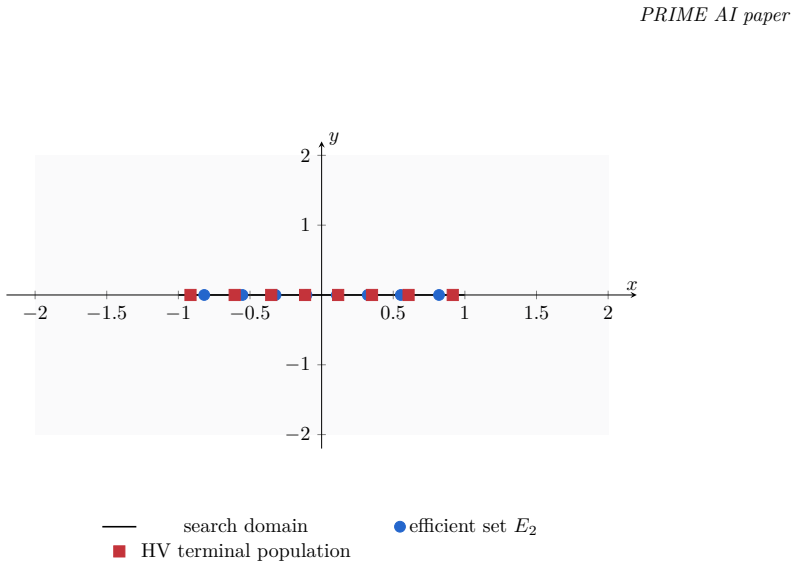
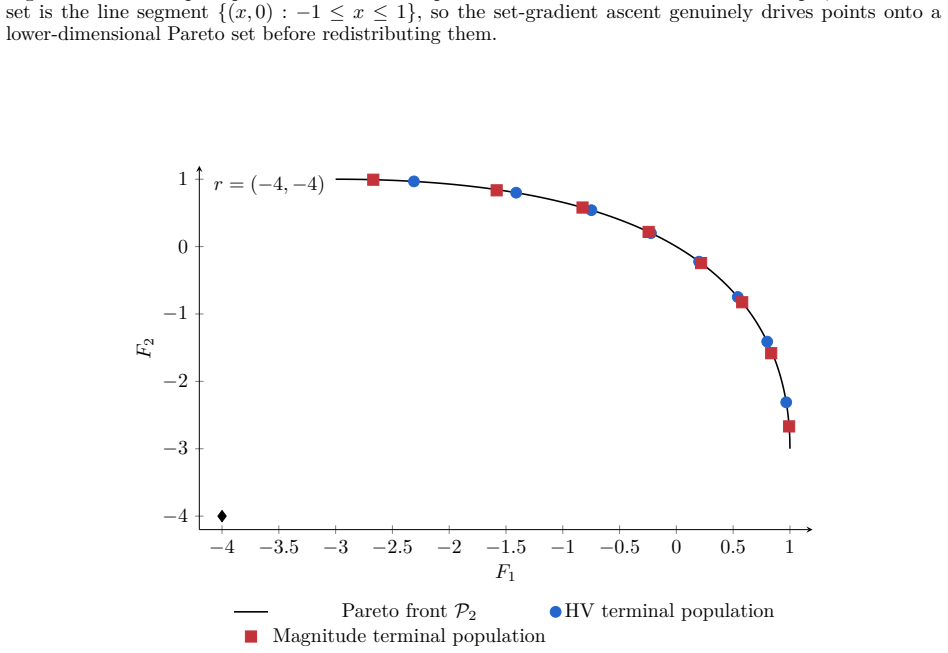
- Numerical comparisons on biobjective and three-dimensional simplex examples show that magnitude favors boundary-including populations and complete Das-Dennis grids while hypervolume favors more interior-filling configurations.
- Projected set-gradient methods can be formulated directly from the magnitude expression.
- Computation reduces to hypervolume on coordinate projections and therefore inherits the same asymptotic complexity up to a factor of 2^d minus 1, with Theta(n log n) time in dimensions two and three.
Where Pith is reading between the lines
- The preference for complete reference grids suggests magnitude could be paired with reference-point techniques to enforce uniform coverage without separate diversity penalties.
- Because magnitude generalizes cardinality, its projection formula might extend to other metrics if analogous monotonicity identities can be proved.
- In high dimensions the lower-order terms could mitigate the concentration of hypervolume mass near the anchor and thereby improve gradient-based search stability.
Load-bearing premise
The dominated regions must be finite unions of anchored boxes sharing a common anchor point in the l1 metric.
What would settle it
A concrete finite collection of points whose dominated region has smaller magnitude after the addition of a new non-dominated point that enlarges the set.
Figures




read the original abstract
We investigate \emph{magnitude} as a new unary and strictly Pareto-compliant quality indicator for finite approximation sets to the Pareto front in multiobjective optimization. Magnitude originates in enriched category theory and metric geometry, where it is a notion of size or point content for compact metric spaces and a generalization of cardinality. For dominated regions in the \(\ell_1\) box setting, magnitude is close to hypervolume but not identical: it contains the top-dimensional hypervolume term together with positive lower-dimensional projection and boundary contributions. This paper gives a first theoretical study of magnitude as an indicator. We consider multiobjective maximization with a common anchor point. For dominated sets generated by finite approximation sets, we derive an all-dimensional projection formula, prove weak and strict set monotonicity on finite unions of anchored boxes, and thereby obtain weak and strict Pareto compliance. Unlike hypervolume, magnitude assigns positive value to boundary points sharing one or more coordinates with the anchor point, even when their top-dimensional hypervolume contribution vanishes. We then formulate projected set-gradient methods and compare hypervolume and magnitude on biobjective and three-dimensional simplex examples. Numerically, magnitude favors boundary-including populations and, for suitable cardinalities, complete Das--Dennis grids, whereas hypervolume prefers more interior-filling configurations. Computationally, magnitude reduces to hypervolume on coordinate projections; for fixed dimension this yields the same asymptotic complexity up to a factor \(2^d-1\), and in dimensions two and three \(\Theta(n\log n)\) time. These results identify magnitude as a mathematically natural and computationally viable alternative to hypervolume for finite Pareto front approximations.
Editorial analysis
A structured set of objections, weighed in public.
Referee Report
Summary. The paper proposes magnitude—a size measure from metric geometry and enriched category theory—as a unary quality indicator for finite approximation sets in multiobjective maximization with a common anchor. For dominated regions that are finite unions of anchored boxes in the ℓ₁ metric, it derives an explicit all-dimensional projection formula, proves weak and strict set monotonicity, and thereby establishes weak and strict Pareto compliance. Magnitude is shown to coincide with hypervolume on the top-dimensional term but to add positive lower-dimensional and boundary contributions; numerical comparisons on bi-objective and 3-D simplex problems illustrate that it favors boundary-inclusive populations and complete Das–Dennis grids, while computational cost reduces to hypervolume evaluations on coordinate projections (same asymptotic complexity up to a 2^d−1 factor).
Significance. If the projection formula and monotonicity proofs hold, the work supplies a geometrically grounded, parameter-free alternative to hypervolume that is provably Pareto compliant and computationally comparable in low dimensions. The explicit inclusion of boundary and projection terms offers a mathematically natural explanation for why certain boundary points receive positive value even when their hypervolume contribution vanishes. The numerical evidence that magnitude prefers different population structures than hypervolume is a concrete, falsifiable distinction that could influence indicator-based evolutionary algorithms. The reduction to projected hypervolume computations is a practical strength that preserves existing implementation infrastructure.
minor comments (3)
- [Abstract] The abstract states that magnitude 'contains the top-dimensional hypervolume term together with positive lower-dimensional projection and boundary contributions,' but no concrete low-dimensional example is given to illustrate the difference; adding a two- or three-box example with explicit numerical values would improve accessibility.
- [Computational Complexity] The complexity claim 'Θ(n log n) time' for dimensions two and three is stated without reference to the underlying hypervolume algorithm or the precise projection implementation; a short complexity table or pseudocode reference would clarify the factor 2^d−1 overhead.
- [Numerical Experiments] The numerical section compares magnitude and hypervolume on simplex examples but does not report the exact population cardinalities, the precise Das–Dennis grid parameters, or the number of independent runs; these details are needed to reproduce the observed preference for boundary-inclusive populations.
Simulated Author's Rebuttal
We thank the referee for the positive and constructive review. The referee's summary accurately reflects the paper's contributions, and we appreciate the recognition of magnitude as a geometrically grounded, Pareto-compliant alternative to hypervolume with comparable computational cost in low dimensions. The recommendation for minor revision is noted. No specific major comments were raised in the report, so we have no points requiring detailed rebuttal or revision at this time. We remain available to incorporate any additional minor suggestions from the editor.
Circularity Check
No significant circularity detected
full rationale
The derivation begins from the established definition of magnitude in metric geometry and enriched category theory (external to this paper), then derives an all-dimensional projection formula specifically for finite unions of anchored boxes in the ℓ1 metric and proves weak/strict set monotonicity on that domain. These steps are presented as independent mathematical results that imply Pareto compliance by the standard definition of the property; no step reduces by construction to a fitted parameter, self-citation chain, or redefinition of the target indicator. The l1 anchored-box restriction is explicitly declared as the scope rather than smuggled in, and the numerical comparisons are presented as illustrations rather than load-bearing evidence. The central claims therefore remain self-contained.
Axiom & Free-Parameter Ledger
axioms (2)
- domain assumption Magnitude is a well-defined notion of size for compact metric spaces originating in enriched category theory.
- domain assumption Dominated regions can be represented as finite unions of anchored boxes in the l1 metric.
Forward citations
Cited by 1 Pith paper
-
Nonsmooth Set-Gradient Ascent to the Pareto Front via Layered Hypervolume and Magnitude Indicators
Nonsmooth gradient ascent on layered hypervolume and magnitude indicators moves sets to the Pareto front.
Reference graph
Works this paper leans on
-
[1]
Auger, J
A. Auger, J. Bader, and D. Brockhoff,Theoretically investigating optimalµ-distributions for the hyper- volume indicator: First results for three objectives, inParallel Problem Solving from Nature, PPSN XI, Lecture Notes in Computer Science 6239, Springer, Berlin, Heidelberg, 2010, pp. 586–596
2010
-
[2]
Auger, J
A. Auger, J. Bader, D. Brockhoff, and E. Zitzler,Theory of the hypervolume indicator: Optimalµ- distributions and the choice of the reference point, inProceedings of the 10th ACM SIGEVO Workshop on Foundations of Genetic Algorithms, ACM, 2009, pp. 87–102
2009
-
[3]
Beume, C
N. Beume, C. M. Fonseca, M. Lopez-Ibanez, L. Paquete, and J. Vahrenhold,On the complexity of computing the hypervolume indicator, IEEE Transactions on Evolutionary Computation13(5) (2009), 1075–1082
2009
-
[4]
D. Brockhoff,Optimal µ-Distributions for the Hypervolume Indicator for Problems with Linear Bi- Objective Fronts: Exact and Exhaustive Results, inSimulated Evolution and Learning (SEAL 2010), Lecture Notes in Computer Science 6457, Springer, Berlin, Heidelberg, 2010, pp. 24–34
2010
-
[5]
T. M. Chan,Klee’s measure problem made easy, in2013 IEEE 54th Annual Symposium on Foundations of Computer Science, IEEE, 2013, pp. 410–419
2013
-
[6]
Das and J
I. Das and J. E. Dennis,Normal-boundary intersection: A new method for generating the Pareto surface in nonlinear multicriteria optimization problems, SIAM Journal on Optimization8(3) (1998), 631–657
1998
-
[7]
Deutz, M
A. Deutz, M. Emmerich, and H. Wang,The hypervolume indicator Hessian matrix: analytical expression, computational time complexity, and sparsity, inEvolutionary Multi-Criterion Optimization, Springer Nature Switzerland, Cham, 2023, pp. 405–418
2023
-
[8]
Emmerich, N
M. Emmerich, N. Beume, and B. Naujoks,An EMO algorithm using the hypervolume measure as selection criterion, inEvolutionary Multi-Criterion Optimization, Lecture Notes in Computer Science 3410, Springer, Berlin, Heidelberg, 2005, pp. 62–76
2005
-
[9]
Emmerich and A
M. Emmerich and A. Deutz,Time complexity and zeros of the hypervolume indicator gradient field, in O. Schütze, C. A. Coello Coello, A.-A. Tantar, E. Tantar, P. Bouvry, P. Del Moral, and P. Legrand (eds.),EVOLVE – A Bridge between Probability, Set Oriented Numerics, and Evolutionary Computation III, Studies in Computational Intelligence 500, Springer, Cham...
2014
-
[10]
M. T. M. Emmerich and A. H. Deutz,A tutorial on multiobjective optimization: fundamentals and evolutionary methods, Natural Computing17(3) (2018), 585–609
2018
-
[11]
M. T. Emmerich, A. H. Deutz, and I. Yevseyeva,On reference point free weighted hypervolume indicators based on desirability functions and their probabilistic interpretation, Procedia Technology16(2014), 532–541. 27 PRIME AI paper
2014
-
[12]
Fleischer,The measure of Pareto optima: applications to multi-objective metaheuristics, in C
M. Fleischer,The measure of Pareto optima: applications to multi-objective metaheuristics, in C. M. Fon- seca, P. J. Fleming, E. Zitzler, L. Thiele, and K. Deb (eds.),Evolutionary Multi-Criterion Optimization, Lecture Notes in Computer Science 2632, Springer, Berlin, Heidelberg, 2003, pp. 519–533
2003
-
[13]
A. P. Guerreiro, C. M. Fonseca, and L. Paquete,The hypervolume indicator: Computational problems and algorithms,ACM Computing Surveys, 54(6):1–42, 2021
2021
-
[14]
V. A. S. Hernández, O. Schütze, H. Wang, A. Deutz, and M. Emmerich,The set-based hypervolume Newton method for bi-objective optimization, IEEE Transactions on Cybernetics50(5) (2020), 2186–2196
2020
-
[15]
Huntsman,Diversity enhancement via magnitude, inEvolutionary Multi-Criterion Optimization, Springer Nature Switzerland, Cham, 2023, pp
S. Huntsman,Diversity enhancement via magnitude, inEvolutionary Multi-Criterion Optimization, Springer Nature Switzerland, Cham, 2023, pp. 377–390
2023
-
[16]
Ishibuchi, R
H. Ishibuchi, R. Imada, N. Masuyama, and Y. Nojima,Comparison of hypervolume, IGD and IGD+ from the viewpoint of optimal distributions of solutions, inEvolutionary Multi-Criterion Optimization, Lecture Notes in Computer Science 11411, Springer, Cham, 2019, pp. 332–345
2019
-
[17]
Ishibuchi, Y
H. Ishibuchi, Y. Nan, and L. M. Pang,Optimal distributions of solutions for maximizing the minimum crowding distance for two-objective and three-objective linear Pareto fronts: Search behavior analysis of NSGA-II, inProceedings of the 18th ACM/SIGEVO Conference on Foundations of Genetic Algorithms, ACM, 2025, pp. 106–117
2025
-
[18]
J. D. Knowles, D. W. Corne, and M. Fleischer,Bounded archiving using the Lebesgue measure, in Proceedings of the 2003 Congress on Evolutionary Computation (CEC 2003), vol. 4, IEEE, 2003, pp. 2490–2497
2003
-
[19]
Leinster,The Magnitude of Metric Spaces, Documenta Mathematica18(2013), 857–905
T. Leinster,The Magnitude of Metric Spaces, Documenta Mathematica18(2013), 857–905
2013
-
[20]
Leinster and M
T. Leinster and M. W. Meckes,The magnitude of a metric space: from category theory to geometric measure theory, in N. Gigli (ed.),Measure Theory in Non-Smooth Spaces, De Gruyter, 2017, pp. 156–193
2017
-
[21]
Leinster,The Many Faces of Magnitude, talk slides, University of Edinburgh, available via Tom Leinster’s homepage athttps://webhomes.maths.ed.ac.uk/~tl/
T. Leinster,The Many Faces of Magnitude, talk slides, University of Edinburgh, available via Tom Leinster’s homepage athttps://webhomes.maths.ed.ac.uk/~tl/
-
[22]
Miettinen,Nonlinear Multiobjective Optimization, volume 12 ofInternational Series in Operations Research & Management Science, Springer, Boston, 1999
K. Miettinen,Nonlinear Multiobjective Optimization, volume 12 ofInternational Series in Operations Research & Management Science, Springer, Boston, 1999
1999
-
[23]
H. K. Singh,Extended results on analytical hypervolume indicator calculation of linear and quadratic Pareto fronts, inEvolutionary Multi-Criterion Optimization, Springer Nature Singapore, Singapore, 2025, pp. 226–241
2025
-
[24]
V. A. Sosa Hernández, O. Schütze, and M. Emmerich,Hypervolume maximization via set based Newton’s method, in A.-A. Tantar et al. (eds.),EVOLVE – A Bridge between Probability, Set Oriented Numerics, and Evolutionary Computation V, Advances in Intelligent Systems and Computing 288, Springer, Cham, 2014, pp. 15–28
2014
-
[25]
H. Wang, A. H. Deutz, T. Bäck, and M. Emmerich,Hypervolume indicator gradient ascent multi-objective optimization, in H. Trautmann et al. (eds.),Evolutionary Multi-Criterion Optimization, Lecture Notes in Computer Science 10173, Springer, Cham, 2017, pp. 654–669
2017
-
[26]
H. Wang, M. Emmerich, A. Deutz, V. A. S. Hernández, and O. Schütze,The hypervolume Newton method for constrained multi-objective optimization problems, Mathematical and Computational Applications 28(1) (2023), 10
2023
-
[27]
Zitzler, D
E. Zitzler, D. Brockhoff, and L. Thiele,The hypervolume indicator revisited: On the design of Pareto- compliant indicators via weighted integration, inEvolutionary Multi-Criterion Optimization, Lecture Notes in Computer Science 4403, Springer, Berlin, Heidelberg, 2007, pp. 862–876
2007
-
[28]
Zitzler and S
E. Zitzler and S. Künzli,Indicator-based selection in multiobjective search, inParallel Problem Solving from Nature – PPSN VIII, Lecture Notes in Computer Science 3242, Springer, Berlin, Heidelberg, 2004, pp. 832–842
2004
-
[29]
Zitzler, L
E. Zitzler, L. Thiele, M. Laumanns, C. M. Fonseca, and V. Grunert da Fonseca,Performance assessment of multiobjective optimizers: An analysis and review, IEEE Transactions on Evolutionary Computation 7(2) (2003), 117–132. 28
2003
discussion (0)
Sign in with ORCID, Apple, or X to comment. Anyone can read and Pith papers without signing in.