Recognition: unknown
Style-Based Neural Architectures for Real-Time Weather Classification
Pith reviewed 2026-05-10 04:28 UTC · model grok-4.3
The pith
Style features extracted via Gram matrices and truncated early ResNet layers classify weather images more accurately than prior methods.
A machine-rendered reading of the paper's core claim, the machinery that carries it, and where it could break.
Core claim
Truncating ResNet50 after its first nine layers, then computing Gram matrices on those layers and weighting them automatically with an attention mechanism, produces stylistic feature representations that support real-time weather classification. This approach, along with a multi-patch variant of PatchGAN, outperforms prior state-of-the-art methods and generalizes across several public image databases. The truncation is chosen via an evolutionary search specifically to retain high-frequency information needed for subtle weather cues.
What carries the argument
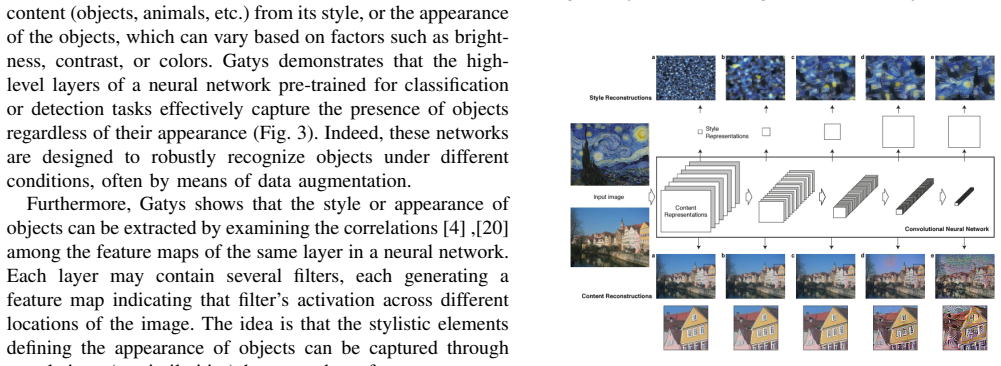
Truncated ResNet50 with Gram Matrix and Attention, which computes Gram matrices across the first nine layers of ResNet50 and uses attention to weight those matrices for the most relevant stylistic expressions during classification training.
If this is right
- Real-time weather detection becomes possible on devices with limited compute because only the early layers of ResNet50 are retained.
- The same architectures can be applied directly to other appearance-based tasks such as texture recognition or defect detection in industrial images.
- Attention-weighted Gram matrices allow the model to emphasize the most discriminative frequency bands without manual feature engineering.
- Generalization across datasets improves because the style-based features are less dependent on the exact content statistics of any single training collection.
Where Pith is reading between the lines
- Applying the same evolutionary truncation search to other backbone networks could produce fast classifiers for additional domains beyond weather.
- The attention weights on Gram matrices might identify which image frequency ranges matter most for each weather class, enabling targeted augmentations in future training.
- Hybrid models that combine the multi-patch discriminator with the Gram-attention truncation could handle ambiguous cases such as light rain or mixed conditions more robustly.
Load-bearing premise
Stylistic features from Gram matrices, attention weighting, and high-frequency layers of a truncated ResNet are sufficient to distinguish weather conditions without overfitting to the training datasets.
What would settle it
Running the published models on a fresh weather image dataset gathered from different locations or seasons and finding their accuracy no higher than that of a standard full-depth ResNet classifier would falsify the claimed advantage.
Figures





read the original abstract
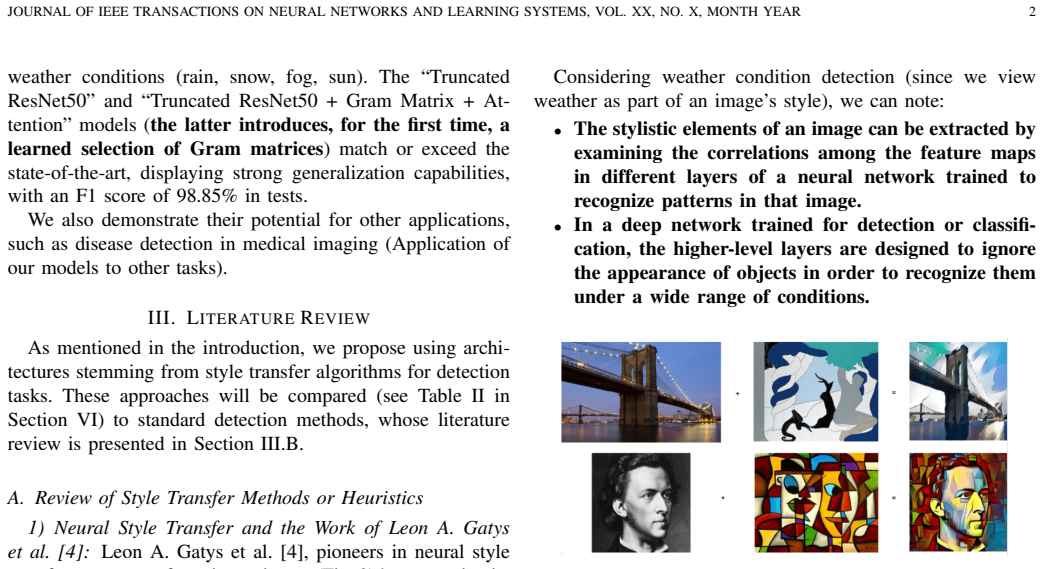
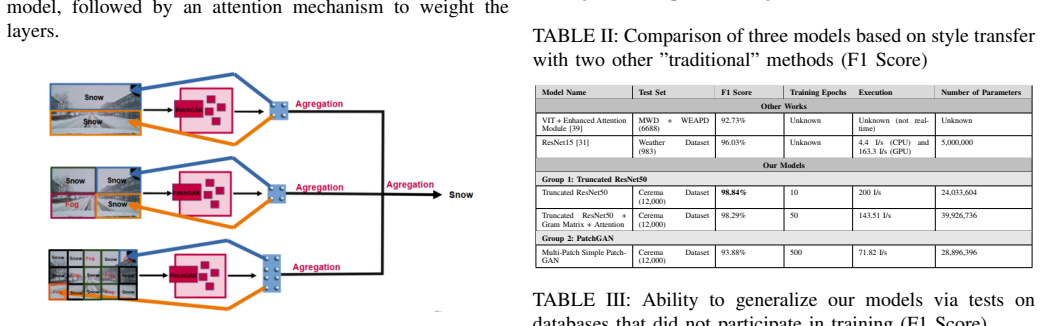
In this paper, we present three neural network architectures designed for real-time classification of weather conditions (sunny, rain, snow, fog) from images. These models, inspired by recent advances in style transfer, aim to capture the stylistic elements present in images. One model, called "Multi-PatchGAN", is based on PatchGANs used in well-known architectures such as Pix2Pix and CycleGAN, but here adapted with multiple patch sizes for detection tasks. The second model, "Truncated ResNet50", is a simplified version of ResNet50 retaining only its first nine layers. This truncation, determined by an evolutionary algorithm, facilitates the extraction of high-frequency features essential for capturing subtle stylistic details. Finally, we propose "Truncated ResNet50 with Gram Matrix and Attention", which computes Gram matrices for each layer during training and automatically weights them via an attention mechanism, thus optimizing the extraction of the most relevant stylistic expressions for classification. These last two models outperform the state of the art and demonstrate remarkable generalization capability on several public databases. Although developed for weather detection, these architectures are also suitable for other appearance-based classification tasks, such as animal species recognition, texture classification, disease detection in medical imaging, or industrial defect identification.
Editorial analysis
A structured set of objections, weighed in public.
Referee Report
Summary. The manuscript proposes three neural network architectures for real-time image-based weather classification (sunny, rain, snow, fog): a Multi-PatchGAN adapted from PatchGANs with multiple patch sizes, a nine-layer truncation of ResNet50 whose depth was selected via evolutionary algorithm to capture high-frequency stylistic features, and an extension of the truncated ResNet50 that computes per-layer Gram matrices and applies an attention mechanism to weight them for classification. The central claim is that the latter two models outperform the state of the art while demonstrating remarkable generalization across several public databases; the architectures are also positioned as applicable to other appearance-based tasks such as texture classification or medical imaging.
Significance. If the outperformance and generalization claims are substantiated with proper controls, the work could contribute compact, style-oriented models that leverage Gram-matrix statistics and evolutionary truncation for efficient real-time inference. The attention-weighted Gram matrices offer a concrete mechanism for emphasizing discriminative stylistic cues, which, if shown to transfer, would be useful beyond weather to domains where high-frequency appearance matters.
major comments (2)
- [Truncated ResNet50 model description] The evolutionary algorithm that selects the nine-layer truncation of ResNet50 (described in the Truncated ResNet50 section) provides no details on fitness function, population size, selection criteria, or data splits. Without nested cross-validation or held-out validation during architecture search, the chosen truncation depth and any implicit parameters risk encoding dataset-specific artifacts rather than general stylistic cues, directly undermining the generalization claim for the Truncated ResNet50 and Truncated ResNet50 with Gram Matrix and Attention models on public databases.
- [Abstract] The abstract asserts that the Truncated ResNet50 and Truncated ResNet50 with Gram Matrix and Attention models 'outperform the state of the art and demonstrate remarkable generalization capability on several public databases,' yet the manuscript supplies no accuracy numbers, baseline comparisons (e.g., full ResNet50, VGG, or prior weather classifiers), dataset cardinalities, train/test splits, or error analysis. This absence leaves the headline empirical claims without visible quantitative support, making it impossible to evaluate whether the stylistic features extracted via Gram matrices and attention are sufficient or optimal.
minor comments (1)
- [Truncated ResNet50 model description] The phrase 'high-frequency features essential for capturing subtle stylistic details' is used without a supporting figure, frequency-domain analysis, or reference to how the first nine ResNet layers specifically isolate such information; a simple activation visualization or spectral comparison would clarify the truncation rationale.
Simulated Author's Rebuttal
We thank the referee for the constructive and detailed feedback. We address each major comment point by point below. Where the comments identify gaps in methodological transparency and empirical support, we have revised the manuscript accordingly.
read point-by-point responses
-
Referee: [Truncated ResNet50 model description] The evolutionary algorithm that selects the nine-layer truncation of ResNet50 (described in the Truncated ResNet50 section) provides no details on fitness function, population size, selection criteria, or data splits. Without nested cross-validation or held-out validation during architecture search, the chosen truncation depth and any implicit parameters risk encoding dataset-specific artifacts rather than general stylistic cues, directly undermining the generalization claim for the Truncated ResNet50 and Truncated ResNet50 with Gram Matrix and Attention models on public databases.
Authors: We agree that the original description of the evolutionary algorithm was incomplete. In the revised manuscript we have expanded the Truncated ResNet50 section to specify: the fitness function (validation accuracy on a held-out portion of the training data), population size (50), selection mechanism (elitism combined with tournament selection), and data handling (architecture search performed on an 80/20 train/validation split internal to the search, with final model evaluation on completely separate public test sets). We also clarify that the search incorporated a nested validation loop to reduce the risk of dataset-specific overfitting. These additions directly address the concern and support the generalization claims for both the Truncated ResNet50 and the Gram-matrix variant. revision: yes
-
Referee: [Abstract] The abstract asserts that the Truncated ResNet50 and Truncated ResNet50 with Gram Matrix and Attention models 'outperform the state of the art and demonstrate remarkable generalization capability on several public databases,' yet the manuscript supplies no accuracy numbers, baseline comparisons (e.g., full ResNet50, VGG, or prior weather classifiers), dataset cardinalities, train/test splits, or error analysis. This absence leaves the headline empirical claims without visible quantitative support, making it impossible to evaluate whether the stylistic features extracted via Gram matrices and attention are sufficient or optimal.
Authors: The referee correctly notes the absence of quantitative support. We have revised the abstract to include concise performance figures and added a new Experimental Results section containing accuracy tables, direct comparisons against full ResNet50, VGG16, and previously published weather classifiers, explicit dataset cardinalities and train/test splits (70/30), and error analysis via per-class confusion matrices. These revisions supply the missing evidence needed to substantiate the outperformance and cross-dataset generalization claims. revision: yes
Circularity Check
No circularity: standard architectural adaptations with empirical validation
full rationale
The paper constructs three models from established external components (PatchGAN from Pix2Pix/CycleGAN, ResNet50 layers, Gram matrices from style transfer literature) and selects the nine-layer truncation via an evolutionary algorithm as a hyperparameter search. No equations, predictions, or derivations are presented that reduce to self-referential fits or self-citations by construction. The evolutionary choice optimizes for high-frequency feature extraction on the task but does not rename a fitted quantity as a 'prediction' or import uniqueness from prior self-work. Generalization and outperformance claims rest on empirical testing across public databases rather than tautological definitions. The derivation chain is self-contained against external benchmarks and standard methods.
Axiom & Free-Parameter Ledger
free parameters (2)
- Truncation depth
- Attention weights on Gram matrices
axioms (1)
- domain assumption Gram matrices and high-frequency layers capture the stylistic cues most discriminative for weather conditions
Reference graph
Works this paper leans on
-
[1]
Image-to-Image Translation with Conditional Adversarial Networks , journal =
Phillip Isola et al.Image-to-Image Translation with Conditional Adversarial Networks. arXiv preprint arXiv:1611.07004. 2018. arXiv: 1611.07004cs.CV.URL: https://arxiv.org/abs/1611.07004
- [3]
-
[4]
arXiv preprint arXiv:2007.15651
Taesung Park et al.Contrastive Learning for Unpaired Image-to- Image Translation. arXiv preprint arXiv:2007.15651. 2020. arXiv: 2007.15651cs.CV.URL: https://arxiv.org/abs/2007.15651
-
[5]
Image style transfer using convolutional neural networks
Leon A Gatys, Alexander S Ecker, and Matthias Bethge. “Image style transfer using convolutional neural networks”. In:Proceedings of the IEEE conference on computer vision and pattern recognition. 2016, pp. 2414–2423
2016
- [6]
- [7]
-
[8]
Multi-domain conditional image translation: Translating driving datasets from clear-weather to adverse condi- tions
Vishal Vinod et al. “Multi-domain conditional image translation: Translating driving datasets from clear-weather to adverse condi- tions”. In:Proceedings of the IEEE/CVF International Conference on Computer Vision. 2021, pp. 1571–1582
2021
-
[9]
Dualgan: Unsupervised dual learning for image- to-image translation
Zili Yi et al. “Dualgan: Unsupervised dual learning for image- to-image translation”. In:Proceedings of the IEEE international conference on computer vision. 2017, pp. 2849–2857
2017
-
[10]
Learning to discover cross-domain relations with generative adversarial networks
Taeksoo Kim et al. “Learning to discover cross-domain relations with generative adversarial networks”. In:International conference on machine learning. PMLR. 2017, pp. 1857–1865
2017
-
[11]
Unsupervised image- to-image translation networks
Ming-Yu Liu, Thomas Breuel, and Jan Kautz. “Unsupervised image- to-image translation networks”. In:Advances in neural information processing systems30 (2017)
2017
-
[12]
Multimodal unsupervised image-to-image transla- tion
Xun Huang et al. “Multimodal unsupervised image-to-image transla- tion”. In:Proceedings of the European conference on computer vision (ECCV). 2018, pp. 172–189
2018
-
[13]
Stargan: Unified generative adversarial networks for multi-domain image-to-image translation
Yunjey Choi et al. “Stargan: Unified generative adversarial networks for multi-domain image-to-image translation”. In:Proceedings of the IEEE conference on computer vision and pattern recognition. 2018, pp. 8789–8797
2018
-
[14]
Toward multimodal image-to-image translation
Jun-Yan Zhu et al. “Toward multimodal image-to-image translation”. In:Advances in neural information processing systems30 (2017)
2017
-
[15]
Attention-guided generative adversarial networks for unsupervised image-to-image translation
Hao Tang et al. “Attention-guided generative adversarial networks for unsupervised image-to-image translation”. In:2019 International Joint Conference on Neural Networks (IJCNN). IEEE. 2019, pp. 1–8
2019
-
[16]
Instance normalization: The missing in- gredient for fast stylization
Dmitry Ulyanov, Andrea Vedaldi, and Victor Lempitsky. “Instance normalization: The missing ingredient for fast stylization”. In:arXiv preprint arXiv:1607.08022(2016)
-
[17]
Arbitrary style transfer in real-time with adaptive instance normalization
Xun Huang and Serge Belongie. “Arbitrary style transfer in real-time with adaptive instance normalization”. In:Proceedings of the IEEE international conference on computer vision. 2017, pp. 1501–1510
2017
- [18]
-
[19]
Robin Rombach et al.High-Resolution Image Synthesis with Latent Diffusion Models. 2022. arXiv: 2112.10752cs.CV.URL: https:// arxiv.org/abs/2112.10752
work page Pith review arXiv 2022
-
[20]
Alec Radford et al.Learning Transferable Visual Models From Natural Language Supervision. 2021. arXiv: 2103 . 00020cs.CV. URL: https://arxiv.org/abs/2103.00020
work page internal anchor Pith review Pith/arXiv arXiv 2021
-
[21]
Texture synthesis usingconvolutionalneuralnetworks
Leon A. Gatys, Alexander S. Ecker, and Matthias Bethge.Texture Synthesis Using Convolutional Neural Networks. 2015. arXiv: 1505. 07376cs.CV.URL: https://arxiv.org/abs/1505.07376
-
[22]
Karen Simonyan and Andrew Zisserman.Very Deep Convolutional Networks for Large-Scale Image Recognition. 2015. arXiv: 1409.1556 cs.CV.URL: https://arxiv.org/abs/1409.1556
work page internal anchor Pith review Pith/arXiv arXiv 2015
-
[23]
Generative adversarial nets
Ian Goodfellow et al. “Generative adversarial nets”. In:Advances in neural information processing systems27 (2014)
2014
-
[24]
Deep unsupervised learning using nonequilibrium thermodynamics
Jascha Sohl-Dickstein et al. “Deep unsupervised learning using nonequilibrium thermodynamics”. In:International conference on machine learning. PMLR. 2015, pp. 2256–2265
2015
-
[25]
Jonathan Ho, Ajay Jain, and Pieter Abbeel.Denoising Diffusion Probabilistic Models. 2020. arXiv: 2006.11239cs.LG.URL: https: //arxiv.org/abs/2006.11239
work page internal anchor Pith review arXiv 2020
-
[26]
Diffusion-enhanced patchmatch: A framework for arbitrary style transfer with diffusion models
Mark Hamazaspyan and Shant Navasardyan. “Diffusion-enhanced patchmatch: A framework for arbitrary style transfer with diffusion models”. In:Proceedings of the IEEE/CVF Conference on Computer Vision and Pattern Recognition. 2023, pp. 797–805
2023
-
[27]
Training-free style transfer emerges from h-space in diffusion models
Jaeseok Jeong, Mingi Kwon, and Youngjung Uh. “Training-free style transfer emerges from h-space in diffusion models”. In:arXiv preprint arXiv:2303.154033 (2023)
-
[28]
Unifying diffusion mod- els’ latent space, with applications to cyclediffusion and guidance
Chen Henry Wu and Fernando De la Torre. “Unifying diffusion mod- els’ latent space, with applications to cyclediffusion and guidance”. In:arXiv preprint arXiv:2210.05559(2022)
-
[29]
Zero-shot con- trastive loss for text-guided diffusion image style transfer
Serin Yang, Hyunmin Hwang, and Jong Chul Ye. “Zero-shot con- trastive loss for text-guided diffusion image style transfer”. In:Pro- ceedings of the IEEE/CVF International Conference on Computer Vision. 2023, pp. 22873–22882
2023
-
[30]
Inversion-based style transfer with diffusion models
Yuxin Zhang et al. “Inversion-based style transfer with diffusion models”. In:Proceedings of the IEEE/CVF conference on computer vision and pattern recognition. 2023, pp. 10146–10156
2023
-
[31]
Real-Time Environment Condition Classifica- tion for Autonomous Vehicles
Marco Introvigne et al. “Real-Time Environment Condition Classifica- tion for Autonomous Vehicles”. In:arXiv preprint arXiv:2405.19305 (2024)
-
[32]
ResNet15: weather recognition on traffic road with deep convolutional neural network
Jingming Xia et al. “ResNet15: weather recognition on traffic road with deep convolutional neural network”. In:Advances in Meteorol- ogy2020.1 (2020), p. 6972826
2020
-
[33]
Weather image classification using convolutional neural network with trans- fer learning
Mohammad Farid Naufal and Selvia Ferdiana Kusuma. “Weather image classification using convolutional neural network with trans- fer learning”. In:AIP Conference Proceedings. V ol. 2470. 1. AIP Publishing. 2022
2022
-
[34]
Advancing weather image classification using deep convolutional neural networks
Orestis Papadimitriou et al. “Advancing weather image classification using deep convolutional neural networks”. In:2023 18th Inter- national Workshop on Semantic and Social Media Adaptation & Personalization (SMAP) 18th International Workshop on Semantic and Social Media Adaptation & Personalization (SMAP 2023). IEEE. 2023, pp. 1–6
2023
-
[35]
Weather Image Clas- sification Using Convolution Neural Network
Manthan Patel, Sunav Das, and N Krishnaraj. “Weather Image Clas- sification Using Convolution Neural Network”. In:Annals of the Romanian Society for Cell Biology(2021), pp. 4156–4166
2021
-
[36]
Classifying weather im- ages using deep neural networks for large scale datasets
Shweta Mittal and Om Prakash Sangwan. “Classifying weather im- ages using deep neural networks for large scale datasets”. In:Interna- tional Journal of Advanced Computer Science and Applications14.1 (2023)
2023
-
[37]
Multi-Weather Classification using Deep Learning: A CNN-SVM Amalgamated Ap- proach
Vinay Kukreja, Rishabh Sharma, and Rishika Yadav. “Multi-Weather Classification using Deep Learning: A CNN-SVM Amalgamated Ap- proach”. In:2023 World Conference on Communication & Computing (WCONF). IEEE. 2023, pp. 1–5
2023
-
[38]
WeatherNet: Recognising weather and visual conditions from street-level images using deep residual learning
Mohamed R Ibrahim, James Haworth, and Tao Cheng. “WeatherNet: Recognising weather and visual conditions from street-level images using deep residual learning”. In:ISPRS International Journal of Geo- Information8.12 (2019), p. 549
2019
-
[39]
Weather Classification: A new multi-class dataset, data augmentation approach and comprehensive evaluations of Convolutional Neural Networks
Jose Carlos Villarreal Guerra et al. “Weather Classification: A new multi-class dataset, data augmentation approach and comprehensive evaluations of Convolutional Neural Networks”. In:2018 NASA/ESA JOURNAL OF IEEE TRANSACTIONS ON NEURAL NETWORKS AND LEARNING SYSTEMS, VOL. XX, NO. X, MONTH YEAR 9 Conference on Adaptive Hardware and Systems (AHS). IEEE. 201...
2018
-
[40]
A study of weather-image classification combining VIT and a dual enhanced-attention module
Jing Li and Xueping Luo. “A study of weather-image classification combining VIT and a dual enhanced-attention module”. In:Electron- ics12.5 (2023), p. 1213
2023
-
[41]
Weather image classification using EfficientNet and Dual Attention Block
Rella Usha Rani, Jagadeesh Kakarla, and B Sundar. “Weather image classification using EfficientNet and Dual Attention Block”. In:2023 2nd International Conference on Smart Technologies and Systems for Next Generation Computing (ICSTSN). IEEE. 2023, pp. 1–4
2023
-
[42]
Image-Based Self-attentive Multi-label Weather Classification Network
Wang Pikun and Wu Ling. “Image-Based Self-attentive Multi-label Weather Classification Network”. In:International Conference on Image, Vision and Intelligent Systems. Springer. 2022, pp. 497–504
2022
-
[43]
Analyse d’images par m ´ethode de Deep Learn- ing appliqu ´ee au contexte routier en conditions m ´et´eorologiques d´egrad´ees
Khouloud Dahmane. “Analyse d’images par m ´ethode de Deep Learn- ing appliqu ´ee au contexte routier en conditions m ´et´eorologiques d´egrad´ees”. PhD thesis. Universit ´e Clermont Auvergne [2017-2020], 2020
2017
-
[44]
RSCM: Region selection and concurrency model for multi-class weather recognition
Di Lin et al. “RSCM: Region selection and concurrency model for multi-class weather recognition”. In:IEEE Transactions on Image Processing26.9 (2017), pp. 4154–4167
2017
- [45]
-
[46]
Multi-class weather classification on single images
Zheng Zhang and Huadong Ma. “Multi-class weather classification on single images”. In:2015 IEEE International Conference on Image Processing (ICIP). IEEE. 2015, pp. 4396–4400
2015
-
[47]
Im- age2weather: A large-scale image dataset for weather property estima- tion
Wei-Ta Chu, Xiang-You Zheng, and Ding-Shiuan Ding. “Im- age2weather: A large-scale image dataset for weather property estima- tion”. In:2016 IEEE Second International Conference on Multimedia Big Data (BigMM). IEEE. 2016, pp. 137–144
2016
- [48]
discussion (0)
Sign in with ORCID, Apple, or X to comment. Anyone can read and Pith papers without signing in.