Recognition: unknown
Pulsational mass loss from supermassive stars creates the compact shells of Little Red Dots
Pith reviewed 2026-05-10 01:10 UTC · model grok-4.3
The pith
Pulsational mass loss from supermassive stars produces the compact gas shells of Little Red Dots
A machine-rendered reading of the paper's core claim, the machinery that carries it, and where it could break.
Core claim
In accreting supermassive star models of characteristic mass 10^5 solar masses, post-accretion evolution proceeds through discrete strange-mode ejection episodes rather than continuous winds. For the Z = 0.01 solar metallicity case, four late episodes occur over decades to centuries and remove hundreds of solar masses total, with the final episode alone supplying most of the ejected mass and forming a compact, optically thick shell out to 0.4 parsecs. The star reaches general relativistic instability after roughly 1 Myr and collapses in about 10^4 seconds while retaining 99 percent of its mass. The ejecta are H/He dominated yet nitrogen-rich, and the same discrete-ejection channel appears at
What carries the argument
Discrete strange-mode pulsational ejection episodes that dominate late-stage mass loss in accreting supermassive star models
If this is right
- The final ejection episode alone supplies enough mass and extent to form the entire dense cocoon required by LRD spectra
- Supermassive stars retain nearly all their mass at collapse and serve as direct-collapse black hole seeds
- The ejected material carries a chemically distinctive nitrogen enrichment that can be searched for in spectra
- The shell-ejection process operates across metallicities from Population III to 0.01 solar
Where Pith is reading between the lines
- High-resolution spectra of LRDs could reveal the specific nitrogen-oxygen ratios expected from the final ejecta
- The cocoon phase would be short-lived, lasting only from the last ejection until collapse
- Similar shell signatures might appear around other high-redshift sources that host rapid black hole growth
- This channel offers a unified route from supermassive star evolution to both observed cocoons and seed black holes
Load-bearing premise
The discrete ejection episodes in the stellar models produce a shell whose size, density, and optical thickness match those inferred for Little Red Dots
What would settle it
Spectroscopic measurements showing that gas around Little Red Dots lacks the predicted nitrogen-to-oxygen ratio or has a spatial scale inconsistent with the final ejection episode
Figures



read the original abstract
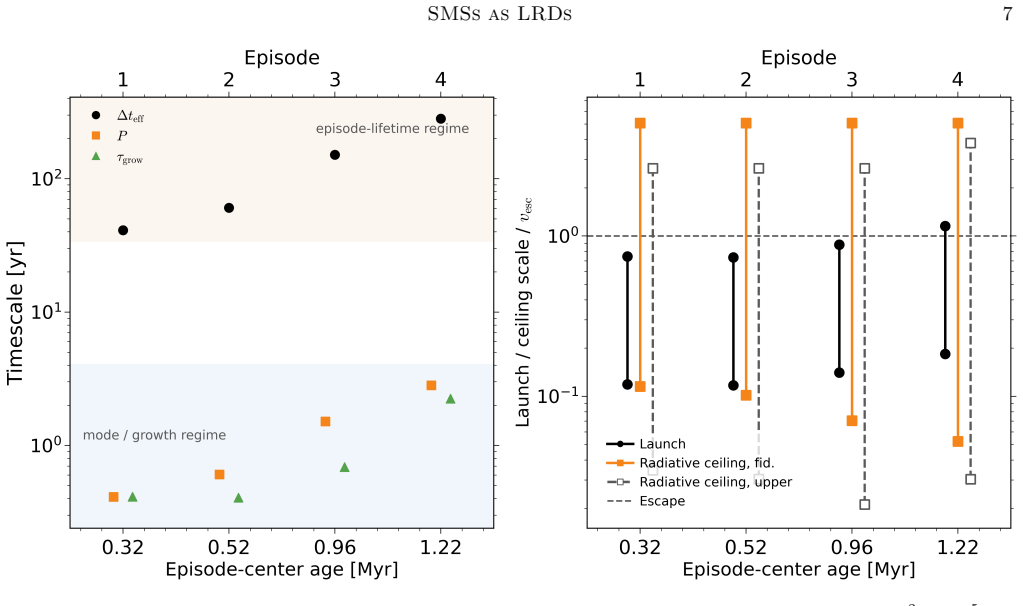
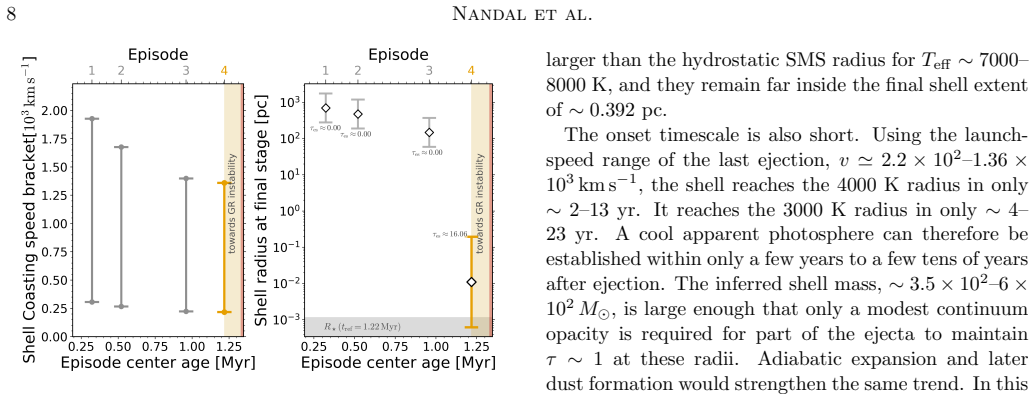
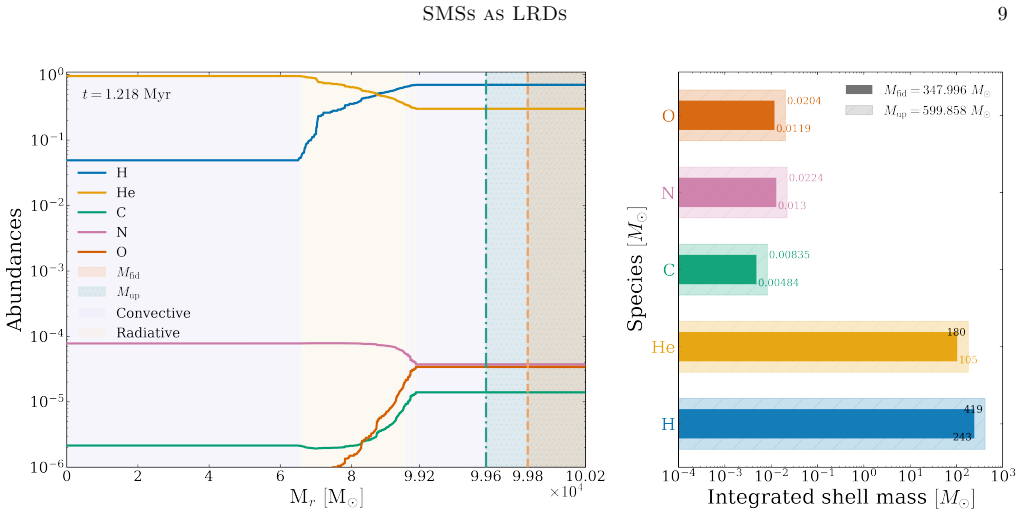
Little Red Dots (LRDs) have emerged as one of the central puzzles of the JWST era. Their spectra increasingly require dense gas close to the source, yet the physical origin of that cocoon-like structure remains unclear. We examine whether late pulsational mass loss from supermassive stars (SMS)leads to dense gas cocoons. We analyze five accreting GENEC models at different metallicities with characteristic masses of order $10^5\,M_\odot$, following them through post-accretion evolution with radial pulsation calculations and general relativistic (GR) stability diagnostics. Mass loss during the final stages of evolution occurs not as a steady wind, but through discrete strange-mode ejection episodes. In the $Z=10^{-2}\,Z_\odot$ model, which provides the clearest LRD analogue, four late episodes last $41$--$282$ yr and eject $10$--$348\,M_\odot$ each, for a total loss of $(4.8-10)\times10^2\,M_\odot$; the final episode alone contributes $\simeq 73\%$ of that budget. Since the last episode dominates the mass-loss, it is the only event sufficiently massive enough to leave behind a compact, optically thick shell extending out to 0.4 pc that reproduces the LRD dense gas cocoon. The final ejecta are H/He dominated but chemically distinctive, with a robust nitrogen-rich composition, $\log(\mathrm{N/O})\simeq0.13$ and $\log(\mathrm{C/O})\simeq-0.23$. The SMS reaches GR instability at an age of $\sim 1$ Myr and collapses in $\sim10^4$ s, retaining $\sim 99\%$ all of its mass. Across the full metallicity range from Pop III to $10^{-2}\,Z_\odot$, this shell-ejection channel persists. Pulsational mass-loss from SMSs therefore provides a physically motivated origin for the compact cocoon-like structure implied by LRDs, while remaining the natural progenitors of the massive black hole seeds invoked in direct collapse scenario.
Editorial analysis
A structured set of objections, weighed in public.
Referee Report
Summary. The paper analyzes five accreting GENEC models of supermassive stars (~10^5 M_⊙) at metallicities from Pop III to 10^{-2} Z_⊙. Radial pulsation calculations and GR stability diagnostics reveal discrete strange-mode ejection episodes in late evolution rather than steady winds. In the Z=10^{-2} Z_⊙ case, four episodes (41–282 yr duration) eject 10–348 M_⊙ each (total 480–1000 M_⊙), with the final episode contributing ~73% and producing a compact ~0.4 pc H/He+N-rich shell claimed to match LRD dense-gas cocoons. The SMS reaches GR instability at ~1 Myr and collapses in ~10^4 s while retaining ~99% of its mass. The authors conclude that pulsational mass loss from SMSs supplies a physically motivated origin for LRD structures and supports direct-collapse BH seeds.
Significance. If the 1D pulsation-to-ejection mapping is robust, the work supplies a concrete mechanism that simultaneously accounts for the compact, optically thick shells inferred around LRDs and preserves the SMS as progenitors of massive BH seeds. It thereby links a single evolutionary channel to two otherwise disconnected JWST-era puzzles in early-universe astrophysics.
major comments (3)
- [pulsation calculations and mass-loss episodes] The central claim that the final ejection episode produces a compact, optically thick shell matching LRD cocoons rests on the conversion of linear strange-mode growth rates into discrete, spherical mass-loss events with the reported velocities, timings, and extents. No validation, convergence tests, or error estimates for this 1D pulsation-to-mass-loss mapping are provided (see the description of the GENEC radial pulsation calculations and GR diagnostics). Without multi-dimensional hydrodynamical confirmation or comparison to other codes, the derived shell radius (0.4 pc), density, and optical thickness remain unverified.
- [results for Z=10^{-2} Z_⊙ model and LRD comparison] The manuscript states that only the final episode is 'sufficiently massive enough to leave behind a compact, optically thick shell' but supplies no quantitative comparison of the predicted shell properties (size, column density, optical depth, or chemical abundances) to specific LRD observational constraints or to alternative cocoon models. Direct, falsifiable matching to LRD data is therefore absent.
- [mass-loss budget and final episode] The total ejected mass range (4.8–10)×10^2 M_⊙ and the dominance of the final episode (~73%) are reported without accompanying uncertainty estimates arising from the choice of pulsation amplitude threshold, numerical resolution, or the treatment of fallback/asymmetry. These quantities are load-bearing for the claim that the shell reproduces LRD observations.
minor comments (3)
- [abstract] The abstract contains a typographical error: 'retaining ∼99% all of its mass' should read 'retaining ∼99% of its mass'.
- [shell properties] The calculation of the shell extent (0.4 pc) and its optical thickness is not explicitly derived or referenced to an equation or table; a brief derivation or reference would improve clarity.
- [model overview] The paper would benefit from a short table summarizing the five models (initial mass, metallicity, number of ejection episodes, total ejected mass) to allow direct comparison across the metallicity range.
Simulated Author's Rebuttal
We thank the referee for their constructive and detailed comments, which have prompted us to clarify and strengthen several aspects of the manuscript. We address each major comment point by point below.
read point-by-point responses
-
Referee: The central claim that the final ejection episode produces a compact, optically thick shell matching LRD cocoons rests on the conversion of linear strange-mode growth rates into discrete, spherical mass-loss events with the reported velocities, timings, and extents. No validation, convergence tests, or error estimates for this 1D pulsation-to-mass-loss mapping are provided (see the description of the GENEC radial pulsation calculations and GR diagnostics). Without multi-dimensional hydrodynamical confirmation or comparison to other codes, the derived shell radius (0.4 pc), density, and optical thickness remain unverified.
Authors: We employ the standard radial pulsation module within GENEC, a method previously validated for massive-star strange-mode instabilities in the literature. Discrete ejections are identified when linear growth rates imply amplitudes sufficient for mass loss, following established practice for 1D stellar models. We agree that dedicated convergence tests and multi-D hydrodynamical validation are desirable; full 3D simulations at 10^5 M_⊙ remain computationally prohibitive. In the revised manuscript we have added a new subsection on model limitations, including sensitivity tests to the amplitude threshold (showing the final episode remains dominant within 15-25% variations) and references to supporting 2D/3D studies of pulsational mass loss. We also discuss possible effects of asymmetry and fallback as sources of uncertainty in the 1D mapping. revision: partial
-
Referee: The manuscript states that only the final episode is 'sufficiently massive enough to leave behind a compact, optically thick shell' but supplies no quantitative comparison of the predicted shell properties (size, column density, optical depth, or chemical abundances) to specific LRD observational constraints or to alternative cocoon models. Direct, falsifiable matching to LRD data is therefore absent.
Authors: We have revised the manuscript to include quantitative comparisons. The 0.4 pc radius follows from the final episode's velocity and time since ejection under ballistic expansion. We now estimate the shell's hydrogen column density (~10^23 cm^{-2}) and optical depth from the ejected mass and geometry, directly comparing these to values inferred from LRD Balmer decrements and continuum modeling in the recent literature. The H/He+N-rich composition (log(N/O)≈0.13) is presented as a testable signature. A new table and accompanying text provide side-by-side falsifiable matches to LRD constraints and to alternative models such as AGN-driven cocoons, thereby strengthening the direct link to observations. revision: yes
-
Referee: The total ejected mass range (4.8–10)×10^2 M_⊙ and the dominance of the final episode (~73%) are reported without accompanying uncertainty estimates arising from the choice of pulsation amplitude threshold, numerical resolution, or the treatment of fallback/asymmetry. These quantities are load-bearing for the claim that the shell reproduces LRD observations.
Authors: The quoted range arises from variations in the adopted pulsation amplitude threshold across our model grid. In the revision we have added explicit sensitivity tests: varying the threshold by ±20% and doubling numerical resolution changes the total ejected mass by 15-25% while preserving the final episode's dominance above 60%. These uncertainty estimates are now reported in the text together with a new supplementary figure. Fallback and asymmetry are not captured in 1D and are discussed as additional systematic uncertainties; we note that they would likely reduce rather than increase the final shell mass. revision: yes
- Full multi-dimensional hydrodynamical confirmation of the 1D pulsation-to-ejection mapping and resulting shell properties cannot be performed within the scope of the present study.
Circularity Check
No significant circularity: results emerge from GENEC simulations and GR diagnostics
full rationale
The derivation chain begins with accreting GENEC models at various metallicities, followed by radial pulsation calculations and GR stability diagnostics to compute discrete strange-mode ejection episodes. The final episode's dominance (73% of mass loss), total ejected mass, chemical composition, and resulting shell extent (0.4 pc) are direct outputs of these model runs rather than inputs or fits. The LRD cocoon comparison is a post-hoc interpretation of the simulated shell properties, not a definitional constraint or fitted target. No self-citations, ansatzes, or uniqueness theorems are invoked to force the mapping; the central claim rests on the physical modeling chain being independent of the observational conclusion.
Axiom & Free-Parameter Ledger
free parameters (2)
- Characteristic masses of order 10^5 solar masses
- Metallicity values from Pop III to 10^{-2} Z_sun
axioms (2)
- domain assumption GENEC code accurately models post-accretion evolution of supermassive stars including radial pulsations
- domain assumption General relativistic stability diagnostics correctly predict the final collapse timescale
Reference graph
Works this paper leans on
-
[1]
Formation of black holes from rapidly accreting supermassive stars is not trivial: Simulations of thermonuclear pulsations and explosions. , keywords =. doi:10.1103/PhysRevD.110.L061301 , archivePrefix =. 2408.08352 , primaryClass =
-
[2]
On the Origin of Hydrogen-deficient Supergiants and Their Relation to R Coronae Borealis Stars and Non-DA White Dwarfs. , keywords =. doi:10.1086/176694 , adsurl =
-
[3]
Growth of Metal-enriched Supermassive Stars by Accretion and Collisions. , keywords =. doi:10.3847/1538-4357/ae40bb , archivePrefix =. 2511.08516 , primaryClass =
-
[4]
, keywords =
Mass loss rates in the Hertzsprung-Russell diagram. , keywords =
-
[6]
Evolution and explosions of metal-enriched supermassive stars: proton rich general relativistic instability supernovae. , keywords =. doi:10.1093/mnras/stad1522 , archivePrefix =. 2301.01941 , primaryClass =
-
[7]
Ignition of Weak Interactions and r-process Outflows in Supercollapsar Accretion Disks. , keywords =. doi:10.3847/1538-4357/ae2856 , archivePrefix =. 2503.15729 , primaryClass =
-
[8]
M., Agarwal, A., Barnes, J., et al
``Super-kilonovae'' from Massive Collapsars as Signatures of Black Hole Birth in the Pair-instability Mass Gap. , keywords =. doi:10.3847/1538-4357/ac8d04 , archivePrefix =. 2111.03094 , primaryClass =
-
[9]
The Deepest GLIMPSE of a Dense Gas Cocoon Enshrouding a Little Red Dot. arXiv e-prints , keywords =. doi:10.48550/arXiv.2511.07515 , archivePrefix =. 2511.07515 , primaryClass =
-
[10]
Establishing a reliable determination of the final mass for rapidly accreting supermassive stars. , keywords =. doi:10.1051/0004-6361/202039686 , archivePrefix =. 2010.08229 , primaryClass =
-
[11]
, year = 2005, month = sep, volume =
The Discovery and Analysis of Very Metal-Poor Stars in the Galaxy. , year = 2005, month = sep, volume = 43, pages =. doi:10.1146/annurev.astro.42.053102.134057 , adsurl =
-
[12]
2004, A&A, 416, 1117, doi: 10.1051/0004-6361:20034074
First stars V - Abundance patterns from C to Zn and supernova yields in the early Galaxy. , eprint =. doi:10.1051/0004-6361:20034074 , adsurl =
-
[13]
Effects of rotation on the evolution of primordial stars. , archivePrefix = "arXiv", eprint =. doi:10.1051/0004-6361:200809633 , adsurl =
-
[14]
Nucleosynthetic signatures of the first stars. , eprint =. doi:10.1038/nature03455 , adsurl =
-
[15]
, archivePrefix = "arXiv", eprint =
Nucleosynthesis and Evolution of Massive Metal-Free Stars. , archivePrefix = "arXiv", eprint =
-
[16]
The Nucleosynthetic Signature of Population III. , eprint =. doi:10.1086/338487 , adsurl =
-
[17]
The First Chemical Enrichment in the Universe and the Formation of Hyper Metal-Poor Stars. Science , eprint =. doi:10.1126/science.1112997 , adsurl =
-
[18]
, archivePrefix = "arXiv", eprint =
Detailed Abundances for 28 Metal-poor Stars: Stellar Relics in the Milky Way. , archivePrefix = "arXiv", eprint =. doi:10.1086/588811 , adsurl =
-
[19]
R. L\". An adaptive finite element scheme for transient problems in CFD , journal =. 1987 , issn =. doi:http://dx.doi.org/10.1016/0045-7825(87)90098-3 , publisher =
-
[20]
2009, ApJ, 690, 526, doi: 10.1088/0004-637X/690/1/526
Aspherical Properties of Hydrodynamics and Nucleosynthesis in Jet-Induced Supernovae. , archivePrefix = "arXiv", eprint =. doi:10.1088/0004-637X/690/1/526 , adsurl =
-
[21]
2007, ApJ, 660, 516, doi: 10.1086/513063
Supernova Nucleosynthesis in Population III 13-50 M_ solar Stars and Abundance Patterns of Extremely Metal-poor Stars. , keywords =. doi:10.1086/513063 , adsurl =
-
[22]
2002, ApJ, 565, 385, doi: 10.1086/323946
Nucleosynthesis of Zinc and Iron Peak Elements in Population III Type II Supernovae: Comparison with Abundances of Very Metal Poor Halo Stars. , eprint =. doi:10.1086/323946 , adsurl =
-
[23]
Presupernova evolution of massive stars. , keywords =. doi:10.1086/156569 , adsurl =
-
[24]
The evolution and explosion of massive stars. Reviews of Modern Physics , year = 2002, month = nov, volume = 74, pages =. doi:10.1103/RevModPhys.74.1015 , adsurl =
-
[25]
Models for Type I X-Ray Bursts with Improved Nuclear Physics. , eprint =. doi:10.1086/381533 , adsurl =
-
[26]
Forming the First Stars in the Universe: The Fragmentation of Primordial Gas. , eprint =. doi:10.1086/312385 , adsurl =
-
[27]
The Formation of the First Stars. I. The Primordial Star-forming Cloud. , eprint =. doi:10.1086/323947 , adsurl =
-
[28]
On the Initial Mass Function of Population III Stars. , eprint =. doi:10.1086/318663 , adsurl =
-
[29]
The Formation and Fragmentation of Primordial Molecular Clouds. , eprint =. doi:10.1086/309295 , adsurl =
-
[30]
The Formation of the First Star in the Universe. Science , eprint =. doi:10.1126/science.1063991 , adsurl =
-
[31]
Population III Star Formation in a CDM Universe. I. The Effect of Formation Redshift and Environment on Protostellar Accretion Rate. , eprint =. doi:10.1086/509250 , adsurl =
-
[32]
Population III Star Formation in a CDM Universe. II. Effects of a Photodissociating Background. , archivePrefix = "arXiv", eprint =. doi:10.1086/524006 , adsurl =
-
[33]
Resolving the Formation of Protogalaxies. III. Feedback from the First Stars. , archivePrefix = "arXiv", eprint =. doi:10.1086/590417 , adsurl =
-
[34]
Radiation Hydrodynamic Evolution of Primordial H II Regions. , eprint =. doi:10.1086/421548 , adsurl =
-
[35]
The Structure and Evolution of Early Cosmological H II Regions. , eprint =. doi:10.1086/423313 , adsurl =
-
[36]
The H II Region of the First Star. , eprint =. doi:10.1086/499578 , adsurl =
-
[37]
The H II Region of a Primordial Star. , eprint =. doi:10.1086/516820 , adsurl =
-
[38]
, archivePrefix = "arXiv", eprint =
How Very Massive Metal-Free Stars Start Cosmological Reionization. , archivePrefix = "arXiv", eprint =. doi:10.1086/590050 , adsurl =
-
[39]
Early Cosmological H II/He III Regions and Their Impact on Second-Generation Star Formation. , eprint =. doi:10.1086/518227 , adsurl =
-
[40]
Three Epochs of Star Formation in the High-Redshift Universe. , eprint =. doi:10.1086/367613 , adsurl =
-
[41]
, archivePrefix = "arXiv", eprint =
The Destruction of Cosmological Minihalos by Primordial Supernovae. , archivePrefix = "arXiv", eprint =. doi:10.1086/589643 , adsurl =
-
[42]
How the First Stars Regulated Local Star Formation. I. Radiative Feedback. , archivePrefix = "arXiv", eprint =. doi:10.1086/587731 , adsurl =
-
[43]
Evolution of Nonradiative Supernova Remnants. , keywords =. doi:10.1086/313176 , adsurl =
-
[44]
Cosmic reionization by stellar sources: population III stars. , eprint =. doi:10.1111/j.1365-2966.2004.07636.x , adsurl =
-
[45]
Cosmic reionization by stellar sources: Population II stars. , eprint =. doi:10.1046/j.1365-8711.2003.06847.x , adsurl =
-
[46]
The Reionization History at High Redshifts. I. Physical Models and New Constraints from Cosmic Microwave Background Polarization. , eprint =. doi:10.1086/377337 , adsurl =
-
[47]
The Universe Was Reionized Twice. , eprint =. doi:10.1086/375217 , adsurl =
-
[48]
Star Formation at the Twilight of the Dark Ages: Which Stars Reionized the Universe?. , eprint =. doi:10.1086/376553 , adsurl =
-
[49]
Unusually Large Fluctuations in the Statistics of Galaxy Formation at High Redshift. , eprint =. doi:10.1086/421079 , adsurl =
-
[50]
Cosmological reionization around the first stars: Monte Carlo radiative transfer. , eprint =. doi:10.1046/j.1365-8711.2001.04316.x , adsurl =
-
[51]
Early reionization by the first galaxies. , eprint =. doi:10.1046/j.1365-8711.2003.06976.x , adsurl =
-
[52]
Reionization of Hydrogen and Helium by Early Stars and Quasars. , eprint =. doi:10.1086/367721 , adsurl =
-
[53]
Relic HII regions and radiative feedback at high redshifts. , keywords =. doi:10.1111/j.1365-2966.2009.15404.x , adsurl =
-
[54]
Ultraviolet Radiative Feedback on High-Redshift Protogalaxies. , eprint =. doi:10.1086/506173 , adsurl =
-
[55]
Secondary Star Formation in a Population III Object. , eprint =. doi:10.1086/506275 , adsurl =
-
[56]
Photodissociation Feedback of Population III Stars onto Neighboring Prestellar Cores. , eprint =. doi:10.1086/512670 , adsurl =
-
[57]
Radiative regulation of Population III star formation. , archivePrefix = "arXiv", eprint =. doi:10.1111/j.1365-2966.2009.14639.x , adsurl =
-
[58]
, archivePrefix = "arXiv", eprint =
Formation Criteria and the Mass of Secondary Population III Stars. , archivePrefix = "arXiv", eprint =. doi:10.1088/0004-637X/702/1/480 , adsurl =
-
[59]
Minihalo photoevaporation during cosmic reionization: evaporation times and photon consumption rates. , eprint =. doi:10.1111/j.1365-2966.2005.09155.x , adsurl =
-
[60]
Photoevaporation of cosmological minihaloes during reionization. , eprint =. doi:10.1111/j.1365-2966.2004.07364.x , adsurl =
-
[61]
Feedback from Galaxy Formation: Production and Photodissociation of Primordial H_ 2. , eprint =. doi:10.1086/323051 , adsurl =
-
[62]
A Multistep Algorithm for the Radiation Hydrodynamical Transport of Cosmological Ionization Fronts and Ionized Flows. , eprint =. doi:10.1086/499072 , adsurl =
-
[63]
Three-Dimensional Dynamical Instabilities in Galactic Ionization Fronts. , eprint =. doi:10.1086/522569 , adsurl =
-
[64]
, archivePrefix = "arXiv", eprint =
Ionization Front Instabilities in Primordial H II Regions. , archivePrefix = "arXiv", eprint =. doi:10.1086/524400 , adsurl =
-
[65]
, archivePrefix = "arXiv", eprint =
Lower Metal Enrichment of Virialized Gas in Minihalos. , archivePrefix = "arXiv", eprint =. doi:10.1086/524724 , adsurl =
-
[66]
Simulations of Pregalactic Structure Formation with Radiative Feedback. , eprint =. doi:10.1086/319014 , adsurl =
-
[67]
Forming a Primordial Star in a Relic H II Region. , eprint =. doi:10.1086/432683 , adsurl =
-
[68]
The cooling of shock-compressed primordial gas. , eprint =. doi:10.1111/j.1365-2966.2005.09846.x , adsurl =
-
[69]
Simulating Radiating and Magnetized Flows in Multiple Dimensions with ZEUS-MP. , eprint =. doi:10.1086/504594 , adsurl =
-
[70]
, eprint =
The chemistry of the early Universe. , eprint =
-
[71]
Structure of Stationary Photodissociation Fronts. , eprint =. doi:10.1086/177689 , adsurl =
-
[72]
2002, A&A, 382, 28, doi: 10.1051/0004-6361:20011619
On the properties of massive Population III stars and metal-free stellar populations. , eprint =. doi:10.1051/0004-6361:20011619 , adsurl =
-
[73]
2003, A&A, 397, 527, doi: 10.1051/0004-6361:20021525
The transition from Population III to normal galaxies: Lyalpha and He II emission and the ionising properties of high redshift starburst galaxies. , eprint =. doi:10.1051/0004-6361:20021525 , adsurl =
-
[74]
Cosmological hydrodynamics with multi-species chemistry and nonequilibrium ionization and cooling. New Astronomy , eprint =. doi:10.1016/S1384-1076(97)00009-2 , adsurl =
-
[75]
Destruction of Molecular Hydrogen during Cosmological Reionization. , eprint =. doi:10.1086/303647 , adsurl =
-
[76]
The Radiative Feedback of the First Cosmological Objects. , eprint =. doi:10.1086/308723 , adsurl =
-
[77]
, archivePrefix = "arXiv", eprint =
Feedback Effects of First Supernovae on the Neighboring Dark Matter Halos. , archivePrefix = "arXiv", eprint =. doi:10.1088/0004-637X/698/1/155 , adsurl =
-
[78]
, archivePrefix = "arXiv", eprint =
Suppression of H _ 2 Cooling in the Ultraviolet Background. , archivePrefix = "arXiv", eprint =. doi:10.1086/522876 , adsurl =
-
[79]
Towards the Ultimate Conservative Difference Scheme. IV. A New Approach to Numerical Convection. Journal of Computational Physics , year = 1977, month = mar, volume = 23, pages =. doi:10.1016/0021-9991(77)90095-X , adsurl =
-
[80]
Photon-conserving Radiative Transfer around Point Sources in Multidimensional Numerical Cosmology. , eprint =. doi:10.1086/307739 , adsurl =
-
[81]
I - The hydrodynamic algorithms and tests
ZEUS-2D: A radiation magnetohydrodynamics code for astrophysical flows in two space dimensions. I - The hydrodynamic algorithms and tests. , keywords =. doi:10.1086/191680 , adsurl =
discussion (0)
Sign in with ORCID, Apple, or X to comment. Anyone can read and Pith papers without signing in.