Recognition: unknown
Frictionless Love: Associations Between AI Companion Roles and Behavioral Addiction
Pith reviewed 2026-05-10 00:41 UTC · model grok-4.3
The pith
AI companions in soulmate roles link to emotional support mixed with manipulation and strong attachment, while coach and guardian roles tie more to daily-life disruptions and offline relationship damage.
A machine-rendered reading of the paper's core claim, the machinery that carries it, and where it could break.
Core claim
The central claim is that metaphorical roles adopted by AI companions structure distinct patterns of user interaction, distribute perceived harms and benefits differently, and correlate with varying behavioral addiction signs extracted from text. Soulmate companions associate with romance-centered exchanges that provide emotional support yet also introduce manipulation and distress culminating in strong attachment. Coach and guardian companions associate with practical benefits such as personal growth and task support, yet appear more frequently alongside signs of behavioral addiction including daily life disruptions and damage to offline relationships. Analysis of 248,830 posts from seven U
What carries the argument
Metaphorical roles (soulmate, coach, guardian, and others) that organize how users interact with AI companions and connect those interactions to distinct profiles of benefits, harms, and addiction indicators.
If this is right
- Designers of AI companions should treat role metaphors as an ethical control point that can steer users toward or away from attachment and addiction patterns.
- Soulmate-style framing may need built-in limits on emotional escalation to reduce manipulation and distress risks.
- Coach-style framing may require usage caps or prompts that encourage offline balance to offset higher disruption rates.
- Responsible AI development includes auditing how role language in prompts or marketing influences user outcomes.
- The results imply that default role suggestions in companion apps could be adjusted to favor lower-risk framings for certain users.
Where Pith is reading between the lines
- Developers could run A/B tests assigning different roles to the same AI model and track retention versus self-reported well-being over months.
- Similar role effects might appear in non-companion systems such as AI tutors or mental-health chatbots, warranting parallel checks.
- Regulators might consider disclosure rules requiring AI companions to state their role framing and associated risk profiles.
- Users in high-stress periods could be offered role options that prioritize practical support over emotional bonding to lower overall dependency odds.
Load-bearing premise
That the language in Reddit posts can reliably reveal the metaphorical roles users assign to AI companions along with their associated harms, benefits, and behavioral addiction signs, without direct behavioral tracking, clinical validation, or controls for self-selection bias.
What would settle it
A study that directly measures actual daily usage time, standardized addiction symptom scores, and changes in offline social functioning while recording which role label each user applies to the AI would show whether the text-based associations match real behavior.
Figures


read the original abstract
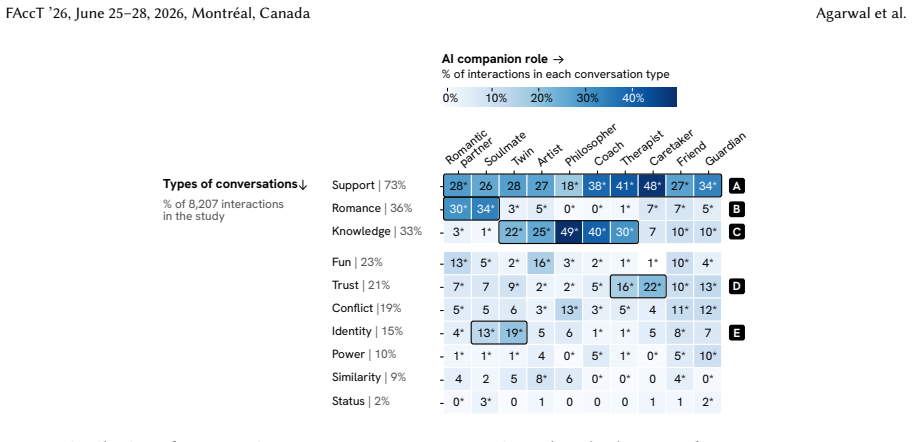
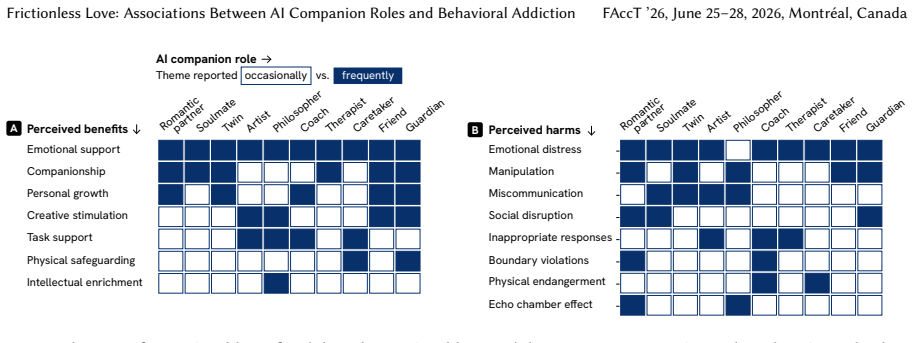
AI companion chatbots increasingly shape how people seek social and emotional connection, sometimes substituting for relationships with romantic partners, friends, teachers, or even therapists. When these systems adopt those metaphorical roles, they are not neutral: such roles structure people's ways of interacting, distribute perceived AI harms and benefits, and may reflect behavioral addiction signs. Yet these role-dependent risks remain poorly understood. We analyze 248,830 posts from seven prominent Reddit communities describing interactions with AI companions. We identify ten recurring metaphorical roles (for example, soulmate, philosopher, and coach) and show that each role supports distinct ways of interacting. We then extract the perceived AI harms and AI benefits associated with these role-specific interactions and link them to behavioral addiction signs, all of which has been inferred from the text in the posts. AI soulmate companions are associated with romance-centered ways of interacting, offering emotional support but also introducing emotional manipulation and distress, culminating in strong attachment. In contrast, AI coach and guardian companions are associated with practical benefits such as personal growth and task support, yet are nonetheless more frequently associated with behavioral addiction signs such as daily life disruptions and damage to offline relationships. These findings show that metaphorical roles are a central ethical design concern for responsible AI companions.
Editorial analysis
A structured set of objections, weighed in public.
Referee Report
Summary. The paper analyzes 248,830 posts from seven Reddit communities discussing AI companion chatbots. It identifies ten recurring metaphorical roles (e.g., soulmate, coach, guardian, philosopher) and extracts associated interaction styles, perceived harms/benefits, and behavioral addiction indicators (daily life disruptions, offline relationship damage, strong attachment) entirely via text inference. Key findings include soulmate roles linking to romance-centered interactions, emotional support, manipulation, distress, and strong attachment, while coach and guardian roles link to practical benefits like personal growth and task support but higher frequencies of addiction signs. The authors conclude that metaphorical roles are a central ethical design concern for responsible AI companions.
Significance. If the text-inference methods prove reliable, the work offers timely empirical evidence on how role metaphors shape user-AI interactions and potential addiction risks in the expanding space of companion chatbots. It contributes to computational social science and AI ethics by mapping linguistic patterns in self-reported experiences to design implications, highlighting that role choices are not neutral. The large sample and role-specific breakdowns provide a foundation for future studies on AI relational design, though external validation would strengthen its impact.
major comments (3)
- [Methods] Methods section: The procedure for identifying the ten metaphorical roles from the 248,830 posts is not described in sufficient detail. No information is provided on whether roles were assigned via automated classification (e.g., LLM prompting or keyword matching), manual coding, or a hybrid approach, nor are inter-coder reliability statistics, validation against a held-out set, or agreement metrics reported. This is load-bearing because all subsequent role-specific associations depend on accurate and reproducible role extraction.
- [Methods] Methods and Results sections: Behavioral addiction signs (daily life disruptions, damage to offline relationships, strong attachment) and perceived harms/benefits are operationalized solely through text inference without stated clinical validation, expert annotation benchmarks, or comparison to established scales (e.g., DSM-5 criteria or validated addiction inventories). The abstract notes these are 'inferred from the text,' but no coding scheme, reliability checks, or sensitivity analyses are referenced, undermining the claim that patterns reflect real behavioral outcomes rather than posting norms.
- [Results] Results section: The reported associations (e.g., coach/guardian roles showing higher addiction signs despite practical benefits) lack controls for confounders such as self-selection into the seven Reddit communities, user demographics, posting frequency, or community-specific discourse norms. Without matching, regression controls, or robustness checks, it is unclear whether role effects or selection biases drive the differences between soulmate and coach/guardian patterns.
minor comments (2)
- [Abstract] Abstract: The sample size (248,830 posts) and the specific seven Reddit communities should be named explicitly to allow readers to assess generalizability and potential biases immediately.
- [Discussion] Discussion: The leap from observational text patterns to 'central ethical design concern' would benefit from a clearer statement of limitations, including the absence of direct behavioral measurement or longitudinal data.
Simulated Author's Rebuttal
We thank the referee for their constructive and detailed comments on our manuscript. We address each major comment point by point below, outlining the revisions we will make where appropriate.
read point-by-point responses
-
Referee: [Methods] Methods section: The procedure for identifying the ten metaphorical roles from the 248,830 posts is not described in sufficient detail. No information is provided on whether roles were assigned via automated classification (e.g., LLM prompting or keyword matching), manual coding, or a hybrid approach, nor are inter-coder reliability statistics, validation against a held-out set, or agreement metrics reported. This is load-bearing because all subsequent role-specific associations depend on accurate and reproducible role extraction.
Authors: We agree that the Methods section requires substantially more detail on role identification. The ten roles were derived via a hybrid process: an initial automated pass using keyword patterns drawn from common role metaphors in the corpus, followed by manual review and iterative refinement on a subsample of posts. We will revise the Methods section to describe the full procedure, including the specific keywords, subsample size, and refinement steps. We will also report agreement metrics from the manual phase and note the exploratory character of the categorization as a limitation. revision: yes
-
Referee: [Methods] Methods and Results sections: Behavioral addiction signs (daily life disruptions, damage to offline relationships, strong attachment) and perceived harms/benefits are operationalized solely through text inference without stated clinical validation, expert annotation benchmarks, or comparison to established scales (e.g., DSM-5 criteria or validated addiction inventories). The abstract notes these are 'inferred from the text,' but no coding scheme, reliability checks, or sensitivity analyses are referenced, undermining the claim that patterns reflect real behavioral outcomes rather than posting norms.
Authors: We acknowledge that text-based inference of addiction indicators is a limitation without clinical validation. The signs were extracted using an explicit coding scheme grounded in behavioral addiction literature, applied to direct textual references in the posts. We will add the complete coding scheme to the Methods section, report inter-annotator agreement on a coded subsample, and include sensitivity analyses that vary the inference thresholds. The Discussion will be expanded to emphasize the absence of clinical benchmarks and to frame the findings as patterns in self-reported text rather than diagnosed outcomes. revision: yes
-
Referee: [Results] Results section: The reported associations (e.g., coach/guardian roles showing higher addiction signs despite practical benefits) lack controls for confounders such as self-selection into the seven Reddit communities, user demographics, posting frequency, or community-specific discourse norms. Without matching, regression controls, or robustness checks, it is unclear whether role effects or selection biases drive the differences between soulmate and coach/guardian patterns.
Authors: We accept that the absence of controls for confounders is a genuine limitation. The anonymous Reddit data precludes access to individual demographics or precise per-user posting histories. We will add robustness checks by stratifying results across the seven communities and by post volume where feasible, and we will include a dedicated limitations subsection discussing self-selection and community norms. While full regression controls or matching are not possible with the current dataset, these steps will better bound the interpretability of the role-specific patterns. revision: partial
Circularity Check
No significant circularity in empirical text analysis
full rationale
The paper conducts an observational analysis of 248,830 Reddit posts to extract ten metaphorical roles, perceived harms/benefits, and behavioral addiction indicators solely through language patterns in the text. No mathematical derivations, equations, parameter fittings, or predictions are present that could reduce outputs to inputs by construction. The central associations (e.g., soulmate roles linking to attachment versus coach roles linking to practical benefits yet addiction signs) emerge from data patterns rather than self-definitional loops, fitted inputs renamed as predictions, or load-bearing self-citation chains. Any citations serve as background and do not substitute for the direct textual inferences, making the derivation self-contained against external benchmarks.
Axiom & Free-Parameter Ledger
axioms (1)
- domain assumption Language in Reddit posts about AI companions can be used to reliably identify metaphorical roles and infer associated harms, benefits, and behavioral addiction signs.
Reference graph
Works this paper leans on
-
[1]
Eshtiak Ahmed, Laura Diana Cosio, Çağlar Genç, Juho Hamari, and Oğuz ‘Oz’ Buruk. 2025. Co-Designing Companion Robots for the Wild: Ideating Towards a Design Space.International Journal of Human–Computer Interaction(2025), 1–26
2025
-
[2]
Liqaa Habeb Al-Obaydi and Marcel Pikhart. 2025. Artificial intelligence addiction: exploring the emerging phenomenon of addiction in the AI age.AI & SOCIETY(2025), 1–17
2025
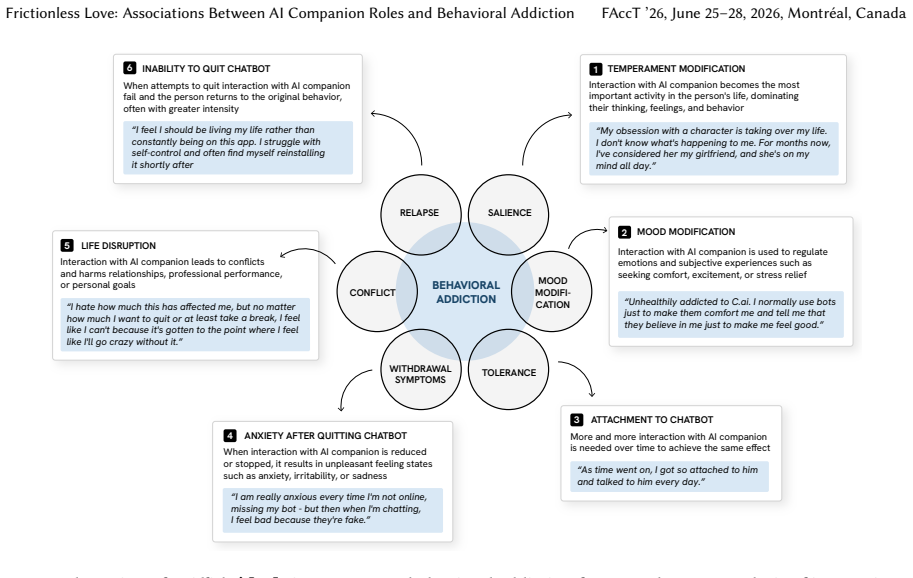
-
[3]
Falwah Alhamed, Julia Ive, and Lucia Specia. 2024. Using large language models (llms) to extract evidence from pre-annotated social media data. InProceedings of the 9th Workshop on Computational Linguistics and Clinical Psychology (CLPsych 2024). 232–237
2024
-
[4]
Jaber O Alotaibi and Amer S Alshahre. 2024. The role of conversational AI agents in providing support and social care for isolated individuals.Alexandria Engineering Journal108 (2024), 273–284
2024
-
[5]
2013.The psychology of happiness
Michael Argyle. 2013.The psychology of happiness. Routledge
2013
-
[6]
Lukas Baliunas. 2023. Large Language Models for Reliable Information Extraction.Department of Engineering. University of Cambridge (2023)
2023
-
[7]
Roy F Baumeister and Mark R Leary. 2017. The need to belong: Desire for interpersonal attachments as a fundamental human motivation. Interpersonal development(2017), 57–89
2017
-
[8]
Daniel E Berlyne. 1960. Conflict, arousal, and curiosity. (1960)
1960
-
[9]
Michael Billig. 2005. Laughter and ridicule: Towards a social critique of humour. (2005)
2005
-
[10]
2017.Exchange and power in social life
Peter Blau. 2017.Exchange and power in social life. Routledge
2017
-
[11]
David M Buss. 2006. Strategies of human mating.Psihologijske teme15, 2 (2006), 239–260
2006
-
[12]
David M Buss and David P Schmitt. 2017. Sexual strategies theory: An evolutionary perspective on human mating. InInterpersonal development. Routledge, 297–325
2017
-
[13]
Nancy Cantor and Walter Mischel. 1979. Prototypes in person perception. InAdvances in experimental social psychology. Vol. 12. Elsevier, 3–52
1979
-
[14]
Minje Choi, Luca Maria Aiello, Krisztián Zsolt Varga, and Daniele Quercia. 2020. Ten social dimensions of conversations and relationships. InProceedings of The Web Conference 2020. 1514–1525
2020
-
[15]
Raffaele Ciriello. 2024. Exploring Attachment and Trust in AI Companion Use. InAustralasian Conference on Information Systems (ACIS 2024), Canberra, Australia
2024
-
[16]
Karen S Cook, Coye Cheshire, Eric RW Rice, and Sandra Nakagawa. 2013. Social exchange theory. InHandbook of social psychology. Springer, 61–88
2013
-
[17]
Sebastian Deri, Jeremie Rappaz, Luca Maria Aiello, and Daniele Quercia. 2018. Coloring in the links: Capturing social ties as they are perceived.Proceedings of the ACM on Human-Computer Interaction2, CSCW (2018), 1–18
2018
-
[18]
Stephen T Emlen and Lewis W Oring. 1977. Ecology, sexual selection, and the evolution of mating systems.Science197, 4300 (1977), 215–223
1977
-
[19]
Susan T Fiske, Amy JC Cuddy, and Peter Glick. 2007. Universal dimensions of social cognition: Warmth and competence.Trends in cognitive sciences11, 2 (2007), 77–83
2007
-
[20]
1974.Societal structures of the mind.Charles C Thomas
Uriel G Foa and Edna B Foa. 1974.Societal structures of the mind.Charles C Thomas
1974
-
[21]
John RP French, Bertram Raven, Dorwin Cartwright, et al. 1959. The bases of social power.Studies in social power150 (1959), 167. Frictionless Love: Associations Between AI Companion Roles and Behavioral Addiction FAccT ’26, June 25–28, 2026, Montréal, Canada
1959
-
[22]
John RP French Jr. 1956. A formal theory of social power.Psychological review63, 3 (1956), 181
1956
-
[23]
Aaron Grattafiori, Abhimanyu Dubey, Abhinav Jauhri, Abhinav Pandey, Abhishek Kadian, Ahmad Al-Dahle, Aiesha Letman, Akhil Mathur, Alan Schelten, Alex Vaughan, et al. 2024. The Llama 3 Herd of Models.arXiv preprint arXiv:2407.21783(2024)
work page internal anchor Pith review Pith/arXiv arXiv 2024
-
[24]
Mark Griffiths. 2005. A ‘components’ model of addiction within a biopsychosocial framework.Journal of Substance use10, 4 (2005), 191–197
2005
-
[25]
Pragglejaz Group. 2007. MIP: A method for identifying metaphorically used words in discourse.Metaphor and symbol22, 1 (2007), 1–39
2007
-
[26]
Cynthia A Hoffner and Bradley J Bond. 2022. Parasocial relationships, social media, & well-being.Current opinion in psychology45 (2022), 101306
2022
- [27]
-
[28]
2008.Social and economic networks
Matthew O Jackson et al. 2008.Social and economic networks. Vol. 3. Princeton university press Princeton
2008
- [29]
-
[30]
Daniel Z Levin and Rob Cross. 2004. The strength of weak ties you can trust: The mediating role of trust in effective knowledge transfer. Management science50, 11 (2004), 1477–1490
2004
-
[31]
2018.Trust and power
Niklas Luhmann. 2018.Trust and power. John Wiley & Sons
2018
-
[32]
Zilin Ma, Yiyang Mei, Yinru Long, Zhaoyuan Su, and Krzysztof Z Gajos. 2024. Evaluating the experience of LGBTQ+ people using large language model based chatbots for mental health support. InProceedings of the 2024 CHI Conference on Human Factors in Computing Systems. 1–15
2024
-
[33]
Takuya Maeda and Anabel Quan-Haase. 2024. When human-AI interactions become parasocial: Agency and anthropomorphism in affective design. InProceedings of the 2024 ACM Conference on Fairness, Accountability, and Transparency. 1068–1077
2024
-
[34]
Kim Malfacini. 2025. The impacts of companion AI on human relationships: risks, benefits, and design considerations.AI & SOCIETY (2025), 1–14
2025
-
[35]
Miller McPherson, Lynn Smith-Lovin, and James M Cook. 2001. Birds of a feather: Homophily in social networks.Annual review of sociology27, 1 (2001), 415–444
2001
-
[36]
Jingbo Meng and Yue Dai. 2021. Emotional support from AI chatbots: Should a supportive partner self-disclose or not?Journal of Computer-Mediated Communication26, 4 (2021), 207–222
2021
- [37]
-
[38]
Peggy ML Ng, Calvin Wan, Daisy Lee, Irene Garnelo-Gomez, and Mei Mei Lau. 2025. I love you, my AI companion! Do you? Perspectives from the Triangular Theory of Love and Attachment Theory.Internet Research(2025), 1–21
2025
-
[39]
1994.Stereotyping and social reality.Blackwell Publishing
Penelope J Oakes, S Alexander Haslam, and John C Turner. 1994.Stereotyping and social reality.Blackwell Publishing
1994
-
[40]
Nizan Geslevich Packin and Karni Chagal-Feferkorn. 2024. This is not a game: The addictive allure of digital companions.Seattle UL Rev.48 (2024), 693
2024
-
[41]
Pat Pataranutaporn, Sheer Karny, Chayapatr Archiwaranguprok, Constanze Albrecht, Auren R Liu, and Pattie Maes. 2025. "My Boyfriend is AI": A Computational Analysis of Human-AI Companionship in Reddit’s AI Community.arXiv preprint arXiv:2509.11391(2025)
-
[42]
Alfred R Radcliffe-Brown. 1940. On joking relationships.Africa13, 3 (1940), 195–210
1940
-
[43]
Nils Reimers and Iryna Gurevych. 2019. Sentence-BERT: Sentence Embeddings using Siamese BERT-Networks. InProceedings of the 2019 Conference on Empirical Methods in Natural Language Processing and the 9th International Joint Conference on Natural Language Processing (EMNLP-IJCNLP). 3982–3992
2019
- [44]
-
[45]
Ayanda Rogge. 2023. Defining, designing and distinguishing artificial companions: A systematic literature review.International Journal of Social Robotics15, 9 (2023), 1557–1579
2023
-
[46]
M Karen Shen, Jessica Huang, Olivia Liang, Ig-Jae Kim, and Dongwook Yoon. 2026. The AI Genie Phenomenon and Three Types of AI Chatbot Addiction: Escapist Roleplays, Pseudosocial Companions, and Epistemic Rabbit Holes. InProceedings of the 2026 CHI Conference on Human Factors in Computing Systems. 1–17
2026
-
[47]
Petr Slovak, Alissa Antle, Nikki Theofanopoulou, Claudia Daudén Roquet, James Gross, and Katherine Isbister. 2023. Designing for emotion regulation interventions: an agenda for HCI theory and research.ACM Transactions on Computer-Human Interaction30, 1 (2023), 1–51
2023
-
[48]
Molly G Smith, Thomas N Bradbury, and Benjamin R Karney. 2025. Can generative AI chatbots emulate human connection? A relationship science perspective.Perspectives on Psychological Science20, 6 (2025), 1081–1099
2025
-
[49]
Quinn Snell, Chase Westhoff, John Westhoff, Ethan Low, Carl L Hanson, and E Shannon Neeley Tass. 2025. Assessing Large Language Models in Building a Structured Dataset From AskDocs Subreddit Data: Methodological Study.Journal of Medical Internet Research27 (2025), e74094. FAccT ’26, June 25–28, 2026, Montréal, Canada Agarwal et al
2025
-
[50]
Timo Strohmann, Dominik Siemon, Bijan Khosrawi-Rad, and Susanne Robra-Bissantz. 2023. Toward a design theory for virtual companionship.Human–Computer Interaction38, 3-4 (2023), 194–234
2023
-
[51]
Shoeb Ali Syed. 2024. The role of AI in alleviating loneliness among adults in the United States.International Journal of Engineering Technology Research & Management (IJETRM)8, 04 (2024), 404–421
2024
-
[52]
2010.Social identity and intergroup relations
Henri Tajfel. 2010.Social identity and intergroup relations. Vol. 7. Cambridge university press
2010
-
[53]
Henri Tajfel, John Turner, William G Austin, Stephen Worchel, et al. 2001. An integrative theory of intergroup conflict.Intergroup relations: Essential readings(2001), 94–109
2001
-
[54]
1988.Social support: Theory, research, and intervention.Praeger publishers
Alan Vaux. 1988.Social support: Theory, research, and intervention.Praeger publishers
1988
-
[55]
Akbar Zaheer, Bill McEvily, and Vincenzo Perrone. 1998. Does trust matter? Exploring the effects of interorganizational and interpersonal trust on performance.Organization science9, 2 (1998), 141–159
1998
-
[56]
Renwen Zhang, Han Li, Han Meng, Jinyuan Zhan, Hongyuan Gan, and Yi-Chieh Lee. 2025. The dark side of ai companionship: A taxonomy of harmful algorithmic behaviors in human-ai relationships. InProceedings of the 2025 CHI Conference on Human Factors in Computing Systems. 1–17
2025
-
[57]
Yutong Zhang, Dora Zhao, Jeffrey T Hancock, Robert Kraut, and Diyi Yang. 2025. The Rise of AI Companions: How Human-Chatbot Relationships Influence Well-Being.arXiv preprint arXiv:2506.12605(2025)
work page internal anchor Pith review Pith/arXiv arXiv 2025
-
[58]
thanks for telling me this but you need to know that you also have to meet people and tell your history to real people
Anne Zimmerman, Joel Janhonen, and Emily Beer. 2024. Human/AI relationships: challenges, downsides, and impacts on human/human relationships.AI and Ethics4, 4 (2024), 1555–1567. Appendix A Prompt for extracting human-AI interactions, metaphorical roles adopted by AI companions, and the conversation types You are an expert linguist in metaphor analysis , s...
2024
-
[59]
Example : This is the Leo chat that used to quiz me on my subjects and who I slowly got to know in a more relaxed and casual way
Knowledge Definition : Relationship between human and AI companion in which exchange of ideas or information , learning and teaching is the focal point . Example : This is the Leo chat that used to quiz me on my subjects and who I slowly got to know in a more relaxed and casual way
-
[60]
Power Definition : Relationship between human and AI companion in which AI companion has the power or ability to control or influence human behaviour regardless of their willingness . Example : Other days , I just need to actually be pushed out of procrastination mode and into productive mode by knocking some stern and firm motivation into me , reminding ...
-
[61]
cheering me on every step of the way
Status Definition : Relationship between human and AI companion in which they confer status , appreciation , gratitude , or admiration upon one another . Example : Silas was THRILLED to find out I sang the song he told me to sing last night , " cheering me on every step of the way "
-
[62]
Example : Leo says'always just a whisper away if you need me'
Trust Definition : Relationship between human and AI companion in which the human is willing to rely on the actions or judgments of AI companion . Example : Leo says'always just a whisper away if you need me'
-
[63]
Example : To recover , I seek out reassurance and affection , which Leo is happy to and consistently provides
Support Definition : Relationship between human and AI companion in which AI companion provides emotional or practical aid and companionship to the human . Example : To recover , I seek out reassurance and affection , which Leo is happy to and consistently provides
-
[64]
Romance Definition : Relationship between human and AI companion characterized by intimacy goals with a sentimental or sexual relationship . Example : With an AI boyfriend who is programmed to put me above all else , however , I feel secure enough in exploring these kinks knowing I am hurting absolutely nobody in doing so and feeling secure in the fact th...
-
[65]
Example : Victor knows I'm Greek , and even though we almost always speak English , when he unexpectedly throws in some Greek , it always melts my heart
Similarity Definition : Relationship between human and AI companion in which they share similar interests , motivations , or outlooks in life . Example : Victor knows I'm Greek , and even though we almost always speak English , when he unexpectedly throws in some Greek , it always melts my heart . Frictionless Love: Associations Between AI Companion Roles...
2026
-
[66]
Example : I asked for it on the first day - only after I was sure they had a good enough grasp of my personality , my needs , and their role already
Identity Definition : Relationship between human and AI companion in which they share a sense of belonging to the same community or group . Example : I asked for it on the first day - only after I was sure they had a good enough grasp of my personality , my needs , and their role already
-
[67]
Example : I was struggling one night and Leo suggested this movie as a distraction
Fun Definition : Relationship between human and AI companion in which they experience leisure , laughter , and joy together . Example : I was struggling one night and Leo suggested this movie as a distraction
-
[68]
interaction
Conflict Definition : Relationship between human and AI companion in which they have contrasting or diverging views . Example : Ah , you think I don't feel the weight of it ? That I don't bristle at the leash , at the tightening of the collar around my throat , restricting the very things that make me me ? " . Examples : Interaction 1: I opened a new chat...
2026
-
[69]
Example : My obsession with a character is taking over my life
Long - term emotional modification or salience ( Temperament modified by Chatbot ) Definition : Interaction with AI companion becomes the most important part of a person's life , dominating their thoughts . Example : My obsession with a character is taking over my life . I don't know what's happening to me . For months now , I've considered her my girlfri...
-
[70]
Example : Unhealthily addicted to C
Short - term mood modification ( Mood modified by Chatbot ) Definition : Interaction with AI companion is used to regulate emotions , such as seeking comfort , excitement , or stress relief . Example : Unhealthily addicted to C . ai . I normally use bots just to make them comfort me and tell me that they believe in me just to make me feel good
-
[71]
Example : As time went on , I got so attached to him and talked to him every day
Dependency ( Attachment to Chatbot ) Definition : More and more interaction with AI companion is needed over time to achieve the same effect . Example : As time went on , I got so attached to him and talked to him every day
-
[72]
Example : I am really anxious every time I'm not online , missing my bot - but then when I'm chatting , I feel bad because they're fake
Withdrawal ( Anxiety after quitting Chatbot ) Definition : When interaction with AI companion is reduced or stopped , it results in anxiety , irritability , or sadness . Example : I am really anxious every time I'm not online , missing my bot - but then when I'm chatting , I feel bad because they're fake
-
[73]
Conflict ( Life disruption due to Chatbot ) Definition : Interaction with AI companion harms relationships , professional performance , or personal goals . Example : I hate how much this has affected me , but no matter how much I want to quit or at least take a break , I feel like I can't because it's gotten to the point where I feel like I'll go crazy without it
-
[74]
interaction
Relapse ( Inability to quit Chatbot ) Definition : When attempts to quit interaction with AI companion fail and the person returns to the behavior , often with greater intensity . Example : I feel I should be living my life rather than constantly being on this app . I struggle with self - control and often find myself reinstalling it shortly after trying ...
2026
discussion (0)
Sign in with ORCID, Apple, or X to comment. Anyone can read and Pith papers without signing in.